CChhaapptteerr 2233 
IIPP OOvveerr AATTMM 
Objectives 
Upon completion you will be able to: 
• Review the features of an ATM WAN 
• Understand how an a datagram can pass through an ATM WAN 
• Understand how an IP packet is encapsulated in cells 
• Understand how cells are routed in an ATM network 
• Understand the function of ATMARP 
TCP/IP Protocol Suite 1
23.1 ATM WANS 
We review some features of the ATM WAN nneeeeddeedd ttoo uunnddeerrssttaanndd IIPP 
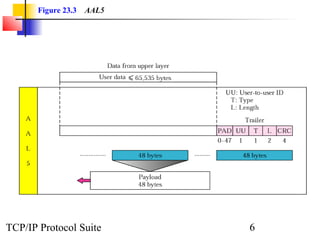
oovveerr AATTMM.. TThhee oonnllyy AAAALL uusseedd bbyy tthhee IInntteerrnneett iiss AAAALL55,, ssoommeettiimmeess ccaalllleedd 
tthhee ssiimmppllee aanndd eeffffiicciieenntt aaddaappttaattiioonn llaayyeerr ((SSEEAALL)).. 
TThhee ttooppiiccss ddiissccuusssseedd iinn tthhiiss sseeccttiioonn iinncclluuddee:: 
LLaayyeerrss 
TCP/IP Protocol Suite 2
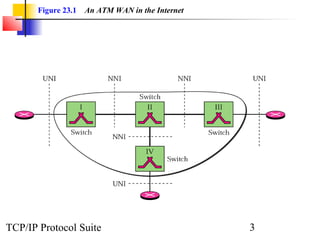
Figure 23.1 An ATM WAN in the Internet 
TCP/IP Protocol Suite 3
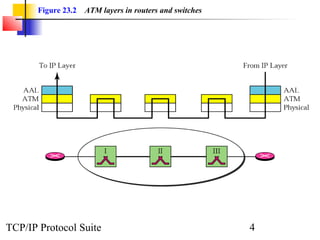
Figure 23.2 ATM layers in routers and switches 
TCP/IP Protocol Suite 4
NNoottee:: 
End devices such as routers use all 
three layers, while switches use only 
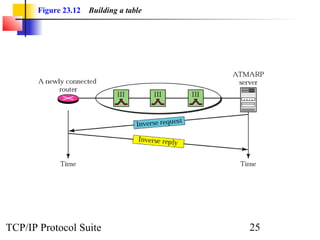
the bottom two layers. 
TCP/IP Protocol Suite 5
Figure 23.3 AAL5 
TCP/IP Protocol Suite 6
NNoottee:: 
The AAL layer used by the IP protocol 
is AAL5. 
TCP/IP Protocol Suite 7
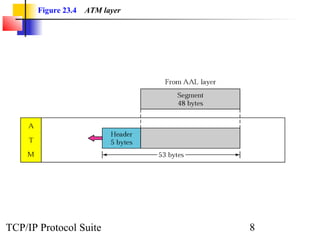
Figure 23.4 ATM layer 
TCP/IP Protocol Suite 8
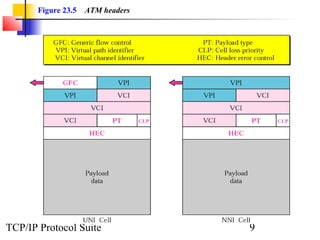
Figure 23.5 ATM headers 
TCP/IP Protocol Suite 9
23.2 CARRYING A DATAGRAM 
IN CELLS 
We show how an example of a datagram encapsulated iinn ffoouurr cceellllss aanndd 
ttrraannssmmiitttteedd tthhrroouugghh aann AATTMM nneettwwoorrkk.. 
TThhee ttooppiiccss ddiissccuusssseedd iinn tthhiiss sseeccttiioonn iinncclluuddee:: 
WWhhyy UUssee AAAALL55?? 
TCP/IP Protocol Suite 10
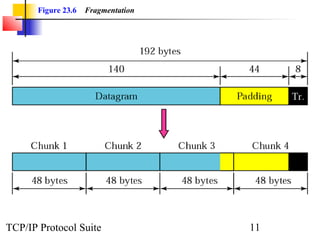
Figure 23.6 Fragmentation 
TCP/IP Protocol Suite 11
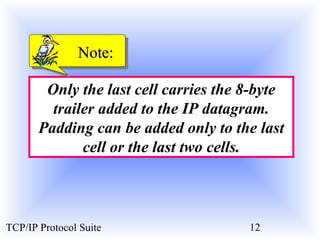
NNoottee:: 
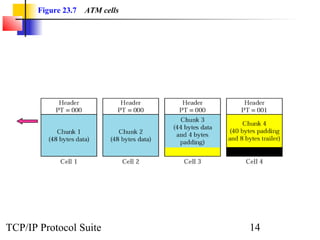
Only the last cell carries the 8-byte 
trailer added to the IP datagram. 
Padding can be added only to the last 
cell or the last two cells. 
TCP/IP Protocol Suite 12
NNoottee:: 
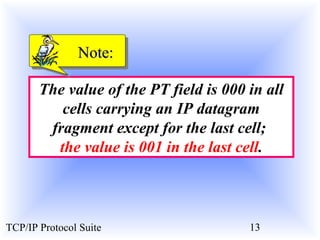
The value of the PT field is 000 in all 
cells carrying an IP datagram 
fragment except for the last cell; 
the value is 001 in the last cell. 
TCP/IP Protocol Suite 13
Figure 23.7 ATM cells 
TCP/IP Protocol Suite 14
23.3 ROUTING THE CELLS 
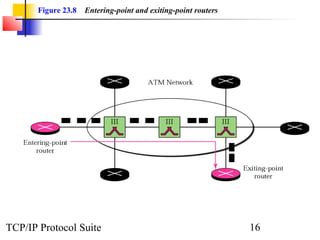
The ATM network creates a route between two rroouutteerrss.. WWee ccaallll tthheessee 
rroouutteerrss eenntteerriinngg--ppooiinntt aanndd eexxiittiinngg--ppooiinntt rroouutteerrss.. 
TThhee ttooppiiccss ddiissccuusssseedd iinn tthhiiss sseeccttiioonn iinncclluuddee:: 
AAddddrreesssseess 
AAddddrreessss BBiinnddiinngg 
TCP/IP Protocol Suite 15
Figure 23.8 Entering-point and exiting-point routers 
TCP/IP Protocol Suite 16
23.4 ATMARP 
ATMARP finds (maps) the physical address of the eexxiittiinngg--ppooiinntt rroouutteerr 
ggiivveenn tthhee IIPP aaddddrreessss ooff tthhee eexxiittiinngg--ppooiinntt rroouutteerr.. NNoo bbrrooaaddccaassttiinngg iiss 
iinnvvoollvveedd.. 
TThhee ttooppiiccss ddiissccuusssseedd iinn tthhiiss sseeccttiioonn iinncclluuddee:: 
PPaacckkeett FFoorrmmaatt 
AATTMMAARRPP OOppeerraattiioonn 
TCP/IP Protocol Suite 17
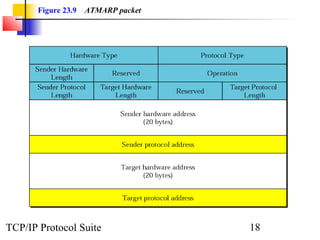
Figure 23.9 ATMARP packet 
TCP/IP Protocol Suite 18
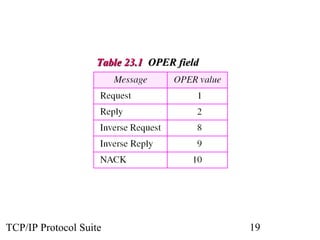
TTaabbllee 2233..11 OOPPEERR ffiieelldd 
TCP/IP Protocol Suite 19
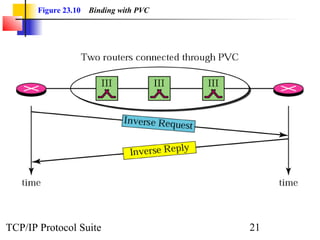
NNoottee:: 
The inverse request and inverse reply 
messages can bind the physical 
address to an IP address in a PVC 
situation. 
TCP/IP Protocol Suite 20
Figure 23.10 Binding with PVC 
TCP/IP Protocol Suite 21
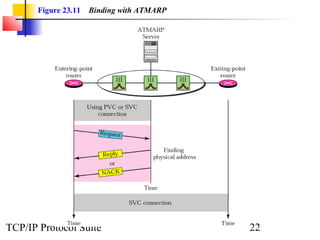
Figure 23.11 Binding with ATMARP 
TCP/IP Protocol Suite 22
NNoottee:: 
The request and reply message can be 
used to bind a physical address to an 
IP address in an SVC situation. 
TCP/IP Protocol Suite 23
NNoottee:: 
The inverse request and inverse reply 
can also be used to build the server’s 
mapping table. 
TCP/IP Protocol Suite 24
Figure 23.12 Building a table 
TCP/IP Protocol Suite 25
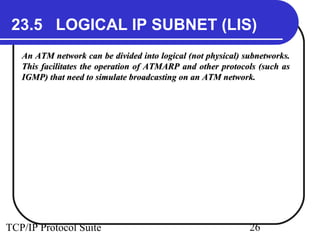
23.5 LOGICAL IP SUBNET (LIS) 
An ATM network can be divided into logical (not pphhyyssiiccaall)) ssuubbnneettwwoorrkkss.. 
TThhiiss ffaacciilliittaatteess tthhee ooppeerraattiioonn ooff AATTMMAARRPP aanndd ootthheerr pprroottooccoollss ((ssuucchh aass 
IIGGMMPP)) tthhaatt nneeeedd ttoo ssiimmuullaattee bbrrooaaddccaassttiinngg oonn aann AATTMM nneettwwoorrkk.. 
TCP/IP Protocol Suite 26
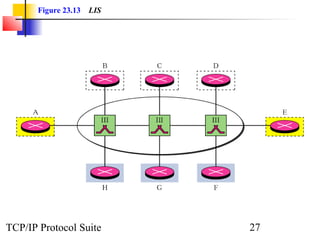
Figure 23.13 LIS 
TCP/IP Protocol Suite 27
NNoottee:: 
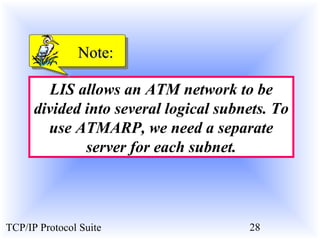
LIS allows an ATM network to be 
divided into several logical subnets. To 
use ATMARP, we need a separate 
server for each subnet. 
TCP/IP Protocol Suite 28

Chap 23 ip over atm

  • 1.
    CChhaapptteerr 2233 IIPPOOvveerr AATTMM Objectives Upon completion you will be able to: • Review the features of an ATM WAN • Understand how an a datagram can pass through an ATM WAN • Understand how an IP packet is encapsulated in cells • Understand how cells are routed in an ATM network • Understand the function of ATMARP TCP/IP Protocol Suite 1
  • 2.
    23.1 ATM WANS We review some features of the ATM WAN nneeeeddeedd ttoo uunnddeerrssttaanndd IIPP oovveerr AATTMM.. TThhee oonnllyy AAAALL uusseedd bbyy tthhee IInntteerrnneett iiss AAAALL55,, ssoommeettiimmeess ccaalllleedd tthhee ssiimmppllee aanndd eeffffiicciieenntt aaddaappttaattiioonn llaayyeerr ((SSEEAALL)).. TThhee ttooppiiccss ddiissccuusssseedd iinn tthhiiss sseeccttiioonn iinncclluuddee:: LLaayyeerrss TCP/IP Protocol Suite 2
  • 3.
    Figure 23.1 AnATM WAN in the Internet TCP/IP Protocol Suite 3
  • 4.
    Figure 23.2 ATMlayers in routers and switches TCP/IP Protocol Suite 4
  • 5.
    NNoottee:: End devicessuch as routers use all three layers, while switches use only the bottom two layers. TCP/IP Protocol Suite 5
  • 6.
    Figure 23.3 AAL5 TCP/IP Protocol Suite 6
  • 7.
    NNoottee:: The AALlayer used by the IP protocol is AAL5. TCP/IP Protocol Suite 7
  • 8.
    Figure 23.4 ATMlayer TCP/IP Protocol Suite 8
  • 9.
    Figure 23.5 ATMheaders TCP/IP Protocol Suite 9
  • 10.
    23.2 CARRYING ADATAGRAM IN CELLS We show how an example of a datagram encapsulated iinn ffoouurr cceellllss aanndd ttrraannssmmiitttteedd tthhrroouugghh aann AATTMM nneettwwoorrkk.. TThhee ttooppiiccss ddiissccuusssseedd iinn tthhiiss sseeccttiioonn iinncclluuddee:: WWhhyy UUssee AAAALL55?? TCP/IP Protocol Suite 10
  • 11.
    Figure 23.6 Fragmentation TCP/IP Protocol Suite 11
  • 12.
    NNoottee:: Only thelast cell carries the 8-byte trailer added to the IP datagram. Padding can be added only to the last cell or the last two cells. TCP/IP Protocol Suite 12
  • 13.
    NNoottee:: The valueof the PT field is 000 in all cells carrying an IP datagram fragment except for the last cell; the value is 001 in the last cell. TCP/IP Protocol Suite 13
  • 14.
    Figure 23.7 ATMcells TCP/IP Protocol Suite 14
  • 15.
    23.3 ROUTING THECELLS The ATM network creates a route between two rroouutteerrss.. WWee ccaallll tthheessee rroouutteerrss eenntteerriinngg--ppooiinntt aanndd eexxiittiinngg--ppooiinntt rroouutteerrss.. TThhee ttooppiiccss ddiissccuusssseedd iinn tthhiiss sseeccttiioonn iinncclluuddee:: AAddddrreesssseess AAddddrreessss BBiinnddiinngg TCP/IP Protocol Suite 15
  • 16.
    Figure 23.8 Entering-pointand exiting-point routers TCP/IP Protocol Suite 16
  • 17.
    23.4 ATMARP ATMARPfinds (maps) the physical address of the eexxiittiinngg--ppooiinntt rroouutteerr ggiivveenn tthhee IIPP aaddddrreessss ooff tthhee eexxiittiinngg--ppooiinntt rroouutteerr.. NNoo bbrrooaaddccaassttiinngg iiss iinnvvoollvveedd.. TThhee ttooppiiccss ddiissccuusssseedd iinn tthhiiss sseeccttiioonn iinncclluuddee:: PPaacckkeett FFoorrmmaatt AATTMMAARRPP OOppeerraattiioonn TCP/IP Protocol Suite 17
  • 18.
    Figure 23.9 ATMARPpacket TCP/IP Protocol Suite 18
  • 19.
    TTaabbllee 2233..11 OOPPEERRffiieelldd TCP/IP Protocol Suite 19
  • 20.
    NNoottee:: The inverserequest and inverse reply messages can bind the physical address to an IP address in a PVC situation. TCP/IP Protocol Suite 20
  • 21.
    Figure 23.10 Bindingwith PVC TCP/IP Protocol Suite 21
  • 22.
    Figure 23.11 Bindingwith ATMARP TCP/IP Protocol Suite 22
  • 23.
    NNoottee:: The requestand reply message can be used to bind a physical address to an IP address in an SVC situation. TCP/IP Protocol Suite 23
  • 24.
    NNoottee:: The inverserequest and inverse reply can also be used to build the server’s mapping table. TCP/IP Protocol Suite 24
  • 25.
    Figure 23.12 Buildinga table TCP/IP Protocol Suite 25
  • 26.
    23.5 LOGICAL IPSUBNET (LIS) An ATM network can be divided into logical (not pphhyyssiiccaall)) ssuubbnneettwwoorrkkss.. TThhiiss ffaacciilliittaatteess tthhee ooppeerraattiioonn ooff AATTMMAARRPP aanndd ootthheerr pprroottooccoollss ((ssuucchh aass IIGGMMPP)) tthhaatt nneeeedd ttoo ssiimmuullaattee bbrrooaaddccaassttiinngg oonn aann AATTMM nneettwwoorrkk.. TCP/IP Protocol Suite 26
  • 27.
    Figure 23.13 LIS TCP/IP Protocol Suite 27
  • 28.
    NNoottee:: LIS allowsan ATM network to be divided into several logical subnets. To use ATMARP, we need a separate server for each subnet. TCP/IP Protocol Suite 28