Location, Pattern, and Structure of Cities
Urban Geography
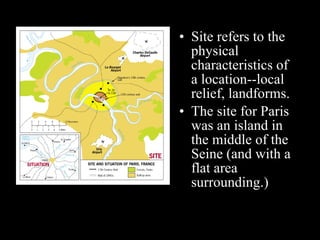
Site refers to the physical characteristics of a location--local relief, landforms. The site for Paris was an island in the middle of the Seine (and with a flat area surrounding.)
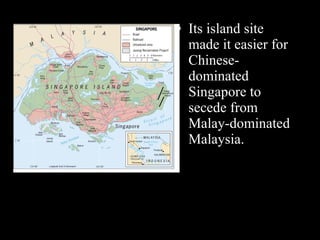
Its island site made it easier for Chinese-dominated Singapore to secede from Malay-dominated Malaysia.
Situation refers to the relative location of a place in terms of the larger regional or spatial system of which it is a part. Suggests spatial interconnection and interdependence.
Situation can change with circumstances. Changing political or economic circumstances can make a location more attractive.  Agglomeration leads to growth.
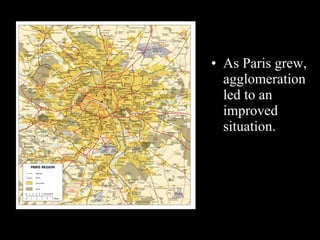
As Paris grew, agglomeration led to an improved situation.
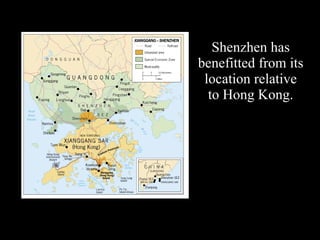
Shenzhen has benefitted from its location relative to Hong Kong.
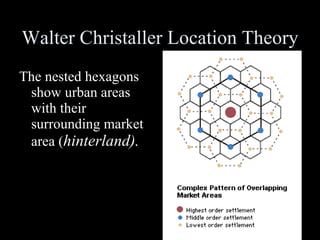
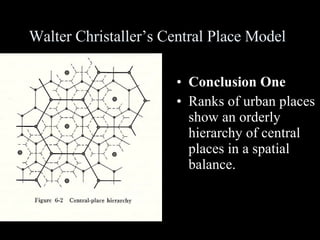
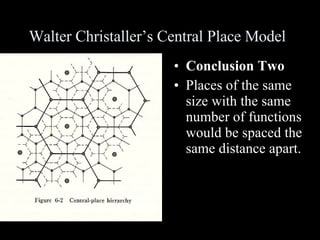
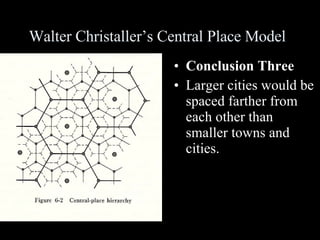
Walter Christaller Location Theory The nested hexagons show urban areas with their surrounding market area ( hinterland).
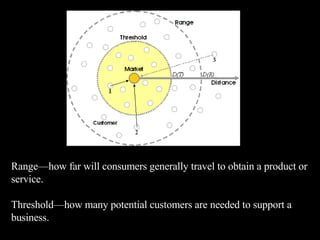
Range—how far will consumers generally travel to obtain a product or service. Threshold—how many potential customers are needed to support a business.
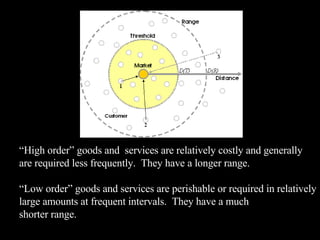
“ High order” goods and  services are relatively costly and generally are required less frequently.  They have a longer range. “ Low order” goods and services are perishable or required in relatively large amounts at frequent intervals.  They have a much shorter range.
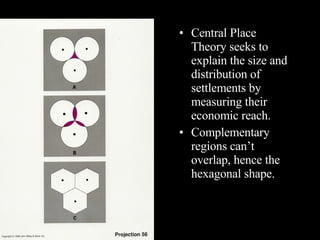
Central Place Theory seeks to explain the size and distribution of settlements by measuring their economic reach. Complementary regions can’t overlap, hence the hexagonal shape.
Walter Christaller’s Central Place Model Conclusion One Ranks of urban places show an orderly hierarchy of central places in a spatial balance.
Walter Christaller’s Central Place Model Conclusion Two Places of the same size with the same number of functions would be spaced the same distance apart.
Walter Christaller’s Central Place Model Conclusion Three Larger cities would be spaced farther from each other than smaller towns and cities.
 
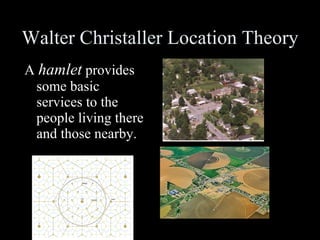
Walter Christaller Location Theory A  hamlet  provides some basic services to the people living there and those nearby.
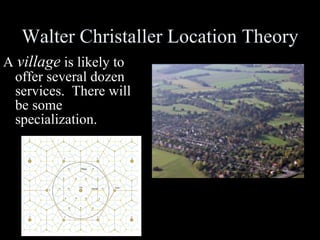
Walter Christaller Location Theory A  village  is likely to offer several dozen services.  There will be some specialization.
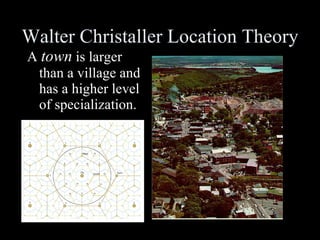
Walter Christaller Location Theory A  town  is larger than a village and has a higher level of specialization.
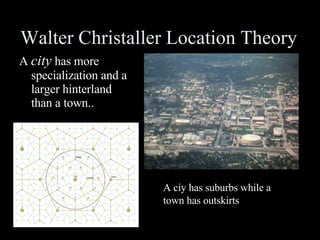
Walter Christaller Location Theory A  city  has more specialization and a larger hinterland than a town.. A ciy has suburbs while a town has outskirts
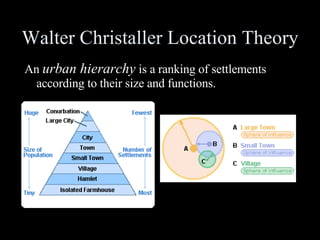
Walter Christaller Location Theory An  urban hierarchy  is a ranking of settlements according to their size and functions.
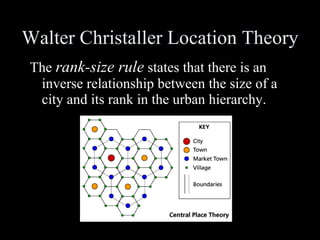
Walter Christaller Location Theory The  rank-size rule  states that there is an inverse relationship between the size of a city and its rank in the urban hierarchy.
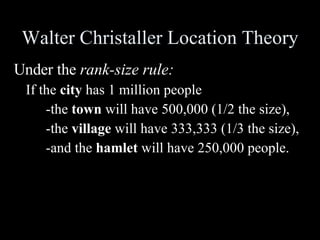
Walter Christaller Location Theory Under the  rank-size rule:   If the  city  has 1 million people -the  town  will have 500,000 (1/2 the size), -the  village  will have 333,333 (1/3 the size), -and the  hamlet  will have 250,000 people.
 
 
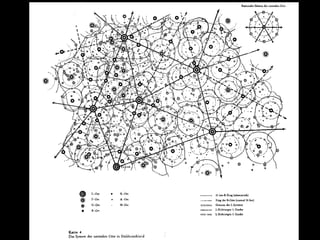
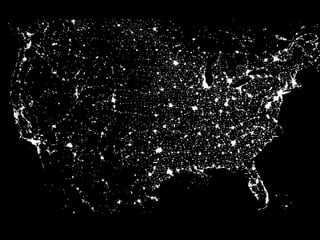
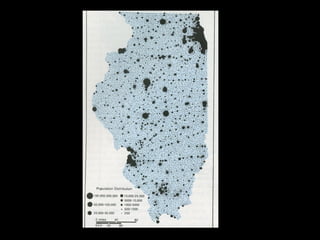
Walter Christaller Location Theory Christaller’s central place theory tends not hold in countries that have unitary systems of government or those that have gone through extended periods as colonies. They have  primate cities .
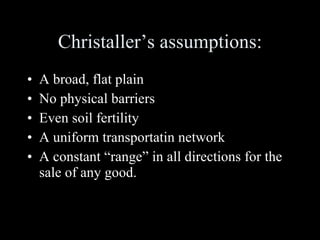
Christaller’s assumptions: A broad, flat plain No physical barriers Even soil fertility A uniform transportatin network A constant “range” in all directions for the sale of any good.
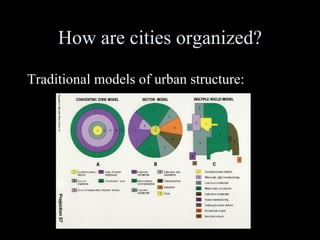
How are cities organized? Traditional models of urban structure:
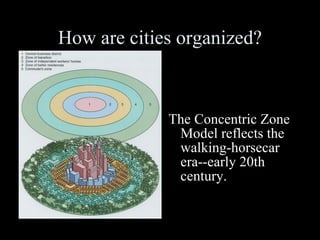
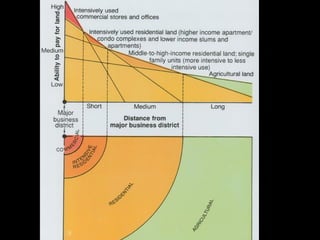
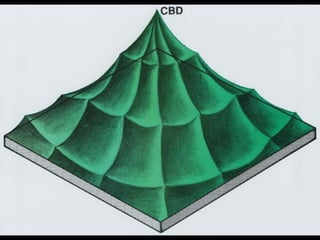
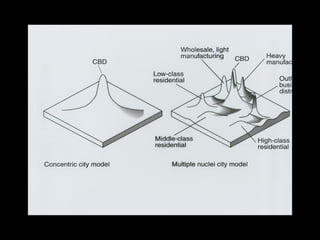
How are cities organized? The Concentric Zone Model reflects the walking-horsecar era--early 20th century.
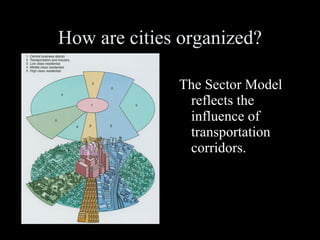
How are cities organized? The Sector Model reflects the influence of transportation corridors.
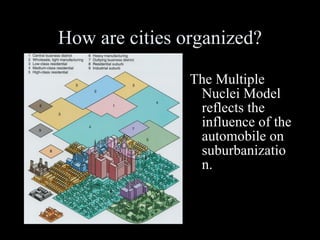
How are cities organized? The Multiple Nuclei Model reflects the influence of the automobile on suburbanization.
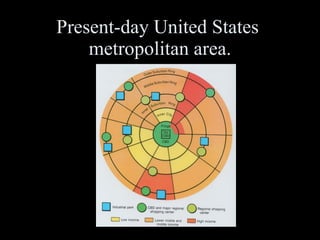
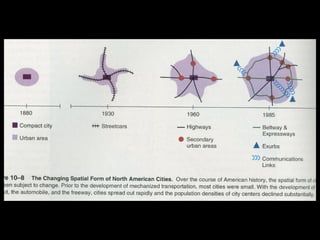
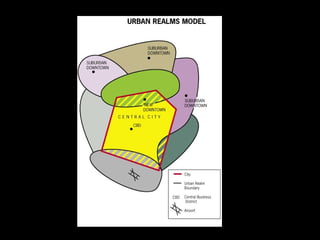
Present-day United States  metropolitan area.


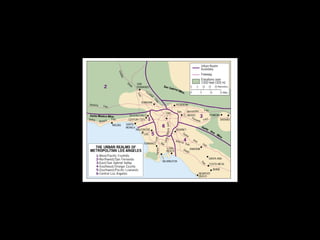
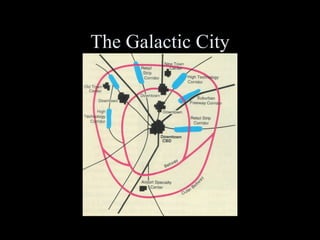
The Galactic City
 
 
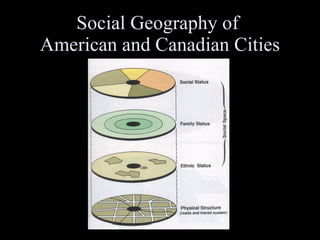
Social Geography of  American and Canadian Cities
 
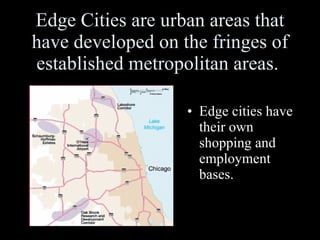
Edge Cities are urban areas that have developed on the fringes of established metropolitan areas.  Edge cities have their own shopping and employment bases.
Redlining occurs when lenders refuse to approve of loans within risky neighborhoods.  Contributed to “ghettoization” when funds were not available for upkeep.  Eventually, property values would decline and developers could convert land usage for their profit.
Blockbusting occurred when property in a white neighborhood was offered to an African American at a low price. White flight led to properties changing hands--profitable for real estate agents. Property values declined and land use was converted to more profitable tenements.
Basic and Non-basic sectors Basic sector products or services of an urban economy are exported outside the city itself, earning income for the community. Nonbasic sector jobs supply an urban area’s resident population with goods and services that have no “export” implication.
Multiplier Effect In urban geography, this refers to the expected addition of nonbasic workers to a city’s employment base that accompanies new basic sector employment. For cities over 1 million, each job in the basic sector will add two jobs in the nonbasic sector.
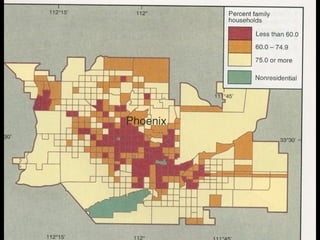
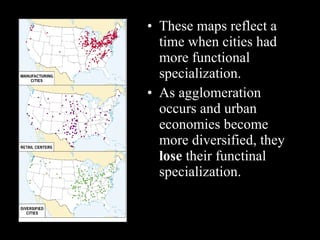
These maps reflect a time when cities had more functional specialization. As agglomeration occurs and urban economies become more diversified, they  lose  their functinal specialization.

Ch22

  • 1.
    Location, Pattern, andStructure of Cities
  • 2.
  • 3.
    Site refers tothe physical characteristics of a location--local relief, landforms. The site for Paris was an island in the middle of the Seine (and with a flat area surrounding.)
  • 4.
    Its island sitemade it easier for Chinese-dominated Singapore to secede from Malay-dominated Malaysia.
  • 5.
    Situation refers tothe relative location of a place in terms of the larger regional or spatial system of which it is a part. Suggests spatial interconnection and interdependence.
  • 6.
    Situation can changewith circumstances. Changing political or economic circumstances can make a location more attractive. Agglomeration leads to growth.
  • 7.
    As Paris grew,agglomeration led to an improved situation.
  • 8.
    Shenzhen has benefittedfrom its location relative to Hong Kong.
  • 9.
    Walter Christaller LocationTheory The nested hexagons show urban areas with their surrounding market area ( hinterland).
  • 10.
    Range—how far willconsumers generally travel to obtain a product or service. Threshold—how many potential customers are needed to support a business.
  • 11.
    “ High order”goods and services are relatively costly and generally are required less frequently. They have a longer range. “ Low order” goods and services are perishable or required in relatively large amounts at frequent intervals. They have a much shorter range.
  • 12.
    Central Place Theoryseeks to explain the size and distribution of settlements by measuring their economic reach. Complementary regions can’t overlap, hence the hexagonal shape.
  • 13.
    Walter Christaller’s CentralPlace Model Conclusion One Ranks of urban places show an orderly hierarchy of central places in a spatial balance.
  • 14.
    Walter Christaller’s CentralPlace Model Conclusion Two Places of the same size with the same number of functions would be spaced the same distance apart.
  • 15.
    Walter Christaller’s CentralPlace Model Conclusion Three Larger cities would be spaced farther from each other than smaller towns and cities.
  • 16.
  • 17.
    Walter Christaller LocationTheory A hamlet provides some basic services to the people living there and those nearby.
  • 18.
    Walter Christaller LocationTheory A village is likely to offer several dozen services. There will be some specialization.
  • 19.
    Walter Christaller LocationTheory A town is larger than a village and has a higher level of specialization.
  • 20.
    Walter Christaller LocationTheory A city has more specialization and a larger hinterland than a town.. A ciy has suburbs while a town has outskirts
  • 21.
    Walter Christaller LocationTheory An urban hierarchy is a ranking of settlements according to their size and functions.
  • 22.
    Walter Christaller LocationTheory The rank-size rule states that there is an inverse relationship between the size of a city and its rank in the urban hierarchy.
  • 23.
    Walter Christaller LocationTheory Under the rank-size rule: If the city has 1 million people -the town will have 500,000 (1/2 the size), -the village will have 333,333 (1/3 the size), -and the hamlet will have 250,000 people.
  • 24.
  • 25.
  • 26.
    Walter Christaller LocationTheory Christaller’s central place theory tends not hold in countries that have unitary systems of government or those that have gone through extended periods as colonies. They have primate cities .
  • 27.
    Christaller’s assumptions: Abroad, flat plain No physical barriers Even soil fertility A uniform transportatin network A constant “range” in all directions for the sale of any good.
  • 28.
    How are citiesorganized? Traditional models of urban structure:
  • 29.
    How are citiesorganized? The Concentric Zone Model reflects the walking-horsecar era--early 20th century.
  • 30.
    How are citiesorganized? The Sector Model reflects the influence of transportation corridors.
  • 31.
    How are citiesorganized? The Multiple Nuclei Model reflects the influence of the automobile on suburbanization.
  • 32.
    Present-day United States metropolitan area.
  • 33.
  • 34.
  • 35.
  • 36.
  • 37.
  • 38.
  • 39.
  • 40.
    Social Geography of American and Canadian Cities
  • 41.
  • 42.
    Edge Cities areurban areas that have developed on the fringes of established metropolitan areas. Edge cities have their own shopping and employment bases.
  • 43.
    Redlining occurs whenlenders refuse to approve of loans within risky neighborhoods. Contributed to “ghettoization” when funds were not available for upkeep. Eventually, property values would decline and developers could convert land usage for their profit.
  • 44.
    Blockbusting occurred whenproperty in a white neighborhood was offered to an African American at a low price. White flight led to properties changing hands--profitable for real estate agents. Property values declined and land use was converted to more profitable tenements.
  • 45.
    Basic and Non-basicsectors Basic sector products or services of an urban economy are exported outside the city itself, earning income for the community. Nonbasic sector jobs supply an urban area’s resident population with goods and services that have no “export” implication.
  • 46.
    Multiplier Effect Inurban geography, this refers to the expected addition of nonbasic workers to a city’s employment base that accompanies new basic sector employment. For cities over 1 million, each job in the basic sector will add two jobs in the nonbasic sector.
  • 47.
    These maps reflecta time when cities had more functional specialization. As agglomeration occurs and urban economies become more diversified, they lose their functinal specialization.