Central Place Theory.
Compiled by. Big Ben.
(CTIE)
Central Place Theory
•Central place is a market center for the
exchange of goods and services by people
attracted from the surrounding area
•Centrality is crucial to the development of
urban places and their service areas
•Hinterland refers to the area surrounding a
central place from which consumers are drawn
Central Place Theory
•The urban hierarchy of settlements is based on
the functions available in a given settlement
•Functions and services attract people from the
urban areas as well as the hinterlands
•Every urban center has an economic reach
•Central places compete with each other to
provide goods and services
Central Place Theory
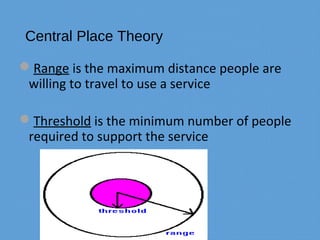
Range is the maximum distance people are
willing to travel to use a service
Threshold is the minimum number of people
required to support the service
Central Place Theory
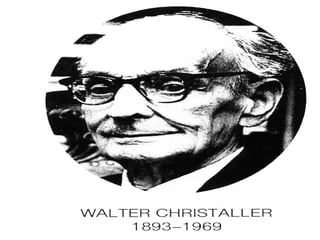
•Christaller attempted to design a model that would
show how and where central places in the urban
hierarchy would be functionally and spatially
distributed
Central Place Theory: Assumptions
•The surface of the ideal region would be flat and
have no physical barriers
•Soil fertility would be universal
•Population, purchasing power evenly distributed
•Uniform transport network that permitted direct
travel from each settlement to the other
•Constant maximum distance or range for the sale of
any good or service produced in a town prevailed in
all directions from the town center
•Consumers are rational in decision making
•Fair competition
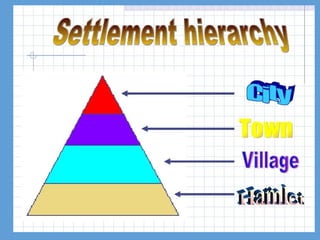
Hierarchy of Settlements
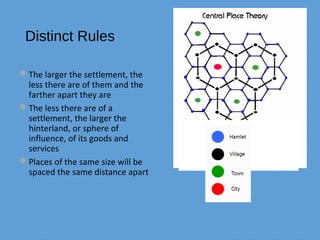
•Hamlet: fewest goods and services available
•Village: includes the region of the hamlet and some
additional goods and services
• Town: includes the region of the village and hamlet
and provides some additional goods and services
•City: includes the region of the village, hamlet and
town and provides additional goods and services
Distinct Rules
The larger the settlement, the
less there are of them and the
farther apart they are
The less there are of a
settlement, the larger the
hinterland, or sphere of
influence, of its goods and
services
Places of the same size will be
spaced the same distance apart
ADVANTAGES
•The theory does a reasonably good job of
describing the spatial pattern of urbanization. No
other economic theory explains why there is a
hierarchy of urban centers.
• Central place theory does a good job of
describing the location of trade and service
activity.
• It also does a good job of describing consumer
market oriented manufacturing.
• Trade and service activity has an increasing
relevance as the U.S. economy shifts from
manufacturing to services over time.
• Small-town community economic
developers can secure quite specific, relevant
information about what kind of trade or
service enterprise will likely work, and what
kind of enterprise will not likely work in a
given small community.
Disadvantages of Central
Place Theory
•Large areas of flat land rarely exist (i.e.
Netherlands)  transport is “uneven”
•More types of transport – costs cannot be
proportional to distance
•People and wealth are not evenly distributed
•People do not always go to the nearest place
• Purchasing power of people differs
• Perfect competition is unreal – some make more than
others
• Shopping habits have changed – People travel larger
distances to buy lower order goods (i.e. hypermarkets)
• Theory sees central place as having a particular
function  in reality, places have several which change
over time
• Good for agricultural regions but not industrial or post
industrial regions
• Doesn’t incorporate the temporal aspect in developing
areas
THANKSTHANKS

Central place theory

  • 2.
    Central Place Theory. Compiledby. Big Ben. (CTIE)
  • 3.
    Central Place Theory •Centralplace is a market center for the exchange of goods and services by people attracted from the surrounding area •Centrality is crucial to the development of urban places and their service areas •Hinterland refers to the area surrounding a central place from which consumers are drawn
  • 4.
    Central Place Theory •Theurban hierarchy of settlements is based on the functions available in a given settlement •Functions and services attract people from the urban areas as well as the hinterlands •Every urban center has an economic reach •Central places compete with each other to provide goods and services
  • 5.
    Central Place Theory Rangeis the maximum distance people are willing to travel to use a service Threshold is the minimum number of people required to support the service
  • 6.
    Central Place Theory •Christallerattempted to design a model that would show how and where central places in the urban hierarchy would be functionally and spatially distributed
  • 7.
    Central Place Theory:Assumptions •The surface of the ideal region would be flat and have no physical barriers •Soil fertility would be universal •Population, purchasing power evenly distributed •Uniform transport network that permitted direct travel from each settlement to the other •Constant maximum distance or range for the sale of any good or service produced in a town prevailed in all directions from the town center •Consumers are rational in decision making •Fair competition
  • 8.
    Hierarchy of Settlements •Hamlet:fewest goods and services available •Village: includes the region of the hamlet and some additional goods and services • Town: includes the region of the village and hamlet and provides some additional goods and services •City: includes the region of the village, hamlet and town and provides additional goods and services
  • 10.
    Distinct Rules The largerthe settlement, the less there are of them and the farther apart they are The less there are of a settlement, the larger the hinterland, or sphere of influence, of its goods and services Places of the same size will be spaced the same distance apart
  • 11.
    ADVANTAGES •The theory doesa reasonably good job of describing the spatial pattern of urbanization. No other economic theory explains why there is a hierarchy of urban centers. • Central place theory does a good job of describing the location of trade and service activity. • It also does a good job of describing consumer market oriented manufacturing.
  • 12.
    • Trade andservice activity has an increasing relevance as the U.S. economy shifts from manufacturing to services over time. • Small-town community economic developers can secure quite specific, relevant information about what kind of trade or service enterprise will likely work, and what kind of enterprise will not likely work in a given small community.
  • 13.
    Disadvantages of Central PlaceTheory •Large areas of flat land rarely exist (i.e. Netherlands)  transport is “uneven” •More types of transport – costs cannot be proportional to distance •People and wealth are not evenly distributed •People do not always go to the nearest place
  • 14.
    • Purchasing powerof people differs • Perfect competition is unreal – some make more than others • Shopping habits have changed – People travel larger distances to buy lower order goods (i.e. hypermarkets) • Theory sees central place as having a particular function  in reality, places have several which change over time • Good for agricultural regions but not industrial or post industrial regions • Doesn’t incorporate the temporal aspect in developing areas
  • 15.