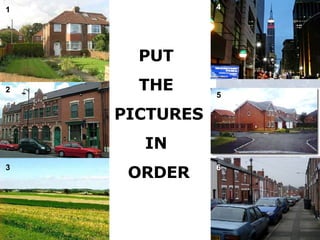
PUT  THE  PICTURES  IN  ORDER 1 2 3 4 5 6
Urban Models
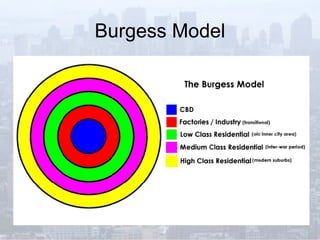
Burgess’ Model On a plain piece of paper have a go at remembering the Burgess model. HINT: this is the one with lots of circles!
Burgess Model
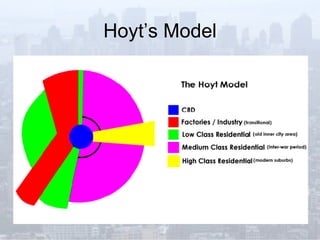
Hoyt’s Model On a plain piece of paper have a go at remembering the Hoyt model. HINT: this is the one with circles and wedges!
Hoyt’s Model
Quick Task on Burgess and Hoyt Using the information we have just spoken about write a short description of each of the models on your sheet in the ‘description’ segment. Think about: What the model is showing – how it is structured? What information it is based upon
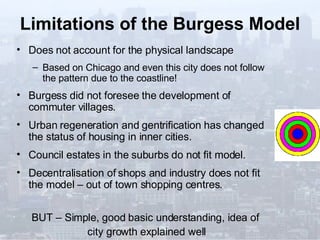
Limitations of the Burgess Model Does not account for the physical landscape Based on Chicago and even this city does not follow the pattern due to the coastline! Burgess did not foresee the development of commuter villages. Urban regeneration and gentrification has changed the status of housing in inner cities. Council estates in the suburbs do not fit model. Decentralisation of shops and industry does not fit the model – out of town shopping centres. BUT – Simple, good basic understanding, idea of  city growth explained well
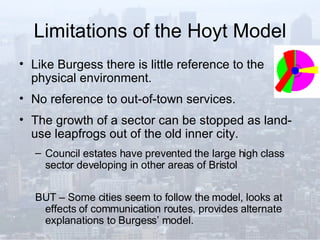
Limitations of the Hoyt Model Like Burgess there is little reference to the physical environment. No reference to out-of-town services. The growth of a sector can be stopped as land-use leapfrogs out of the old inner city. Council estates have prevented the large high class sector developing in other areas of Bristol BUT – Some cities seem to follow the model, looks at effects of communication routes, provides alternate explanations to Burgess’ model.
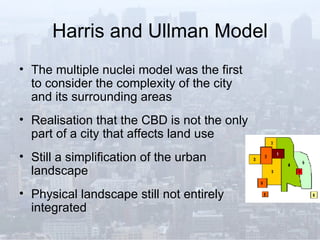
Harris and  Ullman Model Otherwise known as the multiple nuclei model. Idea that cities are not formed around one CBD but a number of  separate nuclei  in the urban pattern. These  nodes  become specialised and differentiated based on a number of attributes: Differential accessibility. Some activities require specialized facilities such as port and rail terminals.  Land use compatibility. Similar activities group together. This may be defined as centripetal forces. Land use incompatibility. Some activities are repelling each-other such as high quality residential and heavy industrial. This may be defined as centrifugal forces.  Location suitability. Some activities cannot afford the rent of the optimal site for their location .
Harris and Ullman Model The multiple nuclei model was the first to consider the complexity of the city and its surrounding areas Realisation that the CBD is not the only part of a city that affects land use Still a simplification of the urban landscape Physical landscape still not entirely integrated
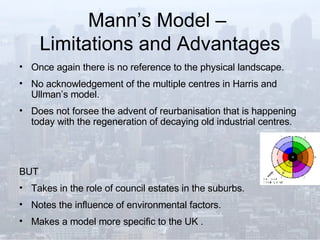
Mann’s Model A British Urban Land Use Model. A combination of the ideas of Burgess and Hoyt with both concentric rings and sectors. Based on Sheffield, Nottingham and Huddersfield. The role of the prevailing wind is important.
Mann’s Model –  Limitations and Advantages Once again there is no reference to the physical landscape. No acknowledgement of the multiple centres in Harris and Ullman’s model. Does not forsee the advent of reurbanisation that is happening today with the regeneration of decaying old industrial centres. BUT  Takes in the role of council estates in the suburbs. Notes the influence of environmental factors. Makes a model more specific to the UK .
Mann’s Model Can we relate it to Ipswich?
Round-Up On a new piece of paper: Sketch either the multiple nuclei model  or  Mann’s model as best you can remember it. Write down the three points you think are the most important from this lesson. Write one thing you have learnt today that you did not know before Hand this to me as you leave!

Urban Models for MEDCs

  • 1.
    PUT THE PICTURES IN ORDER 1 2 3 4 5 6
  • 2.
  • 3.
    Burgess’ Model Ona plain piece of paper have a go at remembering the Burgess model. HINT: this is the one with lots of circles!
  • 4.
  • 5.
    Hoyt’s Model Ona plain piece of paper have a go at remembering the Hoyt model. HINT: this is the one with circles and wedges!
  • 6.
  • 7.
    Quick Task onBurgess and Hoyt Using the information we have just spoken about write a short description of each of the models on your sheet in the ‘description’ segment. Think about: What the model is showing – how it is structured? What information it is based upon
  • 8.
    Limitations of theBurgess Model Does not account for the physical landscape Based on Chicago and even this city does not follow the pattern due to the coastline! Burgess did not foresee the development of commuter villages. Urban regeneration and gentrification has changed the status of housing in inner cities. Council estates in the suburbs do not fit model. Decentralisation of shops and industry does not fit the model – out of town shopping centres. BUT – Simple, good basic understanding, idea of city growth explained well
  • 9.
    Limitations of theHoyt Model Like Burgess there is little reference to the physical environment. No reference to out-of-town services. The growth of a sector can be stopped as land-use leapfrogs out of the old inner city. Council estates have prevented the large high class sector developing in other areas of Bristol BUT – Some cities seem to follow the model, looks at effects of communication routes, provides alternate explanations to Burgess’ model.
  • 10.
    Harris and Ullman Model Otherwise known as the multiple nuclei model. Idea that cities are not formed around one CBD but a number of separate nuclei in the urban pattern. These nodes become specialised and differentiated based on a number of attributes: Differential accessibility. Some activities require specialized facilities such as port and rail terminals. Land use compatibility. Similar activities group together. This may be defined as centripetal forces. Land use incompatibility. Some activities are repelling each-other such as high quality residential and heavy industrial. This may be defined as centrifugal forces. Location suitability. Some activities cannot afford the rent of the optimal site for their location .
  • 11.
    Harris and UllmanModel The multiple nuclei model was the first to consider the complexity of the city and its surrounding areas Realisation that the CBD is not the only part of a city that affects land use Still a simplification of the urban landscape Physical landscape still not entirely integrated
  • 12.
    Mann’s Model ABritish Urban Land Use Model. A combination of the ideas of Burgess and Hoyt with both concentric rings and sectors. Based on Sheffield, Nottingham and Huddersfield. The role of the prevailing wind is important.
  • 13.
    Mann’s Model – Limitations and Advantages Once again there is no reference to the physical landscape. No acknowledgement of the multiple centres in Harris and Ullman’s model. Does not forsee the advent of reurbanisation that is happening today with the regeneration of decaying old industrial centres. BUT Takes in the role of council estates in the suburbs. Notes the influence of environmental factors. Makes a model more specific to the UK .
  • 14.
    Mann’s Model Canwe relate it to Ipswich?
  • 15.
    Round-Up On anew piece of paper: Sketch either the multiple nuclei model or Mann’s model as best you can remember it. Write down the three points you think are the most important from this lesson. Write one thing you have learnt today that you did not know before Hand this to me as you leave!