An introduction to Islamic city
INTRODUCTION TO THE ISLAMIC CITY
Islam according to Fishel (1956) and Hassan(1972), is an
urban religion
ًreligious practices, belief, and values especially those
relating to organization and authority , emphasized the
social gathering and discouraged nomadism and
dispersing.
Early Muslim towns were erected to preach Islam, playing
role of ‘citadel of faith” (fischel,1956(
9th
century ad – this prestigious (religious) role was replaced
by political motives as various parts of the Muslim world
broke their traditional link with the main Caliphate in the
east.
An introduction to Islamic city
Local divisions and conflicts in addition to continuous raids
of nomads, have created a process of urban decline.
Stability was not regained until the arrival of Ottomans in 16
century. In desire to revive the old Caliphate, as well as to
defend against Spanish and Portuguese occupation of
North African Western coast, The Ottomans were enable to
control most of the Muslim world.
They brought peace, security and prosperity, the main
ingredients for urban recovery and growth.
With increasing power of 17th
century imperial Europe, the
main role of these towns was to provide military
enforcement for Ottoman resistance against European
domination of the Mediterranean Sea.
An introduction to Islamic city
By the 18th
and early 19th
centuries, Muslim cities
experienced periods of wide spread disease and famine.
That followed by falling in the hands of colonial powers.
The death sentences for the traditional Muslim city through
the introduction of new alien morphological, socio-cultural
and economic characteristics.
The European town created new situation and slowly
emptied the Muslim city from its functional viability.
After independence, Muslim countries, in their quest for
development, adopted a policy of modernization leading
to further alienation of the little left of the traditional Muslim
city..
An introduction to Islamic city
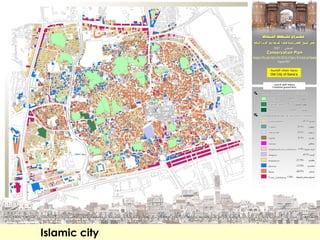
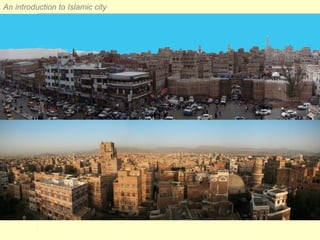
Islamic city
An introduction to Islamic city
A number of factors played decisive roles in ordering and
shaping the plan and form of Muslim city.
DESIGN PRINCIPLES OF THE MUSLIM CITY
The Muslim city reflected the general socio-cultural, political
and economic structures of the newly created society.
1 Natural laws
the adaptation of the built form and plan of the city to
natural circumstances expressed through weather
conditions and topography. These were expressed in the
adoption of concepts such as courtyard, terrace, narrow
covered streets and gardens. Such elements were
designed for coping with hot weather conditions
dominating the Muslim environment.
An introduction to Islamic city
2 Religious and cultural beliefs
The religious beliefs and practices formed the centre of
cultural life these populations, thus giving the mosque the
central position in spatial and institutional hierarchies.
The cultural beliefs separating public and private lives
regulated the spatial order between uses and areas
An introduction to Islamic city
3 Design principles stemmed from Sharia Law
4 Social principles
The Muslim city also reflected the rules of sharia (Islamic
law) in terms of physical and social relations between
public and private realms, and between neighbour and
social group. The principle was made into a law which sets
the height of the wall above the height a camel rider.
The social organization of the urban society was based on
social groupings sharing the same blood, ethic origin and
cultural perspective. Development was therefore directed
towards meeting these social needs especially in terms of
kinship, solidarity, defense, social order and religious
practices.
An introduction to Islamic city
COMPONENTS OF THE MUSLIM CITY
The main Mosque
It occupied the heart of the town and was usually
surrounded by the suq (market). This was where weekly
Friday prayers were held and attached to it there was the
madrassa providing religious and scientific teaching.
Located outside the main mosque provided the economic
activity in the town . The central area was also the
gathering of the other public activities such as social
services, administration, trade, arts and craft and baths
(hamman) and hotels (Funduq and Waqala(
Suqs
1
2
An introduction to Islamic city
Citadel
Also known as Casbah, representing the palace of governor,
the citadel was surrounded by its own walls and constituted a
district on its own with its own mosque, guards, offices and
residence. Its was usually located in the high part of the town
near wall.
3
Residential Quarters
They were described by Eikelman (1981) as clusters of
households of particular quality of life based on closeness
(Qaraba) which is manifested in personal ties, common interests
and shared moral unity. They were usually dense and each
quarter had its own mosque used for daily prayer, Quranic
school (madrassa), bakery, shops and other first necessity
objects. They even had their own gates. They were also
ethnically organized, Muslim group in quarters and Jews in
others so that each group could practice and celebrate its own
cultural beliefs
4
An introduction to Islamic city
Street network
Connecting between these quarters and to the central place
was a network of narrow winding streets consisting of public and
private and semi-private streets and cul de sacs
Wall
A well-defended wall surrounded the town with a number of
gates
Exterior
There were the cemeteries , a weekly market just outside the
main gate were most animal suqs were held in addition to
prive gardens and field.
5
6
7
An introduction to Islamic city
Conclusion
The Muslim city had a cultural, social, political and economic
logic in terms of physical fabric, layout, and uses which can
provide a lesson for modern planning and design practices.
The Muslim city can be easily adapted to meet modern
functionality and living standards and maintain its high
congruence with our natural, religious and socio-cultural
environment.
It is still very relevant and viable to today’s urban requirement
of our society, a fact confirmed by number of scholars such as
Abu-Lughod (1987) and Hassan Fathi’s vernacular architecture
projects in Egypt.

intro to islamic city

  • 1.
    An introduction toIslamic city INTRODUCTION TO THE ISLAMIC CITY Islam according to Fishel (1956) and Hassan(1972), is an urban religion ًreligious practices, belief, and values especially those relating to organization and authority , emphasized the social gathering and discouraged nomadism and dispersing. Early Muslim towns were erected to preach Islam, playing role of ‘citadel of faith” (fischel,1956( 9th century ad – this prestigious (religious) role was replaced by political motives as various parts of the Muslim world broke their traditional link with the main Caliphate in the east.
  • 2.
    An introduction toIslamic city Local divisions and conflicts in addition to continuous raids of nomads, have created a process of urban decline. Stability was not regained until the arrival of Ottomans in 16 century. In desire to revive the old Caliphate, as well as to defend against Spanish and Portuguese occupation of North African Western coast, The Ottomans were enable to control most of the Muslim world. They brought peace, security and prosperity, the main ingredients for urban recovery and growth. With increasing power of 17th century imperial Europe, the main role of these towns was to provide military enforcement for Ottoman resistance against European domination of the Mediterranean Sea.
  • 3.
    An introduction toIslamic city By the 18th and early 19th centuries, Muslim cities experienced periods of wide spread disease and famine. That followed by falling in the hands of colonial powers. The death sentences for the traditional Muslim city through the introduction of new alien morphological, socio-cultural and economic characteristics. The European town created new situation and slowly emptied the Muslim city from its functional viability. After independence, Muslim countries, in their quest for development, adopted a policy of modernization leading to further alienation of the little left of the traditional Muslim city..
  • 4.
    An introduction toIslamic city Islamic city
  • 5.
    An introduction toIslamic city
  • 6.
    An introduction toIslamic city A number of factors played decisive roles in ordering and shaping the plan and form of Muslim city. DESIGN PRINCIPLES OF THE MUSLIM CITY The Muslim city reflected the general socio-cultural, political and economic structures of the newly created society. 1 Natural laws the adaptation of the built form and plan of the city to natural circumstances expressed through weather conditions and topography. These were expressed in the adoption of concepts such as courtyard, terrace, narrow covered streets and gardens. Such elements were designed for coping with hot weather conditions dominating the Muslim environment.
  • 7.
    An introduction toIslamic city 2 Religious and cultural beliefs The religious beliefs and practices formed the centre of cultural life these populations, thus giving the mosque the central position in spatial and institutional hierarchies. The cultural beliefs separating public and private lives regulated the spatial order between uses and areas
  • 8.
    An introduction toIslamic city 3 Design principles stemmed from Sharia Law 4 Social principles The Muslim city also reflected the rules of sharia (Islamic law) in terms of physical and social relations between public and private realms, and between neighbour and social group. The principle was made into a law which sets the height of the wall above the height a camel rider. The social organization of the urban society was based on social groupings sharing the same blood, ethic origin and cultural perspective. Development was therefore directed towards meeting these social needs especially in terms of kinship, solidarity, defense, social order and religious practices.
  • 9.
    An introduction toIslamic city COMPONENTS OF THE MUSLIM CITY The main Mosque It occupied the heart of the town and was usually surrounded by the suq (market). This was where weekly Friday prayers were held and attached to it there was the madrassa providing religious and scientific teaching. Located outside the main mosque provided the economic activity in the town . The central area was also the gathering of the other public activities such as social services, administration, trade, arts and craft and baths (hamman) and hotels (Funduq and Waqala( Suqs 1 2
  • 10.
    An introduction toIslamic city Citadel Also known as Casbah, representing the palace of governor, the citadel was surrounded by its own walls and constituted a district on its own with its own mosque, guards, offices and residence. Its was usually located in the high part of the town near wall. 3 Residential Quarters They were described by Eikelman (1981) as clusters of households of particular quality of life based on closeness (Qaraba) which is manifested in personal ties, common interests and shared moral unity. They were usually dense and each quarter had its own mosque used for daily prayer, Quranic school (madrassa), bakery, shops and other first necessity objects. They even had their own gates. They were also ethnically organized, Muslim group in quarters and Jews in others so that each group could practice and celebrate its own cultural beliefs 4
  • 11.
    An introduction toIslamic city Street network Connecting between these quarters and to the central place was a network of narrow winding streets consisting of public and private and semi-private streets and cul de sacs Wall A well-defended wall surrounded the town with a number of gates Exterior There were the cemeteries , a weekly market just outside the main gate were most animal suqs were held in addition to prive gardens and field. 5 6 7
  • 12.
    An introduction toIslamic city Conclusion The Muslim city had a cultural, social, political and economic logic in terms of physical fabric, layout, and uses which can provide a lesson for modern planning and design practices. The Muslim city can be easily adapted to meet modern functionality and living standards and maintain its high congruence with our natural, religious and socio-cultural environment. It is still very relevant and viable to today’s urban requirement of our society, a fact confirmed by number of scholars such as Abu-Lughod (1987) and Hassan Fathi’s vernacular architecture projects in Egypt.