What is Landscape?
What is Landscape Architecture?
What is Landscape Design?
What is Landscape Design Process?
Proudly presented by Yeo Chin Sheng
Tay Ke Tian
Ng Pei Hong
Clinton Tham Vun Khee
Lim Chee Siang
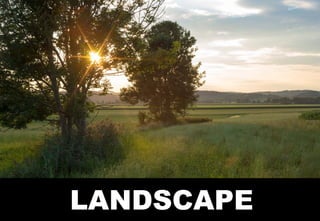
LANDSCAPE
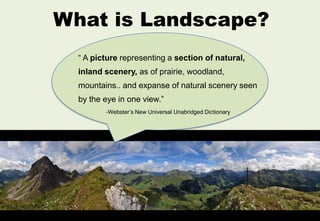
What is Landscape?
“ A picture representing a section of natural,
inland scenery, as of prairie, woodland,
mountains.. and expanse of natural scenery seen
by the eye in one view.”
-Webster’s New Universal Unabridged Dictionary
Landscape is more than just scenery.
“LAND” means both a place and
the people living there.
“SCAPE” means “to shape”, and also
mean association, partnership.
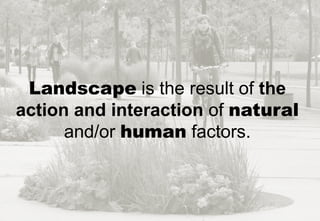
Landscape is the result of the
action and interaction of natural
and/or human factors.
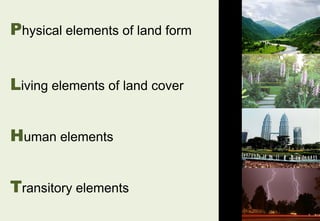
Physical elements of land form
Living elements of land cover
Human elements
Transitory elements
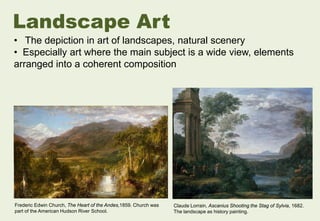
Landscape Art
Frederic Edwin Church, The Heart of the Andes,1859. Church was
part of the American Hudson River School.
Claude Lorrain, Ascanius Shooting the Stag of Sylvia, 1682.
The landscape as history painting.
• The depiction in art of landscapes, natural scenery
• Especially art where the main subject is a wide view, elements
arranged into a coherent composition
• “A landscape designed and created intentionally by man”
• An "associative cultural landscape" which may be valued because
of the "religious, artistic or cultural associations of the natural
element"
Cultural Landscape
Tongariro National Park, New Zealand (1993)
"In 1993 Tongariro became the first
property to be inscribed on the World
Heritage List under the revised
criteria describing cultural
landscapes. The mountains at the
heart of the park have cultural and
religious significance for the Maori
people and symbolize the spiritual
links between this community and its
environment. The park has active
and extinct volcanoes, a diverse
range of ecosystems and some
spectacular landscapes."
The science of studying and improving relationships between
ecological processes in the environment and particular
ecosystems
Landscape Ecolgy
Landscape Planning
• A branch of landscape architecture
• An activity concerned with reconciling competing land uses
while protecting natural processes, significant cultural, natural
resources
Mineral working in the Sierra Nevada, outside Granada,
Spain. This is part of a Landscape, and it can be planned
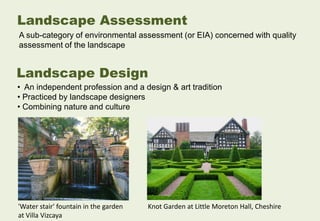
A sub-category of environmental assessment (or EIA) concerned with quality
assessment of the landscape
Landscape Assessment
Landscape Design
• An independent profession and a design & art tradition
• Practiced by landscape designers
• Combining nature and culture
'Water stair' fountain in the garden
at Villa Vizcaya
Knot Garden at Little Moreton Hall, Cheshire
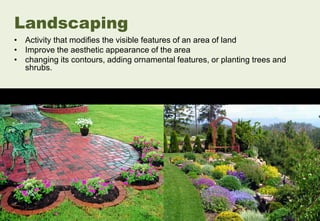
• Activity that modifies the visible features of an area of land
• Improve the aesthetic appearance of the area
• changing its contours, adding ornamental features, or planting trees and
shrubs.
Landscaping
Importance of Landscape
• Support our health and wellbeing by
encouraging physical outdoor activity and
an antidote to stress
• Offers aesthetic enjoyment, escapism,
tranquility, and a sense of belonging to
an area with a distinct natural and
cultural identity.
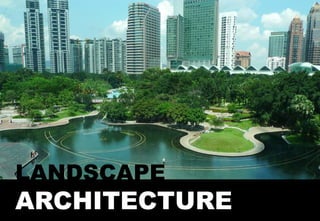
LANDSCAPE
ARCHITECTURE
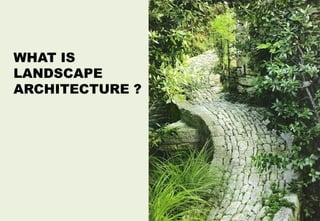
WHAT IS
LANDSCAPE
ARCHITECTURE ?
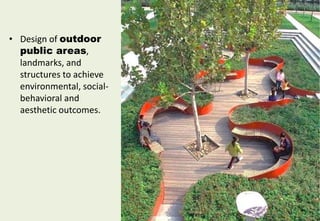
• Design of outdoor
public areas,
landmarks, and
structures to achieve
environmental, social-
behavioral and
aesthetic outcomes.
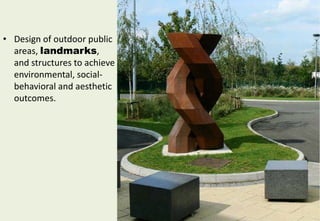
• Design of outdoor public
areas, landmarks,
and structures to achieve
environmental, social-
behavioral and aesthetic
outcomes.
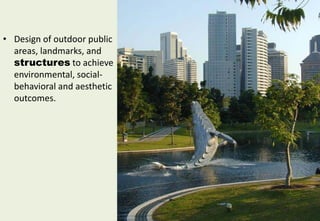
• Design of outdoor public
areas, landmarks, and
structures to achieve
environmental, social-
behavioral and aesthetic
outcomes.
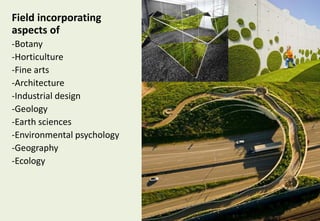
Field incorporating
aspects of
-Botany
-Horticulture
-Fine arts
-Architecture
-Industrial design
-Geology
-Earth sciences
-Environmental psychology
-Geography
-Ecology
Landscape Architect
• Apply creative and technical skill, scientific,
cultural and political knowledge in the planned
arrangement of natural and constructed
elements on the land integrating ecological
sustainability.
• Resulting environments shall serve useful,
aesthetic, safe and enjoyable purposes
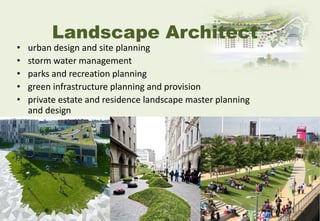
• urban design and site planning
• storm water management
• parks and recreation planning
• green infrastructure planning and provision
• private estate and residence landscape master planning
and design
Landscape Architect
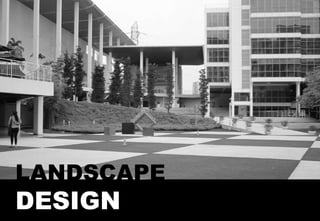
LANDSCAPE
DESIGN
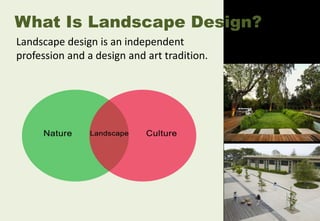
What Is Landscape Design?
Landscape design is an independent
profession and a design and art tradition.
Principles of Landscape
Design
• Unity
• Colors
• Line
• Form
• Texture
• Scale
• Balance
• Simplicity and variety
- Attracts and hold attention
- Starts with the story line develop in the family analysis
Unity- is the quality of oneness
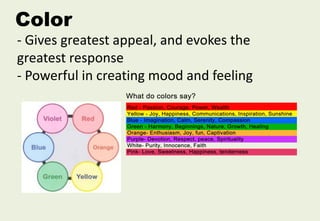
- Gives greatest appeal, and evokes the
greatest response
- Powerful in creating mood and feeling
Color
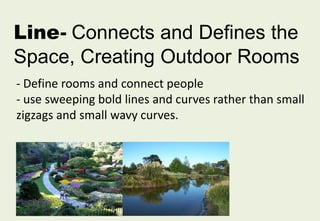
Line- Connects and Defines the
Space, Creating Outdoor Rooms
- Define rooms and connect people
- use sweeping bold lines and curves rather than small
zigzags and small wavy curves.
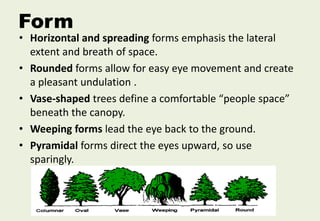
Form
• Horizontal and spreading forms emphasis the lateral
extent and breath of space.
• Rounded forms allow for easy eye movement and create
a pleasant undulation .
• Vase-shaped trees define a comfortable “people space”
beneath the canopy.
• Weeping forms lead the eye back to the ground.
• Pyramidal forms direct the eyes upward, so use
sparingly.
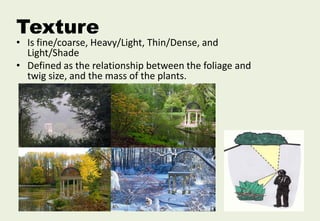
Texture
• Is fine/coarse, Heavy/Light, Thin/Dense, and
Light/Shade
• Defined as the relationship between the foliage and
twig size, and the mass of the plants.
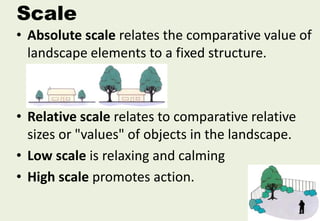
Scale
• Absolute scale relates the comparative value of
landscape elements to a fixed structure.
• Relative scale relates to comparative relative
sizes or "values" of objects in the landscape.
• Low scale is relaxing and calming
• High scale promotes action.
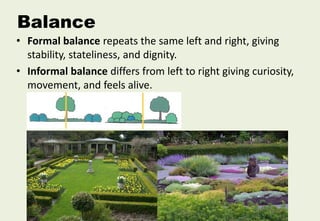
Balance
• Formal balance repeats the same left and right, giving
stability, stateliness, and dignity.
• Informal balance differs from left to right giving curiosity,
movement, and feels alive.
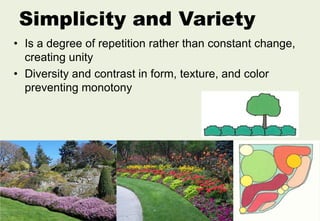
Simplicity and Variety
• Is a degree of repetition rather than constant change,
creating unity
• Diversity and contrast in form, texture, and color
preventing monotony
LANDSCAPE
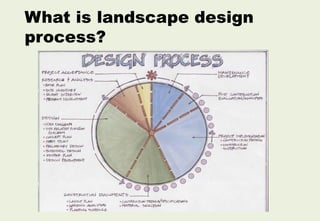
DESIGN PROCESS
What is landscape design
process?
Research & Analysis
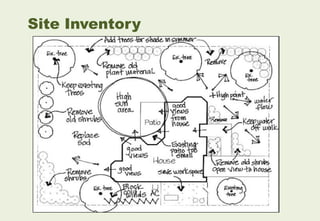
• Site inventory: soil, drainage, climate
conditions, and existing vegetation
• Critical for both plant selection and
placement and locating family
activities and functions.
• Important because the same climate
conditions that affect the plants--temperature,
humidity, rain, wind, and sunlight--also affect
the user
Site Inventory
Determining Your Needs
• Checklist of your/ your client’s needs and
desires (This helps you determine how your
yard and landscape will be used)
• Establish a theme for the form and style of
your design
Themes
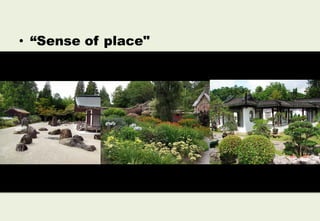
• Common themes include geometric, such as a
circle, square, and rectangle; or naturalistic
such as irregular (organic edge) or curvilinear
• Spanish, French, Italian, Middle Eastern,
Oriental, English, and American
• Tropical, desert, meadow, woodland, marsh,
or coastal plantings
• “Sense of place"
Creating Functional Diagrams
• Idea diagram
• Site related function diagram
• Program development (Locate the activity
spaces on the site)
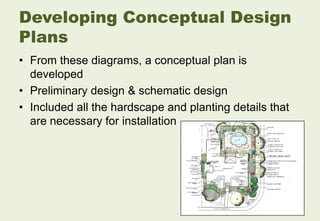
Developing Conceptual Design
Plans
• From these diagrams, a conceptual plan is
developed
• Preliminary design & schematic design
• Included all the hardscape and planting details that
are necessary for installation
Throughout the design process there are 10
important things to consider:
• Understand your site for plant selection and activity location
• Remember the user by considering what you want and need
• Use a form and/or style theme to help determine shapes and organize
spaces
• Create and link spaces by designating activity areas and linking with
elements
• Consider the function of plants for both the environment and the user
• Structure the plantings by using massing and layering techniques
• Highlight important points such as transition areas and focal points
• Pay attention to detail in the materials, the colors, and the surface
textures
• Take time into account for the growth and maintenance of plants
• Protect your resources by using sustainable design practices
Reference
• https://edis.ifas.ufl.edu/ep375
• http://www.eatcology.com/operative-landscape-architecture-theory-1
• http://www.akasla.org/resources/What-is-LA
• http://www.gardenvisit.com/landscape_architecture/andscape_debate/d
efinition_eid
• https://www.asla.org/design/index.html
• http://www.ext.colostate.edu/mg/gardennotes/413.html
• http://www.houzz.com/photos/modern/landscape
• http://web.mit.edu/spirn/www/landscape/define.htm
• http://www.devon.gov.uk/index/environmentplanning/natural_environm
ent/landscape/whatislandscape.htm
• http://iwanttobealandscapearchitect.com/whatis/index.html

What is landscape? What is landscape architecture? What is landscape design? What is landscape design process?

  • 1.
    What is Landscape? Whatis Landscape Architecture? What is Landscape Design? What is Landscape Design Process? Proudly presented by Yeo Chin Sheng Tay Ke Tian Ng Pei Hong Clinton Tham Vun Khee Lim Chee Siang
  • 2.
  • 3.
    What is Landscape? “A picture representing a section of natural, inland scenery, as of prairie, woodland, mountains.. and expanse of natural scenery seen by the eye in one view.” -Webster’s New Universal Unabridged Dictionary
  • 4.
    Landscape is morethan just scenery. “LAND” means both a place and the people living there. “SCAPE” means “to shape”, and also mean association, partnership.
  • 5.
    Landscape is theresult of the action and interaction of natural and/or human factors.
  • 6.
    Physical elements ofland form Living elements of land cover Human elements Transitory elements
  • 7.
    Landscape Art Frederic EdwinChurch, The Heart of the Andes,1859. Church was part of the American Hudson River School. Claude Lorrain, Ascanius Shooting the Stag of Sylvia, 1682. The landscape as history painting. • The depiction in art of landscapes, natural scenery • Especially art where the main subject is a wide view, elements arranged into a coherent composition
  • 8.
    • “A landscapedesigned and created intentionally by man” • An "associative cultural landscape" which may be valued because of the "religious, artistic or cultural associations of the natural element" Cultural Landscape Tongariro National Park, New Zealand (1993) "In 1993 Tongariro became the first property to be inscribed on the World Heritage List under the revised criteria describing cultural landscapes. The mountains at the heart of the park have cultural and religious significance for the Maori people and symbolize the spiritual links between this community and its environment. The park has active and extinct volcanoes, a diverse range of ecosystems and some spectacular landscapes."
  • 9.
    The science ofstudying and improving relationships between ecological processes in the environment and particular ecosystems Landscape Ecolgy
  • 10.
    Landscape Planning • Abranch of landscape architecture • An activity concerned with reconciling competing land uses while protecting natural processes, significant cultural, natural resources Mineral working in the Sierra Nevada, outside Granada, Spain. This is part of a Landscape, and it can be planned
  • 11.
    A sub-category ofenvironmental assessment (or EIA) concerned with quality assessment of the landscape Landscape Assessment Landscape Design • An independent profession and a design & art tradition • Practiced by landscape designers • Combining nature and culture 'Water stair' fountain in the garden at Villa Vizcaya Knot Garden at Little Moreton Hall, Cheshire
  • 12.
    • Activity thatmodifies the visible features of an area of land • Improve the aesthetic appearance of the area • changing its contours, adding ornamental features, or planting trees and shrubs. Landscaping
  • 13.
    Importance of Landscape •Support our health and wellbeing by encouraging physical outdoor activity and an antidote to stress • Offers aesthetic enjoyment, escapism, tranquility, and a sense of belonging to an area with a distinct natural and cultural identity.
  • 14.
  • 15.
  • 16.
    • Design ofoutdoor public areas, landmarks, and structures to achieve environmental, social- behavioral and aesthetic outcomes.
  • 17.
    • Design ofoutdoor public areas, landmarks, and structures to achieve environmental, social- behavioral and aesthetic outcomes.
  • 18.
    • Design ofoutdoor public areas, landmarks, and structures to achieve environmental, social- behavioral and aesthetic outcomes.
  • 19.
    Field incorporating aspects of -Botany -Horticulture -Finearts -Architecture -Industrial design -Geology -Earth sciences -Environmental psychology -Geography -Ecology
  • 20.
    Landscape Architect • Applycreative and technical skill, scientific, cultural and political knowledge in the planned arrangement of natural and constructed elements on the land integrating ecological sustainability. • Resulting environments shall serve useful, aesthetic, safe and enjoyable purposes
  • 21.
    • urban designand site planning • storm water management • parks and recreation planning • green infrastructure planning and provision • private estate and residence landscape master planning and design Landscape Architect
  • 22.
  • 23.
    What Is LandscapeDesign? Landscape design is an independent profession and a design and art tradition.
  • 24.
    Principles of Landscape Design •Unity • Colors • Line • Form • Texture • Scale • Balance • Simplicity and variety
  • 25.
    - Attracts andhold attention - Starts with the story line develop in the family analysis Unity- is the quality of oneness
  • 26.
    - Gives greatestappeal, and evokes the greatest response - Powerful in creating mood and feeling Color
  • 27.
    Line- Connects andDefines the Space, Creating Outdoor Rooms - Define rooms and connect people - use sweeping bold lines and curves rather than small zigzags and small wavy curves.
  • 28.
    Form • Horizontal andspreading forms emphasis the lateral extent and breath of space. • Rounded forms allow for easy eye movement and create a pleasant undulation . • Vase-shaped trees define a comfortable “people space” beneath the canopy. • Weeping forms lead the eye back to the ground. • Pyramidal forms direct the eyes upward, so use sparingly.
  • 29.
    Texture • Is fine/coarse,Heavy/Light, Thin/Dense, and Light/Shade • Defined as the relationship between the foliage and twig size, and the mass of the plants.
  • 30.
    Scale • Absolute scalerelates the comparative value of landscape elements to a fixed structure. • Relative scale relates to comparative relative sizes or "values" of objects in the landscape. • Low scale is relaxing and calming • High scale promotes action.
  • 31.
    Balance • Formal balancerepeats the same left and right, giving stability, stateliness, and dignity. • Informal balance differs from left to right giving curiosity, movement, and feels alive.
  • 32.
    Simplicity and Variety •Is a degree of repetition rather than constant change, creating unity • Diversity and contrast in form, texture, and color preventing monotony
  • 33.
  • 34.
    What is landscapedesign process?
  • 35.
    Research & Analysis •Site inventory: soil, drainage, climate conditions, and existing vegetation • Critical for both plant selection and placement and locating family activities and functions. • Important because the same climate conditions that affect the plants--temperature, humidity, rain, wind, and sunlight--also affect the user
  • 36.
  • 37.
    Determining Your Needs •Checklist of your/ your client’s needs and desires (This helps you determine how your yard and landscape will be used) • Establish a theme for the form and style of your design
  • 38.
    Themes • Common themesinclude geometric, such as a circle, square, and rectangle; or naturalistic such as irregular (organic edge) or curvilinear • Spanish, French, Italian, Middle Eastern, Oriental, English, and American • Tropical, desert, meadow, woodland, marsh, or coastal plantings
  • 39.
  • 40.
    Creating Functional Diagrams •Idea diagram • Site related function diagram • Program development (Locate the activity spaces on the site)
  • 41.
    Developing Conceptual Design Plans •From these diagrams, a conceptual plan is developed • Preliminary design & schematic design • Included all the hardscape and planting details that are necessary for installation
  • 42.
    Throughout the designprocess there are 10 important things to consider: • Understand your site for plant selection and activity location • Remember the user by considering what you want and need • Use a form and/or style theme to help determine shapes and organize spaces • Create and link spaces by designating activity areas and linking with elements • Consider the function of plants for both the environment and the user • Structure the plantings by using massing and layering techniques • Highlight important points such as transition areas and focal points • Pay attention to detail in the materials, the colors, and the surface textures • Take time into account for the growth and maintenance of plants • Protect your resources by using sustainable design practices
  • 43.
    Reference • https://edis.ifas.ufl.edu/ep375 • http://www.eatcology.com/operative-landscape-architecture-theory-1 •http://www.akasla.org/resources/What-is-LA • http://www.gardenvisit.com/landscape_architecture/andscape_debate/d efinition_eid • https://www.asla.org/design/index.html • http://www.ext.colostate.edu/mg/gardennotes/413.html • http://www.houzz.com/photos/modern/landscape • http://web.mit.edu/spirn/www/landscape/define.htm • http://www.devon.gov.uk/index/environmentplanning/natural_environm ent/landscape/whatislandscape.htm • http://iwanttobealandscapearchitect.com/whatis/index.html