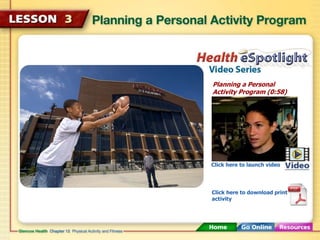
Planning a Personal 
Activity Program (0:58) 
Click here to launch video 
Click here to download print 
activity
Planning your physical activity can 
help you achieve specific fitness goals.
specificity 
overload 
progression 
warm-up 
workout 
cool-down 
resting heart rate
Your Fitness Plan 
The physical activities you choose depend 
on factors such as your fitness goals and the 
activities you like. 
Identifying a specific fitness goal is a good way 
to get motivated to get in shape.
Your Fitness Goals 
In Lesson 2, you learned how to measure your 
level of fitness. 
This knowledge can serve as a starting point for 
setting your fitness goals.
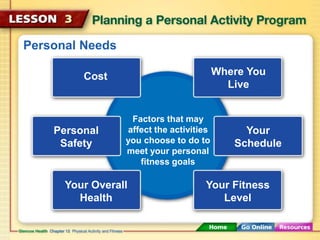
Personal Needs 
Cost Where You 
Factors that may 
affect the activities 
you choose to do to 
meet your personal 
fitness goals 
Live 
Your 
Schedule 
Your Fitness 
Level 
Personal 
Safety 
Your Overall 
Health
Types of Activities 
Choose different types of activity to meet specific 
fitness goals and to prevent boredom. 
Create a fitness journal to keep track of the fitness 
activities you do each day.
Moderate-Intensity Physical Activities 
Moderate-intensity 
physical activities 
count toward your 
daily dose of 
physical activity. 
Walking 
Climbing Stairs 
Household Chores 
Yard Work
Aerobic Activities 
Aerobic activity raises your heart rate. 
Aim for at least three 20-minute sessions each 
week of vigorous aerobic activity.
Aerobic Activities 
Cycling 
Aerobic 
Activities 
Brisk 
Walking 
Running 
Most Team 
Sports 
Skating Dancing 
Cross-Country 
Skiing
Strength Training 
Strength training develops muscle tone. 
Aim for at least two or three sessions per week of 
20 to 30 minutes each, with at least one day off 
between sessions.
Strength Training 
Rowing 
Strength 
Training 
Cross-Country 
Skiing 
Pull-Ups 
Skating 
Cycling Push-Ups 
Running
Flexibility Exercises 
Flexibility exercises 
include stretching 
for 10 to 12 minutes 
a day. 
Gymnastics 
Martial Arts 
Ballet 
Pilates 
Yoga 
Stretching
Principles of Building Fitness 
Effective fitness plans focus on four 
principles: specificity, overload, progression, 
and regularity. 
When designing your physical activity program, 
you will consider your needs and interests.
Principles of Building Fitness 
Choosing strength-training activities to build 
muscular strength is an example of specificity. 
Specificity 
Choosing the right types of 
activities to improve a given 
element of fitness
Principles of Building Fitness 
To overload is to increase the demands on your 
body in order to make it adapt and grow stronger. 
Overload 
Exercising at a level that’s 
beyond your regular daily 
activities
Principles of Building Fitness 
Progression is working a little harder or longer 
during each session, and more often during the 
week. 
Progression 
Gradually increasing the demands 
on your body
Principles of Building Fitness 
Regularity means working out on a regular basis. 
You need at least three balanced workouts a week 
to maintain your fitness level.
Stages of a Workout 
An exercise session has three stages: 
warm-up, workout, and cool-down. 
Using the three stages will get your body ready 
for physical activity and help you to avoid 
injuries.
Warm-Up 
The warm-up stage increases blood flow, 
delivering needed oxygen and fuel to your 
muscles, and increases your pulse rate and body 
temperature. 
Warm-up 
Gentle cardiovascular activity that 
prepares the muscles for work
Warm-Up 
To warm up, choose an activity that will work the 
same muscles you’re going to use during your 
workout. 
After warming up your muscles, take a few minutes 
to stretch to prepare your muscles for activity and 
increase your flexibility.
Workout 
Use the F.I.T.T. formula when planning your 
workout. 
Workout 
The part of an exercise session 
when you are exercising at your 
highest peak
Workout 
The F.I.T.T. Formula 
F 
I 
T 
T 
Frequency of workouts. 
Intensity of workouts. 
Type of Activity 
Time (duration) of workouts
Workout 
F Frequency of workouts. 
Schedule at least three exercise sessions a week, 
but give your body time to rest between workouts. 
Include other types of physical activity during the 
week to get an hour of activity each day.
Workout 
I Intensity of workouts. 
Push yourself hard enough to create overload. 
For aerobic activities, exercise within your target 
heart range. For strength training, you should feel 
strain on your muscles, but not pain.
Workout 
T Type of Activity. 
Vary your activities throughout the week to build 
different elements of fitness. 
If you jog Monday and Wednesday, try lifting 
weights on Tuesday and Thursday.
Workout 
T Time (duration) of workouts. 
To build cardiovascular fitness, keep your heart 
rate within your target range for at least 20 
minutes. 
Strength-training sessions should take 20 to 30 
minutes, while flexibility can be increased in just 10 
minutes of stretching.
Cool-Down 
The cool-down allows your heart rate, breathing, 
and body temperature to return to normal 
gradually. 
Cool down 
Low-level activity that 
prepares your body to return 
to a resting state
Cool-Down 
Stretching your 
muscles helps 
prevent injuries.
Tracking Your Progress 
Track your progress to see how your fitness 
level increases over time. 
A fitness journal can help you track your 
progress.
Tracking Your Progress 
As your fitness level increases, your resting heart 
rate will drop. 
Resting heart rate 
The number of times your 
heart beats per minute when 
you are not active
Tracking Your Progress 
To check your resting 
heart rate, sit quietly for at 
least five minutes, take 
your pulse for 15 
seconds, then multiply the 
result by four.
After You Read 
Reviewing Facts and Vocabulary 
1. What personal factors can affect your 
choice of physical activities? 
Cost, where you live, schedule, fitness 
level, overall health, personal safety
After You Read 
Reviewing Facts and Vocabulary 
2. What are the four principles of building 
fitness? 
Specificity, overload, progression, and 
regularity
After You Read 
Reviewing Facts and Vocabulary 
3. What are the benefits of warming up 
before exercise and cooling down after 
exercise? 
It reduces strain on the heart and can help 
prevent muscle soreness.
Ch12 03

Ch12 03

  • 1.
    Planning a Personal Activity Program (0:58) Click here to launch video Click here to download print activity
  • 2.
    Planning your physicalactivity can help you achieve specific fitness goals.
  • 3.
    specificity overload progression warm-up workout cool-down resting heart rate
  • 4.
    Your Fitness Plan The physical activities you choose depend on factors such as your fitness goals and the activities you like. Identifying a specific fitness goal is a good way to get motivated to get in shape.
  • 5.
    Your Fitness Goals In Lesson 2, you learned how to measure your level of fitness. This knowledge can serve as a starting point for setting your fitness goals.
  • 6.
    Personal Needs CostWhere You Factors that may affect the activities you choose to do to meet your personal fitness goals Live Your Schedule Your Fitness Level Personal Safety Your Overall Health
  • 7.
    Types of Activities Choose different types of activity to meet specific fitness goals and to prevent boredom. Create a fitness journal to keep track of the fitness activities you do each day.
  • 8.
    Moderate-Intensity Physical Activities Moderate-intensity physical activities count toward your daily dose of physical activity. Walking Climbing Stairs Household Chores Yard Work
  • 9.
    Aerobic Activities Aerobicactivity raises your heart rate. Aim for at least three 20-minute sessions each week of vigorous aerobic activity.
  • 10.
    Aerobic Activities Cycling Aerobic Activities Brisk Walking Running Most Team Sports Skating Dancing Cross-Country Skiing
  • 11.
    Strength Training Strengthtraining develops muscle tone. Aim for at least two or three sessions per week of 20 to 30 minutes each, with at least one day off between sessions.
  • 12.
    Strength Training Rowing Strength Training Cross-Country Skiing Pull-Ups Skating Cycling Push-Ups Running
  • 13.
    Flexibility Exercises Flexibilityexercises include stretching for 10 to 12 minutes a day. Gymnastics Martial Arts Ballet Pilates Yoga Stretching
  • 14.
    Principles of BuildingFitness Effective fitness plans focus on four principles: specificity, overload, progression, and regularity. When designing your physical activity program, you will consider your needs and interests.
  • 15.
    Principles of BuildingFitness Choosing strength-training activities to build muscular strength is an example of specificity. Specificity Choosing the right types of activities to improve a given element of fitness
  • 16.
    Principles of BuildingFitness To overload is to increase the demands on your body in order to make it adapt and grow stronger. Overload Exercising at a level that’s beyond your regular daily activities
  • 17.
    Principles of BuildingFitness Progression is working a little harder or longer during each session, and more often during the week. Progression Gradually increasing the demands on your body
  • 18.
    Principles of BuildingFitness Regularity means working out on a regular basis. You need at least three balanced workouts a week to maintain your fitness level.
  • 19.
    Stages of aWorkout An exercise session has three stages: warm-up, workout, and cool-down. Using the three stages will get your body ready for physical activity and help you to avoid injuries.
  • 20.
    Warm-Up The warm-upstage increases blood flow, delivering needed oxygen and fuel to your muscles, and increases your pulse rate and body temperature. Warm-up Gentle cardiovascular activity that prepares the muscles for work
  • 21.
    Warm-Up To warmup, choose an activity that will work the same muscles you’re going to use during your workout. After warming up your muscles, take a few minutes to stretch to prepare your muscles for activity and increase your flexibility.
  • 22.
    Workout Use theF.I.T.T. formula when planning your workout. Workout The part of an exercise session when you are exercising at your highest peak
  • 23.
    Workout The F.I.T.T.Formula F I T T Frequency of workouts. Intensity of workouts. Type of Activity Time (duration) of workouts
  • 24.
    Workout F Frequencyof workouts. Schedule at least three exercise sessions a week, but give your body time to rest between workouts. Include other types of physical activity during the week to get an hour of activity each day.
  • 25.
    Workout I Intensityof workouts. Push yourself hard enough to create overload. For aerobic activities, exercise within your target heart range. For strength training, you should feel strain on your muscles, but not pain.
  • 26.
    Workout T Typeof Activity. Vary your activities throughout the week to build different elements of fitness. If you jog Monday and Wednesday, try lifting weights on Tuesday and Thursday.
  • 27.
    Workout T Time(duration) of workouts. To build cardiovascular fitness, keep your heart rate within your target range for at least 20 minutes. Strength-training sessions should take 20 to 30 minutes, while flexibility can be increased in just 10 minutes of stretching.
  • 28.
    Cool-Down The cool-downallows your heart rate, breathing, and body temperature to return to normal gradually. Cool down Low-level activity that prepares your body to return to a resting state
  • 29.
    Cool-Down Stretching your muscles helps prevent injuries.
  • 30.
    Tracking Your Progress Track your progress to see how your fitness level increases over time. A fitness journal can help you track your progress.
  • 31.
    Tracking Your Progress As your fitness level increases, your resting heart rate will drop. Resting heart rate The number of times your heart beats per minute when you are not active
  • 32.
    Tracking Your Progress To check your resting heart rate, sit quietly for at least five minutes, take your pulse for 15 seconds, then multiply the result by four.
  • 33.
    After You Read Reviewing Facts and Vocabulary 1. What personal factors can affect your choice of physical activities? Cost, where you live, schedule, fitness level, overall health, personal safety
  • 34.
    After You Read Reviewing Facts and Vocabulary 2. What are the four principles of building fitness? Specificity, overload, progression, and regularity
  • 35.
    After You Read Reviewing Facts and Vocabulary 3. What are the benefits of warming up before exercise and cooling down after exercise? It reduces strain on the heart and can help prevent muscle soreness.