EXERCISE
PRINCIPLES
EXERCISE PRINCIPLES
•Exercise principles are guidelines for
designing an exercise program to help you
improve your fitness.
FITT PRINCIPLE
FITT PRINCIPLE
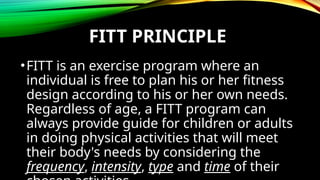
•FITT is an exercise program where an
individual is free to plan his or her fitness
design according to his or her own needs.
Regardless of age, a FITT program can
always provide guide for children or adults
in doing physical activities that will meet
their body's needs by considering the
frequency, intensity, type and time of their
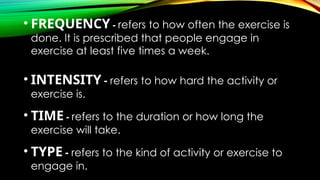
• FREQUENCY - refers to how often the exercise is
done. It is prescribed that people engage in
exercise at least five times a week.
• INTENSITY - refers to how hard the activity or
exercise is.
• TIME - refers to the duration or how long the
exercise will take.
• TYPE - refers to the kind of activity or exercise to
engage in.
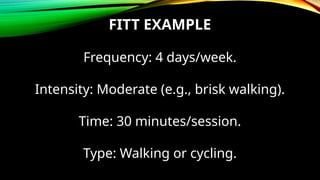
FITT EXAMPLE
Frequency: 4 days/week.
Intensity: Moderate (e.g., brisk walking).
Time: 30 minutes/session.
Type: Walking or cycling.
THE PRINCIPLE
OF TRAINING
There are three principles of
training that are
fundamental to any kind of
training routine. These
principles of training are
overload, progression, and
specificity. These principles
are key to seeing
continuous improvement
throughout the course of
training. Without utilizing
them, plateaus are
inevitable, and improvement
The
Principl
e of
Trainin
g
The core idea of the
overload principle is
gradually increasing the
level of stress being put on
the body. This can be done
through increased exercise
frequency, greater intensity,
more time spent exercising
or using a different type of
the same exercise.
Overloa
d
Principl
e
of any training routine. The
principle of progression states
that bodies adapt to the current
exercise routine over time, so
changing up the training keeps
your body from getting too used
to one routine. A key component
of progression is utilizing the
overload principle to prevent the
body from getting too used to
one training routine. Generally,
this entails increasing the
amount of exercise being
performed, since overload calls
for an increase in stress during
Progressi
on
Principle
The specificity principle
states that each form of
activity would produce
different results. This means
that if one has specific gains
in mind, one must apply
plan and execute activities
that would target those
goals.
Specifici
ty
Principle
WARM-UP AND
COOL-DOWN
ROUTINES:
IMPORTANCE AND
PROPER
TECHNIQUES
WARM UP
Both warm-ups and cool-downs are
essential parts of any workout routine.
They serve to enhance performance,
reduce the risk of injury, and promote
recovery.
IMPORTANCE OF WARM-UP
A warm-up prepares your body for the
physical demands of a workout by
gradually increasing your heart rate,
blood flow to muscles, and core body
temperature.
BENEFITS OF A WARM-UP
•Increased blood flow to muscles.
•Improved flexibility and range of motion.
•Enhanced joint mobility and lubrication.
•Mental preparation for exercise.
•Reduction in muscle stiffness during the
workout
PROPER TECHNIQUES FOR WARM-UP
A proper warm-up should last about 5-10
minutes and can involve the following:
• Dynamic stretches: These are active stretches that involve
moving the muscles and joints through their full range of
motion, such as leg swings, arm circles, or lunges.
• Aerobic activity: Light jogging, brisk walking, or cycling to
gradually increase the heart rate.
• Joint mobility exercises: involve moving joints in circular
motions, like wrist rotations or hip circles.
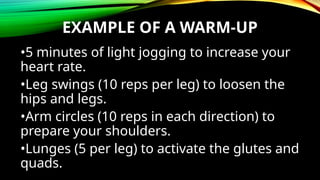
EXAMPLE OF A WARM-UP
•5 minutes of light jogging to increase your
heart rate.
•Leg swings (10 reps per leg) to loosen the
hips and legs.
•Arm circles (10 reps in each direction) to
prepare your shoulders.
•Lunges (5 per leg) to activate the glutes and
quads.
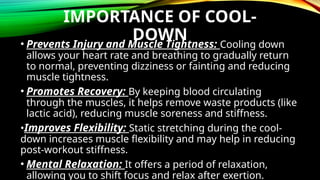
IMPORTANCE OF COOL-
DOWN
• Prevents Injury and Muscle Tightness: Cooling down
allows your heart rate and breathing to gradually return
to normal, preventing dizziness or fainting and reducing
muscle tightness.
• Promotes Recovery: By keeping blood circulating
through the muscles, it helps remove waste products (like
lactic acid), reducing muscle soreness and stiffness.
•Improves Flexibility: Static stretching during the cool-
down increases muscle flexibility and may help in reducing
post-workout stiffness.
• Mental Relaxation: It offers a period of relaxation,
allowing you to shift focus and relax after exertion.
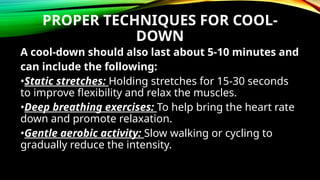
PROPER TECHNIQUES FOR COOL-
DOWN
A cool-down should also last about 5-10 minutes and
can include the following:
•Static stretches: Holding stretches for 15-30 seconds
to improve flexibility and relax the muscles.
•Deep breathing exercises: To help bring the heart rate
down and promote relaxation.
•Gentle aerobic activity: Slow walking or cycling to
gradually reduce the intensity.
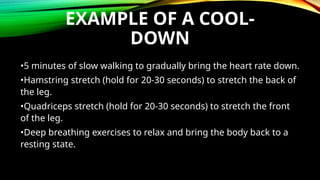
EXAMPLE OF A COOL-
DOWN
•5 minutes of slow walking to gradually bring the heart rate down.
•Hamstring stretch (hold for 20-30 seconds) to stretch the back of
the leg.
•Quadriceps stretch (hold for 20-30 seconds) to stretch the front
of the leg.
•Deep breathing exercises to relax and bring the body back to a
resting state.
THANK YOU!
Reporters:
Badadao, Bautista, Berdon, & Besario
CREDITS TO THE OWNER
OF IMAGE: VERYWELL FIT

exercise principle.pptx pathfit 2 report week 1

  • 1.
  • 2.
    EXERCISE PRINCIPLES •Exercise principlesare guidelines for designing an exercise program to help you improve your fitness.
  • 3.
  • 4.
    FITT PRINCIPLE •FITT isan exercise program where an individual is free to plan his or her fitness design according to his or her own needs. Regardless of age, a FITT program can always provide guide for children or adults in doing physical activities that will meet their body's needs by considering the frequency, intensity, type and time of their
  • 5.
    • FREQUENCY -refers to how often the exercise is done. It is prescribed that people engage in exercise at least five times a week. • INTENSITY - refers to how hard the activity or exercise is. • TIME - refers to the duration or how long the exercise will take. • TYPE - refers to the kind of activity or exercise to engage in.
  • 6.
    FITT EXAMPLE Frequency: 4days/week. Intensity: Moderate (e.g., brisk walking). Time: 30 minutes/session. Type: Walking or cycling.
  • 7.
  • 8.
    There are threeprinciples of training that are fundamental to any kind of training routine. These principles of training are overload, progression, and specificity. These principles are key to seeing continuous improvement throughout the course of training. Without utilizing them, plateaus are inevitable, and improvement The Principl e of Trainin g
  • 9.
    The core ideaof the overload principle is gradually increasing the level of stress being put on the body. This can be done through increased exercise frequency, greater intensity, more time spent exercising or using a different type of the same exercise. Overloa d Principl e
  • 10.
    of any trainingroutine. The principle of progression states that bodies adapt to the current exercise routine over time, so changing up the training keeps your body from getting too used to one routine. A key component of progression is utilizing the overload principle to prevent the body from getting too used to one training routine. Generally, this entails increasing the amount of exercise being performed, since overload calls for an increase in stress during Progressi on Principle
  • 11.
    The specificity principle statesthat each form of activity would produce different results. This means that if one has specific gains in mind, one must apply plan and execute activities that would target those goals. Specifici ty Principle
  • 12.
  • 13.
    WARM UP Both warm-upsand cool-downs are essential parts of any workout routine. They serve to enhance performance, reduce the risk of injury, and promote recovery.
  • 14.
    IMPORTANCE OF WARM-UP Awarm-up prepares your body for the physical demands of a workout by gradually increasing your heart rate, blood flow to muscles, and core body temperature.
  • 15.
    BENEFITS OF AWARM-UP •Increased blood flow to muscles. •Improved flexibility and range of motion. •Enhanced joint mobility and lubrication. •Mental preparation for exercise. •Reduction in muscle stiffness during the workout
  • 16.
    PROPER TECHNIQUES FORWARM-UP A proper warm-up should last about 5-10 minutes and can involve the following: • Dynamic stretches: These are active stretches that involve moving the muscles and joints through their full range of motion, such as leg swings, arm circles, or lunges. • Aerobic activity: Light jogging, brisk walking, or cycling to gradually increase the heart rate. • Joint mobility exercises: involve moving joints in circular motions, like wrist rotations or hip circles.
  • 17.
    EXAMPLE OF AWARM-UP •5 minutes of light jogging to increase your heart rate. •Leg swings (10 reps per leg) to loosen the hips and legs. •Arm circles (10 reps in each direction) to prepare your shoulders. •Lunges (5 per leg) to activate the glutes and quads.
  • 18.
    IMPORTANCE OF COOL- DOWN •Prevents Injury and Muscle Tightness: Cooling down allows your heart rate and breathing to gradually return to normal, preventing dizziness or fainting and reducing muscle tightness. • Promotes Recovery: By keeping blood circulating through the muscles, it helps remove waste products (like lactic acid), reducing muscle soreness and stiffness. •Improves Flexibility: Static stretching during the cool- down increases muscle flexibility and may help in reducing post-workout stiffness. • Mental Relaxation: It offers a period of relaxation, allowing you to shift focus and relax after exertion.
  • 19.
    PROPER TECHNIQUES FORCOOL- DOWN A cool-down should also last about 5-10 minutes and can include the following: •Static stretches: Holding stretches for 15-30 seconds to improve flexibility and relax the muscles. •Deep breathing exercises: To help bring the heart rate down and promote relaxation. •Gentle aerobic activity: Slow walking or cycling to gradually reduce the intensity.
  • 20.
    EXAMPLE OF ACOOL- DOWN •5 minutes of slow walking to gradually bring the heart rate down. •Hamstring stretch (hold for 20-30 seconds) to stretch the back of the leg. •Quadriceps stretch (hold for 20-30 seconds) to stretch the front of the leg. •Deep breathing exercises to relax and bring the body back to a resting state.
  • 21.
  • 22.
    CREDITS TO THEOWNER OF IMAGE: VERYWELL FIT