Maintaining a Healthy 
Weight (3:24) 
Click here to launch video 
Click here to download 
print activity
Maintaining a healthy weight helps 
you protect your health and prevent 
disease.
metabolism 
body mass index (BMI) 
overweight 
obese 
underweight
The Calorie Connection 
You maintain your weight by taking in as 
many calories as you use. 
Calories are units used to measure the energy 
found in food.
The Calorie Connection 
If you consume more calories than your body 
needs, you will gain weight. 
If you use more calories than you take in, you will 
lose weight.
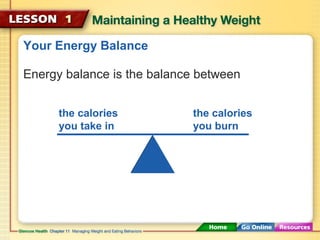
Your Energy Balance 
Energy balance is the balance between 
the calories 
you take in 
the calories 
you burn
Your Energy Balance 
Your metabolism converts the food you eat 
into fuel. 
Metabolism 
The process by which the body 
breaks down substances and gets 
energy from food
Your Energy Balance 
It takes about 3,500 calories to equal 1 pound of 
body fat. 
Thus, if you consume 500 fewer calories than 
you use every day, you will lose 1 pound per 
week.
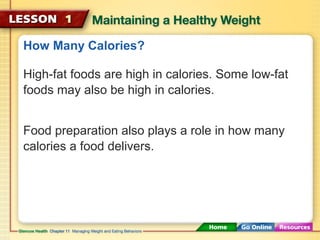
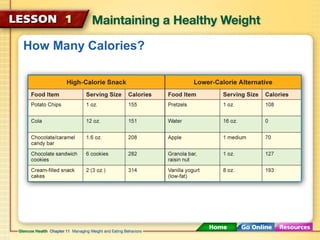
How Many Calories? 
High-fat foods are high in calories. Some low-fat 
foods may also be high in calories. 
Food preparation also plays a role in how many 
calories a food delivers.
How Many Calories?
Maintaining a Healthy Weight 
Body mass index and body composition help 
you judge whether your weight is healthy. 
The right weight for each person is based on 
age, gender, height, body frame, and stage and 
rate of growth.
Body Mass Index 
To learn if your body weight falls into a healthy 
range, calculate your body mass index (BMI). 
Body mass index (BMI) 
A measure of body weight 
relative to height
Body Mass Index 
Your BMI can help you to determine if you’re 
overweight or at risk for being overweight. 
Overweight 
Heavier than the standard weight 
range for your height
Body Composition 
Your body composition is the ratio of fat to lean 
tissue in your body.
Body Composition 
Every teen grows at his or 
her own rate. 
Some of your friends will 
be taller or shorter than 
you, and some will weigh 
more or less than you.
Your Weight and Your Health 
Being either overweight or underweight 
carries health risks. 
People whose weight does not fall into a 
healthy range are at a higher risk for various 
diseases.
Your Weight and Your Health 
Staying active helps 
you maintain a 
healthy weight.
Weighing Too Much 
Teens who are overweight may be at risk of 
becoming obese. 
Obese 
Having an excess of body fat
Weighing Too Much 
Health Problems Associated with Being Overweight 
Hypertension 
Cardiovascular disease 
Type 2 diabetes 
Osteoarthritis 
Gallbladder disease 
Asthma and other respiratory problems 
Certain types of cancer
Weighing Too Little 
Teens who are underweight may feel weak, tire 
easily, or have trouble concentrating. 
Underweight 
Below the standard weight range 
for your height
Weighing Too Little 
For some teens, being too thin can mean that they 
are not getting the calories and nutrients their 
growing bodies need. 
They also may be exercising excessively to burn 
calories.
Managing Your Weight 
Stay physically active and eat healthful foods. 
Teens should eat a healthful, well-balanced diet 
every day to reach a healthy weight.
Managing Your Weight 
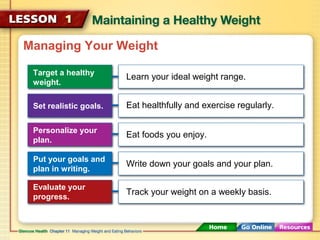
Target a healthy 
weight. 
Set realistic goals. 
Personalize your 
plan. 
Put your goals and 
plan in writing. 
Evaluate your 
progress. 
Learn your ideal weight range. 
Eat healthfully and exercise regularly. 
Eat foods you enjoy. 
Write down your goals and your plan. 
Track your weight on a weekly basis.
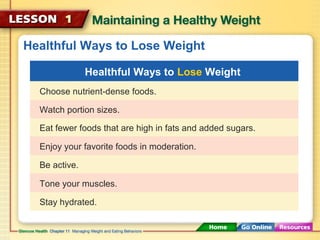
Healthful Ways to Lose Weight 
Choose nutrient-dense foods. 
Watch portion sizes. 
Eat fewer foods that are high in fats and added sugars. 
Enjoy your favorite foods in moderation. 
Be active. 
Tone your muscles. 
Stay hydrated.
Healthful Ways to Lose Weight 
Healthful Ways to Gain Weight 
Select foods from the five major food groups that are higher in 
calories. 
Choose higher-calorie, nutrient-rich foods. 
Eat nutritious snacks. 
Get regular physical activity.
Physical Activity and Weight Management 
This graph shows how many calories a person weighing 125 to 
175 pounds can burn doing each activity for 10 minutes.
Physical Activity and Weight Management 
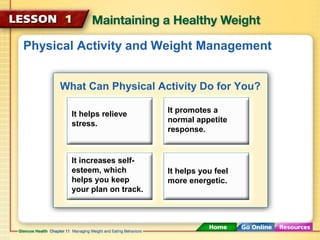
What Can Physical Activity Do for You? 
It helps relieve 
stress. 
It promotes a 
normal appetite 
response. 
It increases self-esteem, 
which 
helps you keep 
your plan on track. 
It helps you feel 
more energetic.
After You Read 
Reviewing Facts and Vocabulary 
1. What is metabolism? 
Metabolism is the process by which the 
body breaks down substances and gets 
energy from food.
After You Read 
Reviewing Facts and Vocabulary 
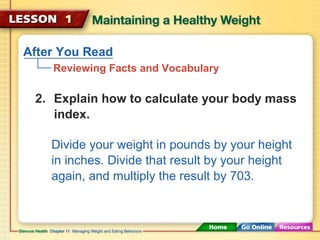
2. Explain how to calculate your body mass 
index. 
Divide your weight in pounds by your height 
in inches. Divide that result by your height 
again, and multiply the result by 703.
After You Read 
Reviewing Facts and Vocabulary 
3. List three health problems associated 
with being overweight and obese. 
Any three: hypertension, cardiovascular 
disease, type 2 diabetes, osteoarthritis, 
gallbladder disease, asthma and other 
respiratory problems, certain types of cancer
Ch11 01

Ch11 01

  • 1.
    Maintaining a Healthy Weight (3:24) Click here to launch video Click here to download print activity
  • 2.
    Maintaining a healthyweight helps you protect your health and prevent disease.
  • 3.
    metabolism body massindex (BMI) overweight obese underweight
  • 4.
    The Calorie Connection You maintain your weight by taking in as many calories as you use. Calories are units used to measure the energy found in food.
  • 5.
    The Calorie Connection If you consume more calories than your body needs, you will gain weight. If you use more calories than you take in, you will lose weight.
  • 6.
    Your Energy Balance Energy balance is the balance between the calories you take in the calories you burn
  • 7.
    Your Energy Balance Your metabolism converts the food you eat into fuel. Metabolism The process by which the body breaks down substances and gets energy from food
  • 8.
    Your Energy Balance It takes about 3,500 calories to equal 1 pound of body fat. Thus, if you consume 500 fewer calories than you use every day, you will lose 1 pound per week.
  • 9.
    How Many Calories? High-fat foods are high in calories. Some low-fat foods may also be high in calories. Food preparation also plays a role in how many calories a food delivers.
  • 10.
  • 11.
    Maintaining a HealthyWeight Body mass index and body composition help you judge whether your weight is healthy. The right weight for each person is based on age, gender, height, body frame, and stage and rate of growth.
  • 12.
    Body Mass Index To learn if your body weight falls into a healthy range, calculate your body mass index (BMI). Body mass index (BMI) A measure of body weight relative to height
  • 13.
    Body Mass Index Your BMI can help you to determine if you’re overweight or at risk for being overweight. Overweight Heavier than the standard weight range for your height
  • 14.
    Body Composition Yourbody composition is the ratio of fat to lean tissue in your body.
  • 15.
    Body Composition Everyteen grows at his or her own rate. Some of your friends will be taller or shorter than you, and some will weigh more or less than you.
  • 16.
    Your Weight andYour Health Being either overweight or underweight carries health risks. People whose weight does not fall into a healthy range are at a higher risk for various diseases.
  • 17.
    Your Weight andYour Health Staying active helps you maintain a healthy weight.
  • 18.
    Weighing Too Much Teens who are overweight may be at risk of becoming obese. Obese Having an excess of body fat
  • 19.
    Weighing Too Much Health Problems Associated with Being Overweight Hypertension Cardiovascular disease Type 2 diabetes Osteoarthritis Gallbladder disease Asthma and other respiratory problems Certain types of cancer
  • 20.
    Weighing Too Little Teens who are underweight may feel weak, tire easily, or have trouble concentrating. Underweight Below the standard weight range for your height
  • 21.
    Weighing Too Little For some teens, being too thin can mean that they are not getting the calories and nutrients their growing bodies need. They also may be exercising excessively to burn calories.
  • 22.
    Managing Your Weight Stay physically active and eat healthful foods. Teens should eat a healthful, well-balanced diet every day to reach a healthy weight.
  • 23.
    Managing Your Weight Target a healthy weight. Set realistic goals. Personalize your plan. Put your goals and plan in writing. Evaluate your progress. Learn your ideal weight range. Eat healthfully and exercise regularly. Eat foods you enjoy. Write down your goals and your plan. Track your weight on a weekly basis.
  • 24.
    Healthful Ways toLose Weight Healthful Ways to Lose Weight Choose nutrient-dense foods. Watch portion sizes. Eat fewer foods that are high in fats and added sugars. Enjoy your favorite foods in moderation. Be active. Tone your muscles. Stay hydrated.
  • 25.
    Healthful Ways toLose Weight Healthful Ways to Gain Weight Select foods from the five major food groups that are higher in calories. Choose higher-calorie, nutrient-rich foods. Eat nutritious snacks. Get regular physical activity.
  • 26.
    Physical Activity andWeight Management This graph shows how many calories a person weighing 125 to 175 pounds can burn doing each activity for 10 minutes.
  • 27.
    Physical Activity andWeight Management What Can Physical Activity Do for You? It helps relieve stress. It promotes a normal appetite response. It increases self-esteem, which helps you keep your plan on track. It helps you feel more energetic.
  • 28.
    After You Read Reviewing Facts and Vocabulary 1. What is metabolism? Metabolism is the process by which the body breaks down substances and gets energy from food.
  • 29.
    After You Read Reviewing Facts and Vocabulary 2. Explain how to calculate your body mass index. Divide your weight in pounds by your height in inches. Divide that result by your height again, and multiply the result by 703.
  • 30.
    After You Read Reviewing Facts and Vocabulary 3. List three health problems associated with being overweight and obese. Any three: hypertension, cardiovascular disease, type 2 diabetes, osteoarthritis, gallbladder disease, asthma and other respiratory problems, certain types of cancer