1. Early management approaches included scientific management, which focused on efficiency, and administrative theory, which examined organizational principles.
2. The behavioral school emphasized the human element, with Hawthorne studies showing the importance of groups and workplace culture.
3. Modern approaches include systems theory, contingency theory, and emerging ideas around quality management.
Discusses the historical evolution of management, including classical theories like scientific management, administrative principles, and bureaucratic management.
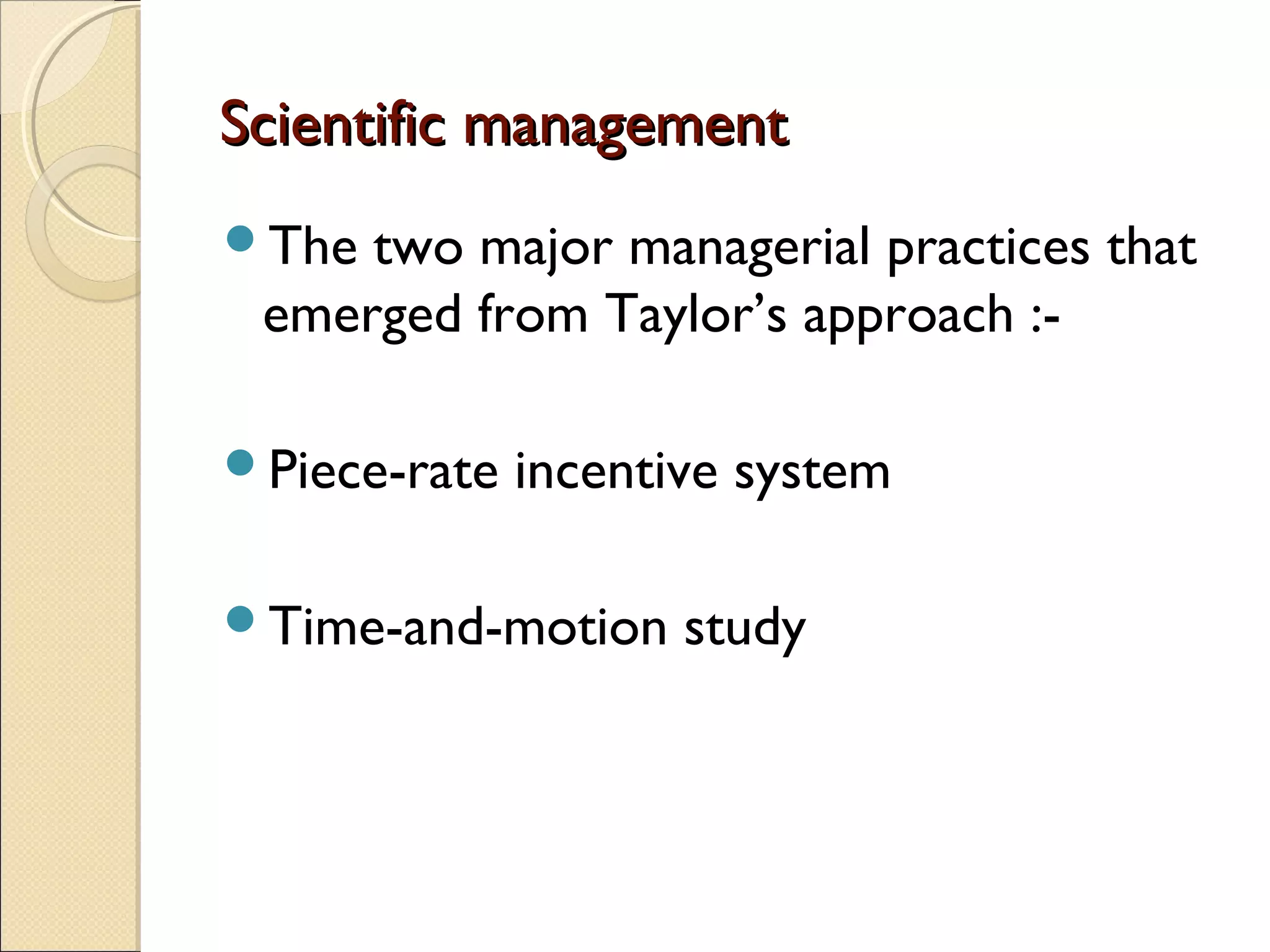
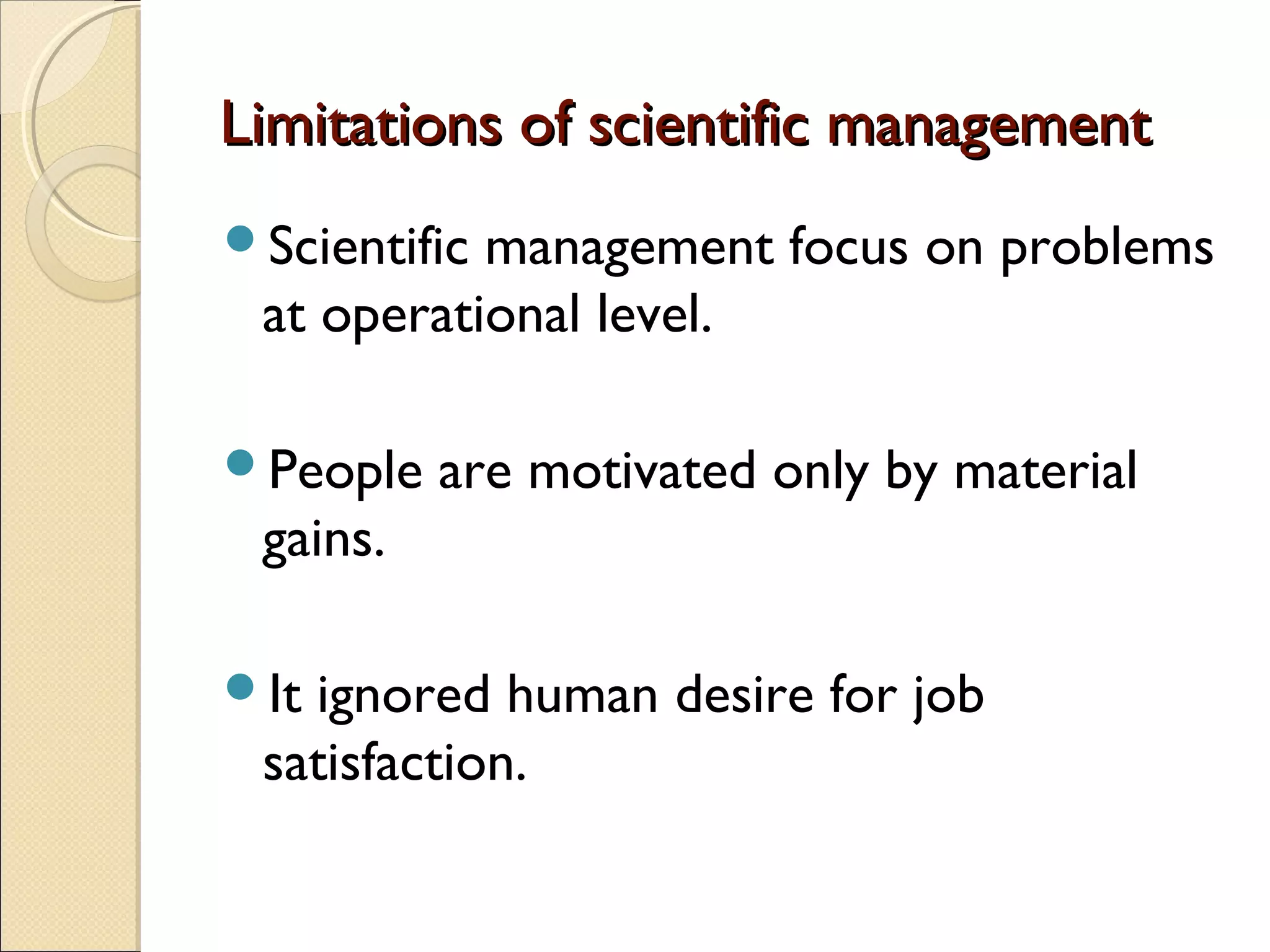
Details the scientific management approach by F.W. Taylor, emphasizing efficiency, work methods and managerial practices, while addressing its limitations.
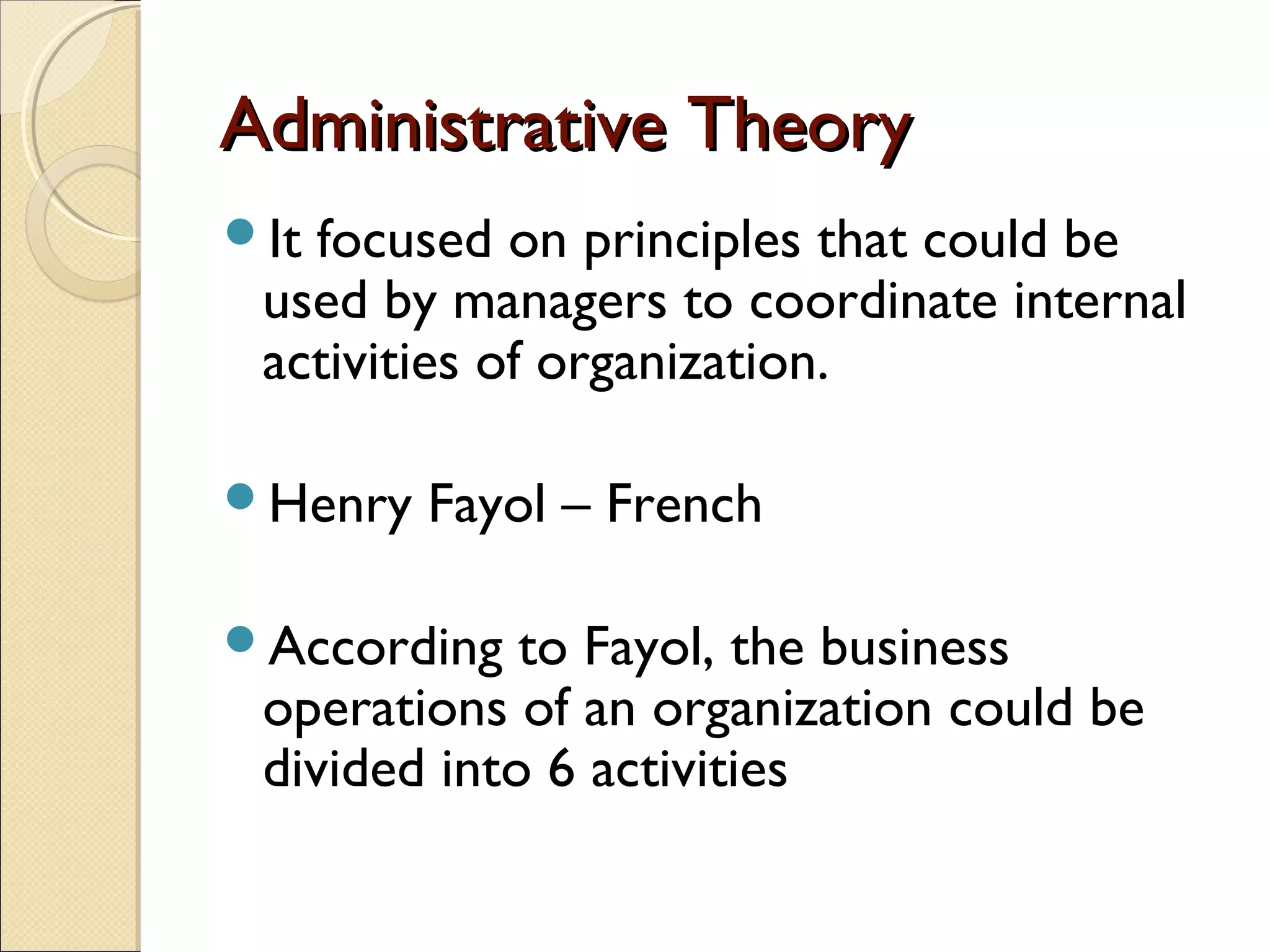
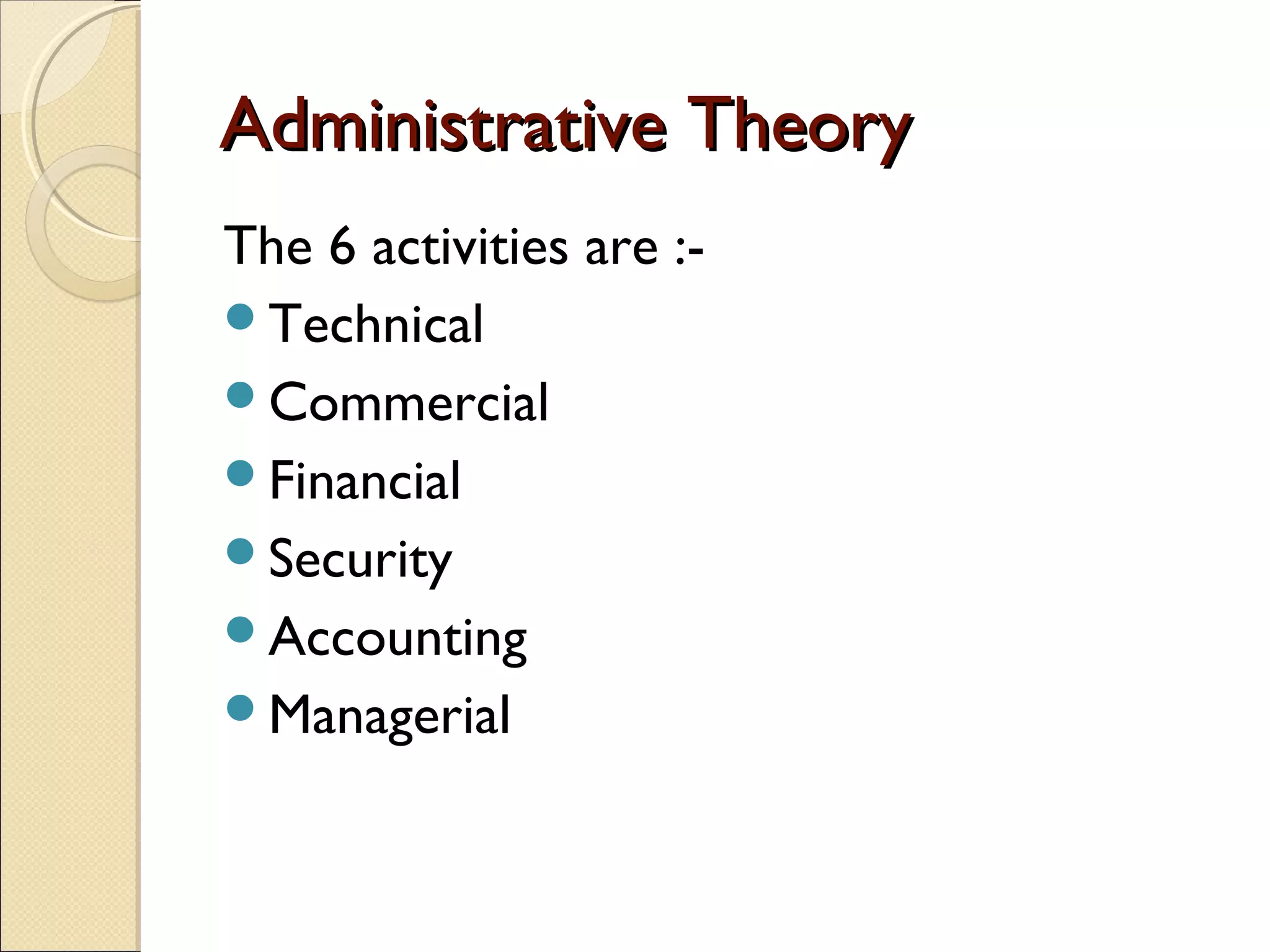
Explores Fayol's administrative theory, focusing on six key activities and fourteen management principles for organizational effectiveness.
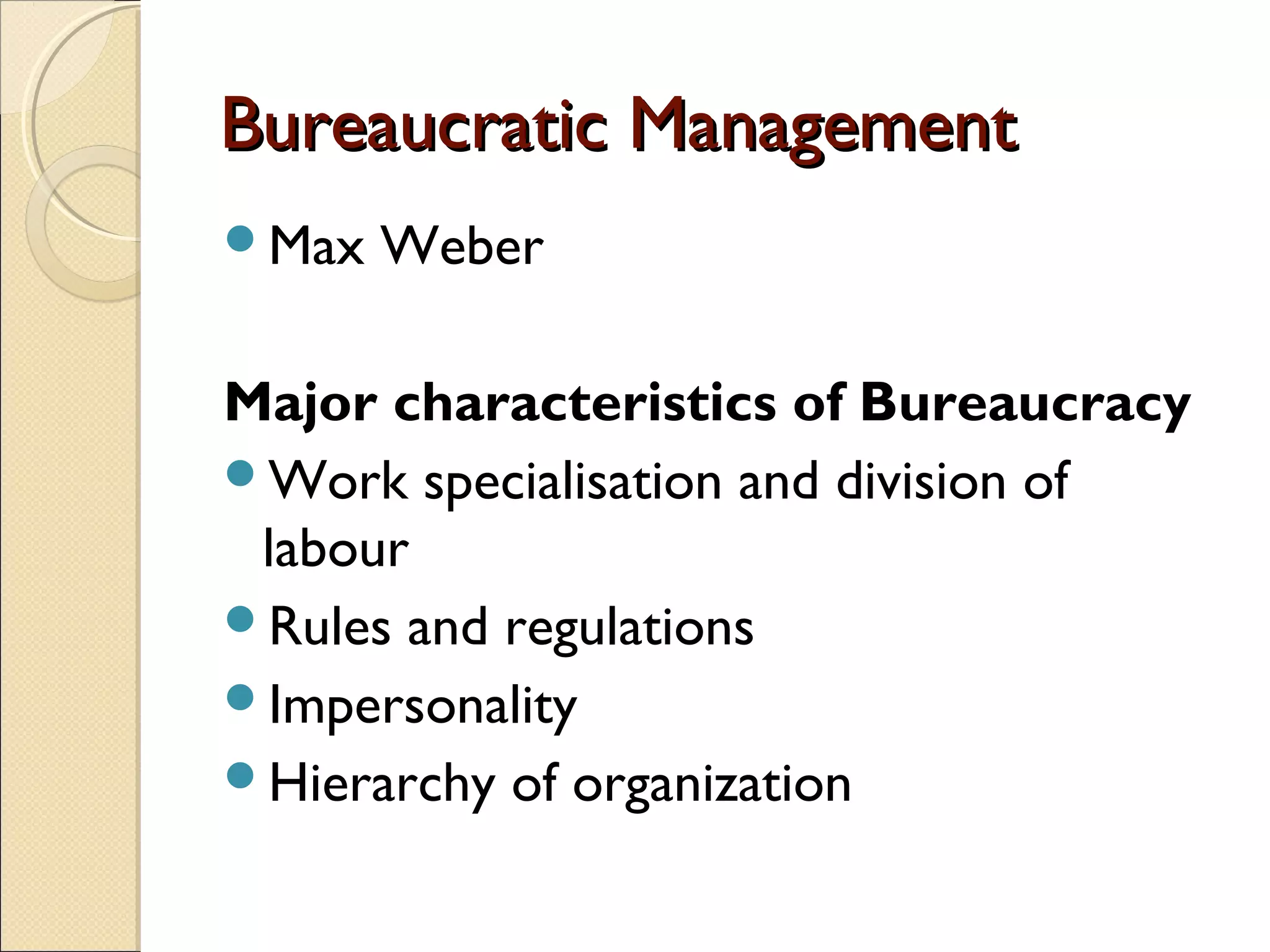
Discusses Weber's bureaucratic management including key characteristics, and the limitations that bureaucracy presents to creativity and flexibility.
Focuses on the human element in management, highlighting Elton Mayo's Hawthorne studies and the criticisms surrounding its conclusions.
Examines Maslow's hierarchy of needs theory, discussing how needs motivate behavior and the progression through different levels of needs.
Introduces McGregor's Theory X and Theory Y, contrasting two managerial perspectives on employee behavior and motivation.
Presents Argyris's theories of maturity-immaturity and the implications of employee engagement on development.
Outlines various quantitative approaches to management, including operations research and management information systems.
Describes modern management approaches, such as systems approach and contingency theory, emphasizing organizational interdependence.
Highlights emerging management theories including William Ouchi's theory Z, which emphasizes job security and quality management.
Early approaches toManagementEarly approaches to Management
The Industrial Revolution, which began in
Europe in the mid-1700s, was the starting
point for the development of
management concepts and theories.
3.
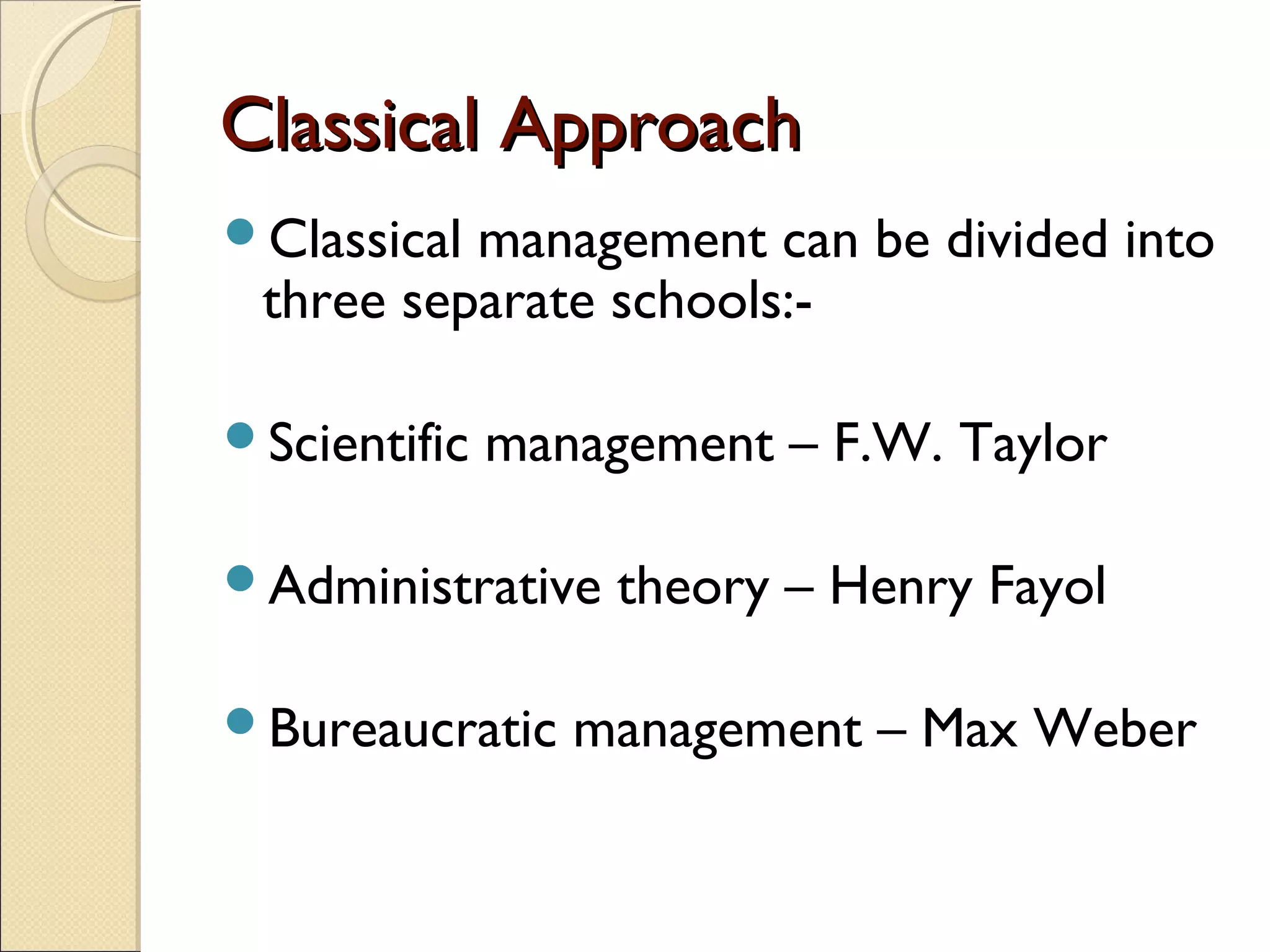
Classical ApproachClassical Approach
Classicalmanagement can be divided into
three separate schools:-
Scientific management – F.W. Taylor
Administrative theory – Henry Fayol
Bureaucratic management – Max Weber
4.
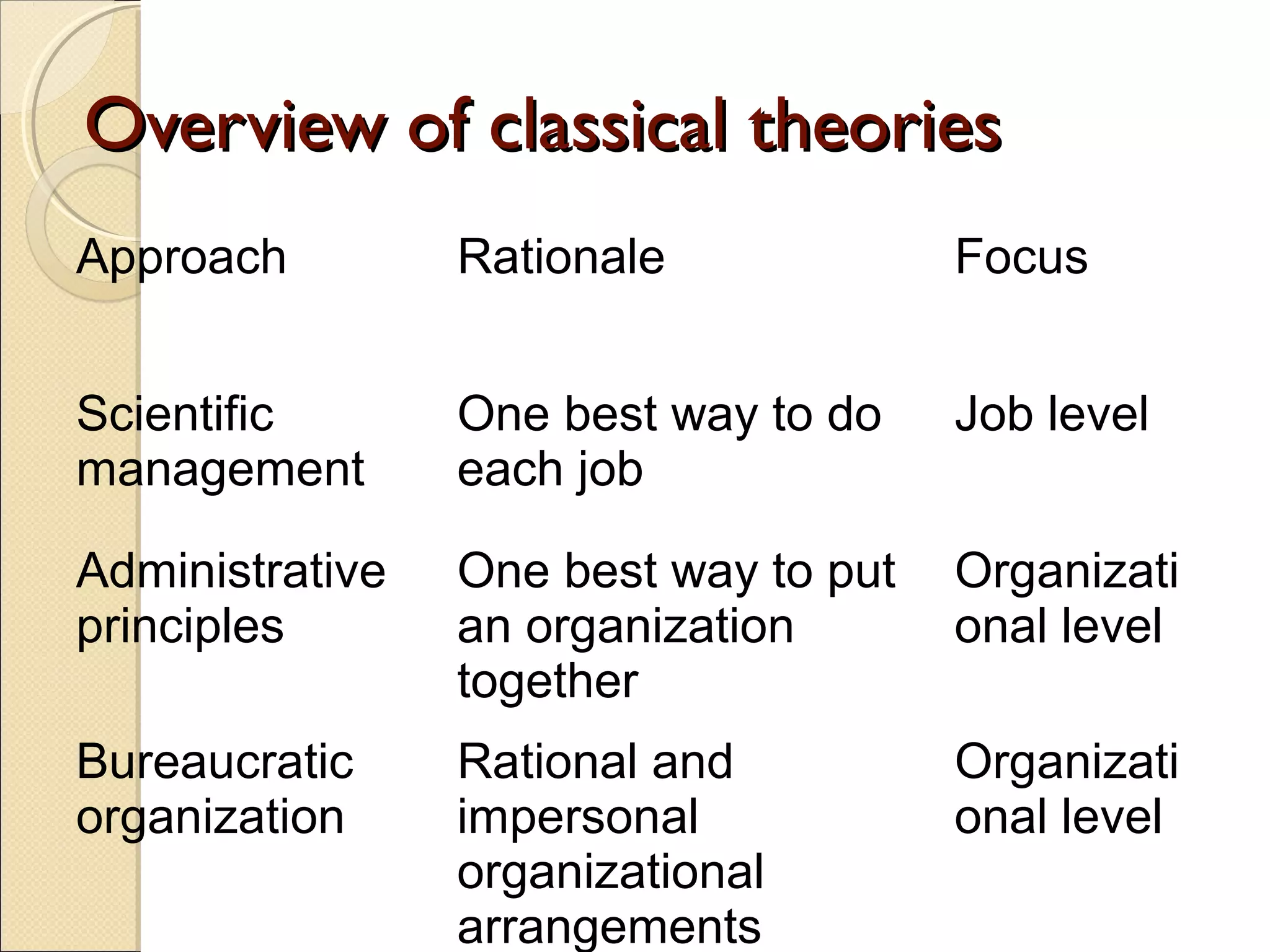
Overview of classicaltheoriesOverview of classical theories
Approach Rationale Focus
Scientific
management
One best way to do
each job
Job level
Administrative
principles
One best way to put
an organization
together
Organizati
onal level
Bureaucratic
organization
Rational and
impersonal
organizational
arrangements
Organizati
onal level
Scientific managementScientific management
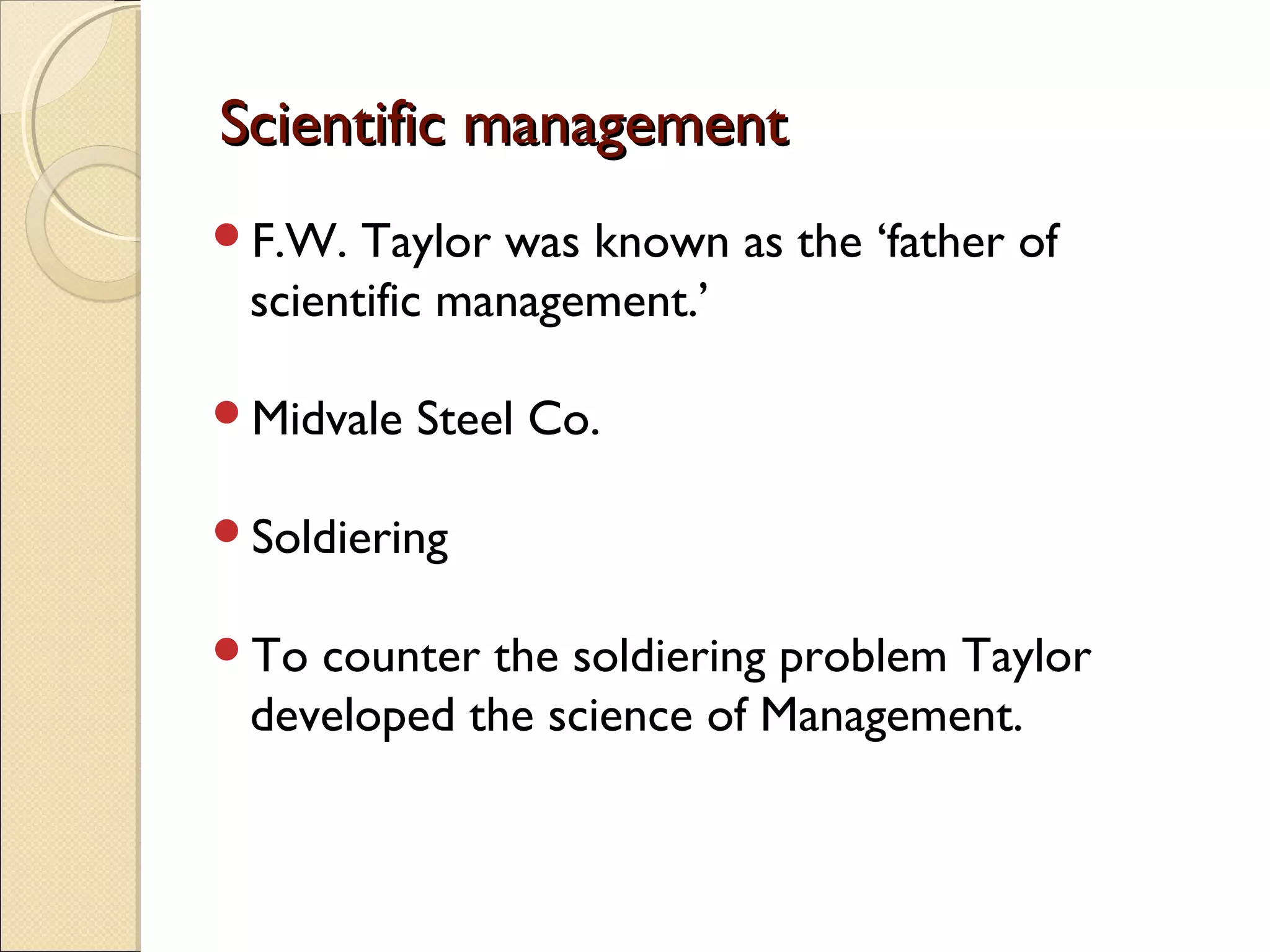
F.W.Taylor was known as the ‘father of
scientific management.’
Midvale Steel Co.
Soldiering
To counter the soldiering problem Taylor
developed the science of Management.
8.
Scientific managementScientific management
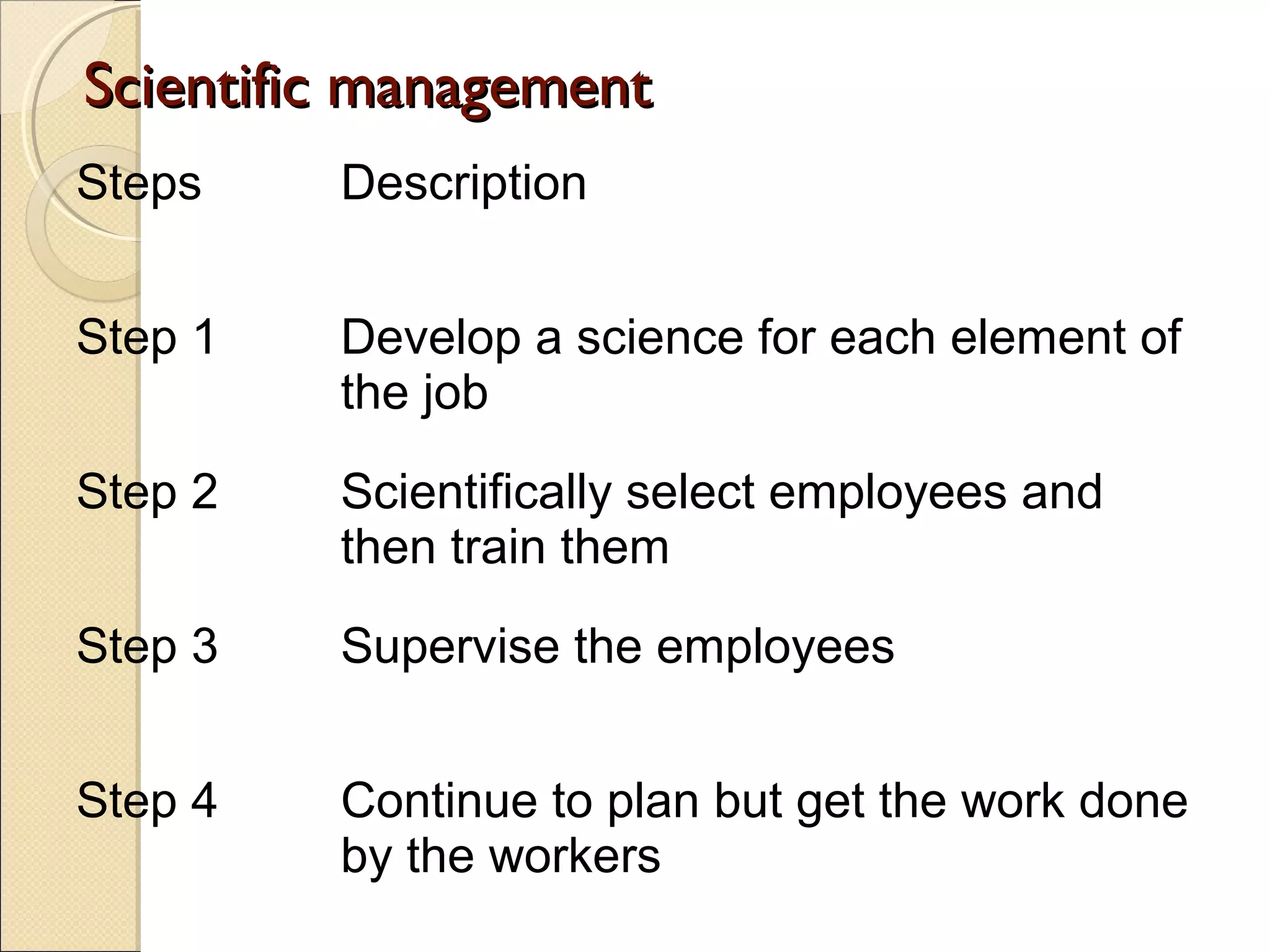
StepsDescription
Step 1 Develop a science for each element of
the job
Step 2 Scientifically select employees and
then train them
Step 3 Supervise the employees
Step 4 Continue to plan but get the work done
by the workers
Limitations of scientificmanagementLimitations of scientific management
Scientific management focus on problems
at operational level.
People are motivated only by material
gains.
It ignored human desire for job
satisfaction.
11.
Administrative TheoryAdministrative Theory
Itfocused on principles that could be
used by managers to coordinate internal
activities of organization.
Henry Fayol – French
According to Fayol, the business
operations of an organization could be
divided into 6 activities
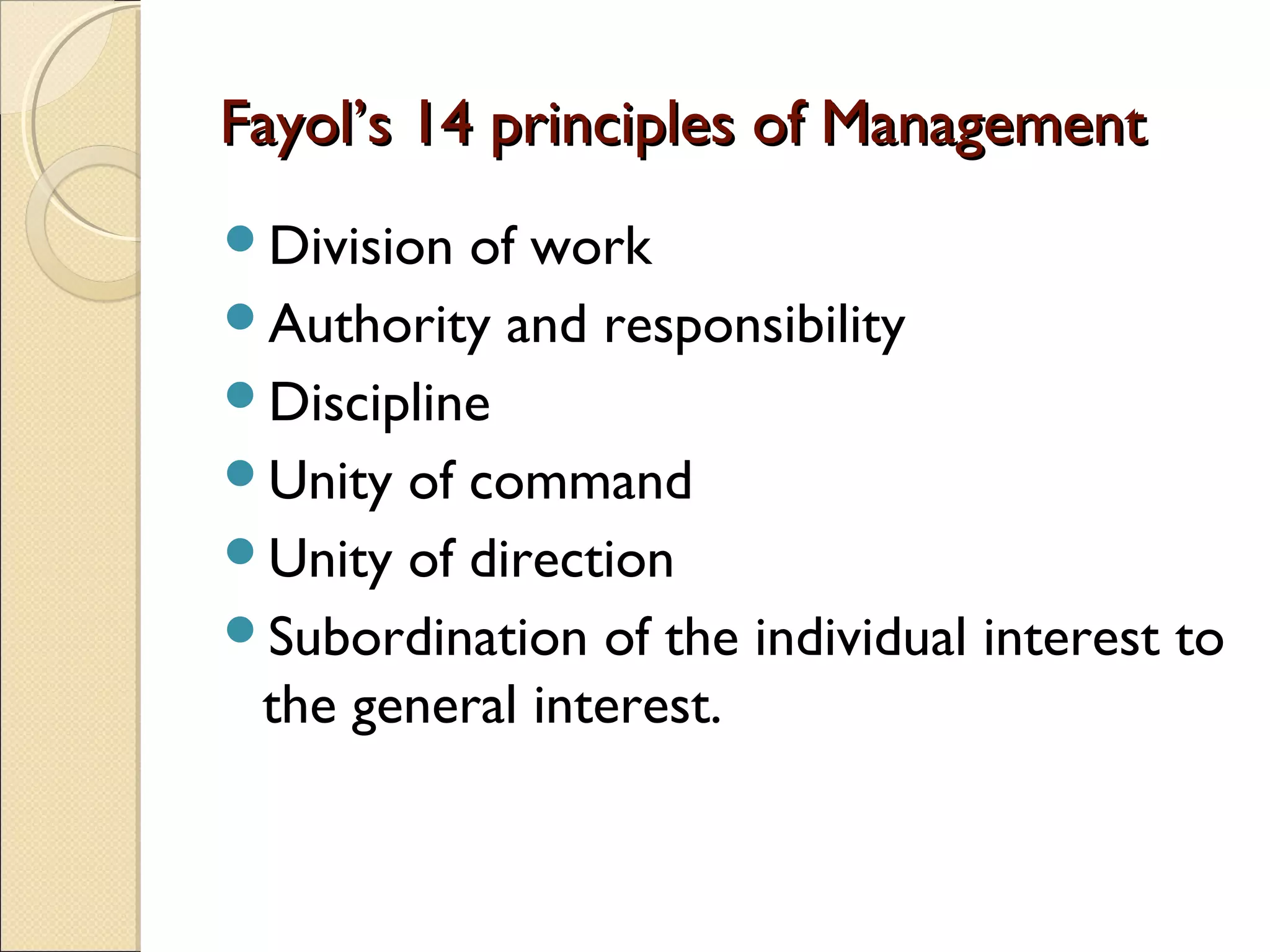
Fayol’s 14 principlesof ManagementFayol’s 14 principles of Management
Division of work
Authority and responsibility
Discipline
Unity of command
Unity of direction
Subordination of the individual interest to
the general interest.
14.
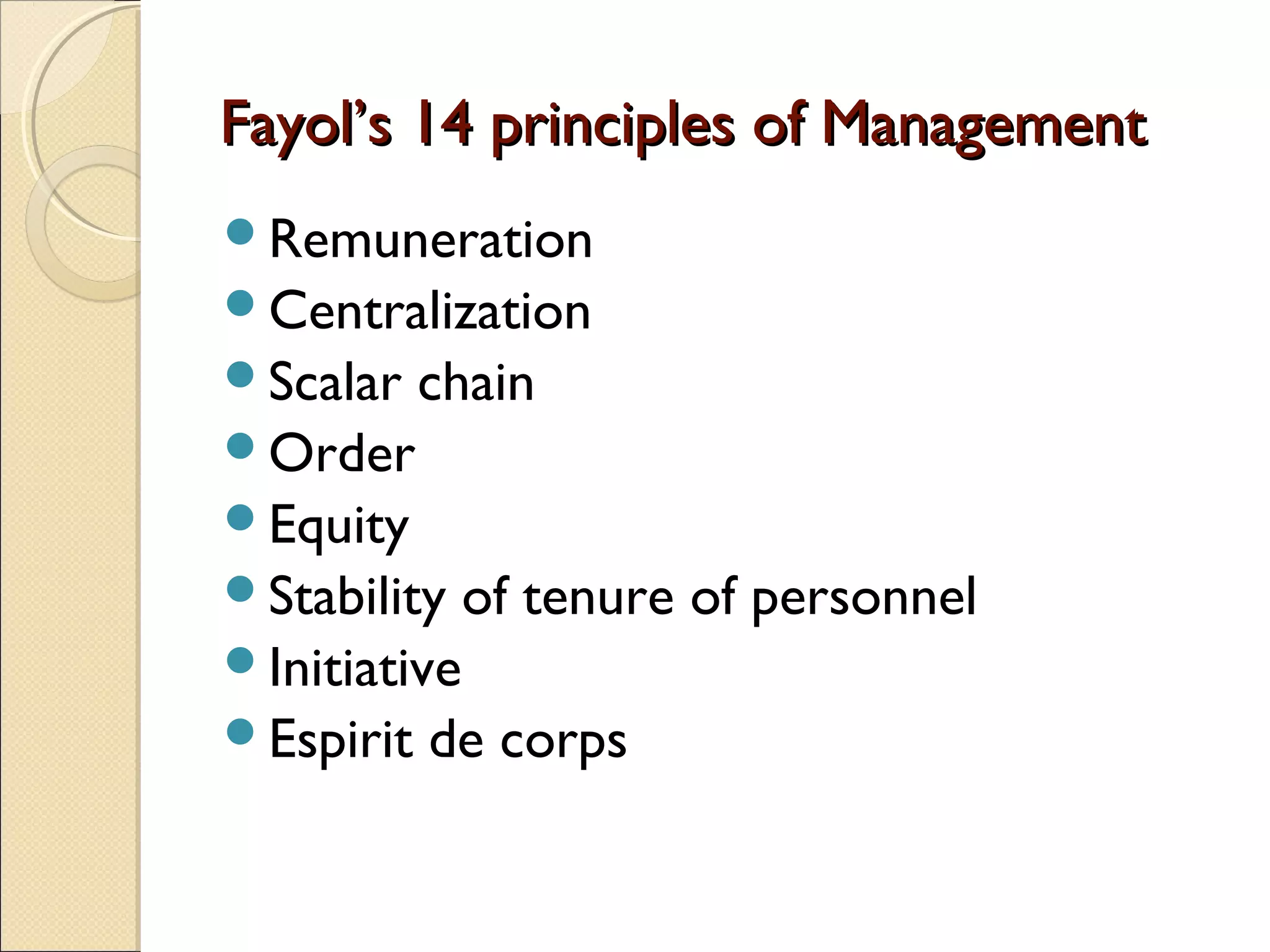
Fayol’s 14 principlesof ManagementFayol’s 14 principles of Management
Remuneration
Centralization
Scalar chain
Order
Equity
Stability of tenure of personnel
Initiative
Espirit de corps
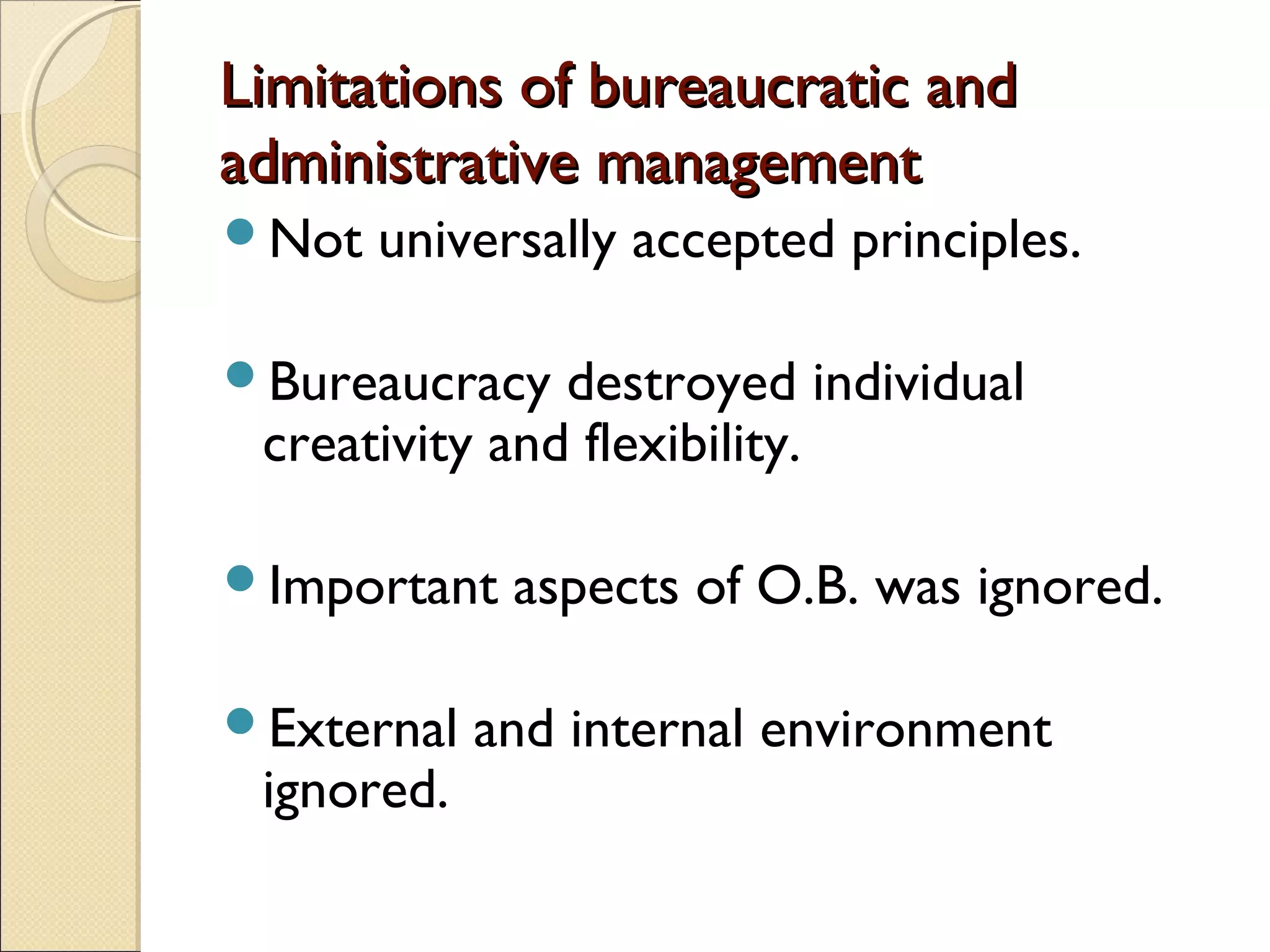
Limitations of bureaucraticandLimitations of bureaucratic and
administrative managementadministrative management
Not universally accepted principles.
Bureaucracy destroyed individual
creativity and flexibility.
Important aspects of O.B. was ignored.
External and internal environment
ignored.
Elton Mayo :Focusing on HumanElton Mayo : Focusing on Human
RelationsRelations
Father of the Human Relations Approach
Western Electric’s Hawthorne Plant
19.
Elton Mayo :Focusing on HumanElton Mayo : Focusing on Human
RelationsRelations
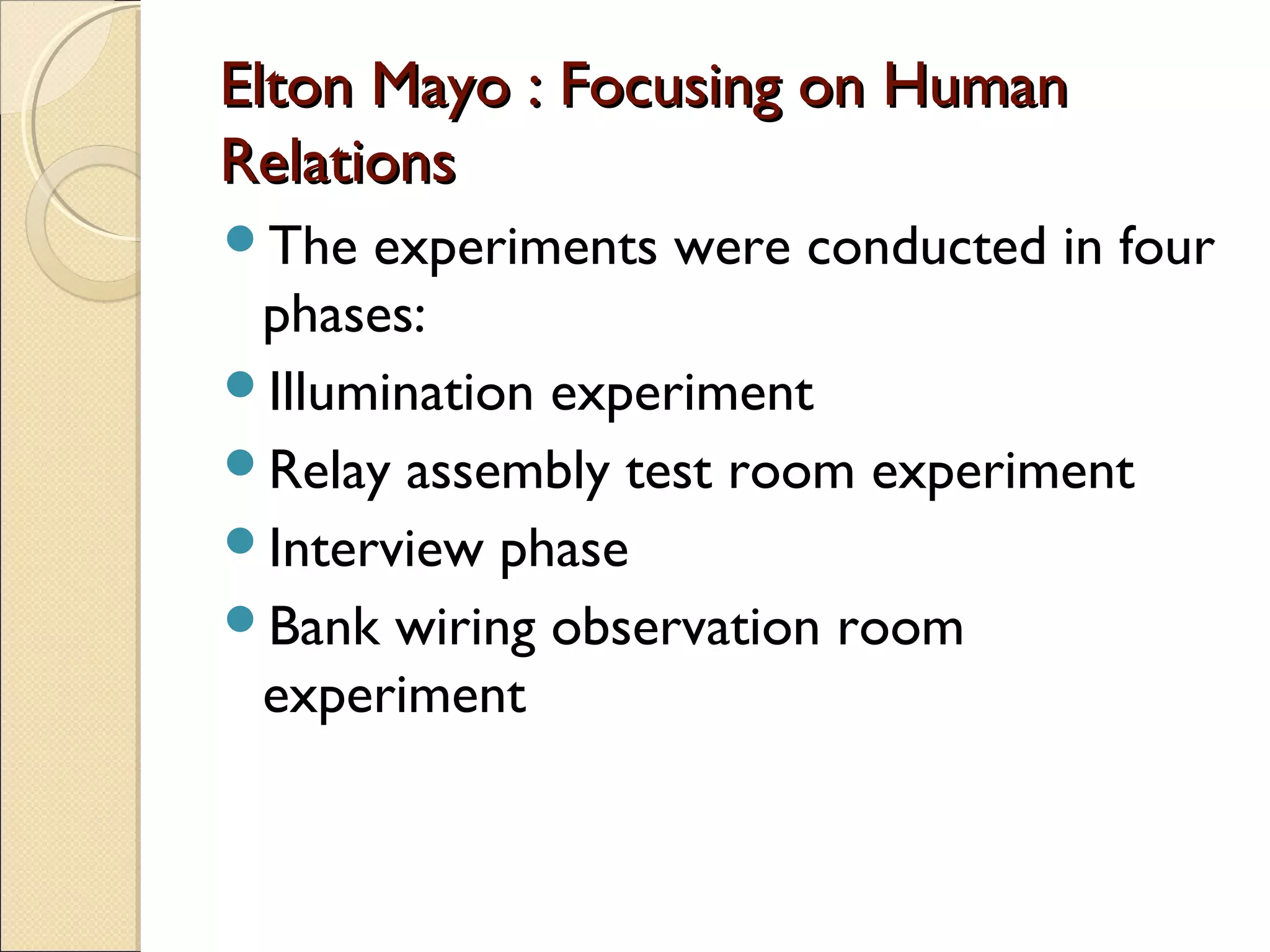
The experiments were conducted in four
phases:
Illumination experiment
Relay assembly test room experiment
Interview phase
Bank wiring observation room
experiment
20.
Contributions of HawthornestudiesContributions of Hawthorne studies
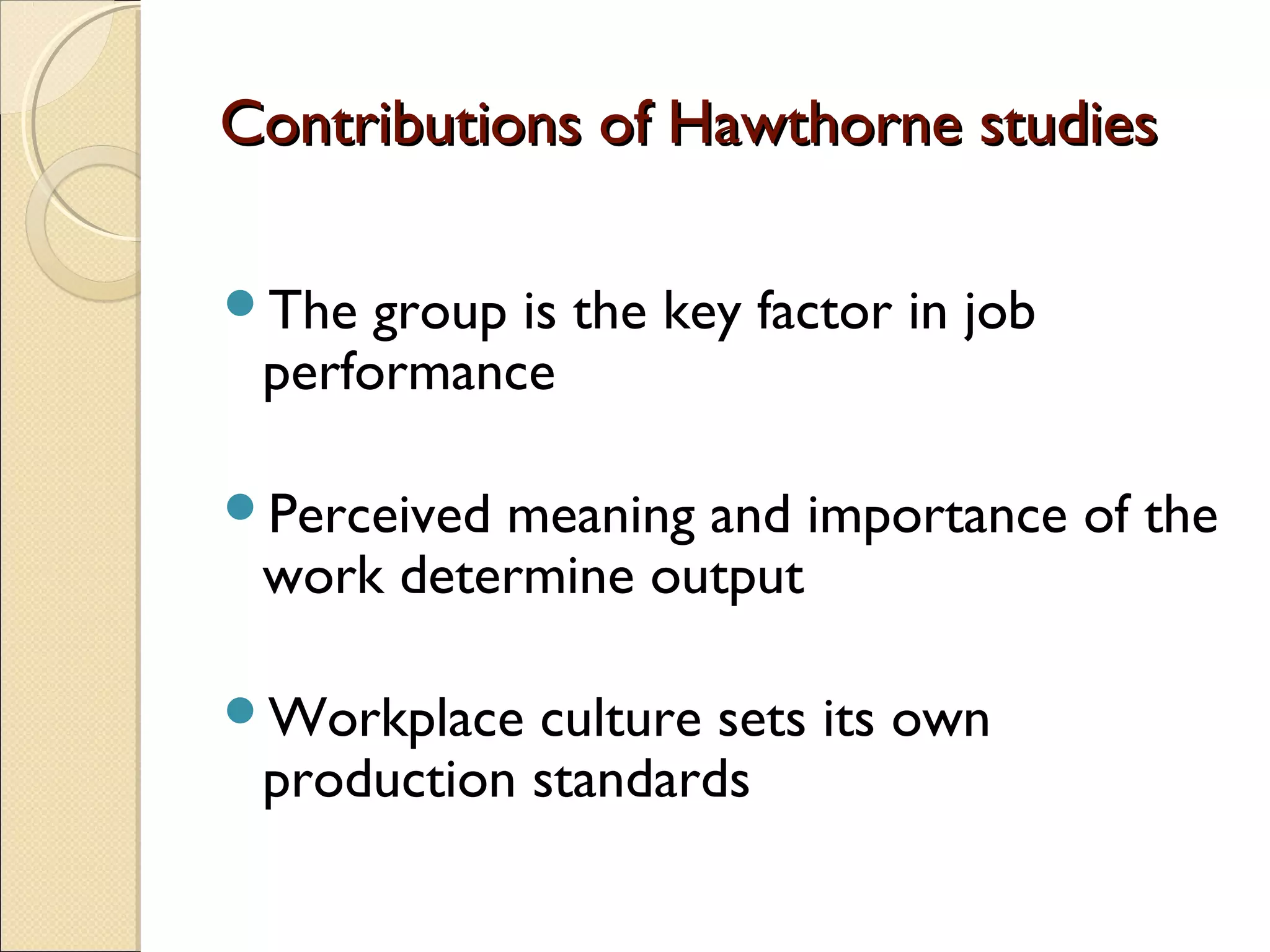
The group is the key factor in job
performance
Perceived meaning and importance of the
work determine output
Workplace culture sets its own
production standards
21.
Criticism of HawthornestudiesCriticism of Hawthorne studies
Critics felt that the conclusions were
supported by little evidence.
The relationship made between
satisfaction of workers and productivity
was too simple.
The studies failed to focus on the
atitudes if employees.
22.
Abraham Maslow :Hierarchy of needsAbraham Maslow : Hierarchy of needs
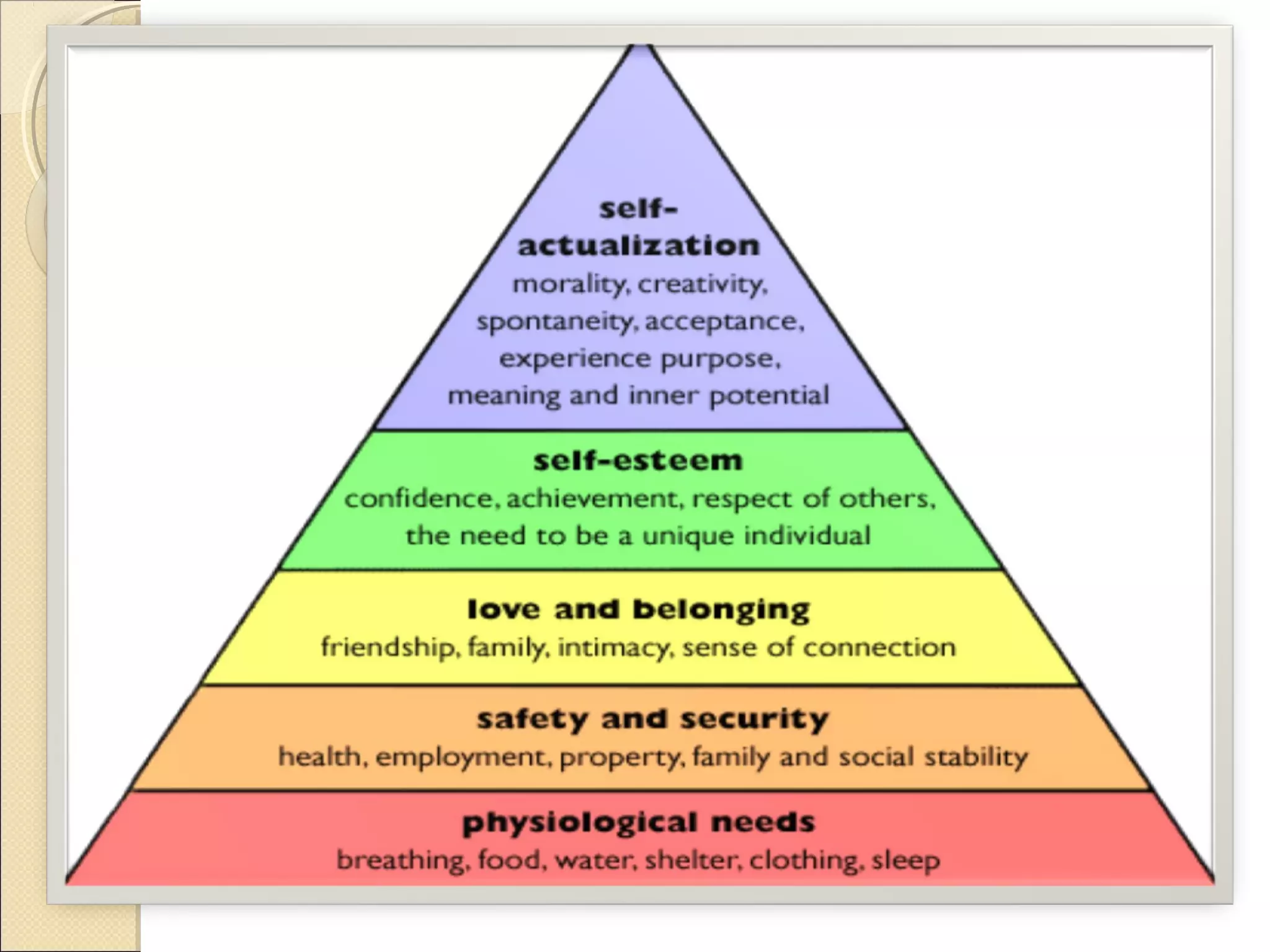
People are motivated by a hierarchy of
needs
His theory had three assumptions
All of us have needs which are never
fulfilled
Through our actions we try to fulfill our
unsatisfied needs
Needs can be classified into 5 types
24.
Abraham Maslow :Hierarchy of needsAbraham Maslow : Hierarchy of needs
According to Maslow, once needs at a
specific level have been satisfied, they no
longer act as motivators of behaviour.
Then individual strives to fulfill needs at
the next level.
25.
Douglas McGregor :Theory X andDouglas McGregor : Theory X and
Theory YTheory Y
These theories reflect two extreme sets
of belief that different managers have
about their workers.
Theory X represents an essentially
negative view.
Theory Y reflects a more positive view.
26.
Chris Argris :Matching human andChris Argris : Matching human and
organizational developmentorganizational development
Maturity –immaturity theory
Model I and Model II
Model I – Employees are manipulative
and not willing to take risks
Modern approaches tomanagementModern approaches to management
1. Systems approach
Organizations cannot exist in isolation
Four major components – Inputs,
transformation process, output and
feedback
Open and closed systems
29.
Modern approaches tomanagementModern approaches to management
2. Contingency theory
Situational theory
30.
Emerging Approaches inManagementEmerging Approaches in Management
ThoughtsThoughts
William Ouchi – theory Z
Conducted research on both American and
Japanese management approaches
Theory Z involves providing job security to
employees to ensure their loyalty
Quality management