MANAGEMENT AND
ITS EVOLUTION
Asif Jamal
Visiting Lecturer
University of Sindh, Mirpurkhas Campus
Remember Please
 Economic Influences
 Social Influences
 Political Influences
 Technological Influences
 Global Influences
Objectives of The Chapter
To Understand
 Early Approaches to management
 Classical Approach
 Behavioral Approach
 Quantitative Approach
 Modern Approaches to management
 Emerging approaches in management thought.
Introduction
Both theory and history are indispensable
tools for managing contemporary
organizations.
A theory is a conceptual framework for
organizing knowledge that provides a blueprint
for various courses of action.
Early Approaches to Management
Name Period Contribution
Robert Owen 1771-1858 Proposed legislative reforms to
improve working conditions of labor
Charles
Babbage
1792-1871 Advocated the concept or ‘division
of labor’
Andrew Ure 1778-1857 Advocated the study of
management
Charles Dupin 1784-1873
Henry R.Towne 1844-1924 Emphasized the need to consider
management as separated field of
study and the importance of
business skills for running a
business.
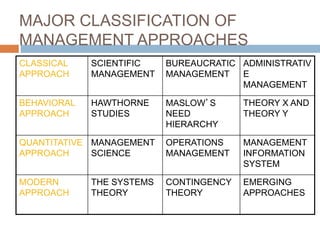
MAJOR CLASSIFICATION OF
MANAGEMENT APPROACHES
CLASSICAL
APPROACH
SCIENTIFIC
MANAGEMENT
BUREAUCRATIC
MANAGEMENT
ADMINISTRATIV
E
MANAGEMENT
BEHAVIORAL
APPROACH
HAWTHORNE
STUDIES
MASLOW’S
NEED
HIERARCHY
THEORY X AND
THEORY Y
QUANTITATIVE
APPROACH
MANAGEMENT
SCIENCE
OPERATIONS
MANAGEMENT
MANAGEMENT
INFORMATION
SYSTEM
MODERN
APPROACH
THE SYSTEMS
THEORY
CONTINGENCY
THEORY
EMERGING
APPROACHES
Classical Approach
 Forms the foundation for the field of
management
 The schools for management thoughts are:
 Scientific Management
 Administrative Theory
 Bureaucratic Management
CLASSICAL APPROACH
1. SCIENTIFIC MANAGEMENT-F.W. TAYLOR
 Piece rate incentive system
 Time and motion study
 Gantt scheduling chart-Henry Laurence Gantt
2. ADMINISTRATIVE THEORY- HENRY FAYOL
 Technical
 Commercial
 Financial
 Security
 Accounting
 managerial
CLASSICAL APPROACH
3. BUREAUCRATIC MANAGEMENT- MAX
WEBER
 Work specialization and division of labor
 Abstract rules and regulations
 Impersonality of managers
 Hierarchy of organization structure
Scientific Management
Early 1900s
 It is defined as “that kind of management
which conducts a business or affairs by
standards established, by facts or truths
gained through systematic observation,
experiment, or reasoning.”
 Major contributors:
 Frederick Winslow Taylor
 Frank and Lillian Gillbreth
 Henry L.Gantt
Frederick Winslow Taylor
 “Father of scientific management”(1878)
 Two major managerial practices:
 Piece-rate incentive system
 Time-and-motion study
Frank and Lillian Gillbreth
 1868-1924
 Motion study involves finding out the
best sequence and minimum number of
motions needed to complete a task.
 Explore new ways for eliminating
unnecessary motions and reducing work
fatigue.
HENRY L.GANTT(1861-1919)
 Well known for Task – and - bonus
system -The Gantt chart
 If the worker completed the work fast,
i.e., in less than the standard time, he
received a bonus.
 It is a Simple chart that compares
actual and planned performances.
Limitations of
Scientific Management
 Do not focus on the management of an
organization from a manager’s point of
view.
 people were “ rational ” and were
motivated primarily by the desire for
material gain.
 It also ignored the human desire for job
satisfaction.
Administrative Theory:
 It focused on principles that could be used
by managers to coordinate the internal
activities of organizations.
 Henri Fayol (1841-1925)
Henri Fayol (1841-1925)
Fourteen principles:
 Division of work
 Authority and
responsibility
 Discipline
 Unity of command
 Unity of direction
 Subordination of the
individual interest to the
general interest
 Remuneration
 Centralization:
 Scalar chain
 Order
 Equity
 Stability
 Initiative
 Espirit de corps
(team spirit)
Bureaucratic Management
Weber (1864-1920)
Characteristics of Weber’s ideal Bureaucracy:
 Work specification and division of labor
 Abstract rules and regulations:
 Impersonality of managers:
 Hierarchy of organization structure:
Limitations of Bureaucratic Management
and Administrative Theory
 Not universally applicable to today ’ s
complex organizations.
 Fayol’s principles like that of specialization
were frequently in conflict with the principle
of unity of command.
 Principle characteristic of bureaucracy
changes in the global environment.
 Classical theorists ignored the problems of
leadership, motivation, power or information
relations.
Behavioral Approach
 The behavioral approach to management
emphasized individual attitudes and
behaviors and group processes, and
recognized the significance of behavioral
process in the workplace.
HAWTHORNE STUDIES
 Illumination studies
 Relay assembly room study
 Bank wiring room study
Contributions of Behavioral Thinkers to
Management Thought
Name Period Contribution
Mary Parker
Follet
1868-
1933
Advocated the concept of ‘power
sharing’ and integration
Elton Mayo 1868-
1933
foundation for the Human Relations
Movement;
Abraham
Maslow
1908 –
1970
motivated by a hierarchy of needs
Douglas
McGregor
1906-
1964
Theory X and Theory Y personalities
Chris Argyris - Classified organizations based on
the employees’ set of values
Mary Parker Follet (1868-1933)
 Power, according to Follet, was the ability
to influence and bring about a change.
 Concept of integration, which involves
finding a solution acceptable to all group
members
Elton Mayo (1868-1933)
Pre-judgment Findings
Job performance
depends on the
individual worker
The group is the key factors
in job performance
Fatigue is the main
factor affecting
output.
Perceived meaning and
importance of the work
determining output.
Management sets
production standards
Workplace culture sets its
own production standards.
Abraham Maslow
His theory rested on these assumptions.
 Physiological needs;
 Safety or security needs
 Belongingness or social needs;
 Esteem or status needs
 Self actualization or self-fulfillment needs.
Maslow’s Need Hierarchy
Self actualization needs
Esteem needs
Social needs
Safety needs
Physiological needs
Douglas Mcgregor
Theory X Theory Y
Most People dislike
work
Work is a natural activity
like play.
Most People must be
coerced and threatened
before they work.
People are capable of self
direction and self control
Most people prefer to
be directed. They avoid
responsibility and have
little ambition.
People become committed
to organizational
objectives if they are
rewarded in doing so.
Chris Argyris
 Maturity – immaturity theory
 People progress from a stage of
immaturity and dependence to a state of
maturity and independence.
 Model I and Model II organization
analysis.
1. Model I organization are manipulative
2. Model II organization are open to learning
Quantitative Approach
 It includes the application of statistics,
optimization models, information models
and computer simulations. More
specifically, this approach focuses on
achieving organizational effectiveness.
 Three main branches:
 Management Science
 Operations Management and
 Management Information Systems.
Management Science
 It stresses the use of mathematical
models and statistical methods for
decision-making.
 Another name is the Operations
Research.
Operations Management
 It deals with the effective management
of the production process and the timely
delivery of an organization’s products
and services.
Management
Information Systems
 Management information systems
focuses on designing and
implementing computer-based
information systems for business
organizations.
Modern Approaches
to Management
 Systems Theory
 Contingency Theory
Systems Theory
Resources
 Labor
 Materials
 Capital
 Machinery
 Information
Managerial and
Technological
Abilities
 Planning
 Organizing
 Staffing
 Leading
 Controlling
 Technology
 Goods
 Services
 Profits and
losses
 Employee
 satisfaction
Inputs
Transformation process Outputs
Feedback
Contingency Theory
Systems Viewpoint
How the parts fits
together
•Individual
•Group
•Organization
•environment
Behavioral Viewpoint
How managers influence
others
•Interpersonal Roles
•Informational Roles
•Decisional Roles
Traditional
viewpoint
What managers
do
•Plan
•Organize
•Lead
• Control
Contingency
Viewpoint
Managers’
use of other
view points to
solve
problems
•External
environment
•Technology
•Individuals
Emerging Approaches In Management
Thought
 William Ouchi, outlined new theory called
Theory Z.
 It is the blend of positive aspects of both
American and Japanese management
styles.
 Quality Management is a management
approach that directs the efforts of
management towards bringing about
continuous improvement in product and
service quality to achieve higher levels of
customer satisfaction and build customer
loyalty.
Now you are familiar with
 Different classification of management
approaches
 A few theorists and theories
 Early Approaches to Management
 Classical Approach
 Behavioral Approach
 Quantitative Approach
 Modern Approaches to management
 Emerging approaches in management
thought.

Management & Evolutions

  • 1.
    MANAGEMENT AND ITS EVOLUTION AsifJamal Visiting Lecturer University of Sindh, Mirpurkhas Campus
  • 2.
    Remember Please  EconomicInfluences  Social Influences  Political Influences  Technological Influences  Global Influences
  • 3.
    Objectives of TheChapter To Understand  Early Approaches to management  Classical Approach  Behavioral Approach  Quantitative Approach  Modern Approaches to management  Emerging approaches in management thought.
  • 4.
    Introduction Both theory andhistory are indispensable tools for managing contemporary organizations. A theory is a conceptual framework for organizing knowledge that provides a blueprint for various courses of action.
  • 5.
    Early Approaches toManagement Name Period Contribution Robert Owen 1771-1858 Proposed legislative reforms to improve working conditions of labor Charles Babbage 1792-1871 Advocated the concept or ‘division of labor’ Andrew Ure 1778-1857 Advocated the study of management Charles Dupin 1784-1873 Henry R.Towne 1844-1924 Emphasized the need to consider management as separated field of study and the importance of business skills for running a business.
  • 6.
    MAJOR CLASSIFICATION OF MANAGEMENTAPPROACHES CLASSICAL APPROACH SCIENTIFIC MANAGEMENT BUREAUCRATIC MANAGEMENT ADMINISTRATIV E MANAGEMENT BEHAVIORAL APPROACH HAWTHORNE STUDIES MASLOW’S NEED HIERARCHY THEORY X AND THEORY Y QUANTITATIVE APPROACH MANAGEMENT SCIENCE OPERATIONS MANAGEMENT MANAGEMENT INFORMATION SYSTEM MODERN APPROACH THE SYSTEMS THEORY CONTINGENCY THEORY EMERGING APPROACHES
  • 7.
    Classical Approach  Formsthe foundation for the field of management  The schools for management thoughts are:  Scientific Management  Administrative Theory  Bureaucratic Management
  • 8.
    CLASSICAL APPROACH 1. SCIENTIFICMANAGEMENT-F.W. TAYLOR  Piece rate incentive system  Time and motion study  Gantt scheduling chart-Henry Laurence Gantt 2. ADMINISTRATIVE THEORY- HENRY FAYOL  Technical  Commercial  Financial  Security  Accounting  managerial
  • 9.
    CLASSICAL APPROACH 3. BUREAUCRATICMANAGEMENT- MAX WEBER  Work specialization and division of labor  Abstract rules and regulations  Impersonality of managers  Hierarchy of organization structure
  • 10.
    Scientific Management Early 1900s It is defined as “that kind of management which conducts a business or affairs by standards established, by facts or truths gained through systematic observation, experiment, or reasoning.”  Major contributors:  Frederick Winslow Taylor  Frank and Lillian Gillbreth  Henry L.Gantt
  • 11.
    Frederick Winslow Taylor “Father of scientific management”(1878)  Two major managerial practices:  Piece-rate incentive system  Time-and-motion study
  • 12.
    Frank and LillianGillbreth  1868-1924  Motion study involves finding out the best sequence and minimum number of motions needed to complete a task.  Explore new ways for eliminating unnecessary motions and reducing work fatigue.
  • 13.
    HENRY L.GANTT(1861-1919)  Wellknown for Task – and - bonus system -The Gantt chart  If the worker completed the work fast, i.e., in less than the standard time, he received a bonus.  It is a Simple chart that compares actual and planned performances.
  • 14.
    Limitations of Scientific Management Do not focus on the management of an organization from a manager’s point of view.  people were “ rational ” and were motivated primarily by the desire for material gain.  It also ignored the human desire for job satisfaction.
  • 15.
    Administrative Theory:  Itfocused on principles that could be used by managers to coordinate the internal activities of organizations.  Henri Fayol (1841-1925)
  • 16.
    Henri Fayol (1841-1925) Fourteenprinciples:  Division of work  Authority and responsibility  Discipline  Unity of command  Unity of direction  Subordination of the individual interest to the general interest  Remuneration  Centralization:  Scalar chain  Order  Equity  Stability  Initiative  Espirit de corps (team spirit)
  • 17.
    Bureaucratic Management Weber (1864-1920) Characteristicsof Weber’s ideal Bureaucracy:  Work specification and division of labor  Abstract rules and regulations:  Impersonality of managers:  Hierarchy of organization structure:
  • 18.
    Limitations of BureaucraticManagement and Administrative Theory  Not universally applicable to today ’ s complex organizations.  Fayol’s principles like that of specialization were frequently in conflict with the principle of unity of command.  Principle characteristic of bureaucracy changes in the global environment.  Classical theorists ignored the problems of leadership, motivation, power or information relations.
  • 19.
    Behavioral Approach  Thebehavioral approach to management emphasized individual attitudes and behaviors and group processes, and recognized the significance of behavioral process in the workplace.
  • 20.
    HAWTHORNE STUDIES  Illuminationstudies  Relay assembly room study  Bank wiring room study
  • 21.
    Contributions of BehavioralThinkers to Management Thought Name Period Contribution Mary Parker Follet 1868- 1933 Advocated the concept of ‘power sharing’ and integration Elton Mayo 1868- 1933 foundation for the Human Relations Movement; Abraham Maslow 1908 – 1970 motivated by a hierarchy of needs Douglas McGregor 1906- 1964 Theory X and Theory Y personalities Chris Argyris - Classified organizations based on the employees’ set of values
  • 22.
    Mary Parker Follet(1868-1933)  Power, according to Follet, was the ability to influence and bring about a change.  Concept of integration, which involves finding a solution acceptable to all group members
  • 23.
    Elton Mayo (1868-1933) Pre-judgmentFindings Job performance depends on the individual worker The group is the key factors in job performance Fatigue is the main factor affecting output. Perceived meaning and importance of the work determining output. Management sets production standards Workplace culture sets its own production standards.
  • 24.
    Abraham Maslow His theoryrested on these assumptions.  Physiological needs;  Safety or security needs  Belongingness or social needs;  Esteem or status needs  Self actualization or self-fulfillment needs.
  • 25.
    Maslow’s Need Hierarchy Selfactualization needs Esteem needs Social needs Safety needs Physiological needs
  • 26.
    Douglas Mcgregor Theory XTheory Y Most People dislike work Work is a natural activity like play. Most People must be coerced and threatened before they work. People are capable of self direction and self control Most people prefer to be directed. They avoid responsibility and have little ambition. People become committed to organizational objectives if they are rewarded in doing so.
  • 27.
    Chris Argyris  Maturity– immaturity theory  People progress from a stage of immaturity and dependence to a state of maturity and independence.  Model I and Model II organization analysis. 1. Model I organization are manipulative 2. Model II organization are open to learning
  • 28.
    Quantitative Approach  Itincludes the application of statistics, optimization models, information models and computer simulations. More specifically, this approach focuses on achieving organizational effectiveness.  Three main branches:  Management Science  Operations Management and  Management Information Systems.
  • 29.
    Management Science  Itstresses the use of mathematical models and statistical methods for decision-making.  Another name is the Operations Research.
  • 30.
    Operations Management  Itdeals with the effective management of the production process and the timely delivery of an organization’s products and services.
  • 31.
    Management Information Systems  Managementinformation systems focuses on designing and implementing computer-based information systems for business organizations.
  • 32.
    Modern Approaches to Management Systems Theory  Contingency Theory
  • 33.
    Systems Theory Resources  Labor Materials  Capital  Machinery  Information Managerial and Technological Abilities  Planning  Organizing  Staffing  Leading  Controlling  Technology  Goods  Services  Profits and losses  Employee  satisfaction Inputs Transformation process Outputs Feedback
  • 34.
    Contingency Theory Systems Viewpoint Howthe parts fits together •Individual •Group •Organization •environment Behavioral Viewpoint How managers influence others •Interpersonal Roles •Informational Roles •Decisional Roles Traditional viewpoint What managers do •Plan •Organize •Lead • Control Contingency Viewpoint Managers’ use of other view points to solve problems •External environment •Technology •Individuals
  • 35.
    Emerging Approaches InManagement Thought  William Ouchi, outlined new theory called Theory Z.  It is the blend of positive aspects of both American and Japanese management styles.  Quality Management is a management approach that directs the efforts of management towards bringing about continuous improvement in product and service quality to achieve higher levels of customer satisfaction and build customer loyalty.
  • 36.
    Now you arefamiliar with  Different classification of management approaches  A few theorists and theories  Early Approaches to Management  Classical Approach  Behavioral Approach  Quantitative Approach  Modern Approaches to management  Emerging approaches in management thought.