Fundamental of
Management
FACULTY OF BUSINESS MANAGEMENT
TOPIC 1:
Introduction to
Management
Learning outcome
1. Define organization, management, and
measuring managerial performance.
2. Provide examples of management
functions and activities, managerial
levels, skills and roles.
3. Explain the history and contributions of
management theories.
Organization
 A group of individual
who work together
toward common goals.
 Is a social entity that is
goal directed and
deliberately
structured.
Definition of Organization and Management
Someone who plans and makes
decision , organizes ,leads and
controls human, financial physical
and information resources.
Manager
Is the process of administering and coordinating
resources effectively and efficiently in an effort to
achieve the goals of the organization.
The process of planning ,organizing, leading and
controlling the work of organization members and of using
all available organizational resources to reach stated
organizational goals
Management
Measuring managerial
Performance
 Effectiveness
- Pursuing the appropriate goals- ―Doing the
right things‖
 Efficiency
- Using the fewest inputs to generate a given
output- ―Doing things right‖
High
Low
Poor Good
Effective but not
efficient. Some
resource are
wasted
Effective &
efficient. Goal are
achieve & resource
are well utilized,
area of high
productivity
Neither effective
nor efficient, goal
are not achieve,
resource wasted in
the process
Efficient but not
effective, no
wasted resource
but goals not
achieve
Resource utilization
Goalattainment
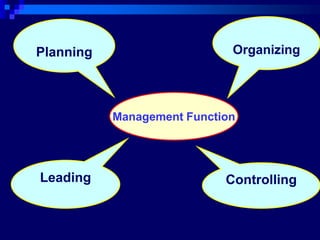
Management Function
OrganizingPlanning
Leading Controlling
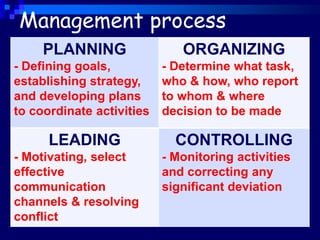
Management process
PLANNING
- Defining goals,
establishing strategy,
and developing plans
to coordinate activities
ORGANIZING
- Determine what task,
who & how, who report
to whom & where
decision to be made
LEADING
- Motivating, select
effective
communication
channels & resolving
conflict
CONTROLLING
- Monitoring activities
and correcting any
significant deviation
Management Function and
Activities
 Planning
- Setting goals and defining the actions
necessary to achieve those goals.
- Where the organization wants to be in the
future and how to get there.
- Defining goals for future organizational
performance and deciding on the tasks and
use of resources needed to attain them.
Cont…
 Organizing
- The process of determining the tasks to be
done ,who will do them and how those tasks
will be managed and coordinated.
- Also involved the assignment of task ,
grouping of tasks into department and the
allocation of resources to department.
 Leading
- Motivating and directing the member of the
organization so that they contribute to the
achievement of the goals of the organization.
- Use of influence to motivate employee to achieve
organizational goals,-creating share culture and
value , communication goals to employee
throughout the organization and infusing employee
with the desire to perform at a high level.
Cont…
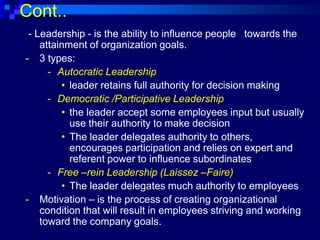
Cont..
- Leadership - is the ability to influence people towards the
attainment of organization goals.
- 3 types:
- Autocratic Leadership
• leader retains full authority for decision making
- Democratic /Participative Leadership
• the leader accept some employees input but usually
use their authority to make decision
• The leader delegates authority to others,
encourages participation and relies on expert and
referent power to influence subordinates
- Free –rein Leadership (Laissez –Faire)
• The leader delegates much authority to employees
- Motivation – is the process of creating organizational
condition that will result in employees striving and working
toward the company goals.
 Controlling
- Monitoring the performance of the
organization , identifying deviations between
planned and actual results and taking
corrective action when necessary.
Cont..
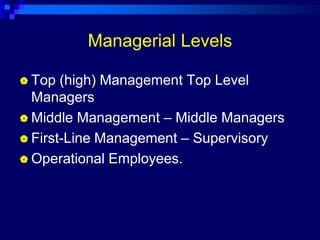
Managerial Levels
 Top (high) Management Top Level
Managers
 Middle Management – Middle Managers
 First-Line Management – Supervisory
 Operational Employees.
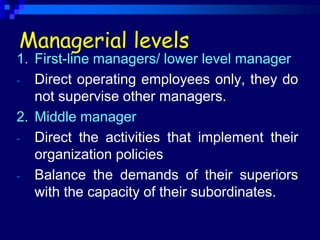
Managerial levels
1. First-line managers/ lower level manager
- Direct operating employees only, they do
not supervise other managers.
2. Middle manager
- Direct the activities that implement their
organization policies
- Balance the demands of their superiors
with the capacity of their subordinates.
3. Top managers
- Responsible for the overall management
of the organization.
- Establish operating policies & guides the
organization‘s interactions with its
environment.
Managerial Skills
 Conceptual Skills (Analytical Skills)
- The ability to analyze complex situations and respond
effectively to the challenges faced by the organization.
 Interpersonal Skill( Human Skill)
- Ability to work effectively with members of one‘s
workgroup as well as with other work groups within the
organization
Cont..
 Technical Skills
- The ability to utilize tools, techniques and procedures
that are specific to a particular field
 Decision Making Skill
- The ability to make a good decision making
Skills Needed at Different Levels of Management
Managerial Roles – developed by
Henry Mintzberg
A Role is a set of expectation for a manager ‗s behaviors
 Interpersonal Roles – helps the managers in managing
the organizational smoothly
 Figurehead – Managers may have to appear at
community function, attend social events and signing
legal documents
 Leader – Responsibility for the success/failure of their
work groups. A person responsible for hiring, training
and motivating subordinates in organization.
 Liaison – A person who perform and interacts with
other people outside the organizations.
Cont…
Informational Roles – managers responsible for
ensuring that the people with whom they work have
sufficient information to do their jobs effectively
 Monitor – Managers seek out information from their
subordinates.
 Disseminator – information receive
internally/externally will be transmitted to the
subordinates.
 Spokesperson – Managers must often
communicate information to individuals outside
their units and their organizations.
Cont…
Decisional Roles – Managers responsibility for
processing information and reaching
conclusions.
 Entrepreneur – Managers initiates projects that
capitalize on opportunities and have been identified
 Disturbance Handler – Managers is responsible for
corrective actions when the organizations faces
important and unexpected disturbances
 Resources Allocator – Managers is responsible in
allocating the resources or the organizations
 Negotiator – Managers may negotiate with
employees, suppliers, customers or other workgroups
Figure 2.1 Chronological Development of Management
Perspectives
Comprehensive Analysis of
Management
1) Classical approach to management
resulted from the first significant,
concentrated effort to develop a body of
management thought. Management writers
who participated in this efforts are
considered the pioneer of management
study.
Subfields of the Classical Perspective on
Management
Focuses on the
individual worker’s
productivity
Focuses on the
functions of
management
Focuses on
the overall
organizational
system
1a) Scientific Management: Taylor
 Frederick W. Taylor (1856-1915)
- Father of ―Scientific Management.
• attempted to define ―the one best way‖ to perform
every task through systematic study and other
scientific methods.
• believed that improved management practices
lead to improved productivity.
- Three areas of focus:
• Task Performance
• Supervision
• Motivation
Task Performance
 Scientific management incorporates basic
expectations of management, including:
• Development of work standards
• Selection of workers
• Training of workers
• Support of workers
Supervision
 Taylor felt that a single supervisor could
not be an expert at all tasks.
• As a result, each first-level supervisor should
be responsible only workers who perform a
common function familiar to the supervisor.
• This became known as ―Functional
Foremanship.‖
Motivation
Taylor believed money was the way to
motivate workers to their fullest capabilities.
- He advocated a piecework system in which
worker‘s pay was tied to their output.
• Workers who met a standard level of
production were paid a standard wage rate.
• Workers whose production exceeded the
standard were paid at a higher rate for all of
their production output.
1b) Administrative Management:
Fayol
 Henri Fayol (1841–1925)
• First recognized that successful managers
had to understand the basic managerial
functions.
• Developed a set of 14 general principles of
management.
• Fayol‘s managerial functions of planning,
leading, organizing and controlling are
routinely used in modern organizations.
Table 2.1 Fayol‘s General Principles of Management
1. Division of work
2. Authority and
responsibility
3. Discipline
4. Unity of command
5. Unity of direction
6. Subordination of
individual interest to the
common good
7. Remuneration of
personnel
8. Centralization
9. Scalar chain
10. Order
11. Equity
12. Stability
13. Initiative
14. Esprit de corps
Source: Based on Henri Fayol, General and Industrial
Management, trans. Constana Storrs (London: Pittman &
Sons, 1949).
1c) Bureaucratic Management
 Focuses on the overall organizational
system.
 Bureaucratic management is based upon:
• Firm rules
• Policies and procedures
• A fixed hierarchy
• A clear division of labor
Bureaucratic Management: Weber
 Max Weber (1864–1920)
- A German sociologist and historian who
envisioned a system of management that
would be based upon impersonal and rational
behavior—the approach to management now
referred to as ―bureaucracy.‖
• Division of labor
• Hierarchy of authority
• Rules and procedures
• Impersonality
• Employee selection and promotion
Weber‘s Forms of Authority
 Traditional authority
- Subordinate obedience based upon custom or
tradition (e.g., kings, queens, chiefs).
 Charismatic authority
- Subordinates voluntarily comply with a leader
because of his or her special personal qualities or
abilities (e.g., Martin Luther King, Gandhi).
 Rational-legal authority
- Subordinate obedience based upon the position
held by superiors within the organization (e.g.,
police officers, executives, supervisors).
Classical versus Behavioral
Perspective
Focused on
rational behavior
Classical
Perspective
Acknowledged the
importance of human
behavior
Behavioral
Perspective
vs.
2) Behavioral Perspective
 Followed the classical perspective in the
development of management thought.
- Acknowledged the importance of human
behavior in shaping management style
- Is associated with:
• Mary Parker Follett
• Elton Mayo
• Douglas McGregor
Mary Parker Follett
 Concluded that a key to effective management
was coordination.
 Felt that managers needed to coordinate and
harmonize group effort rather than force and
coerce people.
 Believed that management is a continuous,
dynamic process.
 Felt that the best decisions would be made by
people who were closest to the situation.
Follett on Effective Work Groups
Four principles of coordination to promote
effective work groups:
1. Coordination requires that people be in direct
contact with one another.
2. Coordination is essential during the initial stages of
any endeavor.
3. Coordination must address all factors and phases
of any endeavor.
4. Coordination is a continuous, ongoing process.
Elton Mayo
 Conducted the famous Hawthorne
Experiments.
- ―Hawthorne Effect‖
• Productivity increased because attention was paid
to the workers in the experiment.
• Phenomenon whereby individual or group
performance is influenced by human behavior
factors.
 His work represents the transition from
scientific management to the early human
relations movement.
Douglas McGregor
 Proposed the Theory X and Theory Y
styles of management.
- Theory X managers perceive that their
subordinates have an inherent dislike of work
and will avoid it if at all possible.
- Theory Y managers perceive that their
subordinates enjoy work and that they will
gain satisfaction from performing their jobs.
Table 2.3 Comparison of Theory X and Theory Y
Assumptions
Factor Theory X Assumptions Theory Y Assumptions
Employee attitude Employees dislike work and Employees enjoy work and
toward work will avoid it if at all possible. will actively seek it.
Management view Employees must be directed, Employees are self-motivated
of direction coerced, controlled, or threatened and self-directed toward achieving
to get them to put forth adequate effort. organizational goals.
Employee view Employees wish to avoid responsibility; Employees seek responsibility;
of direction they prefer to be directed and told what they wish to use their creativity,
to do and how to do it. imagination, and ingenuity in
performing their jobs.
Management style Authoritarian style of management Participatory style of management
3)The Contingency Perspective
 A view that proposes that there is no one
best approach to management for all
situations.
- Asserts that managers are responsible for
determining which managerial approach is
likely to be most effective in a given situation.
- This requires managers to identify the key
contingencies in a given situation.
4) The system Approach
 Views the organization as a unified,
directed system of interrelated parts.
 The systems sees each change in a part
of the system as having an impact on all
others parts.
 The system helps managers to realize that
every action has consequences
somewhere inside as outside the
organization.
Comprises of two systems
Open system
- characterized by interaction with external
environment
Closed system
- interaction with internal environment (do
not interact with external)
External
environment
Input
(the physical,
human,
material,
financial &
info process)
Conversion
(comprise
the tech
used to
convert
inputs to
outputs
Output
(the original
inputs as &
changed by
transformation
process
Feedback
(info about a
system‘s status &
performance
End of Chapter 1

Chapter 1 intro-management

  • 1.
  • 2.
  • 3.
    Learning outcome 1. Defineorganization, management, and measuring managerial performance. 2. Provide examples of management functions and activities, managerial levels, skills and roles. 3. Explain the history and contributions of management theories.
  • 4.
    Organization  A groupof individual who work together toward common goals.  Is a social entity that is goal directed and deliberately structured. Definition of Organization and Management
  • 5.
    Someone who plansand makes decision , organizes ,leads and controls human, financial physical and information resources. Manager
  • 6.
    Is the processof administering and coordinating resources effectively and efficiently in an effort to achieve the goals of the organization. The process of planning ,organizing, leading and controlling the work of organization members and of using all available organizational resources to reach stated organizational goals Management
  • 7.
    Measuring managerial Performance  Effectiveness -Pursuing the appropriate goals- ―Doing the right things‖  Efficiency - Using the fewest inputs to generate a given output- ―Doing things right‖
  • 8.
    High Low Poor Good Effective butnot efficient. Some resource are wasted Effective & efficient. Goal are achieve & resource are well utilized, area of high productivity Neither effective nor efficient, goal are not achieve, resource wasted in the process Efficient but not effective, no wasted resource but goals not achieve Resource utilization Goalattainment
  • 9.
  • 10.
    Management process PLANNING - Defininggoals, establishing strategy, and developing plans to coordinate activities ORGANIZING - Determine what task, who & how, who report to whom & where decision to be made LEADING - Motivating, select effective communication channels & resolving conflict CONTROLLING - Monitoring activities and correcting any significant deviation
  • 11.
    Management Function and Activities Planning - Setting goals and defining the actions necessary to achieve those goals. - Where the organization wants to be in the future and how to get there. - Defining goals for future organizational performance and deciding on the tasks and use of resources needed to attain them.
  • 12.
    Cont…  Organizing - Theprocess of determining the tasks to be done ,who will do them and how those tasks will be managed and coordinated. - Also involved the assignment of task , grouping of tasks into department and the allocation of resources to department.
  • 13.
     Leading - Motivatingand directing the member of the organization so that they contribute to the achievement of the goals of the organization. - Use of influence to motivate employee to achieve organizational goals,-creating share culture and value , communication goals to employee throughout the organization and infusing employee with the desire to perform at a high level. Cont…
  • 14.
    Cont.. - Leadership -is the ability to influence people towards the attainment of organization goals. - 3 types: - Autocratic Leadership • leader retains full authority for decision making - Democratic /Participative Leadership • the leader accept some employees input but usually use their authority to make decision • The leader delegates authority to others, encourages participation and relies on expert and referent power to influence subordinates - Free –rein Leadership (Laissez –Faire) • The leader delegates much authority to employees - Motivation – is the process of creating organizational condition that will result in employees striving and working toward the company goals.
  • 15.
     Controlling - Monitoringthe performance of the organization , identifying deviations between planned and actual results and taking corrective action when necessary. Cont..
  • 16.
    Managerial Levels  Top(high) Management Top Level Managers  Middle Management – Middle Managers  First-Line Management – Supervisory  Operational Employees.
  • 17.
    Managerial levels 1. First-linemanagers/ lower level manager - Direct operating employees only, they do not supervise other managers. 2. Middle manager - Direct the activities that implement their organization policies - Balance the demands of their superiors with the capacity of their subordinates.
  • 18.
    3. Top managers -Responsible for the overall management of the organization. - Establish operating policies & guides the organization‘s interactions with its environment.
  • 19.
    Managerial Skills  ConceptualSkills (Analytical Skills) - The ability to analyze complex situations and respond effectively to the challenges faced by the organization.  Interpersonal Skill( Human Skill) - Ability to work effectively with members of one‘s workgroup as well as with other work groups within the organization
  • 20.
    Cont..  Technical Skills -The ability to utilize tools, techniques and procedures that are specific to a particular field  Decision Making Skill - The ability to make a good decision making
  • 21.
    Skills Needed atDifferent Levels of Management
  • 22.
    Managerial Roles –developed by Henry Mintzberg A Role is a set of expectation for a manager ‗s behaviors  Interpersonal Roles – helps the managers in managing the organizational smoothly  Figurehead – Managers may have to appear at community function, attend social events and signing legal documents  Leader – Responsibility for the success/failure of their work groups. A person responsible for hiring, training and motivating subordinates in organization.  Liaison – A person who perform and interacts with other people outside the organizations.
  • 23.
    Cont… Informational Roles –managers responsible for ensuring that the people with whom they work have sufficient information to do their jobs effectively  Monitor – Managers seek out information from their subordinates.  Disseminator – information receive internally/externally will be transmitted to the subordinates.  Spokesperson – Managers must often communicate information to individuals outside their units and their organizations.
  • 24.
    Cont… Decisional Roles –Managers responsibility for processing information and reaching conclusions.  Entrepreneur – Managers initiates projects that capitalize on opportunities and have been identified  Disturbance Handler – Managers is responsible for corrective actions when the organizations faces important and unexpected disturbances  Resources Allocator – Managers is responsible in allocating the resources or the organizations  Negotiator – Managers may negotiate with employees, suppliers, customers or other workgroups
  • 25.
    Figure 2.1 ChronologicalDevelopment of Management Perspectives
  • 26.
    Comprehensive Analysis of Management 1)Classical approach to management resulted from the first significant, concentrated effort to develop a body of management thought. Management writers who participated in this efforts are considered the pioneer of management study.
  • 27.
    Subfields of theClassical Perspective on Management Focuses on the individual worker’s productivity Focuses on the functions of management Focuses on the overall organizational system
  • 28.
    1a) Scientific Management:Taylor  Frederick W. Taylor (1856-1915) - Father of ―Scientific Management. • attempted to define ―the one best way‖ to perform every task through systematic study and other scientific methods. • believed that improved management practices lead to improved productivity. - Three areas of focus: • Task Performance • Supervision • Motivation
  • 29.
    Task Performance  Scientificmanagement incorporates basic expectations of management, including: • Development of work standards • Selection of workers • Training of workers • Support of workers
  • 30.
    Supervision  Taylor feltthat a single supervisor could not be an expert at all tasks. • As a result, each first-level supervisor should be responsible only workers who perform a common function familiar to the supervisor. • This became known as ―Functional Foremanship.‖
  • 31.
    Motivation Taylor believed moneywas the way to motivate workers to their fullest capabilities. - He advocated a piecework system in which worker‘s pay was tied to their output. • Workers who met a standard level of production were paid a standard wage rate. • Workers whose production exceeded the standard were paid at a higher rate for all of their production output.
  • 32.
    1b) Administrative Management: Fayol Henri Fayol (1841–1925) • First recognized that successful managers had to understand the basic managerial functions. • Developed a set of 14 general principles of management. • Fayol‘s managerial functions of planning, leading, organizing and controlling are routinely used in modern organizations.
  • 33.
    Table 2.1 Fayol‘sGeneral Principles of Management 1. Division of work 2. Authority and responsibility 3. Discipline 4. Unity of command 5. Unity of direction 6. Subordination of individual interest to the common good 7. Remuneration of personnel 8. Centralization 9. Scalar chain 10. Order 11. Equity 12. Stability 13. Initiative 14. Esprit de corps Source: Based on Henri Fayol, General and Industrial Management, trans. Constana Storrs (London: Pittman & Sons, 1949).
  • 34.
    1c) Bureaucratic Management Focuses on the overall organizational system.  Bureaucratic management is based upon: • Firm rules • Policies and procedures • A fixed hierarchy • A clear division of labor
  • 35.
    Bureaucratic Management: Weber Max Weber (1864–1920) - A German sociologist and historian who envisioned a system of management that would be based upon impersonal and rational behavior—the approach to management now referred to as ―bureaucracy.‖ • Division of labor • Hierarchy of authority • Rules and procedures • Impersonality • Employee selection and promotion
  • 36.
    Weber‘s Forms ofAuthority  Traditional authority - Subordinate obedience based upon custom or tradition (e.g., kings, queens, chiefs).  Charismatic authority - Subordinates voluntarily comply with a leader because of his or her special personal qualities or abilities (e.g., Martin Luther King, Gandhi).  Rational-legal authority - Subordinate obedience based upon the position held by superiors within the organization (e.g., police officers, executives, supervisors).
  • 37.
    Classical versus Behavioral Perspective Focusedon rational behavior Classical Perspective Acknowledged the importance of human behavior Behavioral Perspective vs.
  • 38.
    2) Behavioral Perspective Followed the classical perspective in the development of management thought. - Acknowledged the importance of human behavior in shaping management style - Is associated with: • Mary Parker Follett • Elton Mayo • Douglas McGregor
  • 39.
    Mary Parker Follett Concluded that a key to effective management was coordination.  Felt that managers needed to coordinate and harmonize group effort rather than force and coerce people.  Believed that management is a continuous, dynamic process.  Felt that the best decisions would be made by people who were closest to the situation.
  • 40.
    Follett on EffectiveWork Groups Four principles of coordination to promote effective work groups: 1. Coordination requires that people be in direct contact with one another. 2. Coordination is essential during the initial stages of any endeavor. 3. Coordination must address all factors and phases of any endeavor. 4. Coordination is a continuous, ongoing process.
  • 41.
    Elton Mayo  Conductedthe famous Hawthorne Experiments. - ―Hawthorne Effect‖ • Productivity increased because attention was paid to the workers in the experiment. • Phenomenon whereby individual or group performance is influenced by human behavior factors.  His work represents the transition from scientific management to the early human relations movement.
  • 42.
    Douglas McGregor  Proposedthe Theory X and Theory Y styles of management. - Theory X managers perceive that their subordinates have an inherent dislike of work and will avoid it if at all possible. - Theory Y managers perceive that their subordinates enjoy work and that they will gain satisfaction from performing their jobs.
  • 43.
    Table 2.3 Comparisonof Theory X and Theory Y Assumptions Factor Theory X Assumptions Theory Y Assumptions Employee attitude Employees dislike work and Employees enjoy work and toward work will avoid it if at all possible. will actively seek it. Management view Employees must be directed, Employees are self-motivated of direction coerced, controlled, or threatened and self-directed toward achieving to get them to put forth adequate effort. organizational goals. Employee view Employees wish to avoid responsibility; Employees seek responsibility; of direction they prefer to be directed and told what they wish to use their creativity, to do and how to do it. imagination, and ingenuity in performing their jobs. Management style Authoritarian style of management Participatory style of management
  • 44.
    3)The Contingency Perspective A view that proposes that there is no one best approach to management for all situations. - Asserts that managers are responsible for determining which managerial approach is likely to be most effective in a given situation. - This requires managers to identify the key contingencies in a given situation.
  • 45.
    4) The systemApproach  Views the organization as a unified, directed system of interrelated parts.  The systems sees each change in a part of the system as having an impact on all others parts.  The system helps managers to realize that every action has consequences somewhere inside as outside the organization.
  • 46.
    Comprises of twosystems Open system - characterized by interaction with external environment Closed system - interaction with internal environment (do not interact with external)
  • 47.
    External environment Input (the physical, human, material, financial & infoprocess) Conversion (comprise the tech used to convert inputs to outputs Output (the original inputs as & changed by transformation process Feedback (info about a system‘s status & performance
  • 48.