History Module THE HISTORICAL ROOTS OF CONTEMPORARY MANAGEMENT PRACTICES
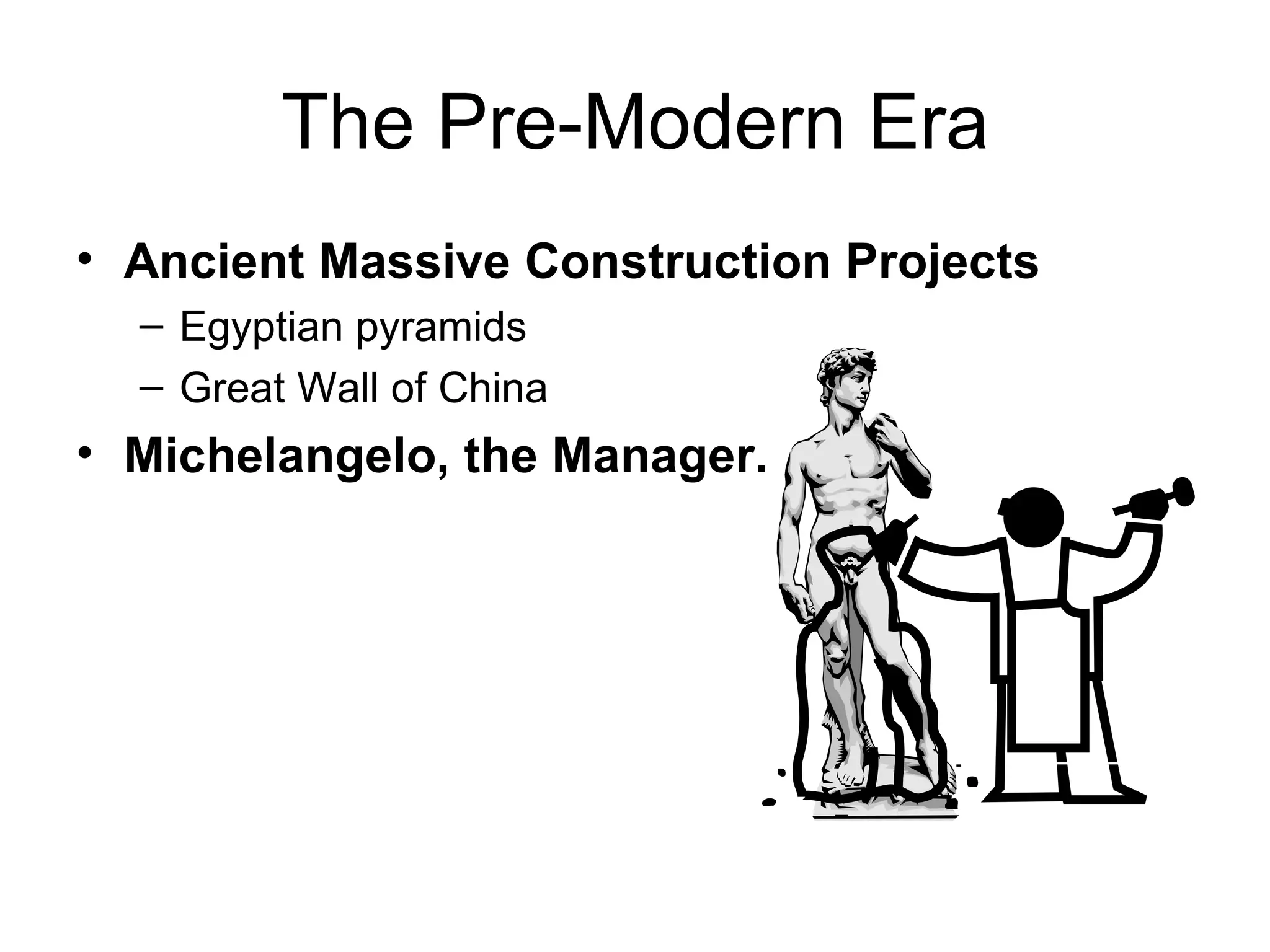
The Pre-Modern Era Ancient Massive Construction Projects Egyptian pyramids Great Wall of China Michelangelo, the Manager.
Adam Smith’s Contribution To The Field Of Management Wrote the Wealth of Nations (1776) Advocated the economic advantages that organizations and society would reap from the division of labor: Increased productivity by increasing each worker’s skill and dexterity. Time saved that is commonly lost in changing tasks. The creation of labor-saving inventions and machinery.
Industrial Revolution’s Influence  On Management Practices Industrial Revolution Machine power began to substitute for human power Lead to mass production of economical goods Improved and less costly transportation systems became available Created larger markets for goods. Larger organizations developed to serve larger markets Created the need for formalized management practices.
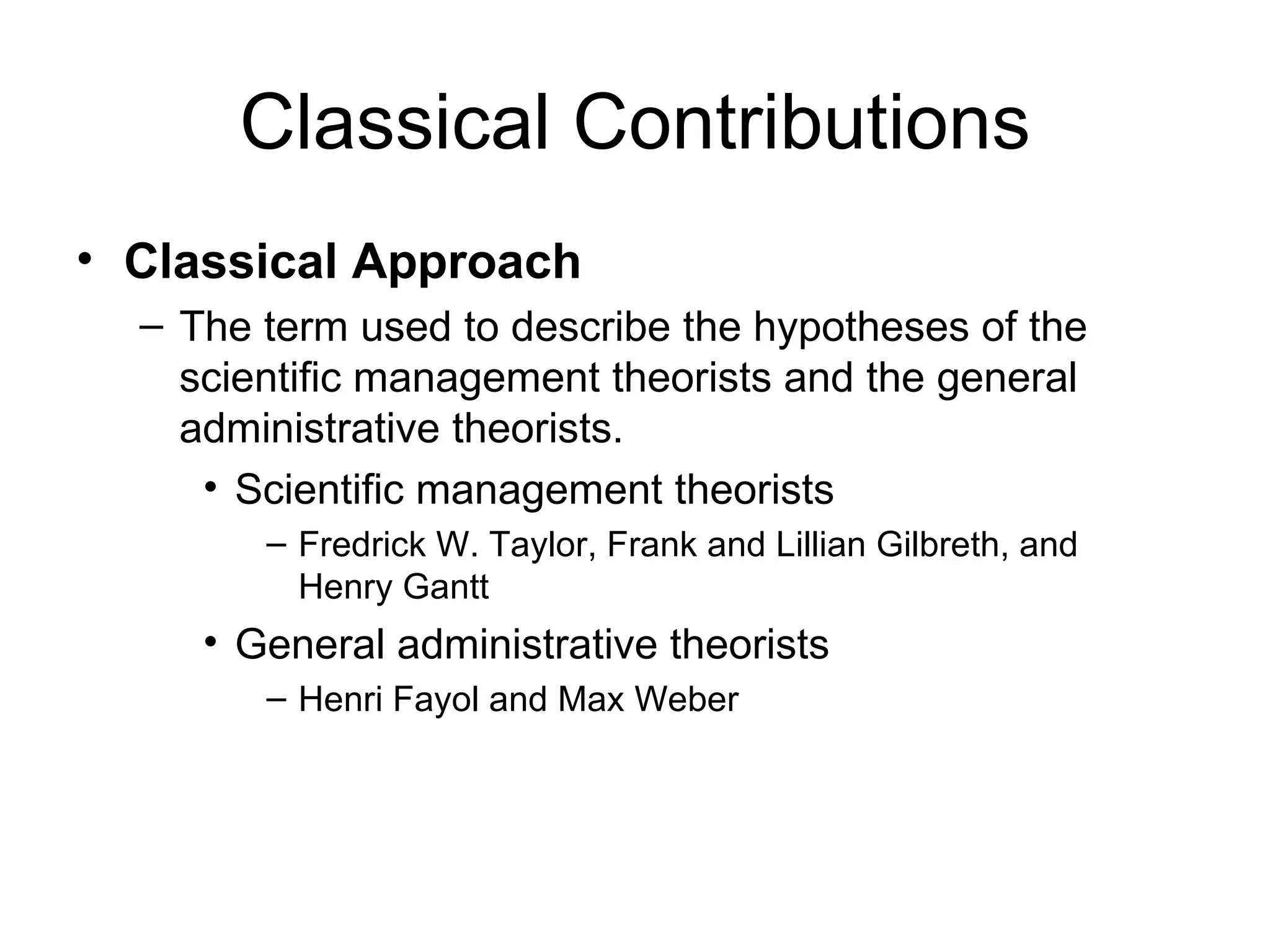
Classical Contributions Classical Approach The term used to describe the hypotheses of the scientific management theorists and the general administrative theorists. Scientific management theorists Fredrick W. Taylor, Frank and Lillian Gilbreth, and Henry Gantt General administrative theorists Henri Fayol and Max Weber
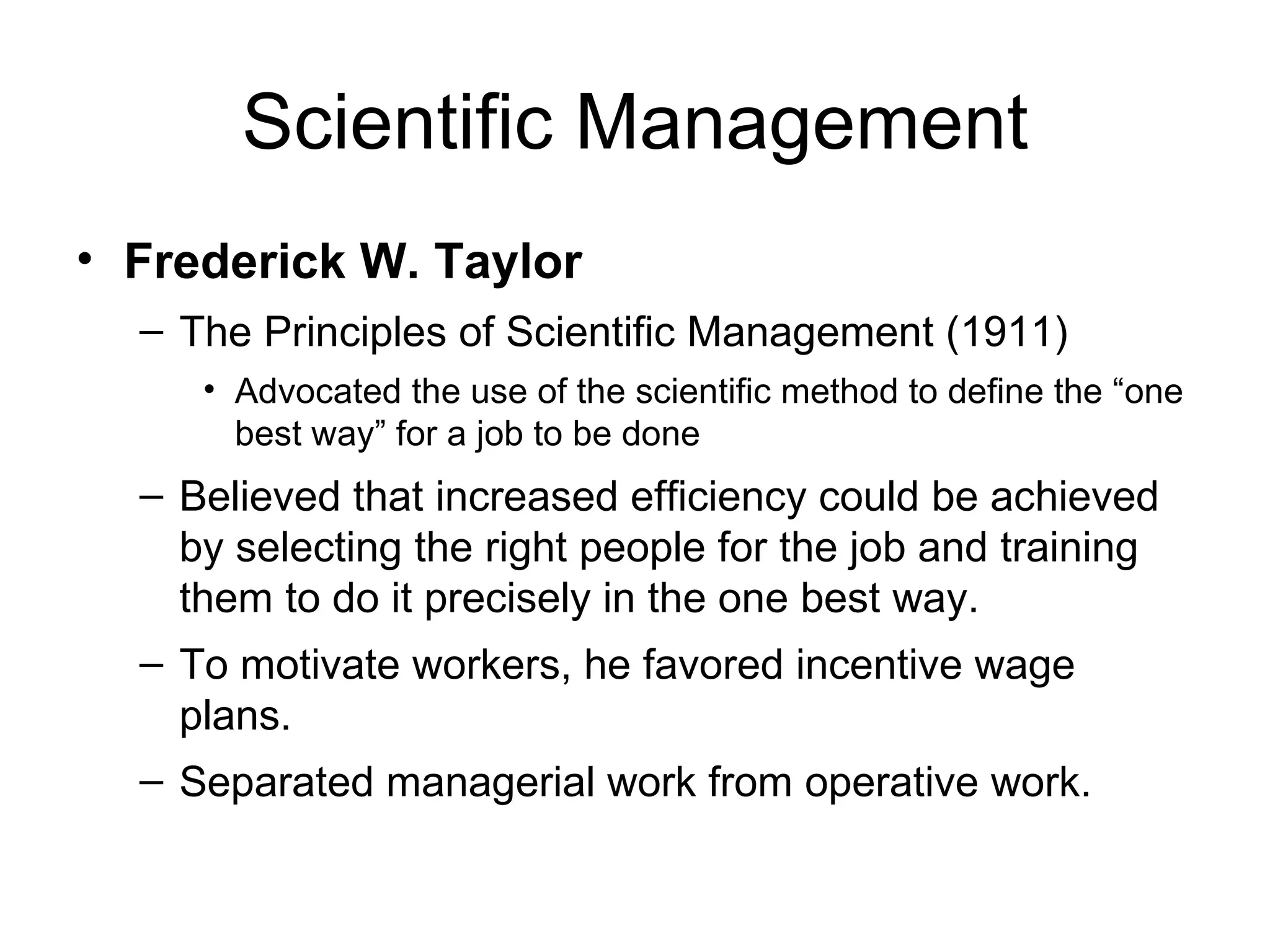
Scientific Management Frederick W. Taylor The Principles of Scientific Management (1911) Advocated the use of the scientific method to define the “one best way” for a job to be done Believed that increased efficiency could be achieved by selecting the right people for the job and training them to do it precisely in the one best way. To motivate workers, he favored incentive wage plans. Separated managerial work from operative work.
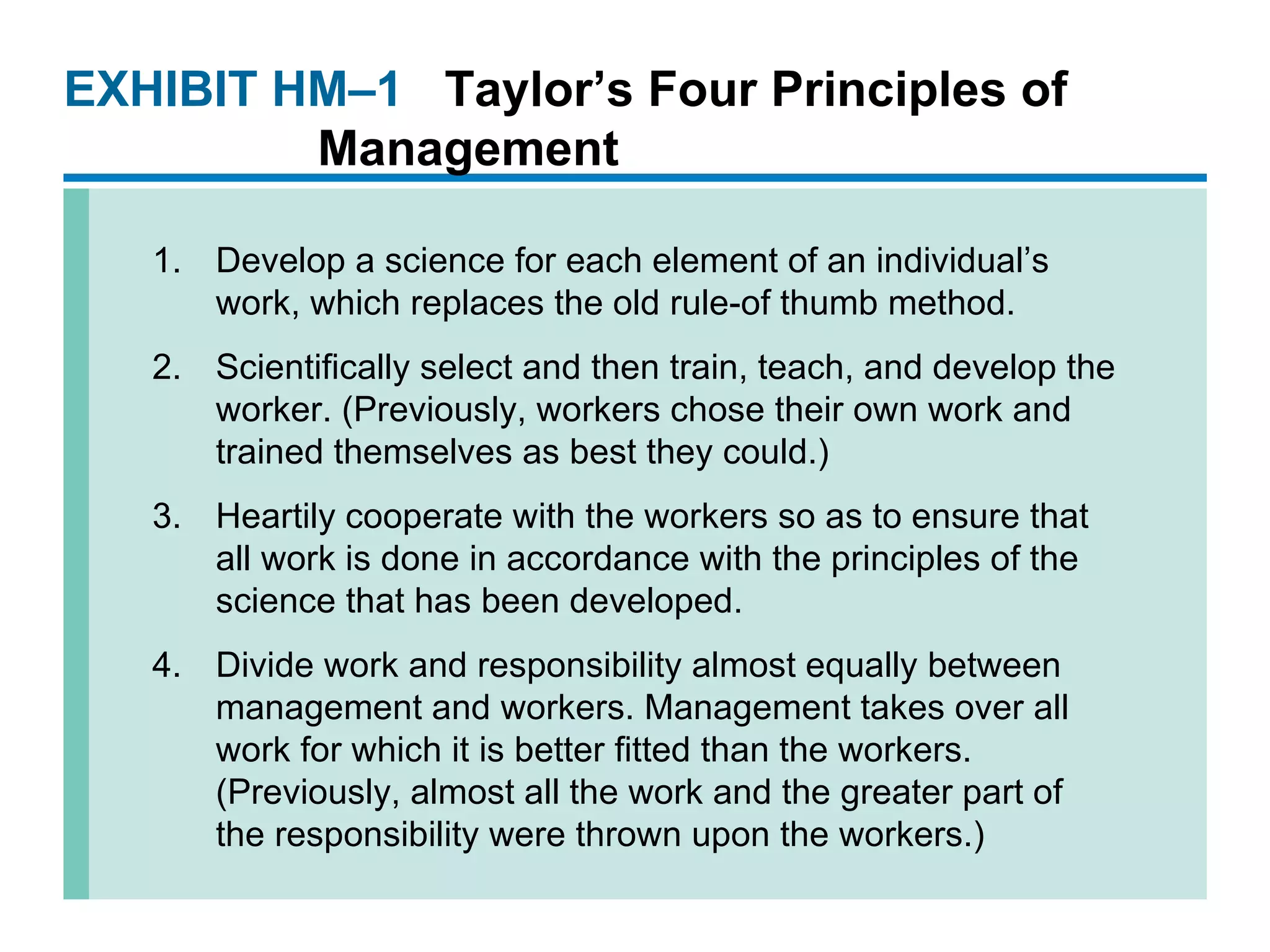
EXHIBIT HM –1 Taylor’s Four Principles of Management Develop a science for each element of an individual’s work, which replaces the old rule-of thumb method. Scientifically select and then train, teach, and develop the worker. (Previously, workers chose their own work and trained themselves as best they could.) Heartily cooperate with the workers so as to ensure that all work is done in accordance with the principles of the science that has been developed. Divide work and responsibility almost equally between management and workers. Management takes over all work for which it is better fitted than the workers. (Previously, almost all the work and the greater part of the responsibility were thrown upon the workers.)
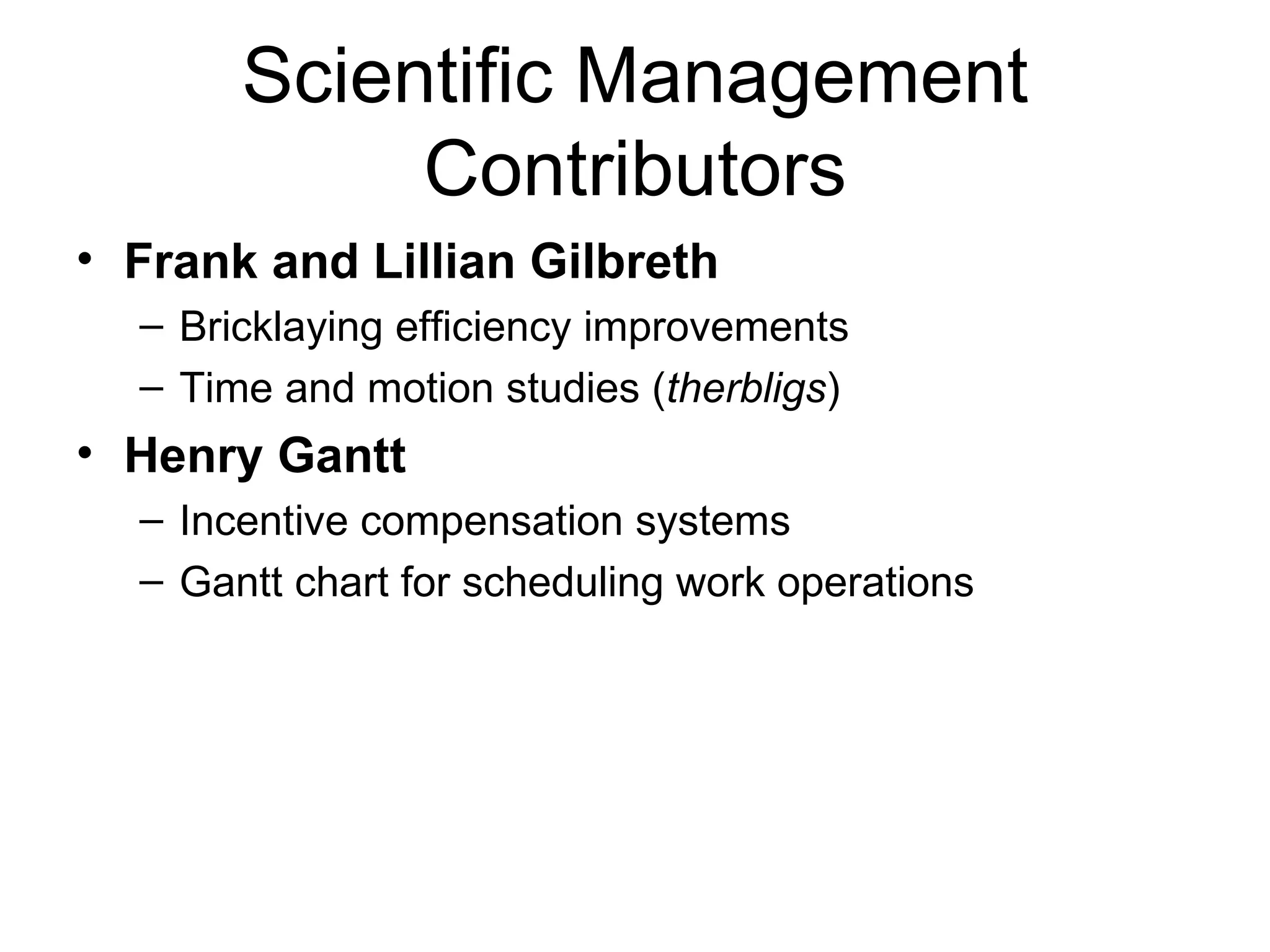
Scientific Management Contributors Frank and Lillian Gilbreth Bricklaying efficiency improvements Time and motion studies ( therbligs ) Henry Gantt Incentive compensation systems Gantt chart for scheduling work operations
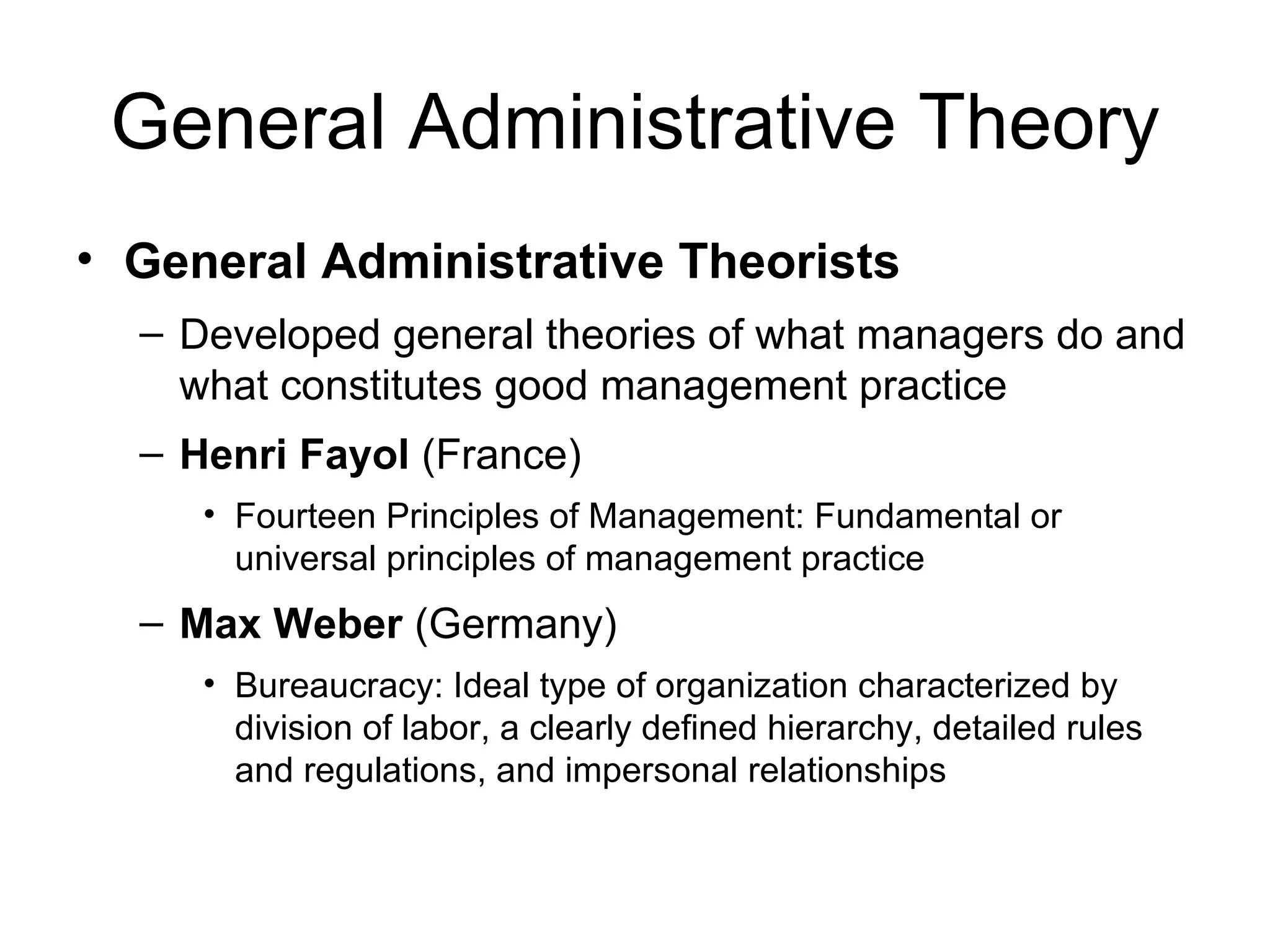
General Administrative Theory General Administrative Theorists Developed general theories of what managers do and what constitutes good management practice Henri Fayol  (France) Fourteen Principles of Management: Fundamental or universal principles of management practice Max Weber  (Germany) Bureaucracy: Ideal type of organization characterized by division of labor, a clearly defined hierarchy, detailed rules and regulations, and impersonal relationships
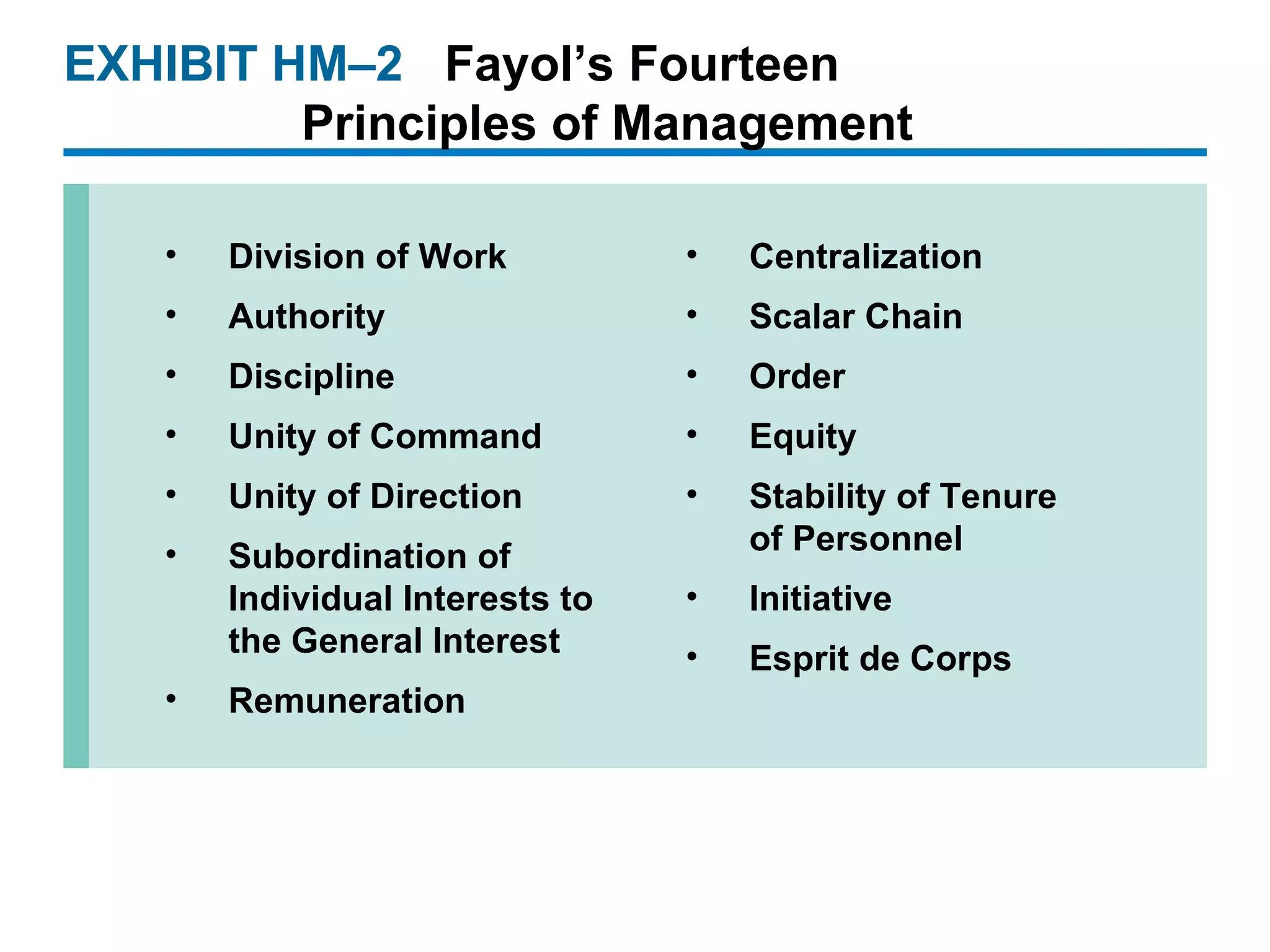
EXHIBIT HM –2 Fayol’s Fourteen  Principles of Management Division of Work Authority Discipline Unity of Command Unity of Direction Subordination of Individual Interests to the General Interest Remuneration Centralization Scalar Chain Order Equity Stability of Tenure of Personnel Initiative Esprit de Corps
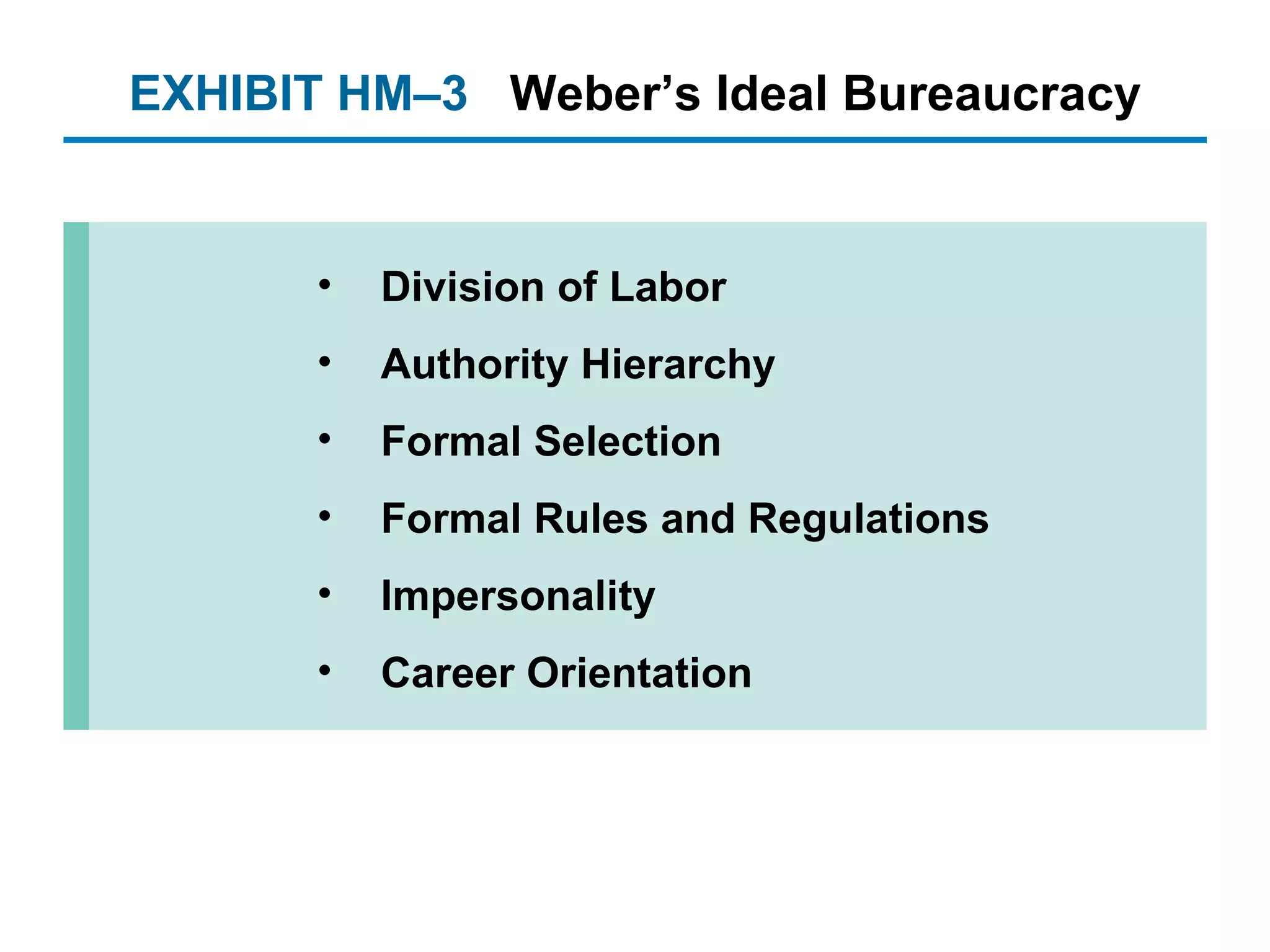
EXHIBIT HM –3 Weber’s Ideal Bureaucracy Division of Labor Authority Hierarchy Formal Selection Formal Rules and Regulations Impersonality Career Orientation
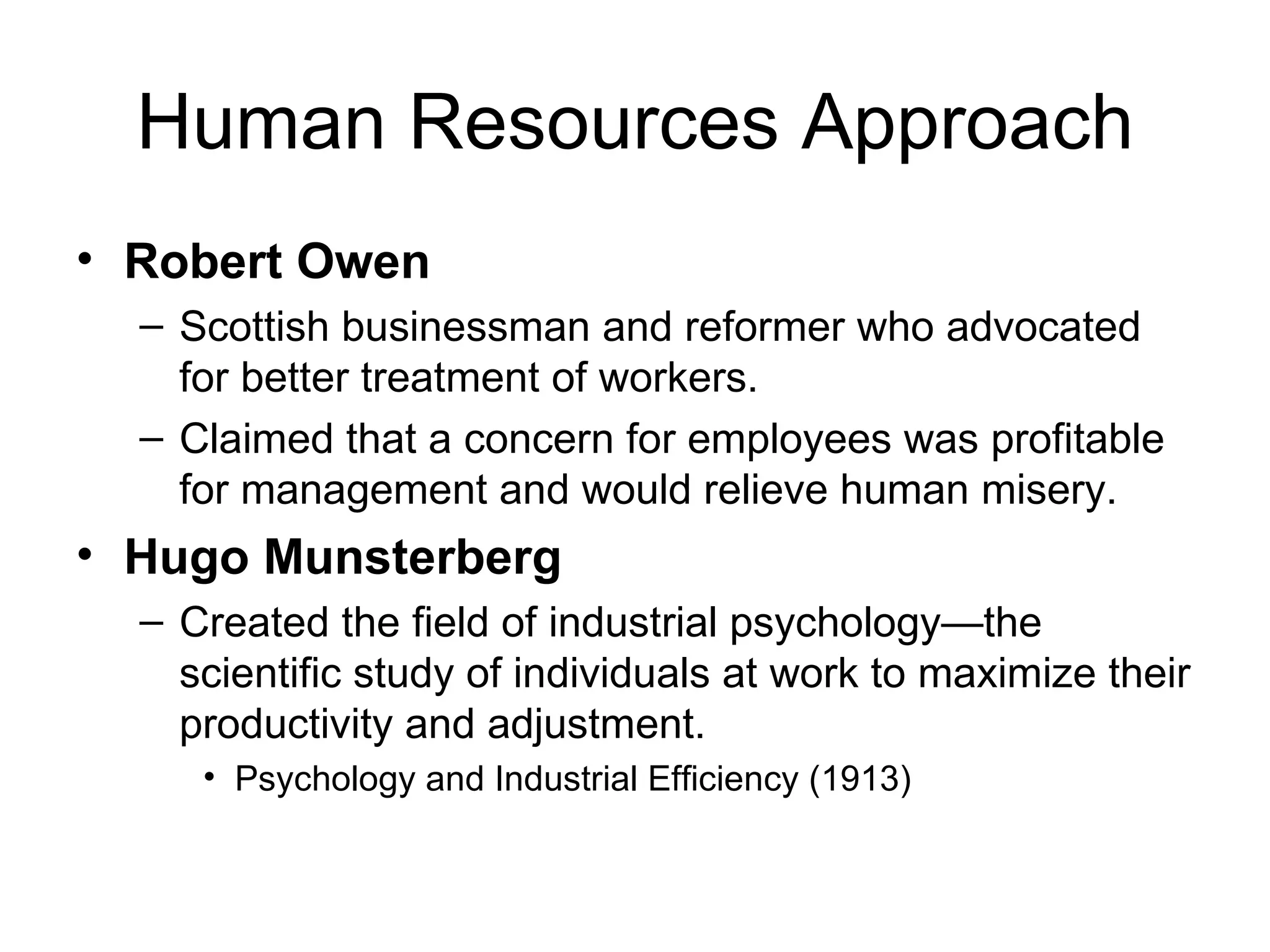
Human Resources Approach Robert Owen Scottish businessman and reformer who advocated for better treatment of workers. Claimed that a concern for employees was profitable for management and would relieve human misery. Hugo Munsterberg Created the field of industrial psychology—the scientific study of individuals at work to maximize their productivity and adjustment. Psychology and Industrial Efficiency (1913)
Human Resources Approach (cont’d) Mary Parker Follett   Recognized that organizations could be viewed from the perspective of individual and group behavior. Believed that individual potential could only be released by group association. Chester Barnard Saw organizations as social systems that require human interaction and cooperation.  Expressed his views on the “acceptance of authority” in his book The Functions of the Executive (1938).
Hawthorne Studies A series of studies done during the 1920s and 1930s that provided new insights into group norms and behaviors led by  Elton Mayo Hawthorne effect Social norms or standards of the group are the key determinants of individual work behavior. Changed the prevalent view of the time that people were no different than machines.
Human Relations Movement Based on a belief in the importance of employee satisfaction—a satisfied worker was believed to be a productive worker. Advocates believed in people’s capabilities and were concerned with making management practices more humane. Dale Carnegie Abraham Maslow Douglas McGregor
The Quantitative Approach Operations Research (Management Science) Evolved out of the development of mathematical and statistical solutions to military problems during World War II. Involves the use of statistics, optimization models, information models, and computer simulations to improve management decision making for planning and control.
Social Events That Shaped  Management Approaches Classical Approach The desire for increased efficiency of labor intensive operations Human Resources Approach The backlash to the overly mechanistic view of employees held by the classicists. The Great Depression. The Quantitative Approaches World War II armament production
What is the Process Approach? Management Theory Jungle  (Harold Koontz) The diversity of approaches to the study of management—functions, quantitative emphasis, human relations approaches—each offer something to management theory, but many are only managerial tools. Process Approach Planning, leading, and controlling activities are circular and continuous functions of management.
The Systems Approach Defines a system as a set of interrelated and interdependent parts arranged in a manner that produces a unified whole Closed system :  a system that is not influenced by and does not interact with its environment Open system:  a system that dynamically interacts with its environment Stakeholders:  any group that is affected by organizational decisions and policies
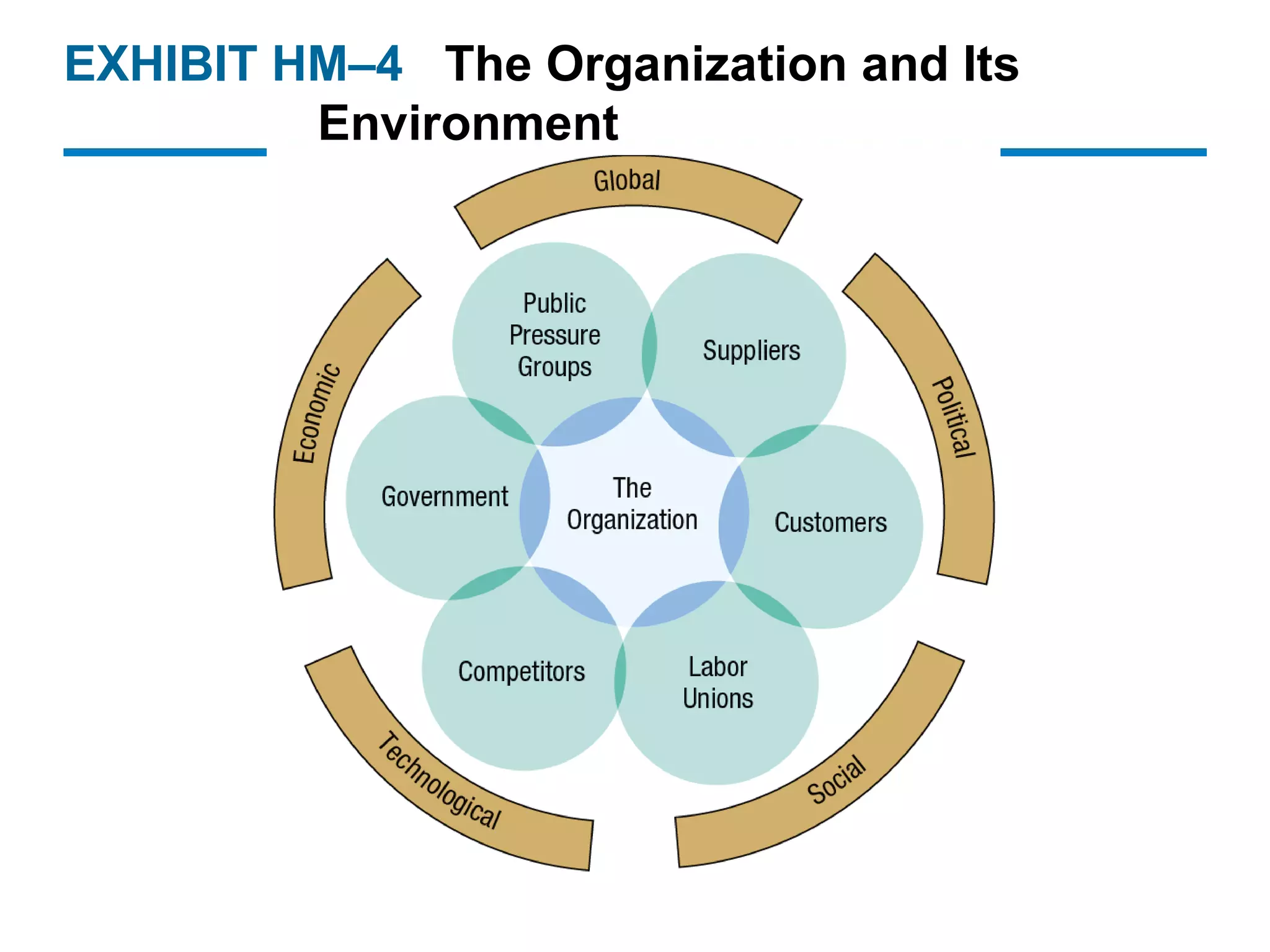
EXHIBIT HM –4 The Organization and Its Environment
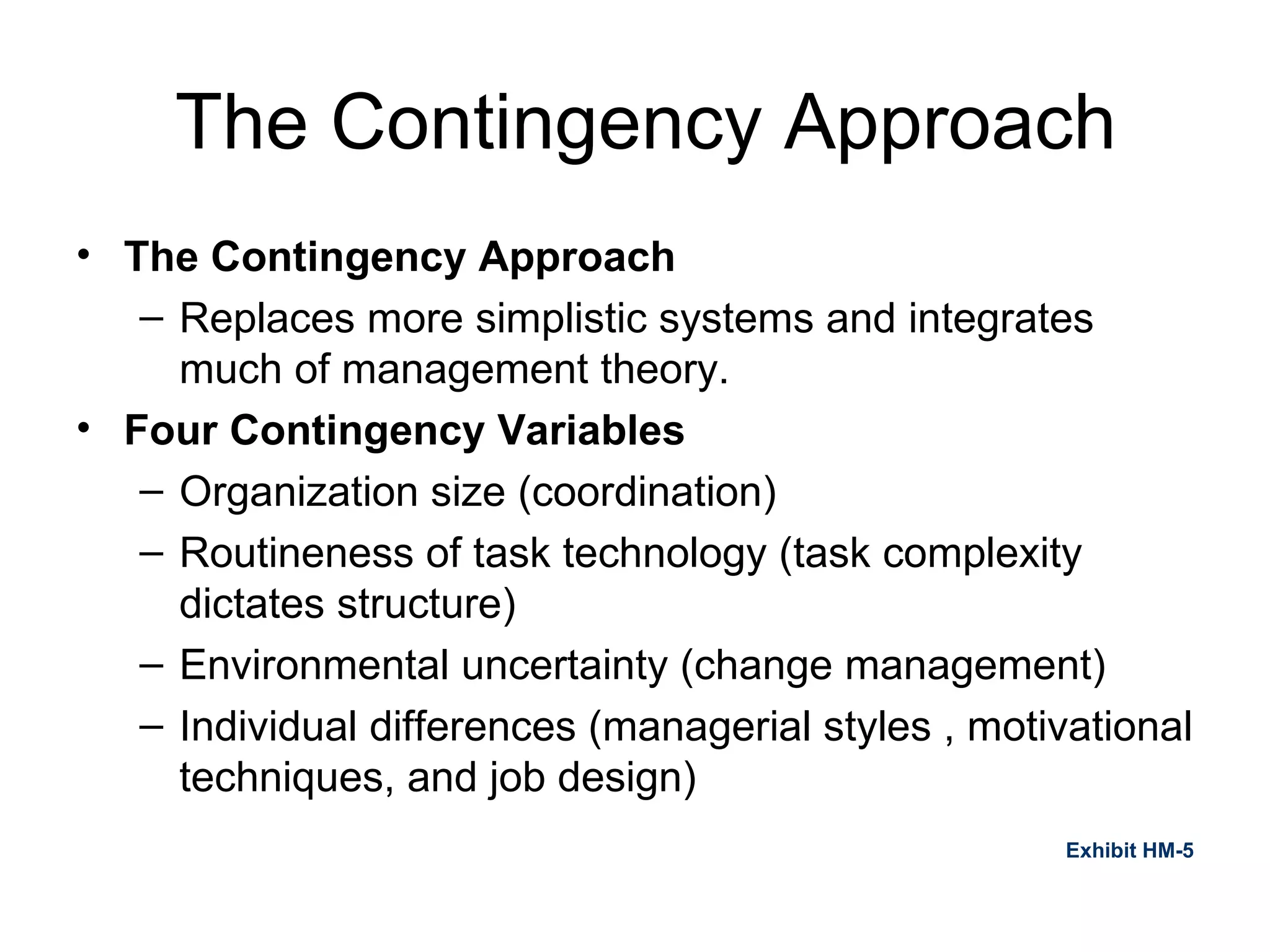
The Contingency Approach The Contingency Approach Replaces more simplistic systems and integrates much of management theory. Four Contingency Variables Organization size (coordination) Routineness of task technology (task complexity dictates structure) Environmental uncertainty (change management) Individual differences (managerial styles , motivational techniques, and job design) Exhibit HM-5
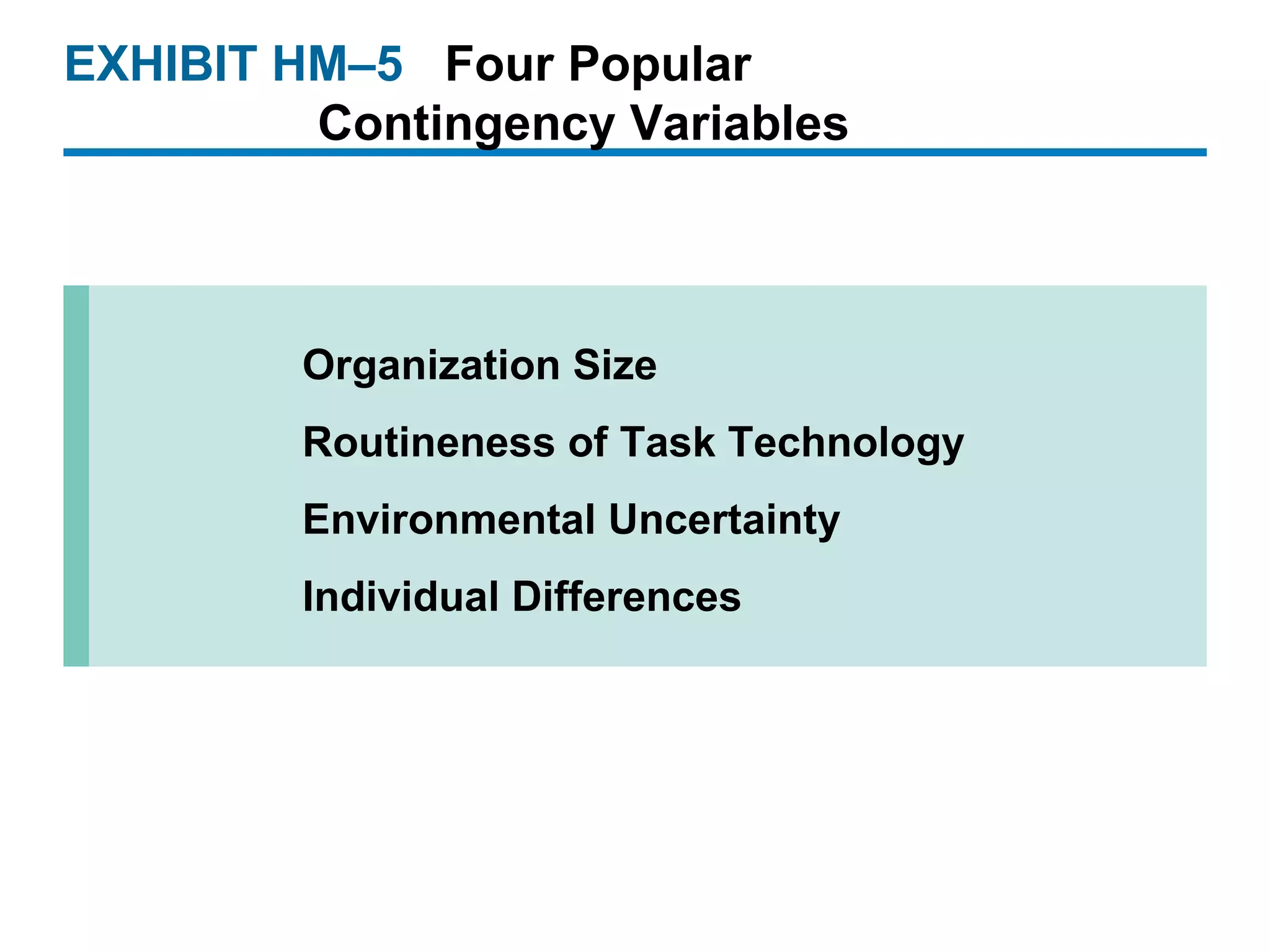
EXHIBIT HM –5 Four Popular  Contingency Variables Organization Size Routineness of Task Technology Environmental Uncertainty Individual Differences

Fom6 history module

  • 1.
    History Module THEHISTORICAL ROOTS OF CONTEMPORARY MANAGEMENT PRACTICES
  • 2.
    The Pre-Modern EraAncient Massive Construction Projects Egyptian pyramids Great Wall of China Michelangelo, the Manager.
  • 3.
    Adam Smith’s ContributionTo The Field Of Management Wrote the Wealth of Nations (1776) Advocated the economic advantages that organizations and society would reap from the division of labor: Increased productivity by increasing each worker’s skill and dexterity. Time saved that is commonly lost in changing tasks. The creation of labor-saving inventions and machinery.
  • 4.
    Industrial Revolution’s Influence On Management Practices Industrial Revolution Machine power began to substitute for human power Lead to mass production of economical goods Improved and less costly transportation systems became available Created larger markets for goods. Larger organizations developed to serve larger markets Created the need for formalized management practices.
  • 5.
    Classical Contributions ClassicalApproach The term used to describe the hypotheses of the scientific management theorists and the general administrative theorists. Scientific management theorists Fredrick W. Taylor, Frank and Lillian Gilbreth, and Henry Gantt General administrative theorists Henri Fayol and Max Weber
  • 6.
    Scientific Management FrederickW. Taylor The Principles of Scientific Management (1911) Advocated the use of the scientific method to define the “one best way” for a job to be done Believed that increased efficiency could be achieved by selecting the right people for the job and training them to do it precisely in the one best way. To motivate workers, he favored incentive wage plans. Separated managerial work from operative work.
  • 7.
    EXHIBIT HM –1Taylor’s Four Principles of Management Develop a science for each element of an individual’s work, which replaces the old rule-of thumb method. Scientifically select and then train, teach, and develop the worker. (Previously, workers chose their own work and trained themselves as best they could.) Heartily cooperate with the workers so as to ensure that all work is done in accordance with the principles of the science that has been developed. Divide work and responsibility almost equally between management and workers. Management takes over all work for which it is better fitted than the workers. (Previously, almost all the work and the greater part of the responsibility were thrown upon the workers.)
  • 8.
    Scientific Management ContributorsFrank and Lillian Gilbreth Bricklaying efficiency improvements Time and motion studies ( therbligs ) Henry Gantt Incentive compensation systems Gantt chart for scheduling work operations
  • 9.
    General Administrative TheoryGeneral Administrative Theorists Developed general theories of what managers do and what constitutes good management practice Henri Fayol (France) Fourteen Principles of Management: Fundamental or universal principles of management practice Max Weber (Germany) Bureaucracy: Ideal type of organization characterized by division of labor, a clearly defined hierarchy, detailed rules and regulations, and impersonal relationships
  • 10.
    EXHIBIT HM –2Fayol’s Fourteen Principles of Management Division of Work Authority Discipline Unity of Command Unity of Direction Subordination of Individual Interests to the General Interest Remuneration Centralization Scalar Chain Order Equity Stability of Tenure of Personnel Initiative Esprit de Corps
  • 11.
    EXHIBIT HM –3Weber’s Ideal Bureaucracy Division of Labor Authority Hierarchy Formal Selection Formal Rules and Regulations Impersonality Career Orientation
  • 12.
    Human Resources ApproachRobert Owen Scottish businessman and reformer who advocated for better treatment of workers. Claimed that a concern for employees was profitable for management and would relieve human misery. Hugo Munsterberg Created the field of industrial psychology—the scientific study of individuals at work to maximize their productivity and adjustment. Psychology and Industrial Efficiency (1913)
  • 13.
    Human Resources Approach(cont’d) Mary Parker Follett Recognized that organizations could be viewed from the perspective of individual and group behavior. Believed that individual potential could only be released by group association. Chester Barnard Saw organizations as social systems that require human interaction and cooperation. Expressed his views on the “acceptance of authority” in his book The Functions of the Executive (1938).
  • 14.
    Hawthorne Studies Aseries of studies done during the 1920s and 1930s that provided new insights into group norms and behaviors led by Elton Mayo Hawthorne effect Social norms or standards of the group are the key determinants of individual work behavior. Changed the prevalent view of the time that people were no different than machines.
  • 15.
    Human Relations MovementBased on a belief in the importance of employee satisfaction—a satisfied worker was believed to be a productive worker. Advocates believed in people’s capabilities and were concerned with making management practices more humane. Dale Carnegie Abraham Maslow Douglas McGregor
  • 16.
    The Quantitative ApproachOperations Research (Management Science) Evolved out of the development of mathematical and statistical solutions to military problems during World War II. Involves the use of statistics, optimization models, information models, and computer simulations to improve management decision making for planning and control.
  • 17.
    Social Events ThatShaped Management Approaches Classical Approach The desire for increased efficiency of labor intensive operations Human Resources Approach The backlash to the overly mechanistic view of employees held by the classicists. The Great Depression. The Quantitative Approaches World War II armament production
  • 18.
    What is theProcess Approach? Management Theory Jungle (Harold Koontz) The diversity of approaches to the study of management—functions, quantitative emphasis, human relations approaches—each offer something to management theory, but many are only managerial tools. Process Approach Planning, leading, and controlling activities are circular and continuous functions of management.
  • 19.
    The Systems ApproachDefines a system as a set of interrelated and interdependent parts arranged in a manner that produces a unified whole Closed system : a system that is not influenced by and does not interact with its environment Open system: a system that dynamically interacts with its environment Stakeholders: any group that is affected by organizational decisions and policies
  • 20.
    EXHIBIT HM –4The Organization and Its Environment
  • 21.
    The Contingency ApproachThe Contingency Approach Replaces more simplistic systems and integrates much of management theory. Four Contingency Variables Organization size (coordination) Routineness of task technology (task complexity dictates structure) Environmental uncertainty (change management) Individual differences (managerial styles , motivational techniques, and job design) Exhibit HM-5
  • 22.
    EXHIBIT HM –5Four Popular Contingency Variables Organization Size Routineness of Task Technology Environmental Uncertainty Individual Differences