高頻電子電路
第一章 知識回顧與通訊系統簡介
李健榮 助理教授
Department of Electronic Engineering
National Taipei University of Technology
大綱
• dB的定義
• 相量(Phasor)
• 調變
• 線性調變與線性發射機
• 線性解調變與線性接收機
• 調變訊號譜
• 複數波包
Department of Electronic Engineering, NTUT2/40
dB的定義
• , where
• Power gain
• Voltage gain
• Power (dBW)
• Power (dBm)
• Voltage (dBV)
• Voltage (dBuV)
( )dB 10 log G= ⋅ ( )aG
b
=
2
1
10 log
P
P
 = ⋅  
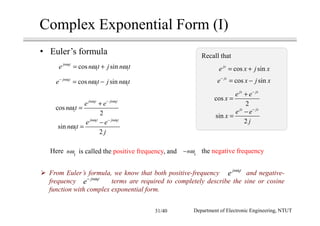
 
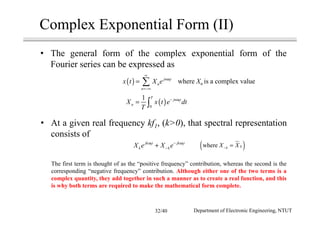
2
1
20 log
V
V
 = ⋅  
 
( )10 log
1-W
P= ⋅
( )10 log
1-mW
P= ⋅
( )20 log
1-Volt
V= ⋅
( )20 log
1- V
V
µ= ⋅
相對的相對的相對的相對的(Relative )
(比值比值比值比值, 無單位無單位無單位無單位, dB)
絕對的絕對的絕對的絕對的(Absolute )
(單位單位單位單位, dBW, dBm, dBV…)
Department of Electronic Engineering, NTUT3/40
In some textbooks, phasor may be
represented as
尤拉公式
• Euler’s Formula states that: cos sinjx
e x j x= +
( ) ( ) ( )
{ } { }cos Re Re
j t j j t
p p pv t V t V e V e e
ω φ φ ω
ω φ +
= ⋅ + = ⋅ = ⋅
( )cos sin
def
j
p p pV V e V V jφ
φ φ φ= ⋅ = ∠ = +• Phasor :
Don’t be confused with Vector which is commonly denoted as .A
phasor
A real signal can be represented as:
V
V
( ) ( )cospv t V tω φ= ⋅ +
Department of Electronic Engineering, NTUT4/40
Euler’s Trick on the Definition of e
2 3
lim 1 1
1! 2! 3!
n
x
n
x x x x
e
n→∞
 
= + = + + + + 
 
…
x jx=
( ) ( )
2 3 2 4 3 5
1 1
1! 2! 3! 2! 4! 3! 5!
jx jx jxjx x x x x
e j x
   
= + + + + = − + − + + − + − +   
   
… … …
• Euler played a trick : Let , where 1j = −
1
lim 1
n
n
e
n→∞
 
= + 
 
6/33
2 4
cos 1
2! 4!
x x
x = − + − +…
3 5
sin
3! 5!
x x
x x= − + − +…
cos sinjx
e x j x= +
cos sinjx
e x j x−
= −
cos
2
jx jx
e e
x
−
+
=
sin
2
jx jx
e e
x
j
−
−
=
• Use and
we have
Department of Electronic Engineering, NTUT5/40
座標系統
x-axis
y-axis
x-axis
y-axis
P(r,θ)
θ
r
P(x,y)
2 2
r x y= +
1
tan
y
x
θ −
=
cosx r θ=
siny r θ=
Cartesian Coordinate System Polar Coordinate System
(x,0)
(0,y)
( )cos ,0r θ
( )0, sinr θ
Projection
on x-axis
Projection
on y-axis
Department of Electronic Engineering, NTUT6/40
正弦波形
x-axis
y-axis
P(x,y)
x
y
r
θ θθ
y
θ
0 π/2 π 3π/2 2π
Go along the circle, the projection on y-axis results in a sine
wave.
Department of Electronic Engineering, NTUT7/40
x
θ
0
π/2
π
3π/2
餘弦波形
x-axis
y-axis
θ
Go along the circle, the projection
on x-axis results in a cosine wave.
Sinusoidal waves relate to a Circle
very closely.
Complete going along the circle to
finish a cycle, and the angle θ
rotates with 2π rads and you are
back to the original starting-point
and. Complete another cycle again,
sinusoidal waveform in one period
repeats again. Keep going along the
circle, the waveform will
periodically appear.
Department of Electronic Engineering, NTUT8/40
複數平面(I)
It seems to be the same thing with x-y plan, right?
• Carl Friedrich Gauss (1777-1855) defined the complex plan.
He defined the unit length on Im-axis is equal to “j”.
A complex Z = x + jy can be denoted as (x, yj) on the complex plan.
(sometimes, ‘j’may be written as ‘i’which represent imaginary)
Re-axis
Im-axis
Re-axis
Im-axis
P(r,θ)
θ
r
P(x,yj)
2 2
r x y= +
1
tan
y
x
θ −
=
cosx r θ=
siny r θ=
(x,0j)
(0,yj)
( )cos ,0r θ
( )0, sinr θ
( )1j = −
Department of Electronic Engineering, NTUT9/40
複數平面(II)
Re-axis
Im-axis
1
Every time you multiply something by j, that thing will rotate 90 degrees.
1j = − 2
1j = − 3
1j = − − 4
1j =
1*j=j
j
j*j=-1
-1
-j
-1*j=-j -j*j=1
(0.5,0.2j)
(-0.2, 0.5j)
(-0.5, -0.2j)
(0.2, -0.5j)
• Multiplying j by j and so on:
Department of Electronic Engineering, NTUT10/40
正弦波
Re-axis
Im-axis
P(x,y)
x
y
r
θ θθ
y = rsinθ
θ
0 π/2 π 3π/2 2π
To see the cosine waveform, the same operation can be applied to trace out
the projection on Re-axis.
Department of Electronic Engineering, NTUT11/40
相量表示法 (I) – 以sine為基底
( ) ( ) { } { }sin Im Imj j t j j
sv t A t Ae e Ae eφ ω φ θ
ω φ= + = =
Re-axis
Im-axis
P(A,ϕ)
y = Asinϕ
θ
0 π/2 π 3π/2 2π
ϕ
tθ ω=
Given the phasor denoted as a point on the complex-plan, you should know it
represents a sinusoidal signal. Keep this in mind, it is very important!
time-domain waveform
Department of Electronic Engineering, NTUT12/40
相量表示法 (II) – 以cosine為基底
( ) ( ) { } { }cos Re Rej j t j j
sv t A t Ae e Ae eφ ω φ θ
ω φ= + = =
Re-axis
Im-axis
P(A, ϕ)
y = Acos ϕ
θ
0 π/2 π 3π/2 2π
ϕ
tθ ω=
time-domain waveform
Department of Electronic Engineering, NTUT13/40
相量表示法 (III)
( ) ( ) { }1
1 1 1 1sin Im j j t
v t A t Ae eφ ω
ω φ= + =
Re-axis
Im-axis
P(A1, ϕ1)
ϕ1
P(A2, ϕ2)
P(A3, ϕ3)
θ
0 π/2 π 3π/2 2π
tθ ω=
A1sin ϕ1
( ) ( ) { }2
2 2 2 2sin Im j j t
v t A t A e eφ ω
ω φ= + =
( ) ( ) { }3
3 3 3 3sin Im j j t
v t A t A e eφ ω
ω φ= + =
A2sin ϕ2
A3sin ϕ3
Department of Electronic Engineering, NTUT14/40
到處都是相量
• Circuit Analysis, Microelectronics:
Phasor is often constant.
• Field and Wave Electromagnetics, Microwave Engineering:
Phasor varies with the propagation distance.
• Communication System:
Phasor varies with time (complex envelope, envelope, or
equivalent lowpass signal of the bandpass signal).
( ) ( )5cos 1000 30sv t t= + 5 30sV = ∠
( ) ( ) ( ) ( ) ( )
{ }, cos cos Re
j x t j x t
v x t A x t B x t Ae Be
β ω β ω
β ω β ω − − +
= − + + = +
( ) j x j x
V x Ae Beβ β−
= +
( ){ }Re j t
V x e ω
=
Department of Electronic Engineering, NTUT15/40
調變(調制)
• Why modulation?
Communication
Bandwidth
Antenna Size
Security, avoid Interferes, etc.
Voice
Electric signal
Audio
Equipment
Audio
Equipment
Modulator Demodulator
Electric signal
Voice
Department of Electronic Engineering, NTUT16/40
振幅調變(Amplitude Modulation)
( ) ( ) cos2m BB cs t s t A f tπ= ⋅
Baseband real signal
Voice
Electric signal
Audio
Equipment
Audio
Equipment
Modulator Demodulator
Electric signal
Voice
( )BBs t
cos2 cA f tπ
Carrier (or local)
High-frequency sinusoid
Amplitude-modulated signal
(AM signal)
Department of Electronic Engineering, NTUT17/40
頻率調變(Frequency Modulation)
( ) ( ){ }cos 2m c f BBs t A f K s t tπ  = + ⋅ 
Voice
Electric signal
Audio
Equipment
Audio
Equipment
Modulator Demodulator
Electric signal
Voice
Baseband real signal
( )BBs t
cos2 cA f tπ
Carrier (or local)
High-frequency sinusoid
Frequency-modulated signal
(FM signal)
Department of Electronic Engineering, NTUT18/40
相位調變(Phase Modulation)
Voice
Electric signal
Audio
Equipment
Audio
Equipment
Modulator Demodulator
Electric signal
Voice
( ) ( )cos 2m c p BBs t A f t K s tπ = + 
( )cos 2 c BBA f t tπ φ= +  
Baseband real signal
( )BBs t
cos2 cA f tπ
Carrier (or local)
High-frequency sinusoid
Phase-modulated signal
(PM signal)
Department of Electronic Engineering, NTUT19/40
線性調變(Linear Modulation)
( ) ( ) ( )cos 2m BB c BBs t A t f t tπ φ= ⋅ +  
Voice
Electric signal
Audio
Equipment
Audio
Equipment
Modulator Demodulator
Electric signal
Voice
Baseband real signal
( )BBs t
cos2 cA f tπ
Carrier (or local)
High-frequency sinusoid
Linear-modulated signal
( )BBs t ( ) ( ), ?BB BBA t tφ
Department of Electronic Engineering, NTUT20/40
線性調變之數學推導
• Consider a modulated signal
( ) ( ) ( ) ( ) ( )
{ }2
cos 2 Re c BBj f t t
m BB c BB BBs t A t f t t A t e
π φ
π φ
+  
= ⋅ + = ⋅  
( ) ( )
( ) ( ) ( ){ }2 2
Re Re cos sinBB c cj t j f t j f t
BB BB BB BBA t e e A t t j t eφ π π
φ φ = ⋅ = ⋅ +   
( ) ( ) ( )
( ) ( ) ( )cos sinBBj t
l BB BB BB BBs t A t e A t t j t
φ
φ φ= ⋅ = ⋅ +  
( ) ( ) ( ) ( ) ( ) ( )cos sinBB BB BB BBA t t jA t t I t jQ tφ φ= ⋅ + ⋅ = +
( ) ( ) ( ) ( ){ }Re cos2 sin2m c cs t I t jQ t f t j f tπ π= + ⋅ +  
( ) ( )cos2 sin 2c cI t f t Q t f tπ π= −
Time-varying phasor (information in both amplitude and phase)
( )BBs t : real
( )ls t : complex
Modulated signal is the linear combination of I(t), Q(t), and the carrier. Thus the linear modulator
is also called “I/Q Modulator,” and it is an universal modulator.
Department of Electronic Engineering, NTUT21/40
線性調變器
• The modulator accomplishes the mathematical operation.
( ) ( ) ( ) ( ) ( ){ }Re cos sin cos2 sin 2m BB BB BB c cs t A t t j t f t j f tφ φ π π= ⋅ + +  
( ) ( ) ( ) ( )cos cos2 sin sin 2BB BB c BB BB cA t t f t A t t f tφ π φ π= −
( ) ( )cos2 sin 2c cI t f t Q t f tπ π= −
( )I t
cos ctω
sin ctω−
( )Q t
( )ms t
( )I t
cos ctω
sin ctω
( )Q t
( )ms t
+
− 90
( )I t
cos ctω
( )Q t
( )ms t
Department of Electronic Engineering, NTUT
I component Q component
I channel Q channel
22/40
線性發射機架構
• Linear Transmitter
90
( )I t
cos ctω
( )Q t
( )ms t
Power Amplifier
(PA)
Antenna
Baseband
Processor
90
cos ctω
( )ms t
Power Amplifier
(PA)
Antenna
Matching /
BPF
Matching
( )I t
( )Q t
Baseband
Processor
Department of Electronic Engineering, NTUT23/40
線性解調變
( ) ( ) ( ) ( ) ( )cos 2 cos2 sin2m BB c BB c cs t A t f t t I t f t Q t f tπ φ π π= ⋅ + = −  
( ) ( ) ( ) ( ) ( ) ( ) ( )2 1 1
cos2 cos 2 sin2 cos2 cos4 1 sin4 sin0
2 2
m c c c c c cs t f t I t f t Q t f t f t I t f t Q t f tπ π π π π π= − ⋅ = ⋅ + − ⋅ +
( ) ( ) ( ) ( ) ( ) ( ) ( )2 1 1
sin2 cos2 sin2 sin 2 sin4 sin0 1 cos4
2 2
m c c c c c cs t f t I t f t f t Q t f t I t f t Q t f tπ π π π π π− = − + = − ⋅ + + ⋅ −
( ) ( ) ( )cos4 sin 4
2 2 2
c c
I t I t Q t
f t f tπ π
 
= + − 
 
( ) ( ) ( )sin4 cos4
2 2 2
c c
Q t I t Q t
f t f tπ π
 
= − + 
 
?
Receiver
( )ms t ( )BBs t
Received modulated signal:
Multiplied by “cosine”:
Multiplied by “−−−− sine”:
High-frequency components
(should be filtered out)
High-frequency components
(should be filtered out)
Department of Electronic Engineering, NTUT24/40
線性解調器
( )I t
cos ctω
sin ctω−
( )Q t
( )ms t
LPF
LPF
( )I t
( )Q t
( )ms t
LPF
LPF
90
cos ctω
( ) ( ) ( )
( ) ( )BBj t
l BBs t A t e I t jQ t
φ
= ⋅ = +
( ) ( ) ( )2 2
BBA t I t Q t= +
( )
( )
( )
1
tanBB
Q t
t
I t
φ −
=
Baseband
Processing
Original Information (or data)
( )I t
( )Q t
Department of Electronic Engineering, NTUT25/40
線性接收機架構
• Linear Receiver (direct conversion)
90
( )I t
cos ctω
( )Q t
( )ms t
Low Noise Amplifier
(LNA)
Baseband
Processor
LPF
LPF
Matching /
BPF
90
( )I t
cos ctω
( )Q t
( )ms t
Low Noise Amplifier
(LNA)
Baseband
Processor
LPF
LPF
Matching
Department of Electronic Engineering, NTUT26/40
調變訊號的頻譜
• Fourier Series Representations
• Non-periodic Waveform and Fourier Transform
• Spectrum of a Real Signal
• AM, PM, and Linear Modulated Signal
• Concept of Complex Envelope
Department of Electronic Engineering, NTUT27/40
傅立葉級數
• There are three forms to represent the Fourier Series of a
periodic signal :
Sine-cosine form
Amplitude-phase form
Complex exponential form
( ) ( )0 1 1
1
cos sinn n
n
x t A A n t B n tω ω
∞
=
= + +∑
( ) ( )0 1
1
cosn n
n
x t C C n tω φ
∞
=
= + +∑
( ) 1jn t
n
n
x t X e ω
∞
=−∞
= ∑
( )x t
Department of Electronic Engineering, NTUT
t
x(t)
t
t
t
( )X jω
ω
1f 13 f 15 f
.etc
T1
1 1C φ∠
2 2C φ∠
3 3C φ∠
28/40
Sine-Cosine Form
( )0 0
area under curve in one cycle
period T
1 T
A x t dt
T
= =∫
( ) 10
2
cos , for 1 but not for 0
T
nA x t n tdt n n
T
ω= ≥ =∫
( ) 10
2
sin , for 1
T
nB x t n tdt n
T
ω= ≥∫
is the DC term
(average value over one cycle)
• Other than DC, there are two components appearing at a given
harmonic frequency in the most general case: a cosine term
with an amplitude An and a sine term with an amplitude Bn.
(A complete cycle can also be noted
from )~
2 2
T T−
Department of Electronic Engineering, NTUT29/40
Amplitude-Phase Form
( ) ( )0 1
1
cosn n
n
x t C C n tω φ
∞
=
= + +∑
( ) ( )0 1
1
sinn n
n
x t C C n tω θ
∞
=
= + +∑
2 2
n n nC A B= +
• The sum of two or more sinusoids of a given frequency is
equivalent to a single sinusoid at the same frequency.
• The amplitude-phase form of the Fourier series can be
expressed as either
or
0 0C A= is the DC term
is the net amplitude of a given component at frequency nf1,
since sine and cosine phasor forms are always
perpendicular to each other.
where
Department of Electronic Engineering, NTUT30/40
Complex Exponential Form (I)
1
1 1cos sinjn t
e n t j n tω
ω ω= +
1
1 1cos sinjn t
e n t j n tω
ω ω−
= −
1 1
1cos
2
jn t jn t
e e
n t
ω ω
ω
−
+
=
1 1
1sin
2
jn t jn t
e e
n t
j
ω ω
ω
−
−
=
cos sinjx
e x j x= +
cos sinjx
e x j x−
= −
cos
2
jx jx
e e
x
−
+
=
sin
2
jx jx
e e
x
j
−
−
=
Recall that
• Euler’s formula
1
nω is called the positive frequency, and 1
nω− the negative frequency
From Euler’s formula, we know that both positive-frequency and negative-
frequency terms are required to completely describe the sine or cosine
function with complex exponential form.
Here
1jn t
e ω
1jn t
e ω−
Department of Electronic Engineering, NTUT31/40
Complex Exponential Form (II)
1 1jk t jk t
k kX e X eω ω−
−+ ( )where kkX X− =
( ) 1jn t
n
n
x t X e ω
∞
=−∞
= ∑
( ) 1
0
1 T
jn t
nX x t e dt
T
ω−
= ∫
• The general form of the complex exponential form of the
Fourier series can be expressed as
where Xn is a complex value
• At a given real frequency kf1, (k>0), that spectral representation
consists of
The first term is thought of as the “positive frequency” contribution, whereas the second is the
corresponding “negative frequency” contribution. Although either one of the two terms is a
complex quantity, they add together in such a manner as to create a real function, and this
is why both terms are required to make the mathematical form complete.
Department of Electronic Engineering, NTUT32/40
當週期趨近無限大
T 2T 3T 4T 5T
( )x t
f
nX
T 2T
T
T
f
nX
f
nX
f
nX
Single pulse T → ∞
Department of Electronic Engineering, NTUT33/40
傅立葉轉換
( ) ( )X f F x t=   F ( ) ( )1
x t F X f−
=   F
( ) ( ) j t
X f x t e dtω
∞
−
−∞
= ∫
( ) ( ) j t
x t X f e dfω
∞
−∞
= ∫
• Fourier transformation and its inverse operation :
• The actual mathematical processes involved in these operations
are as follows:
2 fω π=
• The Fourier transform is, in general, a complex function
and has both a magnitude and an angle:
( )X f
( ) ( ) ( )
( ) ( )j f
X f X f e X f fφ
φ= = ∠
( )X f
f
For the nonperiodic signal, its spectrum is continuous, and, in
general, it consists of components at all frequencies in the
range over which the spectrum is present.
Department of Electronic Engineering, NTUT34/40
調變譜 (I)
• From Euler’s Formula :
• AM signal (DSB-SC)
cos
2
jx jx
e e
x
−
+
=
A “real signal” is composed of positive and negative frequency components.
( ) ( )cos2m cs t A t f tπ=
Two-sided amplitude frequency spectrum
( ) ( )2 1000 2 10001
50cos 2 1000
2
j t j t
t e eπ π
π × − ×
× = +
2525
0 Hz 1 kHz1 kHz−
f
One-sided amplitude frequency spectrum
50
0 Hz 1 kHz
( )50cos 2 1000tπ ×
f
t( ) ( )BBs t A t=
f
f
cf0 Hzcf−
0 Hz
USBLSB
USBLSBLSBUSB
cos2 cf tπ
Department of Electronic Engineering, NTUT
“real signal”
35/40
Phase
Modulator
調變譜 (II)
t( )BBs t
f
0 Hz
USBLSB
cos2 cf tπ
( ) ( )2 2
2 2
c cj t j tj f t j f tA A
e e e e
φ φπ π− −
= +
( ) ( )( )cos 2m cs t A f t tπ φ= +
( )
{ } ( )
{ }2 2
Re Rec c
j f t t j t j f t
A e A e e
π φ φ π+  
= ⋅ = ⋅
Department of Electronic Engineering, NTUT
“real signal”
f
cf0 Hzcf−
USBLSBLSBUSB
“complex”“complex” “real”
• PM signal
Complex conjugate
36/40
調變譜 (III)
I/Q
Modulator
t( )BBs t
f
0 Hz
USBLSB
cos2 cf tπ
( ) ( ) ( ) ( )2 2
2 2
c cj t j tj f t j f tA t A t
e e e eφ φπ π− −
= +
( ) ( ) ( )( )cos 2m cs t A t f t tπ φ= +
( ) ( )
{ }2
Re cj t j f t
A t e eφ π
= ⋅
“real signal”
• I/Q modulated signal
( )I t
( )Q t
f
cf0 Hzcf−
USBLSBLSBUSB
“complex”“complex” “real”
Department of Electronic Engineering, NTUT
Complex conjugate
37/40
複數波包的概念 (I)
• Bandpass real signal :
( ) ( ) ( )( )
( ) ( ) ( ) ( )2 2
cos 2
2 2
c cj t j tj f t j f t
m c
A t A t
s t A t f t t e e e e
φ φπ π
π φ − −
= + = +
( ) ( )
( ) ( )2 21 1
2 2
c cj t j tj f t j f t
A t e e A t e eφ φπ π− −
= +
( )ls t ( )ls t∗
( )lS f∗
( )lS f
Complex timed value
Spectrum
( ) ( )
( ) ( )2 21 1
2 2
c cj t j tj f t j f t
A t e e A t e eφ φπ π− −
= +
( ) 2 cj f t
ls t e π
⋅ ( ) 2 cj f t
ls t e π−∗
⋅
( )l cS f f∗
− −( )l cS f f−
Complex timed value
Spectrum
( ) ( ) ( )
1
2
m l c l cS f S f f S f f∗
 = − + − − 
f
cf0 Hzcf−
USBLSBLSBUSB
( )
1
2
l cS f f−( )
1
2
l cS f f∗
− −
Spectrum of the bandpass signal
Department of Electronic Engineering, NTUT38/40
複數波包的概念 (II)
• Equivalent low-pass signal (complex envelope):
f
0 Hz
( )lS f
cfcf−
( ) 21
2
cj f t
ls t e π
⋅( ) 21
2
cj f t
ls t e π−∗
⋅
( ) ( ) ( )
( ) ( )j t
ls t A t e I t jQ t
φ
= = +
( ) ( ) ( )
1
2
m l c l cS f S f f S f f∗
 = − + − − 
f
cf0 Hzcf−
USBLSBLSBUSB
( ) ( )
1
2
I t jQ t+  
Spectrum of the bandpass signal
( ) ( )
1
2
I t jQ t−  
( )ms t
( ) ( ) ( )
( ) ( )BBj t
ls t A t e I t jQ t
φ
= = +
complex envelope
( ) ( ) ( ) ( ) ( ) 2
cos 2 Re cj t j f t
m cs t A t f t t A t e eφ π
π φ  = ⋅ + = ⋅    
( ) ( ){ }2
Re cj f t
I t jQ t e π
= +  
complex envelope
carriercarrier2 cj f t
e π
carrier
Department of Electronic Engineering, NTUT39/40
本章總結
• In this chapter, the phasor was introduced to manifest itself in
the mathematical operation for communication engineering.
• A modulated signal is a linear combination of I(t), Q(t), and
the carrier. This mathematical combination can be realized
with a practical circuitry, say, “modulator.”
• The demodulation is the decomposition of the modulated
signal, which is the reverse process to recover the baseband
signal I(t) and Q(t).
• The modulated signal can be viewed as a complex envelope
carried by a sinusoidal carrier. With this equivalent lowpass
form to represent a bandpass system, the mathematical
analysis can be easily simplified.
Department of Electronic Engineering, NTUT40/40

射頻電子 - [第一章] 知識回顧與通訊系統簡介

  • 1.
    高頻電子電路 第一章 知識回顧與通訊系統簡介 李健榮 助理教授 Departmentof Electronic Engineering National Taipei University of Technology
  • 2.
    大綱 • dB的定義 • 相量(Phasor) •調變 • 線性調變與線性發射機 • 線性解調變與線性接收機 • 調變訊號譜 • 複數波包 Department of Electronic Engineering, NTUT2/40
  • 3.
    dB的定義 • , where •Power gain • Voltage gain • Power (dBW) • Power (dBm) • Voltage (dBV) • Voltage (dBuV) ( )dB 10 log G= ⋅ ( )aG b = 2 1 10 log P P  = ⋅     2 1 20 log V V  = ⋅     ( )10 log 1-W P= ⋅ ( )10 log 1-mW P= ⋅ ( )20 log 1-Volt V= ⋅ ( )20 log 1- V V µ= ⋅ 相對的相對的相對的相對的(Relative ) (比值比值比值比值, 無單位無單位無單位無單位, dB) 絕對的絕對的絕對的絕對的(Absolute ) (單位單位單位單位, dBW, dBm, dBV…) Department of Electronic Engineering, NTUT3/40
  • 4.
    In some textbooks,phasor may be represented as 尤拉公式 • Euler’s Formula states that: cos sinjx e x j x= + ( ) ( ) ( ) { } { }cos Re Re j t j j t p p pv t V t V e V e e ω φ φ ω ω φ + = ⋅ + = ⋅ = ⋅ ( )cos sin def j p p pV V e V V jφ φ φ φ= ⋅ = ∠ = +• Phasor : Don’t be confused with Vector which is commonly denoted as .A phasor A real signal can be represented as: V V ( ) ( )cospv t V tω φ= ⋅ + Department of Electronic Engineering, NTUT4/40
  • 5.
    Euler’s Trick onthe Definition of e 2 3 lim 1 1 1! 2! 3! n x n x x x x e n→∞   = + = + + + +    … x jx= ( ) ( ) 2 3 2 4 3 5 1 1 1! 2! 3! 2! 4! 3! 5! jx jx jxjx x x x x e j x     = + + + + = − + − + + − + − +        … … … • Euler played a trick : Let , where 1j = − 1 lim 1 n n e n→∞   = +    6/33 2 4 cos 1 2! 4! x x x = − + − +… 3 5 sin 3! 5! x x x x= − + − +… cos sinjx e x j x= + cos sinjx e x j x− = − cos 2 jx jx e e x − + = sin 2 jx jx e e x j − − = • Use and we have Department of Electronic Engineering, NTUT5/40
  • 6.
    座標系統 x-axis y-axis x-axis y-axis P(r,θ) θ r P(x,y) 2 2 r xy= + 1 tan y x θ − = cosx r θ= siny r θ= Cartesian Coordinate System Polar Coordinate System (x,0) (0,y) ( )cos ,0r θ ( )0, sinr θ Projection on x-axis Projection on y-axis Department of Electronic Engineering, NTUT6/40
  • 7.
    正弦波形 x-axis y-axis P(x,y) x y r θ θθ y θ 0 π/2π 3π/2 2π Go along the circle, the projection on y-axis results in a sine wave. Department of Electronic Engineering, NTUT7/40
  • 8.
    x θ 0 π/2 π 3π/2 餘弦波形 x-axis y-axis θ Go along thecircle, the projection on x-axis results in a cosine wave. Sinusoidal waves relate to a Circle very closely. Complete going along the circle to finish a cycle, and the angle θ rotates with 2π rads and you are back to the original starting-point and. Complete another cycle again, sinusoidal waveform in one period repeats again. Keep going along the circle, the waveform will periodically appear. Department of Electronic Engineering, NTUT8/40
  • 9.
    複數平面(I) It seems tobe the same thing with x-y plan, right? • Carl Friedrich Gauss (1777-1855) defined the complex plan. He defined the unit length on Im-axis is equal to “j”. A complex Z = x + jy can be denoted as (x, yj) on the complex plan. (sometimes, ‘j’may be written as ‘i’which represent imaginary) Re-axis Im-axis Re-axis Im-axis P(r,θ) θ r P(x,yj) 2 2 r x y= + 1 tan y x θ − = cosx r θ= siny r θ= (x,0j) (0,yj) ( )cos ,0r θ ( )0, sinr θ ( )1j = − Department of Electronic Engineering, NTUT9/40
  • 10.
    複數平面(II) Re-axis Im-axis 1 Every time youmultiply something by j, that thing will rotate 90 degrees. 1j = − 2 1j = − 3 1j = − − 4 1j = 1*j=j j j*j=-1 -1 -j -1*j=-j -j*j=1 (0.5,0.2j) (-0.2, 0.5j) (-0.5, -0.2j) (0.2, -0.5j) • Multiplying j by j and so on: Department of Electronic Engineering, NTUT10/40
  • 11.
    正弦波 Re-axis Im-axis P(x,y) x y r θ θθ y =rsinθ θ 0 π/2 π 3π/2 2π To see the cosine waveform, the same operation can be applied to trace out the projection on Re-axis. Department of Electronic Engineering, NTUT11/40
  • 12.
    相量表示法 (I) –以sine為基底 ( ) ( ) { } { }sin Im Imj j t j j sv t A t Ae e Ae eφ ω φ θ ω φ= + = = Re-axis Im-axis P(A,ϕ) y = Asinϕ θ 0 π/2 π 3π/2 2π ϕ tθ ω= Given the phasor denoted as a point on the complex-plan, you should know it represents a sinusoidal signal. Keep this in mind, it is very important! time-domain waveform Department of Electronic Engineering, NTUT12/40
  • 13.
    相量表示法 (II) –以cosine為基底 ( ) ( ) { } { }cos Re Rej j t j j sv t A t Ae e Ae eφ ω φ θ ω φ= + = = Re-axis Im-axis P(A, ϕ) y = Acos ϕ θ 0 π/2 π 3π/2 2π ϕ tθ ω= time-domain waveform Department of Electronic Engineering, NTUT13/40
  • 14.
    相量表示法 (III) ( )( ) { }1 1 1 1 1sin Im j j t v t A t Ae eφ ω ω φ= + = Re-axis Im-axis P(A1, ϕ1) ϕ1 P(A2, ϕ2) P(A3, ϕ3) θ 0 π/2 π 3π/2 2π tθ ω= A1sin ϕ1 ( ) ( ) { }2 2 2 2 2sin Im j j t v t A t A e eφ ω ω φ= + = ( ) ( ) { }3 3 3 3 3sin Im j j t v t A t A e eφ ω ω φ= + = A2sin ϕ2 A3sin ϕ3 Department of Electronic Engineering, NTUT14/40
  • 15.
    到處都是相量 • Circuit Analysis,Microelectronics: Phasor is often constant. • Field and Wave Electromagnetics, Microwave Engineering: Phasor varies with the propagation distance. • Communication System: Phasor varies with time (complex envelope, envelope, or equivalent lowpass signal of the bandpass signal). ( ) ( )5cos 1000 30sv t t= + 5 30sV = ∠ ( ) ( ) ( ) ( ) ( ) { }, cos cos Re j x t j x t v x t A x t B x t Ae Be β ω β ω β ω β ω − − + = − + + = + ( ) j x j x V x Ae Beβ β− = + ( ){ }Re j t V x e ω = Department of Electronic Engineering, NTUT15/40
  • 16.
    調變(調制) • Why modulation? Communication Bandwidth AntennaSize Security, avoid Interferes, etc. Voice Electric signal Audio Equipment Audio Equipment Modulator Demodulator Electric signal Voice Department of Electronic Engineering, NTUT16/40
  • 17.
    振幅調變(Amplitude Modulation) ( )( ) cos2m BB cs t s t A f tπ= ⋅ Baseband real signal Voice Electric signal Audio Equipment Audio Equipment Modulator Demodulator Electric signal Voice ( )BBs t cos2 cA f tπ Carrier (or local) High-frequency sinusoid Amplitude-modulated signal (AM signal) Department of Electronic Engineering, NTUT17/40
  • 18.
    頻率調變(Frequency Modulation) ( )( ){ }cos 2m c f BBs t A f K s t tπ  = + ⋅  Voice Electric signal Audio Equipment Audio Equipment Modulator Demodulator Electric signal Voice Baseband real signal ( )BBs t cos2 cA f tπ Carrier (or local) High-frequency sinusoid Frequency-modulated signal (FM signal) Department of Electronic Engineering, NTUT18/40
  • 19.
    相位調變(Phase Modulation) Voice Electric signal Audio Equipment Audio Equipment ModulatorDemodulator Electric signal Voice ( ) ( )cos 2m c p BBs t A f t K s tπ = +  ( )cos 2 c BBA f t tπ φ= +   Baseband real signal ( )BBs t cos2 cA f tπ Carrier (or local) High-frequency sinusoid Phase-modulated signal (PM signal) Department of Electronic Engineering, NTUT19/40
  • 20.
    線性調變(Linear Modulation) ( )( ) ( )cos 2m BB c BBs t A t f t tπ φ= ⋅ +   Voice Electric signal Audio Equipment Audio Equipment Modulator Demodulator Electric signal Voice Baseband real signal ( )BBs t cos2 cA f tπ Carrier (or local) High-frequency sinusoid Linear-modulated signal ( )BBs t ( ) ( ), ?BB BBA t tφ Department of Electronic Engineering, NTUT20/40
  • 21.
    線性調變之數學推導 • Consider amodulated signal ( ) ( ) ( ) ( ) ( ) { }2 cos 2 Re c BBj f t t m BB c BB BBs t A t f t t A t e π φ π φ +   = ⋅ + = ⋅   ( ) ( ) ( ) ( ) ( ){ }2 2 Re Re cos sinBB c cj t j f t j f t BB BB BB BBA t e e A t t j t eφ π π φ φ = ⋅ = ⋅ +    ( ) ( ) ( ) ( ) ( ) ( )cos sinBBj t l BB BB BB BBs t A t e A t t j t φ φ φ= ⋅ = ⋅ +   ( ) ( ) ( ) ( ) ( ) ( )cos sinBB BB BB BBA t t jA t t I t jQ tφ φ= ⋅ + ⋅ = + ( ) ( ) ( ) ( ){ }Re cos2 sin2m c cs t I t jQ t f t j f tπ π= + ⋅ +   ( ) ( )cos2 sin 2c cI t f t Q t f tπ π= − Time-varying phasor (information in both amplitude and phase) ( )BBs t : real ( )ls t : complex Modulated signal is the linear combination of I(t), Q(t), and the carrier. Thus the linear modulator is also called “I/Q Modulator,” and it is an universal modulator. Department of Electronic Engineering, NTUT21/40
  • 22.
    線性調變器 • The modulatoraccomplishes the mathematical operation. ( ) ( ) ( ) ( ) ( ){ }Re cos sin cos2 sin 2m BB BB BB c cs t A t t j t f t j f tφ φ π π= ⋅ + +   ( ) ( ) ( ) ( )cos cos2 sin sin 2BB BB c BB BB cA t t f t A t t f tφ π φ π= − ( ) ( )cos2 sin 2c cI t f t Q t f tπ π= − ( )I t cos ctω sin ctω− ( )Q t ( )ms t ( )I t cos ctω sin ctω ( )Q t ( )ms t + − 90 ( )I t cos ctω ( )Q t ( )ms t Department of Electronic Engineering, NTUT I component Q component I channel Q channel 22/40
  • 23.
    線性發射機架構 • Linear Transmitter 90 ()I t cos ctω ( )Q t ( )ms t Power Amplifier (PA) Antenna Baseband Processor 90 cos ctω ( )ms t Power Amplifier (PA) Antenna Matching / BPF Matching ( )I t ( )Q t Baseband Processor Department of Electronic Engineering, NTUT23/40
  • 24.
    線性解調變 ( ) () ( ) ( ) ( )cos 2 cos2 sin2m BB c BB c cs t A t f t t I t f t Q t f tπ φ π π= ⋅ + = −   ( ) ( ) ( ) ( ) ( ) ( ) ( )2 1 1 cos2 cos 2 sin2 cos2 cos4 1 sin4 sin0 2 2 m c c c c c cs t f t I t f t Q t f t f t I t f t Q t f tπ π π π π π= − ⋅ = ⋅ + − ⋅ + ( ) ( ) ( ) ( ) ( ) ( ) ( )2 1 1 sin2 cos2 sin2 sin 2 sin4 sin0 1 cos4 2 2 m c c c c c cs t f t I t f t f t Q t f t I t f t Q t f tπ π π π π π− = − + = − ⋅ + + ⋅ − ( ) ( ) ( )cos4 sin 4 2 2 2 c c I t I t Q t f t f tπ π   = + −    ( ) ( ) ( )sin4 cos4 2 2 2 c c Q t I t Q t f t f tπ π   = − +    ? Receiver ( )ms t ( )BBs t Received modulated signal: Multiplied by “cosine”: Multiplied by “−−−− sine”: High-frequency components (should be filtered out) High-frequency components (should be filtered out) Department of Electronic Engineering, NTUT24/40
  • 25.
    線性解調器 ( )I t cosctω sin ctω− ( )Q t ( )ms t LPF LPF ( )I t ( )Q t ( )ms t LPF LPF 90 cos ctω ( ) ( ) ( ) ( ) ( )BBj t l BBs t A t e I t jQ t φ = ⋅ = + ( ) ( ) ( )2 2 BBA t I t Q t= + ( ) ( ) ( ) 1 tanBB Q t t I t φ − = Baseband Processing Original Information (or data) ( )I t ( )Q t Department of Electronic Engineering, NTUT25/40
  • 26.
    線性接收機架構 • Linear Receiver(direct conversion) 90 ( )I t cos ctω ( )Q t ( )ms t Low Noise Amplifier (LNA) Baseband Processor LPF LPF Matching / BPF 90 ( )I t cos ctω ( )Q t ( )ms t Low Noise Amplifier (LNA) Baseband Processor LPF LPF Matching Department of Electronic Engineering, NTUT26/40
  • 27.
    調變訊號的頻譜 • Fourier SeriesRepresentations • Non-periodic Waveform and Fourier Transform • Spectrum of a Real Signal • AM, PM, and Linear Modulated Signal • Concept of Complex Envelope Department of Electronic Engineering, NTUT27/40
  • 28.
    傅立葉級數 • There arethree forms to represent the Fourier Series of a periodic signal : Sine-cosine form Amplitude-phase form Complex exponential form ( ) ( )0 1 1 1 cos sinn n n x t A A n t B n tω ω ∞ = = + +∑ ( ) ( )0 1 1 cosn n n x t C C n tω φ ∞ = = + +∑ ( ) 1jn t n n x t X e ω ∞ =−∞ = ∑ ( )x t Department of Electronic Engineering, NTUT t x(t) t t t ( )X jω ω 1f 13 f 15 f .etc T1 1 1C φ∠ 2 2C φ∠ 3 3C φ∠ 28/40
  • 29.
    Sine-Cosine Form ( )00 area under curve in one cycle period T 1 T A x t dt T = =∫ ( ) 10 2 cos , for 1 but not for 0 T nA x t n tdt n n T ω= ≥ =∫ ( ) 10 2 sin , for 1 T nB x t n tdt n T ω= ≥∫ is the DC term (average value over one cycle) • Other than DC, there are two components appearing at a given harmonic frequency in the most general case: a cosine term with an amplitude An and a sine term with an amplitude Bn. (A complete cycle can also be noted from )~ 2 2 T T− Department of Electronic Engineering, NTUT29/40
  • 30.
    Amplitude-Phase Form ( )( )0 1 1 cosn n n x t C C n tω φ ∞ = = + +∑ ( ) ( )0 1 1 sinn n n x t C C n tω θ ∞ = = + +∑ 2 2 n n nC A B= + • The sum of two or more sinusoids of a given frequency is equivalent to a single sinusoid at the same frequency. • The amplitude-phase form of the Fourier series can be expressed as either or 0 0C A= is the DC term is the net amplitude of a given component at frequency nf1, since sine and cosine phasor forms are always perpendicular to each other. where Department of Electronic Engineering, NTUT30/40
  • 31.
    Complex Exponential Form(I) 1 1 1cos sinjn t e n t j n tω ω ω= + 1 1 1cos sinjn t e n t j n tω ω ω− = − 1 1 1cos 2 jn t jn t e e n t ω ω ω − + = 1 1 1sin 2 jn t jn t e e n t j ω ω ω − − = cos sinjx e x j x= + cos sinjx e x j x− = − cos 2 jx jx e e x − + = sin 2 jx jx e e x j − − = Recall that • Euler’s formula 1 nω is called the positive frequency, and 1 nω− the negative frequency From Euler’s formula, we know that both positive-frequency and negative- frequency terms are required to completely describe the sine or cosine function with complex exponential form. Here 1jn t e ω 1jn t e ω− Department of Electronic Engineering, NTUT31/40
  • 32.
    Complex Exponential Form(II) 1 1jk t jk t k kX e X eω ω− −+ ( )where kkX X− = ( ) 1jn t n n x t X e ω ∞ =−∞ = ∑ ( ) 1 0 1 T jn t nX x t e dt T ω− = ∫ • The general form of the complex exponential form of the Fourier series can be expressed as where Xn is a complex value • At a given real frequency kf1, (k>0), that spectral representation consists of The first term is thought of as the “positive frequency” contribution, whereas the second is the corresponding “negative frequency” contribution. Although either one of the two terms is a complex quantity, they add together in such a manner as to create a real function, and this is why both terms are required to make the mathematical form complete. Department of Electronic Engineering, NTUT32/40
  • 33.
    當週期趨近無限大 T 2T 3T4T 5T ( )x t f nX T 2T T T f nX f nX f nX Single pulse T → ∞ Department of Electronic Engineering, NTUT33/40
  • 34.
    傅立葉轉換 ( ) ()X f F x t=   F ( ) ( )1 x t F X f− =   F ( ) ( ) j t X f x t e dtω ∞ − −∞ = ∫ ( ) ( ) j t x t X f e dfω ∞ −∞ = ∫ • Fourier transformation and its inverse operation : • The actual mathematical processes involved in these operations are as follows: 2 fω π= • The Fourier transform is, in general, a complex function and has both a magnitude and an angle: ( )X f ( ) ( ) ( ) ( ) ( )j f X f X f e X f fφ φ= = ∠ ( )X f f For the nonperiodic signal, its spectrum is continuous, and, in general, it consists of components at all frequencies in the range over which the spectrum is present. Department of Electronic Engineering, NTUT34/40
  • 35.
    調變譜 (I) • FromEuler’s Formula : • AM signal (DSB-SC) cos 2 jx jx e e x − + = A “real signal” is composed of positive and negative frequency components. ( ) ( )cos2m cs t A t f tπ= Two-sided amplitude frequency spectrum ( ) ( )2 1000 2 10001 50cos 2 1000 2 j t j t t e eπ π π × − × × = + 2525 0 Hz 1 kHz1 kHz− f One-sided amplitude frequency spectrum 50 0 Hz 1 kHz ( )50cos 2 1000tπ × f t( ) ( )BBs t A t= f f cf0 Hzcf− 0 Hz USBLSB USBLSBLSBUSB cos2 cf tπ Department of Electronic Engineering, NTUT “real signal” 35/40
  • 36.
    Phase Modulator 調變譜 (II) t( )BBst f 0 Hz USBLSB cos2 cf tπ ( ) ( )2 2 2 2 c cj t j tj f t j f tA A e e e e φ φπ π− − = + ( ) ( )( )cos 2m cs t A f t tπ φ= + ( ) { } ( ) { }2 2 Re Rec c j f t t j t j f t A e A e e π φ φ π+   = ⋅ = ⋅ Department of Electronic Engineering, NTUT “real signal” f cf0 Hzcf− USBLSBLSBUSB “complex”“complex” “real” • PM signal Complex conjugate 36/40
  • 37.
    調變譜 (III) I/Q Modulator t( )BBst f 0 Hz USBLSB cos2 cf tπ ( ) ( ) ( ) ( )2 2 2 2 c cj t j tj f t j f tA t A t e e e eφ φπ π− − = + ( ) ( ) ( )( )cos 2m cs t A t f t tπ φ= + ( ) ( ) { }2 Re cj t j f t A t e eφ π = ⋅ “real signal” • I/Q modulated signal ( )I t ( )Q t f cf0 Hzcf− USBLSBLSBUSB “complex”“complex” “real” Department of Electronic Engineering, NTUT Complex conjugate 37/40
  • 38.
    複數波包的概念 (I) • Bandpassreal signal : ( ) ( ) ( )( ) ( ) ( ) ( ) ( )2 2 cos 2 2 2 c cj t j tj f t j f t m c A t A t s t A t f t t e e e e φ φπ π π φ − − = + = + ( ) ( ) ( ) ( )2 21 1 2 2 c cj t j tj f t j f t A t e e A t e eφ φπ π− − = + ( )ls t ( )ls t∗ ( )lS f∗ ( )lS f Complex timed value Spectrum ( ) ( ) ( ) ( )2 21 1 2 2 c cj t j tj f t j f t A t e e A t e eφ φπ π− − = + ( ) 2 cj f t ls t e π ⋅ ( ) 2 cj f t ls t e π−∗ ⋅ ( )l cS f f∗ − −( )l cS f f− Complex timed value Spectrum ( ) ( ) ( ) 1 2 m l c l cS f S f f S f f∗  = − + − −  f cf0 Hzcf− USBLSBLSBUSB ( ) 1 2 l cS f f−( ) 1 2 l cS f f∗ − − Spectrum of the bandpass signal Department of Electronic Engineering, NTUT38/40
  • 39.
    複數波包的概念 (II) • Equivalentlow-pass signal (complex envelope): f 0 Hz ( )lS f cfcf− ( ) 21 2 cj f t ls t e π ⋅( ) 21 2 cj f t ls t e π−∗ ⋅ ( ) ( ) ( ) ( ) ( )j t ls t A t e I t jQ t φ = = + ( ) ( ) ( ) 1 2 m l c l cS f S f f S f f∗  = − + − −  f cf0 Hzcf− USBLSBLSBUSB ( ) ( ) 1 2 I t jQ t+   Spectrum of the bandpass signal ( ) ( ) 1 2 I t jQ t−   ( )ms t ( ) ( ) ( ) ( ) ( )BBj t ls t A t e I t jQ t φ = = + complex envelope ( ) ( ) ( ) ( ) ( ) 2 cos 2 Re cj t j f t m cs t A t f t t A t e eφ π π φ  = ⋅ + = ⋅     ( ) ( ){ }2 Re cj f t I t jQ t e π = +   complex envelope carriercarrier2 cj f t e π carrier Department of Electronic Engineering, NTUT39/40
  • 40.
    本章總結 • In thischapter, the phasor was introduced to manifest itself in the mathematical operation for communication engineering. • A modulated signal is a linear combination of I(t), Q(t), and the carrier. This mathematical combination can be realized with a practical circuitry, say, “modulator.” • The demodulation is the decomposition of the modulated signal, which is the reverse process to recover the baseband signal I(t) and Q(t). • The modulated signal can be viewed as a complex envelope carried by a sinusoidal carrier. With this equivalent lowpass form to represent a bandpass system, the mathematical analysis can be easily simplified. Department of Electronic Engineering, NTUT40/40