Network Analysis
Chapter 2 e, Phasor, and
Sinusoidal Steady-State Analysis
Chien-Jung Li
Department of Electronic Engineering
National Taipei University of Technology
Department of Electronic Engineering, NTUT
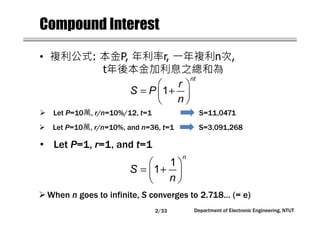
Compound Interest
• 複利公式: 本金P, 年利率r, 一年複利n次,
t年後本金加利息之總和為
 
= + 
 
1
nt
r
S P
n
• Let P=1, r=1, and t=1
 
= + 
 
1
1
n
S
n
When n goes to infinite, S converges to 2.718… (= e)
Let P=10萬, r/n=10%/12, t=1 S=11,0471
Let P=10萬, r/n=10%, and n=36, t=1 S=3,091,268
2/33
Department of Electronic Engineering, NTUT
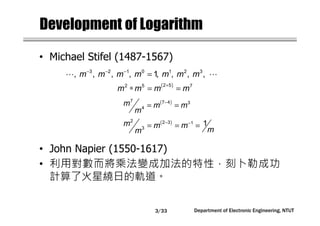
Development of Logarithm
• Michael Stifel (1487-1567)
• John Napier (1550-1617)
• 利用對數而將乘法變成加法的特性,刻卜勒成功
計算了火星繞日的軌道。
( )+
∗ = =
2 52 5 7
m m m m
( )−
= =
7 7 4 3
4
m m m
m
( )− −
= = =
2 2 3 1
3
1m m m
mm
− − −
=⋯ ⋯3 2 1 0 1 2 3
, , , , 1, , , ,m m m m m m m
3/33
Department of Electronic Engineering, NTUT
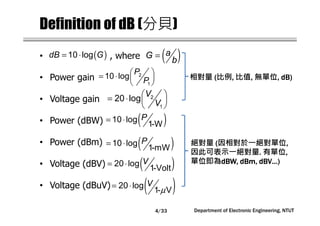
Definition of dB (分貝)
• , where
• Power gain
• Voltage gain
• Power (dBW)
• Power (dBm)
• Voltage (dBV)
• Voltage (dBuV)
( )= ⋅10 logdB G ( )= aG
b
 = ⋅  
 
2
1
10 log
P
P
 = ⋅  
 
2
1
20 log
V
V
( )= ⋅10 log
1-W
P
( )= ⋅10 log
1-mW
P
( )= ⋅20 log
1-Volt
V
( )µ
= ⋅20 log
1- V
V
相對量 ((((比例,,,, 比值,,,, 無單位, dB), dB), dB), dB)
絕對量 ((((因相對於一絕對單位,,,,
因此可表示一絕對量.... 有單位,,,,
單位即為dBWdBWdBWdBW,,,, dBmdBmdBmdBm,,,, dBVdBVdBVdBV…)…)…)…)
4/33
Department of Electronic Engineering, NTUT
In some textbooks, phasor may be
represented as
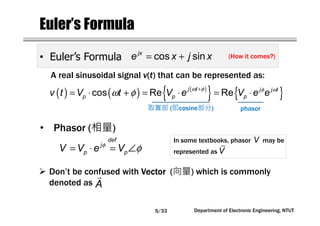
Euler’s Formula
• Euler’s Formula cos sinjx
e x j x= +
( ) ( ) ( )
{ } { }ω φ φ ω
ω φ +
= ⋅ + = ⋅ = ⋅cos Re Re
j t j j t
p p pv t V t V e V e e
φ
φ= ⋅ = ∠
def
j
p pV V e V
• Phasor (相量)
Don’t be confused with VectorVectorVectorVector (向量) which is commonly
denoted as A
(How it comes?)
取實部 (即cosine部分) phasor
A real sinusoidal signal v(t) that can be represented as:
V
V
5/33
Department of Electronic Engineering, NTUT
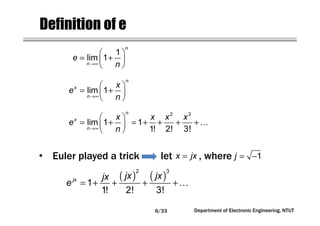
Definition of e
lim 1
n
x
n
x
e
n→∞
 
= + 
 
2 3
lim 1 1
1! 2! 3!
n
x
n
x x x x
e
n→∞
 
= + = + + + + 
 
…
x jx=
( ) ( )
2 3
1
1! 2! 3!
jx jx jxjx
e = + + + +…
• Euler played a trick let , where 1j = −
1
lim 1
n
n
e
n→∞
 
= + 
 
6/33
Department of Electronic Engineering, NTUT
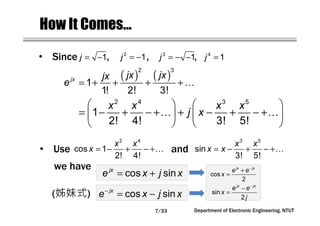
• Since , , ,
How It Comes…
1j = − 2
1j = − 3
1j = − − 4
1j =
   
= − + − + + − + − +   
   
… …
2 4 3 5
1
2! 4! 3! 5!
x x x x
j x
2 4
cos 1
2! 4!
x x
x = − + − +…
3 5
sin
3! 5!
x x
x x= − + − +…
cos sinjx
e x j x= +
cos sinjx
e x j x−
= −
cos
2
jx jx
e e
x
−
+
=
−
−
=sin
2
jx jx
e e
x
j
( ) ( )= + + + +…
2 3
1
1! 2! 3!
jx jx jxjx
e
• Use and
we have
(姊妹式)
7/33
Department of Electronic Engineering, NTUT
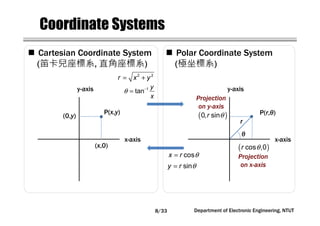
Coordinate Systems
x-axis
y-axis
x-axis
y-axis
P(r,θ)
θ
r
P(x,y)
2 2
r x y= +
1
tan
y
x
θ −
=
cosx r θ=
siny r θ=
Cartesian Coordinate System
(笛卡兒座標系, 直角座標系)
Polar Coordinate System
(極坐標系)
(x,0)
(0,y)
( )cos ,0r θ
( )0, sinr θ
Projection
on x-axis
Projection
on y-axis
8/33
Department of Electronic Engineering, NTUT
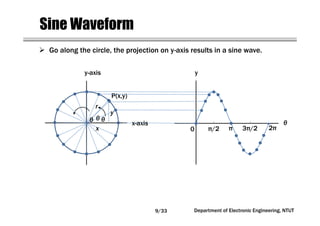
Sine Waveform
x-axis
y-axis
P(x,y)
x
y
r
θ θθ
y
θ
0 π/2 π 3π/2 2π
Go along the circle, the projection on y-axis results in a sine wave.
9/33
Department of Electronic Engineering, NTUT
x
θ
0
π/2
π
3π/2
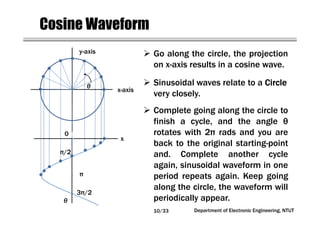
Cosine Waveform
x-axis
y-axis
θ
Go along the circle, the projection
on x-axis results in a cosine wave.
Sinusoidal waves relate to a CircleCircleCircleCircle
very closely.
Complete going along the circle to
finish a cycle, and the angle θ
rotates with 2π rads and you are
back to the original starting-point
and. Complete another cycle
again, sinusoidal waveform in one
period repeats again. Keep going
along the circle, the waveform will
periodically appear.
10/33
Department of Electronic Engineering, NTUT
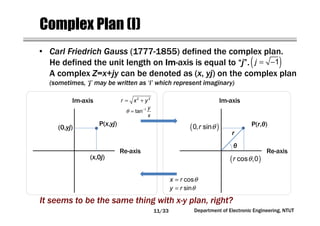
Complex Plan (I)
It seems to be the same thing with x-y plan, right?
• Carl Friedrich Gauss (1777-1855) defined the complex plan.
He defined the unit length on ImImImIm-axis is equal to “j”.
A complex Z=x+jy can be denoted as (x, yj) on the complex plan.
(sometimes, ‘j’ may be written as ‘i’ which represent imaginary)
Re-axis
Im-axis
Re-axis
Im-axis
P(r,θ)
θ
r
P(x,yj)
2 2
r x y= +
1
tan
y
x
θ −
=
cosx r θ=
siny r θ=
(x,0j)
(0,yj)
( )cos ,0r θ
( )0, sinr θ
( )1j = −
11/33
Department of Electronic Engineering, NTUT
Complex Plan (II)
Re-axis
Im-axis
1
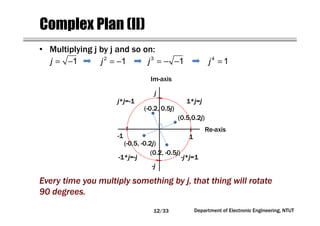
Every time you multiply something by j, that thing will rotate
90 degrees.
1j = − 2
1j = − 3
1j = − − 4
1j =
1*j=j
j
j*j=-1
-1
-j
-1*j=-j -j*j=1
(0.5,0.2j)
(-0.2, 0.5j)
(-0.5, -0.2j)
(0.2, -0.5j)
• Multiplying j by j and so on:
12/33
Department of Electronic Engineering, NTUT
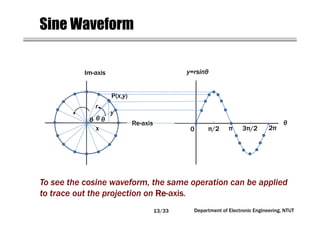
Sine Waveform
Re-axis
Im-axis
P(x,y)
x
y
r
θ θθ
y=rsinθ
θ
0 π/2 π 3π/2 2π
To see the cosine waveform, the same operation can be applied
to trace out the projection on ReReReRe-axis.
13/33
Department of Electronic Engineering, NTUT
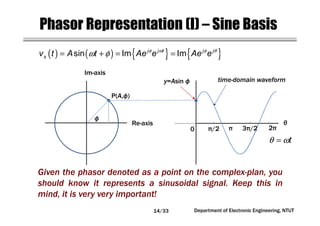
Phasor Representation (I) – Sine Basis
( ) ( ) { } { }φ ω φ θ
ω φ= + = =sin Im Imj j t j j
sv t A t Ae e Ae e
Re-axis
Im-axis
P(A,ф)
y=Asin ф
θ
0 π/2 π 3π/2 2π
ф
tθ ω=
Given the phasor denoted as a point on the complex-plan, you
should know it represents a sinusoidal signal. Keep this in
mind, it is very very important!
time-domain waveform
14/33
Department of Electronic Engineering, NTUT
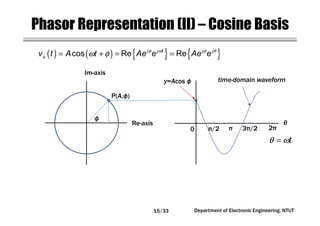
Phasor Representation (II) – Cosine Basis
( ) ( ) { } { }φ ω φ θ
ω φ= + = =cos Re Rej j t j j
sv t A t Ae e Ae e
Re-axis
Im-axis
P(A,ф)
y=Acos ф
θ
0 π/2 π 3π/2 2π
ф
tθ ω=
time-domain waveform
15/33
Department of Electronic Engineering, NTUT
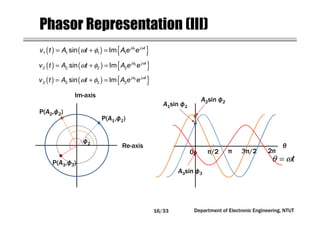
Phasor Representation (III)
( ) ( ) { }φ ω
ω φ= + = 1
1 1 1 1sin Im j j t
v t A t A e e
Re-axis
Im-axis
P(A1,ф1)
ф1
P(A2,ф2)
P(A3,ф3)
θ
0 π/2 π 3π/2 2π
tθ ω=
A1sin ф1
( ) ( ) { }φ ω
ω φ= + = 2
2 2 2 2sin Im j j t
v t A t A e e
( ) ( ) { }φ ω
ω φ= + = 3
3 3 3 3sin Im j j t
v t A t A e e
A2sin ф2
A3sin ф3
16/33
Department of Electronic Engineering, NTUT
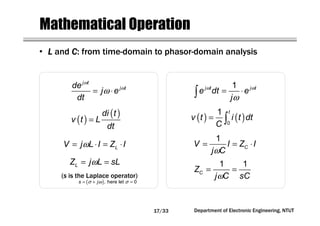
Mathematical Operation
j t
j tde
j e
dt
ω
ω
ω= ⋅
1j t j t
e dt e
j
ω ω
ω
= ⋅∫
( ) ( )0
1 t
v t i t dt
C
= ∫
ω
= = ⋅
1
CV I Z I
j C
( )
( )di t
v t L
dt
=
ω= ⋅ = ⋅LV j L I Z I
ω
= =
1 1
CZ
j C sC
ω= =LZ j L sL
• LLLL and CCCC: from time-domain to phasor-domain analysis
(s is the Laplace operator)
( )σ ω σ= + =, here let 0s j
17/33
Department of Electronic Engineering, NTUT
Phasor Everywhere
• 電路學、電子學: Phasor 常見為一個固定值 (亦可為變量)
• 電磁學、微波工程: Phasor 常見為變動量, 隨傳播方向變化
• 通訊系統: Phasor 常見為變動量, 隨時間變化
此變動的phasor也經常被稱作複數波包(complex envelope)、波包
(envelope),或帶通訊號的等效低通訊號(equivalent lowpass signal of
the bandpass signal)。Phasor如果被拆成正交兩成分,常稱作I/Q訊
號,而在數位通訊裡表示I/Q訊號的複數平面(座標系)也被稱為星座
圖(constellation)。
• You will see “Phasor” many times in your E.E. life. It just
appears with different names, and it is just a representation
or an analysis technique.
• Keep in mind that a phasor represents a signal, it’s like a
head on your body.
18/33
Department of Electronic Engineering, NTUT
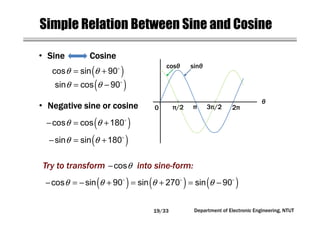
Simple Relation Between Sine and Cosine
• Sine CosineSine CosineSine CosineSine Cosine
π/2 π 3π/2 2π
sinθ
θ
0
cosθ
• Negative sine or cosineNegative sine or cosineNegative sine or cosineNegative sine or cosine
( )θ θ= +cos sin 90
( )θ θ= −sin cos 90
( )θ θ− = +cos cos 180
( )θ θ− = +sin sin 180
Try to transform into sine-form:θ−cos
( ) ( ) ( )θ θ θ θ− = − + = + = −cos sin 90 sin 270 sin 90
19/33
Department of Electronic Engineering, NTUT
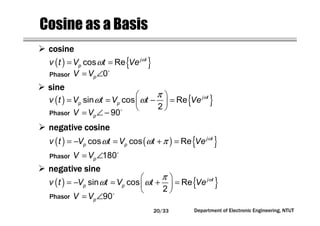
Cosine as a Basis
( ) { }ω
ω= =cos Re j t
pv t V t Ve
= ∠0pV V
( ) { }ωπ
ω ω
 
= = − = 
 
sin cos Re
2
j t
p pv t V t V t Ve
= ∠ − 90pV V
( ) ( ) { }ω
ω ω π= − = + =cos cos Re j t
p pv t V t V t Ve
= ∠180pV V
( ) { }ωπ
ω ω
 
= − = + = 
 
sin cos Re
2
j t
p pv t V t V t Ve
= ∠90pV V
cosinecosinecosinecosine
sinesinesinesine
negative cosinenegative cosinenegative cosinenegative cosine
negative sinenegative sinenegative sinenegative sine
Phasor
Phasor
Phasor
Phasor
20/33
Department of Electronic Engineering, NTUT
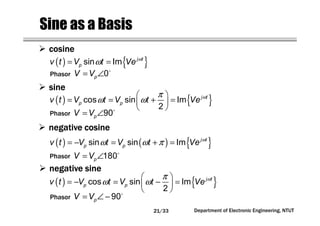
Sine as a Basis
( ) { }ω
ω= =sin Im j t
pv t V t Ve
= ∠0pV V
( ) { }ωπ
ω ω
 
= = + = 
 
cos sin Im
2
j t
p pv t V t V t Ve
= ∠90pV V
( ) ( ) { }ω
ω ω π= − = + =sin sin Im j t
p pv t V t V t Ve
= ∠180pV V
( ) { }ωπ
ω ω
 
= − = − = 
 
cos sin Im
2
j t
p pv t V t V t Ve
= ∠ − 90pV V
Phasor
Phasor
Phasor
Phasor
cosinecosinecosinecosine
sinesinesinesine
negative cosinenegative cosinenegative cosinenegative cosine
negative sinenegative sinenegative sinenegative sine
21/33
Department of Electronic Engineering, NTUT
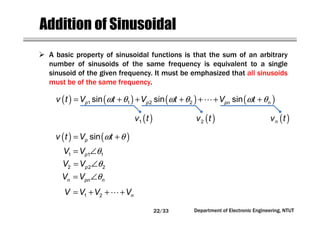
Addition of Sinusoidal
A basic property of sinusoidal functions is that the sum of an arbitrary
number of sinusoids of the same frequency is equivalent to a single
sinusoid of the given frequency. It must be emphasized that all sinusoids
must be of the same frequency.
( ) ( )ω θ= +sinpv t V t
θ= ∠1 1 1pV V
θ= ∠2 2 2pV V
θ= ∠n pn nV V
= + + +⋯1 2 nV V V V
( ) ( ) ( ) ( )ω θ ω θ ω θ= + + + + + +⋯1 1 2 2sin sin sinp p pn nv t V t V t V t
( )1v t ( )2v t ( )nv t
22/33
Department of Electronic Engineering, NTUT
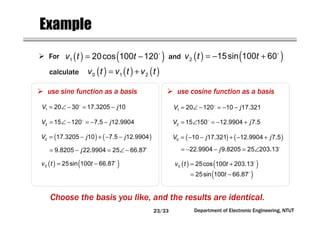
Example
( ) ( ) ( )= +0 1 2v t v t v t
( ) ( )= −1 20cos 100 120v t t ( ) ( )= − +2 15sin 100 60v t t
= ∠ − = −1 20 30 17.3205 10V j
= ∠ − = − −2 15 120 7.5 12.9904V j
( ) ( )= − + − −0 17.3205 10 7.5 12.9904V j j
( ) ( )= −0 25sin 100 66.87v t t
= − = ∠ −9.8205 22.9904 25 66.87j
= ∠ − = − −1 20 120 10 17.321V j
= ∠ = − +2 15 150 12.9904 7.5V j
( ) ( )= − − + − +0 10 17.321 12.9904 7.5V j j
= − − = ∠22.9904 9.8205 25 203.13j
( ) ( )= +0 25cos 100 203.13v t t
( )= −25sin 100 66.87t
Choose the basis you like, and the results are identical.
andFor
calculate
use sine function as a basis use cosine function as a basis
23/33
Department of Electronic Engineering, NTUT
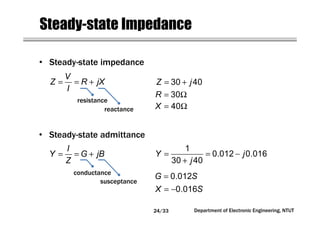
Steady-state Impedance
= = +
V
Z R jX
I
• Steady-state impedance
resistance
reactance
= = +
I
Y G jB
Z
• Steady-state admittance
conductance
susceptance
= +30 40Z j
= Ω30R
= Ω40X
= = −
+
1
0.012 0.016
30 40
Y j
j
= 0.012G S
= −0.016X S
24/33
Department of Electronic Engineering, NTUT
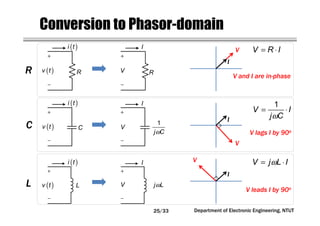
Conversion to Phasor-domain
( )i t
( )v t V
I
RR
( )i t
( )v t
( )i t
( )v t
C
L
ω
1
j C
V
I
ωj LV
I
= ⋅V R I
ω
= ⋅
1
V I
j C
ω= ⋅V j L I
V
I
V
I
V
I
V and I are in-phase
V lags I by 90o
V leads I by 90o
R
C
L
25/33
Department of Electronic Engineering, NTUT
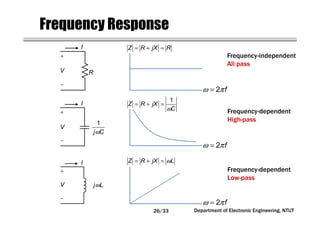
Frequency Response
Frequency-independent
All pass
Frequency-dependent
High-pass
Frequency-dependent
Low-pass
V
I
R
ω
1
j C
V
I
ωj LV
I
= + =Z R jX R
ω
= + =
1
Z R jX
C
ω π= 2 f
ω π= 2 f
ω π= 2 f
ω= + =Z R jX L
26/33
Department of Electronic Engineering, NTUT
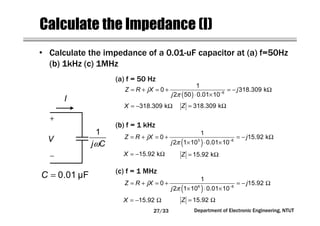
Calculate the Impedance (I)
ω
1
j C
V
• Calculate the impedance of a 0.01-uF capacitor at (a) f=50Hz
(b) 1kHz (c) 1MHz
( )π −
= + = + = − Ω
⋅ × 6
1
0 318.309 k
2 50 0.01 10
Z R jX j
j
= − Ω318.309 kX = Ω318.309 kZ
I
(a) f = 50 Hz
( )π −
= + = + = − Ω
× ⋅ ×3 6
1
0 15.92 k
2 1 10 0.01 10
Z R jX j
j
= − Ω15.92 kX = Ω15.92 kZ
(b) f = 1 kHz
( )π −
= + = + = − Ω
× ⋅ ×6 6
1
0 15.92
2 1 10 0.01 10
Z R jX j
j
= − Ω15.92X = Ω15.92Z
(c) f = 1 MHz
= 0.01 µFC
27/33
Department of Electronic Engineering, NTUT
Calculate the Impedance (II)
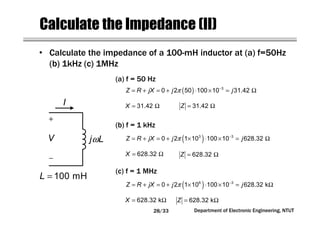
• Calculate the impedance of a 100-mH inductor at (a) f=50Hz
(b) 1kHz (c) 1MHz
( )π −
= + = + ⋅ × = Ω3
0 2 50 100 10 31.42Z R jX j j
= Ω31.42X = Ω31.42Z
(a) f = 50 Hz
( )π −
= + = + × ⋅ × = Ω3 3
0 2 1 10 100 10 628.32Z R jX j j
= Ω628.32X = Ω628.32Z
(b) f = 1 kHz
( )π −
= + = + × ⋅ × = Ω6 3
0 2 1 10 100 10 628.32 kZ R jX j j
= Ω628.32 kX = Ω628.32 kZ
(c) f = 1 MHz
ωj LV
I
= 100 mHL
28/33
Department of Electronic Engineering, NTUT
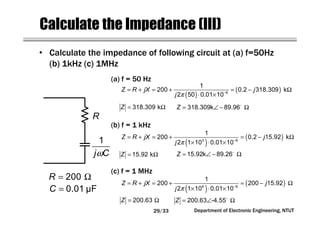
Calculate the Impedance (III)
• Calculate the impedance of following circuit at (a) f=50Hz
(b) 1kHz (c) 1MHz
( )
( )
π −
= + = + = − Ω
⋅ × 6
1
200 0.2 318.309 k
2 50 0.01 10
Z R jX j
j
= Ω318.309 kZ
(a) f = 50 Hz
( )
( )
π −
= + = + = − Ω
× ⋅ ×3 6
1
200 0.2 15.92 k
2 1 10 0.01 10
Z R jX j
j
= Ω15.92 kZ
(b) f = 1 kHz
( )
( )
π −
= + = + = − Ω
× ⋅ ×6 6
1
200 200 15.92
2 1 10 0.01 10
Z R jX j
j
= Ω200.63Z
(c) f = 1 MHz
ω
1
j C
= 0.01 µFC
R
= Ω200R
= ∠ − Ω318.309k 89.96Z
= ∠ − Ω15.92k 89.26Z
= ∠ Ω200.63 -4.55Z
29/33
Department of Electronic Engineering, NTUT
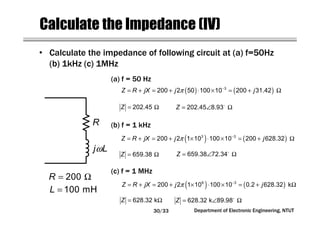
Calculate the Impedance (IV)
• Calculate the impedance of following circuit at (a) f=50Hz
(b) 1kHz (c) 1MHz
( ) ( )π −
= + = + ⋅ × = + Ω3
200 2 50 100 10 200 31.42Z R jX j j
= Ω202.45Z
(a) f = 50 Hz
( ) ( )π −
= + = + × ⋅ × = + Ω3 3
200 2 1 10 100 10 200 628.32Z R jX j j
= Ω659.38Z
(b) f = 1 kHz
( ) ( )π −
= + = + × ⋅ × = + Ω6 3
200 2 1 10 100 10 0.2 628.32 kZ R jX j j
= Ω628.32 kZ
(c) f = 1 MHz
ωj L
= 100 mHL
R
= Ω200R
= ∠ Ω202.45 8.93Z
= ∠ Ω659.38 72.34Z
= ∠ Ω628.32 k 89.98Z
30/33
Department of Electronic Engineering, NTUT
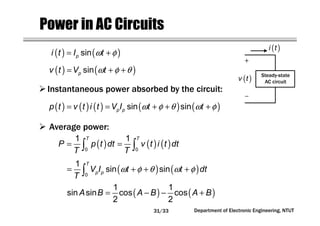
Power in AC Circuits
( ) ( )ω φ= +sinpi t I t
( ) ( )ω φ θ= + +sinpv t V t
Instantaneous power absorbed by the circuit:
( ) ( ) ( ) ( ) ( )ω φ θ ω φ= = + + +sin sinp pp t v t i t V I t t
( ) ( ) ( )= =∫ ∫0 0
1 1T T
P p t dt v t i t dt
T T
Average power:
( ) ( )= − − +
1 1
sin sin cos cos
2 2
A B A B A B
Steady-state
AC circuit
( )i t
( )v t
( ) ( )ω φ θ ω φ= + + +∫0
1
sin sin
T
p pV I t t dt
T
31/33
Department of Electronic Engineering, NTUT
Power in AC Circuits
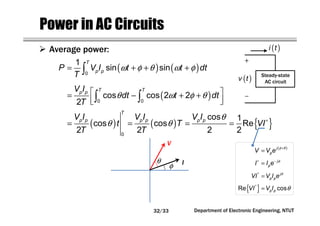
Average power:
( )θ ω φ θ = − + +
  ∫ ∫0 0
cos cos 2 2
2
T Tp pV I
dt t dt
T
( ) ( ) { }
θ
θ θ ∗
= = = =
0
cos 1
cos cos Re
2 2 2 2
T
p p p p p pV I V I V I
t T VI
T T
Steady-state
AC circuit
( )i t
( )v t
( ) ( )ω φ θ ω φ= + + +∫0
1
sin sin
T
p pP V I t t dt
T
V
Iθ
φ
( )φ θ+
=
j
pV V e
φ∗ −
= j
pI I e
θ
=* j
p pVI V I e
{ } θ=*
Re cosp pVI V I
32/33
Department of Electronic Engineering, NTUT
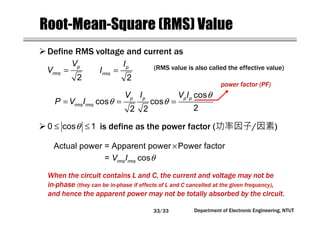
Root-Mean-Square (RMS) Value
θ
θ θ= = =
cos
cos cos
22 2
p p p p
rms rms
V I V I
P V I
(RMS value is also called the effective value)
When the circuit contains L and C, the current and voltage may not be
in-phase (they can be in-phase if effects of L and C cancelled at the given frequency),
and hence the apparent power may not be totally absorbed by the circuit.
Define RMS voltage and current as
=
2
p
rms
V
V =
2
p
rms
I
I
power factor (PF)
is define as the power factor (功率因子/因素)θ≤ ≤0 cos 1
×Actual power = Apparent power Power factor
θ= cosrms rmsV I
33/33

Circuit Network Analysis - [Chapter2] Sinusoidal Steady-state Analysis

  • 1.
    Network Analysis Chapter 2e, Phasor, and Sinusoidal Steady-State Analysis Chien-Jung Li Department of Electronic Engineering National Taipei University of Technology
  • 2.
    Department of ElectronicEngineering, NTUT Compound Interest • 複利公式: 本金P, 年利率r, 一年複利n次, t年後本金加利息之總和為   = +    1 nt r S P n • Let P=1, r=1, and t=1   = +    1 1 n S n When n goes to infinite, S converges to 2.718… (= e) Let P=10萬, r/n=10%/12, t=1 S=11,0471 Let P=10萬, r/n=10%, and n=36, t=1 S=3,091,268 2/33
  • 3.
    Department of ElectronicEngineering, NTUT Development of Logarithm • Michael Stifel (1487-1567) • John Napier (1550-1617) • 利用對數而將乘法變成加法的特性,刻卜勒成功 計算了火星繞日的軌道。 ( )+ ∗ = = 2 52 5 7 m m m m ( )− = = 7 7 4 3 4 m m m m ( )− − = = = 2 2 3 1 3 1m m m mm − − − =⋯ ⋯3 2 1 0 1 2 3 , , , , 1, , , ,m m m m m m m 3/33
  • 4.
    Department of ElectronicEngineering, NTUT Definition of dB (分貝) • , where • Power gain • Voltage gain • Power (dBW) • Power (dBm) • Voltage (dBV) • Voltage (dBuV) ( )= ⋅10 logdB G ( )= aG b  = ⋅     2 1 10 log P P  = ⋅     2 1 20 log V V ( )= ⋅10 log 1-W P ( )= ⋅10 log 1-mW P ( )= ⋅20 log 1-Volt V ( )µ = ⋅20 log 1- V V 相對量 ((((比例,,,, 比值,,,, 無單位, dB), dB), dB), dB) 絕對量 ((((因相對於一絕對單位,,,, 因此可表示一絕對量.... 有單位,,,, 單位即為dBWdBWdBWdBW,,,, dBmdBmdBmdBm,,,, dBVdBVdBVdBV…)…)…)…) 4/33
  • 5.
    Department of ElectronicEngineering, NTUT In some textbooks, phasor may be represented as Euler’s Formula • Euler’s Formula cos sinjx e x j x= + ( ) ( ) ( ) { } { }ω φ φ ω ω φ + = ⋅ + = ⋅ = ⋅cos Re Re j t j j t p p pv t V t V e V e e φ φ= ⋅ = ∠ def j p pV V e V • Phasor (相量) Don’t be confused with VectorVectorVectorVector (向量) which is commonly denoted as A (How it comes?) 取實部 (即cosine部分) phasor A real sinusoidal signal v(t) that can be represented as: V V 5/33
  • 6.
    Department of ElectronicEngineering, NTUT Definition of e lim 1 n x n x e n→∞   = +    2 3 lim 1 1 1! 2! 3! n x n x x x x e n→∞   = + = + + + +    … x jx= ( ) ( ) 2 3 1 1! 2! 3! jx jx jxjx e = + + + +… • Euler played a trick let , where 1j = − 1 lim 1 n n e n→∞   = +    6/33
  • 7.
    Department of ElectronicEngineering, NTUT • Since , , , How It Comes… 1j = − 2 1j = − 3 1j = − − 4 1j =     = − + − + + − + − +        … … 2 4 3 5 1 2! 4! 3! 5! x x x x j x 2 4 cos 1 2! 4! x x x = − + − +… 3 5 sin 3! 5! x x x x= − + − +… cos sinjx e x j x= + cos sinjx e x j x− = − cos 2 jx jx e e x − + = − − =sin 2 jx jx e e x j ( ) ( )= + + + +… 2 3 1 1! 2! 3! jx jx jxjx e • Use and we have (姊妹式) 7/33
  • 8.
    Department of ElectronicEngineering, NTUT Coordinate Systems x-axis y-axis x-axis y-axis P(r,θ) θ r P(x,y) 2 2 r x y= + 1 tan y x θ − = cosx r θ= siny r θ= Cartesian Coordinate System (笛卡兒座標系, 直角座標系) Polar Coordinate System (極坐標系) (x,0) (0,y) ( )cos ,0r θ ( )0, sinr θ Projection on x-axis Projection on y-axis 8/33
  • 9.
    Department of ElectronicEngineering, NTUT Sine Waveform x-axis y-axis P(x,y) x y r θ θθ y θ 0 π/2 π 3π/2 2π Go along the circle, the projection on y-axis results in a sine wave. 9/33
  • 10.
    Department of ElectronicEngineering, NTUT x θ 0 π/2 π 3π/2 Cosine Waveform x-axis y-axis θ Go along the circle, the projection on x-axis results in a cosine wave. Sinusoidal waves relate to a CircleCircleCircleCircle very closely. Complete going along the circle to finish a cycle, and the angle θ rotates with 2π rads and you are back to the original starting-point and. Complete another cycle again, sinusoidal waveform in one period repeats again. Keep going along the circle, the waveform will periodically appear. 10/33
  • 11.
    Department of ElectronicEngineering, NTUT Complex Plan (I) It seems to be the same thing with x-y plan, right? • Carl Friedrich Gauss (1777-1855) defined the complex plan. He defined the unit length on ImImImIm-axis is equal to “j”. A complex Z=x+jy can be denoted as (x, yj) on the complex plan. (sometimes, ‘j’ may be written as ‘i’ which represent imaginary) Re-axis Im-axis Re-axis Im-axis P(r,θ) θ r P(x,yj) 2 2 r x y= + 1 tan y x θ − = cosx r θ= siny r θ= (x,0j) (0,yj) ( )cos ,0r θ ( )0, sinr θ ( )1j = − 11/33
  • 12.
    Department of ElectronicEngineering, NTUT Complex Plan (II) Re-axis Im-axis 1 Every time you multiply something by j, that thing will rotate 90 degrees. 1j = − 2 1j = − 3 1j = − − 4 1j = 1*j=j j j*j=-1 -1 -j -1*j=-j -j*j=1 (0.5,0.2j) (-0.2, 0.5j) (-0.5, -0.2j) (0.2, -0.5j) • Multiplying j by j and so on: 12/33
  • 13.
    Department of ElectronicEngineering, NTUT Sine Waveform Re-axis Im-axis P(x,y) x y r θ θθ y=rsinθ θ 0 π/2 π 3π/2 2π To see the cosine waveform, the same operation can be applied to trace out the projection on ReReReRe-axis. 13/33
  • 14.
    Department of ElectronicEngineering, NTUT Phasor Representation (I) – Sine Basis ( ) ( ) { } { }φ ω φ θ ω φ= + = =sin Im Imj j t j j sv t A t Ae e Ae e Re-axis Im-axis P(A,ф) y=Asin ф θ 0 π/2 π 3π/2 2π ф tθ ω= Given the phasor denoted as a point on the complex-plan, you should know it represents a sinusoidal signal. Keep this in mind, it is very very important! time-domain waveform 14/33
  • 15.
    Department of ElectronicEngineering, NTUT Phasor Representation (II) – Cosine Basis ( ) ( ) { } { }φ ω φ θ ω φ= + = =cos Re Rej j t j j sv t A t Ae e Ae e Re-axis Im-axis P(A,ф) y=Acos ф θ 0 π/2 π 3π/2 2π ф tθ ω= time-domain waveform 15/33
  • 16.
    Department of ElectronicEngineering, NTUT Phasor Representation (III) ( ) ( ) { }φ ω ω φ= + = 1 1 1 1 1sin Im j j t v t A t A e e Re-axis Im-axis P(A1,ф1) ф1 P(A2,ф2) P(A3,ф3) θ 0 π/2 π 3π/2 2π tθ ω= A1sin ф1 ( ) ( ) { }φ ω ω φ= + = 2 2 2 2 2sin Im j j t v t A t A e e ( ) ( ) { }φ ω ω φ= + = 3 3 3 3 3sin Im j j t v t A t A e e A2sin ф2 A3sin ф3 16/33
  • 17.
    Department of ElectronicEngineering, NTUT Mathematical Operation j t j tde j e dt ω ω ω= ⋅ 1j t j t e dt e j ω ω ω = ⋅∫ ( ) ( )0 1 t v t i t dt C = ∫ ω = = ⋅ 1 CV I Z I j C ( ) ( )di t v t L dt = ω= ⋅ = ⋅LV j L I Z I ω = = 1 1 CZ j C sC ω= =LZ j L sL • LLLL and CCCC: from time-domain to phasor-domain analysis (s is the Laplace operator) ( )σ ω σ= + =, here let 0s j 17/33
  • 18.
    Department of ElectronicEngineering, NTUT Phasor Everywhere • 電路學、電子學: Phasor 常見為一個固定值 (亦可為變量) • 電磁學、微波工程: Phasor 常見為變動量, 隨傳播方向變化 • 通訊系統: Phasor 常見為變動量, 隨時間變化 此變動的phasor也經常被稱作複數波包(complex envelope)、波包 (envelope),或帶通訊號的等效低通訊號(equivalent lowpass signal of the bandpass signal)。Phasor如果被拆成正交兩成分,常稱作I/Q訊 號,而在數位通訊裡表示I/Q訊號的複數平面(座標系)也被稱為星座 圖(constellation)。 • You will see “Phasor” many times in your E.E. life. It just appears with different names, and it is just a representation or an analysis technique. • Keep in mind that a phasor represents a signal, it’s like a head on your body. 18/33
  • 19.
    Department of ElectronicEngineering, NTUT Simple Relation Between Sine and Cosine • Sine CosineSine CosineSine CosineSine Cosine π/2 π 3π/2 2π sinθ θ 0 cosθ • Negative sine or cosineNegative sine or cosineNegative sine or cosineNegative sine or cosine ( )θ θ= +cos sin 90 ( )θ θ= −sin cos 90 ( )θ θ− = +cos cos 180 ( )θ θ− = +sin sin 180 Try to transform into sine-form:θ−cos ( ) ( ) ( )θ θ θ θ− = − + = + = −cos sin 90 sin 270 sin 90 19/33
  • 20.
    Department of ElectronicEngineering, NTUT Cosine as a Basis ( ) { }ω ω= =cos Re j t pv t V t Ve = ∠0pV V ( ) { }ωπ ω ω   = = − =    sin cos Re 2 j t p pv t V t V t Ve = ∠ − 90pV V ( ) ( ) { }ω ω ω π= − = + =cos cos Re j t p pv t V t V t Ve = ∠180pV V ( ) { }ωπ ω ω   = − = + =    sin cos Re 2 j t p pv t V t V t Ve = ∠90pV V cosinecosinecosinecosine sinesinesinesine negative cosinenegative cosinenegative cosinenegative cosine negative sinenegative sinenegative sinenegative sine Phasor Phasor Phasor Phasor 20/33
  • 21.
    Department of ElectronicEngineering, NTUT Sine as a Basis ( ) { }ω ω= =sin Im j t pv t V t Ve = ∠0pV V ( ) { }ωπ ω ω   = = + =    cos sin Im 2 j t p pv t V t V t Ve = ∠90pV V ( ) ( ) { }ω ω ω π= − = + =sin sin Im j t p pv t V t V t Ve = ∠180pV V ( ) { }ωπ ω ω   = − = − =    cos sin Im 2 j t p pv t V t V t Ve = ∠ − 90pV V Phasor Phasor Phasor Phasor cosinecosinecosinecosine sinesinesinesine negative cosinenegative cosinenegative cosinenegative cosine negative sinenegative sinenegative sinenegative sine 21/33
  • 22.
    Department of ElectronicEngineering, NTUT Addition of Sinusoidal A basic property of sinusoidal functions is that the sum of an arbitrary number of sinusoids of the same frequency is equivalent to a single sinusoid of the given frequency. It must be emphasized that all sinusoids must be of the same frequency. ( ) ( )ω θ= +sinpv t V t θ= ∠1 1 1pV V θ= ∠2 2 2pV V θ= ∠n pn nV V = + + +⋯1 2 nV V V V ( ) ( ) ( ) ( )ω θ ω θ ω θ= + + + + + +⋯1 1 2 2sin sin sinp p pn nv t V t V t V t ( )1v t ( )2v t ( )nv t 22/33
  • 23.
    Department of ElectronicEngineering, NTUT Example ( ) ( ) ( )= +0 1 2v t v t v t ( ) ( )= −1 20cos 100 120v t t ( ) ( )= − +2 15sin 100 60v t t = ∠ − = −1 20 30 17.3205 10V j = ∠ − = − −2 15 120 7.5 12.9904V j ( ) ( )= − + − −0 17.3205 10 7.5 12.9904V j j ( ) ( )= −0 25sin 100 66.87v t t = − = ∠ −9.8205 22.9904 25 66.87j = ∠ − = − −1 20 120 10 17.321V j = ∠ = − +2 15 150 12.9904 7.5V j ( ) ( )= − − + − +0 10 17.321 12.9904 7.5V j j = − − = ∠22.9904 9.8205 25 203.13j ( ) ( )= +0 25cos 100 203.13v t t ( )= −25sin 100 66.87t Choose the basis you like, and the results are identical. andFor calculate use sine function as a basis use cosine function as a basis 23/33
  • 24.
    Department of ElectronicEngineering, NTUT Steady-state Impedance = = + V Z R jX I • Steady-state impedance resistance reactance = = + I Y G jB Z • Steady-state admittance conductance susceptance = +30 40Z j = Ω30R = Ω40X = = − + 1 0.012 0.016 30 40 Y j j = 0.012G S = −0.016X S 24/33
  • 25.
    Department of ElectronicEngineering, NTUT Conversion to Phasor-domain ( )i t ( )v t V I RR ( )i t ( )v t ( )i t ( )v t C L ω 1 j C V I ωj LV I = ⋅V R I ω = ⋅ 1 V I j C ω= ⋅V j L I V I V I V I V and I are in-phase V lags I by 90o V leads I by 90o R C L 25/33
  • 26.
    Department of ElectronicEngineering, NTUT Frequency Response Frequency-independent All pass Frequency-dependent High-pass Frequency-dependent Low-pass V I R ω 1 j C V I ωj LV I = + =Z R jX R ω = + = 1 Z R jX C ω π= 2 f ω π= 2 f ω π= 2 f ω= + =Z R jX L 26/33
  • 27.
    Department of ElectronicEngineering, NTUT Calculate the Impedance (I) ω 1 j C V • Calculate the impedance of a 0.01-uF capacitor at (a) f=50Hz (b) 1kHz (c) 1MHz ( )π − = + = + = − Ω ⋅ × 6 1 0 318.309 k 2 50 0.01 10 Z R jX j j = − Ω318.309 kX = Ω318.309 kZ I (a) f = 50 Hz ( )π − = + = + = − Ω × ⋅ ×3 6 1 0 15.92 k 2 1 10 0.01 10 Z R jX j j = − Ω15.92 kX = Ω15.92 kZ (b) f = 1 kHz ( )π − = + = + = − Ω × ⋅ ×6 6 1 0 15.92 2 1 10 0.01 10 Z R jX j j = − Ω15.92X = Ω15.92Z (c) f = 1 MHz = 0.01 µFC 27/33
  • 28.
    Department of ElectronicEngineering, NTUT Calculate the Impedance (II) • Calculate the impedance of a 100-mH inductor at (a) f=50Hz (b) 1kHz (c) 1MHz ( )π − = + = + ⋅ × = Ω3 0 2 50 100 10 31.42Z R jX j j = Ω31.42X = Ω31.42Z (a) f = 50 Hz ( )π − = + = + × ⋅ × = Ω3 3 0 2 1 10 100 10 628.32Z R jX j j = Ω628.32X = Ω628.32Z (b) f = 1 kHz ( )π − = + = + × ⋅ × = Ω6 3 0 2 1 10 100 10 628.32 kZ R jX j j = Ω628.32 kX = Ω628.32 kZ (c) f = 1 MHz ωj LV I = 100 mHL 28/33
  • 29.
    Department of ElectronicEngineering, NTUT Calculate the Impedance (III) • Calculate the impedance of following circuit at (a) f=50Hz (b) 1kHz (c) 1MHz ( ) ( ) π − = + = + = − Ω ⋅ × 6 1 200 0.2 318.309 k 2 50 0.01 10 Z R jX j j = Ω318.309 kZ (a) f = 50 Hz ( ) ( ) π − = + = + = − Ω × ⋅ ×3 6 1 200 0.2 15.92 k 2 1 10 0.01 10 Z R jX j j = Ω15.92 kZ (b) f = 1 kHz ( ) ( ) π − = + = + = − Ω × ⋅ ×6 6 1 200 200 15.92 2 1 10 0.01 10 Z R jX j j = Ω200.63Z (c) f = 1 MHz ω 1 j C = 0.01 µFC R = Ω200R = ∠ − Ω318.309k 89.96Z = ∠ − Ω15.92k 89.26Z = ∠ Ω200.63 -4.55Z 29/33
  • 30.
    Department of ElectronicEngineering, NTUT Calculate the Impedance (IV) • Calculate the impedance of following circuit at (a) f=50Hz (b) 1kHz (c) 1MHz ( ) ( )π − = + = + ⋅ × = + Ω3 200 2 50 100 10 200 31.42Z R jX j j = Ω202.45Z (a) f = 50 Hz ( ) ( )π − = + = + × ⋅ × = + Ω3 3 200 2 1 10 100 10 200 628.32Z R jX j j = Ω659.38Z (b) f = 1 kHz ( ) ( )π − = + = + × ⋅ × = + Ω6 3 200 2 1 10 100 10 0.2 628.32 kZ R jX j j = Ω628.32 kZ (c) f = 1 MHz ωj L = 100 mHL R = Ω200R = ∠ Ω202.45 8.93Z = ∠ Ω659.38 72.34Z = ∠ Ω628.32 k 89.98Z 30/33
  • 31.
    Department of ElectronicEngineering, NTUT Power in AC Circuits ( ) ( )ω φ= +sinpi t I t ( ) ( )ω φ θ= + +sinpv t V t Instantaneous power absorbed by the circuit: ( ) ( ) ( ) ( ) ( )ω φ θ ω φ= = + + +sin sinp pp t v t i t V I t t ( ) ( ) ( )= =∫ ∫0 0 1 1T T P p t dt v t i t dt T T Average power: ( ) ( )= − − + 1 1 sin sin cos cos 2 2 A B A B A B Steady-state AC circuit ( )i t ( )v t ( ) ( )ω φ θ ω φ= + + +∫0 1 sin sin T p pV I t t dt T 31/33
  • 32.
    Department of ElectronicEngineering, NTUT Power in AC Circuits Average power: ( )θ ω φ θ = − + +   ∫ ∫0 0 cos cos 2 2 2 T Tp pV I dt t dt T ( ) ( ) { } θ θ θ ∗ = = = = 0 cos 1 cos cos Re 2 2 2 2 T p p p p p pV I V I V I t T VI T T Steady-state AC circuit ( )i t ( )v t ( ) ( )ω φ θ ω φ= + + +∫0 1 sin sin T p pP V I t t dt T V Iθ φ ( )φ θ+ = j pV V e φ∗ − = j pI I e θ =* j p pVI V I e { } θ=* Re cosp pVI V I 32/33
  • 33.
    Department of ElectronicEngineering, NTUT Root-Mean-Square (RMS) Value θ θ θ= = = cos cos cos 22 2 p p p p rms rms V I V I P V I (RMS value is also called the effective value) When the circuit contains L and C, the current and voltage may not be in-phase (they can be in-phase if effects of L and C cancelled at the given frequency), and hence the apparent power may not be totally absorbed by the circuit. Define RMS voltage and current as = 2 p rms V V = 2 p rms I I power factor (PF) is define as the power factor (功率因子/因素)θ≤ ≤0 cos 1 ×Actual power = Apparent power Power factor θ= cosrms rmsV I 33/33