Network Analysis
Chapter 1 Basic Circuit Laws
Chien-Jung Li
Department of Electronic Engineering
National Taipei University of Technology
In This Chapter
• Fast reviews of some basic circuit laws
• Historical points of view
• Reviews of circuit analysis methods
Department of Electronic Engineering, NTUT
(such as mesh-current and node-voltage methods,
Thevenin’s and Norton’s theorem, and superposition
principles)
2/32
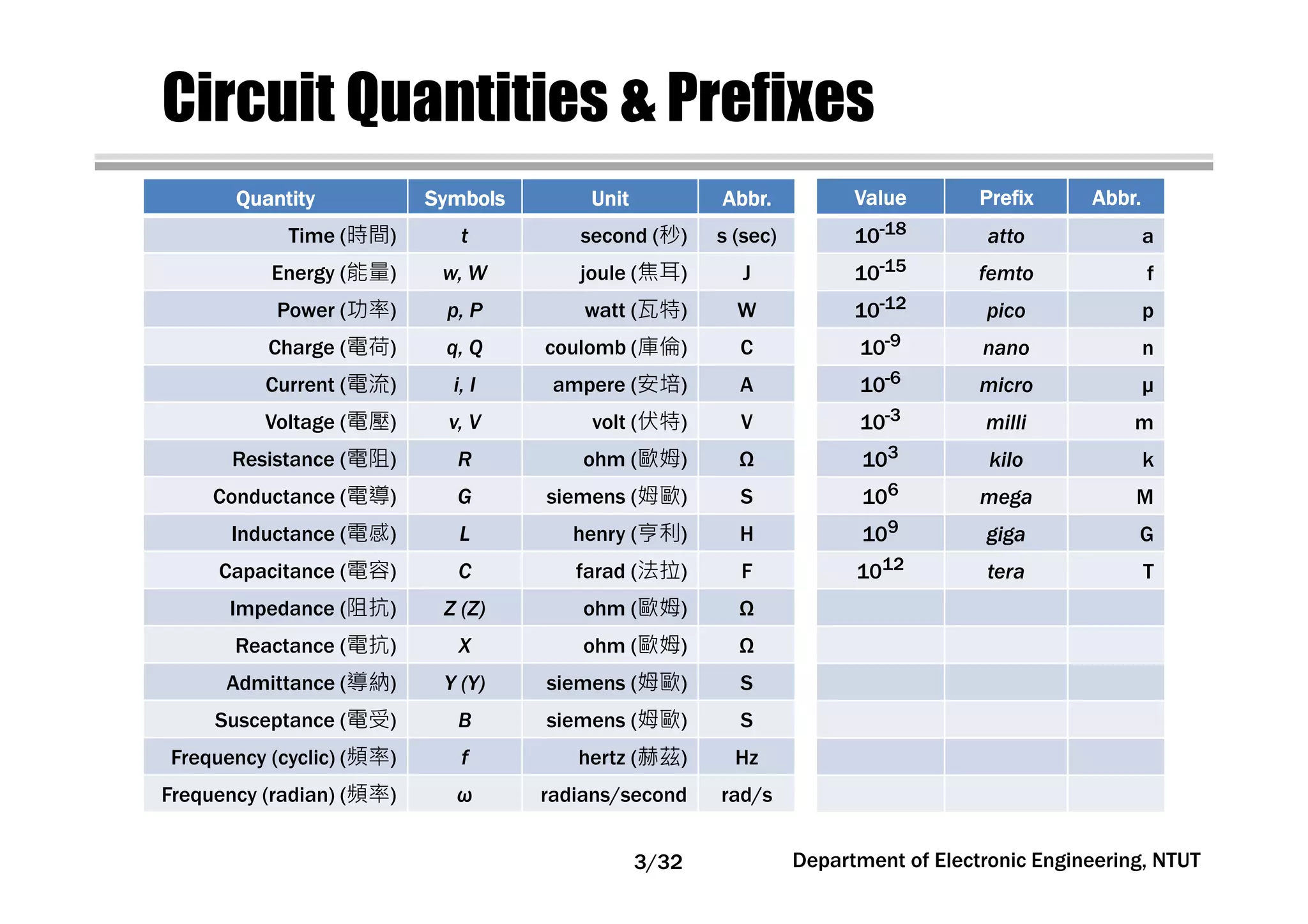
Circuit Quantities & Prefixes
QuantityQuantityQuantityQuantity SymbolsSymbolsSymbolsSymbols UnitUnitUnitUnit Abbr.Abbr.Abbr.Abbr.
Time (時間) t second (秒) s (sec)
Energy (能量) w, W joule (焦耳) J
Power (功率) p, P watt (瓦特) W
Charge (電荷) q, Q coulomb (庫倫) C
Current (電流) i, I ampere (安培) A
Voltage (電壓) v, V volt (伏特) V
Resistance (電阻) R ohm (歐姆) Ω
Conductance (電導) G siemens (姆歐) S
Inductance (電感) L henry (亨利) H
Capacitance (電容) C farad (法拉) F
Impedance (阻抗) Z (Z) ohm (歐姆) Ω
Reactance (電抗) X ohm (歐姆) Ω
Admittance (導納) Y (Y) siemens (姆歐) S
Susceptance (電受) B siemens (姆歐) S
Frequency (cyclic) (頻率) f hertz (赫茲) Hz
Frequency (radian) (頻率) ω radians/second rad/s
ValueValueValueValue PrefixPrefixPrefixPrefix Abbr.Abbr.Abbr.Abbr.
10-18 atto a
10-15 femto f
10-12 pico p
10-9 nano n
10-6 micro µ
10-3 milli m
103 kilo k
106 mega M
109 giga G
1012 tera T
Department of Electronic Engineering, NTUT3/32
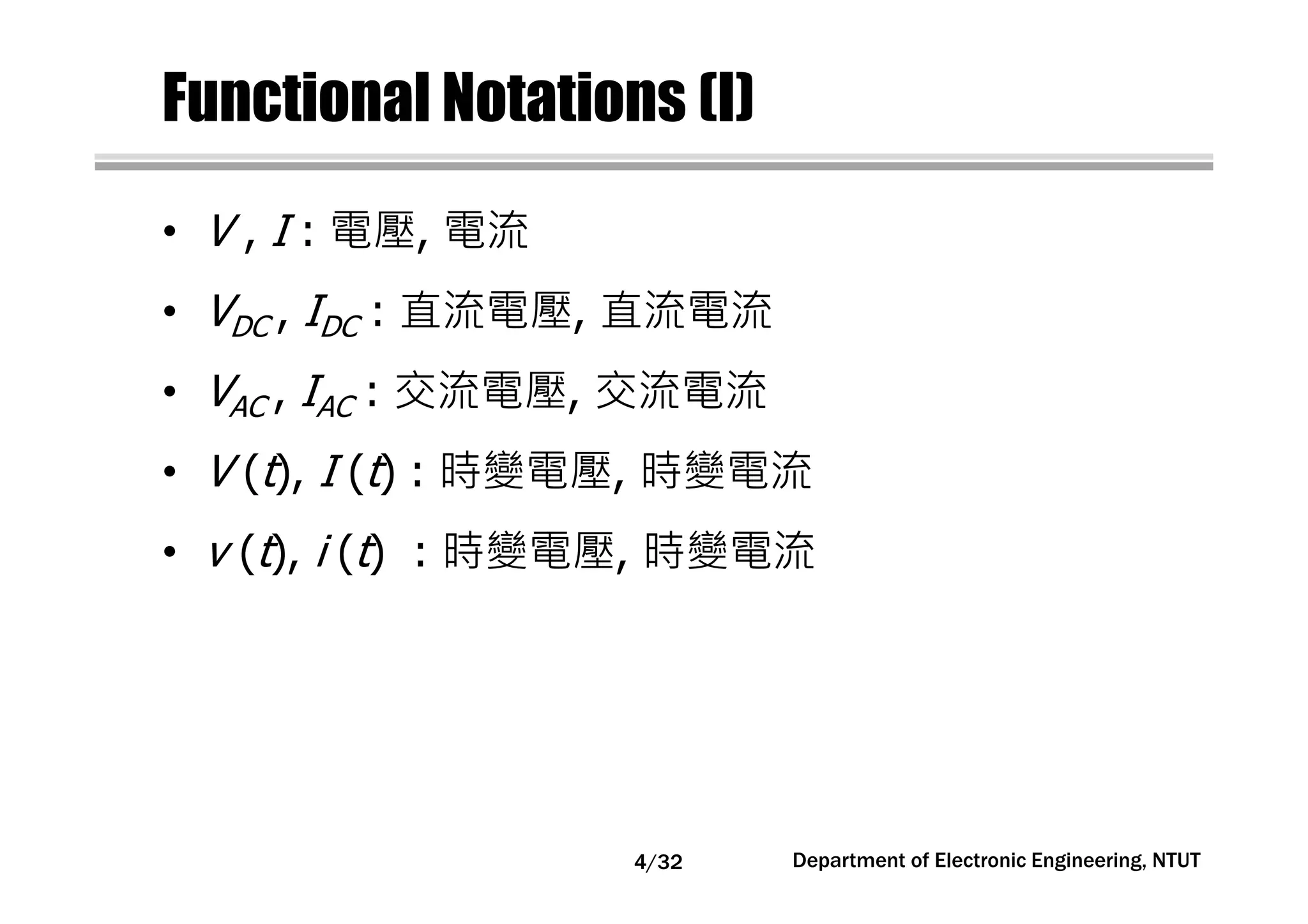
Functional Notations (I)
• V , I : 電壓, 電流
• VDC , IDC : 直流電壓, 直流電流
• VAC , IAC : 交流電壓, 交流電流
• V (t), I (t) : 時變電壓, 時變電流
• v (t), i (t) : 時變電壓, 時變電流
Department of Electronic Engineering, NTUT4/32
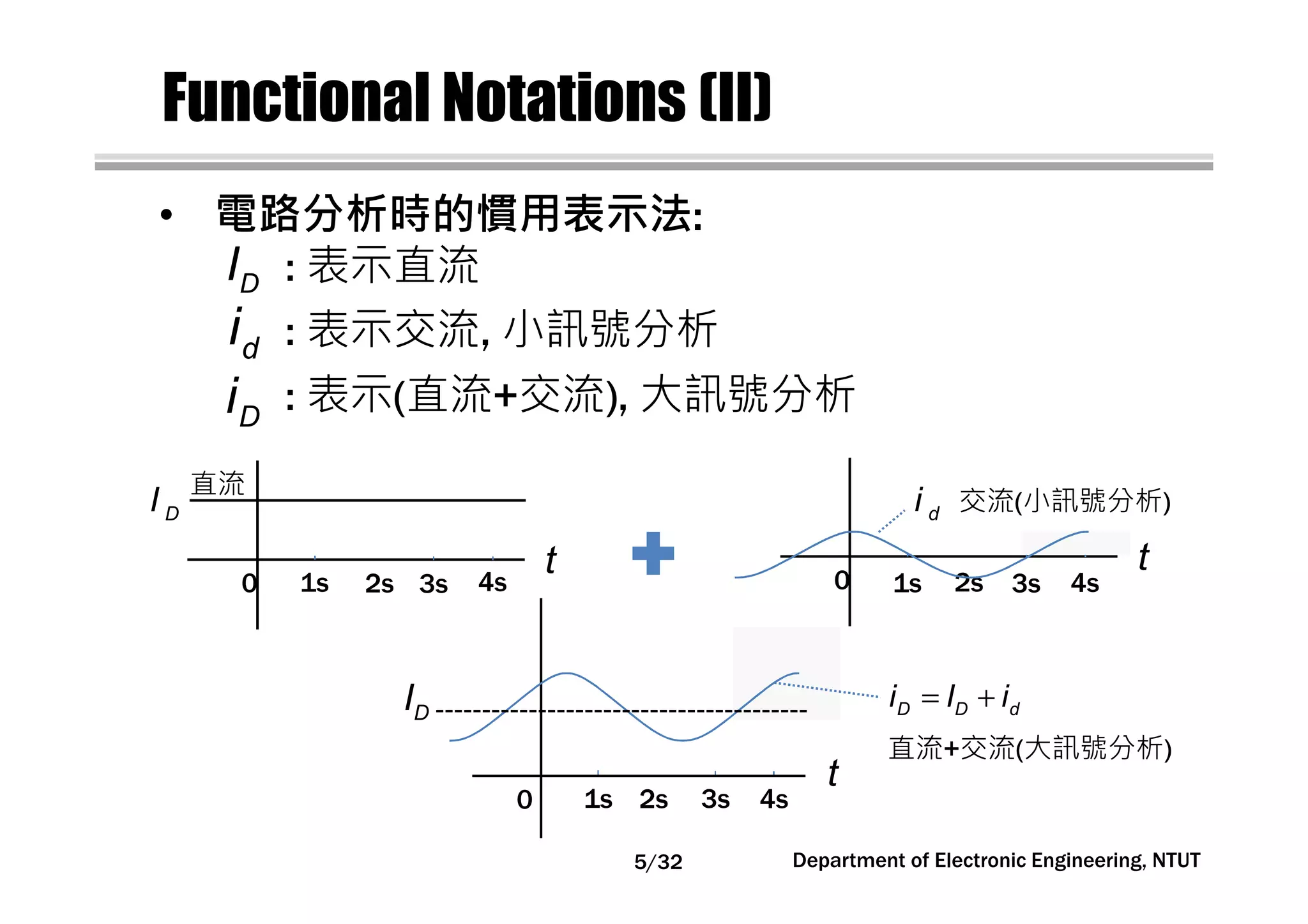
Functional Notations (II)
di
Di
DI : 表示直流
: 表示交流, 小訊號分析
: 表示(直流+交流), 大訊號分析
Department of Electronic Engineering, NTUT
• 電路分析時的慣用表示法::::
0 1s 2s 3s 4s
t
DI
直流
0 1s 2s 3s 4s
t
di 交流(小訊號分析)
0 1s 2s 3s 4s
t
DI = +D D di I i
直流+交流(大訊號分析)
5/32
Energy and Power (I)
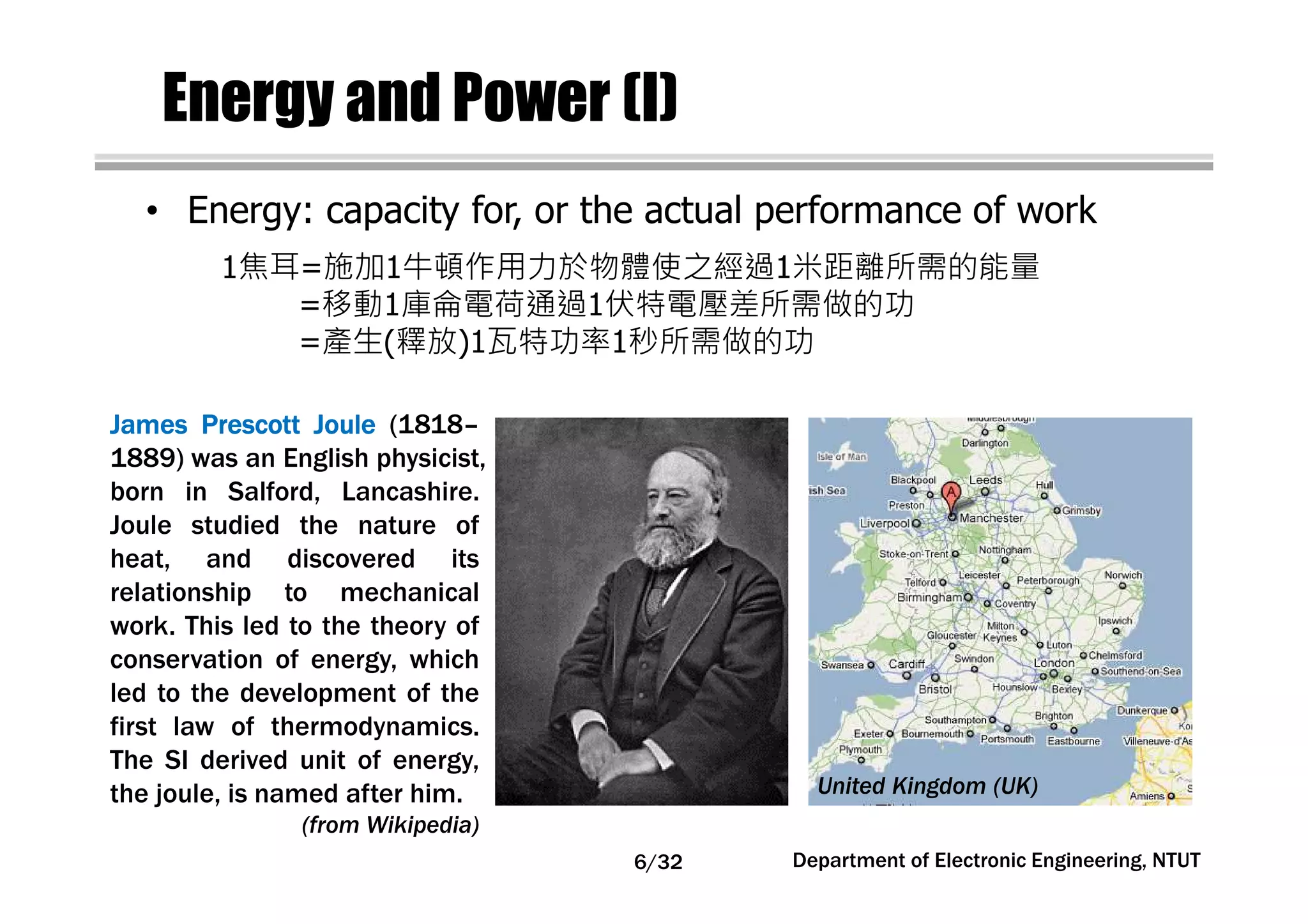
• Energy: capacity for, or the actual performance of work
JamesJamesJamesJames PrescottPrescottPrescottPrescott JouleJouleJouleJoule (1818–
1889) was an English physicist,
born in Salford, Lancashire.
Joule studied the nature of
heat, and discovered its
relationship to mechanical
work. This led to the theory of
conservation of energy, which
led to the development of the
first law of thermodynamics.
The SI derived unit of energy,
the joule, is named after him.
(from Wikipedia)
United Kingdom (UK)
1焦耳=施加1牛頓作用力於物體使之經過1米距離所需的能量
=移動1庫侖電荷通過1伏特電壓差所需做的功
=產生(釋放)1瓦特功率1秒所需做的功
Department of Electronic Engineering, NTUT6/32
Energy and Power (II)
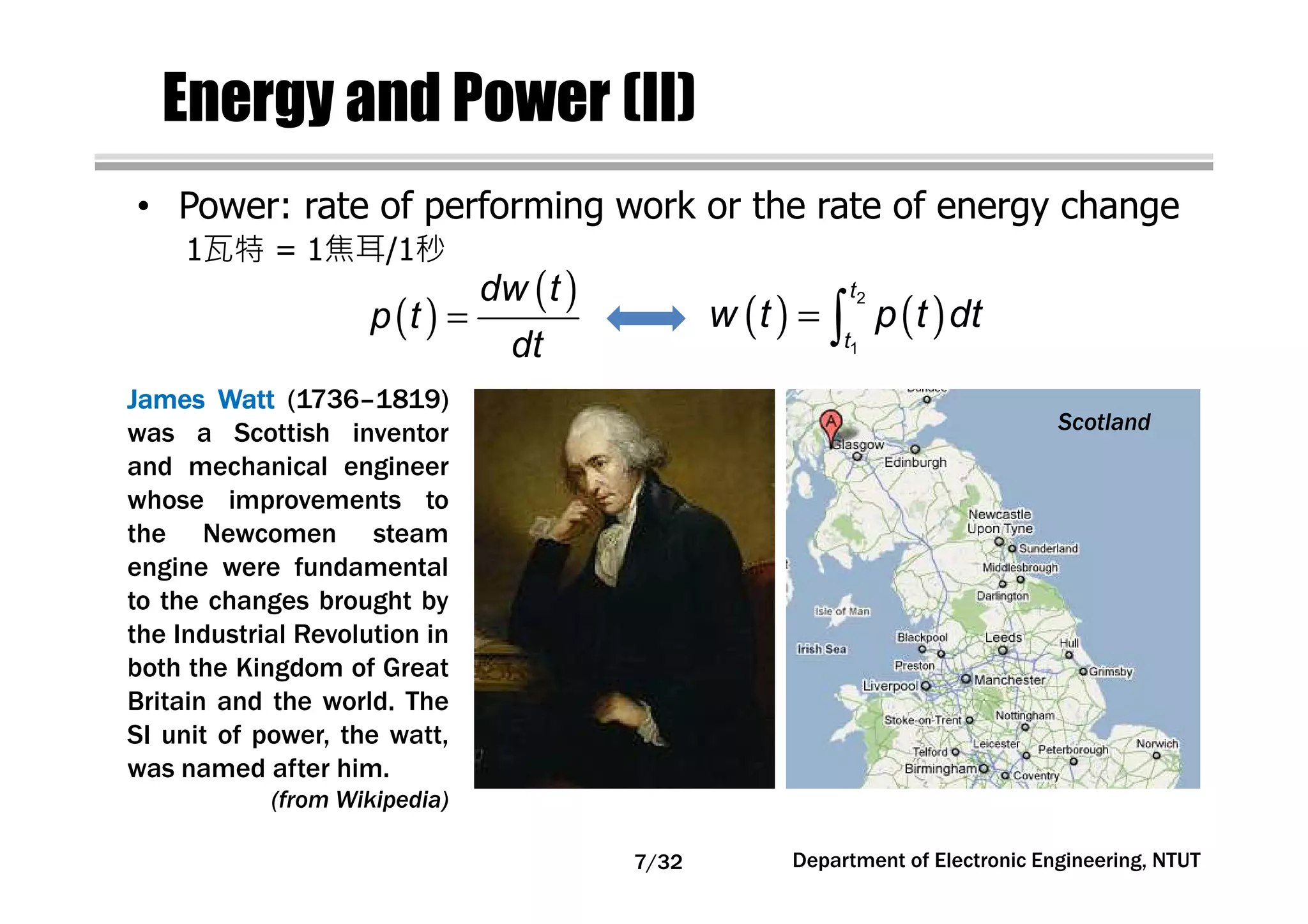
• Power: rate of performing work or the rate of energy change
JamesJamesJamesJames WattWattWattWatt (1736–1819)
was a Scottish inventor
and mechanical engineer
whose improvements to
the Newcomen steam
engine were fundamental
to the changes brought by
the Industrial Revolution in
both the Kingdom of Great
Britain and the world. The
SI unit of power, the watt,
was named after him.
(from Wikipedia)
Scotland
( )
( )=
dw t
p t
dt
( ) ( )= ∫
2
1
t
t
w t p t dt
1瓦特 = 1焦耳/1秒
Department of Electronic Engineering, NTUT7/32
Current and Voltage
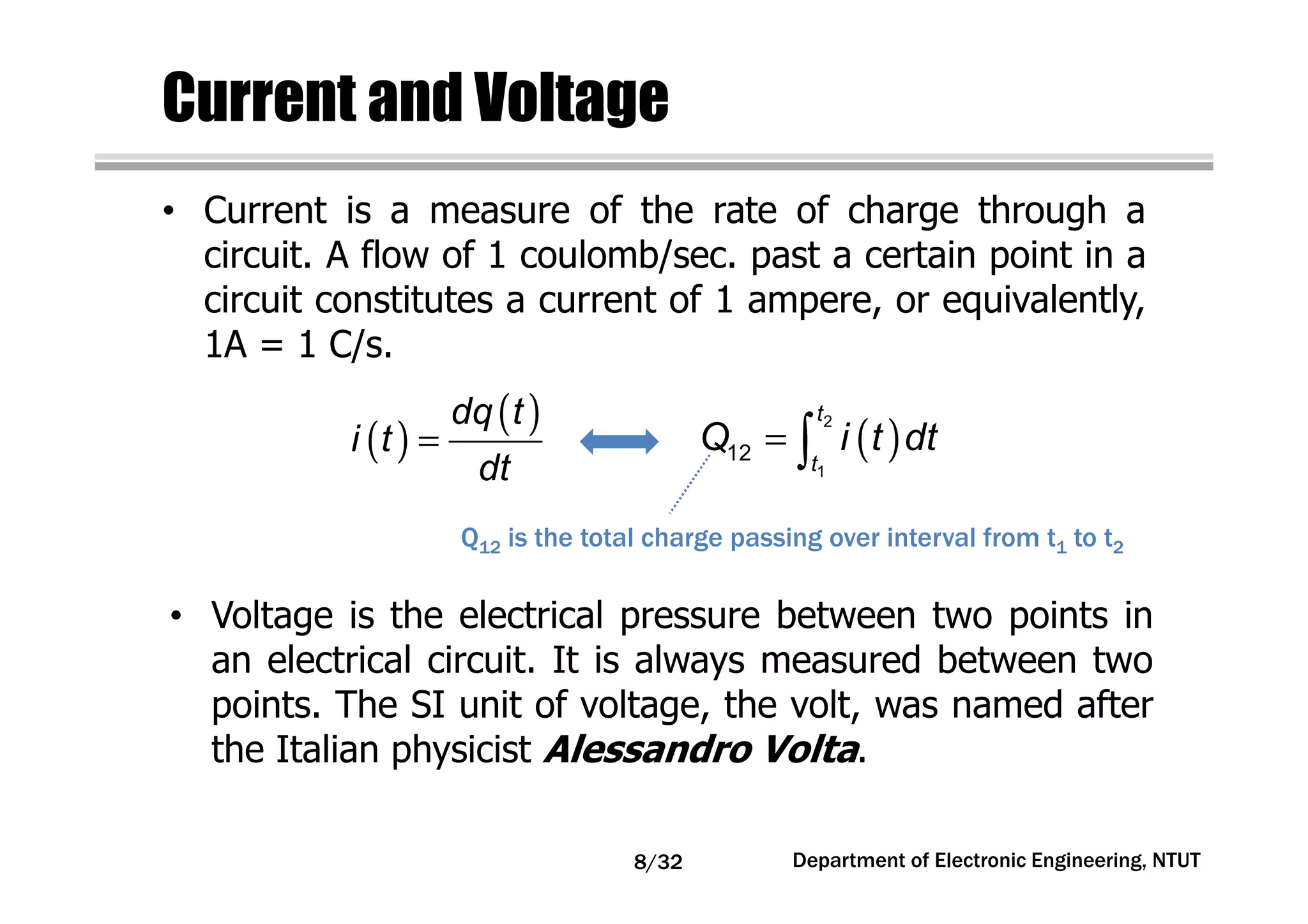
• Current is a measure of the rate of charge through a
circuit. A flow of 1 coulomb/sec. past a certain point in a
circuit constitutes a current of 1 ampere, or equivalently,
1A = 1 C/s.
( )
( )=
dq t
i t
dt
( )= ∫
2
1
12
t
t
Q i t dt
Q12 is the total charge passing over interval from t1 to t2
• Voltage is the electrical pressure between two points in
an electrical circuit. It is always measured between two
points. The SI unit of voltage, the volt, was named after
the Italian physicist Alessandro Volta.
Department of Electronic Engineering, NTUT8/32
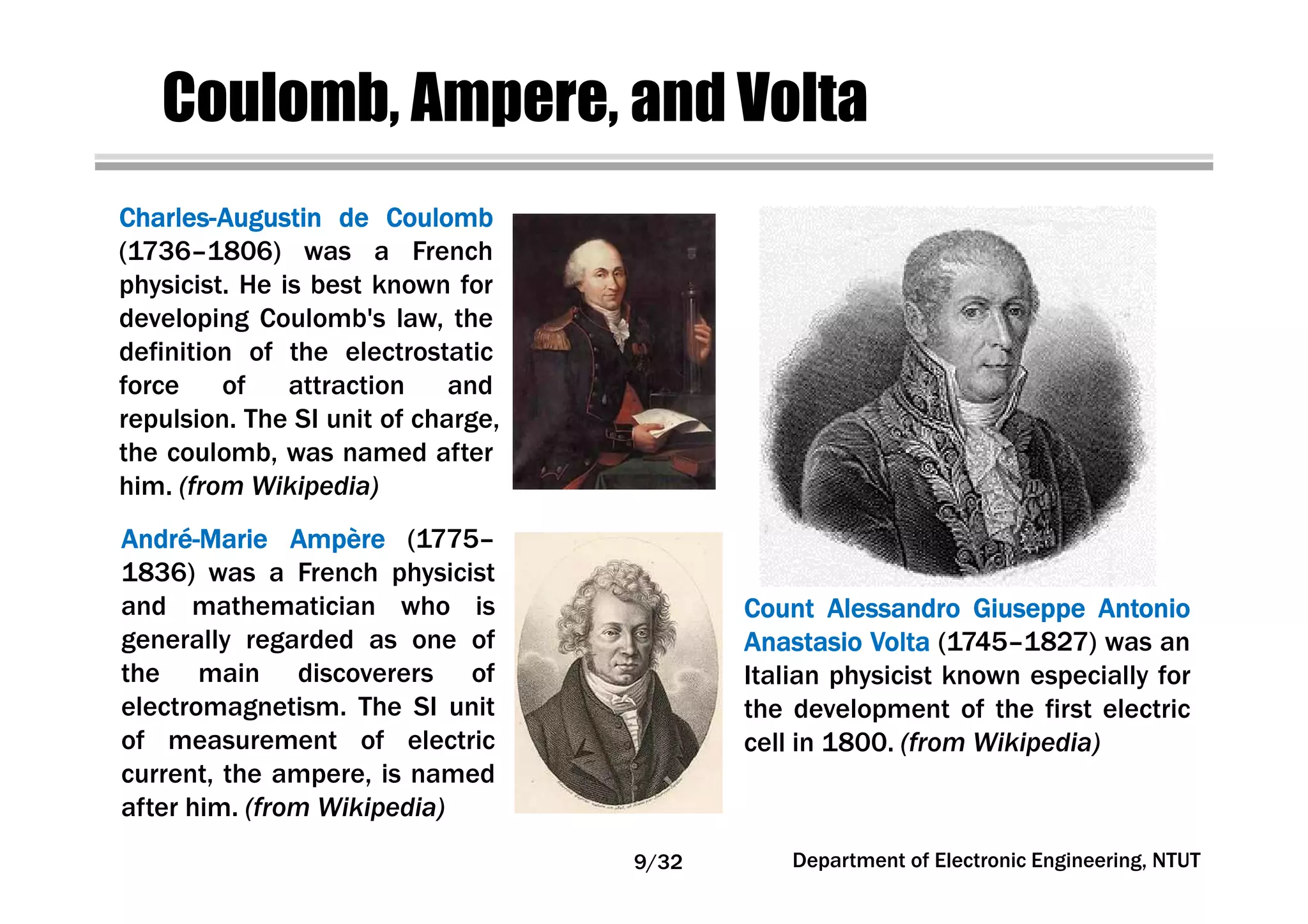
Coulomb, Ampere, and Volta
CharlesCharlesCharlesCharles----AugustinAugustinAugustinAugustin dededede CoulombCoulombCoulombCoulomb
(1736–1806) was a French
physicist. He is best known for
developing Coulomb's law, the
definition of the electrostatic
force of attraction and
repulsion. The SI unit of charge,
the coulomb, was named after
him. (from Wikipedia)
AndréAndréAndréAndré----MarieMarieMarieMarie AmpèreAmpèreAmpèreAmpère (1775–
1836) was a French physicist
and mathematician who is
generally regarded as one of
the main discoverers of
electromagnetism. The SI unit
of measurement of electric
current, the ampere, is named
after him. (from Wikipedia)
CountCountCountCount AlessandroAlessandroAlessandroAlessandro GiuseppeGiuseppeGiuseppeGiuseppe AntonioAntonioAntonioAntonio
AnastasioAnastasioAnastasioAnastasio VoltaVoltaVoltaVolta (1745–1827) was an
Italian physicist known especially for
the development of the first electric
cell in 1800. (from Wikipedia)
Department of Electronic Engineering, NTUT9/32
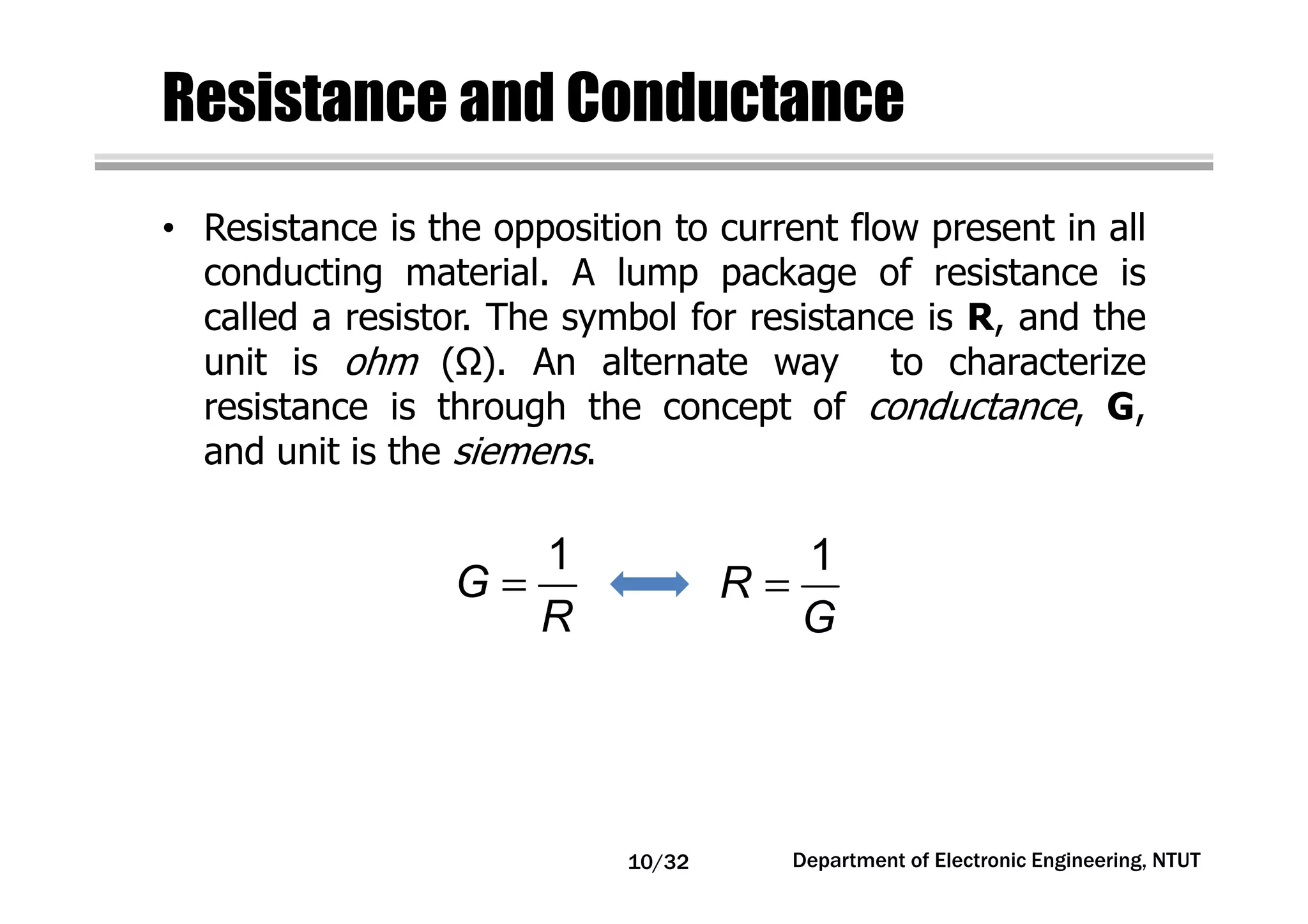
Resistance and Conductance
• Resistance is the opposition to current flow present in all
conducting material. A lump package of resistance is
called a resistor. The symbol for resistance is R, and the
unit is ohm ( ). An alternate way to characterize
resistance is through the concept of conductance, G,
and unit is the siemens.
=
1
G
R
=
1
R
G
Department of Electronic Engineering, NTUT10/32
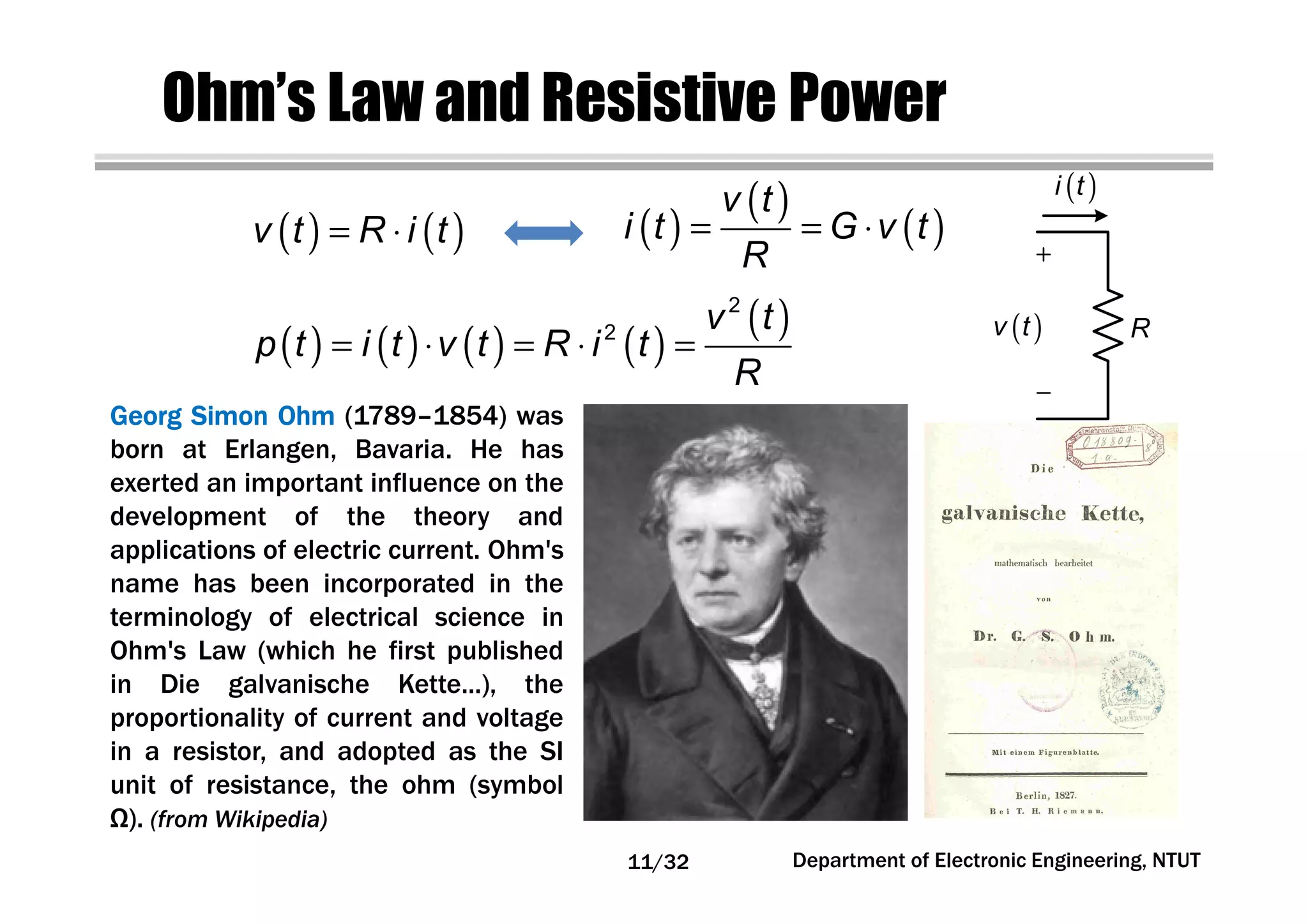
Ohm’s Law and Resistive Power
GeorgGeorgGeorgGeorg SimonSimonSimonSimon OhmOhmOhmOhm (1789–1854) was
born at Erlangen, Bavaria. He has
exerted an important influence on the
development of the theory and
applications of electric current. Ohm's
name has been incorporated in the
terminology of electrical science in
Ohm's Law (which he first published
in Die galvanische Kette...), the
proportionality of current and voltage
in a resistor, and adopted as the SI
unit of resistance, the ohm (symbol
Ω). (from Wikipedia)
( ) ( )v t R i t= ⋅ ( )
( )
( )
v t
i t G v t
R
= = ⋅
( )i t
R( )v t
( ) ( ) ( ) ( )
( )2
2 v t
p t i t v t R i t
R
= ⋅ = ⋅ =
Department of Electronic Engineering, NTUT11/32
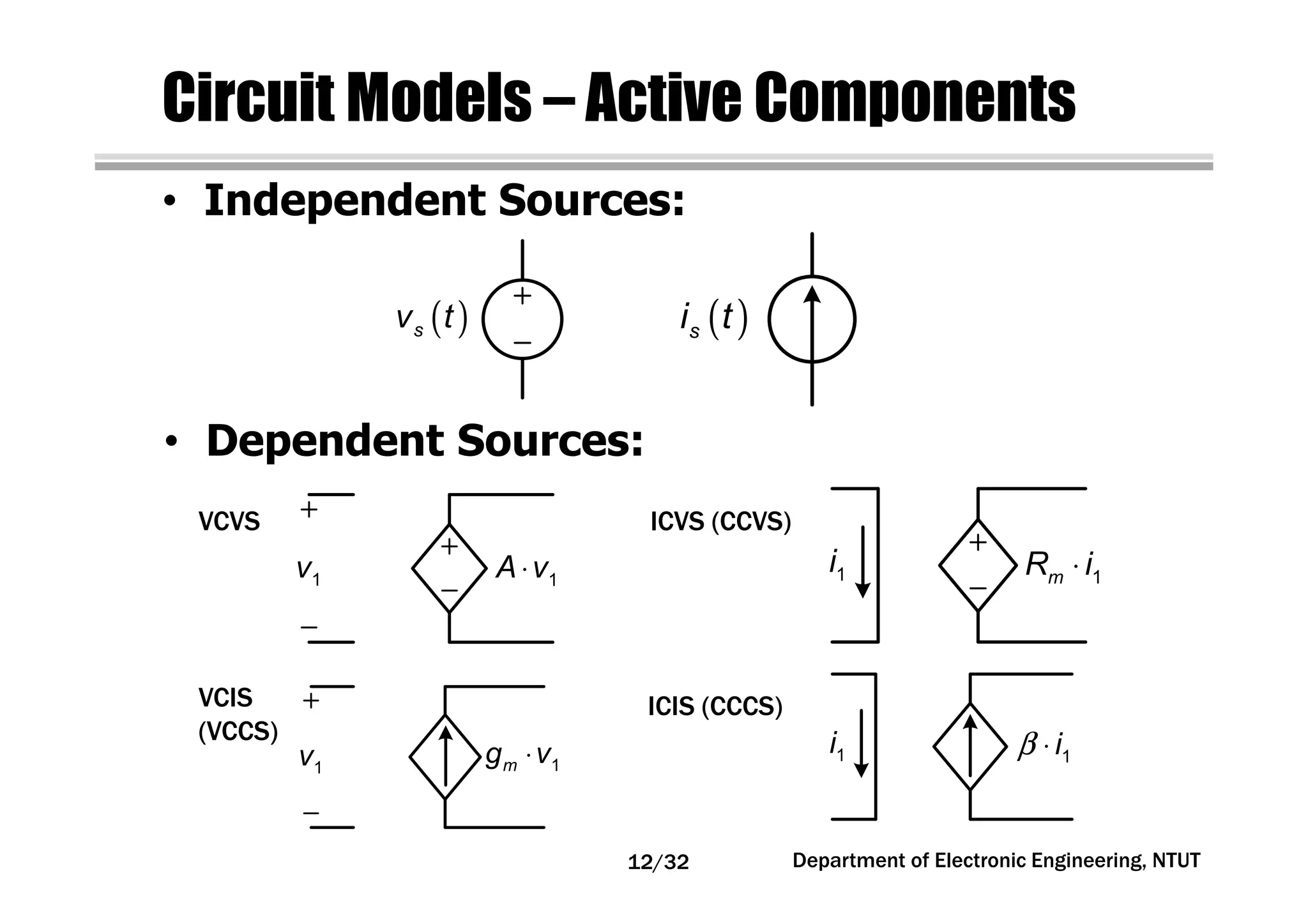
Circuit Models – Active Components
• Independent Sources:
( )sv t ( )si t
1v 1A v⋅ 1i 1mR i⋅
1v 1mg v⋅ 1i 1iβ ⋅
• Dependent Sources:
VCVS ICVS (CCVS)
VCIS
(VCCS)
ICIS (CCCS)
Department of Electronic Engineering, NTUT12/32
Circuit Models – Passive Components
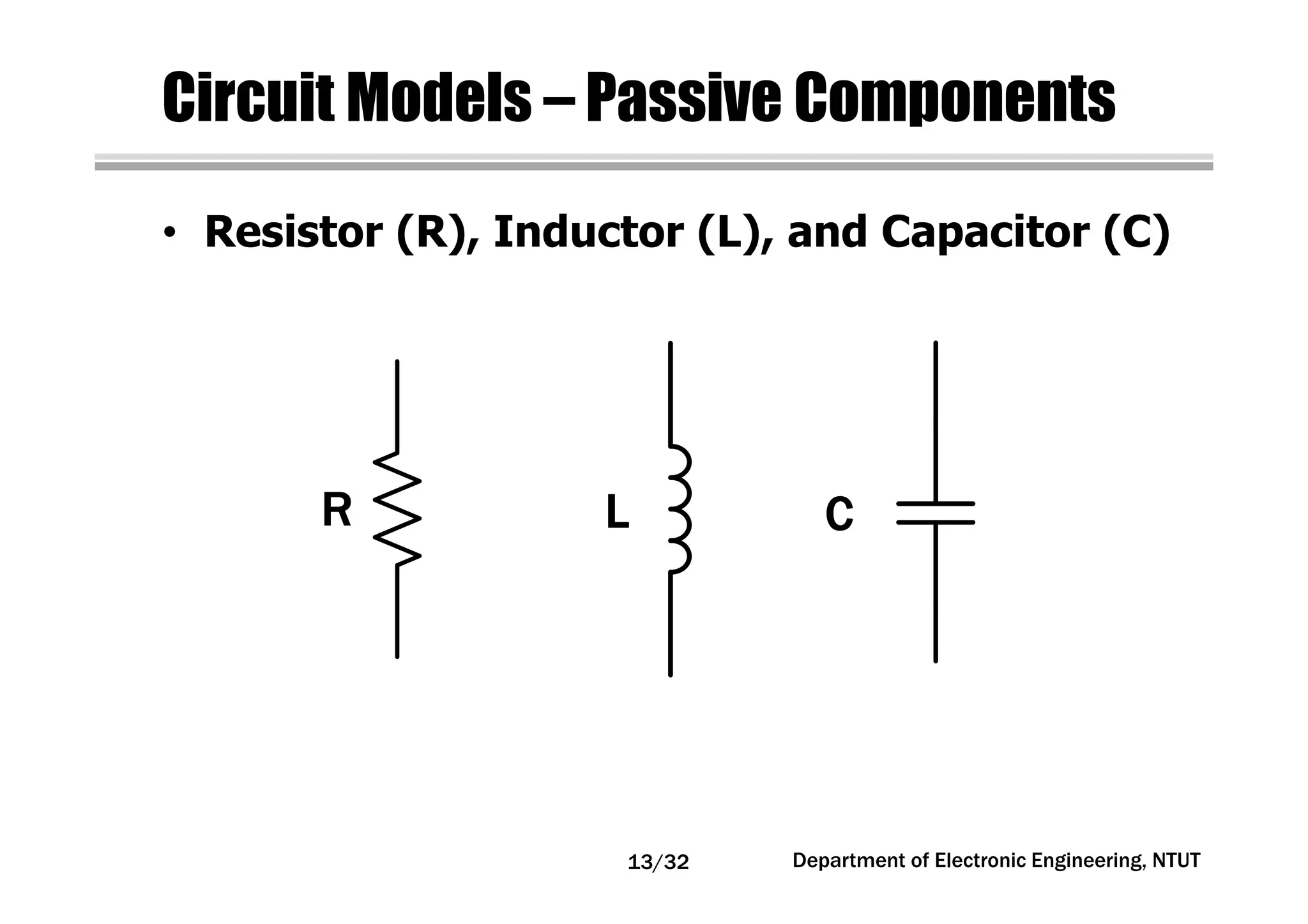
• Resistor (R), Inductor (L), and Capacitor (C)
RRRR LLLL CCCC
Department of Electronic Engineering, NTUT13/32
Equivalent Resistance
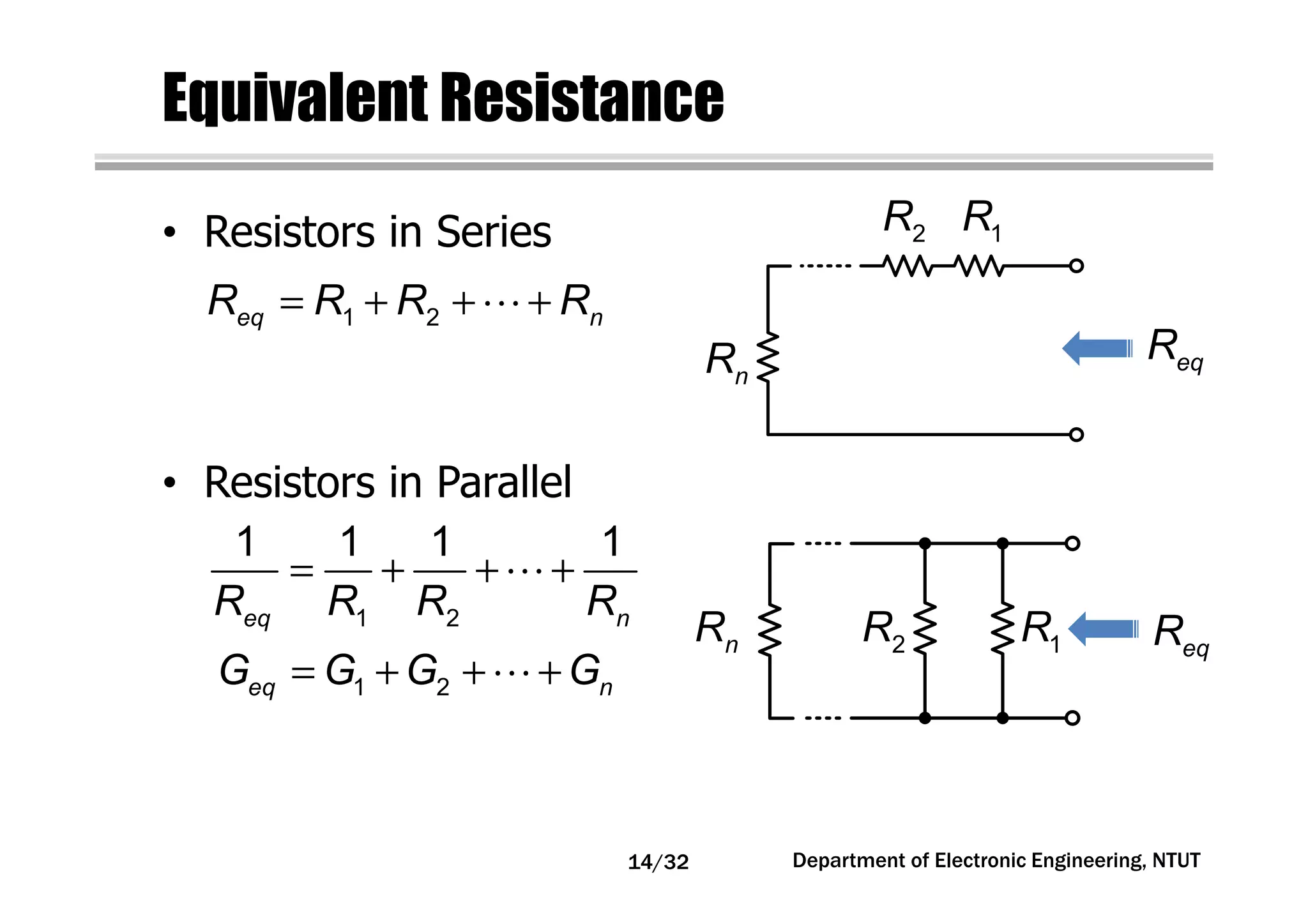
• Resistors in Series
• Resistors in Parallel
Department of Electronic Engineering, NTUT
= + + +⋯1 2eq nR R R R
= + + +⋯
1 2
1 1 1 1
eq nR R R R
= + + +⋯1 2eq nG G G G
eqR
1R2R
nR
1R2RnR eqR
14/32
Voltage Divider
Department of Electronic Engineering, NTUT
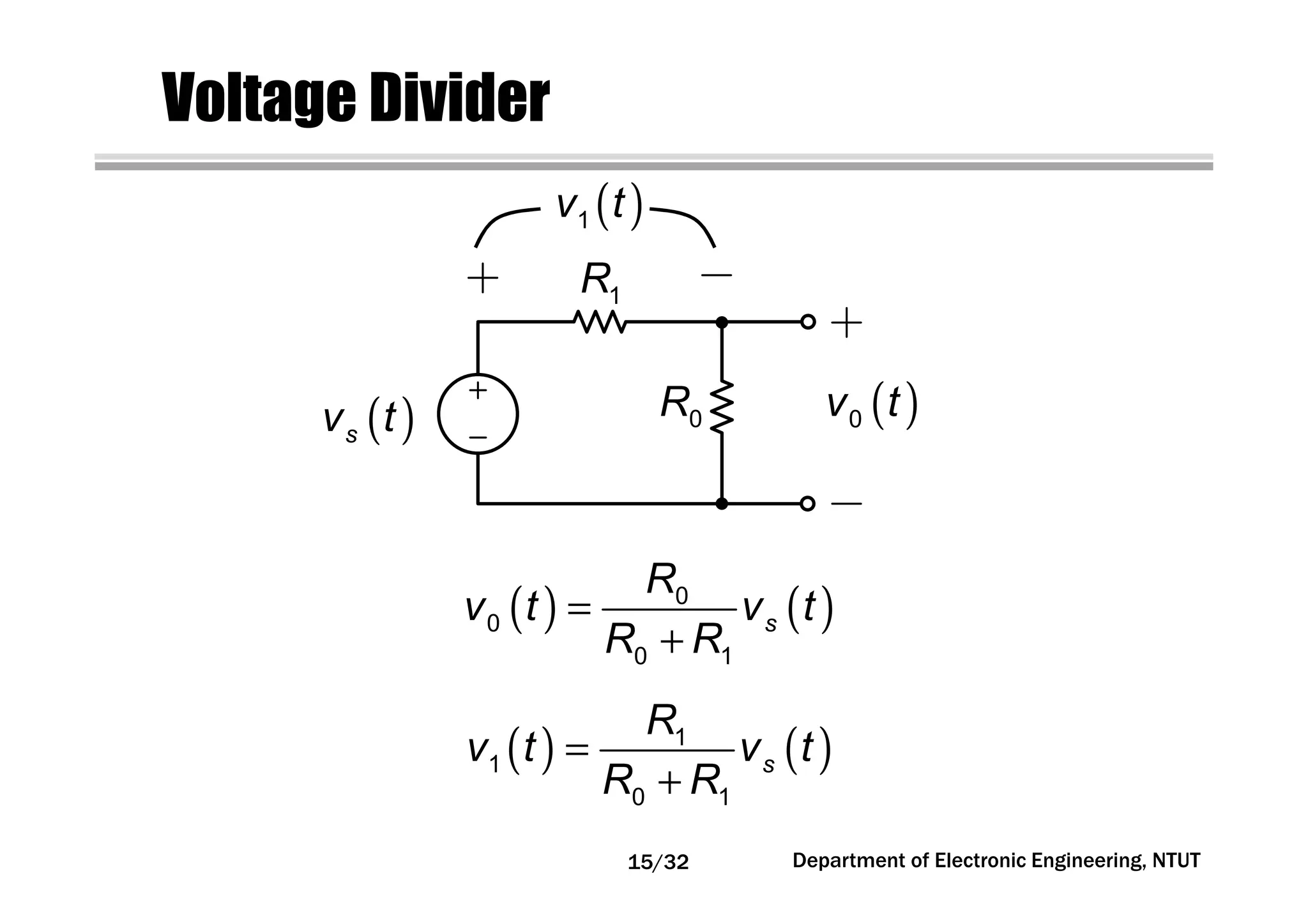
( ) ( )=
+
0
0
0 1
s
R
v t v t
R R
0R
1R
( )sv t ( )0v t
( )1v t
( ) ( )=
+
1
1
0 1
s
R
v t v t
R R
15/32
Current Divider
Department of Electronic Engineering, NTUT
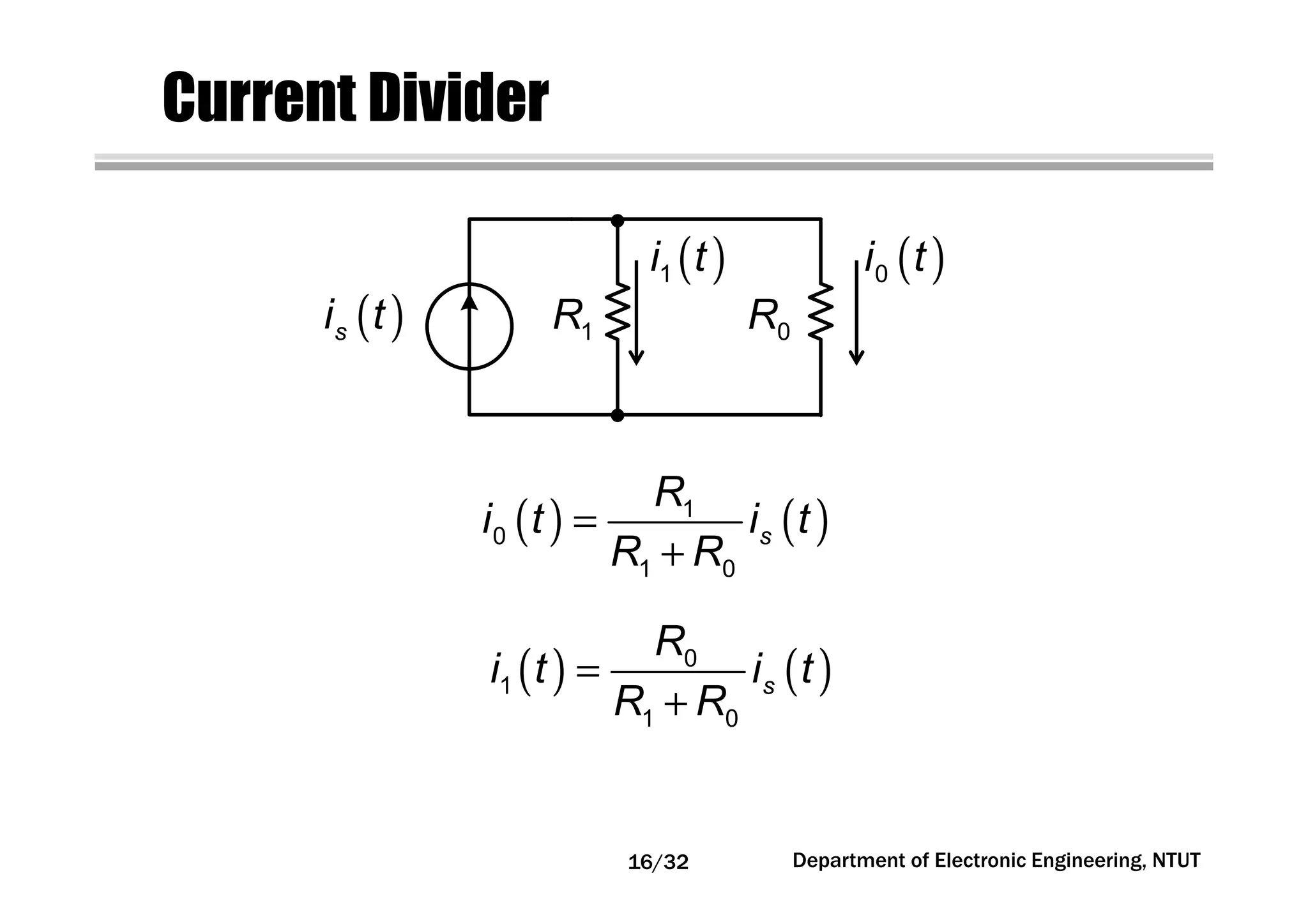
( ) ( )=
+
1
0
1 0
s
R
i t i t
R R
0R1R( )si t
( )0i t( )1i t
( ) ( )=
+
0
1
1 0
s
R
i t i t
R R
16/32
Kirchoff’s Voltage and Current Laws
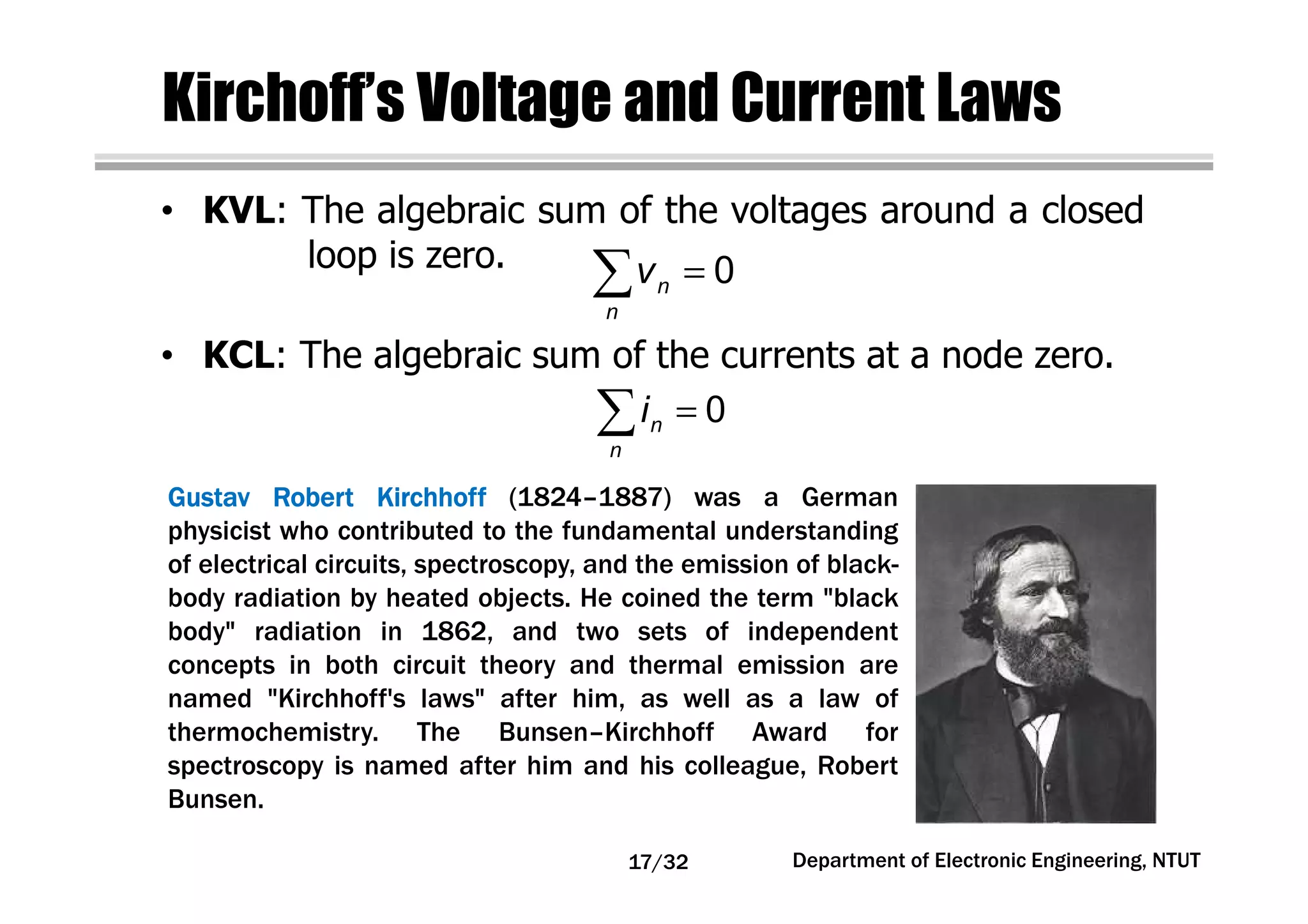
• KVL: The algebraic sum of the voltages around a closed
loop is zero.
GustavGustavGustavGustav RobertRobertRobertRobert KirchhoffKirchhoffKirchhoffKirchhoff (1824–1887) was a German
physicist who contributed to the fundamental understanding
of electrical circuits, spectroscopy, and the emission of black-
body radiation by heated objects. He coined the term "black
body" radiation in 1862, and two sets of independent
concepts in both circuit theory and thermal emission are
named "Kirchhoff's laws" after him, as well as a law of
thermochemistry. The Bunsen–Kirchhoff Award for
spectroscopy is named after him and his colleague, Robert
Bunsen.
0n
n
v =∑
• KCL: The algebraic sum of the currents at a node zero.
=∑ 0n
n
i
Department of Electronic Engineering, NTUT17/32
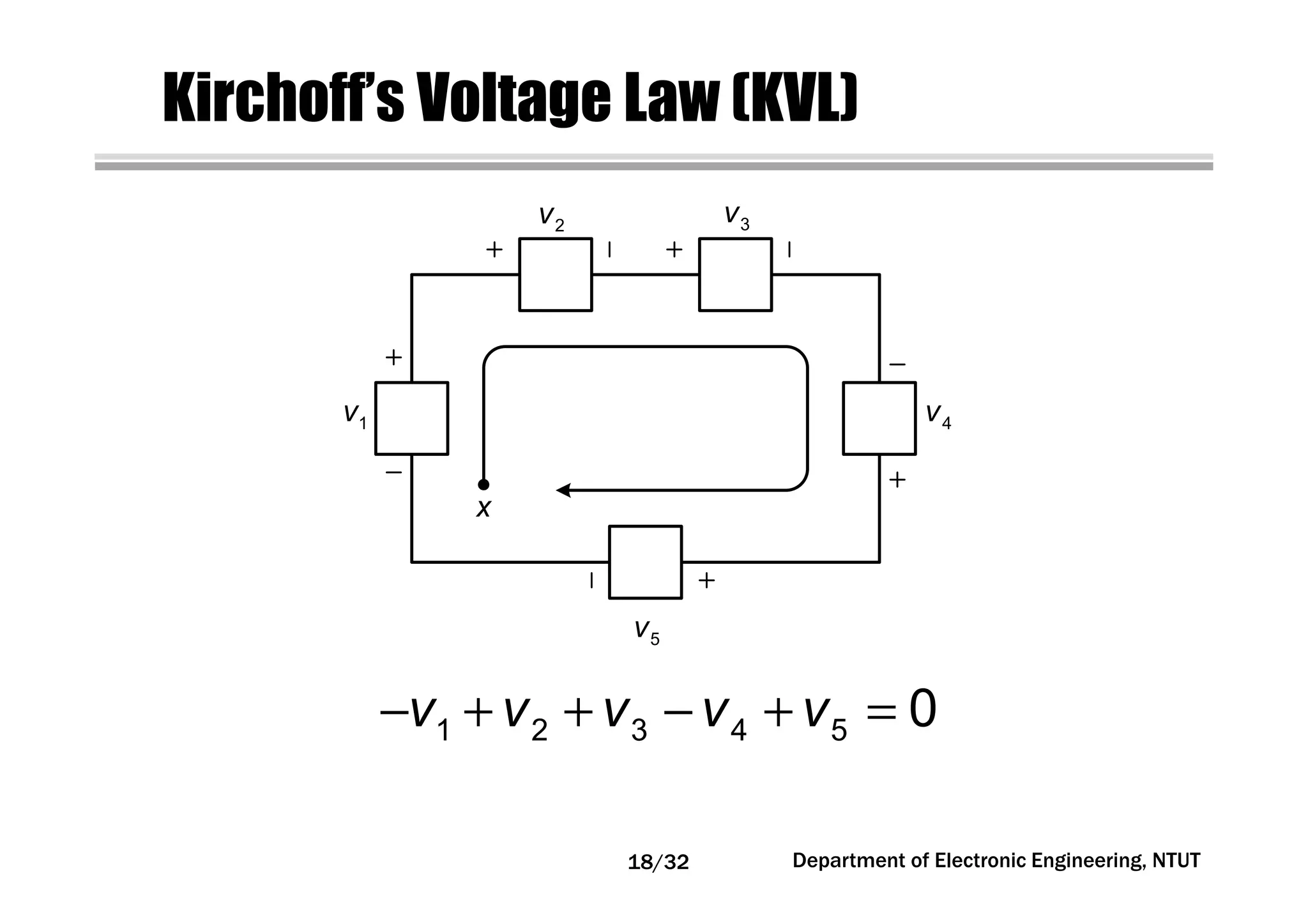
Kirchoff’s Voltage Law (KVL)
1v
2v 3v
4v
5v
x
1 2 3 4 5 0v v v v v− + + − + =
Department of Electronic Engineering, NTUT18/32
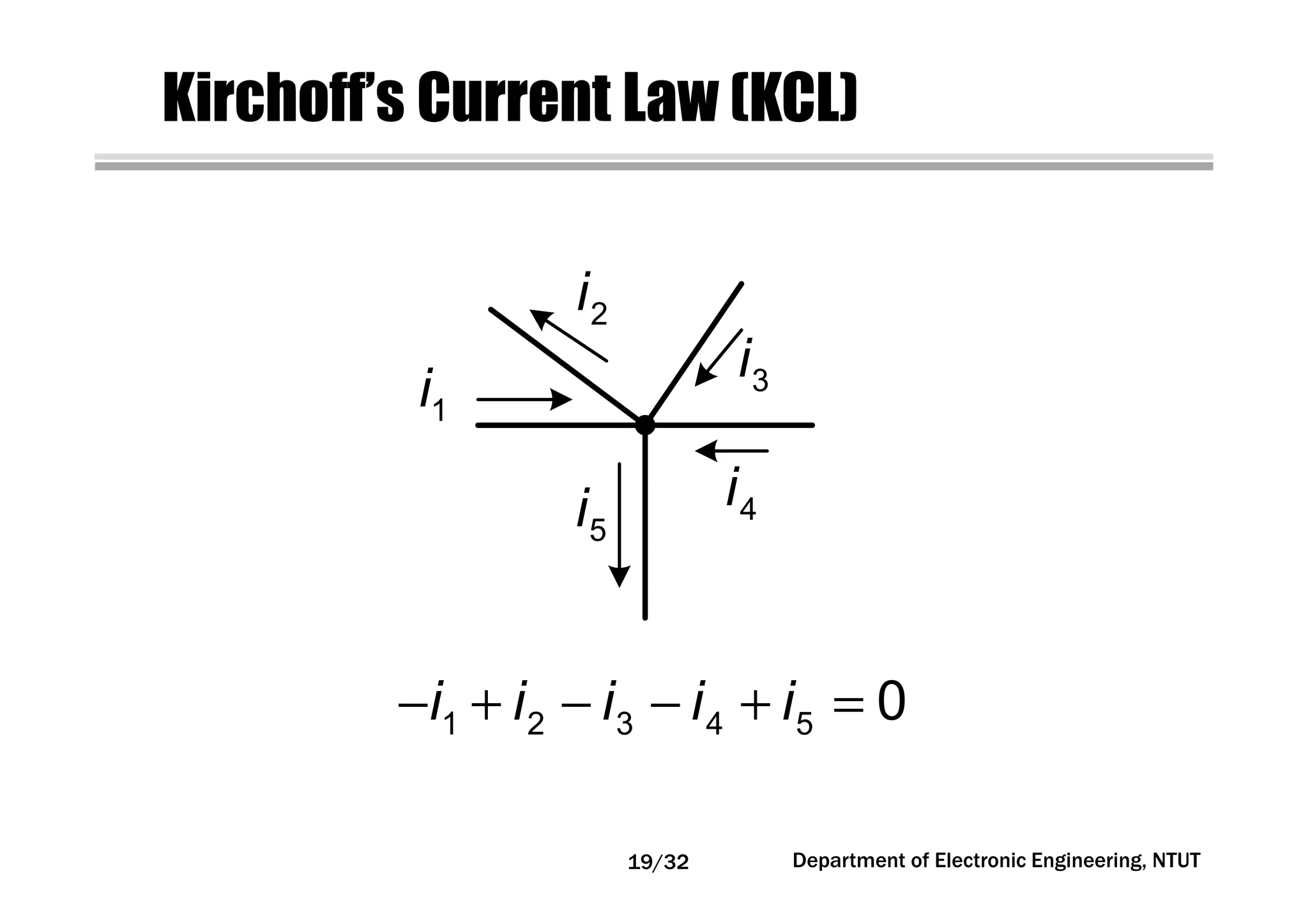
Kirchoff’s Current Law (KCL)
1i
2i
3i
4i
5i
1 2 3 4 5 0i i i i i− + − − + =
Department of Electronic Engineering, NTUT19/32
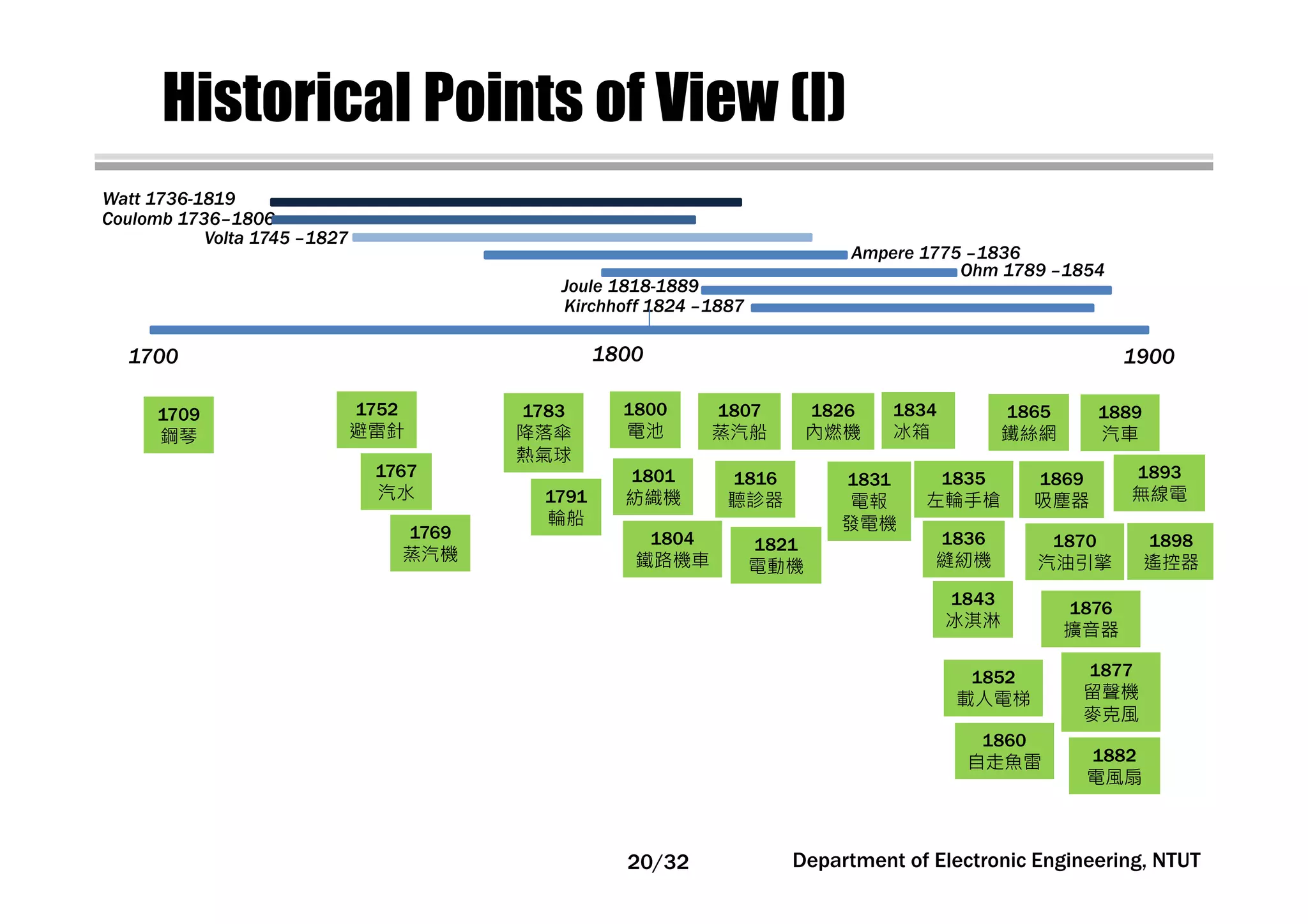
Historical Points of View (I)
Watt 1736-1819
Coulomb 1736–1806
Ampere 1775 –1836
Volta 1745 –1827
Ohm 1789 –1854
Kirchhoff 1824 –1887
1700 19001800
Joule 1818-1889
1709
鋼琴
1752
避雷針
1783
降落傘
熱氣球
1769
蒸汽機
1767
汽水 1791
輪船
1800
電池
1804
鐵路機車
1807
蒸汽船
1816
聽診器
1821
電動機
1826
內燃機
1831
電報
發電機
1834
冰箱
1835
左輪手槍
1836
縫紉機
1843
冰淇淋
1801
紡織機
1860
自走魚雷
1852
載人電梯
1865
鐵絲網
1869
吸塵器
1870
汽油引擎
1876
擴音器
1877
留聲機
麥克風
1882
電風扇
1889
汽車
1893
無線電
1898
遙控器
Department of Electronic Engineering, NTUT20/32
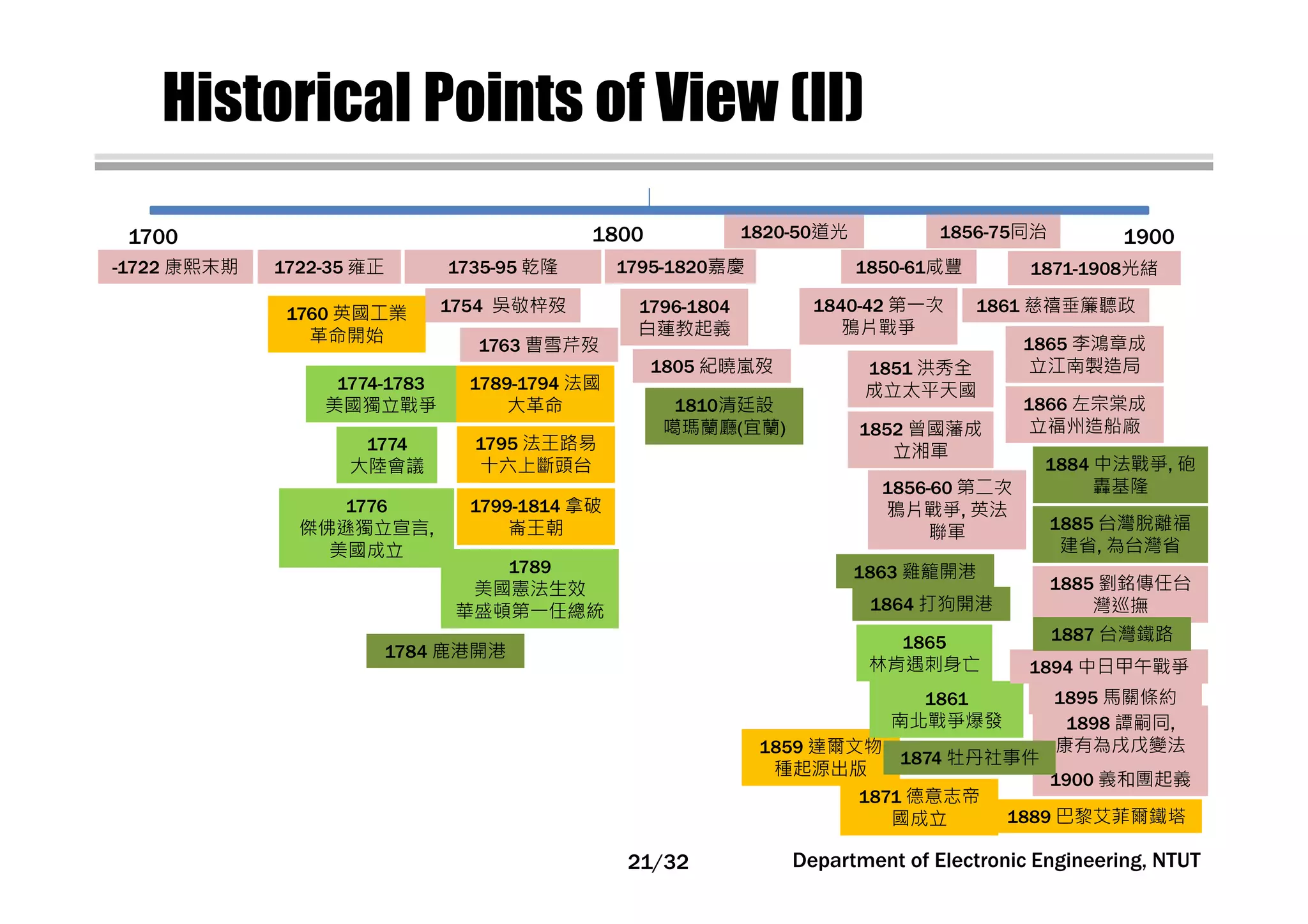
1859 達爾文物
種起源出版
Historical Points of View (II)
1700 19001800
1774-1783
美國獨立戰爭
1774
大陸會議
1776
傑佛遜獨立宣言,
美國成立
1789
美國憲法生效
華盛頓第一任總統
1861
南北戰爭爆發
1865
林肯遇刺身亡
-1722 康熙末期 1735-95 乾隆 1795-1820嘉慶
1820-50道光
1850-61咸豐
1856-75同治
1871-1908光緒1722-35 雍正
1754 吳敬梓歿
1763 曹雪芹歿
1796-1804
白蓮教起義
1805 紀曉嵐歿
1840-42 第一次
鴉片戰爭
1851 洪秀全
成立太平天國
1852 曾國藩成
立湘軍
1856-60 第二次
鴉片戰爭, 英法
聯軍
1861 慈禧垂簾聽政
1865 李鴻章成
立江南製造局
1866 左宗棠成
立福州造船廠
1885 劉銘傳任台
灣巡撫
1894 中日甲午戰爭
1898 譚嗣同,
康有為戌戊變法
1900 義和團起義
1784 鹿港開港
1810清廷設
噶瑪蘭廳(宜蘭)
1863 雞籠開港
1864 打狗開港
1874 牡丹社事件
1884 中法戰爭, 砲
轟基隆
1885 台灣脫離福
建省, 為台灣省
1887 台灣鐵路
1760 英國工業
革命開始
1789-1794 法國
大革命
1795 法王路易
十六上斷頭台
1799-1814 拿破
崙王朝
1871 德意志帝
國成立 1889 巴黎艾菲爾鐵塔
1895 馬關條約
Department of Electronic Engineering, NTUT21/32
Mesh Current Method (I)
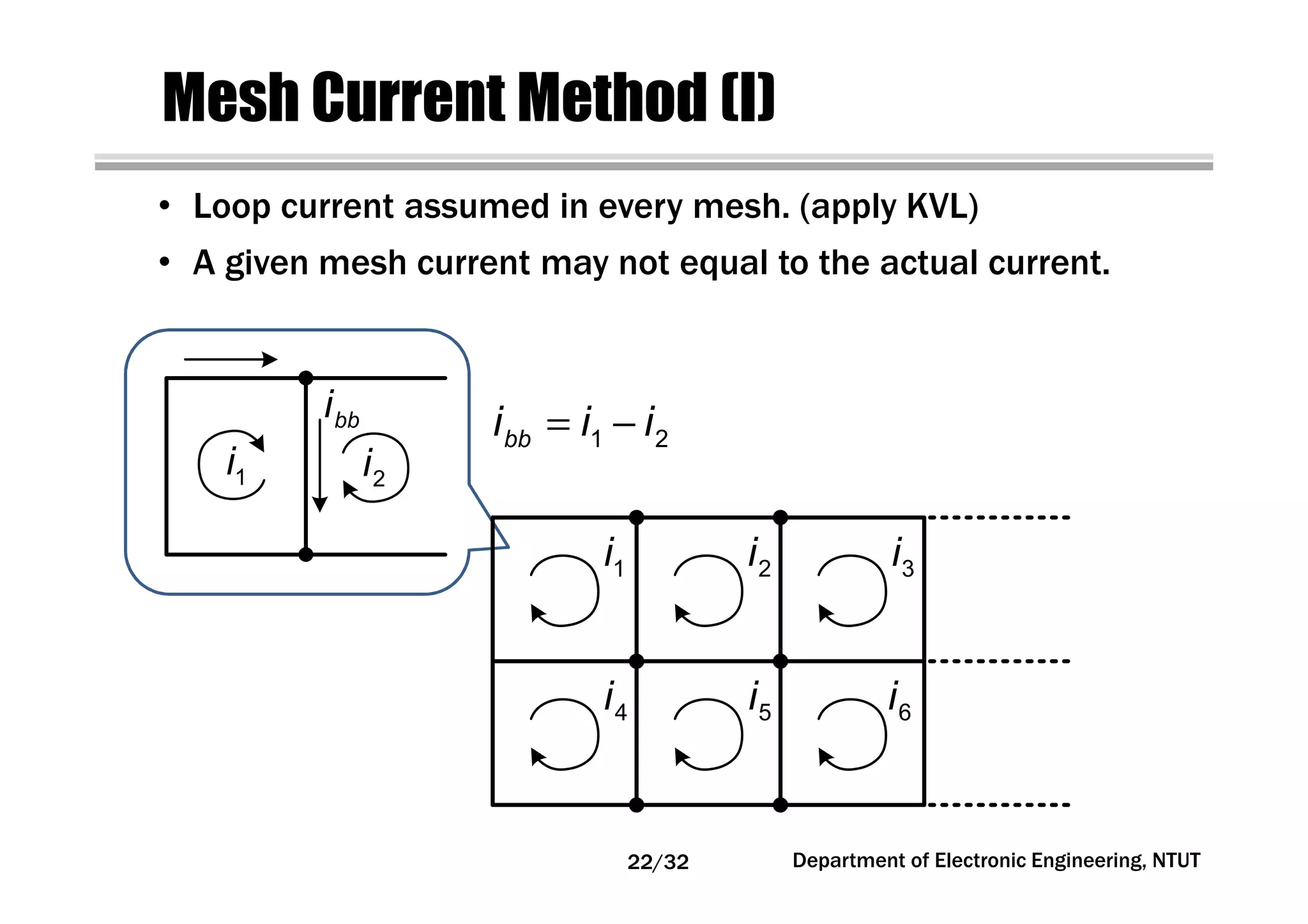
1i 2i 3i
4i 5i 6i
1i 2i
bbi
Department of Electronic Engineering, NTUT
• Loop current assumed in every mesh. (apply KVL)
• A given mesh current may not equal to the actual current.
= −1 2bbi i i
22/32
Mesh Current Method (II)
Department of Electronic Engineering, NTUT
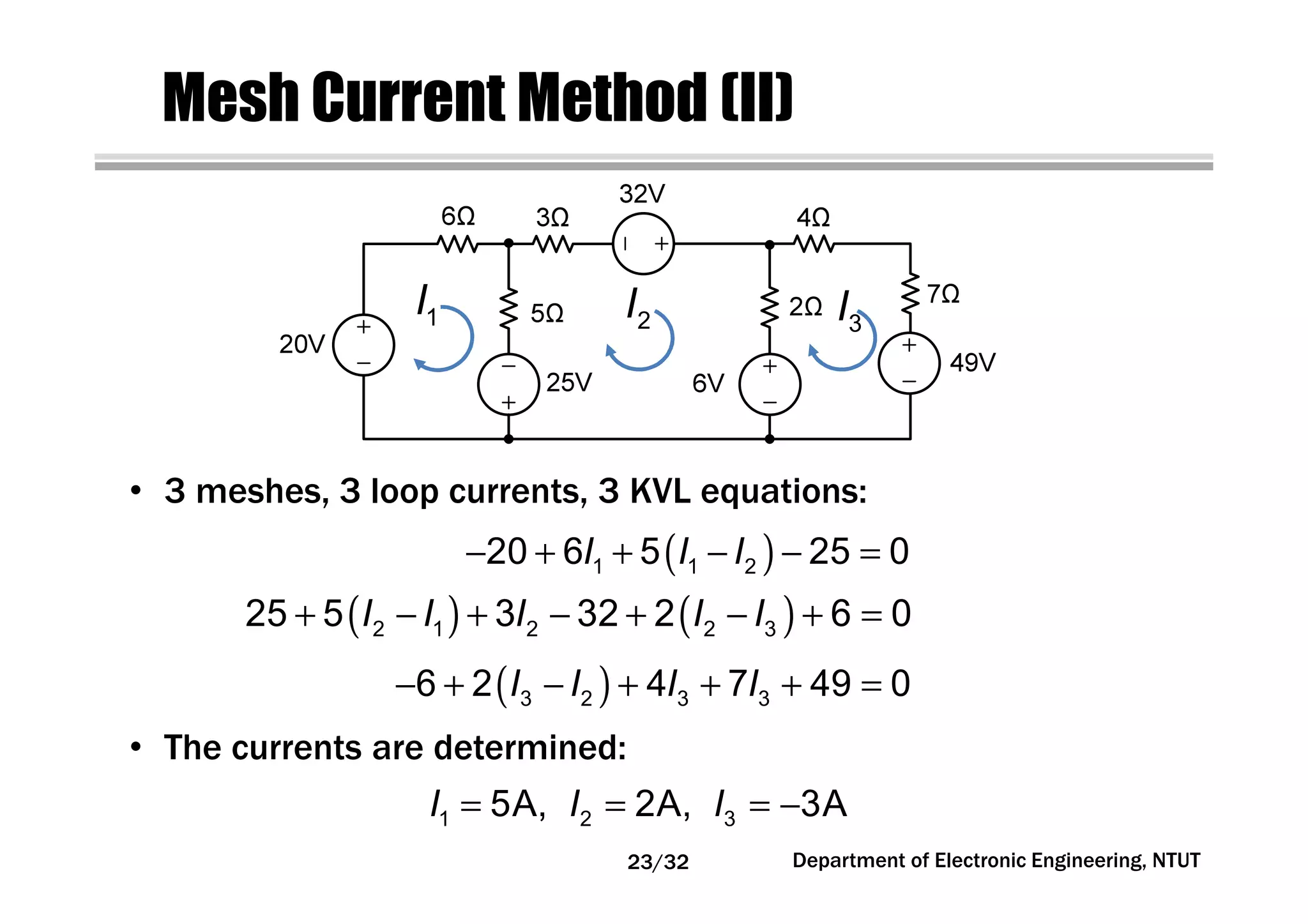
1I 2I 3I
( )− + + − − =1 1 220 6 5 25 0I I I
( ) ( )+ − + − + − + =2 1 2 2 325 5 3 32 2 6 0I I I I I
( )− + − + + + =3 2 3 36 2 4 7 49 0I I I I
• 3 meshes, 3 loop currents, 3 KVL equations:
• The currents are determined:
= = = −1 2 35A, 2A, 3AI I I
23/32
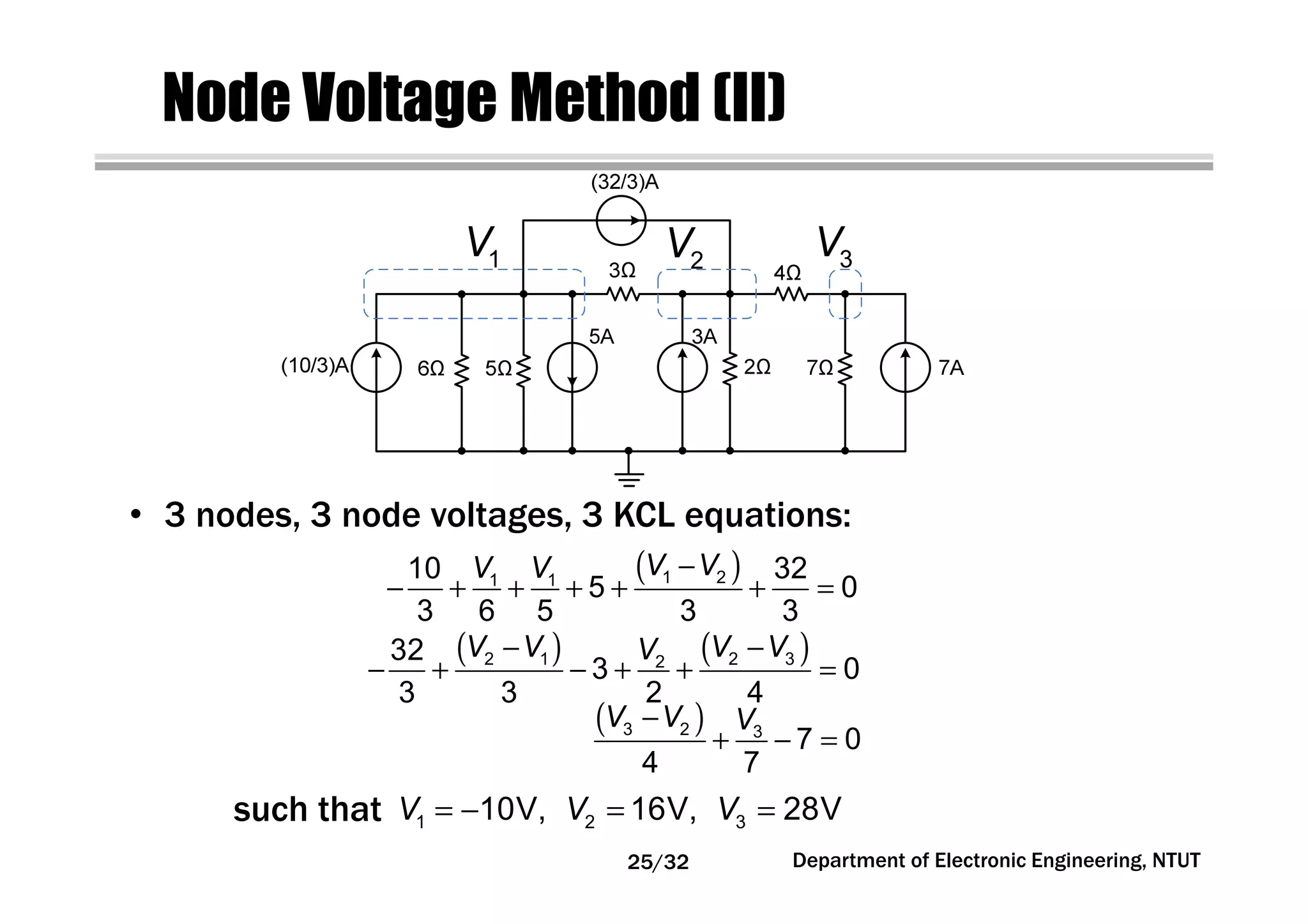
Node Voltage Method (I)
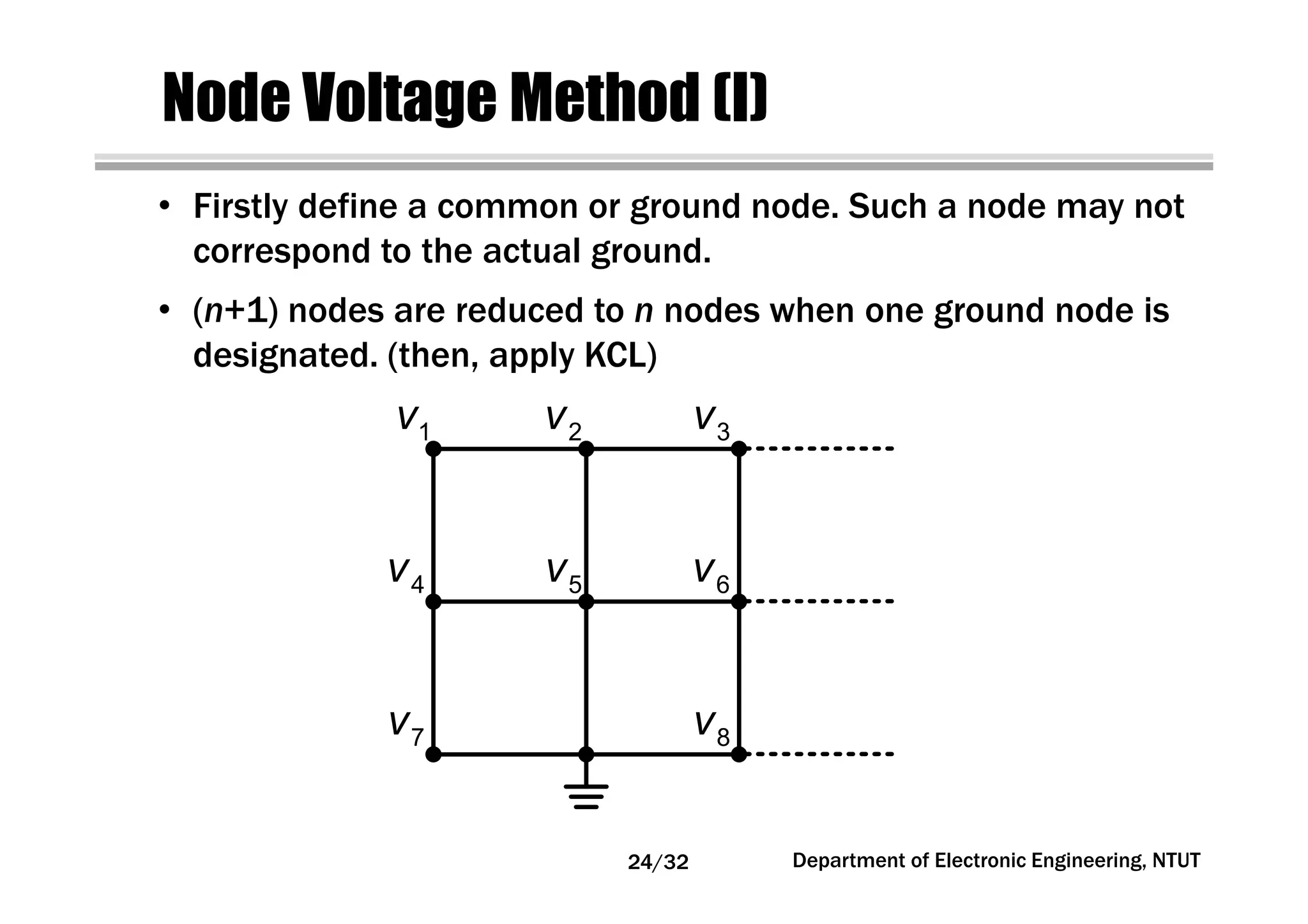
1v 2v 3v
4v 5v 6v
7v 8v
Department of Electronic Engineering, NTUT
• Firstly define a common or ground node. Such a node may not
correspond to the actual ground.
• (n+1) nodes are reduced to n nodes when one ground node is
designated. (then, apply KCL)
24/32
Node Voltage Method (II)
Department of Electronic Engineering, NTUT
1V 2V 3V
( )−
− + + + + + =1 21 110 32
5 0
3 6 5 3 3
V VV V
• 3 nodes, 3 node voltages, 3 KCL equations:
= − = =1 2 310V, 16V, 28VV V V
( ) ( )− −
− + − + + =2 1 2 3232
3 0
3 3 2 4
V V V VV
( )−
+ − =3 2 3
7 0
4 7
V V V
such that
25/32
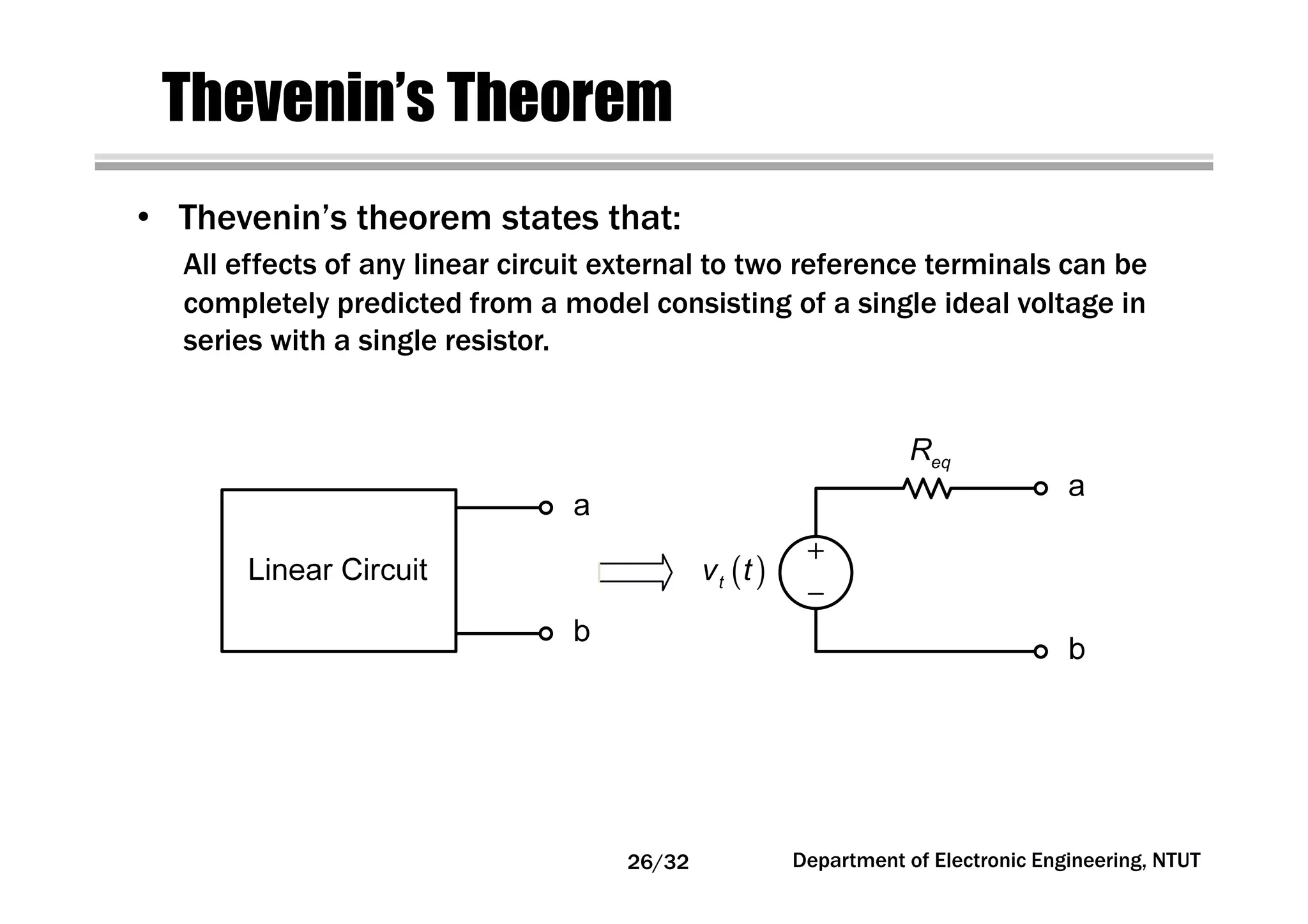
Thevenin’s Theorem
( )tv t
eqR
Department of Electronic Engineering, NTUT
• Thevenin’s theorem states that:
All effects of any linear circuit external to two reference terminals can be
completely predicted from a model consisting of a single ideal voltage in
series with a single resistor.
26/32
Norton’s Theorem
Department of Electronic Engineering, NTUT
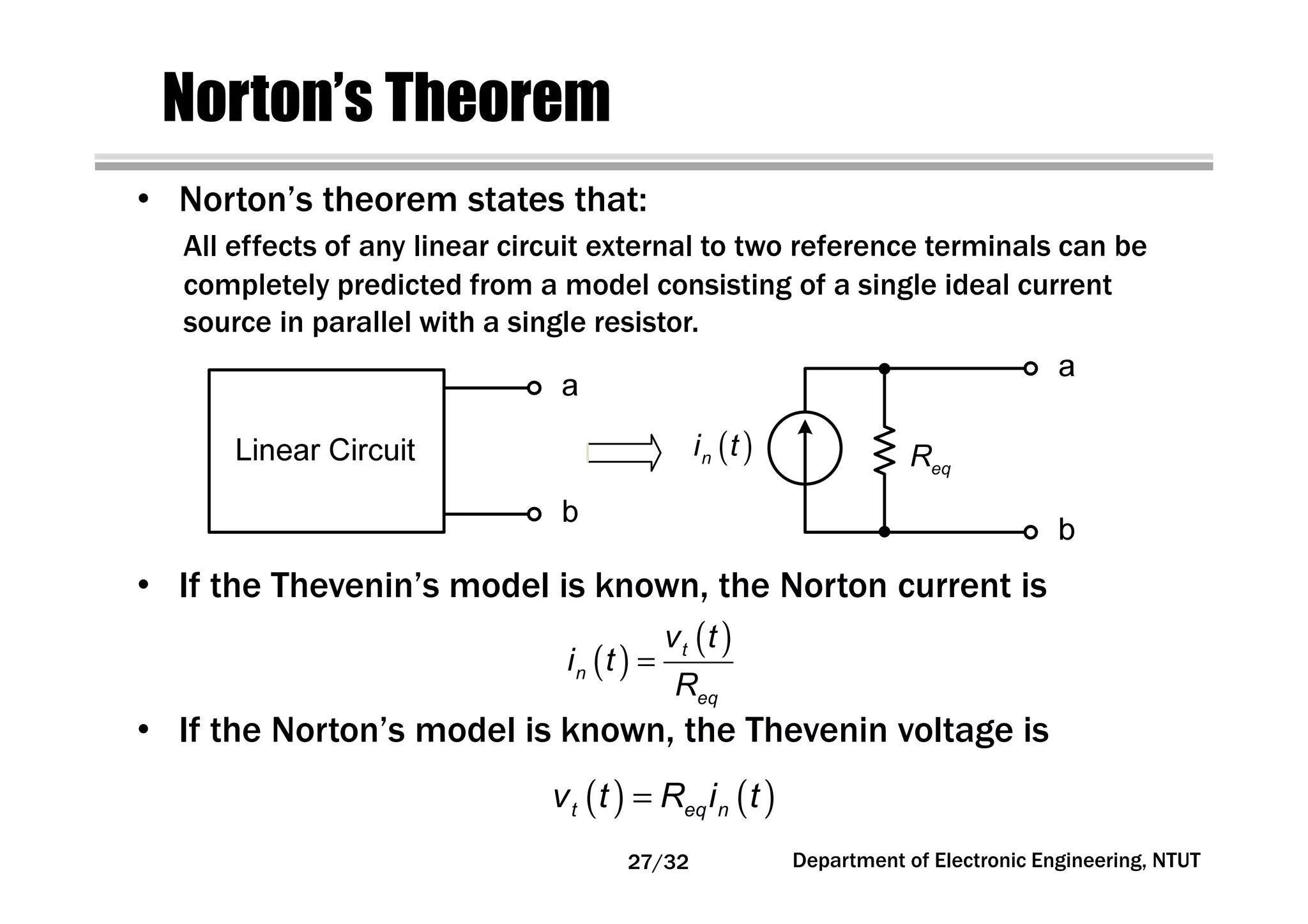
• Norton’s theorem states that:
All effects of any linear circuit external to two reference terminals can be
completely predicted from a model consisting of a single ideal current
source in parallel with a single resistor.
( )
( )= t
n
eq
v t
i t
R
( )ni t
eqR
( ) ( )=t eq nv t R i t
• If the Thevenin’s model is known, the Norton current is
• If the Norton’s model is known, the Thevenin voltage is
27/32
“Equivalent” Model
• When a complex circuit is replaced by a Thevenin or a
Norton model, the model predicts correct results
external to the reference terminals only.
• The internal action of original circuit has been “lost,” and
any internal calculations in the Thevenin or Norton
model are generally meaningless.
• The models are useful when there is a portion of a
circuit that remains fixed for which there is little interest
in the internal behavior nut in which the effect on an
external circuit is to be studied under varying conditions.
• Equivalent does not mean Identical.
Department of Electronic Engineering, NTUT28/32
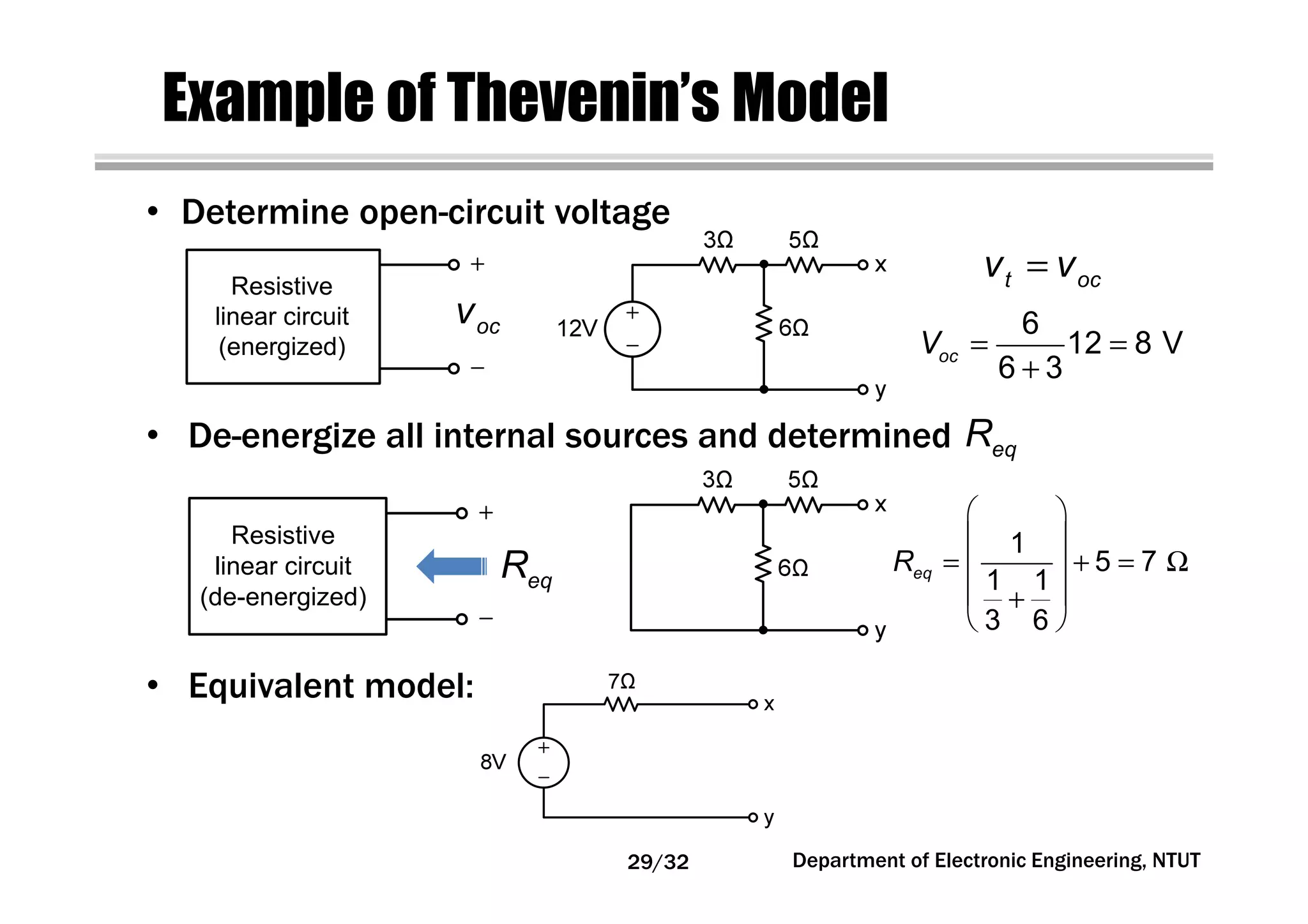
Example of Thevenin’s Model
Department of Electronic Engineering, NTUT
Resistive
linear circuit
(energized)
• Determine open-circuit voltage
• De-energize all internal sources and determined
Resistive
linear circuit
(de-energized)
= =
+
6
12 8 V
6 3
ocV
 
 
= + = Ω 
 +
 
1
5 7
1 1
3 6
eqR
=t ocv v
ocv
eqR
eqR
• Equivalent model:
29/32
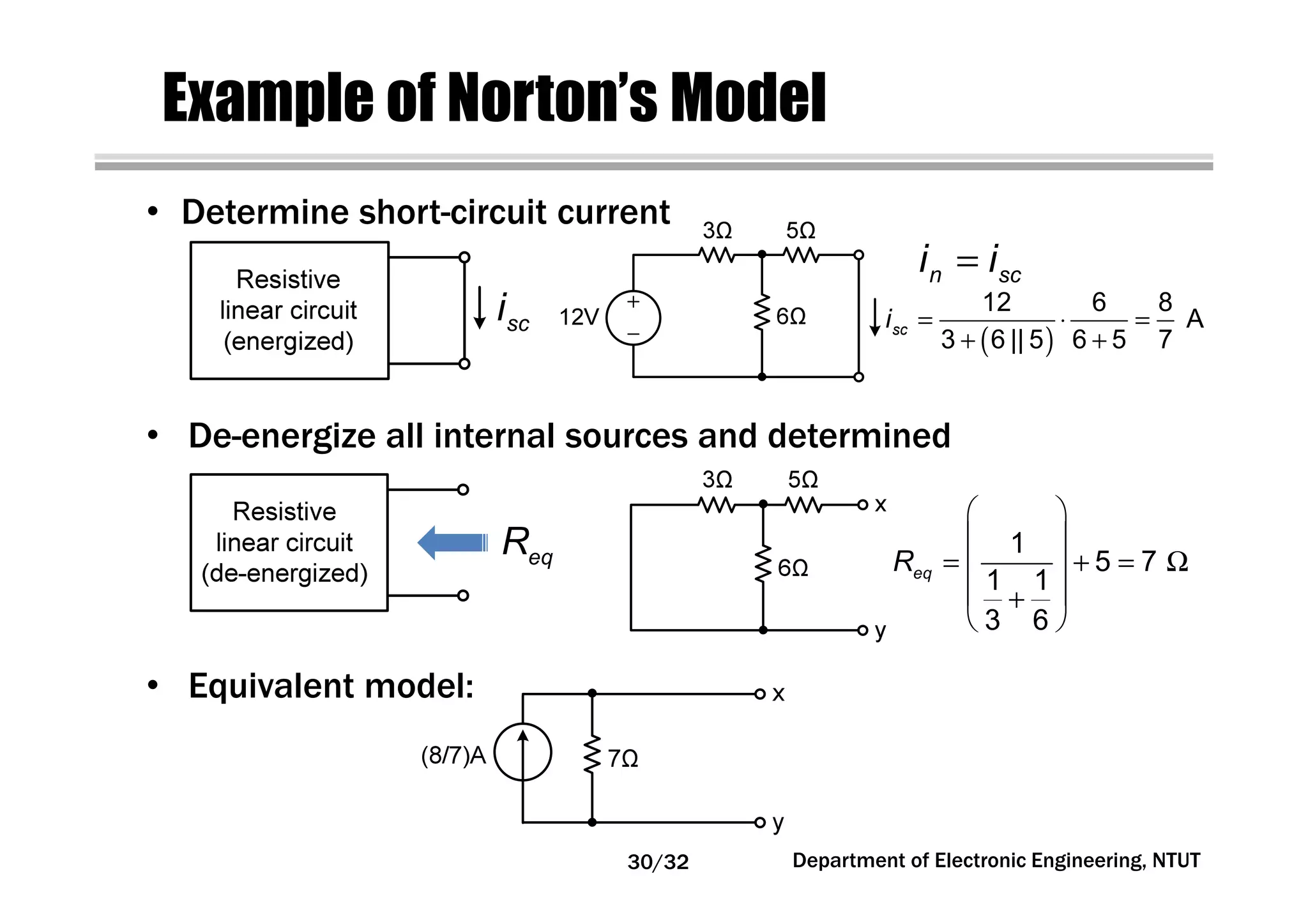
Example of Norton’s Model
Department of Electronic Engineering, NTUT
sci
• Determine short-circuit current
• De-energize all internal sources and determined
• Equivalent model:
=n sci i
( )
= ⋅ =
+ +
12 6 8
A
3 6 || 5 6 5 7
sci
eqR
 
 
= + = Ω 
 +
 
1
5 7
1 1
3 6
eqR
30/32
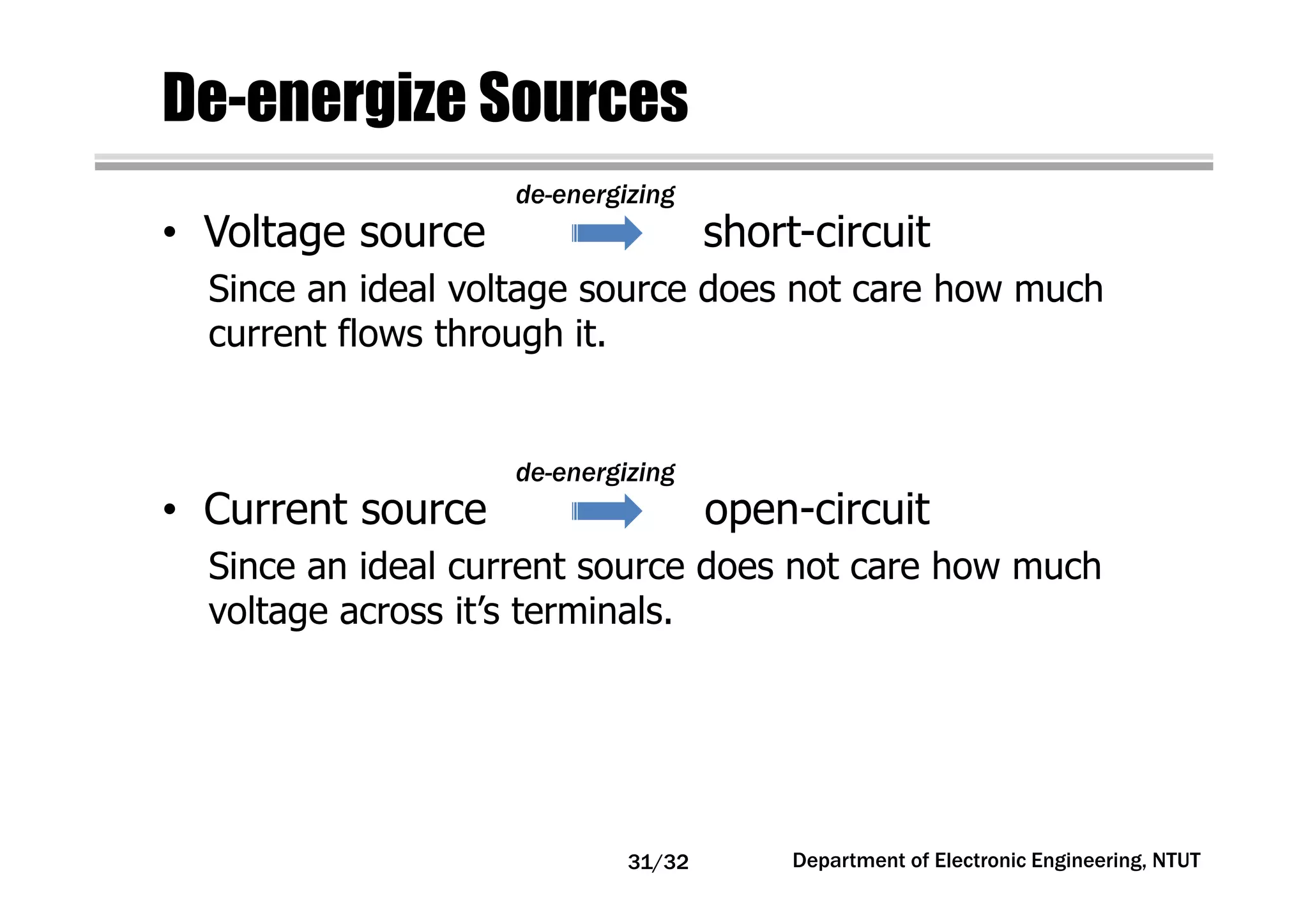
De-energize Sources
• Voltage source short-circuit
Since an ideal voltage source does not care how much
current flows through it.
• Current source open-circuit
Since an ideal current source does not care how much
voltage across it’s terminals.
Department of Electronic Engineering, NTUT
de-energizing
de-energizing
31/32
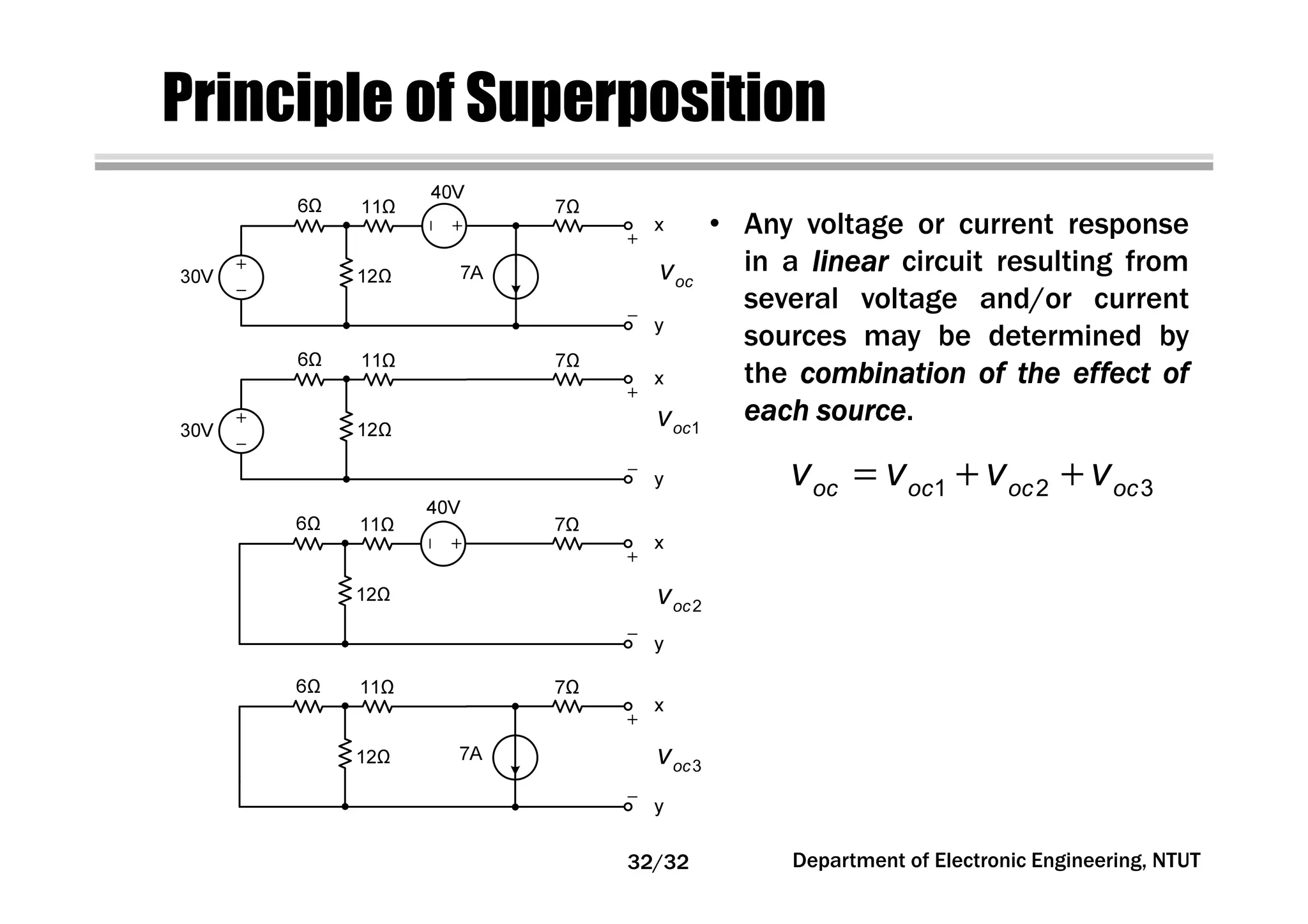
Principle of Superposition
Department of Electronic Engineering, NTUT
= + +1 2 3oc oc oc ocv v v v
1ocv
2ocv
3ocv
ocv
• Any voltage or current response
in a linearlinearlinearlinear circuit resulting from
several voltage and/or current
sources may be determined by
the combinationcombinationcombinationcombination ofofofof thethethethe effecteffecteffecteffect ofofofof
eacheacheacheach sourcesourcesourcesource.
32/32

Circuit Network Analysis - [Chapter1] Basic Circuit Laws

  • 1.
    Network Analysis Chapter 1Basic Circuit Laws Chien-Jung Li Department of Electronic Engineering National Taipei University of Technology
  • 2.
    In This Chapter •Fast reviews of some basic circuit laws • Historical points of view • Reviews of circuit analysis methods Department of Electronic Engineering, NTUT (such as mesh-current and node-voltage methods, Thevenin’s and Norton’s theorem, and superposition principles) 2/32
  • 3.
    Circuit Quantities &Prefixes QuantityQuantityQuantityQuantity SymbolsSymbolsSymbolsSymbols UnitUnitUnitUnit Abbr.Abbr.Abbr.Abbr. Time (時間) t second (秒) s (sec) Energy (能量) w, W joule (焦耳) J Power (功率) p, P watt (瓦特) W Charge (電荷) q, Q coulomb (庫倫) C Current (電流) i, I ampere (安培) A Voltage (電壓) v, V volt (伏特) V Resistance (電阻) R ohm (歐姆) Ω Conductance (電導) G siemens (姆歐) S Inductance (電感) L henry (亨利) H Capacitance (電容) C farad (法拉) F Impedance (阻抗) Z (Z) ohm (歐姆) Ω Reactance (電抗) X ohm (歐姆) Ω Admittance (導納) Y (Y) siemens (姆歐) S Susceptance (電受) B siemens (姆歐) S Frequency (cyclic) (頻率) f hertz (赫茲) Hz Frequency (radian) (頻率) ω radians/second rad/s ValueValueValueValue PrefixPrefixPrefixPrefix Abbr.Abbr.Abbr.Abbr. 10-18 atto a 10-15 femto f 10-12 pico p 10-9 nano n 10-6 micro µ 10-3 milli m 103 kilo k 106 mega M 109 giga G 1012 tera T Department of Electronic Engineering, NTUT3/32
  • 4.
    Functional Notations (I) •V , I : 電壓, 電流 • VDC , IDC : 直流電壓, 直流電流 • VAC , IAC : 交流電壓, 交流電流 • V (t), I (t) : 時變電壓, 時變電流 • v (t), i (t) : 時變電壓, 時變電流 Department of Electronic Engineering, NTUT4/32
  • 5.
    Functional Notations (II) di Di DI: 表示直流 : 表示交流, 小訊號分析 : 表示(直流+交流), 大訊號分析 Department of Electronic Engineering, NTUT • 電路分析時的慣用表示法:::: 0 1s 2s 3s 4s t DI 直流 0 1s 2s 3s 4s t di 交流(小訊號分析) 0 1s 2s 3s 4s t DI = +D D di I i 直流+交流(大訊號分析) 5/32
  • 6.
    Energy and Power(I) • Energy: capacity for, or the actual performance of work JamesJamesJamesJames PrescottPrescottPrescottPrescott JouleJouleJouleJoule (1818– 1889) was an English physicist, born in Salford, Lancashire. Joule studied the nature of heat, and discovered its relationship to mechanical work. This led to the theory of conservation of energy, which led to the development of the first law of thermodynamics. The SI derived unit of energy, the joule, is named after him. (from Wikipedia) United Kingdom (UK) 1焦耳=施加1牛頓作用力於物體使之經過1米距離所需的能量 =移動1庫侖電荷通過1伏特電壓差所需做的功 =產生(釋放)1瓦特功率1秒所需做的功 Department of Electronic Engineering, NTUT6/32
  • 7.
    Energy and Power(II) • Power: rate of performing work or the rate of energy change JamesJamesJamesJames WattWattWattWatt (1736–1819) was a Scottish inventor and mechanical engineer whose improvements to the Newcomen steam engine were fundamental to the changes brought by the Industrial Revolution in both the Kingdom of Great Britain and the world. The SI unit of power, the watt, was named after him. (from Wikipedia) Scotland ( ) ( )= dw t p t dt ( ) ( )= ∫ 2 1 t t w t p t dt 1瓦特 = 1焦耳/1秒 Department of Electronic Engineering, NTUT7/32
  • 8.
    Current and Voltage •Current is a measure of the rate of charge through a circuit. A flow of 1 coulomb/sec. past a certain point in a circuit constitutes a current of 1 ampere, or equivalently, 1A = 1 C/s. ( ) ( )= dq t i t dt ( )= ∫ 2 1 12 t t Q i t dt Q12 is the total charge passing over interval from t1 to t2 • Voltage is the electrical pressure between two points in an electrical circuit. It is always measured between two points. The SI unit of voltage, the volt, was named after the Italian physicist Alessandro Volta. Department of Electronic Engineering, NTUT8/32
  • 9.
    Coulomb, Ampere, andVolta CharlesCharlesCharlesCharles----AugustinAugustinAugustinAugustin dededede CoulombCoulombCoulombCoulomb (1736–1806) was a French physicist. He is best known for developing Coulomb's law, the definition of the electrostatic force of attraction and repulsion. The SI unit of charge, the coulomb, was named after him. (from Wikipedia) AndréAndréAndréAndré----MarieMarieMarieMarie AmpèreAmpèreAmpèreAmpère (1775– 1836) was a French physicist and mathematician who is generally regarded as one of the main discoverers of electromagnetism. The SI unit of measurement of electric current, the ampere, is named after him. (from Wikipedia) CountCountCountCount AlessandroAlessandroAlessandroAlessandro GiuseppeGiuseppeGiuseppeGiuseppe AntonioAntonioAntonioAntonio AnastasioAnastasioAnastasioAnastasio VoltaVoltaVoltaVolta (1745–1827) was an Italian physicist known especially for the development of the first electric cell in 1800. (from Wikipedia) Department of Electronic Engineering, NTUT9/32
  • 10.
    Resistance and Conductance •Resistance is the opposition to current flow present in all conducting material. A lump package of resistance is called a resistor. The symbol for resistance is R, and the unit is ohm ( ). An alternate way to characterize resistance is through the concept of conductance, G, and unit is the siemens. = 1 G R = 1 R G Department of Electronic Engineering, NTUT10/32
  • 11.
    Ohm’s Law andResistive Power GeorgGeorgGeorgGeorg SimonSimonSimonSimon OhmOhmOhmOhm (1789–1854) was born at Erlangen, Bavaria. He has exerted an important influence on the development of the theory and applications of electric current. Ohm's name has been incorporated in the terminology of electrical science in Ohm's Law (which he first published in Die galvanische Kette...), the proportionality of current and voltage in a resistor, and adopted as the SI unit of resistance, the ohm (symbol Ω). (from Wikipedia) ( ) ( )v t R i t= ⋅ ( ) ( ) ( ) v t i t G v t R = = ⋅ ( )i t R( )v t ( ) ( ) ( ) ( ) ( )2 2 v t p t i t v t R i t R = ⋅ = ⋅ = Department of Electronic Engineering, NTUT11/32
  • 12.
    Circuit Models –Active Components • Independent Sources: ( )sv t ( )si t 1v 1A v⋅ 1i 1mR i⋅ 1v 1mg v⋅ 1i 1iβ ⋅ • Dependent Sources: VCVS ICVS (CCVS) VCIS (VCCS) ICIS (CCCS) Department of Electronic Engineering, NTUT12/32
  • 13.
    Circuit Models –Passive Components • Resistor (R), Inductor (L), and Capacitor (C) RRRR LLLL CCCC Department of Electronic Engineering, NTUT13/32
  • 14.
    Equivalent Resistance • Resistorsin Series • Resistors in Parallel Department of Electronic Engineering, NTUT = + + +⋯1 2eq nR R R R = + + +⋯ 1 2 1 1 1 1 eq nR R R R = + + +⋯1 2eq nG G G G eqR 1R2R nR 1R2RnR eqR 14/32
  • 15.
    Voltage Divider Department ofElectronic Engineering, NTUT ( ) ( )= + 0 0 0 1 s R v t v t R R 0R 1R ( )sv t ( )0v t ( )1v t ( ) ( )= + 1 1 0 1 s R v t v t R R 15/32
  • 16.
    Current Divider Department ofElectronic Engineering, NTUT ( ) ( )= + 1 0 1 0 s R i t i t R R 0R1R( )si t ( )0i t( )1i t ( ) ( )= + 0 1 1 0 s R i t i t R R 16/32
  • 17.
    Kirchoff’s Voltage andCurrent Laws • KVL: The algebraic sum of the voltages around a closed loop is zero. GustavGustavGustavGustav RobertRobertRobertRobert KirchhoffKirchhoffKirchhoffKirchhoff (1824–1887) was a German physicist who contributed to the fundamental understanding of electrical circuits, spectroscopy, and the emission of black- body radiation by heated objects. He coined the term "black body" radiation in 1862, and two sets of independent concepts in both circuit theory and thermal emission are named "Kirchhoff's laws" after him, as well as a law of thermochemistry. The Bunsen–Kirchhoff Award for spectroscopy is named after him and his colleague, Robert Bunsen. 0n n v =∑ • KCL: The algebraic sum of the currents at a node zero. =∑ 0n n i Department of Electronic Engineering, NTUT17/32
  • 18.
    Kirchoff’s Voltage Law(KVL) 1v 2v 3v 4v 5v x 1 2 3 4 5 0v v v v v− + + − + = Department of Electronic Engineering, NTUT18/32
  • 19.
    Kirchoff’s Current Law(KCL) 1i 2i 3i 4i 5i 1 2 3 4 5 0i i i i i− + − − + = Department of Electronic Engineering, NTUT19/32
  • 20.
    Historical Points ofView (I) Watt 1736-1819 Coulomb 1736–1806 Ampere 1775 –1836 Volta 1745 –1827 Ohm 1789 –1854 Kirchhoff 1824 –1887 1700 19001800 Joule 1818-1889 1709 鋼琴 1752 避雷針 1783 降落傘 熱氣球 1769 蒸汽機 1767 汽水 1791 輪船 1800 電池 1804 鐵路機車 1807 蒸汽船 1816 聽診器 1821 電動機 1826 內燃機 1831 電報 發電機 1834 冰箱 1835 左輪手槍 1836 縫紉機 1843 冰淇淋 1801 紡織機 1860 自走魚雷 1852 載人電梯 1865 鐵絲網 1869 吸塵器 1870 汽油引擎 1876 擴音器 1877 留聲機 麥克風 1882 電風扇 1889 汽車 1893 無線電 1898 遙控器 Department of Electronic Engineering, NTUT20/32
  • 21.
    1859 達爾文物 種起源出版 Historical Pointsof View (II) 1700 19001800 1774-1783 美國獨立戰爭 1774 大陸會議 1776 傑佛遜獨立宣言, 美國成立 1789 美國憲法生效 華盛頓第一任總統 1861 南北戰爭爆發 1865 林肯遇刺身亡 -1722 康熙末期 1735-95 乾隆 1795-1820嘉慶 1820-50道光 1850-61咸豐 1856-75同治 1871-1908光緒1722-35 雍正 1754 吳敬梓歿 1763 曹雪芹歿 1796-1804 白蓮教起義 1805 紀曉嵐歿 1840-42 第一次 鴉片戰爭 1851 洪秀全 成立太平天國 1852 曾國藩成 立湘軍 1856-60 第二次 鴉片戰爭, 英法 聯軍 1861 慈禧垂簾聽政 1865 李鴻章成 立江南製造局 1866 左宗棠成 立福州造船廠 1885 劉銘傳任台 灣巡撫 1894 中日甲午戰爭 1898 譚嗣同, 康有為戌戊變法 1900 義和團起義 1784 鹿港開港 1810清廷設 噶瑪蘭廳(宜蘭) 1863 雞籠開港 1864 打狗開港 1874 牡丹社事件 1884 中法戰爭, 砲 轟基隆 1885 台灣脫離福 建省, 為台灣省 1887 台灣鐵路 1760 英國工業 革命開始 1789-1794 法國 大革命 1795 法王路易 十六上斷頭台 1799-1814 拿破 崙王朝 1871 德意志帝 國成立 1889 巴黎艾菲爾鐵塔 1895 馬關條約 Department of Electronic Engineering, NTUT21/32
  • 22.
    Mesh Current Method(I) 1i 2i 3i 4i 5i 6i 1i 2i bbi Department of Electronic Engineering, NTUT • Loop current assumed in every mesh. (apply KVL) • A given mesh current may not equal to the actual current. = −1 2bbi i i 22/32
  • 23.
    Mesh Current Method(II) Department of Electronic Engineering, NTUT 1I 2I 3I ( )− + + − − =1 1 220 6 5 25 0I I I ( ) ( )+ − + − + − + =2 1 2 2 325 5 3 32 2 6 0I I I I I ( )− + − + + + =3 2 3 36 2 4 7 49 0I I I I • 3 meshes, 3 loop currents, 3 KVL equations: • The currents are determined: = = = −1 2 35A, 2A, 3AI I I 23/32
  • 24.
    Node Voltage Method(I) 1v 2v 3v 4v 5v 6v 7v 8v Department of Electronic Engineering, NTUT • Firstly define a common or ground node. Such a node may not correspond to the actual ground. • (n+1) nodes are reduced to n nodes when one ground node is designated. (then, apply KCL) 24/32
  • 25.
    Node Voltage Method(II) Department of Electronic Engineering, NTUT 1V 2V 3V ( )− − + + + + + =1 21 110 32 5 0 3 6 5 3 3 V VV V • 3 nodes, 3 node voltages, 3 KCL equations: = − = =1 2 310V, 16V, 28VV V V ( ) ( )− − − + − + + =2 1 2 3232 3 0 3 3 2 4 V V V VV ( )− + − =3 2 3 7 0 4 7 V V V such that 25/32
  • 26.
    Thevenin’s Theorem ( )tvt eqR Department of Electronic Engineering, NTUT • Thevenin’s theorem states that: All effects of any linear circuit external to two reference terminals can be completely predicted from a model consisting of a single ideal voltage in series with a single resistor. 26/32
  • 27.
    Norton’s Theorem Department ofElectronic Engineering, NTUT • Norton’s theorem states that: All effects of any linear circuit external to two reference terminals can be completely predicted from a model consisting of a single ideal current source in parallel with a single resistor. ( ) ( )= t n eq v t i t R ( )ni t eqR ( ) ( )=t eq nv t R i t • If the Thevenin’s model is known, the Norton current is • If the Norton’s model is known, the Thevenin voltage is 27/32
  • 28.
    “Equivalent” Model • Whena complex circuit is replaced by a Thevenin or a Norton model, the model predicts correct results external to the reference terminals only. • The internal action of original circuit has been “lost,” and any internal calculations in the Thevenin or Norton model are generally meaningless. • The models are useful when there is a portion of a circuit that remains fixed for which there is little interest in the internal behavior nut in which the effect on an external circuit is to be studied under varying conditions. • Equivalent does not mean Identical. Department of Electronic Engineering, NTUT28/32
  • 29.
    Example of Thevenin’sModel Department of Electronic Engineering, NTUT Resistive linear circuit (energized) • Determine open-circuit voltage • De-energize all internal sources and determined Resistive linear circuit (de-energized) = = + 6 12 8 V 6 3 ocV     = + = Ω   +   1 5 7 1 1 3 6 eqR =t ocv v ocv eqR eqR • Equivalent model: 29/32
  • 30.
    Example of Norton’sModel Department of Electronic Engineering, NTUT sci • Determine short-circuit current • De-energize all internal sources and determined • Equivalent model: =n sci i ( ) = ⋅ = + + 12 6 8 A 3 6 || 5 6 5 7 sci eqR     = + = Ω   +   1 5 7 1 1 3 6 eqR 30/32
  • 31.
    De-energize Sources • Voltagesource short-circuit Since an ideal voltage source does not care how much current flows through it. • Current source open-circuit Since an ideal current source does not care how much voltage across it’s terminals. Department of Electronic Engineering, NTUT de-energizing de-energizing 31/32
  • 32.
    Principle of Superposition Departmentof Electronic Engineering, NTUT = + +1 2 3oc oc oc ocv v v v 1ocv 2ocv 3ocv ocv • Any voltage or current response in a linearlinearlinearlinear circuit resulting from several voltage and/or current sources may be determined by the combinationcombinationcombinationcombination ofofofof thethethethe effecteffecteffecteffect ofofofof eacheacheacheach sourcesourcesourcesource. 32/32