Multiband RF Transceiver System
Chapter 7
Multiband/Multi-mode
GSM/GPRS/TDMA/AMPS
RF Transceiver System Analysis
Department of Electronic Engineering
National Taipei University of Technology
Outline
• GSM/GPRS/TDMA/AMPS Transceiver Architecture
• Frequency Plan and Specifications
• Noise Figure Requirement Calculation
• Linearity Requirement Calculation
• Selectivity and Blocking Performance Evaluation
• Summary
Department of Electronic Engineering, NTUT2/38
Introduction
• A multimode and dual-band superheterodyne transceiver
design, which actually covers the designs of GSM, TDMA,
AMPS and GPRS mobile systems, is discussed.
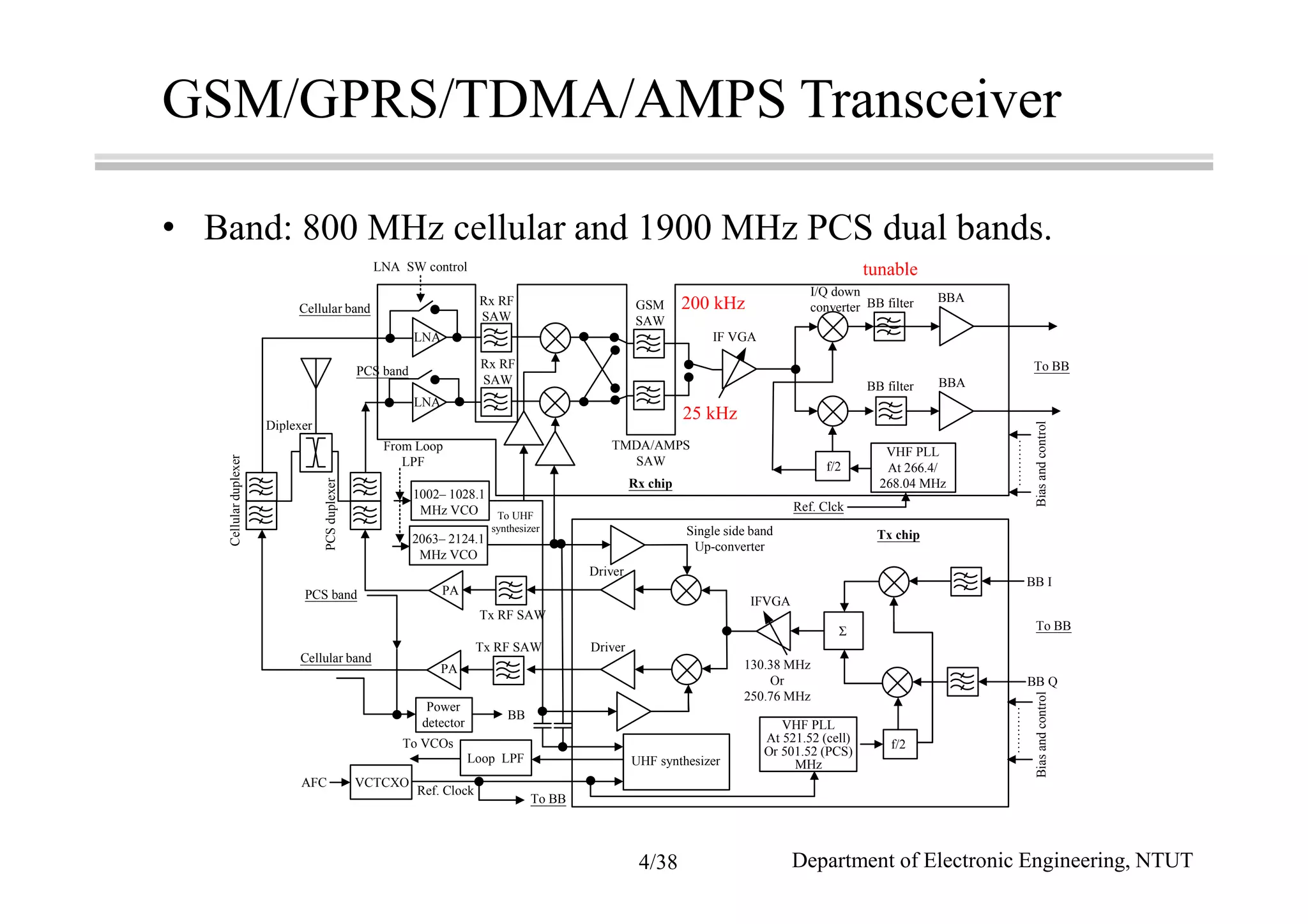
• We’ll first take a look at the architecture of this multi-mode
transceiver. Lately, the specifications of theses applications
will be given with some tables.
• For the receiver, there are things to be done:
(1) Noise Figure: BER Eb/N0 CNR Sensitivity NF
(2) IIP3 : IMD requirement CNR Phase Noise/NF IIP3
(3) Selectivity and Blocking
Department of Electronic Engineering, NTUT3/38
GSM/GPRS/TDMA/AMPS Transceiver
• Band: 800 MHz cellular and 1900 MHz PCS dual bands.
LNA SW control
Cellular band
PCS band
LNA
LNA
Rx RF
SAW
Rx RF
SAW
GSM
SAW
TMDA/AMPS
SAW
IF VGA
I/Q down
converter
BBA
BBABB filter
BB filter
To BB
f/2
VHF PLL
At 266.4/
268.04 MHz
Diplexer
Biasandcontrol
Ref. Clck
Rx chip
Tx chip
Cellularduplexer
PCSduplexer
From Loop
LPF
1002– 1028.1
MHz VCO
2063– 2124.1
MHz VCO
PA
PA
Tx RF SAW
Tx RF SAW
Power
detector
BB
Driver
Driver
PCS band
Cellular band
AFC VCTCXO
To VCOs
Loop LPF
To BB
UHF synthesizer
Ref. Clock
Single side band
Up-converter
130.38 MHz
Or
250.76 MHz
VHF PLL
At 521.52 (cell)
Or 501.52 (PCS)
MHz
IFVGA
f/2
Σ To BB
Biasandcontrol
BB I
BB Q
To UHF
synthesizer
200 kHz
25 kHz
tunable
Department of Electronic Engineering, NTUT4/38
Frequency Plan (I)
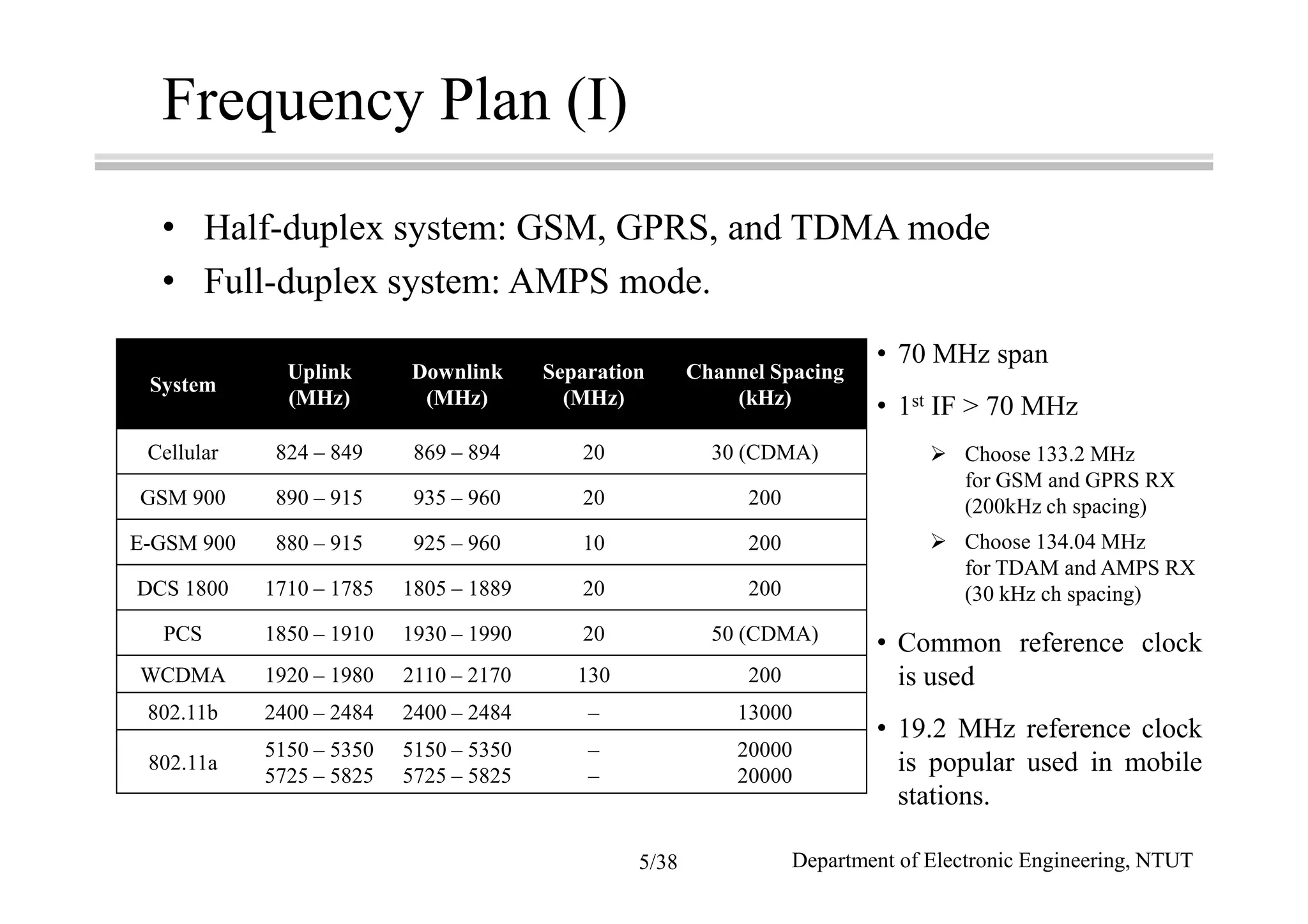
• Half-duplex system: GSM, GPRS, and TDMA mode
• Full-duplex system: AMPS mode.
• 70 MHz span
• 1st IF > 70 MHz
Choose 133.2 MHz
for GSM and GPRS RX
(200kHz ch spacing)
Choose 134.04 MHz
for TDAM and AMPS RX
(30 kHz ch spacing)
• Common reference clock
is used
• 19.2 MHz reference clock
is popular used in mobile
stations.
System
Uplink
(MHz)
Downlink
(MHz)
Separation
(MHz)
Channel Spacing
(kHz)
Cellular 824 – 849 869 – 894 20 30 (CDMA)
GSM 900 890 – 915 935 – 960 20 200
E-GSM 900 880 – 915 925 – 960 10 200
DCS 1800 1710 – 1785 1805 – 1889 20 200
PCS 1850 – 1910 1930 – 1990 20 50 (CDMA)
WCDMA 1920 – 1980 2110 – 2170 130 200
802.11b 2400 – 2484 2400 – 2484 – 13000
802.11a
5150 – 5350
5725 – 5825
5150 – 5350
5725 – 5825
–
–
20000
20000
Department of Electronic Engineering, NTUT5/38
Frequency Plan (II)
• UHF synthesizers frequency tuning range (high-side injection):
800 MHz cellular band: 1002 to 1029 MHz
1900 MHz PCS band: 2063 to 2125 MHz
GSM and GPRS TDMA and AMPS
VCTCXO 19.2 19.2
Receiver IF (MHz) 133.2 134.04
Transmitter IF (MHz) 178.2 179.04
UHF VCO Tuning (MHz) 2004 – 2058 2063 – 2125
Receiver VHF VCO (MHz) 266.4 268.08
Transmitter VHF VCO (MHz) 356.4 358.08
Use a single VCO with a tuning range 2004 to 2125 MHz and a divide-by-2
divider. (2004 to 2125 MHz is about 6% of the VCO operating frequency,
and this is a quite reasonable tuning range that still maintains good phase
noise performance)
Department of Electronic Engineering, NTUT6/38
Multi-Standard Specifications
Department of Electronic Engineering, NTUT7/38
GSM RX Specifications (I)
GSM & GPRS 800/1900 Specifications Note
Frequency Band 869~894 or 1930~1990 MHz
Modulation GMSK
Symbol rate 270.833 ksps
Sensitivity < −102 dBm RBER < 2%
800 MHz band GPRS sensitivity
(packet data channel)
< −100 dBm BLER < 10%
1900 MHz band GPRS sensitivity
(packet data channel)
< −102 dBm BLER < 10%
800 MHz dynamic range > −15 dBm RBER < 0.1%
1900 MHz dynamic range > −23 dBm RBER < 0.1%
Intermodulation spurious response attenuation > −49 dBm
f1: 800 kHz offset (CW)
f2: 1.6 MHz offset (Mod)
Table A
1
2
3
Department of Electronic Engineering, NTUT8/38
GSM RX Specifications (II)
GSM & GPRS 800/1900 Specifications Note
Adjacent channel selectivity > 9 dBc 200kHz offset, 2% BER
Atl. adjacent channel selectivity > 41 dBc 400kHz offset, 2% BER
Blocking characteristic > 49 dBc (600 kHz to 1.6MHz) offset, 2% BER
Blocking characteristic > 66 dBc (1.6 MHz to 3MHz) offset, 2% BER
800 MHz blocking characteristic > 76 dBc > 3 MHz offset, 2% BER
1900 MHz blocking characteristic > 73 dBc > 3 MHz offset, 2% BER
800 MHz spurious emission < −79 dBm/100 kHz In Receiver Band
1900 MHz spurious emission < −71 dBm/100 kHz In Receiver Band
Spurious emission < −36 dBm/100 kHz In Transmitter Band
Table B
Department of Electronic Engineering, NTUT9/38
TDMA RX Specifications
TDMA 800/1900 Specifications Note
Frequency band 869~894 or 1930~1990 MHz
Modulation π / 4 DQPSK
Symbol rate 24.3 ksps
Sensitivity < −110 dBm BER < 3%
Dynamic range > −25 dBm BER < 3%
Intermodulation spurious
response attenuation
> 62 dBc
f1: 120 kHz offset (CW)
f2: 240 kHz offset (CW)
Adjacent channel selectivity > 13 dBc 30 kHz offset, 3% BER
Atl. Adj. channel selectivity > 42 dBc 60 kHz offset, 3% BER
Spurious emission < −80 dBm In receiver band
Table C
1
2
Department of Electronic Engineering, NTUT10/38
AMPS RX Specifications
AMPS 800/1900 Specifications Note
Frequency Band 869 – 894 MHz
Modulation FM
Noise Bandwidth ~27 kHz
Sensitivity < −116 dBm SINAD = 12dB
Dynamic range > −25 dBm
Intermodulation spurious response attenuation > 65 dBc
f1: 60 kHz offset (CW)
f2: 120 kHz offset (CW)
Intermodulation spurious response attenuation > 70 dBc
f1: 330 kHz offset (CW)
f2: 660 kHz offset (CW)
Adjacent channel selectivity > 16 dBc 200 kHz offset, 2% BER
Atl. Adjacent channel selectivity > 60 dBc 400 kHz offset, 2% BER
Spurious emission < −80 dBm In receiver band
Table D
1
2
3
Department of Electronic Engineering, NTUT11/38
Noise Figure Requirement Calculation
Department of Electronic Engineering, NTUT12/38
CNR for GSM
• In the receiver system design, we need to first determine the
carrier-to-noise ratio (CNR) for each operation mode at a
specified BER.
• RBER < 2% for GSM
speech channel (TCH/FH Class II).
We use BT=0.25 here to evaluate
(actually, GSM is 0.3), and get
Eb/N0 = 5 dB
Next step is to find the required CNR.
1(Table A )
Eb/N0 (dB)
BitErrorRate
Department of Electronic Engineering, NTUT13/38
Impairments Consideration
• Consider impairments: Eb/N0 = 5.6 dB
• Bit rate = 271 kHz and the RX noise BW = 182 kHz (the
channel selection filter BW), thus the CNR:
• We can use CNRGSM = 8 dB to reserve 0.7 dB margin
Item Specification Eb/N0 Degradation
Total integrated phase noise of two LOs < −25 dBc 0.1
Group delay distortion of channel filters < 2 µsec 0.4
I and Q imbalance in phase and magnitude < 5 and < 0.5 dB 0.1
0
271
10log 5.6 10log 7.3 dB
182
b b
GSM
E R
CNR
N BW
= + = + =
0.6 dB degradation from impairments
(see Ch3 slide-24)
Department of Electronic Engineering, NTUT14/38
Other Considerations
• However, when the speech channel with AMR (adaptive
multiple rate), the required CNR for the same sensitivity of
−102 dBm will be approximately 1.5 dB higher than that of the
original speech channels - i.e., (8 + 1.5) = 9.5 dB.
• The requirement on the CNR in the worst case is the channel
TCH/AFS5.9 in HT100 propagation condition:
For a −102 dBm sensitivity 9.4 dB CNR is needed even
without AMR.
Department of Electronic Engineering, NTUT15/38
CNR for GPRS
• The corresponding CNR for a 10% block error rate (BLER) in
packet data channels (PDCH) is in general approximately 8 dB
as required by the GSM speech channels, but in the worst case,
it may rise to close to 10 dB.
• However, the reference sensitivity of the GPRS in the worst
case (PDCH/CS-4 in 1800 MHz band, for example) is relaxed
to −100 dBm instead of −102 dBm.
• For simplicity, the performance evaluation of the GSM and
GPRS system RF receivers later on will be based on
CNRmin = 8 dB.
2(Table A )
In the practical system design we should leave enough
margin to cover the performance in the worst case
including GSM speech channel with AMR.
Department of Electronic Engineering, NTUT16/38
CNR for TDMA (I)
• In a similar way, we can determine the CNR for performance
calculation of the TDMA receiver where the signal is π/4 -
DQPSK modulated.
1(Table C )
Eb/N0 (dB)
BitErrorRate
Eb/N0 degradation due to ISI from IF (SAW + ceramic) filters
• Eb/N0 for a 3% BER is
approximately equal to 5
dB in the case of ISI free.
Department of Electronic Engineering, NTUT17/38
CNR for TDMA (II)
• Assume that the channel filters have a total group delay
distortion 1.5 ps, which causes 0.3 dB Eb/N0 increase to keep
the 3% BER, and the other factors such as I and Q channel
mismatching and the phase noise of the LOs raise Eb/N0
another 0.2 dB.
• Therefore, it needs total 5.5 dB to reach 3% BER.
• Considering Rb/BW = 2 (2-bits/symbol) in the case of π/4-
DQPSK modulation, we obtain CNR to be
• Similar to the GSM situation, we add 0.5 dB to the above
CNRTDMA value for performance evaluation of the TDMA
mobile receiver: CNRTDMA = 9 dB.
5.5 10log 2 8.5 dBTDMACNR ≅ + = (see Ch3 slide-24)
Department of Electronic Engineering, NTUT18/38
CNR for AMPS (Analog Wireless System)
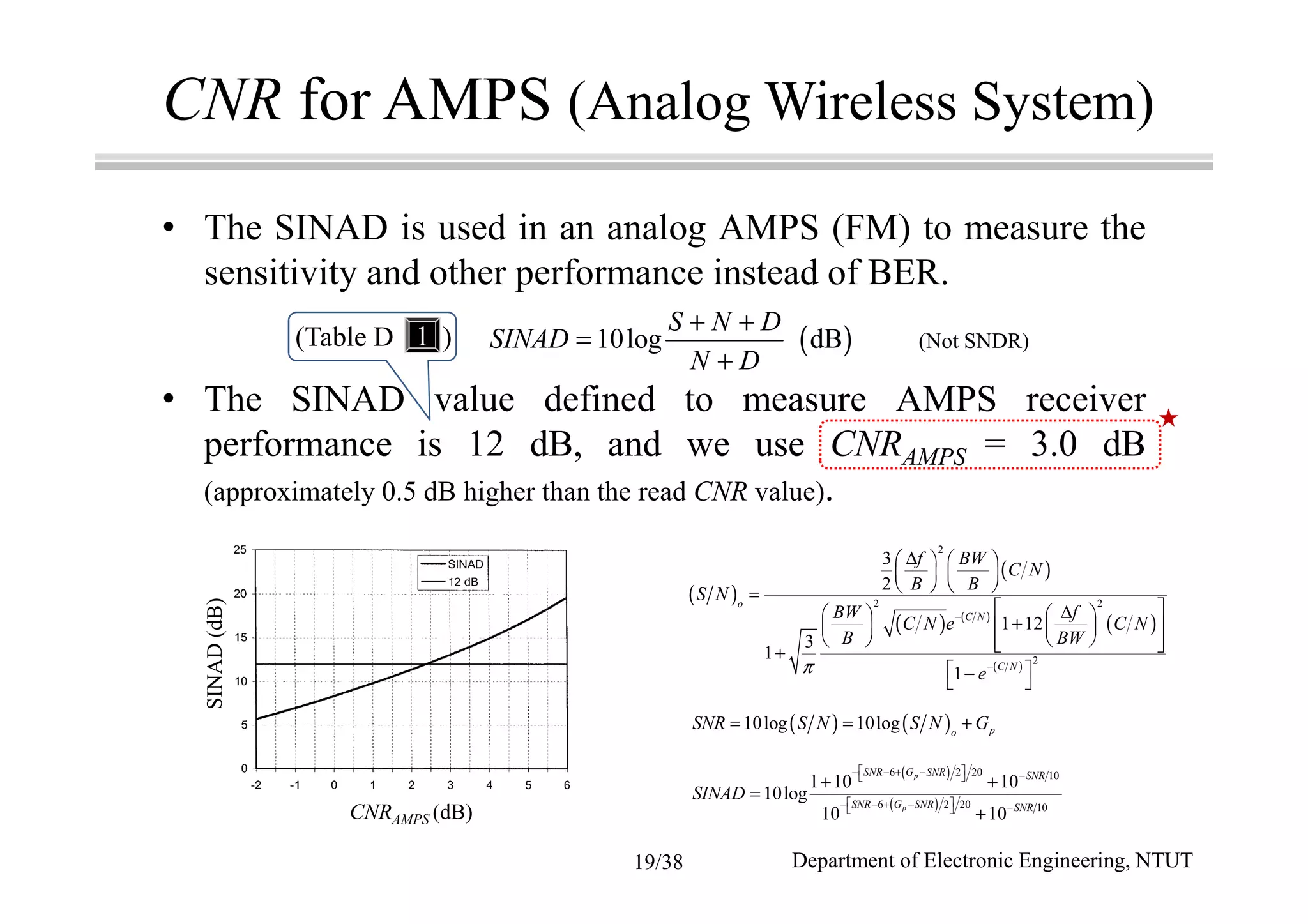
• The SINAD is used in an analog AMPS (FM) to measure the
sensitivity and other performance instead of BER.
• The SINAD value defined to measure AMPS receiver
performance is 12 dB, and we use CNRAMPS = 3.0 dB
(approximately 0.5 dB higher than the read CNR value).
( )10log dB
S N D
SINAD
N D
+ +
=
+
( )
( )
( ) ( )
( )
( )
2
2 2
2
3
2
1 12
3
1
1
o
C N
C N
f BW
C N
B B
S N
BW f
C N e C N
B BW
eπ
−
−
∆   
   
   =
 ∆   
+    
     +
 − 
( ) ( )10log 10log po
SNR S N S N G= = +
(Not SNDR)1(Table D )
CNRAMPS (dB)
SINAD(dB)
( )
( )
6 2 20 10
6 2 20 10
1 10 10
10log
10 10
p
p
SNR G SNR SNR
SNR G SNR SNR
SINAD
 − − + − − 
 − − + − − 
+ +
=
+
Department of Electronic Engineering, NTUT19/38
Required Noise Figure
• The receiver static sensitivity is determined by the noise
bandwidth, noise figure, and CNR.
Usually we would like to have a 4 dB margin in the typical case and a 1.5 dB
margin in the worst case.
( )3
174 106 10log 182 10 8 7.4 dBGSMNF = − − × − ≅
( )3
174 114 10log 27 10 9 6.7 dBTDMANF = − − × − ≅
( )3
174 120 10log 27 10 3 6.7 dBAMPSNF = − − × − ≅
(see Ch4 slide-8, we didn’t consider digital
processing improvement here)
The NF of this multimode receiver
shall be 6.7 dB or lower. The
maximum NF should be 9.2 dB or
less, and thus the sensitivity still has
1.5 dB margin in the worst case.
Spec. GSM/GPRS TDMA AMPS
Noise Floor −174 dBm/Hz −174 dBm/Hz −174 dBm/Hz
Sensitivity (Spec.) −102 dBm −110 dBm −116 dBm
Margin 4 dB 4 dB 4 dB
Sensitivity (Target ) −106 dBm −114 dBm −120 dBm
Noise Figure Requirement 7.4 dB 6.7 dB 6.7 dB
Department of Electronic Engineering, NTUT20/38
Linearity Requirement Calculation
Department of Electronic Engineering, NTUT21/38
Linearity and IIP3
• Receiver linearity is usually measured by the IIP3.
• The linearity requirement is more complicated to determine
than the receiver noise figure.
• The requirement on the overall IIP3 of a wireless mobile
receiver is dominated by the allowed intermodulation
distortion (IMD) or formally referred to as intermodulation
spurious attenuation and the phase noise of UHF synthesizer
LO.
Department of Electronic Engineering, NTUT22/38
IMD Performance Requirements
• GSM:
Desired signal −99 dBm (−102+3)
Minimum interferers −49 dBm
Tone/modulated interferer, offset frequency 800/ 1600 kHz
• TDMA:
Desired signal −107 dBm (−110+3)
Minimum interferers 62 dBc higher;
Tone/tone interferer, offset frequency 120/ 240 kHz
• AMPS:
Desired signal −−−−113 dBm (−116+3)
Minimum close-spaced interferers 65 dBc higher
Close-spaced tone/tone interferer, offset 120/ 240 kHz
Minimum wide spaced interferers 70 dBc higher
Wide-spaced tone/tone interferer, offset 330/ 660 kHz.
3(Table A )
2(Table C )
2(Table D )
3(Table D )
Department of Electronic Engineering, NTUT23/38
You may like to evaluate the desired signal power with the
sensitivity (target), e.g., −106 dBm, calculated in slide-20.
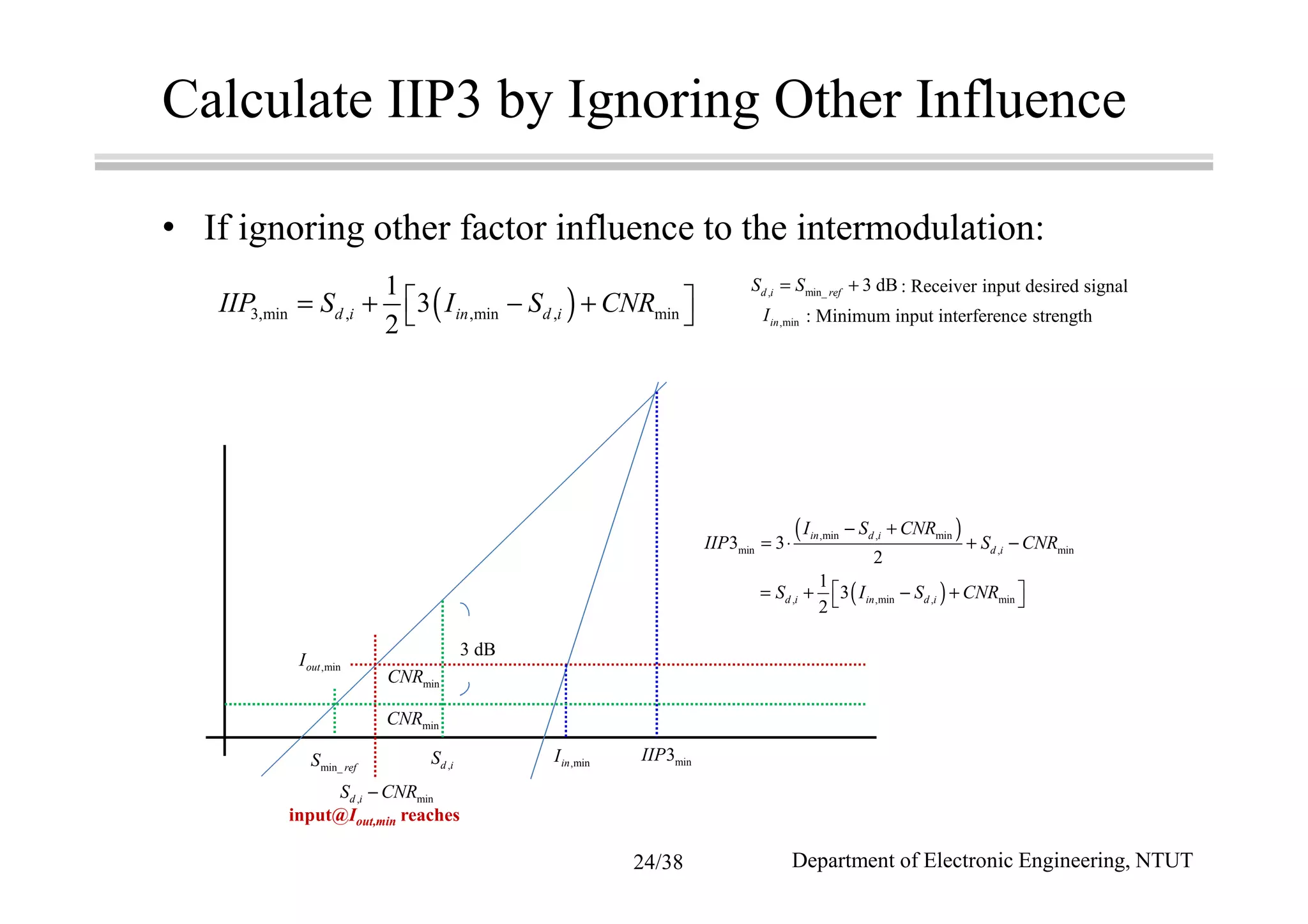
Calculate IIP3 by Ignoring Other Influence
• If ignoring other factor influence to the intermodulation:
( )3,min , ,min , min
1
3
2
d i in d iIIP S I S CNR = + − + 
, min_ 3 dBd i refS S= + : Receiver input desired signal
,mininI : Minimum input interference strength
min_ refS
, mind iS CNR−
min3IIP,mininI
( )
( )
,min , min
min , min
, ,min , min
3 3
2
1
3
2
in d i
d i
d i in d i
I S CNR
IIP S CNR
S I S CNR
− +
= ⋅ + −
 = + − + 
3 dB
,d iS
input@Iout,min reaches
minCNR
minCNR
,minoutI
Department of Electronic Engineering, NTUT24/38
Estimated IIP3
• If ignoring other factor influence to the intermodulation:
( )3,min , ,min , min
1
3
2
d i in d iIIP S I S CNR = + − + 
[ ]3,min
1
99 3 49 8 21.5 dBm
2GSM
IIP = − + × + = −
[ ]3,min
1
107 3 62 9 9.5 dBm
2TDMA
IIP = − + × + = −
[ ]3,min
1
113 3 65 3 14 dBm for close-spaced
2AMPS
IIP = − + × + = −
[ ]3,min
1
113 3 70 3 6.5 dBm for wide-spaced
2AMPS
IIP = − + × + = −
Spec. GSM/GPRS TDMA AMPS
Desired signal −99 dBm −107 dBm −113 dBm
Spurious Response
Attenuation
49 dBc 62 dBc
close wide
65 dBc 70 dBc
CNRmin 8 dB 9 dB 3 dB 3 dB
Required IIP3 −21.5 dBm −9.5 dBm −14 dBm −6.5 dBm
Department of Electronic Engineering, NTUT25/38
Consider Other Influence
• LO phase noise, spurious, and the receiver noise
figure will also impact the IMD performance:
The LO phase noise and spurious level, especially at the offset frequencies
equal to those frequencies where the intermodulation test interferers are
located, should be low enough to ensure that the requested receiver IIP3 for
certain IMD performance is reasonable and feasible.
• The VHF LO phase noise and spurious:
Generally have a negligible impact on the IMD performance if the IF channel
filter has good rejection to the interferers.
max, 2 2 2 2
10 10
3,min ,min , , , ,
1 1 1 1
1
3 10log 10 10
2
nfin ND
in phn j k spu j k
j k j k
IIP I P P
= = = =
  
= − − − −   
   
∑∑ ∑∑
Department of Electronic Engineering, NTUT26/38
LO Phase Noise
Cellular Band Synthesizer PCS Band Synthesizer
Frequency
Offset (kHz)
Phase Noise
(dBc/Hz)
Spurs (dBc)
Phase Noise
(dBc/Hz)
Spurs (dBc)
30 kHz −105 −60 −103 −60
60 kHz −117 −85 −114 −85
120 kHz −125 −90 −122 −90
240 kHz −131 −95 −128 −95
330 kHz −134 −95 −131 −95
660 kHz −140 −95 −137 −95
3000 kHz −144 −95 −142 −95
800 MHz Band 1900 MHz Band
Frequency
Offset (kHz)
Phase Noise
(dBc/Hz)
Spurs (dBc)
Phase Noise
(dBc/Hz)
Spurs (dBc)
200 kHz −118 −60 −114 −60
400 kHz −124 −65 −120 −65
600 kHz −127 −70 −123 −70
800 kHz −130 −78 −126 −78
1600 kHz −136 −85 −132 −85
> |3200 k| Hz −141 −90 −137 −90
The phase noise may vary a couple of dB with temperature from room to hot (60 C) or to cold (-30 C).
ForTDMAandAMPSForGSM
3(Table A )
Table E
Table F
Department of Electronic Engineering, NTUT27/38
Required IIP3 Estimation (I)
• The required IIP3 of 800 MHz band GSM receiver is
calculated by using phase noise for GSM as
• The required IIP3 of 1900 MHz band GSM receiver is
• In a similar way, we can obtain IIP3 for other modes and
bands based on phase noise and spurious for TDMA/AMPS
LO as follows.
3, _1900 14.8 dBmGSMIIP = −
3, _1900 2.8 dBmTDMAIIP = −
3, _800 3.4 dBmTDMAIIP = − 3, _ 12.6 dBmAMPS closeIIP = −
3, _ 9.3 dBmAMPS wideIIP = −
( )
3 3 3 85 49 3
10
99 8 174 7.4 10log18210 130 10log182 10 49 3 136 10log18210 49 3 78 49 3
10 10 10 10 10
3, _800
1
3 49 3 10log 10 10 10 10 10 10 15 dBm
2
GSMIIP
− − +− − − + + ⋅ − + ⋅ − + − + ⋅ − + − − +  
= − + − − − − − − = −   
3(Table A )
3 dB margin
PN@800 kHz PN@1600 kHz
Spurious@800 kHz Spurious@1600 kHz
Use NF=7.4 for GSM
Department of Electronic Engineering, NTUT28/38
Required IIP3 Estimation (II)
• From these results we can conclude that:
TDMA receiver requires the highest linearity, and the receiver operating in the
1900 MHz band needs higher IIP3 than when it is running in the 800 MHz band
since the phase noise of the PCS band LO is worse than that of the cellular band
LO.
• The linearity design of the receiver common path for different
modes should be based on the TDMA requirement, but in the
circuit design we should also consider adjustable bias circuitry
to change the device bias based on operation modes to save the
current consumption.
Department of Electronic Engineering, NTUT29/38
Selectivity and Blocking Performance
Department of Electronic Engineering, NTUT30/38
Selectivity and Blocking Performance
• Receiver selectivity and blocking performance are mainly
determined by :
Channel filters
LO phase noise
Spurious
• The LO phase noise/spurious requirements is also partially
determined by the IMD performance, and therefore we have
already had a basic idea what level phase noise/spurious can
be used in our receiver system design.
Department of Electronic Engineering, NTUT31/38
Channel Selection Filtering
• The channel filter characteristics affect not only the receiver
selectivity and blocking performance but also the IMD
performance.
Since no matter what the adjacent/alternate channel interferers are, distance
blocking signals, or intermodulation interference tones/modulated signals will be
significantly attenuated when they pass through the channel filters.
• It is a trial and error procedure to make a tradeoff between
filtering requirements and feasibility of implementation.
• Examples of channel filter characteristics for the GSM
receiver and for the TDMA or the AMPS receiver are
presented in Table next slide.
Department of Electronic Engineering, NTUT32/38
Channel Filter Characteristics
GSM Channel Filter TDMA/AMPS Channel Filter
Insertion Loss (dB) Insertion Loss (dB)
Typical Worst Typical Worst
In-band 4.5 5.5 In-band 3.5 4.5
Rejection (dB) Rejection (dB)
Offset
frequency
Typical Worst
Offset
frequency
Typical Worst
200 kHz 4 0 30 kHz 3 0
400 kHz 17 12 60 kHz 24 20
600 kHz 27 22 120 kHz 40 35
800 kHz 31 25 240 kHz 50 40
1600 kHz 40 30 330 kHz 45 40
3000 k Hz 40 30 660 kHz 43 35
Table G
Department of Electronic Engineering, NTUT33/38
Calculate Selectivity and Blocking
• Utilizing
• GSM adjacent channel selectivity:
,
,1 ,2 ,1 ,2
174 10log
10 10
/ / / / , ,10log 10log
10 10 10 10
10 10
10log
10 10 10 10
d i
phn phn IF spu spu IF
S CNR BW NF
adj alt block adj alt block d i d iN BW N R BW N N R
S I S S
− − + +
+ −∆ + −∆
 
− ∆ = − = −
 
 + + + 
3
3 3
99 8 174 10log182 10 7.4
10 10
118 10log182 10 108 4 10log182 10 60 55 4
10 10 10 10
10 10
10log 99 46.8 dB
10 10 10 10
adjS
− − − + ⋅ +
− + ⋅ − − + ⋅ − − −
 
− 
∆ = + = 
 + + + 
Rejeciton@200 kHz (adjacent ch.)Spurious@200 kHzPN@200 kHz
VHF LO, IF rejection
(LO performance not shown here)
UHF LO
Department of Electronic Engineering, NTUT34/38
AMPS Adjacent Channel Selectivity
• The AMPS adjacent channel selectivity is calculated in a
similar way:
In the above selectivity calculations, it is assumed that the VHF LO phase noise at
the corresponding adjacent channel is 10 dB worse than the UHF LO phase noise
and the spurious is 5 dB worse.
• The results show margins over 37 and 29 dB, respectively, for
GSM and AMPS cases. (GSM > 9 dBc, Table B; AMPS > 16 dBc, Table D)
3
3 3
117 3 174 10log2710 6.7
10 10
105 10log2710 95 10log2710 3 60 55 3
10 10 10 10
10 10
10log 120 45.1 dB
10 10 10 10
adjS
− − − + ⋅ +
− + ⋅ − + ⋅ − − − −
 
− 
∆ = + = 
 + + + 
Rejeciton@30 kHz (adjacent ch.)Spurious@30 kHzPN@30 kHz
VHF LO, IF rejection
(LO performance not shown here)
UHF LO
Department of Electronic Engineering, NTUT35/38
Selectivity and Blocking Performance (I)
• The adjacent/alternate channel selectivity and
blocking performance can be estimated with the
formula given in previous slide.
• Estimated GSM performance:
800 MHz Band 1900 MHz Band
GSM mobile receiver
Loose LO
(Table F)
Margin
Tight LO
(Table E)
Margin
Loose LO
(Table F)
Margin
Tight LO
(Table E)
Margin
Adjacent channel (dBc) 45.8 36.8 49.4 40.4 45.7 36.7 50.3 41.3
Alternate channel (dBc) 54.0 13.0 56.2 15.2 54.0 13.0 55.9 14.9
Block 0.6 – 1.6 MHz (dB) 59.9 3.9 61.1 5.1 58.3 2.3 60.9 4.9
Block 1.6 – 3.0 MHz (dB) 72.4 6.4 74.9 8.9 69.5 3.5 74.2 8.2
Blocking > 3 MHz 79.4 3.4 82.0 6.0 75.4 2.4 80.1 4.1
Department of Electronic Engineering, NTUT36/38
Selectivity and Blocking Performance (II)
800 MHz Band 1900 MHz Band
TDMA mobile receiver Tight LO Margin Tight LO Margin
Adjacent channel (dBc) 41.2 28.2 40.9 27.9
Alternate channel (dBc) 62.4 20.4 59.6 17.6
AMPS mobile receiver Tight LO Margin Tight LO Margin
Adjacent channel (dBc) 45.1 29.1 NA NA
Alternate channel (dBc) 66.2 6.2 NA NA
• Estimated TDMA/AMPS performance:
Department of Electronic Engineering, NTUT37/38
Summary
• To estimate the required receiver noise figure, one
can start from the BER and sensitivity specifications.
BER Eb/N0 CNR Sensitivity NF
• One can start from the IMD requirement, and utilize
the determined CNR and noise figure to estimate IIP3
requirement.
IMD requirement CNR Phase Noise/NF IIP3
• Selectivity and blocking performance needs some
information, such as filter responses and 1st LO/2nd
LO performance, and sometimes it requires tedious
“trial and error” analysis.
Department of Electronic Engineering, NTUT38/38

Multiband Transceivers - [Chapter 7] Multi-mode/Multi-band GSM/GPRS/TDMA/AMPS System Analysis

  • 1.
    Multiband RF TransceiverSystem Chapter 7 Multiband/Multi-mode GSM/GPRS/TDMA/AMPS RF Transceiver System Analysis Department of Electronic Engineering National Taipei University of Technology
  • 2.
    Outline • GSM/GPRS/TDMA/AMPS TransceiverArchitecture • Frequency Plan and Specifications • Noise Figure Requirement Calculation • Linearity Requirement Calculation • Selectivity and Blocking Performance Evaluation • Summary Department of Electronic Engineering, NTUT2/38
  • 3.
    Introduction • A multimodeand dual-band superheterodyne transceiver design, which actually covers the designs of GSM, TDMA, AMPS and GPRS mobile systems, is discussed. • We’ll first take a look at the architecture of this multi-mode transceiver. Lately, the specifications of theses applications will be given with some tables. • For the receiver, there are things to be done: (1) Noise Figure: BER Eb/N0 CNR Sensitivity NF (2) IIP3 : IMD requirement CNR Phase Noise/NF IIP3 (3) Selectivity and Blocking Department of Electronic Engineering, NTUT3/38
  • 4.
    GSM/GPRS/TDMA/AMPS Transceiver • Band:800 MHz cellular and 1900 MHz PCS dual bands. LNA SW control Cellular band PCS band LNA LNA Rx RF SAW Rx RF SAW GSM SAW TMDA/AMPS SAW IF VGA I/Q down converter BBA BBABB filter BB filter To BB f/2 VHF PLL At 266.4/ 268.04 MHz Diplexer Biasandcontrol Ref. Clck Rx chip Tx chip Cellularduplexer PCSduplexer From Loop LPF 1002– 1028.1 MHz VCO 2063– 2124.1 MHz VCO PA PA Tx RF SAW Tx RF SAW Power detector BB Driver Driver PCS band Cellular band AFC VCTCXO To VCOs Loop LPF To BB UHF synthesizer Ref. Clock Single side band Up-converter 130.38 MHz Or 250.76 MHz VHF PLL At 521.52 (cell) Or 501.52 (PCS) MHz IFVGA f/2 Σ To BB Biasandcontrol BB I BB Q To UHF synthesizer 200 kHz 25 kHz tunable Department of Electronic Engineering, NTUT4/38
  • 5.
    Frequency Plan (I) •Half-duplex system: GSM, GPRS, and TDMA mode • Full-duplex system: AMPS mode. • 70 MHz span • 1st IF > 70 MHz Choose 133.2 MHz for GSM and GPRS RX (200kHz ch spacing) Choose 134.04 MHz for TDAM and AMPS RX (30 kHz ch spacing) • Common reference clock is used • 19.2 MHz reference clock is popular used in mobile stations. System Uplink (MHz) Downlink (MHz) Separation (MHz) Channel Spacing (kHz) Cellular 824 – 849 869 – 894 20 30 (CDMA) GSM 900 890 – 915 935 – 960 20 200 E-GSM 900 880 – 915 925 – 960 10 200 DCS 1800 1710 – 1785 1805 – 1889 20 200 PCS 1850 – 1910 1930 – 1990 20 50 (CDMA) WCDMA 1920 – 1980 2110 – 2170 130 200 802.11b 2400 – 2484 2400 – 2484 – 13000 802.11a 5150 – 5350 5725 – 5825 5150 – 5350 5725 – 5825 – – 20000 20000 Department of Electronic Engineering, NTUT5/38
  • 6.
    Frequency Plan (II) •UHF synthesizers frequency tuning range (high-side injection): 800 MHz cellular band: 1002 to 1029 MHz 1900 MHz PCS band: 2063 to 2125 MHz GSM and GPRS TDMA and AMPS VCTCXO 19.2 19.2 Receiver IF (MHz) 133.2 134.04 Transmitter IF (MHz) 178.2 179.04 UHF VCO Tuning (MHz) 2004 – 2058 2063 – 2125 Receiver VHF VCO (MHz) 266.4 268.08 Transmitter VHF VCO (MHz) 356.4 358.08 Use a single VCO with a tuning range 2004 to 2125 MHz and a divide-by-2 divider. (2004 to 2125 MHz is about 6% of the VCO operating frequency, and this is a quite reasonable tuning range that still maintains good phase noise performance) Department of Electronic Engineering, NTUT6/38
  • 7.
    Multi-Standard Specifications Department ofElectronic Engineering, NTUT7/38
  • 8.
    GSM RX Specifications(I) GSM & GPRS 800/1900 Specifications Note Frequency Band 869~894 or 1930~1990 MHz Modulation GMSK Symbol rate 270.833 ksps Sensitivity < −102 dBm RBER < 2% 800 MHz band GPRS sensitivity (packet data channel) < −100 dBm BLER < 10% 1900 MHz band GPRS sensitivity (packet data channel) < −102 dBm BLER < 10% 800 MHz dynamic range > −15 dBm RBER < 0.1% 1900 MHz dynamic range > −23 dBm RBER < 0.1% Intermodulation spurious response attenuation > −49 dBm f1: 800 kHz offset (CW) f2: 1.6 MHz offset (Mod) Table A 1 2 3 Department of Electronic Engineering, NTUT8/38
  • 9.
    GSM RX Specifications(II) GSM & GPRS 800/1900 Specifications Note Adjacent channel selectivity > 9 dBc 200kHz offset, 2% BER Atl. adjacent channel selectivity > 41 dBc 400kHz offset, 2% BER Blocking characteristic > 49 dBc (600 kHz to 1.6MHz) offset, 2% BER Blocking characteristic > 66 dBc (1.6 MHz to 3MHz) offset, 2% BER 800 MHz blocking characteristic > 76 dBc > 3 MHz offset, 2% BER 1900 MHz blocking characteristic > 73 dBc > 3 MHz offset, 2% BER 800 MHz spurious emission < −79 dBm/100 kHz In Receiver Band 1900 MHz spurious emission < −71 dBm/100 kHz In Receiver Band Spurious emission < −36 dBm/100 kHz In Transmitter Band Table B Department of Electronic Engineering, NTUT9/38
  • 10.
    TDMA RX Specifications TDMA800/1900 Specifications Note Frequency band 869~894 or 1930~1990 MHz Modulation π / 4 DQPSK Symbol rate 24.3 ksps Sensitivity < −110 dBm BER < 3% Dynamic range > −25 dBm BER < 3% Intermodulation spurious response attenuation > 62 dBc f1: 120 kHz offset (CW) f2: 240 kHz offset (CW) Adjacent channel selectivity > 13 dBc 30 kHz offset, 3% BER Atl. Adj. channel selectivity > 42 dBc 60 kHz offset, 3% BER Spurious emission < −80 dBm In receiver band Table C 1 2 Department of Electronic Engineering, NTUT10/38
  • 11.
    AMPS RX Specifications AMPS800/1900 Specifications Note Frequency Band 869 – 894 MHz Modulation FM Noise Bandwidth ~27 kHz Sensitivity < −116 dBm SINAD = 12dB Dynamic range > −25 dBm Intermodulation spurious response attenuation > 65 dBc f1: 60 kHz offset (CW) f2: 120 kHz offset (CW) Intermodulation spurious response attenuation > 70 dBc f1: 330 kHz offset (CW) f2: 660 kHz offset (CW) Adjacent channel selectivity > 16 dBc 200 kHz offset, 2% BER Atl. Adjacent channel selectivity > 60 dBc 400 kHz offset, 2% BER Spurious emission < −80 dBm In receiver band Table D 1 2 3 Department of Electronic Engineering, NTUT11/38
  • 12.
    Noise Figure RequirementCalculation Department of Electronic Engineering, NTUT12/38
  • 13.
    CNR for GSM •In the receiver system design, we need to first determine the carrier-to-noise ratio (CNR) for each operation mode at a specified BER. • RBER < 2% for GSM speech channel (TCH/FH Class II). We use BT=0.25 here to evaluate (actually, GSM is 0.3), and get Eb/N0 = 5 dB Next step is to find the required CNR. 1(Table A ) Eb/N0 (dB) BitErrorRate Department of Electronic Engineering, NTUT13/38
  • 14.
    Impairments Consideration • Considerimpairments: Eb/N0 = 5.6 dB • Bit rate = 271 kHz and the RX noise BW = 182 kHz (the channel selection filter BW), thus the CNR: • We can use CNRGSM = 8 dB to reserve 0.7 dB margin Item Specification Eb/N0 Degradation Total integrated phase noise of two LOs < −25 dBc 0.1 Group delay distortion of channel filters < 2 µsec 0.4 I and Q imbalance in phase and magnitude < 5 and < 0.5 dB 0.1 0 271 10log 5.6 10log 7.3 dB 182 b b GSM E R CNR N BW = + = + = 0.6 dB degradation from impairments (see Ch3 slide-24) Department of Electronic Engineering, NTUT14/38
  • 15.
    Other Considerations • However,when the speech channel with AMR (adaptive multiple rate), the required CNR for the same sensitivity of −102 dBm will be approximately 1.5 dB higher than that of the original speech channels - i.e., (8 + 1.5) = 9.5 dB. • The requirement on the CNR in the worst case is the channel TCH/AFS5.9 in HT100 propagation condition: For a −102 dBm sensitivity 9.4 dB CNR is needed even without AMR. Department of Electronic Engineering, NTUT15/38
  • 16.
    CNR for GPRS •The corresponding CNR for a 10% block error rate (BLER) in packet data channels (PDCH) is in general approximately 8 dB as required by the GSM speech channels, but in the worst case, it may rise to close to 10 dB. • However, the reference sensitivity of the GPRS in the worst case (PDCH/CS-4 in 1800 MHz band, for example) is relaxed to −100 dBm instead of −102 dBm. • For simplicity, the performance evaluation of the GSM and GPRS system RF receivers later on will be based on CNRmin = 8 dB. 2(Table A ) In the practical system design we should leave enough margin to cover the performance in the worst case including GSM speech channel with AMR. Department of Electronic Engineering, NTUT16/38
  • 17.
    CNR for TDMA(I) • In a similar way, we can determine the CNR for performance calculation of the TDMA receiver where the signal is π/4 - DQPSK modulated. 1(Table C ) Eb/N0 (dB) BitErrorRate Eb/N0 degradation due to ISI from IF (SAW + ceramic) filters • Eb/N0 for a 3% BER is approximately equal to 5 dB in the case of ISI free. Department of Electronic Engineering, NTUT17/38
  • 18.
    CNR for TDMA(II) • Assume that the channel filters have a total group delay distortion 1.5 ps, which causes 0.3 dB Eb/N0 increase to keep the 3% BER, and the other factors such as I and Q channel mismatching and the phase noise of the LOs raise Eb/N0 another 0.2 dB. • Therefore, it needs total 5.5 dB to reach 3% BER. • Considering Rb/BW = 2 (2-bits/symbol) in the case of π/4- DQPSK modulation, we obtain CNR to be • Similar to the GSM situation, we add 0.5 dB to the above CNRTDMA value for performance evaluation of the TDMA mobile receiver: CNRTDMA = 9 dB. 5.5 10log 2 8.5 dBTDMACNR ≅ + = (see Ch3 slide-24) Department of Electronic Engineering, NTUT18/38
  • 19.
    CNR for AMPS(Analog Wireless System) • The SINAD is used in an analog AMPS (FM) to measure the sensitivity and other performance instead of BER. • The SINAD value defined to measure AMPS receiver performance is 12 dB, and we use CNRAMPS = 3.0 dB (approximately 0.5 dB higher than the read CNR value). ( )10log dB S N D SINAD N D + + = + ( ) ( ) ( ) ( ) ( ) ( ) 2 2 2 2 3 2 1 12 3 1 1 o C N C N f BW C N B B S N BW f C N e C N B BW eπ − − ∆           =  ∆    +          +  −  ( ) ( )10log 10log po SNR S N S N G= = + (Not SNDR)1(Table D ) CNRAMPS (dB) SINAD(dB) ( ) ( ) 6 2 20 10 6 2 20 10 1 10 10 10log 10 10 p p SNR G SNR SNR SNR G SNR SNR SINAD  − − + − −   − − + − −  + + = + Department of Electronic Engineering, NTUT19/38
  • 20.
    Required Noise Figure •The receiver static sensitivity is determined by the noise bandwidth, noise figure, and CNR. Usually we would like to have a 4 dB margin in the typical case and a 1.5 dB margin in the worst case. ( )3 174 106 10log 182 10 8 7.4 dBGSMNF = − − × − ≅ ( )3 174 114 10log 27 10 9 6.7 dBTDMANF = − − × − ≅ ( )3 174 120 10log 27 10 3 6.7 dBAMPSNF = − − × − ≅ (see Ch4 slide-8, we didn’t consider digital processing improvement here) The NF of this multimode receiver shall be 6.7 dB or lower. The maximum NF should be 9.2 dB or less, and thus the sensitivity still has 1.5 dB margin in the worst case. Spec. GSM/GPRS TDMA AMPS Noise Floor −174 dBm/Hz −174 dBm/Hz −174 dBm/Hz Sensitivity (Spec.) −102 dBm −110 dBm −116 dBm Margin 4 dB 4 dB 4 dB Sensitivity (Target ) −106 dBm −114 dBm −120 dBm Noise Figure Requirement 7.4 dB 6.7 dB 6.7 dB Department of Electronic Engineering, NTUT20/38
  • 21.
    Linearity Requirement Calculation Departmentof Electronic Engineering, NTUT21/38
  • 22.
    Linearity and IIP3 •Receiver linearity is usually measured by the IIP3. • The linearity requirement is more complicated to determine than the receiver noise figure. • The requirement on the overall IIP3 of a wireless mobile receiver is dominated by the allowed intermodulation distortion (IMD) or formally referred to as intermodulation spurious attenuation and the phase noise of UHF synthesizer LO. Department of Electronic Engineering, NTUT22/38
  • 23.
    IMD Performance Requirements •GSM: Desired signal −99 dBm (−102+3) Minimum interferers −49 dBm Tone/modulated interferer, offset frequency 800/ 1600 kHz • TDMA: Desired signal −107 dBm (−110+3) Minimum interferers 62 dBc higher; Tone/tone interferer, offset frequency 120/ 240 kHz • AMPS: Desired signal −−−−113 dBm (−116+3) Minimum close-spaced interferers 65 dBc higher Close-spaced tone/tone interferer, offset 120/ 240 kHz Minimum wide spaced interferers 70 dBc higher Wide-spaced tone/tone interferer, offset 330/ 660 kHz. 3(Table A ) 2(Table C ) 2(Table D ) 3(Table D ) Department of Electronic Engineering, NTUT23/38 You may like to evaluate the desired signal power with the sensitivity (target), e.g., −106 dBm, calculated in slide-20.
  • 24.
    Calculate IIP3 byIgnoring Other Influence • If ignoring other factor influence to the intermodulation: ( )3,min , ,min , min 1 3 2 d i in d iIIP S I S CNR = + − +  , min_ 3 dBd i refS S= + : Receiver input desired signal ,mininI : Minimum input interference strength min_ refS , mind iS CNR− min3IIP,mininI ( ) ( ) ,min , min min , min , ,min , min 3 3 2 1 3 2 in d i d i d i in d i I S CNR IIP S CNR S I S CNR − + = ⋅ + −  = + − +  3 dB ,d iS input@Iout,min reaches minCNR minCNR ,minoutI Department of Electronic Engineering, NTUT24/38
  • 25.
    Estimated IIP3 • Ifignoring other factor influence to the intermodulation: ( )3,min , ,min , min 1 3 2 d i in d iIIP S I S CNR = + − +  [ ]3,min 1 99 3 49 8 21.5 dBm 2GSM IIP = − + × + = − [ ]3,min 1 107 3 62 9 9.5 dBm 2TDMA IIP = − + × + = − [ ]3,min 1 113 3 65 3 14 dBm for close-spaced 2AMPS IIP = − + × + = − [ ]3,min 1 113 3 70 3 6.5 dBm for wide-spaced 2AMPS IIP = − + × + = − Spec. GSM/GPRS TDMA AMPS Desired signal −99 dBm −107 dBm −113 dBm Spurious Response Attenuation 49 dBc 62 dBc close wide 65 dBc 70 dBc CNRmin 8 dB 9 dB 3 dB 3 dB Required IIP3 −21.5 dBm −9.5 dBm −14 dBm −6.5 dBm Department of Electronic Engineering, NTUT25/38
  • 26.
    Consider Other Influence •LO phase noise, spurious, and the receiver noise figure will also impact the IMD performance: The LO phase noise and spurious level, especially at the offset frequencies equal to those frequencies where the intermodulation test interferers are located, should be low enough to ensure that the requested receiver IIP3 for certain IMD performance is reasonable and feasible. • The VHF LO phase noise and spurious: Generally have a negligible impact on the IMD performance if the IF channel filter has good rejection to the interferers. max, 2 2 2 2 10 10 3,min ,min , , , , 1 1 1 1 1 3 10log 10 10 2 nfin ND in phn j k spu j k j k j k IIP I P P = = = =    = − − − −        ∑∑ ∑∑ Department of Electronic Engineering, NTUT26/38
  • 27.
    LO Phase Noise CellularBand Synthesizer PCS Band Synthesizer Frequency Offset (kHz) Phase Noise (dBc/Hz) Spurs (dBc) Phase Noise (dBc/Hz) Spurs (dBc) 30 kHz −105 −60 −103 −60 60 kHz −117 −85 −114 −85 120 kHz −125 −90 −122 −90 240 kHz −131 −95 −128 −95 330 kHz −134 −95 −131 −95 660 kHz −140 −95 −137 −95 3000 kHz −144 −95 −142 −95 800 MHz Band 1900 MHz Band Frequency Offset (kHz) Phase Noise (dBc/Hz) Spurs (dBc) Phase Noise (dBc/Hz) Spurs (dBc) 200 kHz −118 −60 −114 −60 400 kHz −124 −65 −120 −65 600 kHz −127 −70 −123 −70 800 kHz −130 −78 −126 −78 1600 kHz −136 −85 −132 −85 > |3200 k| Hz −141 −90 −137 −90 The phase noise may vary a couple of dB with temperature from room to hot (60 C) or to cold (-30 C). ForTDMAandAMPSForGSM 3(Table A ) Table E Table F Department of Electronic Engineering, NTUT27/38
  • 28.
    Required IIP3 Estimation(I) • The required IIP3 of 800 MHz band GSM receiver is calculated by using phase noise for GSM as • The required IIP3 of 1900 MHz band GSM receiver is • In a similar way, we can obtain IIP3 for other modes and bands based on phase noise and spurious for TDMA/AMPS LO as follows. 3, _1900 14.8 dBmGSMIIP = − 3, _1900 2.8 dBmTDMAIIP = − 3, _800 3.4 dBmTDMAIIP = − 3, _ 12.6 dBmAMPS closeIIP = − 3, _ 9.3 dBmAMPS wideIIP = − ( ) 3 3 3 85 49 3 10 99 8 174 7.4 10log18210 130 10log182 10 49 3 136 10log18210 49 3 78 49 3 10 10 10 10 10 3, _800 1 3 49 3 10log 10 10 10 10 10 10 15 dBm 2 GSMIIP − − +− − − + + ⋅ − + ⋅ − + − + ⋅ − + − − +   = − + − − − − − − = −    3(Table A ) 3 dB margin PN@800 kHz PN@1600 kHz Spurious@800 kHz Spurious@1600 kHz Use NF=7.4 for GSM Department of Electronic Engineering, NTUT28/38
  • 29.
    Required IIP3 Estimation(II) • From these results we can conclude that: TDMA receiver requires the highest linearity, and the receiver operating in the 1900 MHz band needs higher IIP3 than when it is running in the 800 MHz band since the phase noise of the PCS band LO is worse than that of the cellular band LO. • The linearity design of the receiver common path for different modes should be based on the TDMA requirement, but in the circuit design we should also consider adjustable bias circuitry to change the device bias based on operation modes to save the current consumption. Department of Electronic Engineering, NTUT29/38
  • 30.
    Selectivity and BlockingPerformance Department of Electronic Engineering, NTUT30/38
  • 31.
    Selectivity and BlockingPerformance • Receiver selectivity and blocking performance are mainly determined by : Channel filters LO phase noise Spurious • The LO phase noise/spurious requirements is also partially determined by the IMD performance, and therefore we have already had a basic idea what level phase noise/spurious can be used in our receiver system design. Department of Electronic Engineering, NTUT31/38
  • 32.
    Channel Selection Filtering •The channel filter characteristics affect not only the receiver selectivity and blocking performance but also the IMD performance. Since no matter what the adjacent/alternate channel interferers are, distance blocking signals, or intermodulation interference tones/modulated signals will be significantly attenuated when they pass through the channel filters. • It is a trial and error procedure to make a tradeoff between filtering requirements and feasibility of implementation. • Examples of channel filter characteristics for the GSM receiver and for the TDMA or the AMPS receiver are presented in Table next slide. Department of Electronic Engineering, NTUT32/38
  • 33.
    Channel Filter Characteristics GSMChannel Filter TDMA/AMPS Channel Filter Insertion Loss (dB) Insertion Loss (dB) Typical Worst Typical Worst In-band 4.5 5.5 In-band 3.5 4.5 Rejection (dB) Rejection (dB) Offset frequency Typical Worst Offset frequency Typical Worst 200 kHz 4 0 30 kHz 3 0 400 kHz 17 12 60 kHz 24 20 600 kHz 27 22 120 kHz 40 35 800 kHz 31 25 240 kHz 50 40 1600 kHz 40 30 330 kHz 45 40 3000 k Hz 40 30 660 kHz 43 35 Table G Department of Electronic Engineering, NTUT33/38
  • 34.
    Calculate Selectivity andBlocking • Utilizing • GSM adjacent channel selectivity: , ,1 ,2 ,1 ,2 174 10log 10 10 / / / / , ,10log 10log 10 10 10 10 10 10 10log 10 10 10 10 d i phn phn IF spu spu IF S CNR BW NF adj alt block adj alt block d i d iN BW N R BW N N R S I S S − − + + + −∆ + −∆   − ∆ = − = −    + + +  3 3 3 99 8 174 10log182 10 7.4 10 10 118 10log182 10 108 4 10log182 10 60 55 4 10 10 10 10 10 10 10log 99 46.8 dB 10 10 10 10 adjS − − − + ⋅ + − + ⋅ − − + ⋅ − − −   −  ∆ = + =   + + +  Rejeciton@200 kHz (adjacent ch.)Spurious@200 kHzPN@200 kHz VHF LO, IF rejection (LO performance not shown here) UHF LO Department of Electronic Engineering, NTUT34/38
  • 35.
    AMPS Adjacent ChannelSelectivity • The AMPS adjacent channel selectivity is calculated in a similar way: In the above selectivity calculations, it is assumed that the VHF LO phase noise at the corresponding adjacent channel is 10 dB worse than the UHF LO phase noise and the spurious is 5 dB worse. • The results show margins over 37 and 29 dB, respectively, for GSM and AMPS cases. (GSM > 9 dBc, Table B; AMPS > 16 dBc, Table D) 3 3 3 117 3 174 10log2710 6.7 10 10 105 10log2710 95 10log2710 3 60 55 3 10 10 10 10 10 10 10log 120 45.1 dB 10 10 10 10 adjS − − − + ⋅ + − + ⋅ − + ⋅ − − − −   −  ∆ = + =   + + +  Rejeciton@30 kHz (adjacent ch.)Spurious@30 kHzPN@30 kHz VHF LO, IF rejection (LO performance not shown here) UHF LO Department of Electronic Engineering, NTUT35/38
  • 36.
    Selectivity and BlockingPerformance (I) • The adjacent/alternate channel selectivity and blocking performance can be estimated with the formula given in previous slide. • Estimated GSM performance: 800 MHz Band 1900 MHz Band GSM mobile receiver Loose LO (Table F) Margin Tight LO (Table E) Margin Loose LO (Table F) Margin Tight LO (Table E) Margin Adjacent channel (dBc) 45.8 36.8 49.4 40.4 45.7 36.7 50.3 41.3 Alternate channel (dBc) 54.0 13.0 56.2 15.2 54.0 13.0 55.9 14.9 Block 0.6 – 1.6 MHz (dB) 59.9 3.9 61.1 5.1 58.3 2.3 60.9 4.9 Block 1.6 – 3.0 MHz (dB) 72.4 6.4 74.9 8.9 69.5 3.5 74.2 8.2 Blocking > 3 MHz 79.4 3.4 82.0 6.0 75.4 2.4 80.1 4.1 Department of Electronic Engineering, NTUT36/38
  • 37.
    Selectivity and BlockingPerformance (II) 800 MHz Band 1900 MHz Band TDMA mobile receiver Tight LO Margin Tight LO Margin Adjacent channel (dBc) 41.2 28.2 40.9 27.9 Alternate channel (dBc) 62.4 20.4 59.6 17.6 AMPS mobile receiver Tight LO Margin Tight LO Margin Adjacent channel (dBc) 45.1 29.1 NA NA Alternate channel (dBc) 66.2 6.2 NA NA • Estimated TDMA/AMPS performance: Department of Electronic Engineering, NTUT37/38
  • 38.
    Summary • To estimatethe required receiver noise figure, one can start from the BER and sensitivity specifications. BER Eb/N0 CNR Sensitivity NF • One can start from the IMD requirement, and utilize the determined CNR and noise figure to estimate IIP3 requirement. IMD requirement CNR Phase Noise/NF IIP3 • Selectivity and blocking performance needs some information, such as filter responses and 1st LO/2nd LO performance, and sometimes it requires tedious “trial and error” analysis. Department of Electronic Engineering, NTUT38/38