THE UNIQUE
EARTH & ITS
SUBSYSTEMS
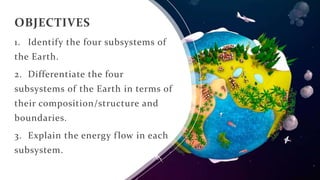
OBJECTIVES
1. Identify the four subsystems of
the Earth.
2. Differentiate the four
subsystems of the Earth in terms of
their composition/structure and
boundaries.
3. Explain the energy flow in each
subsystem.
 How does Earth maintain its existence and functions?
 Through the interactions of its parts called
components.
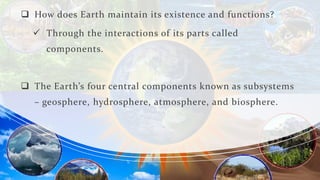
 The Earth’s four central components known as subsystems
– geosphere, hydrosphere, atmosphere, and biosphere.
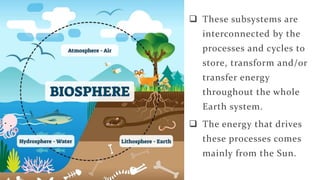
 These subsystems are
interconnected by the
processes and cycles to
store, transform and/or
transfer energy
throughout the whole
Earth system.
 The energy that drives
these processes comes
mainly from the Sun.
 Earth’s subsystems are
dynamic.
 A change in one
subsystem may cause
change in other
subsystems.
 Other subsystems’
degree of response
may describe how
stable or unstable
these subsystems are.
 Glacier is relatively unstable.
 When the temperature of the
atmosphere rises above the
melting point of ice, the
glacier melts.
 Trees and plants are relatively stable.
 When there is water shortage, they
reduce the size of their stomata to
reduce evaporation and maintain its
state of equilibrium.
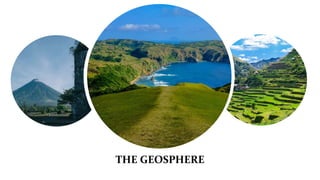
THE GEOSPHERE
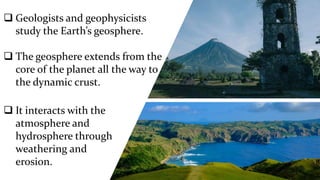
 Geologists and geophysicists
study the Earth’s geosphere.
 The geosphere extends from the
core of the planet all the way to
the dynamic crust.
 It interacts with the
atmosphere and
hydrosphere through
weathering and
erosion.
EARTH’S INTERIOR
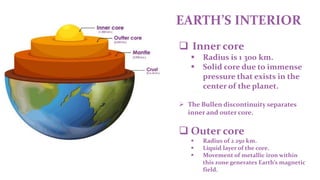
 Inner core
 Radius is 1 300 km.
 Solid core due to immense
pressure that exists in the
center of the planet.
 The Bullen discontinuity separates
inner and outer core.
 Outer core
 Radius of 2 250 km.
 Liquid layer of the core.
 Movement of metallic iron within
this zone generates Earth’s magnetic
field.
EARTH’S INTERIOR
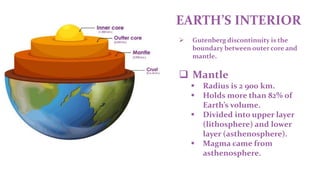
 Gutenberg discontinuity is the
boundary between outer core and
mantle.
 Mantle
 Radius is 2 900 km.
 Holds more than 82% of
Earth’s volume.
 Divided into upper layer
(lithosphere) and lower
layer (asthenosphere).
 Magma came from
asthenosphere.
EARTH’S INTERIOR
 Mohorovicic discontinuity separates
the upper mantle and the crust.
 Crust
 Radius is 8 to 40 km.
 Thin, rocky outer skin.
 Divided into continental
crust and oceanic crust.
ELEMENTS THAT MAKE
UP THE CRUST
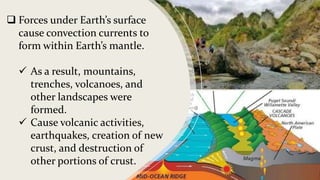
 Forces under Earth’s surface
cause convection currents to
form within Earth’s mantle.
 As a result, mountains,
trenches, volcanoes, and
other landscapes were
formed.
 Cause volcanic activities,
earthquakes, creation of new
crust, and destruction of
other portions of crust.
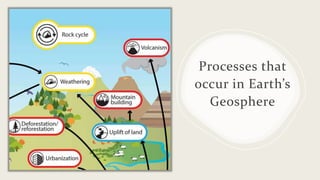
Processes that
occur in Earth’s
Geosphere
Sedimentary rock layer at the
Grand Canyon National Park
Layer of metamorphic rocks in
Marble Canyon, Death Valley,
California.
Obsidian rocks,
Landmannalaugar,
Iceland
ROCK CYCLE
EARTH’S
ATMOSPHERE
 Made of several layers of gases
that enveloped the planet.
 Atmosphere originated from the
word atmo (means vapor) and
sphaira (means ball).
Importance of atmosphere:
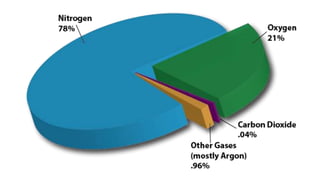
 Contains O2, which is vital for
living organisms.
 O3 found in the atmosphere
protects living organisms from
harmful UV radiation.
 It helps regulate Earth’s
temperature.
Importance of atmosphere:
 The gases found in the
atmosphere are important for
many life processes such as
photosynthesis and respiration.
 Plays a key role in water cycle.
TROPOSPHERE
 Lowermost layer.
 The term
troposphere
literally means the
region where the air
“turns over”.
 All important
weather
phenomena occur.
 The higher you go
up, the colder you
gets.
 The uppermost
layer of the
troposphere is
tropopause.
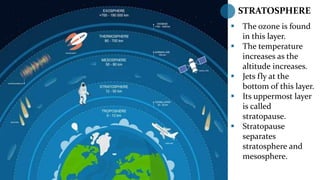
STRATOSPHERE
 The ozone is found
in this layer.
 The temperature
increases as the
altitude increases.
 Jets fly at the
bottom of this layer.
 Its uppermost layer
is called
stratopause.
 Stratopause
separates
stratosphere and
mesosphere.
MESOSPHERE
 The temperature
decreases as the
altitude increases.
 Weather balloons
and other aircraft
cannot fly high
enough to reach
this layer.
 Satellites orbit
above this layer.
 Most meteors
vaporizes in this
layer.
 The mesopause is
the coldest layer of
the atmosphere.
THERMOSPHERE
 Contains only a tiny
fraction of the
atmosphere’s mass.
 You get warm as
you go higher.
 This is the hottest
layer of the
atmosphere.
 The ionosphere is
found within the
mesosphere and
thermosphere.
 Many satellites
orbit in this layer.
THERMOSPHERE
 Auroras happen in
ionosphere because
charged particles
from space collide
with the atoms and
molecules in the
thermosphere,
exciting them into
high energy states.
As a result, those
atoms shed excess
energy by emitting
photons of light.
EXOSPHERE
 Thermopause
serves as the
boundary between
thermosphere and
exosphere.
 The outermost
layer.
 Separates the rest
of the atmosphere
from the outer
space.
 Atoms and
molecules easily
escape in this layer.
4.-The-Unique-Earth.pptx

4.-The-Unique-Earth.pptx

  • 1.
    THE UNIQUE EARTH &ITS SUBSYSTEMS
  • 2.
    OBJECTIVES 1. Identify thefour subsystems of the Earth. 2. Differentiate the four subsystems of the Earth in terms of their composition/structure and boundaries. 3. Explain the energy flow in each subsystem.
  • 3.
     How doesEarth maintain its existence and functions?  Through the interactions of its parts called components.  The Earth’s four central components known as subsystems – geosphere, hydrosphere, atmosphere, and biosphere.
  • 4.
     These subsystemsare interconnected by the processes and cycles to store, transform and/or transfer energy throughout the whole Earth system.  The energy that drives these processes comes mainly from the Sun.
  • 5.
     Earth’s subsystemsare dynamic.  A change in one subsystem may cause change in other subsystems.  Other subsystems’ degree of response may describe how stable or unstable these subsystems are.
  • 6.
     Glacier isrelatively unstable.  When the temperature of the atmosphere rises above the melting point of ice, the glacier melts.  Trees and plants are relatively stable.  When there is water shortage, they reduce the size of their stomata to reduce evaporation and maintain its state of equilibrium.
  • 7.
  • 8.
     Geologists andgeophysicists study the Earth’s geosphere.  The geosphere extends from the core of the planet all the way to the dynamic crust.  It interacts with the atmosphere and hydrosphere through weathering and erosion.
  • 9.
    EARTH’S INTERIOR  Innercore  Radius is 1 300 km.  Solid core due to immense pressure that exists in the center of the planet.  The Bullen discontinuity separates inner and outer core.  Outer core  Radius of 2 250 km.  Liquid layer of the core.  Movement of metallic iron within this zone generates Earth’s magnetic field.
  • 10.
    EARTH’S INTERIOR  Gutenbergdiscontinuity is the boundary between outer core and mantle.  Mantle  Radius is 2 900 km.  Holds more than 82% of Earth’s volume.  Divided into upper layer (lithosphere) and lower layer (asthenosphere).  Magma came from asthenosphere.
  • 11.
    EARTH’S INTERIOR  Mohorovicicdiscontinuity separates the upper mantle and the crust.  Crust  Radius is 8 to 40 km.  Thin, rocky outer skin.  Divided into continental crust and oceanic crust.
  • 12.
  • 13.
     Forces underEarth’s surface cause convection currents to form within Earth’s mantle.  As a result, mountains, trenches, volcanoes, and other landscapes were formed.  Cause volcanic activities, earthquakes, creation of new crust, and destruction of other portions of crust.
  • 14.
    Processes that occur inEarth’s Geosphere
  • 15.
    Sedimentary rock layerat the Grand Canyon National Park Layer of metamorphic rocks in Marble Canyon, Death Valley, California. Obsidian rocks, Landmannalaugar, Iceland ROCK CYCLE
  • 16.
  • 17.
     Made ofseveral layers of gases that enveloped the planet.  Atmosphere originated from the word atmo (means vapor) and sphaira (means ball).
  • 18.
    Importance of atmosphere: Contains O2, which is vital for living organisms.  O3 found in the atmosphere protects living organisms from harmful UV radiation.  It helps regulate Earth’s temperature.
  • 19.
    Importance of atmosphere: The gases found in the atmosphere are important for many life processes such as photosynthesis and respiration.  Plays a key role in water cycle.
  • 21.
    TROPOSPHERE  Lowermost layer. The term troposphere literally means the region where the air “turns over”.  All important weather phenomena occur.  The higher you go up, the colder you gets.  The uppermost layer of the troposphere is tropopause.
  • 22.
    STRATOSPHERE  The ozoneis found in this layer.  The temperature increases as the altitude increases.  Jets fly at the bottom of this layer.  Its uppermost layer is called stratopause.  Stratopause separates stratosphere and mesosphere.
  • 23.
    MESOSPHERE  The temperature decreasesas the altitude increases.  Weather balloons and other aircraft cannot fly high enough to reach this layer.  Satellites orbit above this layer.  Most meteors vaporizes in this layer.  The mesopause is the coldest layer of the atmosphere.
  • 24.
    THERMOSPHERE  Contains onlya tiny fraction of the atmosphere’s mass.  You get warm as you go higher.  This is the hottest layer of the atmosphere.  The ionosphere is found within the mesosphere and thermosphere.  Many satellites orbit in this layer.
  • 25.
    THERMOSPHERE  Auroras happenin ionosphere because charged particles from space collide with the atoms and molecules in the thermosphere, exciting them into high energy states. As a result, those atoms shed excess energy by emitting photons of light.
  • 26.
    EXOSPHERE  Thermopause serves asthe boundary between thermosphere and exosphere.  The outermost layer.  Separates the rest of the atmosphere from the outer space.  Atoms and molecules easily escape in this layer.