OUR PRETTY PLANET
THE EARTH
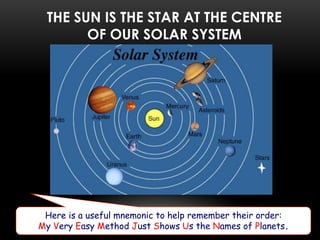
THE SUN IS THE STAR AT THE CENTRE
OF OUR SOLAR SYSTEM
The nine planets orbit the sun.
Here is a useful mnemonic to help remember their order:
My Very Easy Method Just Shows Us the Names of Planets.
ABOUT THE SUN
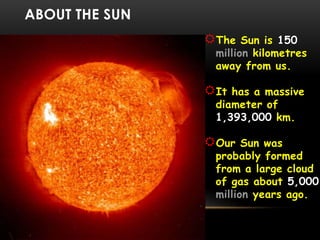
The Sun is 150
million kilometres
away from us.
It has a massive
diameter of
1,393,000 km.
Our Sun was
probably formed
from a large cloud
of gas about 5,000
million years ago.
HOW OLD IS THE EARTH?
• 4.5 to 4.56 Billion
years, based on current
scientific estimates.
• Surface constantly
changes, due to Plate
Tectonics
A BILLION YEAR OLD EARTH
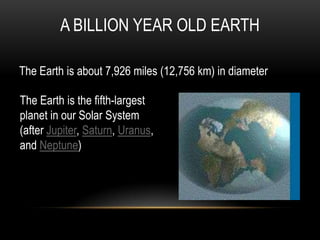
The Earth is about 7,926 miles (12,756 km) in diameter
The Earth is the fifth-largest
planet in our Solar System
(after Jupiter, Saturn, Uranus,
and Neptune)
THE EARTH SHAPE
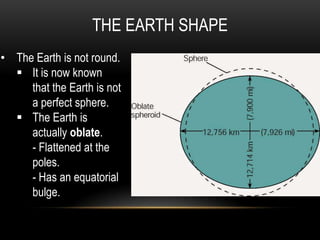
• The Earth is not round.
 It is now known
that the Earth is not
a perfect sphere.
 The Earth is
actually oblate.
- Flattened at the
poles.
- Has an equatorial
bulge.
EARTH IS UNIQUE IN MANY RESPECTS
• Water on its surface.
• Oxygen.
• The only planet in the solar system having living
organisms.
• Earth is the only terrestrial planet having a moderately
strong magnetic field.
• Earth is the only terrestrial planet having a large satellite.
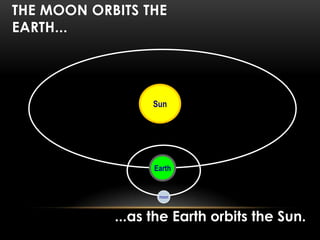
THE MOON ORBITS THE
EARTH...
Sun
Earth
moon
...as the Earth orbits the Sun.
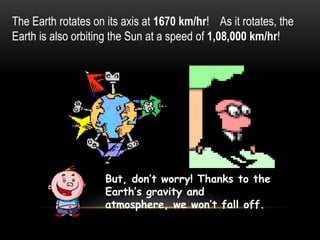
The Earth rotates on its axis at 1670 km/hr! As it rotates, the
Earth is also orbiting the Sun at a speed of 1,08,000 km/hr!
But, don’t worry! Thanks to the
Earth’s gravity and
atmosphere, we won’t fall off.
It takes 24 hours.
It turns anti-clockwise.
Do you know...
It takes 365¼ days.
It turns anti-clockwise.
 How long it takes the Earth
to spin round once?
 Which direction the Earth
turns?
 How long it takes the Earth
to orbit the Sun once?
 Which direction the Earth
orbits the sun?
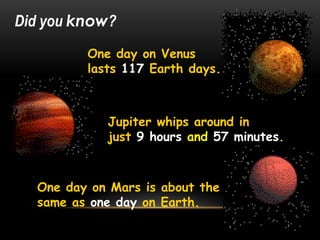
Did you know?
One day on Venus
lasts 117 Earth days.
Jupiter whips around in
just 9 hours and 57 minutes.
One day on Mars is about the
same as one day on Earth.
TEMPERATURE ON EARTH
• The temperature on Earth ranges from between -127°F to
136°F (-88°C to 58°C).
• The coldest recorded temperature was on the continent of
Antarctica (Vostok in July, 1983).
• The hottest recorded temperature was on the continent of
Africa (Libya in September, 1922)
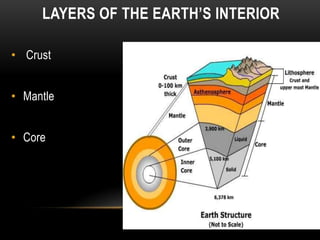
LAYERS OF THE EARTH’S INTERIOR
• Crust
• Mantle
• Core
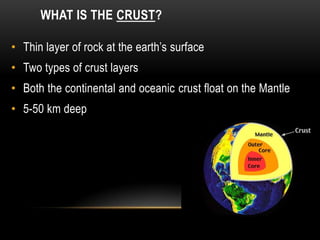
WHAT IS THE CRUST?
• Thin layer of rock at the earth’s surface
• Two types of crust layers
• Both the continental and oceanic crust float on the Mantle
• 5-50 km deep
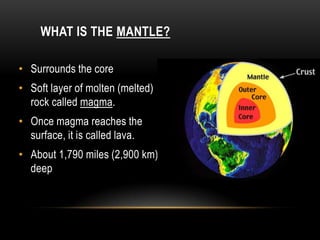
WHAT IS THE MANTLE?
• Surrounds the core
• Soft layer of molten (melted)
rock called magma.
• Once magma reaches the
surface, it is called lava.
• About 1,790 miles (2,900 km)
deep
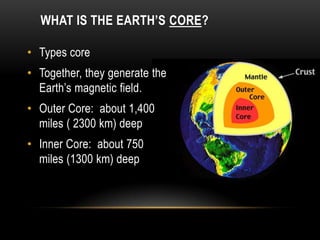
WHAT IS THE EARTH’S CORE?
• Types core
• Together, they generate the
Earth’s magnetic field.
• Outer Core: about 1,400
miles ( 2300 km) deep
• Inner Core: about 750
miles (1300 km) deep
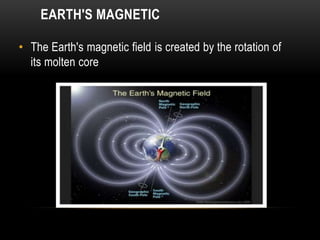
EARTH'S MAGNETIC
• The Earth's magnetic field is created by the rotation of
its molten core
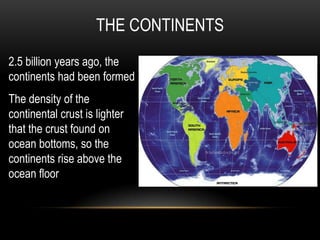
THE CONTINENTS
2.5 billion years ago, the
continents had been formed
The density of the
continental crust is lighter
that the crust found on
ocean bottoms, so the
continents rise above the
ocean floor
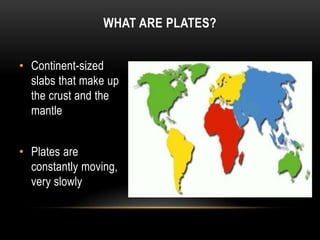
WHAT ARE PLATES?
• Continent-sized
slabs that make up
the crust and the
mantle
• Plates are
constantly moving,
very slowly
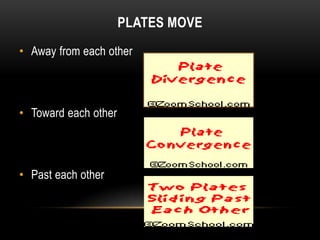
PLATES MOVE
• Away from each other
• Toward each other
• Past each other
WHEN PLATES MOVE
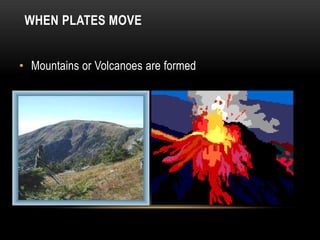
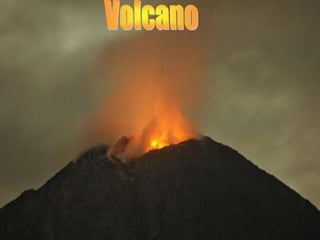
• Mountains or Volcanoes are formed
WHEN PLATES MOVE
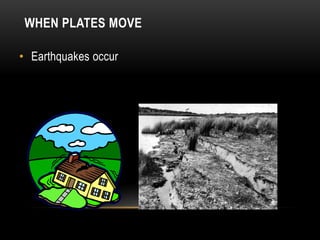
• Earthquakes occur
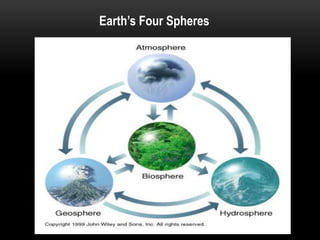
Earth’s Four Spheres
ATMOSPHERE
(MIXTURE OF GASES, SOLIDS, AND LIQUIDS)
• Early atmosphere was much different than today
• Volcanoes produced nitrogen and carbon
dioxide, but little oxygen
• More than 2 billion years ago, early organisms
began producing oxygen
• Eventually, oxygen formed an ozone layer that
protected Earth from harmful rays
• Green plants and diverse life forms developed
ATMOSPHERIC GASES
(MIXTURE OF GASES, SOLIDS, AND LIQUIDS)
• Nitrogen - 78%
• Oxygen - 21%
• Water Vapor – 0 to 4%
• Used for clouds and precipitation
• Carbon Dioxide - .037%
• Keeps Earth warm and is used by plants to make food
• Argon - .93%
• Traces of
neon, helium, methane, krypton, xenon, hydrogen, and
ozone
ATMOSPHERIC GASES
(MIXTURE OF GASES, SOLIDS, AND LIQUIDS)
• Atmosphere is changing with the introduction of
pollutants; increasing human energy use is increasing
the amount of carbon dioxide
• Pollutants mix with oxygen and other chemicals to form
smog
LOWER LAYERS OF ATMOSPHERE
• Troposphere: lowest layer – extends up to 10km;
contains 99% of the water vapor and 75% of the
atmospheric gases
• The troposphere is the first layer above the surface
and contains most clouds and half of the Earth's
atmosphere.
• Weather occurs in this layer.
• Most of the layer’s heat is from Earth
LOWER LAYERS OF ATMOSPHERE
• Stratosphere – directly above troposphere,
extending from 10 km to about 50 km above
Earth’s surface
• Portion of the upper layer contains high levels
of a gas called ozone
• Many jet aircrafts fly in the stratosphere
because it is very stable. Also, the ozone layer
absorbs harmful rays from the Sun.
THE OZONE LAYER
• About 19 km to 48 km above Earth in the stratosphere
(90%) and mesosphere (10%).
• Layer that protects the Earth from the Sun’s harmful
ultraviolet radiation
• Ozone layers has a large hole over Antarctica and a
smaller one over the North Pole
UPPER LAYERS OF ATMOSPHERE
• Mesosphere – extends from the top of the
stratosphere to about 85 km above Earth
• Coldest layer with little ozone
• Rock fragments burn up in the mesosphere.
UPPER LAYERS OF ATMOSPHERE
• Thermosphere – thickest atmospheric layer found
between 85 km and 500 km above Earth’s surface
• The thermosphere is a layer with auroras, known for its
high temperatures.
• Warms as it filters out X-rays and gamma rays from
the Sun
UPPER LAYERS OF ATMOSPHERE
• Exosphere - The atmosphere merges into space in the
extremely thin exosphere. This is the upper limit of our
atmosphere.
• Outer layer where space shuttle orbits.
EARTH COLLAPSE?
• Earth is going to be collapse?
• When ?
• How?
`

Our pretty planet

  • 1.
  • 2.
    THE SUN ISTHE STAR AT THE CENTRE OF OUR SOLAR SYSTEM The nine planets orbit the sun. Here is a useful mnemonic to help remember their order: My Very Easy Method Just Shows Us the Names of Planets.
  • 3.
    ABOUT THE SUN TheSun is 150 million kilometres away from us. It has a massive diameter of 1,393,000 km. Our Sun was probably formed from a large cloud of gas about 5,000 million years ago.
  • 4.
    HOW OLD ISTHE EARTH? • 4.5 to 4.56 Billion years, based on current scientific estimates. • Surface constantly changes, due to Plate Tectonics
  • 5.
    A BILLION YEAROLD EARTH The Earth is about 7,926 miles (12,756 km) in diameter The Earth is the fifth-largest planet in our Solar System (after Jupiter, Saturn, Uranus, and Neptune)
  • 6.
    THE EARTH SHAPE •The Earth is not round.  It is now known that the Earth is not a perfect sphere.  The Earth is actually oblate. - Flattened at the poles. - Has an equatorial bulge.
  • 7.
    EARTH IS UNIQUEIN MANY RESPECTS • Water on its surface. • Oxygen. • The only planet in the solar system having living organisms. • Earth is the only terrestrial planet having a moderately strong magnetic field. • Earth is the only terrestrial planet having a large satellite.
  • 8.
    THE MOON ORBITSTHE EARTH... Sun Earth moon ...as the Earth orbits the Sun.
  • 9.
    The Earth rotateson its axis at 1670 km/hr! As it rotates, the Earth is also orbiting the Sun at a speed of 1,08,000 km/hr! But, don’t worry! Thanks to the Earth’s gravity and atmosphere, we won’t fall off.
  • 10.
    It takes 24hours. It turns anti-clockwise. Do you know... It takes 365¼ days. It turns anti-clockwise.  How long it takes the Earth to spin round once?  Which direction the Earth turns?  How long it takes the Earth to orbit the Sun once?  Which direction the Earth orbits the sun?
  • 11.
    Did you know? Oneday on Venus lasts 117 Earth days. Jupiter whips around in just 9 hours and 57 minutes. One day on Mars is about the same as one day on Earth.
  • 12.
    TEMPERATURE ON EARTH •The temperature on Earth ranges from between -127°F to 136°F (-88°C to 58°C). • The coldest recorded temperature was on the continent of Antarctica (Vostok in July, 1983). • The hottest recorded temperature was on the continent of Africa (Libya in September, 1922)
  • 13.
    LAYERS OF THEEARTH’S INTERIOR • Crust • Mantle • Core
  • 14.
    WHAT IS THECRUST? • Thin layer of rock at the earth’s surface • Two types of crust layers • Both the continental and oceanic crust float on the Mantle • 5-50 km deep
  • 15.
    WHAT IS THEMANTLE? • Surrounds the core • Soft layer of molten (melted) rock called magma. • Once magma reaches the surface, it is called lava. • About 1,790 miles (2,900 km) deep
  • 16.
    WHAT IS THEEARTH’S CORE? • Types core • Together, they generate the Earth’s magnetic field. • Outer Core: about 1,400 miles ( 2300 km) deep • Inner Core: about 750 miles (1300 km) deep
  • 17.
    EARTH'S MAGNETIC • TheEarth's magnetic field is created by the rotation of its molten core
  • 18.
    THE CONTINENTS 2.5 billionyears ago, the continents had been formed The density of the continental crust is lighter that the crust found on ocean bottoms, so the continents rise above the ocean floor
  • 19.
    WHAT ARE PLATES? •Continent-sized slabs that make up the crust and the mantle • Plates are constantly moving, very slowly
  • 20.
    PLATES MOVE • Awayfrom each other • Toward each other • Past each other
  • 21.
    WHEN PLATES MOVE •Mountains or Volcanoes are formed
  • 22.
    WHEN PLATES MOVE •Earthquakes occur
  • 23.
  • 32.
    ATMOSPHERE (MIXTURE OF GASES,SOLIDS, AND LIQUIDS) • Early atmosphere was much different than today • Volcanoes produced nitrogen and carbon dioxide, but little oxygen • More than 2 billion years ago, early organisms began producing oxygen • Eventually, oxygen formed an ozone layer that protected Earth from harmful rays • Green plants and diverse life forms developed
  • 33.
    ATMOSPHERIC GASES (MIXTURE OFGASES, SOLIDS, AND LIQUIDS) • Nitrogen - 78% • Oxygen - 21% • Water Vapor – 0 to 4% • Used for clouds and precipitation • Carbon Dioxide - .037% • Keeps Earth warm and is used by plants to make food • Argon - .93% • Traces of neon, helium, methane, krypton, xenon, hydrogen, and ozone
  • 34.
    ATMOSPHERIC GASES (MIXTURE OFGASES, SOLIDS, AND LIQUIDS) • Atmosphere is changing with the introduction of pollutants; increasing human energy use is increasing the amount of carbon dioxide • Pollutants mix with oxygen and other chemicals to form smog
  • 35.
    LOWER LAYERS OFATMOSPHERE • Troposphere: lowest layer – extends up to 10km; contains 99% of the water vapor and 75% of the atmospheric gases • The troposphere is the first layer above the surface and contains most clouds and half of the Earth's atmosphere. • Weather occurs in this layer. • Most of the layer’s heat is from Earth
  • 36.
    LOWER LAYERS OFATMOSPHERE • Stratosphere – directly above troposphere, extending from 10 km to about 50 km above Earth’s surface • Portion of the upper layer contains high levels of a gas called ozone • Many jet aircrafts fly in the stratosphere because it is very stable. Also, the ozone layer absorbs harmful rays from the Sun.
  • 37.
    THE OZONE LAYER •About 19 km to 48 km above Earth in the stratosphere (90%) and mesosphere (10%). • Layer that protects the Earth from the Sun’s harmful ultraviolet radiation • Ozone layers has a large hole over Antarctica and a smaller one over the North Pole
  • 38.
    UPPER LAYERS OFATMOSPHERE • Mesosphere – extends from the top of the stratosphere to about 85 km above Earth • Coldest layer with little ozone • Rock fragments burn up in the mesosphere.
  • 39.
    UPPER LAYERS OFATMOSPHERE • Thermosphere – thickest atmospheric layer found between 85 km and 500 km above Earth’s surface • The thermosphere is a layer with auroras, known for its high temperatures. • Warms as it filters out X-rays and gamma rays from the Sun
  • 40.
    UPPER LAYERS OFATMOSPHERE • Exosphere - The atmosphere merges into space in the extremely thin exosphere. This is the upper limit of our atmosphere. • Outer layer where space shuttle orbits.
  • 41.
    EARTH COLLAPSE? • Earthis going to be collapse? • When ? • How?
  • 43.

Editor's Notes

  • #3 At the beginning of our solar system there is nothing but only rocks, dust & gas… the rocks collided and groped into bigger bodiesAbout 5.5-6 billion years ago (BYA), the solar nebula begins to collapse About 4.6 BYA, Sun begins fusion About 4.5-4.56 BYA, Proto-Earth formed from planetesimals.
  • #4 At the core of the sun, gravitational attraction produces immense pressure and temperature, which can reach more than 27 million degrees F (15 million degrees C). 
  • #5 How do we know about such long periods of time? Geochronology: The science of determining the ages of rocks.
  • #8 Earth is the only planet with liquid water on its surface.Earth’s atmosphere is the only one having a significant (21%) proportion of molecular oxygen.Earth is, to our best current knowledge, the only planet in the solar system having living organisms.
  • #9 The orbit of the Moon around the Earth is completed in approximately 27.32 daysThe Earth orbits 93 million miles (149,600,000 km) from the Sun.Because of the Earth rotate it self on its axis day & nights will occurs.The earth's spin axis is tilted with respect to its orbital plane. This is what causes the seasonsLatitude affects climate because it is related to the length and intensity of sunlight an area receives. As Earth orbits the sun, sometimes the northern hemisphere is tipped toward the sun, while at other times the southern hemisphere is tipped toward the sunCloser to the equator, it receives a lot of sunlight and warmth all year long and thus maintains a warm climate.
  • #12 2.16 days on Jupiter is equal to 1 day on the earth If a "day" is the time from one sunrise to the next, then on the moon, that's roughly 27.32 earth days.The weight read on the moon would be 1/6 your earth weight
  • #14 1. Oceanic crust (basaltic; 3.0 g cm~3)a. Approximately 5-12 km thickb. Average density of 3.0 g/cm c. The upper mantle is the ultimate source for the lavas that formed the oceanic crust2. Continental crust (granitic; 2.7 g cm3)a. thickest crust (average 35 km; 10 to 70km)b. floats due to isostasy continents “float” higher on the denser mantle than the adjacent oceanic crustal segments
  • #15  The crust is the outermost solid shell of a rocky planet or natural satelliteThe crust is composed of two rocks. The continental crust is mostly granite. The oceanic crust is basalt(volcanic lava rock). The crust is the layer that you live on so it is the most widely studied and understood. The crust of the Earth is broken into many pieces called plates. The plates move along the soft mantle which is the layer located below the crust. Continental crust:  depth of 30-50 kilometresThis is the outer part of the Earth composed essentially of crystalline rocks. The crust is the surface of the Earth. Because cold rocks deform slowly, we refer to this rigid outer shell as the lithosphere (the rocky or strong layer).2) Oceanic crust:  depth of 5-10 kilometresThe majority of the Earth's crust was made through volcanic activity.
  • #16 The Mantle is the largest layer of the Earth.The mantleis composed of very hot dense rock that flows like asphalt under a heavy weight. The movement of the middle mantle (asthenosphere) is the reason that the crustal plates of the Earth move. The movement of the mantle create the movement of the Earth’s platesIn the mantle, temperatures range between 500 to 900 °C New plates can be created during an earthquake (especially at mid-ocean ridges).
  • #17 Solid metallic Inner CoreLiquid metallic Outer CoreBoth made of iron and nickel1) Outer coreso hot that rock melts. Melted rock is called MAGMA, The temperature of the outer core ranges from 4400 °C (8000 °F) in the outer regions to 6100 °C (11000 °F) near the inner core. Shape is like  egg whiteThe core of the Earth is like a ball of very hot metals. 2) Inner Core-may be as hot as the sun, 5000 oC to 7000 oC The inner core of the Earth has temperatures and pressures so great that the metals are squeezed together and are not able to move about like a liquid, but are forced to vibrate in place like a solid. Shape is like egg yolk
  • #18 The Earth is mostly molten iron. The pressure causes the iron to be extremely hot. Convection caused by the heat makes the molten iron move in a rotational fashion causing magnetic forcesThe inner core of the Earth has temperatures and pressures so great that the metals are squeezed together and are not able to move about like a liquid, but are forced to vibrate in place like a solid.
  • #20 The plates are moving at a speed that has been estimated at 1 to 10 cm per year.The current continental and oceanic plates include: Eurasian plate, Australian-Indian plate, Philippine plate, Pacific plate, Juan de Fuca plate, Nazca plate, Cocos plate, North American plate, Caribbean plate, South American plate, African plate, Arabian plate, the Antarctic plate, and the Scotia plate. These plates consist of smaller sub-plates
  • #21 The plates move along smoothly but sometimes they get stuck and pressure builds up.As plates move apart new material is erupted to fill the gapThere are three types of convergent boundary, each defined by what type of crust (continental or oceanic) is coming together.We can have: continent-continent collision, continent-oceanic crust collision or ocean-ocean collision….
  • #22 The plates are moving at a speed that has been estimated at 1 to 10 cm per year.
  • #24 Geosphere: comprises the solid Earth and includes both Earth’s surface and the various layers of the Earth's interior. Atmosphere: gaseous envelope that surrounds the Earth and constitutes the transition between its surface and the vacuum of spaceHydrosphere: includes all water on Earth (including surface water and groundwater)Biosphere: the life zone of the Earth and includes all living organisms, and all organic matter that has not yet decomposed. Spheres are closely connected, Changes are often chain reactions. A change in one sphere results in changes in others
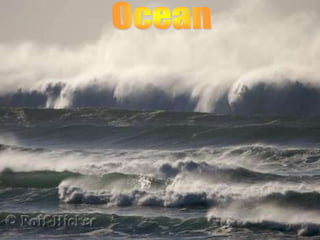
  • #25 LAND FORMSDefinition: Body of salt water larger than a sea The Earth contains 5 oceans: the Arctic, Atlantic, Indian, Pacific, and Southern.The ocean’s water covers over 70% of the EarthThe ocean’s average depth is 12,175 ft!!
  • #26 Definition: An opening in the earth, through which lava, rock, and gases are forced outThe source of this volcanism is a mantle plume of hot mantle material rising up from near the core-mantle boundary through the crust to the surface (see left diagram). Volcanoes in the U.S. are found mainly in Hawaii, Alaska, California, Oregon and Washington. There are more than 1,500 volcanoes in the world & more than 500 active volcanoes Large Volcano #1, Mauna Loa, Mauna Loa is located on the island of Hawaii. Height: Roughly 13,000 feet above sea level, Roughly 56,000 feet from base to summitDiamond is a mineral of carbon, in diamond every carbon atom attaches it self to 4 other atoms Diamonds occur naturally in the earth mantle (150 km below the surface), during the volcanic eruptions chunks of mantle containing embedded diamonds are brought out to the surfacemost were formed between 1 and 3.3 Billion years agoThe Orapa diamond mine is the world's largest diamond mine.Diamond places in India1) Kollur Mine - The Kollur Mine in Guntur district of old Golkonda kingdom, India, was one of the most productive diamond mines in India and the first major diamond center. It is situated on the right bank of the river Krishna. It operated between the sixteenth and mid-nineteenth centuries. In addition to the Kollur Mine, the Paritala,Gollapally[disambiguation needed], Mallavally, Ramallakota, and Banganapally were extremely prolific mines in India during this period. At the height of production, it was recorded that around 60,000 people mined the region, including men, women, and children of all ages.[1][2][3]The most celebrated Kohinoor diamond was mined in the Kollur mines.[4]2) Panna - Panna is a city and a municipality in Panna district in the Indian state of Madhya Pradesh. It is famous for its diamond mines. It is the administrative center of Panna District.3) Bunder Project - The Bunder project is Rio Tinto's first and most advanced[citation needed] diamond mining venture in India. The Bunder project comprises a cluster of eight lamproites (volcanic rock), located in the Bundelkhand region of Madhya Pradesh, 500 km south east of DelhiCarbon in diamond form has a melting point of 3550 C (6422 F) and a boiling point of 4827 C (8720.6 F).
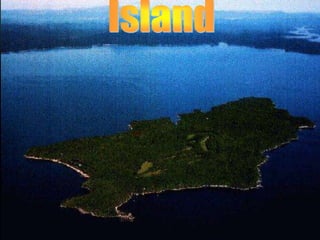
  • #27 Definition: Land that has water on all sides Two Types: Continental islands and Oceanic islands Continental islands are ones that lie close to a continent Oceanic islands are islands found in the middle of the ocean the largest "island continent" would be AntarcticaPacific Islands are largest islands
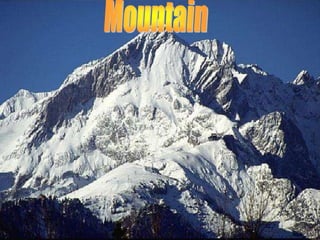
  • #28  Definition: highest kind of landTypes of Mountains: Folded - form when two plates collide head on, and their edges crumble Fault-block - Created when a plate hits a fault and tips upside down, creating erosion and debris, which is at the base of the mountain Volcanic - Formed when molten rock, or magma deep within the earth, erupts, and piles upon the surfaceUnwarped -form when tectonic forces lift the earth's crust into a broad bulge or dome raising it above its surroundings Mount Everest is the highest mountain in the world. The two main mountain ranges in the U.S. are the Appalachians in the east and the Rockys in the west
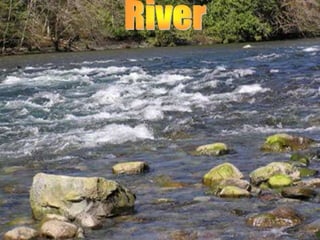
  • #29 Definition: Large stream of water that flows across the land The longest river is the Nile in Egypt - 6,650 kilometres (4132 miles)  The largest river is the Amazon in South America - The Amazon's discharge at its mouth is approximately 7 million cubic feet per second. One important river in America is the Mississippi - 2,530 miles (4,070 km)Ganges–Hooghly–Padma -2,620 km (34th place)Godavari - 1,465 km (93rd place)
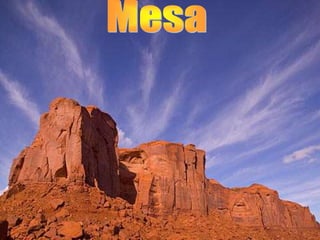
  • #30  Definition: Flat-topped mountain with steep sides, it also called as Lithosphere Means table in Spanish Made up of layered rocksThe Grand Mesa is a large mesa in western Colorado in the United States It has an area of about 500 square miles (1,300 km2) and stretches for about 40 miles (64 km) east of Grand Junction between the Colorado River and the Gunnison River
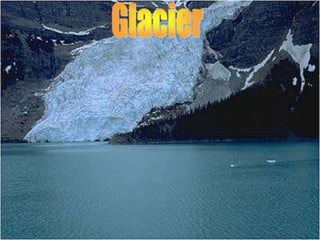
  • #31  Definition: large ice mass that moves slowly down a mountain or across land Can be found on every continent Two types: 1. alpine glaciers that are found in mountains and 2. continental glaciers that cover large parts of a continent Lambert Glacier is a major glacier in East Antarctica. At about 60 miles (100 km) wide, over 250 miles (400 km) long, and about 2,500 m deep, it holds the Guinness world record for the world's largest glacier
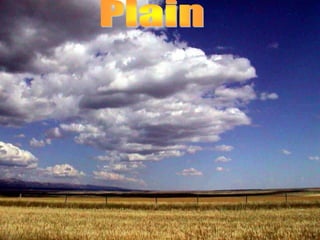
  • #32  Definition: Area of flat or gently rolling low land The two largest landforms in America are the Costal Plains and the Interior Plains. Costal Plain: mostly flat and lies along a large body of water Interior Plains: most of the land between the Rocky Mountains. Mostly flat with forests