Astonishing Astronomy 101
With Doctor Bones (Don R. Mueller, Ph.D.)
Educator
Entertainer
J
U
G
G
L
E
R
Scientist
Science
Explorer
Chapter 7 – Earth
The Blue Planet
The Composition of the Earth
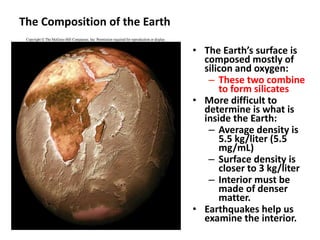
• The Earth’s surface is
composed mostly of
silicon and oxygen:
– These two combine
to form silicates
• More difficult to
determine is what is
inside the Earth:
– Average density is
5.5 kg/liter (5.5
mg/mL)
– Surface density is
closer to 3 kg/liter
– Interior must be
made of denser
matter.
• Earthquakes help us
examine the interior.
Composition of the Earth’s Crust
Chemical Element (Symbol) % of Element in Crust by
Mass
% of Element in Crust by
Number
Oxygen (O) 46% 60%
Silicon (Si) 28% 21%
Aluminum (Al) 8% 6%
Iron (Fe) 6% 2%
Calcium (Ca) 4% 2%
Magnesium (Mg) 2% 2%
Sodium (Na) 2% 2%
Potassium (K) 2% 1%
Titanium (Ti) 0.6% 0.2%
Hydrogen (H) 0.1% 3%
Others (combined) <1% <1%
S and P Waves – Sonogram for the Earth
• Earthquakes generate
two kinds of waves that
help us examine the
interior of the Earth:
• P waves (pressure
waves) act like sound
waves and travel
through rock and liquid
equally well.
• S waves (shear waves)
are like the waves on a
guitar string (moving
side-to-side) and only
travel through rock.
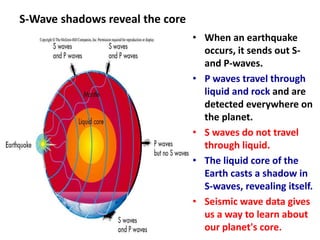
S-Wave shadows reveal the core
• When an earthquake
occurs, it sends out S-
and P-waves.
• P waves travel through
liquid and rock and are
detected everywhere on
the planet.
• S waves do not travel
through liquid.
• The liquid core of the
Earth casts a shadow in
S-waves, revealing itself.
• Seismic wave data gives
us a way to learn about
our planet's core.
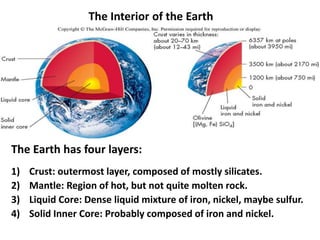
The Interior of the Earth
The Earth has four layers:
1) Crust: outermost layer, composed of mostly silicates.
2) Mantle: Region of hot, but not quite molten rock.
3) Liquid Core: Dense liquid mixture of iron, nickel, maybe sulfur.
4) Solid Inner Core: Probably composed of iron and nickel.
The Earth’s Hot Interior
• The impact of
planetesimals heated
the early Earth to high
temperatures: Causing
differentiation and
radioactive decay.
• The Earth’s core has a
temperature of around
6500 K, as hot as the
surface of the Sun.
• The Earth’s interior has
remained hot due to its
surface area to volume
ratio.
Conduction
• Heat transfer by
conduction occurs in:
• Solids
• Liquids and
• Gases.
Materials with the highest
heat conductivities are
metals.
Metals are good conductors
of heat because they
have free electrons.
Convection
• Mantle material heated near the hot core rises and cooler
material near the top of the mantle sinks.
• This process is called convection and drives the dynamics of
the Earth’s surface.
• Heat transfer by convection occurs only in gases and liquids.
Dynamics at the Earth’s Surface
• As the hot mantle rises, it pushes
aside the Earth’s crust along cracks
known as rifts.
• This rifting pushes apart portions of
the Earth’s crust, called continental
plates.
• The continental plates float atop of
the mantle, moving slowly (~2
cm/year) across the surface of the
planet (plate tectonics).
• As plates are pushed together, one
plate can slide under another.
– This is called subduction.
– Buckling in the crust due to this
process produces mountain
ranges.
• Plates can also slide alongside each
other.
– This is a source of earthquakes.
Plate Tectonics: Over millions of years, the continental plates
drifted apart in some areas and came together in other areas.
Plate Boundaries: Easy to find: just look for
earthquakes and volcanoes.
Please insert figure 35.13
Plate Boundaries:
The Earth’s Magnetic Field
The Earth’s magnetic field
– Similar to the field of a
bar magnet.
– Strongest at the poles.
• The Earth’s magnetic field
is generated by currents
flowing in the molten iron
core.
– Magnetic dynamo.
• All magnetic fields
originate in moving
electric charges.
• The Earth’s magnetic field protects the
surface from harmful cosmic rays and
energetic particles from the Sun.
• A typical value for the Earth’s magnetic
field near sea level is 3 x 10- 5 Tesla (T)
Atmosphere and Hydrosphere
• The Earth is surrounded by an
envelope of gas: atmosphere
– Mass of the atmosphere is
only 10-6 of the total mass
of the Earth.
– Mostly nitrogen (~78%)
• More than 70% of the Earth’s
surface is covered by water, its
hydrosphere
• The earth's atmosphere
helps to keep the surface
warm by absorbing a large
fraction of the outgoing
infrared radiation. The so-
called Greenhouse Effect.
Atmospheric Pressure
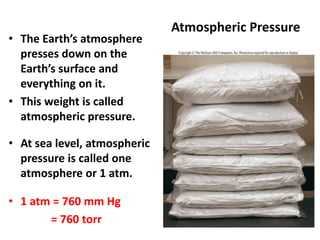
• The Earth’s atmosphere
presses down on the
Earth’s surface and
everything on it.
• This weight is called
atmospheric pressure.
• At sea level, atmospheric
pressure is called one
atmosphere or 1 atm.
• 1 atm = 760 mm Hg
= 760 torr
Atmospheric Layers
• The atmosphere of the Earth
is layered:
– Troposphere
• Lowermost layer, extending
to around 12 km upward.
• Temperature decreases
rapidly with altitude.
• Most clouds are here.
– Stratosphere
• Extends from the
tropopause to about 50 km
upward.
• Temperature increases with
altitude.
• Ozone layer resides here.
Atmospheric Layers
Ionosphere
• Located above 80 km or so.
• Most atoms are ionized – one
or more electrons have been
removed from each atom.
• These ionized particles reflect
AM radio signals back down to
Earth.
• Radio communication is
possible around the curvature
of the Earth because of the
ionosphere.
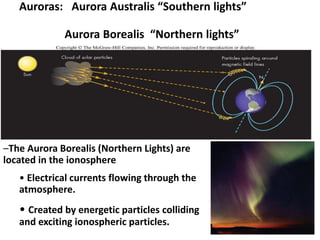
Auroras: Aurora Australis “Southern lights”
Aurora Borealis “Northern lights”
–The Aurora Borealis (Northern Lights) are
located in the ionosphere
• Electrical currents flowing through the
atmosphere.
• Created by energetic particles colliding
and exciting ionospheric particles.
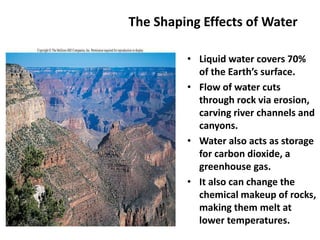
The Shaping Effects of Water
• Liquid water covers 70%
of the Earth’s surface.
• Flow of water cuts
through rock via erosion,
carving river channels and
canyons.
• Water also acts as storage
for carbon dioxide, a
greenhouse gas.
• It also can change the
chemical makeup of rocks,
making them melt at
lower temperatures.
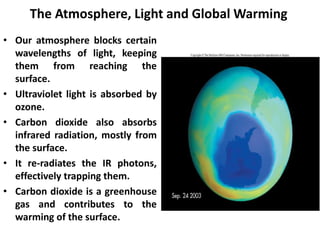
The Atmosphere, Light and Global Warming
• Our atmosphere blocks certain
wavelengths of light, keeping
them from reaching the
surface.
• Ultraviolet light is absorbed by
ozone.
• Carbon dioxide also absorbs
infrared radiation, mostly from
the surface.
• It re-radiates the IR photons,
effectively trapping them.
• Carbon dioxide is a greenhouse
gas and contributes to the
warming of the surface.
The Good Earth
Keep the Earth clean
It’s not Uranus!!!
The Greenhouse Effect
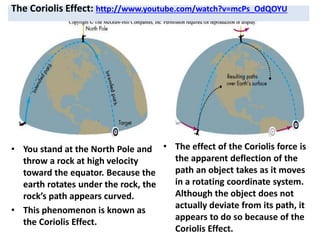
The Coriolis Effect: http://www.youtube.com/watch?v=mcPs_OdQOYU
• You stand at the North Pole and
throw a rock at high velocity
toward the equator. Because the
earth rotates under the rock, the
rock’s path appears curved.
• This phenomenon is known as
the Coriolis Effect.
• The effect of the Coriolis force is
the apparent deflection of the
path an object takes as it moves
in a rotating coordinate system.
Although the object does not
actually deviate from its path, it
appears to do so because of the
Coriolis Effect.
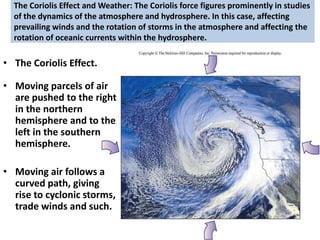
The Coriolis Effect and Weather: The Coriolis force figures prominently in studies
of the dynamics of the atmosphere and hydrosphere. In this case, affecting
prevailing winds and the rotation of storms in the atmosphere and affecting the
rotation of oceanic currents within the hydrosphere.
• The Coriolis Effect.
• Moving parcels of air
are pushed to the right
in the northern
hemisphere and to the
left in the southern
hemisphere.
• Moving air follows a
curved path, giving
rise to cyclonic storms,
trade winds and such.
The Origin of Tides
• The Moon exerts a
gravitational force on
the Earth, stretching
it outward.
• The water responds
to this pull by
flowing towards the
source of the force,
creating tidal bulges
both beneath the
Moon and on the
opposite side of the
Earth.
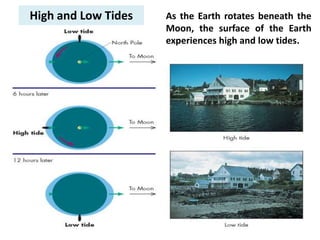
High and Low Tides As the Earth rotates beneath the
Moon, the surface of the Earth
experiences high and low tides.
The Size of the Tidal Force
• Consider 1 kg of water at the average distance between the
Earth’s and Moon’s centers: 3.84 × 10⁸ m. The Moon’s mass is
7.35 × 10²² kg and the gravitational force of the Moon on this
kilogram of water will be:
• A 1 kg amount of water on the side of the Earth nearest the Moon
(Earth’s radius, R) , feels a slightly larger force:
Newtons103.33
m)10(3.84
kg1kg107.35
/kgmnewton106.67
d
mM
GF
5
28
22
2211
2M








Newtons1044.3
m)106.37-m10(3.84
kg1kg1035.7
/kgmnewton1067.6
)(
5
268
22
2211
2,










Rd
mM
GF nearM
The difference is the Tidal force: 1.1  10-6 N
The Sun creates tides, too.
• When the Sun and Moon line up, high tides, called spring
tides form. When the Sun and Moon are at right angles to
each other, their tidal forces work against each other and
smaller neap tides result.
Tidal Braking

Astonishing Astronomy 101 - Chapter 7

  • 1.
    Astonishing Astronomy 101 WithDoctor Bones (Don R. Mueller, Ph.D.) Educator Entertainer J U G G L E R Scientist Science Explorer
  • 2.
    Chapter 7 –Earth The Blue Planet
  • 3.
    The Composition ofthe Earth • The Earth’s surface is composed mostly of silicon and oxygen: – These two combine to form silicates • More difficult to determine is what is inside the Earth: – Average density is 5.5 kg/liter (5.5 mg/mL) – Surface density is closer to 3 kg/liter – Interior must be made of denser matter. • Earthquakes help us examine the interior.
  • 4.
    Composition of theEarth’s Crust Chemical Element (Symbol) % of Element in Crust by Mass % of Element in Crust by Number Oxygen (O) 46% 60% Silicon (Si) 28% 21% Aluminum (Al) 8% 6% Iron (Fe) 6% 2% Calcium (Ca) 4% 2% Magnesium (Mg) 2% 2% Sodium (Na) 2% 2% Potassium (K) 2% 1% Titanium (Ti) 0.6% 0.2% Hydrogen (H) 0.1% 3% Others (combined) <1% <1%
  • 5.
    S and PWaves – Sonogram for the Earth • Earthquakes generate two kinds of waves that help us examine the interior of the Earth: • P waves (pressure waves) act like sound waves and travel through rock and liquid equally well. • S waves (shear waves) are like the waves on a guitar string (moving side-to-side) and only travel through rock.
  • 6.
    S-Wave shadows revealthe core • When an earthquake occurs, it sends out S- and P-waves. • P waves travel through liquid and rock and are detected everywhere on the planet. • S waves do not travel through liquid. • The liquid core of the Earth casts a shadow in S-waves, revealing itself. • Seismic wave data gives us a way to learn about our planet's core.
  • 7.
    The Interior ofthe Earth The Earth has four layers: 1) Crust: outermost layer, composed of mostly silicates. 2) Mantle: Region of hot, but not quite molten rock. 3) Liquid Core: Dense liquid mixture of iron, nickel, maybe sulfur. 4) Solid Inner Core: Probably composed of iron and nickel.
  • 8.
    The Earth’s HotInterior • The impact of planetesimals heated the early Earth to high temperatures: Causing differentiation and radioactive decay. • The Earth’s core has a temperature of around 6500 K, as hot as the surface of the Sun. • The Earth’s interior has remained hot due to its surface area to volume ratio.
  • 9.
    Conduction • Heat transferby conduction occurs in: • Solids • Liquids and • Gases. Materials with the highest heat conductivities are metals. Metals are good conductors of heat because they have free electrons.
  • 10.
    Convection • Mantle materialheated near the hot core rises and cooler material near the top of the mantle sinks. • This process is called convection and drives the dynamics of the Earth’s surface. • Heat transfer by convection occurs only in gases and liquids.
  • 11.
    Dynamics at theEarth’s Surface • As the hot mantle rises, it pushes aside the Earth’s crust along cracks known as rifts. • This rifting pushes apart portions of the Earth’s crust, called continental plates. • The continental plates float atop of the mantle, moving slowly (~2 cm/year) across the surface of the planet (plate tectonics). • As plates are pushed together, one plate can slide under another. – This is called subduction. – Buckling in the crust due to this process produces mountain ranges. • Plates can also slide alongside each other. – This is a source of earthquakes.
  • 12.
    Plate Tectonics: Overmillions of years, the continental plates drifted apart in some areas and came together in other areas.
  • 13.
    Plate Boundaries: Easyto find: just look for earthquakes and volcanoes. Please insert figure 35.13 Plate Boundaries:
  • 14.
    The Earth’s MagneticField The Earth’s magnetic field – Similar to the field of a bar magnet. – Strongest at the poles. • The Earth’s magnetic field is generated by currents flowing in the molten iron core. – Magnetic dynamo. • All magnetic fields originate in moving electric charges. • The Earth’s magnetic field protects the surface from harmful cosmic rays and energetic particles from the Sun. • A typical value for the Earth’s magnetic field near sea level is 3 x 10- 5 Tesla (T)
  • 15.
    Atmosphere and Hydrosphere •The Earth is surrounded by an envelope of gas: atmosphere – Mass of the atmosphere is only 10-6 of the total mass of the Earth. – Mostly nitrogen (~78%) • More than 70% of the Earth’s surface is covered by water, its hydrosphere • The earth's atmosphere helps to keep the surface warm by absorbing a large fraction of the outgoing infrared radiation. The so- called Greenhouse Effect.
  • 16.
    Atmospheric Pressure • TheEarth’s atmosphere presses down on the Earth’s surface and everything on it. • This weight is called atmospheric pressure. • At sea level, atmospheric pressure is called one atmosphere or 1 atm. • 1 atm = 760 mm Hg = 760 torr
  • 17.
    Atmospheric Layers • Theatmosphere of the Earth is layered: – Troposphere • Lowermost layer, extending to around 12 km upward. • Temperature decreases rapidly with altitude. • Most clouds are here. – Stratosphere • Extends from the tropopause to about 50 km upward. • Temperature increases with altitude. • Ozone layer resides here.
  • 18.
    Atmospheric Layers Ionosphere • Locatedabove 80 km or so. • Most atoms are ionized – one or more electrons have been removed from each atom. • These ionized particles reflect AM radio signals back down to Earth. • Radio communication is possible around the curvature of the Earth because of the ionosphere.
  • 19.
    Auroras: Aurora Australis“Southern lights” Aurora Borealis “Northern lights” –The Aurora Borealis (Northern Lights) are located in the ionosphere • Electrical currents flowing through the atmosphere. • Created by energetic particles colliding and exciting ionospheric particles.
  • 20.
    The Shaping Effectsof Water • Liquid water covers 70% of the Earth’s surface. • Flow of water cuts through rock via erosion, carving river channels and canyons. • Water also acts as storage for carbon dioxide, a greenhouse gas. • It also can change the chemical makeup of rocks, making them melt at lower temperatures.
  • 21.
    The Atmosphere, Lightand Global Warming • Our atmosphere blocks certain wavelengths of light, keeping them from reaching the surface. • Ultraviolet light is absorbed by ozone. • Carbon dioxide also absorbs infrared radiation, mostly from the surface. • It re-radiates the IR photons, effectively trapping them. • Carbon dioxide is a greenhouse gas and contributes to the warming of the surface.
  • 22.
    The Good Earth Keepthe Earth clean It’s not Uranus!!!
  • 23.
  • 24.
    The Coriolis Effect:http://www.youtube.com/watch?v=mcPs_OdQOYU • You stand at the North Pole and throw a rock at high velocity toward the equator. Because the earth rotates under the rock, the rock’s path appears curved. • This phenomenon is known as the Coriolis Effect. • The effect of the Coriolis force is the apparent deflection of the path an object takes as it moves in a rotating coordinate system. Although the object does not actually deviate from its path, it appears to do so because of the Coriolis Effect.
  • 25.
    The Coriolis Effectand Weather: The Coriolis force figures prominently in studies of the dynamics of the atmosphere and hydrosphere. In this case, affecting prevailing winds and the rotation of storms in the atmosphere and affecting the rotation of oceanic currents within the hydrosphere. • The Coriolis Effect. • Moving parcels of air are pushed to the right in the northern hemisphere and to the left in the southern hemisphere. • Moving air follows a curved path, giving rise to cyclonic storms, trade winds and such.
  • 26.
    The Origin ofTides • The Moon exerts a gravitational force on the Earth, stretching it outward. • The water responds to this pull by flowing towards the source of the force, creating tidal bulges both beneath the Moon and on the opposite side of the Earth.
  • 27.
    High and LowTides As the Earth rotates beneath the Moon, the surface of the Earth experiences high and low tides.
  • 28.
    The Size ofthe Tidal Force • Consider 1 kg of water at the average distance between the Earth’s and Moon’s centers: 3.84 × 10⁸ m. The Moon’s mass is 7.35 × 10²² kg and the gravitational force of the Moon on this kilogram of water will be: • A 1 kg amount of water on the side of the Earth nearest the Moon (Earth’s radius, R) , feels a slightly larger force: Newtons103.33 m)10(3.84 kg1kg107.35 /kgmnewton106.67 d mM GF 5 28 22 2211 2M         Newtons1044.3 m)106.37-m10(3.84 kg1kg1035.7 /kgmnewton1067.6 )( 5 268 22 2211 2,           Rd mM GF nearM The difference is the Tidal force: 1.1  10-6 N
  • 29.
    The Sun createstides, too. • When the Sun and Moon line up, high tides, called spring tides form. When the Sun and Moon are at right angles to each other, their tidal forces work against each other and smaller neap tides result.
  • 30.