Come to your senses!?! Chapter 4
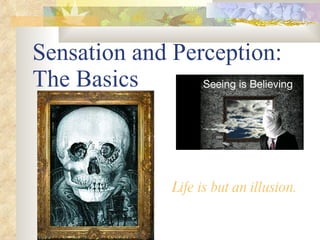
Sensation and Perception: The Basics Life is but an illusion.
Section 1: Basics
On the Threshold of Discovery Earliest psychologists were fascinated by this relationship between the physical and the mental. In fact,  psychophysics , the study of psychological reactions to physical stimuli, is the oldest field of psychology.
Creepy boyfriend??
Defining Sensation and Perception Sensation The detection of physical energy emitted or reflected by physical objects. It occurs when energy in the external environment or the body stimulates receptors in the sense organs. Perception The process by which the brain organizes and interprets sensory information.
Ambiguous Figure Colored surface can be either the outside front surface or the inside back surface Cannot simultaneously be both Brain can interpret the ambiguous cues two different ways
 
The Riddle of Separate Sensations Sense receptors Specialized cells that convert physical energy in the environment or the body to electrical energy that can be transmitted as nerve impulses to the brain.
Sensation & Perception Processes
Measuring Senses Absolute threshold Difference threshold Signal-detection theory
Absolute Threshold The smallest quantity of physical energy that can be reliably detected by an observer.
Absolute Sensory Thresholds Vision:  A single candle flame from 30 miles on a dark, clear night Hearing:  The tick of a watch from 20 feet in total quiet Smell:  1 drop of perfume in a 6-room apartment Touch:  The wing of a bee on your cheek, dropped from 1 cm Taste:  1 tsp. Sugar in 2 gal. water
Difference Threshold …the minimum amount of difference that can be detected between two stimuli. …people’s individual difference thresholds vary slightly.
Absolute and difference thresholds  are constantly in use to guide safety regulations. For example, when warning lights are built into cars, safety engineers must make sure that they’re bright enough to take your attention away from other dashboard lights.  Without psychology, there’d be a lot more car accidents!
Signal-Detection Theory … method of distinguishing sensory stimuli that takes into account not only their strengths but also such elements as the setting, your physical state, your mood, and your attitudes. … also considers psychological factors such as motivations, expectations, and learning. We focus on whatever we consider important.
Sensory Adaptation and Deprivation Adaptation The reduction or disappearance of sensory responsiveness when stimulation is unchanging or repetitious. Prevents us from having to continuously respond to unimportant information. Deprivation The absence of normal levels of sensory stimulation.
Sensory Overload Overstimulation of the senses. Can use selective attention to reduce sensory overload. Selective attention The focusing of attention on selected aspects of the environment and the blocking out of others.
Section 2: Vision
Vision What we see An eye on the world Why the visual system is not a camera How we see colors Constructing the visual world
What We See Hue Visual experience specified by color names and related to the wavelength of light. Brightness Lightness and luminance; the visual experience related to the amount of light emitted from or reflected by an object. Saturation Vividness or purity of color; the visual experience related to the complexity of light waves.
What We See Hue Brightness Saturation
An Eye on the World Cornea Protects eye and bends light toward lens. Lens Focuses on objects by changing shape. Iris Controls amount of light that gets into eye. Pupil Widens or dilates to let in more light.
An Eye on the World Retina Neural tissue lining the back of the eyeball’s interior, which contains the receptors for vision. Rods Visual receptors that respond to dim light. Cones Visual receptors involved in color vision. Most humans have 3 types of cones.
The Structures of the Retina
Why the Visual System is not a Camera Much visual processing is done in the brain. Some cortical cells respond to lines in specific orientations (e.g. horizontal). Other cells in the cortex respond to other shapes (e.g., bulls-eyes, spirals, faces). Feature-detectors Cells in the visual cortex that are sensitive to specific features of the environment.
Hubel & Wiesel’s Experiment
How We See Colors Trichromatic theory Opponent process theory
Trichromatic Theory Young (1802) & von Helmholtz (1852) both proposed that the eye detects 3 primary colors: red, blue, & green All other colors can be derived by combining these three.
Opponent-Process Theory A competing theory of color vision, which assumes that the visual system treats pairs of colors as opposing or antagonistic. Opponent-Process cells are inhibited by a color, and have a burst of activity when it is removed.
Afterimages
Test of Color Deficiency
Constructing the Visual World Form perception Depth and distance perception Visual constancies: When seeing is believing Visual illusions: When seeing is misleading
Form Perception Gestalt principles describe the brain’s organization of sensory building blocks into meaningful units and patterns.
Figure and Ground Proximity Seeing 3 pair of lines in A. Similarity Seeing columns of orange and red dots in B. Continuity Seeing lines that connect  1 to 2 and 3 to 4 in C. Closure Seeing a horse in D.
Depth and Distance Perception Binocular Cues:  Visual cues to depth or distance that require the use of both eyes. Convergence: Turning inward of the eyes, which occurs when they focus on a nearby object. Retinal Disparity: The slight difference in lateral separation between two objects as seen by the left eye and the right eye.
Depth and Distance Perception Monocular Cues:  Visual cues to depth or distance that can be used by one eye alone.
The Ames Room A specially-built room that makes people seem to change size as they move around in it The room is not a rectangle, as viewers assume it is A single peephole prevents using binocular depth cues
Visual Constancies The accurate perception of objects as stable or unchanged despite changes in the sensory patterns they produce. Shape constancy Location constancy Size constancy Brightness constancy Color constancy
Shape Constancy Even though these images cast shadows of different shapes, we still see the quarter as round
Visual  Illusions Illusions are valuable in understanding perception because they are systematic errors. Illusions provide hints about perceptual strategies. In the Muller-Lyer illusion (above) we tend to perceive the line on the right as slightly longer than the one on the left.
The Ponzo Illusion Linear perspective provides context Side lines seem to converge Top line seems farther away But the retinal images of the red lines are equal!
Fooling the Eye The cats in (a) are the same size The diagonal lines in (b) are parallel You can create a “floating fingertip frankfurter” by holding hands as shown, 5-10” in front of face.
Section 3: Hearing
Hearing What we hear An ear on the world Constructing the auditory world
What We Hear Loudness The dimension of auditory experience related to the intensity of a pressure wave. Pitch The dimension of auditory experience related to the frequency of a pressure wave. Timbre (pronounced “TAM-bur”) The distinguishing quality of sound; the dimension of auditory experience related to the complexity of the pressure wave.
An Ear on the World
Auditory Localization Sounds from different directions are not identical as they arrive at left and right ears Loudness Timing Phase The brain calculates a sound’s location by using these differences.
 
Other Senses Taste: savory sensations Smell: The sense of scents Senses of the skin The mystery of pain The environment within
Taste: Savory Sensations Papillae Knoblike elevations on the tongue, containing the taste buds (Singular: papilla). Taste buds  Nests of taste-receptor cells.
Taste Buds Photograph of tongue surface (top), magnified 75 times. 10,000 taste buds line the tongue and mouth. Taste receptors are down inside the “bud” Children have more taste buds than adults.
Four Tastes Four basic tastes Salty, sour, bitter and sweet.  Different people have different tastes based on: Genetics Culture Learning Food attractiveness
Smell: The Sense of Scents Airborne chemical molecules enter the nose and circulate through the nasal cavity. Vapors can also enter through the mouth and pass into nasal cavity. Receptors on the roof of the nasal cavity detect these molecules.
Olfactory System
Sensitivity to Touch
Gate-Control Theory of Pain Experience of pain depends (in part) on whether the pain impulse gets past neurological “gate” in the spinal cord and thus reaches the brain.
Neuromatrix Theory of Pain Theory that the matrix of neurons in the brain is capable of generating pain (and other sensations) in the absence of signals from sensory nerves.
The Environment Within Kinesthesis The sense of body position and movement of body parts; also called kinesthesia. Equilibrium The sense of balance. Semicircular Canals Sense organs in the inner ear, which contribute to equilibrium by responding to rotation of the head.
Perceptual Powers: Origins and Influences Inborn abilities  Critical periods Psychological and cultural Influences on perception
The Visual Cliff Glass surface, with checkerboard underneath at different heights Visual illusion of a cliff Baby can’t fall Mom stands across the gap Babies show increased attention over deep side at age 2 months, but aren’t afraid until about the age they can crawl  (Gibson & Walk, 1960)
The Visual Cliff
Critical Periods If infants miss out on experiences during a crucial period of time, perception will be impaired. When adults who have been blind since birth have vision restored, they may not see well Other senses such has hearing may be influenced similarly.
Psychological and Cultural Influences on Perception We are more likely to perceive something when we need it. What we believe can affect what we perceive. Emotions, such as fear, can influence perceptions of sensory information. Expectations based on our previous experiences influence how we perceive the world. Perceptual Set A habitual way of perceiving, based on expectations. All are influenced by our culture.
Perceptual Set What you see in the centre figures depends on the order in which you look at the figures: If you scan from the left, see an old woman If you scan from the right, see a woman’s figure
Context Effects The same physical stimulus can be interpreted differently We use other cues in the situation to resolve ambiguities Is this the letter B or the number 13?
Puzzles of Perception Subliminal Perception Extrasensory Perception: Reality or Illusion?
Subliminal Perception Perceiving without awareness visual stimuli can affect your behavior even when you are unaware that you saw it nonconscious processing also occurs in memory, thinking, and decision making these effects are often small, however, and difficult to demonstrate and work best with simple stimuli
Subliminal Perception Perception versus Persuasion there is no empirical research to support popular notions that subliminal persuasion has any effect on a person’s behavior persuasion works best when messages, in the form of advertising or self-help tapes, are presented above-threshold, or at a supraliminal level
Extrasensory Perception Extrasensory Perception (ESP): The ability to perceive something without ordinary sensory information This has not been scientifically demonstrated Three types of ESP: Telepathy – Mind-to-mind communication Clairvoyance – Perception of remote events Precognition – Ability to see future events
Parapsychology The study of purported psychic phenomena such as ESP and mental telepathy. Persinger suggests that psychic phenomena are related to signs of temporal lobe epilepsy in otherwise neurologically normal individuals. Most ESP studies produce negative findings and are not easily replicated.
Parapsychology J. B. Rhine conducted many experiments on ESP using stimuli such as these. Rhine believed that his evidence supported the existence of ESP, but his findings were flawed.

Ch 4 sensations and perceptions

  • 1.
    Come to yoursenses!?! Chapter 4
  • 2.
    Sensation and Perception:The Basics Life is but an illusion.
  • 3.
  • 4.
    On the Thresholdof Discovery Earliest psychologists were fascinated by this relationship between the physical and the mental. In fact, psychophysics , the study of psychological reactions to physical stimuli, is the oldest field of psychology.
  • 5.
  • 6.
    Defining Sensation andPerception Sensation The detection of physical energy emitted or reflected by physical objects. It occurs when energy in the external environment or the body stimulates receptors in the sense organs. Perception The process by which the brain organizes and interprets sensory information.
  • 7.
    Ambiguous Figure Coloredsurface can be either the outside front surface or the inside back surface Cannot simultaneously be both Brain can interpret the ambiguous cues two different ways
  • 8.
  • 9.
    The Riddle ofSeparate Sensations Sense receptors Specialized cells that convert physical energy in the environment or the body to electrical energy that can be transmitted as nerve impulses to the brain.
  • 10.
  • 11.
    Measuring Senses Absolutethreshold Difference threshold Signal-detection theory
  • 12.
    Absolute Threshold Thesmallest quantity of physical energy that can be reliably detected by an observer.
  • 13.
    Absolute Sensory ThresholdsVision: A single candle flame from 30 miles on a dark, clear night Hearing: The tick of a watch from 20 feet in total quiet Smell: 1 drop of perfume in a 6-room apartment Touch: The wing of a bee on your cheek, dropped from 1 cm Taste: 1 tsp. Sugar in 2 gal. water
  • 14.
    Difference Threshold …theminimum amount of difference that can be detected between two stimuli. …people’s individual difference thresholds vary slightly.
  • 15.
    Absolute and differencethresholds are constantly in use to guide safety regulations. For example, when warning lights are built into cars, safety engineers must make sure that they’re bright enough to take your attention away from other dashboard lights. Without psychology, there’d be a lot more car accidents!
  • 16.
    Signal-Detection Theory …method of distinguishing sensory stimuli that takes into account not only their strengths but also such elements as the setting, your physical state, your mood, and your attitudes. … also considers psychological factors such as motivations, expectations, and learning. We focus on whatever we consider important.
  • 17.
    Sensory Adaptation andDeprivation Adaptation The reduction or disappearance of sensory responsiveness when stimulation is unchanging or repetitious. Prevents us from having to continuously respond to unimportant information. Deprivation The absence of normal levels of sensory stimulation.
  • 18.
    Sensory Overload Overstimulationof the senses. Can use selective attention to reduce sensory overload. Selective attention The focusing of attention on selected aspects of the environment and the blocking out of others.
  • 19.
  • 20.
    Vision What wesee An eye on the world Why the visual system is not a camera How we see colors Constructing the visual world
  • 21.
    What We SeeHue Visual experience specified by color names and related to the wavelength of light. Brightness Lightness and luminance; the visual experience related to the amount of light emitted from or reflected by an object. Saturation Vividness or purity of color; the visual experience related to the complexity of light waves.
  • 22.
    What We SeeHue Brightness Saturation
  • 23.
    An Eye onthe World Cornea Protects eye and bends light toward lens. Lens Focuses on objects by changing shape. Iris Controls amount of light that gets into eye. Pupil Widens or dilates to let in more light.
  • 24.
    An Eye onthe World Retina Neural tissue lining the back of the eyeball’s interior, which contains the receptors for vision. Rods Visual receptors that respond to dim light. Cones Visual receptors involved in color vision. Most humans have 3 types of cones.
  • 25.
  • 26.
    Why the VisualSystem is not a Camera Much visual processing is done in the brain. Some cortical cells respond to lines in specific orientations (e.g. horizontal). Other cells in the cortex respond to other shapes (e.g., bulls-eyes, spirals, faces). Feature-detectors Cells in the visual cortex that are sensitive to specific features of the environment.
  • 27.
  • 28.
    How We SeeColors Trichromatic theory Opponent process theory
  • 29.
    Trichromatic Theory Young(1802) & von Helmholtz (1852) both proposed that the eye detects 3 primary colors: red, blue, & green All other colors can be derived by combining these three.
  • 30.
    Opponent-Process Theory Acompeting theory of color vision, which assumes that the visual system treats pairs of colors as opposing or antagonistic. Opponent-Process cells are inhibited by a color, and have a burst of activity when it is removed.
  • 31.
  • 32.
    Test of ColorDeficiency
  • 33.
    Constructing the VisualWorld Form perception Depth and distance perception Visual constancies: When seeing is believing Visual illusions: When seeing is misleading
  • 34.
    Form Perception Gestaltprinciples describe the brain’s organization of sensory building blocks into meaningful units and patterns.
  • 35.
    Figure and GroundProximity Seeing 3 pair of lines in A. Similarity Seeing columns of orange and red dots in B. Continuity Seeing lines that connect 1 to 2 and 3 to 4 in C. Closure Seeing a horse in D.
  • 36.
    Depth and DistancePerception Binocular Cues: Visual cues to depth or distance that require the use of both eyes. Convergence: Turning inward of the eyes, which occurs when they focus on a nearby object. Retinal Disparity: The slight difference in lateral separation between two objects as seen by the left eye and the right eye.
  • 37.
    Depth and DistancePerception Monocular Cues: Visual cues to depth or distance that can be used by one eye alone.
  • 38.
    The Ames RoomA specially-built room that makes people seem to change size as they move around in it The room is not a rectangle, as viewers assume it is A single peephole prevents using binocular depth cues
  • 39.
    Visual Constancies Theaccurate perception of objects as stable or unchanged despite changes in the sensory patterns they produce. Shape constancy Location constancy Size constancy Brightness constancy Color constancy
  • 40.
    Shape Constancy Eventhough these images cast shadows of different shapes, we still see the quarter as round
  • 41.
    Visual IllusionsIllusions are valuable in understanding perception because they are systematic errors. Illusions provide hints about perceptual strategies. In the Muller-Lyer illusion (above) we tend to perceive the line on the right as slightly longer than the one on the left.
  • 42.
    The Ponzo IllusionLinear perspective provides context Side lines seem to converge Top line seems farther away But the retinal images of the red lines are equal!
  • 43.
    Fooling the EyeThe cats in (a) are the same size The diagonal lines in (b) are parallel You can create a “floating fingertip frankfurter” by holding hands as shown, 5-10” in front of face.
  • 44.
  • 45.
    Hearing What wehear An ear on the world Constructing the auditory world
  • 46.
    What We HearLoudness The dimension of auditory experience related to the intensity of a pressure wave. Pitch The dimension of auditory experience related to the frequency of a pressure wave. Timbre (pronounced “TAM-bur”) The distinguishing quality of sound; the dimension of auditory experience related to the complexity of the pressure wave.
  • 47.
    An Ear onthe World
  • 48.
    Auditory Localization Soundsfrom different directions are not identical as they arrive at left and right ears Loudness Timing Phase The brain calculates a sound’s location by using these differences.
  • 49.
  • 50.
    Other Senses Taste:savory sensations Smell: The sense of scents Senses of the skin The mystery of pain The environment within
  • 51.
    Taste: Savory SensationsPapillae Knoblike elevations on the tongue, containing the taste buds (Singular: papilla). Taste buds Nests of taste-receptor cells.
  • 52.
    Taste Buds Photographof tongue surface (top), magnified 75 times. 10,000 taste buds line the tongue and mouth. Taste receptors are down inside the “bud” Children have more taste buds than adults.
  • 53.
    Four Tastes Fourbasic tastes Salty, sour, bitter and sweet. Different people have different tastes based on: Genetics Culture Learning Food attractiveness
  • 54.
    Smell: The Senseof Scents Airborne chemical molecules enter the nose and circulate through the nasal cavity. Vapors can also enter through the mouth and pass into nasal cavity. Receptors on the roof of the nasal cavity detect these molecules.
  • 55.
  • 56.
  • 57.
    Gate-Control Theory ofPain Experience of pain depends (in part) on whether the pain impulse gets past neurological “gate” in the spinal cord and thus reaches the brain.
  • 58.
    Neuromatrix Theory ofPain Theory that the matrix of neurons in the brain is capable of generating pain (and other sensations) in the absence of signals from sensory nerves.
  • 59.
    The Environment WithinKinesthesis The sense of body position and movement of body parts; also called kinesthesia. Equilibrium The sense of balance. Semicircular Canals Sense organs in the inner ear, which contribute to equilibrium by responding to rotation of the head.
  • 60.
    Perceptual Powers: Originsand Influences Inborn abilities Critical periods Psychological and cultural Influences on perception
  • 61.
    The Visual CliffGlass surface, with checkerboard underneath at different heights Visual illusion of a cliff Baby can’t fall Mom stands across the gap Babies show increased attention over deep side at age 2 months, but aren’t afraid until about the age they can crawl (Gibson & Walk, 1960)
  • 62.
  • 63.
    Critical Periods Ifinfants miss out on experiences during a crucial period of time, perception will be impaired. When adults who have been blind since birth have vision restored, they may not see well Other senses such has hearing may be influenced similarly.
  • 64.
    Psychological and CulturalInfluences on Perception We are more likely to perceive something when we need it. What we believe can affect what we perceive. Emotions, such as fear, can influence perceptions of sensory information. Expectations based on our previous experiences influence how we perceive the world. Perceptual Set A habitual way of perceiving, based on expectations. All are influenced by our culture.
  • 65.
    Perceptual Set Whatyou see in the centre figures depends on the order in which you look at the figures: If you scan from the left, see an old woman If you scan from the right, see a woman’s figure
  • 66.
    Context Effects Thesame physical stimulus can be interpreted differently We use other cues in the situation to resolve ambiguities Is this the letter B or the number 13?
  • 67.
    Puzzles of PerceptionSubliminal Perception Extrasensory Perception: Reality or Illusion?
  • 68.
    Subliminal Perception Perceivingwithout awareness visual stimuli can affect your behavior even when you are unaware that you saw it nonconscious processing also occurs in memory, thinking, and decision making these effects are often small, however, and difficult to demonstrate and work best with simple stimuli
  • 69.
    Subliminal Perception Perceptionversus Persuasion there is no empirical research to support popular notions that subliminal persuasion has any effect on a person’s behavior persuasion works best when messages, in the form of advertising or self-help tapes, are presented above-threshold, or at a supraliminal level
  • 70.
    Extrasensory Perception ExtrasensoryPerception (ESP): The ability to perceive something without ordinary sensory information This has not been scientifically demonstrated Three types of ESP: Telepathy – Mind-to-mind communication Clairvoyance – Perception of remote events Precognition – Ability to see future events
  • 71.
    Parapsychology The studyof purported psychic phenomena such as ESP and mental telepathy. Persinger suggests that psychic phenomena are related to signs of temporal lobe epilepsy in otherwise neurologically normal individuals. Most ESP studies produce negative findings and are not easily replicated.
  • 72.
    Parapsychology J. B.Rhine conducted many experiments on ESP using stimuli such as these. Rhine believed that his evidence supported the existence of ESP, but his findings were flawed.

Editor's Notes

  • #2 Prepared by Krista D. Forrest, Ph.D., and Michael Lee These slides © 2004 Pearson Education Canada Inc., Toronto, Ontario. Modified by Cynthia Ryan (2010) for use in the classroom. Sources: “The Complete Idiot’s Guide to Psychology” Second Edition
  • #3 Conventional wisdom tries to have it both ways: “Seeing is believing,” and “Life is but an illusion” are equally considered commonsense descriptions of how the world works. And in a very real sense, conventional wisdom IS right. Our senses DO provide us with reasonably reliable information – but the representations they give us of the world aren’t as literally accurate as we tend to believe. Without much conscious effort, we are constantly taking in information about the world and sending it on to our brains to make sense of it. In this chapter, we’ll explore sensation and perception: how our senses process information, and how our first perceptions set the stage for how we think, feel, and interact with our world.
  • #5 The goal of psychophysicists was to map physical reality onto psychological reality. At what point, they wondered does physical reality become human reality? Pioneers began tracking the point at which physical differences in sound or light became mental distinctions. How bright does a light have to be in order for us to see it glowing? What’s the softest sound we can still hear? It depends – on the individual. People have different sensitivities to environmental stimuli.
  • #6 We use our senses to guide us through life. Sometimes, they signal danger ….. That guy makes the hair on my neck stand up … CREEPY! Our senses give us pleasure …. The sight of a beautiful painting…the smell of a puppy…the feel of a rose petal. In reality, it is your physiological response to these things that makes you feel good – not the things themselves. When you have a bad cold and can’t smell for a few days, the sweetest perfume loses something. Your perception is even more complicated; you smell the same perfume but perceive it differently depending on the circumstances …..
  • #11 Figure 3.Davis 2 from: Kassin, S. (1998). Psychology , second edition. Upper Saddle River, NJ: Prentice Hall.
  • #13 Let’s say you and a friend are stargazing and you point out a faint star. Your friend says he can’t see it. Thinking it’s because he’s not looking in the right place, you spend several frustrating minutes giving him the exact location of the star and pointing out brighter stars nearby. If he still can’t see it, it may be because his absolute threshold for light is different from yours. An absolute threshold is the smallest, weakest amount of a stimulus that a person can detect. If you can see the star and he cannot, the star’s light is above your absolute threshold and below your friend’s.
  • #15 Psychophysicists are also interested in our difference threshold , the smallest physical difference between two stimuli that can be recognized. Let’s say that you do your best studying with Nirvana blasting in the background. Your roommate, on the other hand, prefers a study atmosphere similar to a funeral parlor. Your earphones are broken and it’s the night before a major exam. Your roommate asks you to turn down the radio; you want to be considerate but you also don’t really want to turn the radio down. The least amount you can lower the volume to prove your good intentions while still keeping the volume audible would be the just noticeable difference.
  • #29 Figure 5.04 from Wade, C., & Tavris, C. (2002). Invitation to Psychology , 2 nd Ed. Upper Saddle River, NJ: Prentice Hall.
  • #30 Figure 3.9 from: Kassin, S. (2001). Psychology , third edition. Upper Saddle River, NJ: Prentice Hall.
  • #32 Figure 3.10 from: Kassin, S. (1998). Psychology , second edition. Upper Saddle River, NJ: Prentice Hall.
  • #33 Figure 3.12 from: Kassin, S. (1998). Psychology , second edition. Upper Saddle River, NJ: Prentice Hall.
  • #36 Figure 3.23 from: Kassin, S. (1998). Psychology , second edition. Upper Saddle River, NJ: Prentice Hall.
  • #39 Figure 3.24 from: Kassin, S. (1998). Psychology , second edition. Upper Saddle River, NJ: Prentice Hall.
  • #41 Figure 3.25 from: Kassin, S. (1998). Psychology , second edition. Upper Saddle River, NJ: Prentice Hall.
  • #42 Figure 5.07 from Wade, C., & Tavris, C. (2002). Invitation to Psychology , 2 nd Ed. Upper Saddle River, NJ: Prentice Hall.
  • #43 Figure 3.3Davis 2 from: Kassin, S. (1998). Psychology , second edition. Upper Saddle River, NJ: Prentice Hall.
  • #49 Figure 3.14 from: Kassin, S. (1998). Psychology , second edition. Upper Saddle River, NJ: Prentice Hall.
  • #53 Figure 3.17 from: Kassin, S. (1998). Psychology , second edition. Upper Saddle River, NJ: Prentice Hall.
  • #56 Figure 3.16 from: Kassin, S. (1998). Psychology , second edition. Upper Saddle River, NJ: Prentice Hall.
  • #57 Figure 3.18 from: Kassin, S. (1998). Psychology , second edition. Upper Saddle River, NJ: Prentice Hall.
  • #62 Figure 3.27 from: Kassin, S. (2001). Psychology , third edition. Upper Saddle River, NJ: Prentice Hall.
  • #66 Figure 3.28 from: Kassin, S. (1998). Psychology , second edition. Upper Saddle River, NJ: Prentice Hall.
  • #67 Figure 3.Davis 29 from: Kassin, S. (1998). Psychology , second edition. Upper Saddle River, NJ: Prentice Hall.
  • #73 Figure 3.33 from: Kassin, S. (1998). Psychology , second edition. Upper Saddle River, NJ: Prentice Hall.