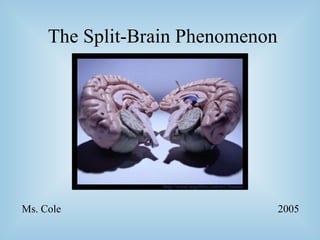
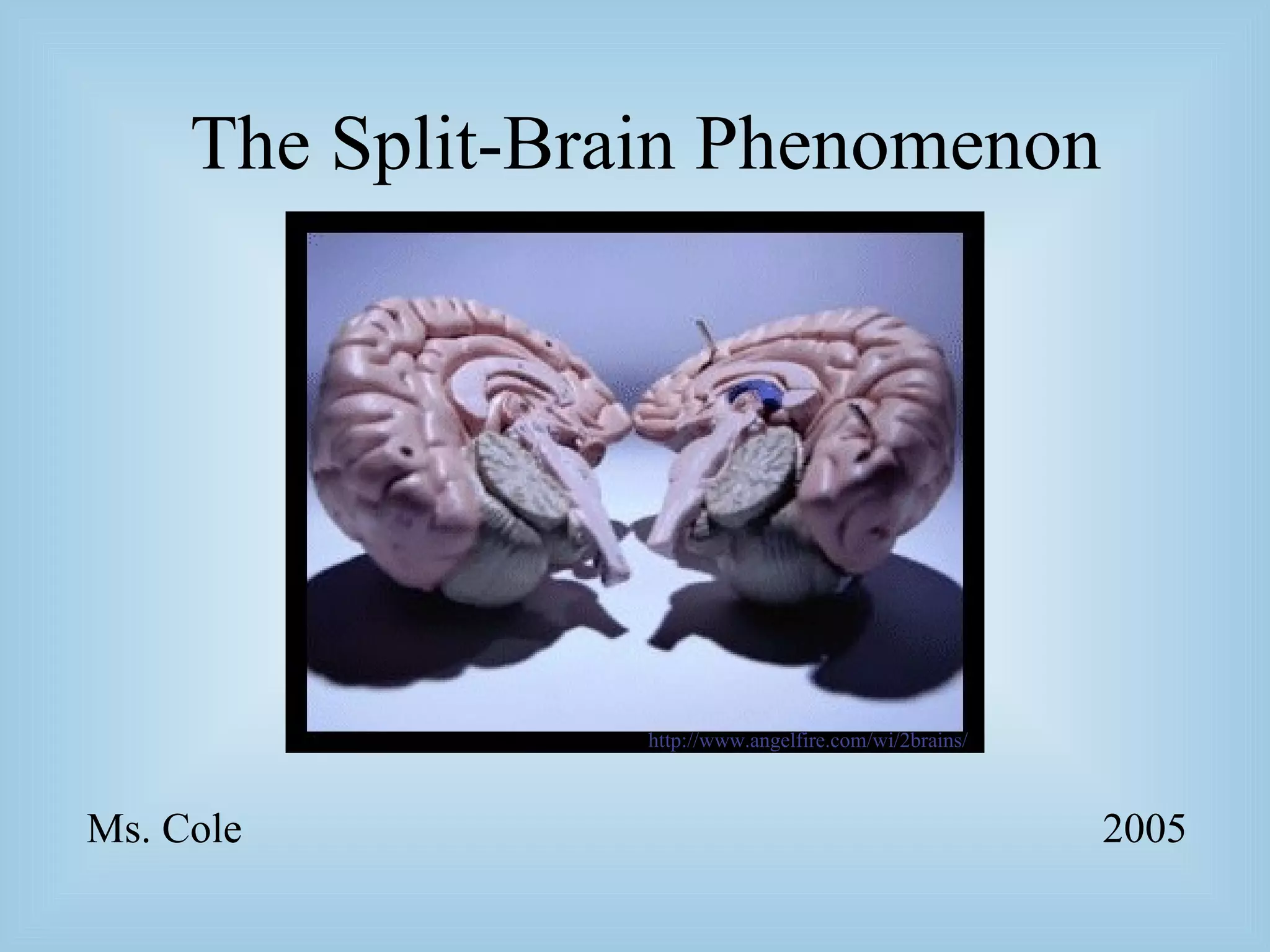
The Split-Brain Phenomenon Ms. Cole 2005 http://www. angelfire .com/ wi / 2brains /
Lesson Outline Basic Neuronal Structure  Basic Brain Structures Left/Right Hemisphere Specialization Vision Seizures Epilepsy Split-Brain Phenomenon Assignment
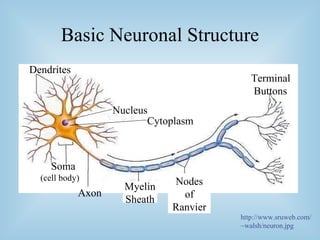
Basic Neuronal Structure Soma (cell body) Axon Terminal Buttons Cytoplasm Nucleus Dendrites Myelin Sheath Nodes of Ranvier http://www.sruweb.com/ ~walsh/neuron.jpg
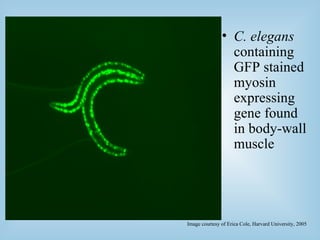
C. elegans  containing GFP stained myosin expressing gene found in body-wall muscle Image courtesy of Erica Cole, Harvard University, 2005
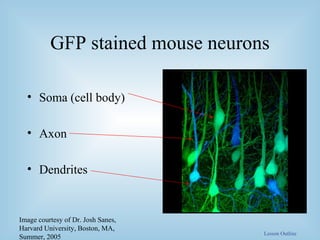
GFP stained mouse neurons Soma (cell body) Axon Dendrites Image courtesy of Dr. Josh Sanes, Harvard University, Boston, MA, Summer, 2005 Lesson Outline
Basic Brain Structure http:// normandy . sandhills .cc. nc .us/ psy150 / frmlobes .html Frontal Lobe Primary  Motor Cortex Primary Somatosensory Cortex Parietal Lobe Occipital Lobe Temporal  Lobe Cerebellum Brain Stem Lesson Outline
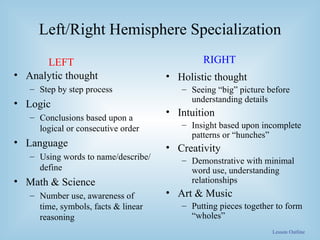
Left/Right Hemisphere Specialization Analytic thought Step by step process Logic Conclusions based upon a logical or consecutive order Language Using words to name/describe/define Math & Science Number use, awareness of time, symbols, facts & linear reasoning Holistic thought Seeing “big” picture before understanding details Intuition Insight based upon incomplete patterns or “hunches” Creativity Demonstrative with minimal word use, understanding relationships Art & Music Putting pieces together to form “wholes” LEFT RIGHT Lesson Outline
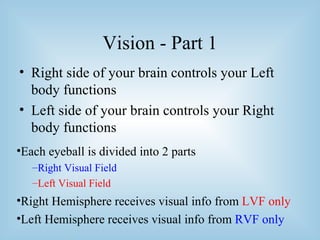
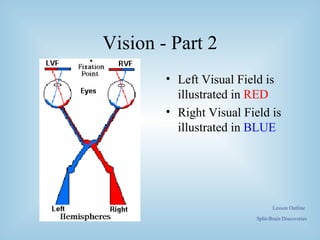
Vision - Part 1 Right side of your brain controls your Left body functions Left side of your brain controls your Right body functions Each eyeball is divided into 2 parts  Right Visual Field Left Visual Field Right Hemisphere receives visual info from  LVF   only Left Hemisphere receives visual info from  RVF   only
Vision - Part 2 Left Visual Field is illustrated in  RED Right Visual Field is illustrated in  BLUE Lesson Outline Split-Brain Discoveries
Seizures  3 basic types  Grand Mal Involves total body convulsions, aka “tonic-clonic” Petit Mal Involves isolated body part convulsion, aka “focal” Absence Patient becomes unresponsive, and has no memory  of occurrence.  Appears to be day-dreaming but cannot awake.  Very rare.
What is a seizure? 1. Abnormal discharge of electrical impulses within the brain 2. Rather than smooth constant production of Action Potentials, neurons fire without any regulation, causing disruption to brain function at the biochemical level Seizures generally have 3 parts:  Aura - period of warning, usually olfactory or visual Ictus - actual seizure period Postictal state - time where body “resets” itself
Causes of Seizures Alcohol Poisoning Drug Overdose/Reaction Head Injury Fever (especially in children) Neurological Defect (usually genetic) Sepsis (in brain) Brain Tumor Stroke Epilepsy Lesson Outline
Epilepsy A seizure disorder in which reoccurring seizures are the main symptom caused by an abnormal discharge of electrical activity from the neurons in the cerebral cortex. In the US more than 4 million people have some form of epilepsy  (http:www.neurologychannel.com/seizures) Risk of epilepsy is greatest in early childhood and late adulthood. Seizures have been found depicted as early as in cavepaintings! 4,000 year old writings depict epileptics as “possessed by demons” Julius Ceasar, King Charles II, Vincent Van Gogh and novelist  Dustoyevsky have all been reported as suffering from seizures!
Treatments for Epilepsy 3 major courses of treatment: Drugs Generally first line of attack because it is effective, relatively inexpensive, and safe Diet Ketogenic diet - lots of fat and almost no carbohydrates This diet drastically alters the way our bodies get energy from food - instead of making glucose, it makes ketones Surgery Commissurotomy
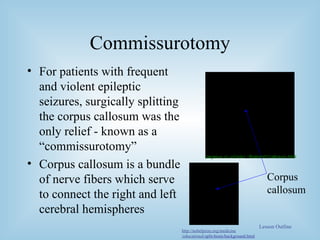
Commissurotomy For patients with frequent and violent epileptic seizures, surgically splitting the corpus callosum was the only relief - known as a “commissurotomy” Corpus callosum is a bundle of nerve fibers which serve to connect the right and left cerebral hemispheres Corpus  callosum Lesson Outline pegasus.cc.ucf.edu/ ~Brainmd1/callosum.html http://nobelprize.org/medicine /educational/ split-brain/background.html
Split - Brain Phenomenon Over 30 years ago studies of patients with a severed corpus callosum discovered some interesting side effects Roger Sperry & Michael Gazzaniga were in the forefront in utilizing these discoveries to determine significant ideas concerning brain function "The Man with 2 Brains”   (click on play video)
Split-Brain Discoveries Ability to speak resides almost exclusively in Left Hemisphere (word recognition) Ability to recognize faces resides almost exclusively in Right Hemisphere (Archimbaldo paintings) “ Don’t leave home without your left hemisphere!” - Michael Gazzaniga “ The great pleasure and feeling in my right brain is more than my left brain can find the words to tell you.” - Roger Sperry Lesson Outline Vision Diagram
Assignment You are to create a power point presentation similar to this one in which you investigate a neurological disease. Choose one disease from the websites below for your project.  I must know which disease you will research ASAP.  In order to get the most “bang for our buck” each of you will have a different disease topic - it’s first come first serve! Neurological diseases 1 Neurological diseases 2
Requirements Title Slide Outline Slide Informational Slides Diagnosis 2. Organism Causing Disease Symptoms Type of Transmission Treatment (s) Vaccine available? Prognosis Scientific Journal Article References
The End!

Split brain Phenomenon

  • 1.
    The Split-Brain PhenomenonMs. Cole 2005 http://www. angelfire .com/ wi / 2brains /
  • 2.
    Lesson Outline BasicNeuronal Structure Basic Brain Structures Left/Right Hemisphere Specialization Vision Seizures Epilepsy Split-Brain Phenomenon Assignment
  • 3.
    Basic Neuronal StructureSoma (cell body) Axon Terminal Buttons Cytoplasm Nucleus Dendrites Myelin Sheath Nodes of Ranvier http://www.sruweb.com/ ~walsh/neuron.jpg
  • 4.
    C. elegans containing GFP stained myosin expressing gene found in body-wall muscle Image courtesy of Erica Cole, Harvard University, 2005
  • 5.
    GFP stained mouseneurons Soma (cell body) Axon Dendrites Image courtesy of Dr. Josh Sanes, Harvard University, Boston, MA, Summer, 2005 Lesson Outline
  • 6.
    Basic Brain Structurehttp:// normandy . sandhills .cc. nc .us/ psy150 / frmlobes .html Frontal Lobe Primary Motor Cortex Primary Somatosensory Cortex Parietal Lobe Occipital Lobe Temporal Lobe Cerebellum Brain Stem Lesson Outline
  • 7.
    Left/Right Hemisphere SpecializationAnalytic thought Step by step process Logic Conclusions based upon a logical or consecutive order Language Using words to name/describe/define Math & Science Number use, awareness of time, symbols, facts & linear reasoning Holistic thought Seeing “big” picture before understanding details Intuition Insight based upon incomplete patterns or “hunches” Creativity Demonstrative with minimal word use, understanding relationships Art & Music Putting pieces together to form “wholes” LEFT RIGHT Lesson Outline
  • 8.
    Vision - Part1 Right side of your brain controls your Left body functions Left side of your brain controls your Right body functions Each eyeball is divided into 2 parts Right Visual Field Left Visual Field Right Hemisphere receives visual info from LVF only Left Hemisphere receives visual info from RVF only
  • 9.
    Vision - Part2 Left Visual Field is illustrated in RED Right Visual Field is illustrated in BLUE Lesson Outline Split-Brain Discoveries
  • 10.
    Seizures 3basic types Grand Mal Involves total body convulsions, aka “tonic-clonic” Petit Mal Involves isolated body part convulsion, aka “focal” Absence Patient becomes unresponsive, and has no memory of occurrence. Appears to be day-dreaming but cannot awake. Very rare.
  • 11.
    What is aseizure? 1. Abnormal discharge of electrical impulses within the brain 2. Rather than smooth constant production of Action Potentials, neurons fire without any regulation, causing disruption to brain function at the biochemical level Seizures generally have 3 parts: Aura - period of warning, usually olfactory or visual Ictus - actual seizure period Postictal state - time where body “resets” itself
  • 12.
    Causes of SeizuresAlcohol Poisoning Drug Overdose/Reaction Head Injury Fever (especially in children) Neurological Defect (usually genetic) Sepsis (in brain) Brain Tumor Stroke Epilepsy Lesson Outline
  • 13.
    Epilepsy A seizuredisorder in which reoccurring seizures are the main symptom caused by an abnormal discharge of electrical activity from the neurons in the cerebral cortex. In the US more than 4 million people have some form of epilepsy (http:www.neurologychannel.com/seizures) Risk of epilepsy is greatest in early childhood and late adulthood. Seizures have been found depicted as early as in cavepaintings! 4,000 year old writings depict epileptics as “possessed by demons” Julius Ceasar, King Charles II, Vincent Van Gogh and novelist Dustoyevsky have all been reported as suffering from seizures!
  • 14.
    Treatments for Epilepsy3 major courses of treatment: Drugs Generally first line of attack because it is effective, relatively inexpensive, and safe Diet Ketogenic diet - lots of fat and almost no carbohydrates This diet drastically alters the way our bodies get energy from food - instead of making glucose, it makes ketones Surgery Commissurotomy
  • 15.
    Commissurotomy For patientswith frequent and violent epileptic seizures, surgically splitting the corpus callosum was the only relief - known as a “commissurotomy” Corpus callosum is a bundle of nerve fibers which serve to connect the right and left cerebral hemispheres Corpus callosum Lesson Outline pegasus.cc.ucf.edu/ ~Brainmd1/callosum.html http://nobelprize.org/medicine /educational/ split-brain/background.html
  • 16.
    Split - BrainPhenomenon Over 30 years ago studies of patients with a severed corpus callosum discovered some interesting side effects Roger Sperry & Michael Gazzaniga were in the forefront in utilizing these discoveries to determine significant ideas concerning brain function "The Man with 2 Brains” (click on play video)
  • 17.
    Split-Brain Discoveries Abilityto speak resides almost exclusively in Left Hemisphere (word recognition) Ability to recognize faces resides almost exclusively in Right Hemisphere (Archimbaldo paintings) “ Don’t leave home without your left hemisphere!” - Michael Gazzaniga “ The great pleasure and feeling in my right brain is more than my left brain can find the words to tell you.” - Roger Sperry Lesson Outline Vision Diagram
  • 18.
    Assignment You areto create a power point presentation similar to this one in which you investigate a neurological disease. Choose one disease from the websites below for your project. I must know which disease you will research ASAP. In order to get the most “bang for our buck” each of you will have a different disease topic - it’s first come first serve! Neurological diseases 1 Neurological diseases 2
  • 19.
    Requirements Title SlideOutline Slide Informational Slides Diagnosis 2. Organism Causing Disease Symptoms Type of Transmission Treatment (s) Vaccine available? Prognosis Scientific Journal Article References
  • 20.