PSYC 3553 – Psychopathology Week 4: Assessment and Diagnosis • September 29, 2009
What is assessment? Goals of clinical assessment: How  and  why  a person is behaving abnormally How that person may be  helped Also may be used to evaluate treatment progress  Focus is  idiographic  – on an individual person
Characteristics of Assessment Tools Standardization A test is administered to a large group, and their performance serves as a common standard (norm) against which individual scores are judged The “ standardization sample ” must be representative One must standardize administration, scoring, and interpretation
Reliability :  The consistency of a test Test – retest reliability Interrater reliability Validity :  the accuracy of the test results   Face validity Predictive validity  Concurrent validity Characteristics of Assessment Tools
Are Classifications Reliable and Valid? Reliability : different diagnosticians agreeing on diagnosis using same classification system DSM-IV : greater reliability than previous editions Used field trials to increase reliability Validity : accuracy of information diagnostic categories provide DSM-IV has greater validity than any previous edition Conducted extensive lit reviews and field studies
I. Clinical Interviews Face-to-face encounters  Often the first contact between a client and a therapist/assessor Used to collect detailed information, especially personal history, about a client Allow the interviewer to focus on whatever topics they consider most important
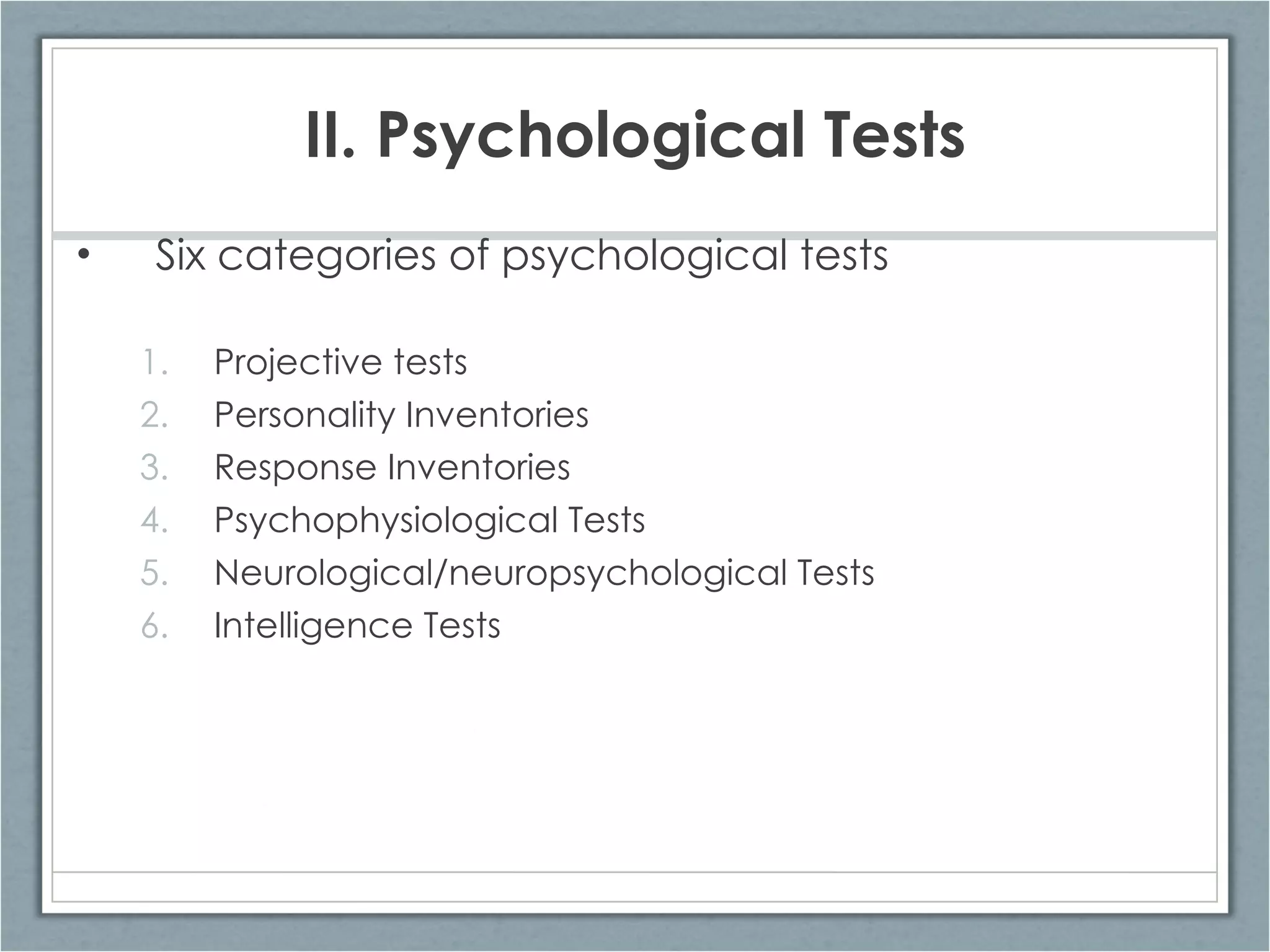
II. Psychological Tests Six categories of psychological tests Projective tests Personality Inventories Response Inventories Psychophysiological Tests  Neurological/neuropsychological Tests Intelligence Tests
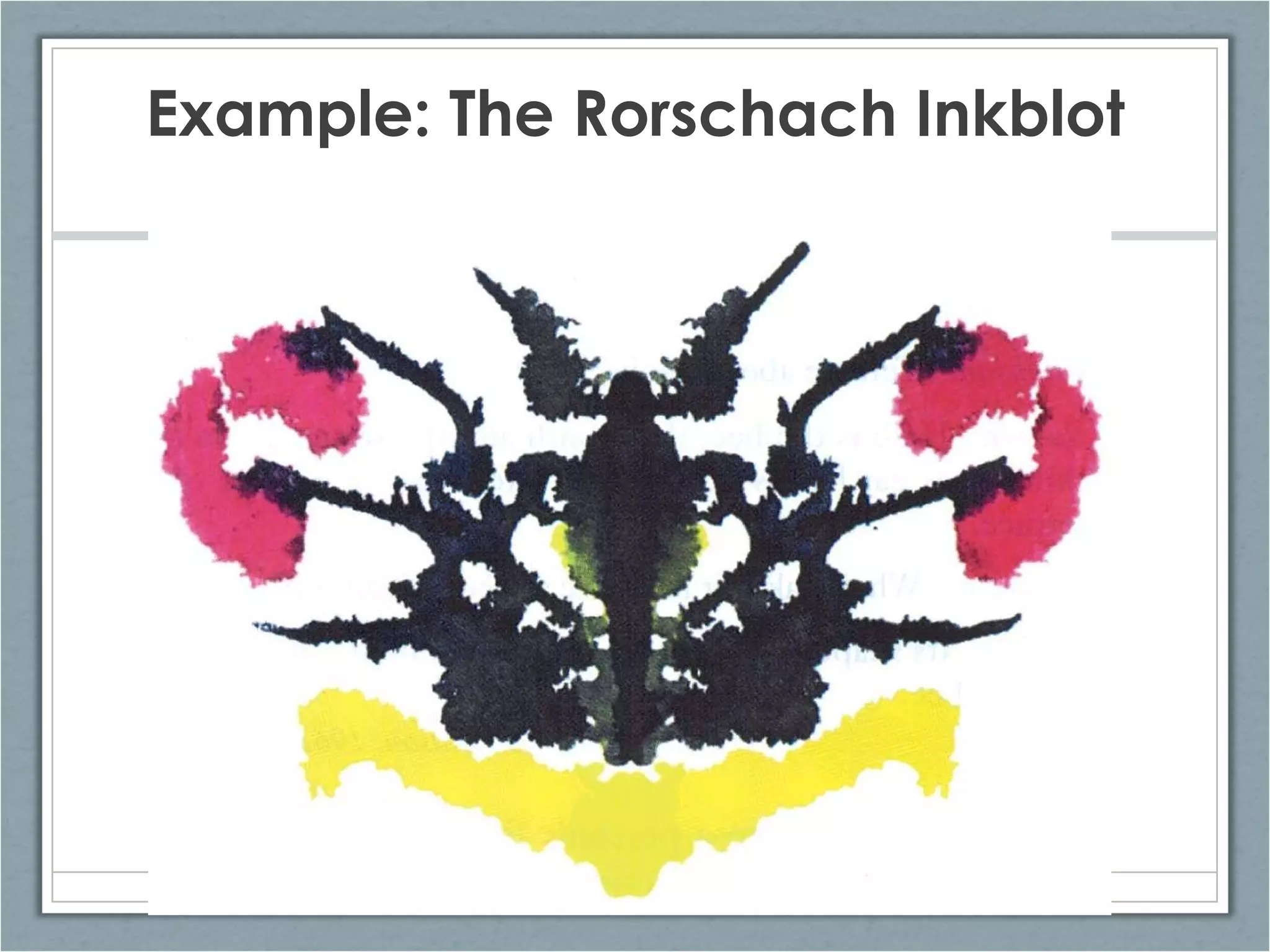
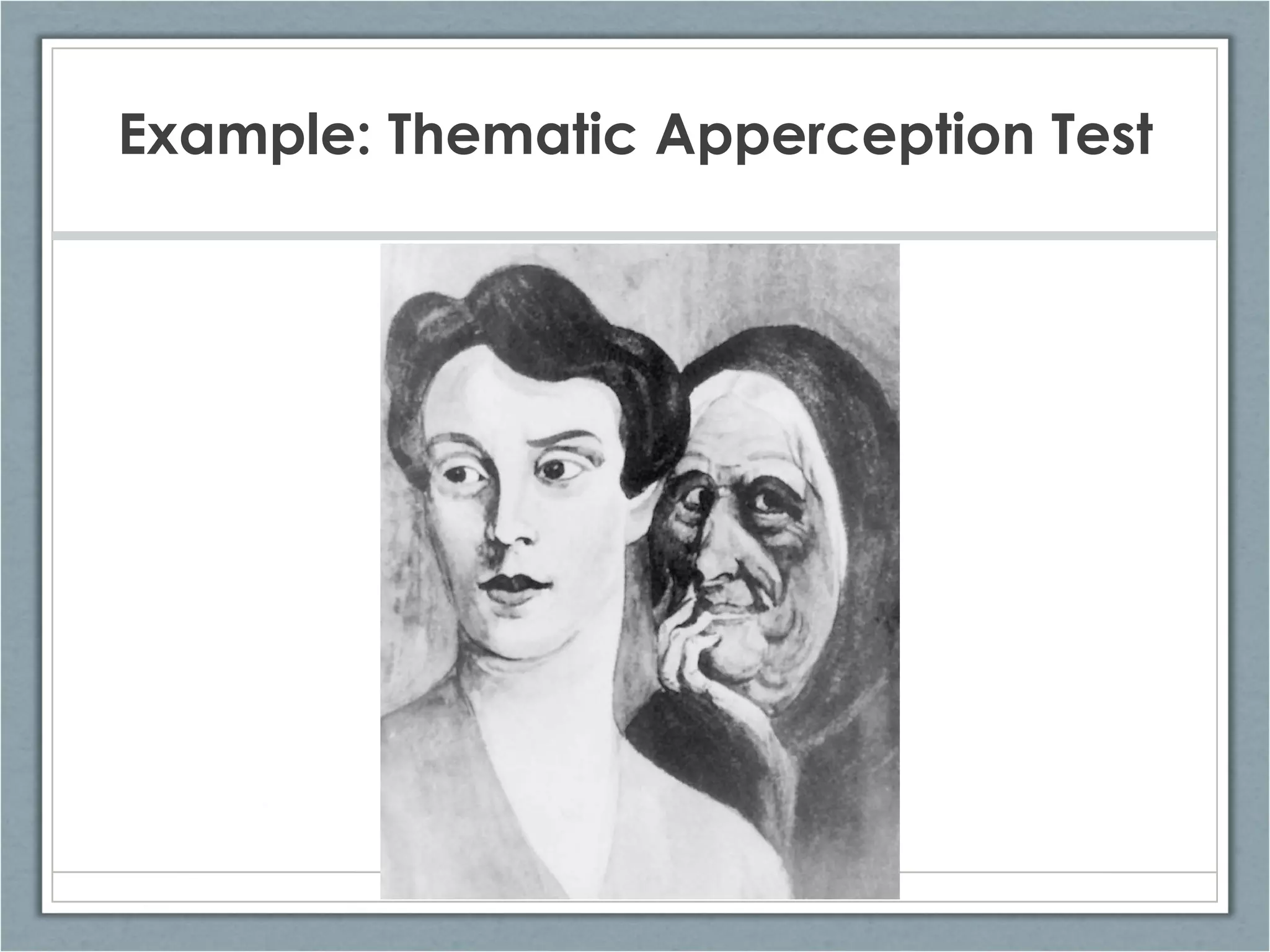
Projective tests : Interpret characteristics onto vague & ambiguous stimuli or follow open-ended instruction Strengths and weaknesses : Helpful for providing “supplementary” information Rarely demonstrated much reliability or validity May be biased against minority ethnic groups II. Psychological Tests
Example: The Rorschach Inkblot
Example: Thematic Apperception Test
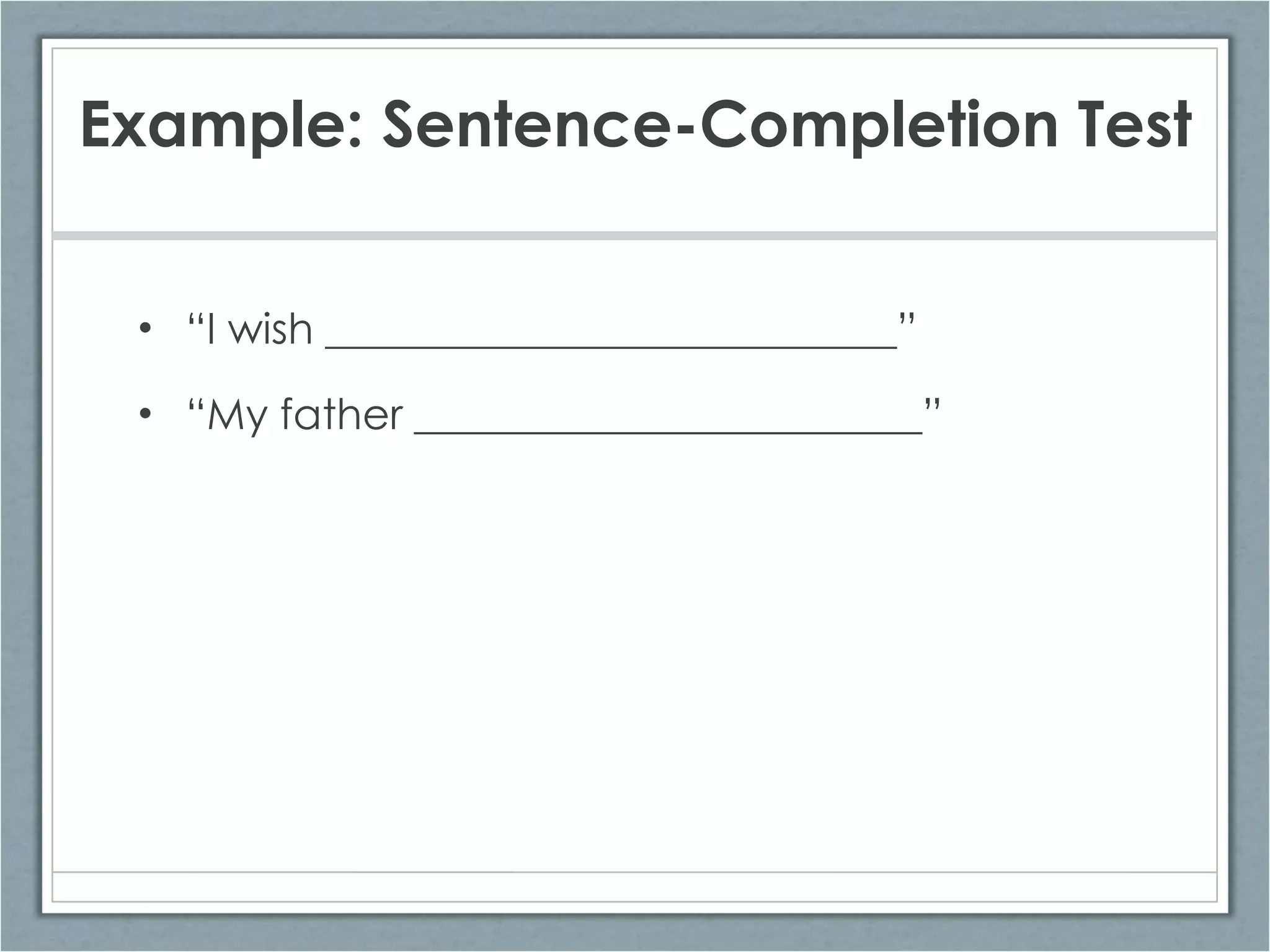
Example: Sentence-Completion Test “ I wish ___________________________” “ My father ________________________”
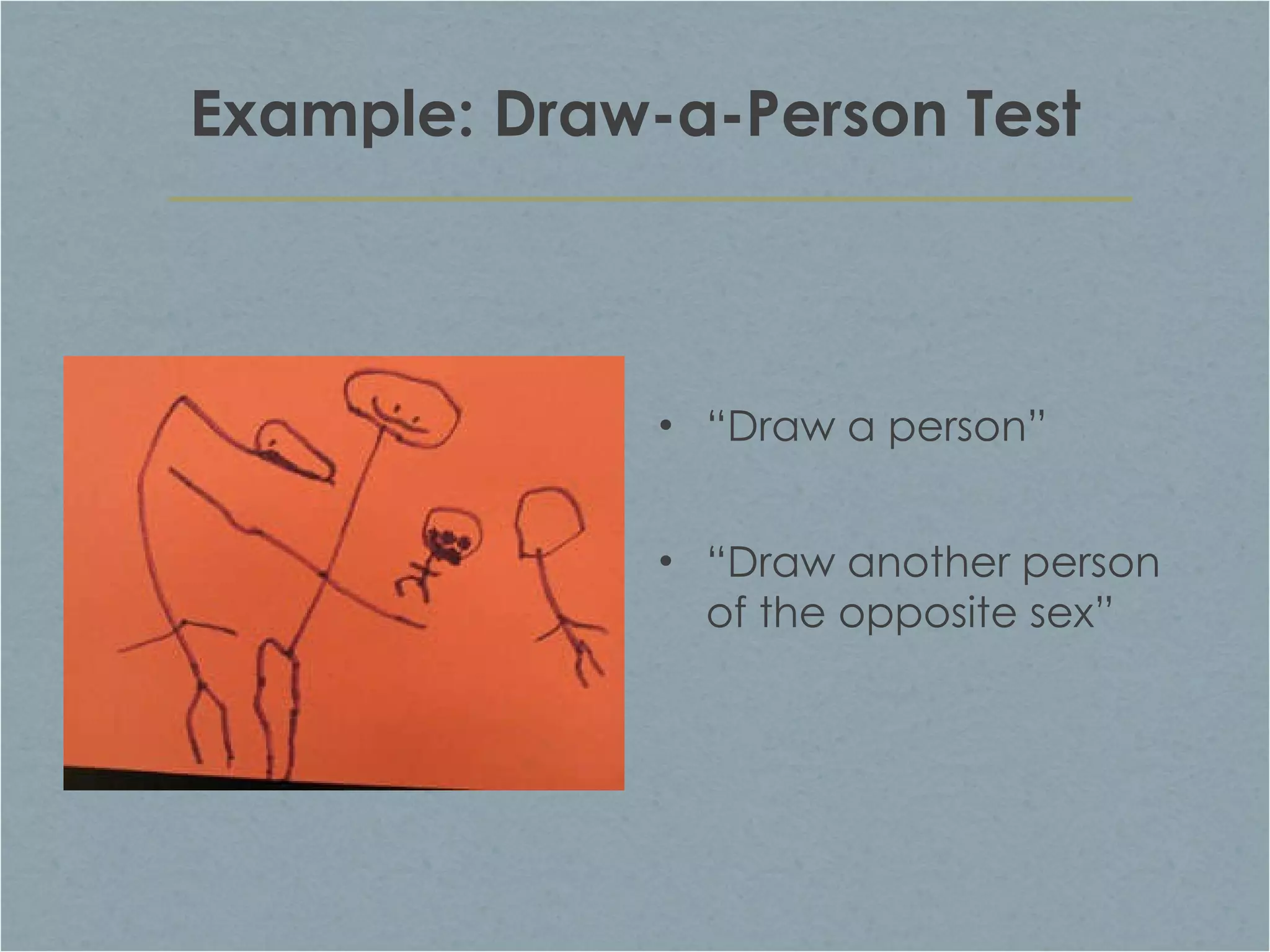
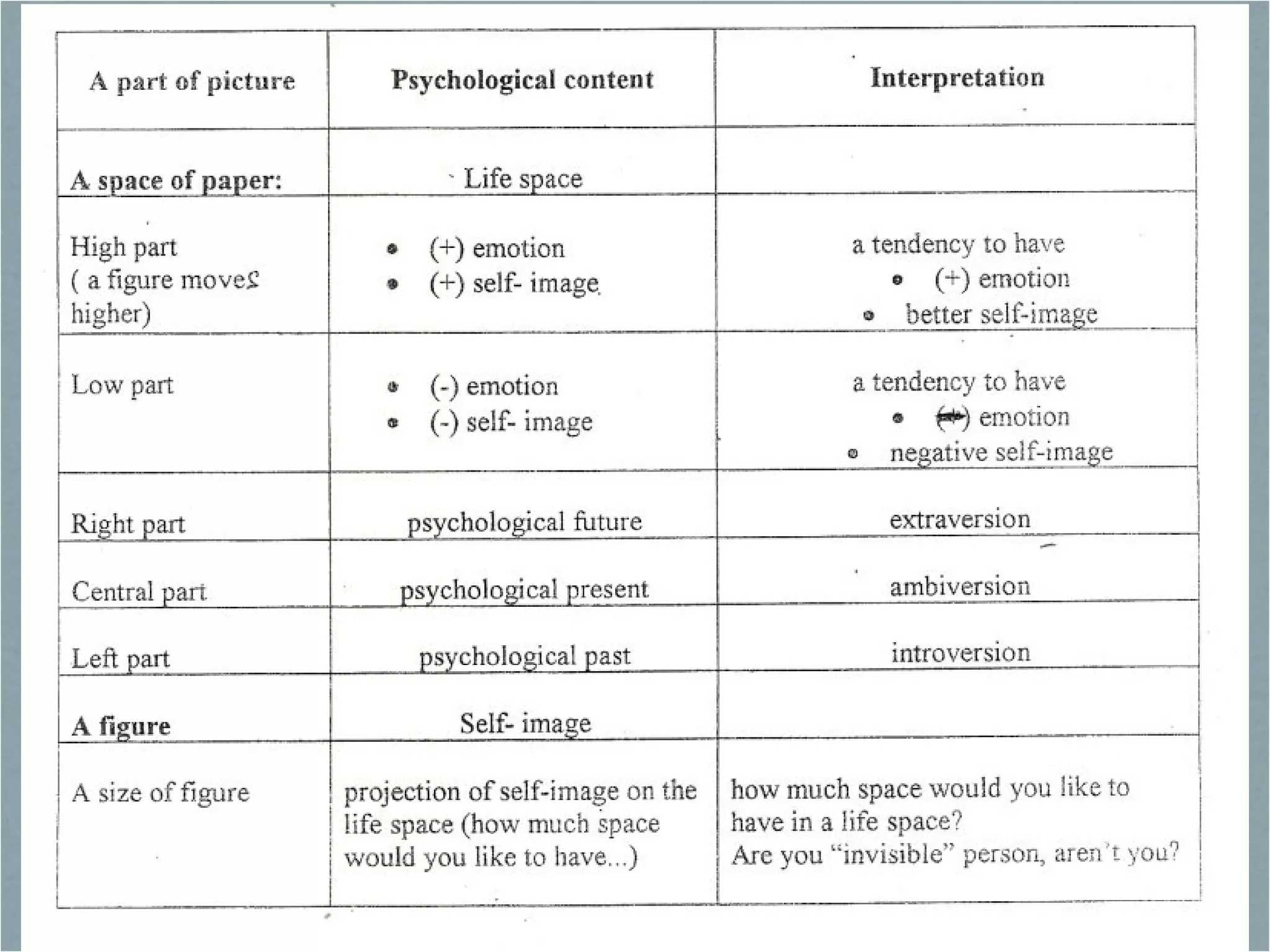
Example: Draw-a-Person Test “ Draw a person” “ Draw another person of the opposite sex”
 
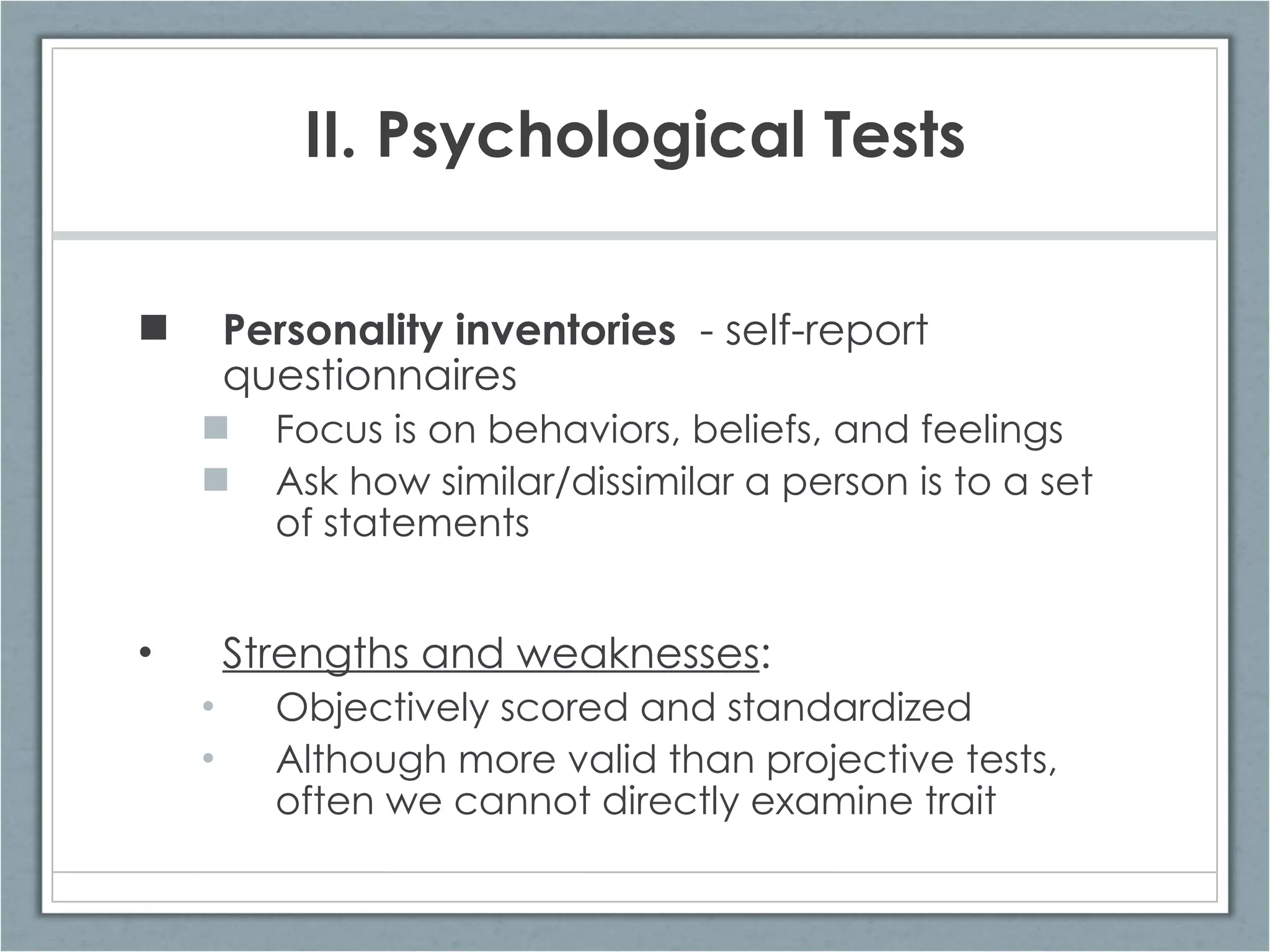
II. Psychological Tests Personality inventories  - self-report questionnaires Focus is on behaviors, beliefs, and feelings Ask how similar/dissimilar a person is to a set of statements Strengths and weaknesses : Objectively scored and standardized Although more valid than projective tests, often we cannot directly examine trait
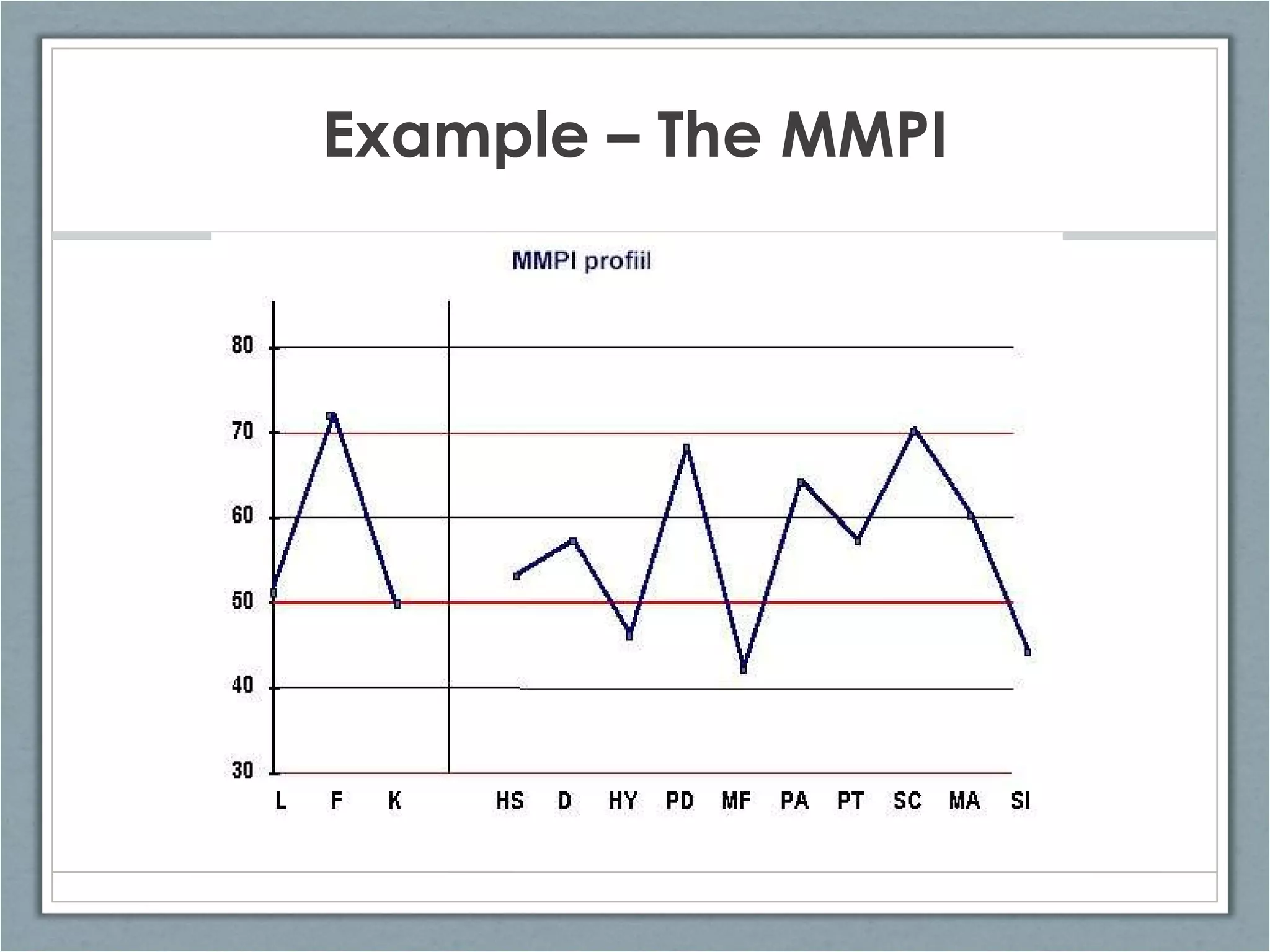
Example – The MMPI
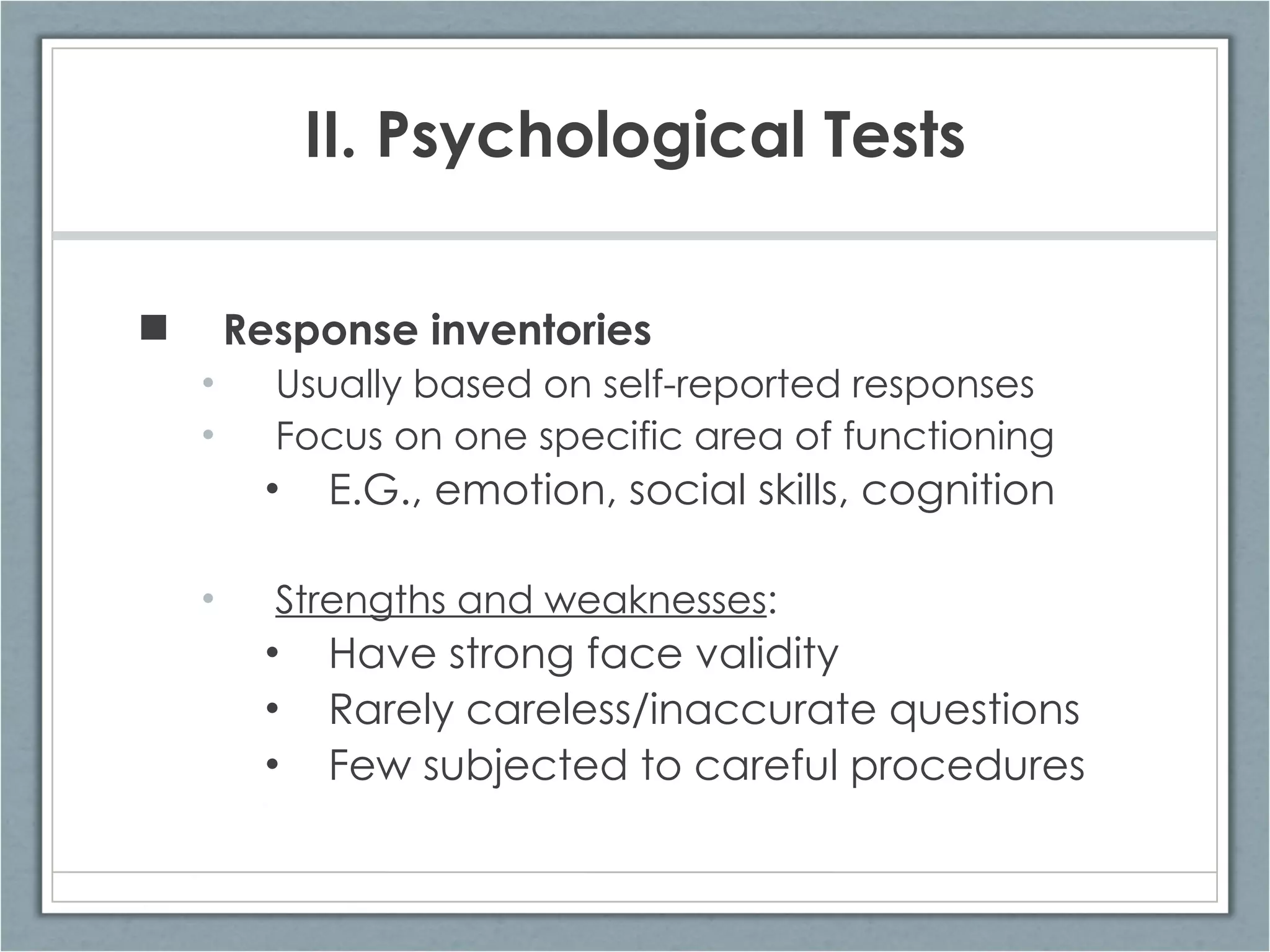
II. Psychological Tests Response inventories   Usually based on self-reported responses Focus on one specific area of functioning E.G., emotion, social skills, cognition Strengths and weaknesses : Have strong face validity Rarely careless/inaccurate questions Few subjected to careful procedures
II. Psychological Tests Psychophysiological tests  Measure physiological response as an indication of psychological problems Most popular is the polygraph (lie detector) Strengths and weaknesses : Require expensive equipment that must be tuned and maintained Physical evidence for psychological symptoms
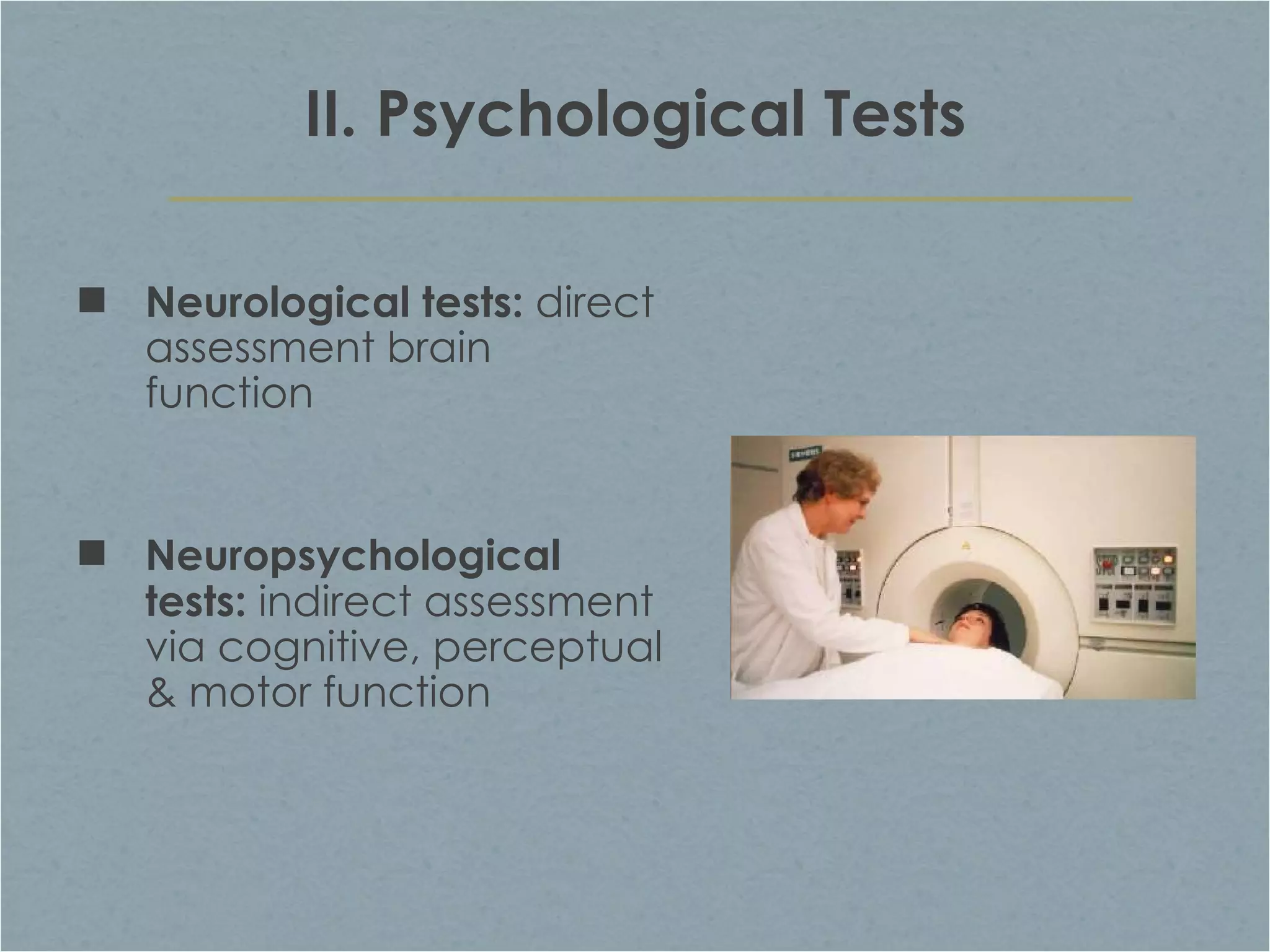
II. Psychological Tests Neurological tests:  direct assessment brain function  Neuropsychological tests:  indirect assessment via cognitive, perceptual & motor function
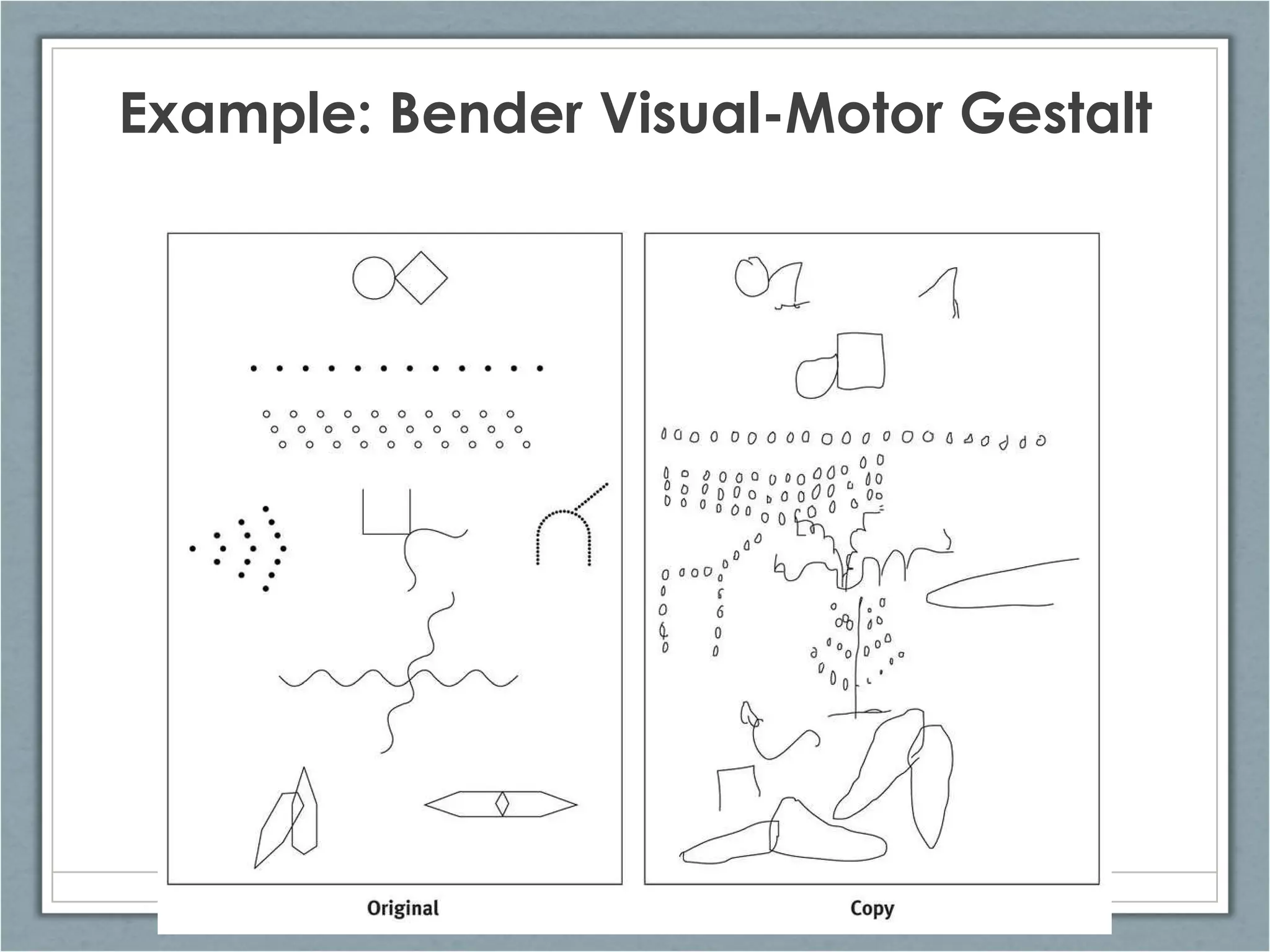
Example: Bender Visual-Motor Gestalt
II. Psychological Tests Intelligence tests Designed to measure intellectual ability Assess both verbal and non-verbal skills Generate an intelligence quotient (IQ) Strengths and weaknesses : Highly standardized, reliable and valid Influences on performance…cultural factors
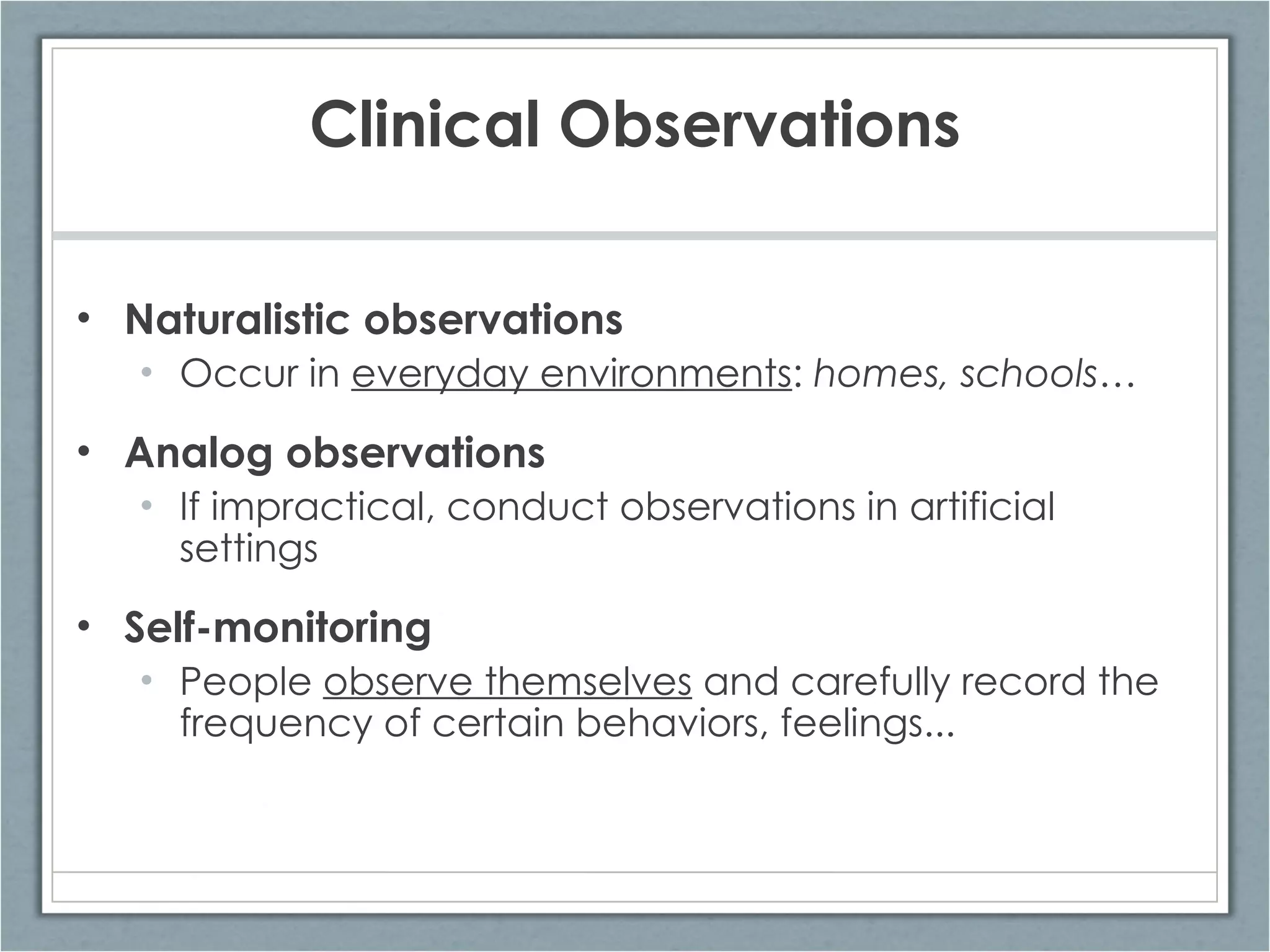
Clinical Observations Naturalistic observations Occur in  everyday environments :  homes, schools… Analog observations If impractical, conduct observations in artificial settings Self-monitoring People  observe themselves  and carefully record the frequency of certain behaviors, feelings...
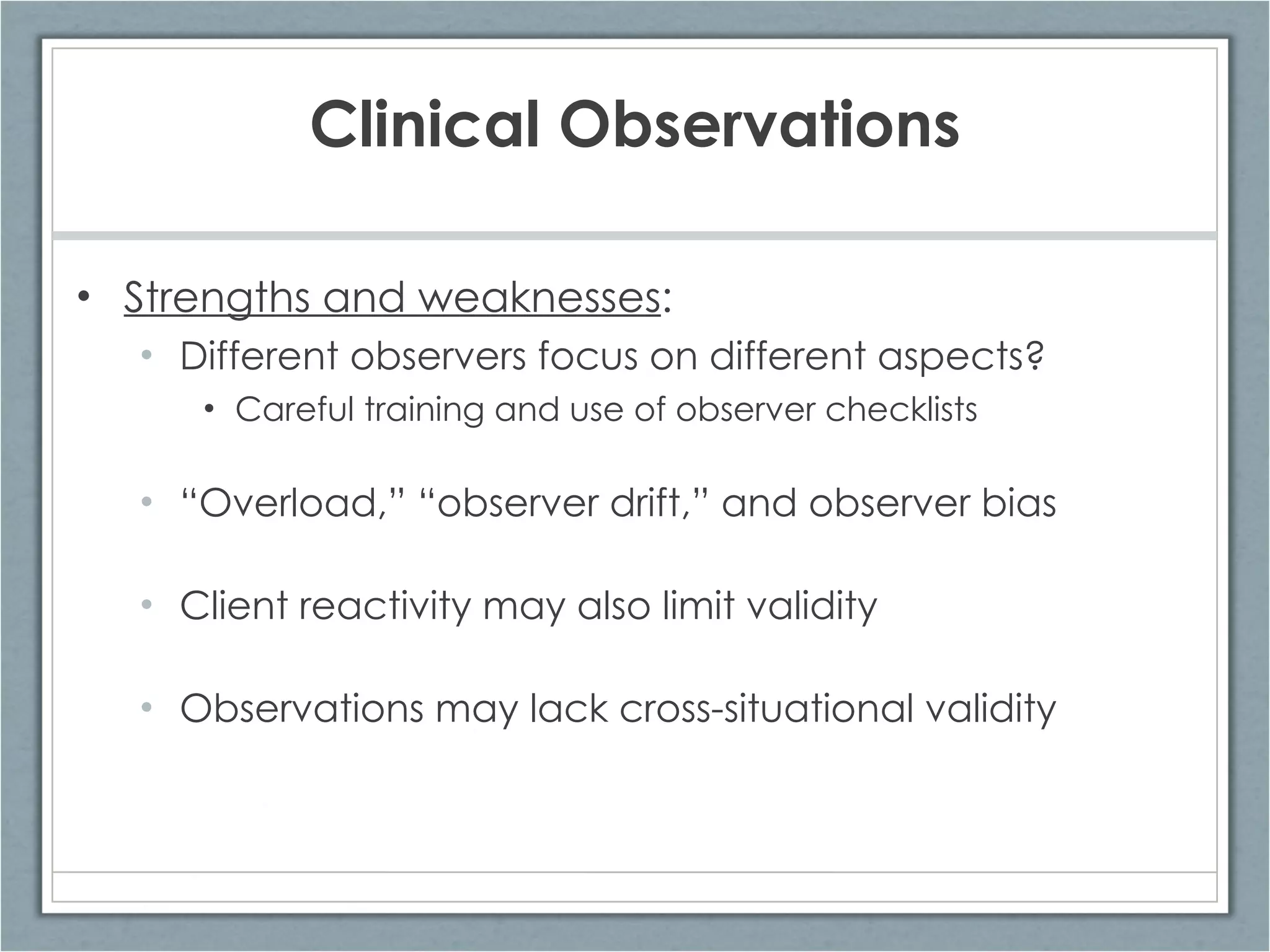
Clinical Observations Strengths and weaknesses : Different observers focus on different aspects? Careful training and use of observer checklists “ Overload,” “observer drift,” and observer bias Client reactivity may also limit validity Observations may lack cross-situational validity
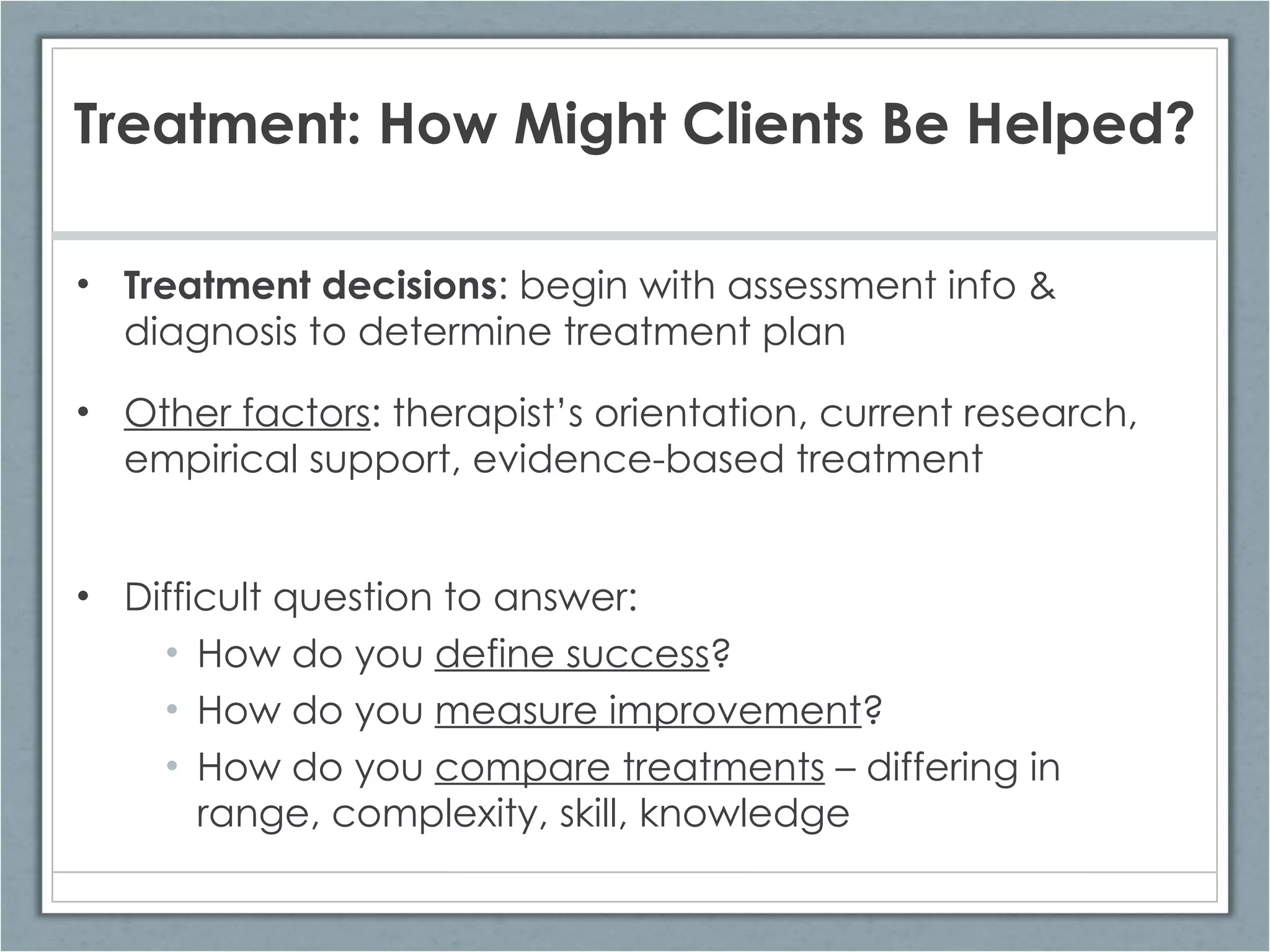
Treatment: How Might Clients Be Helped? Treatment decisions : begin with assessment info & diagnosis to determine treatment plan Other factors : therapist’s orientation, current research, empirical support, evidence-based treatment Difficult question to answer: How do you  define success ? How do you  measure improvement ? How do you  compare treatments  – differing in range, complexity, skill, knowledge
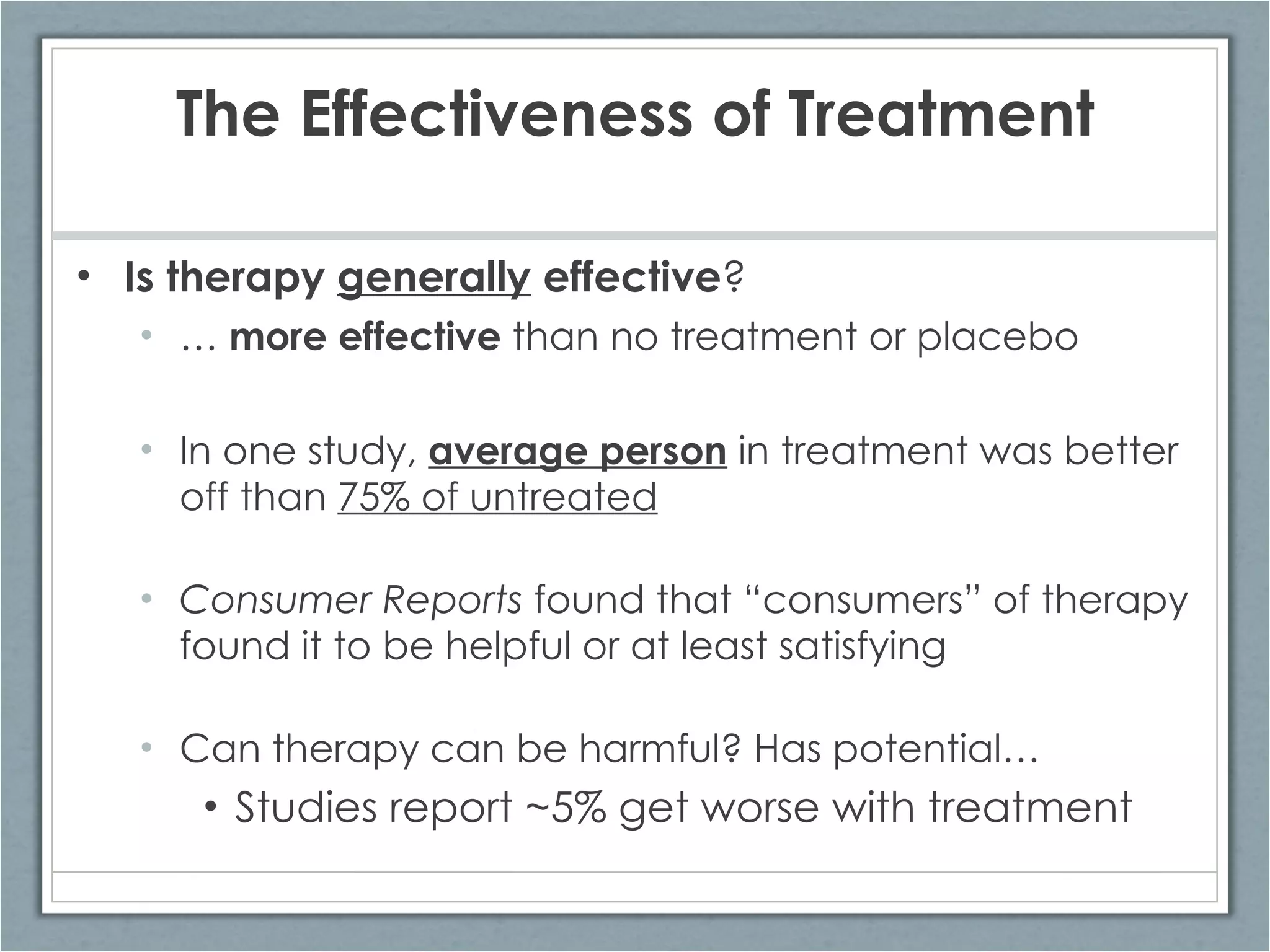
The Effectiveness of Treatment Is therapy  generally  effective ? …   more effective  than no treatment or placebo In one study,  average person  in treatment was better off than  75% of untreated Consumer Reports  found that “consumers” of therapy found it to be helpful or at least satisfying Can therapy can be harmful? Has potential… Studies report ~5% get worse with treatment
The Effectiveness of Treatment Are  particular  therapies effective for  particular  problems ? Studies now conducted to examine efficacy of specific treatments for specific disorders: Recent studies focus on the effectiveness of combined approaches  Drug therapy combined with certain forms of psychotherapy – to treat certain disorders

Assessment & Diagnosis

  • 1.
    PSYC 3553 –Psychopathology Week 4: Assessment and Diagnosis • September 29, 2009
  • 2.
    What is assessment?Goals of clinical assessment: How and why a person is behaving abnormally How that person may be helped Also may be used to evaluate treatment progress Focus is idiographic – on an individual person
  • 3.
    Characteristics of AssessmentTools Standardization A test is administered to a large group, and their performance serves as a common standard (norm) against which individual scores are judged The “ standardization sample ” must be representative One must standardize administration, scoring, and interpretation
  • 4.
    Reliability : The consistency of a test Test – retest reliability Interrater reliability Validity : the accuracy of the test results Face validity Predictive validity Concurrent validity Characteristics of Assessment Tools
  • 5.
    Are Classifications Reliableand Valid? Reliability : different diagnosticians agreeing on diagnosis using same classification system DSM-IV : greater reliability than previous editions Used field trials to increase reliability Validity : accuracy of information diagnostic categories provide DSM-IV has greater validity than any previous edition Conducted extensive lit reviews and field studies
  • 6.
    I. Clinical InterviewsFace-to-face encounters Often the first contact between a client and a therapist/assessor Used to collect detailed information, especially personal history, about a client Allow the interviewer to focus on whatever topics they consider most important
  • 7.
    II. Psychological TestsSix categories of psychological tests Projective tests Personality Inventories Response Inventories Psychophysiological Tests Neurological/neuropsychological Tests Intelligence Tests
  • 8.
    Projective tests :Interpret characteristics onto vague & ambiguous stimuli or follow open-ended instruction Strengths and weaknesses : Helpful for providing “supplementary” information Rarely demonstrated much reliability or validity May be biased against minority ethnic groups II. Psychological Tests
  • 9.
  • 10.
  • 11.
    Example: Sentence-Completion Test“ I wish ___________________________” “ My father ________________________”
  • 12.
    Example: Draw-a-Person Test“ Draw a person” “ Draw another person of the opposite sex”
  • 13.
  • 14.
    II. Psychological TestsPersonality inventories - self-report questionnaires Focus is on behaviors, beliefs, and feelings Ask how similar/dissimilar a person is to a set of statements Strengths and weaknesses : Objectively scored and standardized Although more valid than projective tests, often we cannot directly examine trait
  • 15.
  • 16.
    II. Psychological TestsResponse inventories Usually based on self-reported responses Focus on one specific area of functioning E.G., emotion, social skills, cognition Strengths and weaknesses : Have strong face validity Rarely careless/inaccurate questions Few subjected to careful procedures
  • 17.
    II. Psychological TestsPsychophysiological tests Measure physiological response as an indication of psychological problems Most popular is the polygraph (lie detector) Strengths and weaknesses : Require expensive equipment that must be tuned and maintained Physical evidence for psychological symptoms
  • 18.
    II. Psychological TestsNeurological tests: direct assessment brain function Neuropsychological tests: indirect assessment via cognitive, perceptual & motor function
  • 19.
  • 20.
    II. Psychological TestsIntelligence tests Designed to measure intellectual ability Assess both verbal and non-verbal skills Generate an intelligence quotient (IQ) Strengths and weaknesses : Highly standardized, reliable and valid Influences on performance…cultural factors
  • 21.
    Clinical Observations Naturalisticobservations Occur in everyday environments : homes, schools… Analog observations If impractical, conduct observations in artificial settings Self-monitoring People observe themselves and carefully record the frequency of certain behaviors, feelings...
  • 22.
    Clinical Observations Strengthsand weaknesses : Different observers focus on different aspects? Careful training and use of observer checklists “ Overload,” “observer drift,” and observer bias Client reactivity may also limit validity Observations may lack cross-situational validity
  • 23.
    Treatment: How MightClients Be Helped? Treatment decisions : begin with assessment info & diagnosis to determine treatment plan Other factors : therapist’s orientation, current research, empirical support, evidence-based treatment Difficult question to answer: How do you define success ? How do you measure improvement ? How do you compare treatments – differing in range, complexity, skill, knowledge
  • 24.
    The Effectiveness ofTreatment Is therapy generally effective ? … more effective than no treatment or placebo In one study, average person in treatment was better off than 75% of untreated Consumer Reports found that “consumers” of therapy found it to be helpful or at least satisfying Can therapy can be harmful? Has potential… Studies report ~5% get worse with treatment
  • 25.
    The Effectiveness ofTreatment Are particular therapies effective for particular problems ? Studies now conducted to examine efficacy of specific treatments for specific disorders: Recent studies focus on the effectiveness of combined approaches Drug therapy combined with certain forms of psychotherapy – to treat certain disorders