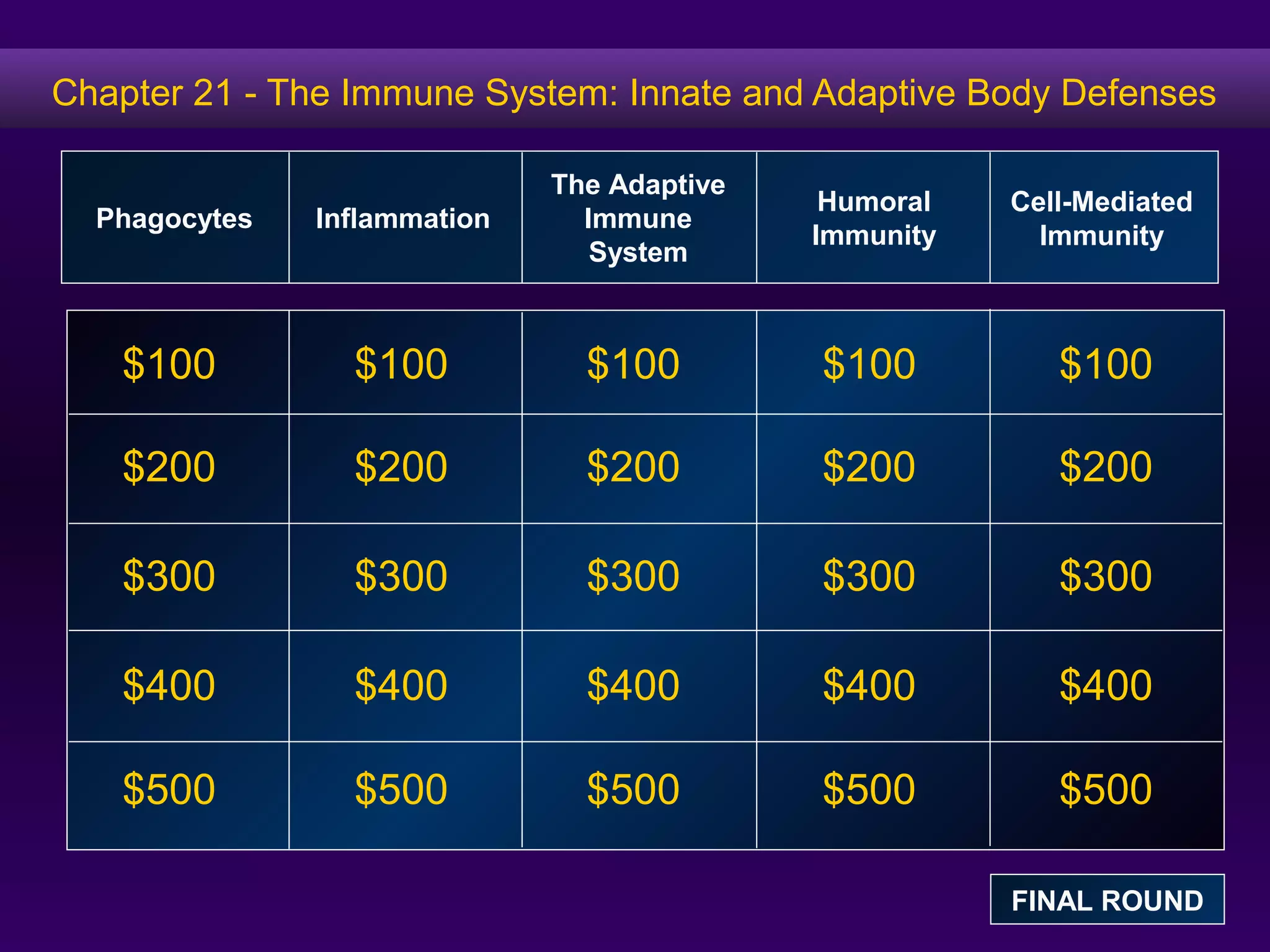
Chapter 21 - The Immune System: Innate and Adaptive Body Defenses
$100
$200
$300
$400
$500
$100 $100$100 $100
$200 $200 $200 $200
$300 $300 $300 $300
$400 $400 $400 $400
$500 $500 $500 $500
Phagocytes Inflammation
The Adaptive
Immune
System
Humoral
Immunity
Cell-Mediated
Immunity
FINAL ROUND
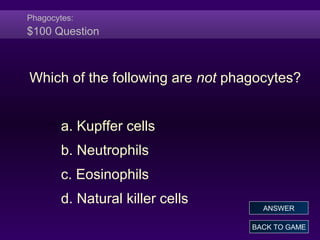
Phagocytes:
$100 Question
Which of the following are not phagocytes?
a. Kupffer cells
b. Neutrophils
c. Eosinophils
d. Natural killer cells
BACK TO GAME
ANSWER
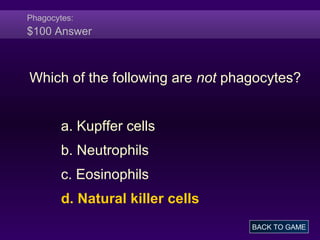
Phagocytes:
$100 Answer
BACK TO GAME
Which of the following are not phagocytes?
a. Kupffer cells
b. Neutrophils
c. Eosinophils
d. Natural killer cells
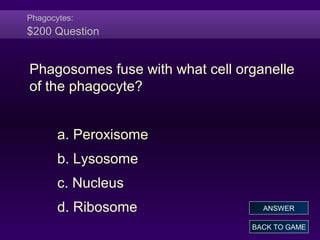
Phagocytes:
$200 Question
Phagosomes fuse with what cell organelle
of the phagocyte?
a. Peroxisome
b. Lysosome
c. Nucleus
d. Ribosome
BACK TO GAME
ANSWER
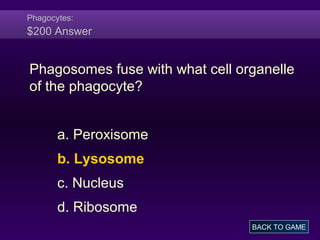
Phagocytes:
$200 Answer
Phagosomes fuse with what cell organelle
of the phagocyte?
a. Peroxisome
b. Lysosome
c. Nucleus
d. Ribosome
BACK TO GAME
Phagocytes:
$300 Question
Neutrophils produce an antimicrobial
chemical called ________.
a. defensin
b. histamine
c. complement
d. interferon
BACK TO GAME
ANSWER
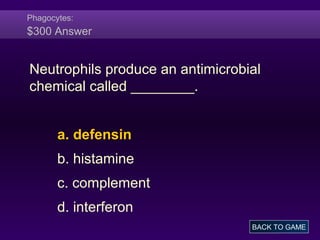
Phagocytes:
$300 Answer
Neutrophils produce an antimicrobial
chemical called ________.
a. defensin
b. histamine
c. complement
d. interferon
BACK TO GAME
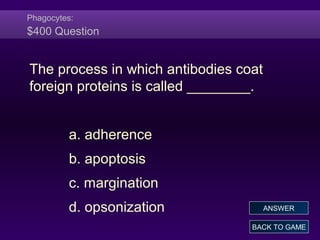
Phagocytes:
$400 Question
The process in which antibodies coat
foreign proteins is called ________.
a. adherence
b. apoptosis
c. margination
d. opsonization
BACK TO GAME
ANSWER
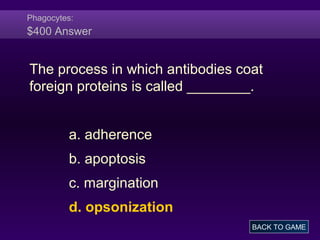
Phagocytes:
$400 Answer
The process in which antibodies coat
foreign proteins is called ________.
a. adherence
b. apoptosis
c. margination
d. opsonization
BACK TO GAME
Phagocytes:
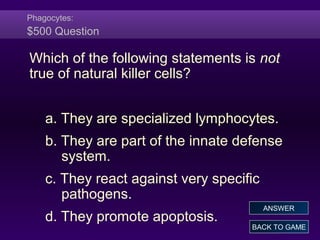
$500 Question
Which of the following statements is not
true of natural killer cells?
a. They are specialized lymphocytes.
b. They are part of the innate defense
system.
c. They react against very specific
pathogens.
d. They promote apoptosis.
BACK TO GAME
ANSWER
Phagocytes:
$500 Answer
Which of the following statements is not
true of natural killer cells?
a. They are specialized lymphocytes.
b. They are part of the innate defense
system.
c. They react against very specific
pathogens.
d. They promote apoptosis.
BACK TO GAME
Inflammation:
$100 Question
Which of the following is not a cardinal
sign of inflammation?
a. Redness
b. Bleeding
c. Heat
d. Pain
BACK TO GAME
ANSWER
Inflammation:
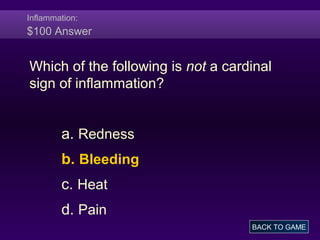
$100 Answer
Which of the following is not a cardinal
sign of inflammation?
a. Redness
b. Bleeding
c. Heat
d. Pain
BACK TO GAME
Inflammation:
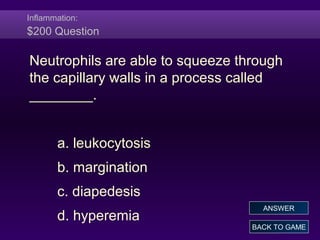
$200 Question
Neutrophils are able to squeeze through
the capillary walls in a process called
________.
a. leukocytosis
b. margination
c. diapedesis
d. hyperemia
BACK TO GAME
ANSWER
Inflammation:
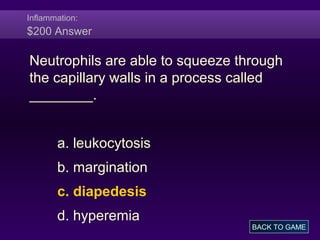
$200 Answer
Neutrophils are able to squeeze through
the capillary walls in a process called
________.
a. leukocytosis
b. margination
c. diapedesis
d. hyperemia
BACK TO GAME
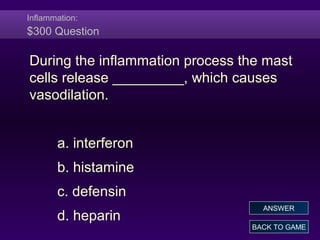
Inflammation:
$300 Question
During the inflammation process the mast
cells release _________, which causes
vasodilation.
a. interferon
b. histamine
c. defensin
d. heparin
BACK TO GAME
ANSWER
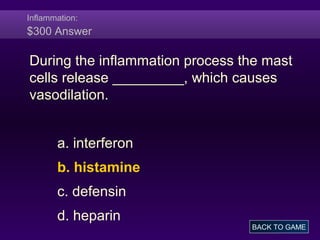
Inflammation:
$300 Answer
During the inflammation process the mast
cells release _________, which causes
vasodilation.
a. interferon
b. histamine
c. defensin
d. heparin
BACK TO GAME
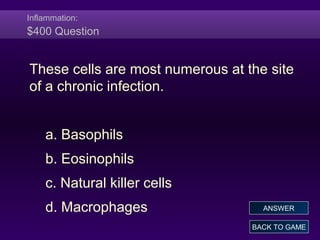
Inflammation:
$400 Question
These cells are most numerous at the site
of a chronic infection.
a. Basophils
b. Eosinophils
c. Natural killer cells
d. Macrophages
BACK TO GAME
ANSWER
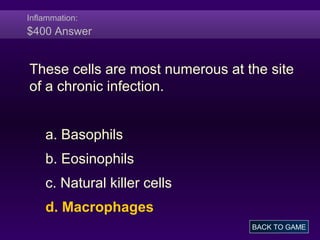
Inflammation:
$400 Answer
These cells are most numerous at the site
of a chronic infection.
a. Basophils
b. Eosinophils
c. Natural killer cells
d. Macrophages
BACK TO GAME
Inflammation:
$500 Question
These proteins are released by infected
cells and help protect surrounding
uninfected cells.
a. Complement
b. Defensins
c. Interferons
d. Prostaglandins
BACK TO GAME
ANSWER
Inflammation:
$500 Answer
These proteins are released by infected
cells and help protect surrounding
uninfected cells.
a. Complement
b. Defensins
c. Interferons
d. Prostaglandins
BACK TO GAME
The Adaptive Immune System:
$100 Question
Substances that provoke an immune
response are called ________.
a. antibodies
b. interferons
c. antigens
d. immunogens
BACK TO GAME
ANSWER
The Adaptive Immune System:
$100 Answer
Substances that provoke an immune
response are called ________.
a. antibodies
b. interferons
c. antigens
d. immunogens
BACK TO GAME
The Adaptive Immune System:
$200 Question
Which of the following is not true of our
adaptive immune system?
a. It is specific.
b. It has memory.
c. It is restricted to the initial infection
site.
d. It uses both antibodies and
cells to fight infection.
BACK TO GAME
ANSWER
The Adaptive Immune System:
$200 Answer
Which of the following is not true of our
adaptive immune system?
a. It is specific.
b. It has memory.
c. It is restricted to the initial infection
site.
d. It uses both antibodies and
cells to fight infection.
BACK TO GAME
The Adaptive Immune System:
$300 Question
The cells involved in cell-mediated
immunity are ________.
a. macrophages
b. neutrophils
c. lymphocytes
d. monocytes
BACK TO GAME
ANSWER
The Adaptive Immune System:
$300 Answer
The cells involved in cell-mediated
immunity are ________.
a. macrophages
b. neutrophils
c. lymphocytes
d. monocytes
BACK TO GAME
The Adaptive Immune System:
$400 Question
Hypersensitivity is usually caused by
_________.
a. a complete antigen
b. bacterium
c. a hapten
d. a virus
BACK TO GAME
ANSWER
The Adaptive Immune System:
$400 Answer
Hypersensitivity is usually caused by
_________.
a. a complete antigen
b. bacteria
c. a hapten
d. a virus
BACK TO GAME
The Adaptive Immune System:
$500 Question
The unresponsiveness of our lymphocytes
to our own body cells is called _________.
a. immunocompetence
b. histocompatibility
c. self-tolerance
d. immunological memory
BACK TO GAME
ANSWER
The Adaptive Immune System:
$500 Answer
The unresponsiveness of our lymphocytes
to our own body cells is called _________.
a. immunocompetence
b. histocompatibility
c. self-tolerance
d. immunological memory
BACK TO GAME
Humoral Immunity:
$100 Question
Clone cells capable of secreting large
amounts of antibodies are called ______.
a. memory cells
b. T cells
c. plasma cells
d. macrophages
BACK TO GAME
ANSWER
Humoral Immunity:
$100 Answer
Clone cells capable of secreting large
amounts of antibodies are called ______.
a. memory cells
b. T cells
c. plasma cells
d. macrophages
BACK TO GAME
Humoral Immunity:
$200 Question
The ability of antibodies to block specific
sites on pathogens so that they cannot
bind to cell receptors is called _______.
a. agglutination
b. activation
c. neutralization
d. precipitation
BACK TO GAME
ANSWER
Humoral Immunity:
$200 Answer
The ability of antibodies to block specific
sites on pathogens so that they cannot
bind to cell receptors is called _______.
a. agglutination
b. activation
c. neutralization
d. precipitation
BACK TO GAME
Humoral Immunity:
$300 Question
Which of the following is an example of
passive immunity?
a. A vaccine
b. Antibody production by B cells
c. A gamma globulin shot
d. A booster shot
BACK TO GAME
ANSWER
Humoral Immunity:
$300 Answer
Which of the following is an example of
passive immunity?
a. A vaccine
b. Antibody production by B cells
c. A gamma globulin shot
d. A booster shot
BACK TO GAME
Humoral Immunity:
$400 Question
The first antibody class to be released into
the bloodstream during an immune
response is ________.
a. IgA
b. IgD
c. IgG
d. IgM
BACK TO GAME
ANSWER
Humoral Immunity:
$400 Answer
The first antibody class to be released into
the bloodstream during an immune
response is ________.
a. IgA
b. IgD
c. IgG
d. IgM
BACK TO GAME
Humoral Immunity:
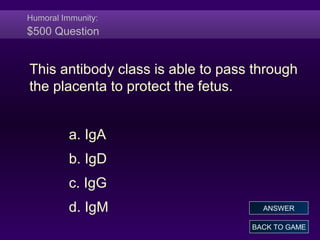
$500 Question
This antibody class is able to pass through
the placenta to protect the fetus.
a. IgA
b. IgD
c. IgG
d. IgM
BACK TO GAME
ANSWER
Humoral Immunity:
$500 Answer
This antibody class is able to pass through
the placenta to protect the fetus.
a. IgA
b. IgD
c. IgG
d. IgM
BACK TO GAME
Cell-Mediated Immunity:
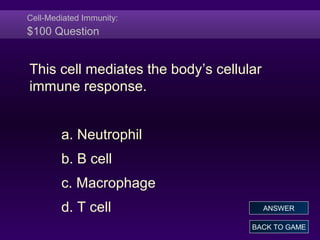
$100 Question
This cell mediates the body’s cellular
immune response.
a. Neutrophil
b. B cell
c. Macrophage
d. T cell
BACK TO GAME
ANSWER
Cell Mediated Immunity:
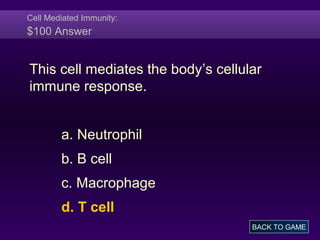
$100 Answer
This cell mediates the body’s cellular
immune response.
a. Neutrophil
b. B cell
c. Macrophage
d. T cell
BACK TO GAME
Cell-Mediated Immunity:
$200 Question
These cells promote antibody production
by the B cells.
a. Memory T cells
b. Cytotoxic T cells
c. Regulatory T cells
d. Helper T cells
BACK TO GAME
ANSWER
Cell-Mediated Immunity:
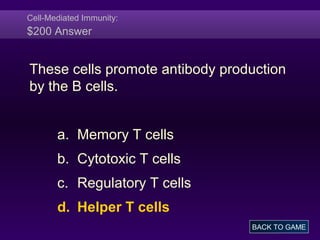
$200 Answer
These cells promote antibody production
by the B cells.
a. Memory T cells
b. Cytotoxic T cells
c. Regulatory T cells
d. Helper T cells
BACK TO GAME
Cell-Mediated Immunity:
$300 Question
This cell is responsible for tissue graft
rejection.
a. Memory cell
b. Cytotoxic cell
c. Regulatory cell
d. Plasma cell
BACK TO GAME
ANSWER
Cell-Mediated Immunity:
$300 Answer
This cell is responsible for tissue graft
rejection.
a. Memory cell
b. Cytotoxic cell
c. Regulatory cell
d. Plasma cell
BACK TO GAME
Cell-Mediated Immunity:
$400 Question
These cells suppress the immune system
and help prevent autoimmune diseases.
a. Memory T cells
b. Cytotoxic T cells
c. Regulatory T cells
d. Helper T cells
BACK TO GAME
ANSWER
Cell-Mediated Immunity:
$400 Answer
These cells suppress the immune system
and help prevent autoimmune diseases.
a. Memory T cells
b. Cytotoxic T cells
c. Regulatory T cells
d. Helper T cells
BACK TO GAME
Cell-Mediated Immunity:
$500 Question
Class II MHC proteins would be found on
all of the following except:
a. dendritic cells.
b. macrophages.
c. B cells.
d. neutrophils.
BACK TO GAME
ANSWER
Cell-Mediated Immunity:
$500 Answer
Class II MHC proteins would be found on
all of the following except:
a. dendritic cells.
b. macrophages.
c. B cells.
d. neutrophils.
BACK TO GAME
FINAL ROUND Question
Monoclonal antibodies _________.
a. are responsible for many incurable
diseases
b. are secreted by hybridomas
c. produce nonspecific antibodies
d. prevent pregnancy
BACK TO GAME
ANSWER
FINAL ROUND Answer
Monoclonal antibodies _________.
a. are responsible for many incurable
diseases
b. are secreted by hybridomas
c. produce nonspecific antibodies
d. prevent pregnancy
BACK TO GAME

Ch 21 quiz show game

  • 1.
    Chapter 21 -The Immune System: Innate and Adaptive Body Defenses $100 $200 $300 $400 $500 $100 $100$100 $100 $200 $200 $200 $200 $300 $300 $300 $300 $400 $400 $400 $400 $500 $500 $500 $500 Phagocytes Inflammation The Adaptive Immune System Humoral Immunity Cell-Mediated Immunity FINAL ROUND
  • 2.
    Phagocytes: $100 Question Which ofthe following are not phagocytes? a. Kupffer cells b. Neutrophils c. Eosinophils d. Natural killer cells BACK TO GAME ANSWER
  • 3.
    Phagocytes: $100 Answer BACK TOGAME Which of the following are not phagocytes? a. Kupffer cells b. Neutrophils c. Eosinophils d. Natural killer cells
  • 4.
    Phagocytes: $200 Question Phagosomes fusewith what cell organelle of the phagocyte? a. Peroxisome b. Lysosome c. Nucleus d. Ribosome BACK TO GAME ANSWER
  • 5.
    Phagocytes: $200 Answer Phagosomes fusewith what cell organelle of the phagocyte? a. Peroxisome b. Lysosome c. Nucleus d. Ribosome BACK TO GAME
  • 6.
    Phagocytes: $300 Question Neutrophils producean antimicrobial chemical called ________. a. defensin b. histamine c. complement d. interferon BACK TO GAME ANSWER
  • 7.
    Phagocytes: $300 Answer Neutrophils producean antimicrobial chemical called ________. a. defensin b. histamine c. complement d. interferon BACK TO GAME
  • 8.
    Phagocytes: $400 Question The processin which antibodies coat foreign proteins is called ________. a. adherence b. apoptosis c. margination d. opsonization BACK TO GAME ANSWER
  • 9.
    Phagocytes: $400 Answer The processin which antibodies coat foreign proteins is called ________. a. adherence b. apoptosis c. margination d. opsonization BACK TO GAME
  • 10.
    Phagocytes: $500 Question Which ofthe following statements is not true of natural killer cells? a. They are specialized lymphocytes. b. They are part of the innate defense system. c. They react against very specific pathogens. d. They promote apoptosis. BACK TO GAME ANSWER
  • 11.
    Phagocytes: $500 Answer Which ofthe following statements is not true of natural killer cells? a. They are specialized lymphocytes. b. They are part of the innate defense system. c. They react against very specific pathogens. d. They promote apoptosis. BACK TO GAME
  • 12.
    Inflammation: $100 Question Which ofthe following is not a cardinal sign of inflammation? a. Redness b. Bleeding c. Heat d. Pain BACK TO GAME ANSWER
  • 13.
    Inflammation: $100 Answer Which ofthe following is not a cardinal sign of inflammation? a. Redness b. Bleeding c. Heat d. Pain BACK TO GAME
  • 14.
    Inflammation: $200 Question Neutrophils areable to squeeze through the capillary walls in a process called ________. a. leukocytosis b. margination c. diapedesis d. hyperemia BACK TO GAME ANSWER
  • 15.
    Inflammation: $200 Answer Neutrophils areable to squeeze through the capillary walls in a process called ________. a. leukocytosis b. margination c. diapedesis d. hyperemia BACK TO GAME
  • 16.
    Inflammation: $300 Question During theinflammation process the mast cells release _________, which causes vasodilation. a. interferon b. histamine c. defensin d. heparin BACK TO GAME ANSWER
  • 17.
    Inflammation: $300 Answer During theinflammation process the mast cells release _________, which causes vasodilation. a. interferon b. histamine c. defensin d. heparin BACK TO GAME
  • 18.
    Inflammation: $400 Question These cellsare most numerous at the site of a chronic infection. a. Basophils b. Eosinophils c. Natural killer cells d. Macrophages BACK TO GAME ANSWER
  • 19.
    Inflammation: $400 Answer These cellsare most numerous at the site of a chronic infection. a. Basophils b. Eosinophils c. Natural killer cells d. Macrophages BACK TO GAME
  • 20.
    Inflammation: $500 Question These proteinsare released by infected cells and help protect surrounding uninfected cells. a. Complement b. Defensins c. Interferons d. Prostaglandins BACK TO GAME ANSWER
  • 21.
    Inflammation: $500 Answer These proteinsare released by infected cells and help protect surrounding uninfected cells. a. Complement b. Defensins c. Interferons d. Prostaglandins BACK TO GAME
  • 22.
    The Adaptive ImmuneSystem: $100 Question Substances that provoke an immune response are called ________. a. antibodies b. interferons c. antigens d. immunogens BACK TO GAME ANSWER
  • 23.
    The Adaptive ImmuneSystem: $100 Answer Substances that provoke an immune response are called ________. a. antibodies b. interferons c. antigens d. immunogens BACK TO GAME
  • 24.
    The Adaptive ImmuneSystem: $200 Question Which of the following is not true of our adaptive immune system? a. It is specific. b. It has memory. c. It is restricted to the initial infection site. d. It uses both antibodies and cells to fight infection. BACK TO GAME ANSWER
  • 25.
    The Adaptive ImmuneSystem: $200 Answer Which of the following is not true of our adaptive immune system? a. It is specific. b. It has memory. c. It is restricted to the initial infection site. d. It uses both antibodies and cells to fight infection. BACK TO GAME
  • 26.
    The Adaptive ImmuneSystem: $300 Question The cells involved in cell-mediated immunity are ________. a. macrophages b. neutrophils c. lymphocytes d. monocytes BACK TO GAME ANSWER
  • 27.
    The Adaptive ImmuneSystem: $300 Answer The cells involved in cell-mediated immunity are ________. a. macrophages b. neutrophils c. lymphocytes d. monocytes BACK TO GAME
  • 28.
    The Adaptive ImmuneSystem: $400 Question Hypersensitivity is usually caused by _________. a. a complete antigen b. bacterium c. a hapten d. a virus BACK TO GAME ANSWER
  • 29.
    The Adaptive ImmuneSystem: $400 Answer Hypersensitivity is usually caused by _________. a. a complete antigen b. bacteria c. a hapten d. a virus BACK TO GAME
  • 30.
    The Adaptive ImmuneSystem: $500 Question The unresponsiveness of our lymphocytes to our own body cells is called _________. a. immunocompetence b. histocompatibility c. self-tolerance d. immunological memory BACK TO GAME ANSWER
  • 31.
    The Adaptive ImmuneSystem: $500 Answer The unresponsiveness of our lymphocytes to our own body cells is called _________. a. immunocompetence b. histocompatibility c. self-tolerance d. immunological memory BACK TO GAME
  • 32.
    Humoral Immunity: $100 Question Clonecells capable of secreting large amounts of antibodies are called ______. a. memory cells b. T cells c. plasma cells d. macrophages BACK TO GAME ANSWER
  • 33.
    Humoral Immunity: $100 Answer Clonecells capable of secreting large amounts of antibodies are called ______. a. memory cells b. T cells c. plasma cells d. macrophages BACK TO GAME
  • 34.
    Humoral Immunity: $200 Question Theability of antibodies to block specific sites on pathogens so that they cannot bind to cell receptors is called _______. a. agglutination b. activation c. neutralization d. precipitation BACK TO GAME ANSWER
  • 35.
    Humoral Immunity: $200 Answer Theability of antibodies to block specific sites on pathogens so that they cannot bind to cell receptors is called _______. a. agglutination b. activation c. neutralization d. precipitation BACK TO GAME
  • 36.
    Humoral Immunity: $300 Question Whichof the following is an example of passive immunity? a. A vaccine b. Antibody production by B cells c. A gamma globulin shot d. A booster shot BACK TO GAME ANSWER
  • 37.
    Humoral Immunity: $300 Answer Whichof the following is an example of passive immunity? a. A vaccine b. Antibody production by B cells c. A gamma globulin shot d. A booster shot BACK TO GAME
  • 38.
    Humoral Immunity: $400 Question Thefirst antibody class to be released into the bloodstream during an immune response is ________. a. IgA b. IgD c. IgG d. IgM BACK TO GAME ANSWER
  • 39.
    Humoral Immunity: $400 Answer Thefirst antibody class to be released into the bloodstream during an immune response is ________. a. IgA b. IgD c. IgG d. IgM BACK TO GAME
  • 40.
    Humoral Immunity: $500 Question Thisantibody class is able to pass through the placenta to protect the fetus. a. IgA b. IgD c. IgG d. IgM BACK TO GAME ANSWER
  • 41.
    Humoral Immunity: $500 Answer Thisantibody class is able to pass through the placenta to protect the fetus. a. IgA b. IgD c. IgG d. IgM BACK TO GAME
  • 42.
    Cell-Mediated Immunity: $100 Question Thiscell mediates the body’s cellular immune response. a. Neutrophil b. B cell c. Macrophage d. T cell BACK TO GAME ANSWER
  • 43.
    Cell Mediated Immunity: $100Answer This cell mediates the body’s cellular immune response. a. Neutrophil b. B cell c. Macrophage d. T cell BACK TO GAME
  • 44.
    Cell-Mediated Immunity: $200 Question Thesecells promote antibody production by the B cells. a. Memory T cells b. Cytotoxic T cells c. Regulatory T cells d. Helper T cells BACK TO GAME ANSWER
  • 45.
    Cell-Mediated Immunity: $200 Answer Thesecells promote antibody production by the B cells. a. Memory T cells b. Cytotoxic T cells c. Regulatory T cells d. Helper T cells BACK TO GAME
  • 46.
    Cell-Mediated Immunity: $300 Question Thiscell is responsible for tissue graft rejection. a. Memory cell b. Cytotoxic cell c. Regulatory cell d. Plasma cell BACK TO GAME ANSWER
  • 47.
    Cell-Mediated Immunity: $300 Answer Thiscell is responsible for tissue graft rejection. a. Memory cell b. Cytotoxic cell c. Regulatory cell d. Plasma cell BACK TO GAME
  • 48.
    Cell-Mediated Immunity: $400 Question Thesecells suppress the immune system and help prevent autoimmune diseases. a. Memory T cells b. Cytotoxic T cells c. Regulatory T cells d. Helper T cells BACK TO GAME ANSWER
  • 49.
    Cell-Mediated Immunity: $400 Answer Thesecells suppress the immune system and help prevent autoimmune diseases. a. Memory T cells b. Cytotoxic T cells c. Regulatory T cells d. Helper T cells BACK TO GAME
  • 50.
    Cell-Mediated Immunity: $500 Question ClassII MHC proteins would be found on all of the following except: a. dendritic cells. b. macrophages. c. B cells. d. neutrophils. BACK TO GAME ANSWER
  • 51.
    Cell-Mediated Immunity: $500 Answer ClassII MHC proteins would be found on all of the following except: a. dendritic cells. b. macrophages. c. B cells. d. neutrophils. BACK TO GAME
  • 52.
    FINAL ROUND Question Monoclonalantibodies _________. a. are responsible for many incurable diseases b. are secreted by hybridomas c. produce nonspecific antibodies d. prevent pregnancy BACK TO GAME ANSWER
  • 53.
    FINAL ROUND Answer Monoclonalantibodies _________. a. are responsible for many incurable diseases b. are secreted by hybridomas c. produce nonspecific antibodies d. prevent pregnancy BACK TO GAME