AUTOIMMUNITY
Dr. Valli Syam
AUTOIMMUNITY
Paul Ehrlich - Immune system could go awry
and instead of reacting against foreign antigens, could
focus its attack on Self Ag – named it “HORROR
INTOXICUS”
Mechanism of self tolerance normally protect an
individual from potentially self reactive lymphocytes –
failure –Autoimmunity
AUTOIMMUNITY
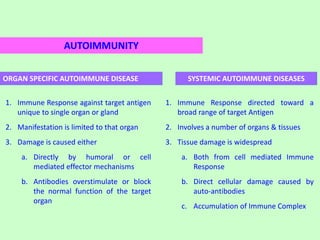
ORGAN SPECIFIC AUTOIMMUNE DISEASE SYSTEMIC AUTOIMMUNE DISEASES
1. Immune Response against target antigen
unique to single organ or gland
2. Manifestation is limited to that organ
3. Damage is caused either
a. Directly by humoral or cell
mediated effector mechanisms
b. Antibodies overstimulate or block
the normal function of the target
organ
1. Immune Response directed toward a
broad range of target Antigen
2. Involves a number of organs & tissues
3. Tissue damage is widespread
a. Both from cell mediated Immune
Response
b. Direct cellular damage caused by
auto-antibodies
c. Accumulation of Immune Complex
ORGAN SPECIFIC AUTOIMMUNE DISEASE
Diseases mediated by Direct Cellular
Damage
Diseases mediated by Stimulating /
Blocking - Autoantibodies
 Lymphocytes and Auto-antibodies bind
to cell membrane Antigens
 Cause Cellular lysis and / or
Inflammatory response in the affected
organs
 Damaged Cellular Structures will be
replaced by connective tissues
 Function of organ declines
 In some Autoimmune Diseases,
Antibodies act as Agonist – binding to
hormone receptor – stimulating
inappropriate activity – lead to an over
production of mediators
 Conversely, Auto-antibodies may act as
antagonists – bind to hormone
receptor – but block the receptor
function
ORGAN SPECIFIC AUTOIMMUNE DISEASE
Diseases mediated by Direct Cellular Damage
Hashimoto’s Thyroiditis
Patient Middle Aged Women
Target Thyroid gland
Immune Cells involved
Auto-antibodies & Sensitized Th1 cells specific for Thyroid
Antigens
Immune Response
Auto Ab against number of thyroid proteins – Thyroglobulin
& Thyroperoxidase – involved in the uptake of Iodine-
binding interferes with Iodine uptake – decreased
production of Thyroid hormone
 Th response – characterized by intense infiltration of
Thyroid gland by Lymphocytes, Macrophages & Plasma cells
– inflammation – Goiter – enlargement of Thyroid gland –
physiological response - Hypothyroidism
ORGAN SPECIFIC AUTOIMMUNE DISEASE
Diseases mediated by Direct Cellular Damage
Auto Immune Anaemia
Pernicious Anaemia Hemolytic Anaemia Drug Induced Anaemia
Target
Intrinsic Factor (Membrane
bound intestinal protein on
gastric parietal cells)
RBC Antigen RBC Antigen
Immune
Cells
involved
Auto-antibody Auto-antibody Auto-antibody
Immune
Response
•Intrinsic Factor facilitates
uptake of Vit B12 from
small intestine
•Binding of Auto-Ab blocks
Vit B12 uptake and
absorption – necessary for
Haemagtopoiesis – Number
of functional mature RBC
decreases below normal
•Auto-ab binding with
Ag on RBC triggers
complement mediated
Hemolysis
•Ab mediated
opsonization &
phagocytosis of RBC
Drugs –
•Penicillin &
Antihypertensive agent
Methyl dopa – interact
with RBC – make them
antigenic
•Opsonization,
Phagocytosis &
Complement meidated
hemolysis
ORGAN SPECIFIC AUTOIMMUNE DISEASE
Diseases mediated by Direct Cellular Damage
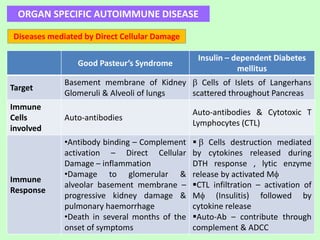
Good Pasteur’s Syndrome
Insulin – dependent Diabetes
mellitus
Target
Basement membrane of Kidney
Glomeruli & Alveoli of lungs
 Cells of Islets of Langerhans
scattered throughout Pancreas
Immune
Cells
involved
Auto-antibodies
Auto-antibodies & Cytotoxic T
Lymphocytes (CTL)
Immune
Response
•Antibody binding – Complement
activation – Direct Cellular
Damage – inflammation
•Damage to glomerular &
alveolar basement membrane –
progressive kidney damage &
pulmonary haemorrhage
•Death in several months of the
onset of symptoms
  Cells destruction mediated
by cytokines released during
DTH response , lytic enzyme
release by activated M
CTL infiltration – activation of
M (Insulitis) followed by
cytokine release
Auto-Ab – contribute through
complement & ADCC
ORGAN SPECIFIC AUTOIMMUNE DISEASE
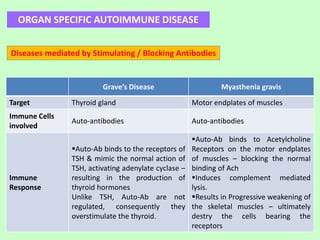
Diseases mediated by Stimulating / Blocking Antibodies
Grave’s Disease Myasthenia gravis
Target Thyroid gland Motor endplates of muscles
Immune Cells
involved
Auto-antibodies Auto-antibodies
Immune
Response
Auto-Ab binds to the receptors of
TSH & mimic the normal action of
TSH, activating adenylate cyclase –
resulting in the production of
thyroid hormones
Unlike TSH, Auto-Ab are not
regulated, consequently they
overstimulate the thyroid.
Auto-Ab binds to Acetylcholine
Receptors on the motor endplates
of muscles – blocking the normal
binding of Ach
Induces complement mediated
lysis.
Results in Progressive weakening of
the skeletal muscles – ultimately
destry the cells bearing the
receptors
SYSTEMIC AUTOIMMUNE DISEASE
SYSTEMIC LUPUS
ETHRYTHEMATOSUS
MULTIPLE SCLEROSIS
RHEUMATOID
ARTHRITIS
Patient Women – 20-40 of age
Women – 40-60 of
age
Target
Tissue Antigens such as
DNA, Histones, RBCs,
Platelets, Leucocytes &
Clotting factors
Myelin Sheath of
nerve fibers
Rhematoid Factor (Ig
M)
Immune Cells
involved
Auto-Antibodies Autoreactive T cells Auto-Antibodies
Immune
Response
•Auto-Ab against RBC
and Platelets –
Complement Mediated
Hemolytic anaemia and
Thrombocytopenia
•Immune complex with
nuclear Ag – deposit on
the walls of small blood
vessels – complement
mediated lysis –
vasculitis &
glomerulonephritis
•Autoreactive T cells
cause inflammatory
lesions on Myelin
Sheath of nerve fibers
– infiltrate the brain
tissue – cause
inflammatory lesions
– neurological
disorders
Auto-Ab
(Rheumatoid Factor)
– interact with
determinants on the
Fc region of Ig G
Forming Ig M – Ig G
complex – deposit in
the joints –
complement
mediated Type III
Hypersensitivity
reaction
REFERENCES
• Immunology – C V Rao, Alpha Science International Limited,
2016
• Kuby immunology –Judith A. Owen, Jenni Punt, Sharon A.
Stranford; with contributions by Patricia P. Jones. New York :
W.H. Freeman, 2013

Autoimmunity

  • 1.
  • 2.
    AUTOIMMUNITY Paul Ehrlich -Immune system could go awry and instead of reacting against foreign antigens, could focus its attack on Self Ag – named it “HORROR INTOXICUS” Mechanism of self tolerance normally protect an individual from potentially self reactive lymphocytes – failure –Autoimmunity
  • 3.
    AUTOIMMUNITY ORGAN SPECIFIC AUTOIMMUNEDISEASE SYSTEMIC AUTOIMMUNE DISEASES 1. Immune Response against target antigen unique to single organ or gland 2. Manifestation is limited to that organ 3. Damage is caused either a. Directly by humoral or cell mediated effector mechanisms b. Antibodies overstimulate or block the normal function of the target organ 1. Immune Response directed toward a broad range of target Antigen 2. Involves a number of organs & tissues 3. Tissue damage is widespread a. Both from cell mediated Immune Response b. Direct cellular damage caused by auto-antibodies c. Accumulation of Immune Complex
  • 4.
    ORGAN SPECIFIC AUTOIMMUNEDISEASE Diseases mediated by Direct Cellular Damage Diseases mediated by Stimulating / Blocking - Autoantibodies  Lymphocytes and Auto-antibodies bind to cell membrane Antigens  Cause Cellular lysis and / or Inflammatory response in the affected organs  Damaged Cellular Structures will be replaced by connective tissues  Function of organ declines  In some Autoimmune Diseases, Antibodies act as Agonist – binding to hormone receptor – stimulating inappropriate activity – lead to an over production of mediators  Conversely, Auto-antibodies may act as antagonists – bind to hormone receptor – but block the receptor function
  • 5.
    ORGAN SPECIFIC AUTOIMMUNEDISEASE Diseases mediated by Direct Cellular Damage Hashimoto’s Thyroiditis Patient Middle Aged Women Target Thyroid gland Immune Cells involved Auto-antibodies & Sensitized Th1 cells specific for Thyroid Antigens Immune Response Auto Ab against number of thyroid proteins – Thyroglobulin & Thyroperoxidase – involved in the uptake of Iodine- binding interferes with Iodine uptake – decreased production of Thyroid hormone  Th response – characterized by intense infiltration of Thyroid gland by Lymphocytes, Macrophages & Plasma cells – inflammation – Goiter – enlargement of Thyroid gland – physiological response - Hypothyroidism
  • 6.
    ORGAN SPECIFIC AUTOIMMUNEDISEASE Diseases mediated by Direct Cellular Damage Auto Immune Anaemia Pernicious Anaemia Hemolytic Anaemia Drug Induced Anaemia Target Intrinsic Factor (Membrane bound intestinal protein on gastric parietal cells) RBC Antigen RBC Antigen Immune Cells involved Auto-antibody Auto-antibody Auto-antibody Immune Response •Intrinsic Factor facilitates uptake of Vit B12 from small intestine •Binding of Auto-Ab blocks Vit B12 uptake and absorption – necessary for Haemagtopoiesis – Number of functional mature RBC decreases below normal •Auto-ab binding with Ag on RBC triggers complement mediated Hemolysis •Ab mediated opsonization & phagocytosis of RBC Drugs – •Penicillin & Antihypertensive agent Methyl dopa – interact with RBC – make them antigenic •Opsonization, Phagocytosis & Complement meidated hemolysis
  • 7.
    ORGAN SPECIFIC AUTOIMMUNEDISEASE Diseases mediated by Direct Cellular Damage Good Pasteur’s Syndrome Insulin – dependent Diabetes mellitus Target Basement membrane of Kidney Glomeruli & Alveoli of lungs  Cells of Islets of Langerhans scattered throughout Pancreas Immune Cells involved Auto-antibodies Auto-antibodies & Cytotoxic T Lymphocytes (CTL) Immune Response •Antibody binding – Complement activation – Direct Cellular Damage – inflammation •Damage to glomerular & alveolar basement membrane – progressive kidney damage & pulmonary haemorrhage •Death in several months of the onset of symptoms   Cells destruction mediated by cytokines released during DTH response , lytic enzyme release by activated M CTL infiltration – activation of M (Insulitis) followed by cytokine release Auto-Ab – contribute through complement & ADCC
  • 8.
    ORGAN SPECIFIC AUTOIMMUNEDISEASE Diseases mediated by Stimulating / Blocking Antibodies Grave’s Disease Myasthenia gravis Target Thyroid gland Motor endplates of muscles Immune Cells involved Auto-antibodies Auto-antibodies Immune Response Auto-Ab binds to the receptors of TSH & mimic the normal action of TSH, activating adenylate cyclase – resulting in the production of thyroid hormones Unlike TSH, Auto-Ab are not regulated, consequently they overstimulate the thyroid. Auto-Ab binds to Acetylcholine Receptors on the motor endplates of muscles – blocking the normal binding of Ach Induces complement mediated lysis. Results in Progressive weakening of the skeletal muscles – ultimately destry the cells bearing the receptors
  • 9.
    SYSTEMIC AUTOIMMUNE DISEASE SYSTEMICLUPUS ETHRYTHEMATOSUS MULTIPLE SCLEROSIS RHEUMATOID ARTHRITIS Patient Women – 20-40 of age Women – 40-60 of age Target Tissue Antigens such as DNA, Histones, RBCs, Platelets, Leucocytes & Clotting factors Myelin Sheath of nerve fibers Rhematoid Factor (Ig M) Immune Cells involved Auto-Antibodies Autoreactive T cells Auto-Antibodies Immune Response •Auto-Ab against RBC and Platelets – Complement Mediated Hemolytic anaemia and Thrombocytopenia •Immune complex with nuclear Ag – deposit on the walls of small blood vessels – complement mediated lysis – vasculitis & glomerulonephritis •Autoreactive T cells cause inflammatory lesions on Myelin Sheath of nerve fibers – infiltrate the brain tissue – cause inflammatory lesions – neurological disorders Auto-Ab (Rheumatoid Factor) – interact with determinants on the Fc region of Ig G Forming Ig M – Ig G complex – deposit in the joints – complement mediated Type III Hypersensitivity reaction
  • 10.
    REFERENCES • Immunology –C V Rao, Alpha Science International Limited, 2016 • Kuby immunology –Judith A. Owen, Jenni Punt, Sharon A. Stranford; with contributions by Patricia P. Jones. New York : W.H. Freeman, 2013