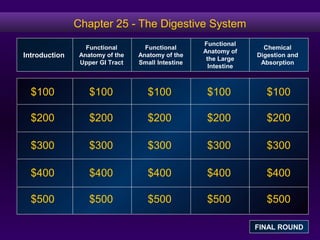
Chapter 25 - The Digestive System
$100
$200
$300
$400
$500
$100 $100$100 $100
$200 $200 $200 $200
$300 $300 $300 $300
$400 $400 $400 $400
$500 $500 $500 $500
Introduction
Functional
Anatomy of the
Upper GI Tract
Functional
Anatomy of the
Small Intestine
Functional
Anatomy of
the Large
Intestine
Chemical
Digestion and
Absorption
FINAL ROUND
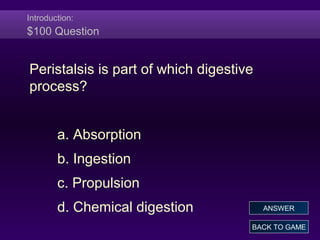
Introduction:
$100 Question
Peristalsis is part of which digestive
process?
a. Absorption
b. Ingestion
c. Propulsion
d. Chemical digestion
BACK TO GAME
ANSWER
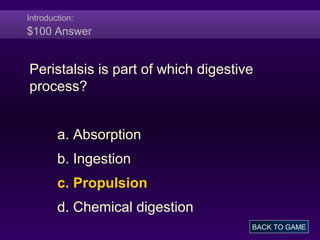
Introduction:
$100 Answer
Peristalsis is part of which digestive
process?
a. Absorption
b. Ingestion
c. Propulsion
d. Chemical digestion
BACK TO GAME
Introduction:
$200 Question
All of the following are part of the
alimentary canal except the:
a. pharynx.
b. esophagus.
c. small intestine.
d. liver.
BACK TO GAME
ANSWER
Introduction:
$200 Answer
All of the following are part of the
alimentary canal except the:
a. pharynx.
b. esophagus.
c. small intestine.
d. liver.
BACK TO GAME
Introduction:
$300 Question
Simple columnar epithelium is found in
which histological layer of the alimentary
canal?
a. Submucosa
b. Muscularis
c. Serosa
d. Mucosa
BACK TO GAME
ANSWER
Introduction:
$300 Answer
Simple columnar epithelium is found in
which histological layer of the alimentary
canal?
a. Submucosa
b. Muscularis
c. Serosa
d. Mucosa
BACK TO GAME
Introduction:
$400 Question
Which histological layer of the alimentary
canal is also known as the visceral
peritoneum?
a. Submucosa
b. Muscularis
c. Serosa
d. Mucosa
BACK TO GAME
ANSWER
Introduction:
$400 Answer
Which histological layer of the alimentary
canal is also known as the visceral
peritoneum?
a. Submucosa
b. Muscularis
c. Serosa
d. Mucosa
BACK TO GAME
Introduction:
$500 Question
The membrane that lines the body wall of
the abdominal cavity is the:
a. ventral mesentery.
b. visceral peritoneum.
c. parietal peritoneum.
d. retroperitoneum.
BACK TO GAME
ANSWER
Introduction:
$500 Answer
The membrane that lines the body wall of
the abdominal cavity is the:
a. ventral mesentery.
b. visceral peritoneum.
c. parietal peritoneum.
d. retroperitoneum.
BACK TO GAME
Functional Anatomy of the Upper GI Tract:
$100 Question
The teeth used to tear and pierce food are
the:
a. incisors.
b. molars.
c. canines.
d. premolars.
BACK TO GAME
ANSWER
Functional Anatomy of the Upper GI Tract:
$100 Answer
The teeth used to tear and pierce food are
the:
a. incisors.
b. molars.
c. canines.
d. premolars.
BACK TO GAME
Functional Anatomy of the Upper GI Tract:
$200 Question
The esophageal hiatus is found on this
organ.
a. Esophagus
b. Stomach
c. Diaphragm
d. Pharynx
BACK TO GAME
ANSWER
Functional Anatomy of the Upper GI Tract:
$200 Answer
The esophageal hiatus is found on this
organ.
a. Esophagus
b. Stomach
c. Diaphragm
d. Pharynx
BACK TO GAME
Functional Anatomy of the Upper GI Tract:
$300 Question
Saliva is composed mainly of:
a. water.
b. amylase.
c. lingual lipase.
d. mucin.
BACK TO GAME
ANSWER
Functional Anatomy of the Upper GI Tract:
$300 Answer
Saliva is composed mainly of:
a. water.
b. amylase.
c. lingual lipase.
d. mucin.
BACK TO GAME
Functional Anatomy of the Upper GI Tract:
$400 Question
Which of the following phases of gastric
secretion is a conditioned reflex?
a. Gastric phase
b. Cephalic phase
c. Intestinal phase
d. All three phases above are
conditioned reflexes.
BACK TO GAME
ANSWER
Functional Anatomy of the Upper GI Tract:
$400 Answer
Which of the following phases of gastric
secretion is a conditioned reflex?
a. Gastric phase
b. Cephalic phase
c. Intestinal phase
d. All three phases above are
conditioned reflexes.
BACK TO GAME
Functional Anatomy of the Upper GI Tract:
$500 Question
The gastric cells that secrete pepsinogen
are the:
a. mucous neck cells.
b. parietal cells.
c. chief cells.
d. enteroendocrine cells.
BACK TO GAME
ANSWER
Functional Anatomy of the Upper GI Tract:
$500 Answer
The gastric cells that secrete pepsinogen
are the:
a. mucous neck cells.
b. parietal cells.
c. chief cells.
d. enteroendocrine cells.
BACK TO GAME
Functional Anatomy of the Small Intestine:
$100 Question
Most of the digestive enzymes found in
the small intestine are secreted by this
accessory organ.
a. Liver
b. Gallbladder
c. Stomach
d. Pancreas
BACK TO GAME
ANSWER
Functional Anatomy of the Small Intestine:
$100 Answer
Most of the digestive enzymes found in
the small intestine are secreted by this
accessory organ.
a. Liver
b. Gallbladder
c. Stomach
d. Pancreas
BACK TO GAME
Functional Anatomy of the Small Intestine:
$200 Question
The fingerlike projections of the intestinal
mucosa are called:
a. rugae.
b. plicae circulares.
c. brush borders.
d. villi.
BACK TO GAME
ANSWER
Functional Anatomy of the Small Intestine:
$200 Answer
The fingerlike projections of the intestinal
mucosa are called:
a. rugae.
b. plicae circulares.
c. brush borders.
d. villi.
BACK TO GAME
Functional Anatomy of the Small Intestine:
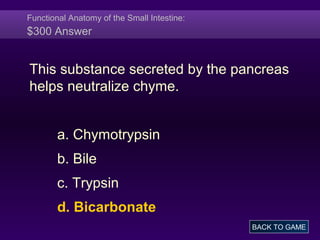
$300 Question
This substance secreted by the pancreas
helps neutralize chyme.
a. Chymotrypsin
b. Bile
c. Trypsin
d. Bicarbonate
BACK TO GAME
ANSWER
Functional Anatomy of the Small Intestine:
$300 Answer
This substance secreted by the pancreas
helps neutralize chyme.
a. Chymotrypsin
b. Bile
c. Trypsin
d. Bicarbonate
BACK TO GAME
Functional Anatomy of the Small Intestine:
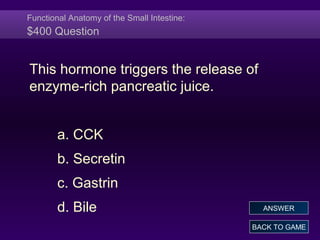
$400 Question
This hormone triggers the release of
enzyme-rich pancreatic juice.
a. CCK
b. Secretin
c. Gastrin
d. Bile
BACK TO GAME
ANSWER
Functional Anatomy of the Small Intestine:
$400 Answer
This hormone triggers the release of
enzyme-rich pancreatic juice.
a. CCK
b. Secretin
c. Gastrin
d. Bile
BACK TO GAME
Functional Anatomy of the Small Intestine:
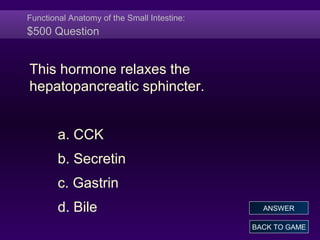
$500 Question
This hormone relaxes the
hepatopancreatic sphincter.
a. CCK
b. Secretin
c. Gastrin
d. Bile
BACK TO GAME
ANSWER
Functional Anatomy of the Small Intestine:
$500 Answer
This hormone relaxes the
hepatopancreatic sphincter.
a. CCK
b. Secretin
c. Gastrin
d. Bile
BACK TO GAME
Functional Anatomy of the Large Intestine:
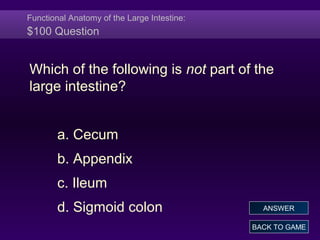
$100 Question
Which of the following is not part of the
large intestine?
a. Cecum
b. Appendix
c. Ileum
d. Sigmoid colon
BACK TO GAME
ANSWER
Functional Anatomy of the Large Intestine:
$100 Answer
Which of the following is not part of the
large intestine?
a. Cecum
b. Appendix
c. Ileum
d. Sigmoid colon
BACK TO GAME
Functional Anatomy of the Large Intestine:
$200 Question
The pocketlike sacs of the large intestine
are called:
a. teniae coli.
b. haustra.
c. epiploic appendages.
d. cecae.
BACK TO GAME
ANSWER
Functional Anatomy of the Large Intestine:
$200 Answer
The pocketlike sacs of the large intestine
are called:
a. teniae coli.
b. haustra.
c. epiploic appendages.
d. cecae.
BACK TO GAME
Functional Anatomy of the Large Intestine:
$300 Question
The functions of the large intestine include
all of the following except:
a. elimination of waste.
b. absorption of water and electrolytes.
c. absorption of nutrients.
d. production of vitamins.
BACK TO GAME
ANSWER
Functional Anatomy of the Large Intestine:
$300 Answer
The functions of the large intestine include
all of the following except:
a. elimination of waste.
b. absorption of water and electrolytes.
c. absorption of nutrients.
d. production of vitamins.
BACK TO GAME
Functional Anatomy of the Large Intestine:
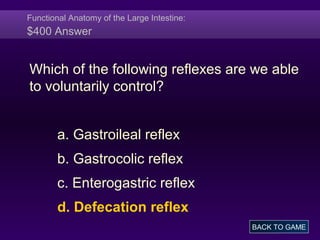
$400 Question
Which of the following reflexes are we able
to voluntarily control?
a. Gastroileal reflex
b. Gastrocolic reflex
c. Enterogastric reflex
d. Defecation reflex
BACK TO GAME
ANSWER
Functional Anatomy of the Large Intestine:
$400 Answer
Which of the following reflexes are we able
to voluntarily control?
a. Gastroileal reflex
b. Gastrocolic reflex
c. Enterogastric reflex
d. Defecation reflex
BACK TO GAME
Functional Anatomy of the Large Intestine:
$500 Question
Mass movement in the large intestine is
initiated by the:
a. gastroileal reflex.
b. gastrocolic reflex.
c. enterogastric reflex.
d. defecation reflex.
BACK TO GAME
ANSWER
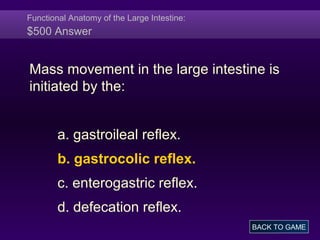
Functional Anatomy of the Large Intestine:
$500 Answer
Mass movement in the large intestine is
initiated by the:
a. gastroileal reflex.
b. gastrocolic reflex.
c. enterogastric reflex.
d. defecation reflex.
BACK TO GAME
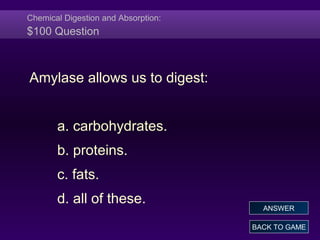
Chemical Digestion and Absorption:
$100 Question
Amylase allows us to digest:
a. carbohydrates.
b. proteins.
c. fats.
d. all of these.
BACK TO GAME
ANSWER
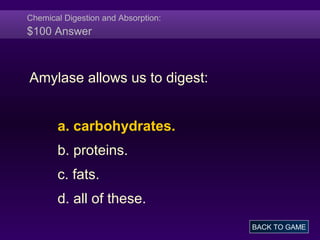
Chemical Digestion and Absorption:
$100 Answer
Amylase allows us to digest:
a. carbohydrates.
b. proteins.
c. fats.
d. all of these.
BACK TO GAME
Chemical Digestion and Absorption:
$200 Question
Which of the following enzymes is not
found in adults?
a. Carboxypolypeptidase
b. Lipase
c. Rennin
d. Chymotrypsin
BACK TO GAME
ANSWER
Chemical Digestion and Absorption:
$200 Answer
Which of the following enzymes is not
found in adults?
a. Carboxypolypeptidase
b. Lipase
c. Rennin
d. Chymotrypsin
BACK TO GAME
Chemical Digestion and Absorption:
$300 Question
Which of the following is not an enzyme?
a. Rennin
b. Lipase
c. Pepsin
d. Bile
BACK TO GAME
ANSWER
Chemical Digestion and Absorption:
$300 Answer
Which of the following is not an enzyme?
a. Rennin
b. Lipase
c. Pepsin
d. Bile
BACK TO GAME
Chemical Digestion and Absorption:
$400 Question
Which enzyme below digests
disaccharides into monosaccharides?
a. Rennin
b. Pepsin
c. Lipase
d. Sucrase
BACK TO GAME
ANSWER
Chemical Digestion and Absorption:
$400 Answer
Which enzyme below digests
disaccharides into monosaccharides?
a. Rennin
b. Pepsin
c. Lipase
d. Sucrase
BACK TO GAME
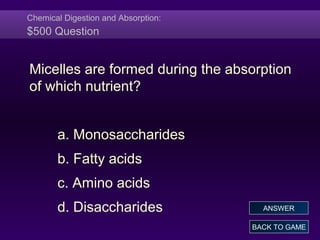
Chemical Digestion and Absorption:
$500 Question
Micelles are formed during the absorption
of which nutrient?
a. Monosaccharides
b. Fatty acids
c. Amino acids
d. Disaccharides
BACK TO GAME
ANSWER
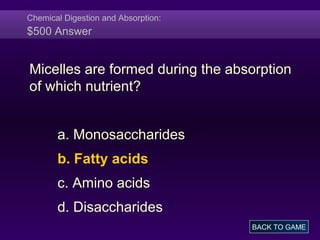
Chemical Digestion and Absorption:
$500 Answer
Micelles are formed during the absorption
of which nutrient?
a. Monosaccharides
b. Fatty acids
c. Amino acids
d. Disaccharides
BACK TO GAME
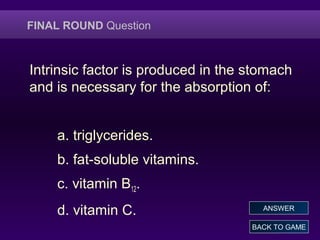
FINAL ROUND Question
Intrinsic factor is produced in the stomach
and is necessary for the absorption of:
a. triglycerides.
b. fat-soluble vitamins.
c. vitamin B12.
d. vitamin C.
BACK TO GAME
ANSWER
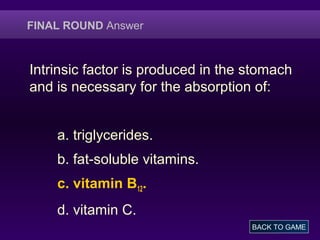
FINAL ROUND Answer
Intrinsic factor is produced in the stomach
and is necessary for the absorption of:
a. triglycerides.
b. fat-soluble vitamins.
c. vitamin B12.
d. vitamin C.
BACK TO GAME

Ch 25 quiz_show_game

  • 1.
    Chapter 25 -The Digestive System $100 $200 $300 $400 $500 $100 $100$100 $100 $200 $200 $200 $200 $300 $300 $300 $300 $400 $400 $400 $400 $500 $500 $500 $500 Introduction Functional Anatomy of the Upper GI Tract Functional Anatomy of the Small Intestine Functional Anatomy of the Large Intestine Chemical Digestion and Absorption FINAL ROUND
  • 2.
    Introduction: $100 Question Peristalsis ispart of which digestive process? a. Absorption b. Ingestion c. Propulsion d. Chemical digestion BACK TO GAME ANSWER
  • 3.
    Introduction: $100 Answer Peristalsis ispart of which digestive process? a. Absorption b. Ingestion c. Propulsion d. Chemical digestion BACK TO GAME
  • 4.
    Introduction: $200 Question All ofthe following are part of the alimentary canal except the: a. pharynx. b. esophagus. c. small intestine. d. liver. BACK TO GAME ANSWER
  • 5.
    Introduction: $200 Answer All ofthe following are part of the alimentary canal except the: a. pharynx. b. esophagus. c. small intestine. d. liver. BACK TO GAME
  • 6.
    Introduction: $300 Question Simple columnarepithelium is found in which histological layer of the alimentary canal? a. Submucosa b. Muscularis c. Serosa d. Mucosa BACK TO GAME ANSWER
  • 7.
    Introduction: $300 Answer Simple columnarepithelium is found in which histological layer of the alimentary canal? a. Submucosa b. Muscularis c. Serosa d. Mucosa BACK TO GAME
  • 8.
    Introduction: $400 Question Which histologicallayer of the alimentary canal is also known as the visceral peritoneum? a. Submucosa b. Muscularis c. Serosa d. Mucosa BACK TO GAME ANSWER
  • 9.
    Introduction: $400 Answer Which histologicallayer of the alimentary canal is also known as the visceral peritoneum? a. Submucosa b. Muscularis c. Serosa d. Mucosa BACK TO GAME
  • 10.
    Introduction: $500 Question The membranethat lines the body wall of the abdominal cavity is the: a. ventral mesentery. b. visceral peritoneum. c. parietal peritoneum. d. retroperitoneum. BACK TO GAME ANSWER
  • 11.
    Introduction: $500 Answer The membranethat lines the body wall of the abdominal cavity is the: a. ventral mesentery. b. visceral peritoneum. c. parietal peritoneum. d. retroperitoneum. BACK TO GAME
  • 12.
    Functional Anatomy ofthe Upper GI Tract: $100 Question The teeth used to tear and pierce food are the: a. incisors. b. molars. c. canines. d. premolars. BACK TO GAME ANSWER
  • 13.
    Functional Anatomy ofthe Upper GI Tract: $100 Answer The teeth used to tear and pierce food are the: a. incisors. b. molars. c. canines. d. premolars. BACK TO GAME
  • 14.
    Functional Anatomy ofthe Upper GI Tract: $200 Question The esophageal hiatus is found on this organ. a. Esophagus b. Stomach c. Diaphragm d. Pharynx BACK TO GAME ANSWER
  • 15.
    Functional Anatomy ofthe Upper GI Tract: $200 Answer The esophageal hiatus is found on this organ. a. Esophagus b. Stomach c. Diaphragm d. Pharynx BACK TO GAME
  • 16.
    Functional Anatomy ofthe Upper GI Tract: $300 Question Saliva is composed mainly of: a. water. b. amylase. c. lingual lipase. d. mucin. BACK TO GAME ANSWER
  • 17.
    Functional Anatomy ofthe Upper GI Tract: $300 Answer Saliva is composed mainly of: a. water. b. amylase. c. lingual lipase. d. mucin. BACK TO GAME
  • 18.
    Functional Anatomy ofthe Upper GI Tract: $400 Question Which of the following phases of gastric secretion is a conditioned reflex? a. Gastric phase b. Cephalic phase c. Intestinal phase d. All three phases above are conditioned reflexes. BACK TO GAME ANSWER
  • 19.
    Functional Anatomy ofthe Upper GI Tract: $400 Answer Which of the following phases of gastric secretion is a conditioned reflex? a. Gastric phase b. Cephalic phase c. Intestinal phase d. All three phases above are conditioned reflexes. BACK TO GAME
  • 20.
    Functional Anatomy ofthe Upper GI Tract: $500 Question The gastric cells that secrete pepsinogen are the: a. mucous neck cells. b. parietal cells. c. chief cells. d. enteroendocrine cells. BACK TO GAME ANSWER
  • 21.
    Functional Anatomy ofthe Upper GI Tract: $500 Answer The gastric cells that secrete pepsinogen are the: a. mucous neck cells. b. parietal cells. c. chief cells. d. enteroendocrine cells. BACK TO GAME
  • 22.
    Functional Anatomy ofthe Small Intestine: $100 Question Most of the digestive enzymes found in the small intestine are secreted by this accessory organ. a. Liver b. Gallbladder c. Stomach d. Pancreas BACK TO GAME ANSWER
  • 23.
    Functional Anatomy ofthe Small Intestine: $100 Answer Most of the digestive enzymes found in the small intestine are secreted by this accessory organ. a. Liver b. Gallbladder c. Stomach d. Pancreas BACK TO GAME
  • 24.
    Functional Anatomy ofthe Small Intestine: $200 Question The fingerlike projections of the intestinal mucosa are called: a. rugae. b. plicae circulares. c. brush borders. d. villi. BACK TO GAME ANSWER
  • 25.
    Functional Anatomy ofthe Small Intestine: $200 Answer The fingerlike projections of the intestinal mucosa are called: a. rugae. b. plicae circulares. c. brush borders. d. villi. BACK TO GAME
  • 26.
    Functional Anatomy ofthe Small Intestine: $300 Question This substance secreted by the pancreas helps neutralize chyme. a. Chymotrypsin b. Bile c. Trypsin d. Bicarbonate BACK TO GAME ANSWER
  • 27.
    Functional Anatomy ofthe Small Intestine: $300 Answer This substance secreted by the pancreas helps neutralize chyme. a. Chymotrypsin b. Bile c. Trypsin d. Bicarbonate BACK TO GAME
  • 28.
    Functional Anatomy ofthe Small Intestine: $400 Question This hormone triggers the release of enzyme-rich pancreatic juice. a. CCK b. Secretin c. Gastrin d. Bile BACK TO GAME ANSWER
  • 29.
    Functional Anatomy ofthe Small Intestine: $400 Answer This hormone triggers the release of enzyme-rich pancreatic juice. a. CCK b. Secretin c. Gastrin d. Bile BACK TO GAME
  • 30.
    Functional Anatomy ofthe Small Intestine: $500 Question This hormone relaxes the hepatopancreatic sphincter. a. CCK b. Secretin c. Gastrin d. Bile BACK TO GAME ANSWER
  • 31.
    Functional Anatomy ofthe Small Intestine: $500 Answer This hormone relaxes the hepatopancreatic sphincter. a. CCK b. Secretin c. Gastrin d. Bile BACK TO GAME
  • 32.
    Functional Anatomy ofthe Large Intestine: $100 Question Which of the following is not part of the large intestine? a. Cecum b. Appendix c. Ileum d. Sigmoid colon BACK TO GAME ANSWER
  • 33.
    Functional Anatomy ofthe Large Intestine: $100 Answer Which of the following is not part of the large intestine? a. Cecum b. Appendix c. Ileum d. Sigmoid colon BACK TO GAME
  • 34.
    Functional Anatomy ofthe Large Intestine: $200 Question The pocketlike sacs of the large intestine are called: a. teniae coli. b. haustra. c. epiploic appendages. d. cecae. BACK TO GAME ANSWER
  • 35.
    Functional Anatomy ofthe Large Intestine: $200 Answer The pocketlike sacs of the large intestine are called: a. teniae coli. b. haustra. c. epiploic appendages. d. cecae. BACK TO GAME
  • 36.
    Functional Anatomy ofthe Large Intestine: $300 Question The functions of the large intestine include all of the following except: a. elimination of waste. b. absorption of water and electrolytes. c. absorption of nutrients. d. production of vitamins. BACK TO GAME ANSWER
  • 37.
    Functional Anatomy ofthe Large Intestine: $300 Answer The functions of the large intestine include all of the following except: a. elimination of waste. b. absorption of water and electrolytes. c. absorption of nutrients. d. production of vitamins. BACK TO GAME
  • 38.
    Functional Anatomy ofthe Large Intestine: $400 Question Which of the following reflexes are we able to voluntarily control? a. Gastroileal reflex b. Gastrocolic reflex c. Enterogastric reflex d. Defecation reflex BACK TO GAME ANSWER
  • 39.
    Functional Anatomy ofthe Large Intestine: $400 Answer Which of the following reflexes are we able to voluntarily control? a. Gastroileal reflex b. Gastrocolic reflex c. Enterogastric reflex d. Defecation reflex BACK TO GAME
  • 40.
    Functional Anatomy ofthe Large Intestine: $500 Question Mass movement in the large intestine is initiated by the: a. gastroileal reflex. b. gastrocolic reflex. c. enterogastric reflex. d. defecation reflex. BACK TO GAME ANSWER
  • 41.
    Functional Anatomy ofthe Large Intestine: $500 Answer Mass movement in the large intestine is initiated by the: a. gastroileal reflex. b. gastrocolic reflex. c. enterogastric reflex. d. defecation reflex. BACK TO GAME
  • 42.
    Chemical Digestion andAbsorption: $100 Question Amylase allows us to digest: a. carbohydrates. b. proteins. c. fats. d. all of these. BACK TO GAME ANSWER
  • 43.
    Chemical Digestion andAbsorption: $100 Answer Amylase allows us to digest: a. carbohydrates. b. proteins. c. fats. d. all of these. BACK TO GAME
  • 44.
    Chemical Digestion andAbsorption: $200 Question Which of the following enzymes is not found in adults? a. Carboxypolypeptidase b. Lipase c. Rennin d. Chymotrypsin BACK TO GAME ANSWER
  • 45.
    Chemical Digestion andAbsorption: $200 Answer Which of the following enzymes is not found in adults? a. Carboxypolypeptidase b. Lipase c. Rennin d. Chymotrypsin BACK TO GAME
  • 46.
    Chemical Digestion andAbsorption: $300 Question Which of the following is not an enzyme? a. Rennin b. Lipase c. Pepsin d. Bile BACK TO GAME ANSWER
  • 47.
    Chemical Digestion andAbsorption: $300 Answer Which of the following is not an enzyme? a. Rennin b. Lipase c. Pepsin d. Bile BACK TO GAME
  • 48.
    Chemical Digestion andAbsorption: $400 Question Which enzyme below digests disaccharides into monosaccharides? a. Rennin b. Pepsin c. Lipase d. Sucrase BACK TO GAME ANSWER
  • 49.
    Chemical Digestion andAbsorption: $400 Answer Which enzyme below digests disaccharides into monosaccharides? a. Rennin b. Pepsin c. Lipase d. Sucrase BACK TO GAME
  • 50.
    Chemical Digestion andAbsorption: $500 Question Micelles are formed during the absorption of which nutrient? a. Monosaccharides b. Fatty acids c. Amino acids d. Disaccharides BACK TO GAME ANSWER
  • 51.
    Chemical Digestion andAbsorption: $500 Answer Micelles are formed during the absorption of which nutrient? a. Monosaccharides b. Fatty acids c. Amino acids d. Disaccharides BACK TO GAME
  • 52.
    FINAL ROUND Question Intrinsicfactor is produced in the stomach and is necessary for the absorption of: a. triglycerides. b. fat-soluble vitamins. c. vitamin B12. d. vitamin C. BACK TO GAME ANSWER
  • 53.
    FINAL ROUND Answer Intrinsicfactor is produced in the stomach and is necessary for the absorption of: a. triglycerides. b. fat-soluble vitamins. c. vitamin B12. d. vitamin C. BACK TO GAME