IMMUNOLOGY
Edsan Colin V. Santander
IMMUNE SYSTEM
- It is a host defense system comprising many
biological structures and processes within
an organism that protects against disease.
- To function properly, an immune system must detect a
wide variety of agents, known as pathogens,
from viruses to parasitic worms,
and distinguish them from the organism's own
healthy tissue.
- In many species, the immune system can be
classified into subsystems, such as the innate
immune system versus the adaptive immune
system
INNATE IMMUNE SYSTEM
 is made of defenses against infection that can be
activated immediately once a pathogen attacks.
The innate immune system is essentially made up
of barriers that aim to keep viruses, bacteria,
parasites, and other foreign particles out of your
body or limit their ability to spread and move
throughout the body.
THE INNATE IMMUNE SYSTEM INCLUDES:
 Physical Barriers - such as skin, the gastrointestinal
tract, the respiratory tract, the nasopharynx, cilia,
eyelashes and other body hair.
 Defense Mechanisms - such as secretions,
mucous, bile, gastric acid, saliva, tears, and sweat.
 General Immune Responses - such as
inflammation, complement, and non-specific cellular
responses. The inflammatory response actively
brings immune cells to the site of an infection by
increasing blood flow to the area.
 The innate immune system is always general,
or nonspecific, meaning anything that is identified
as foreign or non-self is a target for the innate
immune response. The innate immune system is
activated by the presence of antigens and their
chemical properties.
CELLS OF THE INNATE IMMUNE SYSTEM
 There are many types of white blood cells,
or leukocytes, that work to defend and protect the
human body. In order to patrol the entire body,
leukocytes travel by way of the circulatory system.
 The following cells are leukocytes of the innate
immune system:
PHAGOCYTES, OR PHAGOCYTIC CELLS:
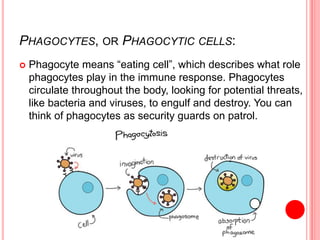
 Phagocyte means “eating cell”, which describes what role
phagocytes play in the immune response. Phagocytes
circulate throughout the body, looking for potential threats,
like bacteria and viruses, to engulf and destroy. You can
think of phagocytes as security guards on patrol.
MACROPHAGES:
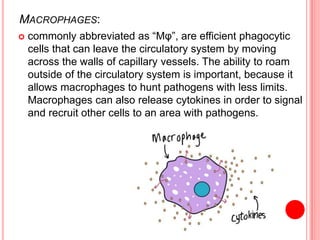
 commonly abbreviated as “Mφ”, are efficient phagocytic
cells that can leave the circulatory system by moving
across the walls of capillary vessels. The ability to roam
outside of the circulatory system is important, because it
allows macrophages to hunt pathogens with less limits.
Macrophages can also release cytokines in order to signal
and recruit other cells to an area with pathogens.
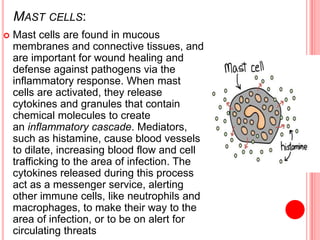
MAST CELLS:
 Mast cells are found in mucous
membranes and connective tissues, and
are important for wound healing and
defense against pathogens via the
inflammatory response. When mast
cells are activated, they release
cytokines and granules that contain
chemical molecules to create
an inflammatory cascade. Mediators,
such as histamine, cause blood vessels
to dilate, increasing blood flow and cell
trafficking to the area of infection. The
cytokines released during this process
act as a messenger service, alerting
other immune cells, like neutrophils and
macrophages, to make their way to the
area of infection, or to be on alert for
circulating threats
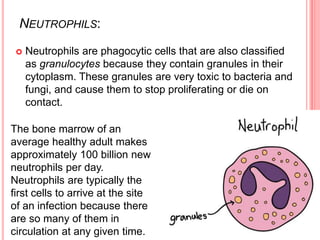
NEUTROPHILS:
 Neutrophils are phagocytic cells that are also classified
as granulocytes because they contain granules in their
cytoplasm. These granules are very toxic to bacteria and
fungi, and cause them to stop proliferating or die on
contact.
The bone marrow of an
average healthy adult makes
approximately 100 billion new
neutrophils per day.
Neutrophils are typically the
first cells to arrive at the site
of an infection because there
are so many of them in
circulation at any given time.
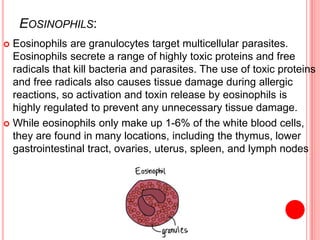
EOSINOPHILS:
 Eosinophils are granulocytes target multicellular parasites.
Eosinophils secrete a range of highly toxic proteins and free
radicals that kill bacteria and parasites. The use of toxic proteins
and free radicals also causes tissue damage during allergic
reactions, so activation and toxin release by eosinophils is
highly regulated to prevent any unnecessary tissue damage.
 While eosinophils only make up 1-6% of the white blood cells,
they are found in many locations, including the thymus, lower
gastrointestinal tract, ovaries, uterus, spleen, and lymph nodes
 Basophils:
Basophils are also granulocytes that attack multicellular
parasites. Basophils release histamine, much like mast
cells. The use of histamine makes basophils and mast
cells key players in mounting an allergic response.
 Natural Killer cells:
Natural Killer cells (NK cells), do not attack pathogens
directly. Instead, natural killer cells destroy infected host
cells in order to stop the spread of an infection. Infected
or compromised host cells can signal natural kill cells
for destruction through the expression of specific
receptors and antigen presentation.
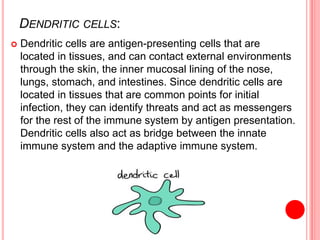
DENDRITIC CELLS:
 Dendritic cells are antigen-presenting cells that are
located in tissues, and can contact external environments
through the skin, the inner mucosal lining of the nose,
lungs, stomach, and intestines. Since dendritic cells are
located in tissues that are common points for initial
infection, they can identify threats and act as messengers
for the rest of the immune system by antigen presentation.
Dendritic cells also act as bridge between the innate
immune system and the adaptive immune system.
ADAPTIVE IMMUNITY
 The adaptive immune system, also called acquired
immunity, uses specific antigens to strategically mount an
immune response. Unlike the innate immune system,
which attacks only based on the identification of general
threats, the adaptive immunity is activated by exposure to
pathogens, and uses an immunological memory to learn
about the threat and enhance the immune response
accordingly. The adaptive immune response is much
slower to respond to threats and infections than the
innate immune response, which is primed and ready to
fight at all times.
ACTIVE IMMUNITY
 Activity immunity comes from exposure to a
pathogen. Surface markers on the pathogen
surface act as antigens, which are binding sites
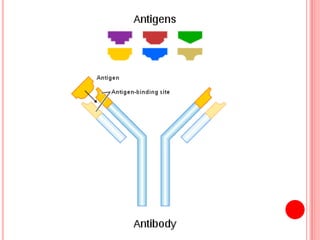
for antibodies. Antibodies are Y-shaped protein
molecules, which can exist on their own or attached
to the membrane of special cells. The body doesn't
keep a store of antibodies on hand to take down an
infection immediately. A process called clonal
selection and expansion builds up sufficient
antibodies.
HUMORAL IMMUNITY
 Humoral immunity is immunity from serum
antibodies produced by plasma cells. More
specifically, someone who has never been exposed
to a specific disease can gain humoral immunity
through administration of antibodies from someone
who has been exposed, and survived the same
disease. “Humoral” refers to the bodily fluids where
these free-floating serum antibodies bind to
antigens and assist with elimination.
CELL-MEDIATED IMMUNITY
 Cell-mediated immunity can be acquired through
T cells from someone who is immune to the target
disease or infection. “Cell-mediated” refers to the
fact that the response is carried out by cytotoxic
cells. Much like humoral immunity, someone who
has not been exposed to a specific disease can
gain cell-mediated immunity through the
administration of T​H and TC, end subscript cells
from someone that has been exposed, and
survived the same disease.
PASSIVE IMMUNITY
 Passive immunity doesn't require the body to make
antibodies to antigens. The antibodies are
introduced from outside the organism.
CELLS OF THE ADAPTIVE IMMUNE SYSTEM
 the adaptive immune system relies on fewer types
of cells to carry out its tasks: B cells and T cells.
 Both B cells and T cells are lymphocytes that are
derived from specific types of stem cells, called
multipotent hematopoietic stem cells, in the bone
marrow. After they are made in the bone marrow,
they need to mature and become activated. Each
type of cell follows different paths to their final,
mature forms.
B CELLS
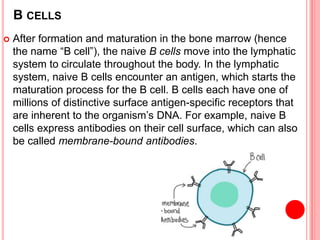
 After formation and maturation in the bone marrow (hence
the name “B cell”), the naive B cells move into the lymphatic
system to circulate throughout the body. In the lymphatic
system, naive B cells encounter an antigen, which starts the
maturation process for the B cell. B cells each have one of
millions of distinctive surface antigen-specific receptors that
are inherent to the organism’s DNA. For example, naive B
cells express antibodies on their cell surface, which can also
be called membrane-bound antibodies.
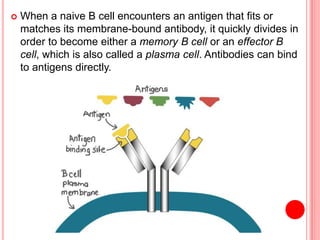
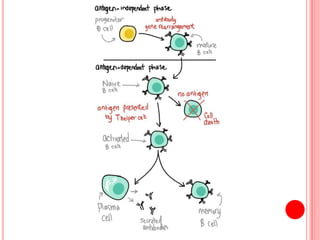
 When a naive B cell encounters an antigen that fits or
matches its membrane-bound antibody, it quickly divides in
order to become either a memory B cell or an effector B
cell, which is also called a plasma cell. Antibodies can bind
to antigens directly.
 Plasma B cells produce the same antibody as the
parent B cell, but they aren’t membrane bound.
Instead, plasma B cells can secrete antibodies.
 Memory B cells are a B cell sub-type that are
formed within germinal centers following primary
infection and are important in generating an
accelerated and more robust antibody-mediated
immune response in the case of re-infection
T CELLS
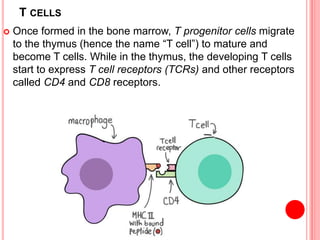
 Once formed in the bone marrow, T progenitor cells migrate
to the thymus (hence the name “T cell”) to mature and
become T cells. While in the thymus, the developing T cells
start to express T cell receptors (TCRs) and other receptors
called CD4 and CD8 receptors.
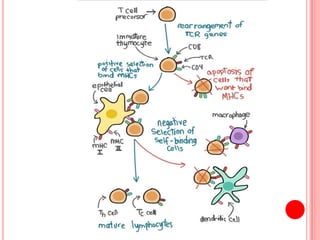
In order to make sure T cells will perform properly
once they have matured and have been released
from the thymus, they undergo two selection
processes:
 Positive selection ensures MHC restriction by
testing the ability of MHCI and MHCII to distinguish
between self and nonself proteins.
 Negative selection tests for self tolerance. Negative
selection tests the binding capabilities of CD4 and
CD8 specifically.
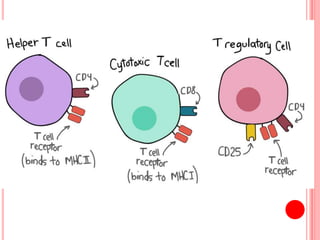
we are left with three types of mature T cells: Helper T
cells, Cytotoxic T cells, and T regulatory cells.
 Helper T cells express CD4, and help with the activation
of, B cells, and other immune cells.
 Cytotoxic T cells express CD8, and are responsible for
removing pathogens and infected host cells.
 T regulatory cells express CD4 and another receptor,
called CD25. T regulatory cells help distinguish between
self and nonself molecules, and by doing so, reduce the
risk of autoimmune diseases.
ANTIGENS
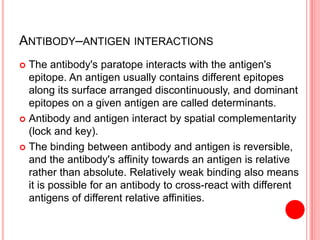
 antigens (Ag) are structures (aka substances)
specifically bound by antibodies (Ab) or a cell surface
version of Ab ~ B cell antigen receptor (BCR).
 Antigens are "targeted" by antibodies. Each antibody is
specifically produced by the immune system to match
an antigen after cells in the immune system
come into contact with it; this allows a precise
identification or matching of the antigen and the
initiation of a tailored response.
ANTIBODY
 Antibody (Ab), also known as an immunoglobulin (Ig), is
a large, Y-shaped protein produced mainly by plasma
cells that is used by the immune system to
neutralize pathogens such as pathogenic
bacteria and viruses.
 Each tip of the "Y" of an antibody contains
a paratope (analogous to a lock) that is specific for one
particular epitope (similarly, analogous to a key) on an
antigen, allowing these two structures to bind together
with precision.
ANTIBODY–ANTIGEN INTERACTIONS
 The antibody's paratope interacts with the antigen's
epitope. An antigen usually contains different epitopes
along its surface arranged discontinuously, and dominant
epitopes on a given antigen are called determinants.
 Antibody and antigen interact by spatial complementarity
(lock and key).
 The binding between antibody and antigen is reversible,
and the antibody's affinity towards an antigen is relative
rather than absolute. Relatively weak binding also means
it is possible for an antibody to cross-react with different
antigens of different relative affinities.
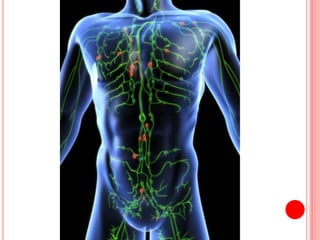
LYMPHATIC SYSTEM
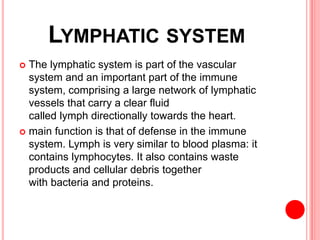
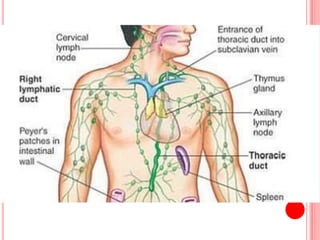
 The lymphatic system is part of the vascular
system and an important part of the immune
system, comprising a large network of lymphatic
vessels that carry a clear fluid
called lymph directionally towards the heart.
 main function is that of defense in the immune
system. Lymph is very similar to blood plasma: it
contains lymphocytes. It also contains waste
products and cellular debris together
with bacteria and proteins.
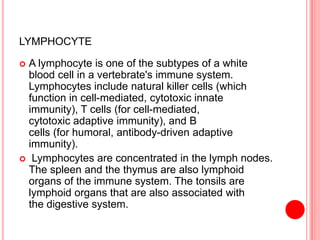
LYMPHOCYTE
 A lymphocyte is one of the subtypes of a white
blood cell in a vertebrate's immune system.
Lymphocytes include natural killer cells (which
function in cell-mediated, cytotoxic innate
immunity), T cells (for cell-mediated,
cytotoxic adaptive immunity), and B
cells (for humoral, antibody-driven adaptive
immunity).
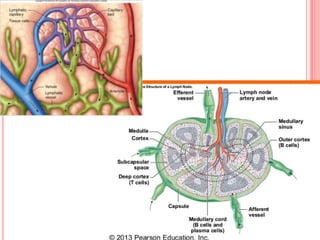
 Lymphocytes are concentrated in the lymph nodes.
The spleen and the thymus are also lymphoid
organs of the immune system. The tonsils are
lymphoid organs that are also associated with
the digestive system.
ALLERGIES
 Allergies, also known as allergic diseases, are a number
of conditions caused by hypersensitivity of the immune
system to typically harmless substances in the
environment.
 The underlying mechanism involves immunoglobulin E
antibodies (IgE), part of the body's immune system,
binding to an allergen and then to a receptor on mast
cells or basophils where it triggers the release of
inflammatory chemicals such as histamine.
Thank You
!!!

Immunology

  • 1.
  • 2.
    IMMUNE SYSTEM - Itis a host defense system comprising many biological structures and processes within an organism that protects against disease. - To function properly, an immune system must detect a wide variety of agents, known as pathogens, from viruses to parasitic worms, and distinguish them from the organism's own healthy tissue. - In many species, the immune system can be classified into subsystems, such as the innate immune system versus the adaptive immune system
  • 3.
    INNATE IMMUNE SYSTEM is made of defenses against infection that can be activated immediately once a pathogen attacks. The innate immune system is essentially made up of barriers that aim to keep viruses, bacteria, parasites, and other foreign particles out of your body or limit their ability to spread and move throughout the body.
  • 4.
    THE INNATE IMMUNESYSTEM INCLUDES:  Physical Barriers - such as skin, the gastrointestinal tract, the respiratory tract, the nasopharynx, cilia, eyelashes and other body hair.  Defense Mechanisms - such as secretions, mucous, bile, gastric acid, saliva, tears, and sweat.  General Immune Responses - such as inflammation, complement, and non-specific cellular responses. The inflammatory response actively brings immune cells to the site of an infection by increasing blood flow to the area.
  • 5.
     The innateimmune system is always general, or nonspecific, meaning anything that is identified as foreign or non-self is a target for the innate immune response. The innate immune system is activated by the presence of antigens and their chemical properties.
  • 6.
    CELLS OF THEINNATE IMMUNE SYSTEM  There are many types of white blood cells, or leukocytes, that work to defend and protect the human body. In order to patrol the entire body, leukocytes travel by way of the circulatory system.  The following cells are leukocytes of the innate immune system:
  • 7.
    PHAGOCYTES, OR PHAGOCYTICCELLS:  Phagocyte means “eating cell”, which describes what role phagocytes play in the immune response. Phagocytes circulate throughout the body, looking for potential threats, like bacteria and viruses, to engulf and destroy. You can think of phagocytes as security guards on patrol.
  • 8.
    MACROPHAGES:  commonly abbreviatedas “Mφ”, are efficient phagocytic cells that can leave the circulatory system by moving across the walls of capillary vessels. The ability to roam outside of the circulatory system is important, because it allows macrophages to hunt pathogens with less limits. Macrophages can also release cytokines in order to signal and recruit other cells to an area with pathogens.
  • 9.
    MAST CELLS:  Mastcells are found in mucous membranes and connective tissues, and are important for wound healing and defense against pathogens via the inflammatory response. When mast cells are activated, they release cytokines and granules that contain chemical molecules to create an inflammatory cascade. Mediators, such as histamine, cause blood vessels to dilate, increasing blood flow and cell trafficking to the area of infection. The cytokines released during this process act as a messenger service, alerting other immune cells, like neutrophils and macrophages, to make their way to the area of infection, or to be on alert for circulating threats
  • 10.
    NEUTROPHILS:  Neutrophils arephagocytic cells that are also classified as granulocytes because they contain granules in their cytoplasm. These granules are very toxic to bacteria and fungi, and cause them to stop proliferating or die on contact. The bone marrow of an average healthy adult makes approximately 100 billion new neutrophils per day. Neutrophils are typically the first cells to arrive at the site of an infection because there are so many of them in circulation at any given time.
  • 11.
    EOSINOPHILS:  Eosinophils aregranulocytes target multicellular parasites. Eosinophils secrete a range of highly toxic proteins and free radicals that kill bacteria and parasites. The use of toxic proteins and free radicals also causes tissue damage during allergic reactions, so activation and toxin release by eosinophils is highly regulated to prevent any unnecessary tissue damage.  While eosinophils only make up 1-6% of the white blood cells, they are found in many locations, including the thymus, lower gastrointestinal tract, ovaries, uterus, spleen, and lymph nodes
  • 12.
     Basophils: Basophils arealso granulocytes that attack multicellular parasites. Basophils release histamine, much like mast cells. The use of histamine makes basophils and mast cells key players in mounting an allergic response.  Natural Killer cells: Natural Killer cells (NK cells), do not attack pathogens directly. Instead, natural killer cells destroy infected host cells in order to stop the spread of an infection. Infected or compromised host cells can signal natural kill cells for destruction through the expression of specific receptors and antigen presentation.
  • 13.
    DENDRITIC CELLS:  Dendriticcells are antigen-presenting cells that are located in tissues, and can contact external environments through the skin, the inner mucosal lining of the nose, lungs, stomach, and intestines. Since dendritic cells are located in tissues that are common points for initial infection, they can identify threats and act as messengers for the rest of the immune system by antigen presentation. Dendritic cells also act as bridge between the innate immune system and the adaptive immune system.
  • 14.
    ADAPTIVE IMMUNITY  Theadaptive immune system, also called acquired immunity, uses specific antigens to strategically mount an immune response. Unlike the innate immune system, which attacks only based on the identification of general threats, the adaptive immunity is activated by exposure to pathogens, and uses an immunological memory to learn about the threat and enhance the immune response accordingly. The adaptive immune response is much slower to respond to threats and infections than the innate immune response, which is primed and ready to fight at all times.
  • 15.
    ACTIVE IMMUNITY  Activityimmunity comes from exposure to a pathogen. Surface markers on the pathogen surface act as antigens, which are binding sites for antibodies. Antibodies are Y-shaped protein molecules, which can exist on their own or attached to the membrane of special cells. The body doesn't keep a store of antibodies on hand to take down an infection immediately. A process called clonal selection and expansion builds up sufficient antibodies.
  • 16.
    HUMORAL IMMUNITY  Humoralimmunity is immunity from serum antibodies produced by plasma cells. More specifically, someone who has never been exposed to a specific disease can gain humoral immunity through administration of antibodies from someone who has been exposed, and survived the same disease. “Humoral” refers to the bodily fluids where these free-floating serum antibodies bind to antigens and assist with elimination.
  • 17.
    CELL-MEDIATED IMMUNITY  Cell-mediatedimmunity can be acquired through T cells from someone who is immune to the target disease or infection. “Cell-mediated” refers to the fact that the response is carried out by cytotoxic cells. Much like humoral immunity, someone who has not been exposed to a specific disease can gain cell-mediated immunity through the administration of T​H and TC, end subscript cells from someone that has been exposed, and survived the same disease.
  • 18.
    PASSIVE IMMUNITY  Passiveimmunity doesn't require the body to make antibodies to antigens. The antibodies are introduced from outside the organism.
  • 19.
    CELLS OF THEADAPTIVE IMMUNE SYSTEM  the adaptive immune system relies on fewer types of cells to carry out its tasks: B cells and T cells.  Both B cells and T cells are lymphocytes that are derived from specific types of stem cells, called multipotent hematopoietic stem cells, in the bone marrow. After they are made in the bone marrow, they need to mature and become activated. Each type of cell follows different paths to their final, mature forms.
  • 20.
    B CELLS  Afterformation and maturation in the bone marrow (hence the name “B cell”), the naive B cells move into the lymphatic system to circulate throughout the body. In the lymphatic system, naive B cells encounter an antigen, which starts the maturation process for the B cell. B cells each have one of millions of distinctive surface antigen-specific receptors that are inherent to the organism’s DNA. For example, naive B cells express antibodies on their cell surface, which can also be called membrane-bound antibodies.
  • 21.
     When anaive B cell encounters an antigen that fits or matches its membrane-bound antibody, it quickly divides in order to become either a memory B cell or an effector B cell, which is also called a plasma cell. Antibodies can bind to antigens directly.
  • 23.
     Plasma Bcells produce the same antibody as the parent B cell, but they aren’t membrane bound. Instead, plasma B cells can secrete antibodies.  Memory B cells are a B cell sub-type that are formed within germinal centers following primary infection and are important in generating an accelerated and more robust antibody-mediated immune response in the case of re-infection
  • 24.
    T CELLS  Onceformed in the bone marrow, T progenitor cells migrate to the thymus (hence the name “T cell”) to mature and become T cells. While in the thymus, the developing T cells start to express T cell receptors (TCRs) and other receptors called CD4 and CD8 receptors.
  • 25.
    In order tomake sure T cells will perform properly once they have matured and have been released from the thymus, they undergo two selection processes:  Positive selection ensures MHC restriction by testing the ability of MHCI and MHCII to distinguish between self and nonself proteins.  Negative selection tests for self tolerance. Negative selection tests the binding capabilities of CD4 and CD8 specifically.
  • 27.
    we are leftwith three types of mature T cells: Helper T cells, Cytotoxic T cells, and T regulatory cells.  Helper T cells express CD4, and help with the activation of, B cells, and other immune cells.  Cytotoxic T cells express CD8, and are responsible for removing pathogens and infected host cells.  T regulatory cells express CD4 and another receptor, called CD25. T regulatory cells help distinguish between self and nonself molecules, and by doing so, reduce the risk of autoimmune diseases.
  • 29.
    ANTIGENS  antigens (Ag)are structures (aka substances) specifically bound by antibodies (Ab) or a cell surface version of Ab ~ B cell antigen receptor (BCR).  Antigens are "targeted" by antibodies. Each antibody is specifically produced by the immune system to match an antigen after cells in the immune system come into contact with it; this allows a precise identification or matching of the antigen and the initiation of a tailored response.
  • 31.
    ANTIBODY  Antibody (Ab),also known as an immunoglobulin (Ig), is a large, Y-shaped protein produced mainly by plasma cells that is used by the immune system to neutralize pathogens such as pathogenic bacteria and viruses.  Each tip of the "Y" of an antibody contains a paratope (analogous to a lock) that is specific for one particular epitope (similarly, analogous to a key) on an antigen, allowing these two structures to bind together with precision.
  • 32.
    ANTIBODY–ANTIGEN INTERACTIONS  Theantibody's paratope interacts with the antigen's epitope. An antigen usually contains different epitopes along its surface arranged discontinuously, and dominant epitopes on a given antigen are called determinants.  Antibody and antigen interact by spatial complementarity (lock and key).  The binding between antibody and antigen is reversible, and the antibody's affinity towards an antigen is relative rather than absolute. Relatively weak binding also means it is possible for an antibody to cross-react with different antigens of different relative affinities.
  • 34.
    LYMPHATIC SYSTEM  Thelymphatic system is part of the vascular system and an important part of the immune system, comprising a large network of lymphatic vessels that carry a clear fluid called lymph directionally towards the heart.  main function is that of defense in the immune system. Lymph is very similar to blood plasma: it contains lymphocytes. It also contains waste products and cellular debris together with bacteria and proteins.
  • 36.
    LYMPHOCYTE  A lymphocyteis one of the subtypes of a white blood cell in a vertebrate's immune system. Lymphocytes include natural killer cells (which function in cell-mediated, cytotoxic innate immunity), T cells (for cell-mediated, cytotoxic adaptive immunity), and B cells (for humoral, antibody-driven adaptive immunity).  Lymphocytes are concentrated in the lymph nodes. The spleen and the thymus are also lymphoid organs of the immune system. The tonsils are lymphoid organs that are also associated with the digestive system.
  • 39.
    ALLERGIES  Allergies, alsoknown as allergic diseases, are a number of conditions caused by hypersensitivity of the immune system to typically harmless substances in the environment.  The underlying mechanism involves immunoglobulin E antibodies (IgE), part of the body's immune system, binding to an allergen and then to a receptor on mast cells or basophils where it triggers the release of inflammatory chemicals such as histamine.
  • 40.