Bradley W. Christian, McLennan Community College
© 2016 Pearson Education, Inc.
$200
$100
$300
$400
$500
$100
$200
$300
$400
$500
$100
$200
$300
$400
$500
$100
$200
$300
$400
$500
$100
$200
$300
$400
$500
Chapter 15: Microbial Mechanisms of Pathogenicity
Portals of
Entry
Bacterial
Pathogens
Viral
Pathogens
Portals of
Exit
Eukaryotic
Pathogens
FINAL ROUND
© 2016 Pearson Education, Inc.
Topic 1: Portals of Entry
$100 Question
The easiest and MOST frequently traveled portal
of entry for infectious microorganisms is the
a. parenteral route.
b. respiratory tract.
c. gastrointestinal tract.
d. skin.
ANSWER
BACK TO GAME
© 2016 Pearson Education, Inc.
Topic 1: Portals of Entry
$100 Answer
The easiest and MOST frequently traveled portal
of entry for infectious microorganisms is the
a. parenteral route.
b. respiratory tract.
c. gastrointestinal tract.
d. skin.
BACK TO GAME
© 2016 Pearson Education, Inc.
Topic 1: Portals of Entry
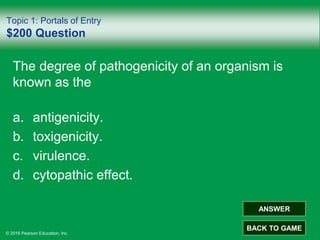
$200 Question
The degree of pathogenicity of an organism is
known as the
a. antigenicity.
b. toxigenicity.
c. virulence.
d. cytopathic effect.
ANSWER
BACK TO GAME
© 2016 Pearson Education, Inc.
Topic 1: Portals of Entry
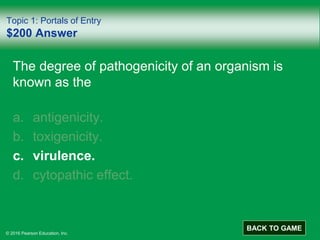
$200 Answer
The degree of pathogenicity of an organism is
known as the
a. antigenicity.
b. toxigenicity.
c. virulence.
d. cytopathic effect.
BACK TO GAME
© 2016 Pearson Education, Inc.
Topic 1: Portals of Entry
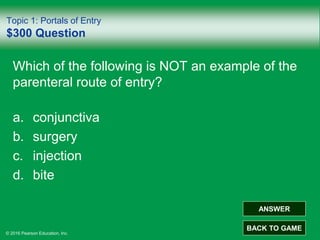
$300 Question
Which of the following is NOT an example of the
parenteral route of entry?
a. conjunctiva
b. surgery
c. injection
d. bite
ANSWER
BACK TO GAME
© 2016 Pearson Education, Inc.
Topic 1: Portals of Entry
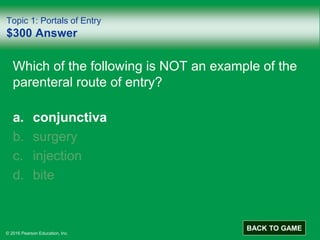
$300 Answer
Which of the following is NOT an example of the
parenteral route of entry?
a. conjunctiva
b. surgery
c. injection
d. bite
BACK TO GAME
© 2016 Pearson Education, Inc.
Topic 1: Portals of Entry
$400 Question
What is the preferred portal of entry for
chlamydia?
a. genitourinary tract
b. gastrointestinal tract
c. skin
d. respiratory tract
ANSWER
BACK TO GAME
© 2016 Pearson Education, Inc.
Topic 1: Portals of Entry
$400 Answer
What is the preferred portal of entry for
chlamydia?
a. genitourinary tract
b. gastrointestinal tract
c. skin
d. respiratory tract
BACK TO GAME
© 2016 Pearson Education, Inc.
Topic 1: Portals of Entry
$500 Question
Communities of microbes that cling to surfaces
and share available nutrients are called
a. biofilms.
b. fimbriae.
c. ligands.
d. superantigens.
ANSWER
BACK TO GAME
© 2016 Pearson Education, Inc.
Topic 1: Portals of Entry
$500 Answer
Communities of microbes that cling to surfaces
and share available nutrients are called
a. biofilms.
b. fimbriae.
c. ligands.
d. superantigens.
BACK TO GAME
© 2016 Pearson Education, Inc.
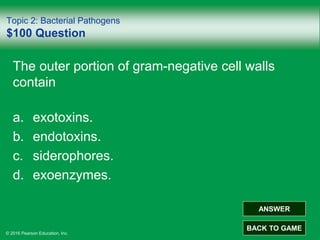
Topic 2: Bacterial Pathogens
$100 Question
The outer portion of gram-negative cell walls
contain
a. exotoxins.
b. endotoxins.
c. siderophores.
d. exoenzymes.
ANSWER
BACK TO GAME
© 2016 Pearson Education, Inc.
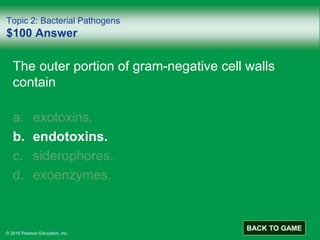
Topic 2: Bacterial Pathogens
$100 Answer
The outer portion of gram-negative cell walls
contain
a. exotoxins.
b. endotoxins.
c. siderophores.
d. exoenzymes.
BACK TO GAME
© 2016 Pearson Education, Inc.
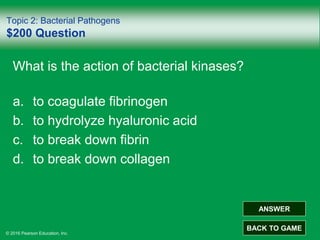
Topic 2: Bacterial Pathogens
$200 Question
What is the action of bacterial kinases?
a. to coagulate fibrinogen
b. to hydrolyze hyaluronic acid
c. to break down fibrin
d. to break down collagen
ANSWER
BACK TO GAME
© 2016 Pearson Education, Inc.
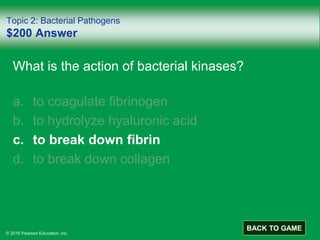
Topic 2: Bacterial Pathogens
$200 Answer
What is the action of bacterial kinases?
a. to coagulate fibrinogen
b. to hydrolyze hyaluronic acid
c. to break down fibrin
d. to break down collagen
BACK TO GAME
© 2016 Pearson Education, Inc.
Topic 2: Bacterial Pathogens
$300 Question
Exotoxins that attack liver cells are known as
a. leukotoxins.
b. cytotoxins.
c. hepatotoxins.
d. enterotoxins.
ANSWER
BACK TO GAME
© 2016 Pearson Education, Inc.
Topic 2: Bacterial Pathogens
$300 Answer
Exotoxins that attack liver cells are known as
a. leukotoxins.
b. cytotoxins.
c. hepatotoxins.
d. enterotoxins.
BACK TO GAME
© 2016 Pearson Education, Inc.
Topic 2: Bacterial Pathogens
$400 Question
Proteins secreted by pathogens that bind iron are
known as
a. superantigens.
b. siderophores.
c. leukocidins.
d. hemolysins.
ANSWER
BACK TO GAME
© 2016 Pearson Education, Inc.
Topic 2: Bacterial Pathogens
$400 Answer
Proteins secreted by pathogens that bind iron are
known as
a. superantigens.
b. siderophores.
c. leukocidins.
d. hemolysins.
BACK TO GAME
© 2016 Pearson Education, Inc.
Topic 2: Bacterial Pathogens
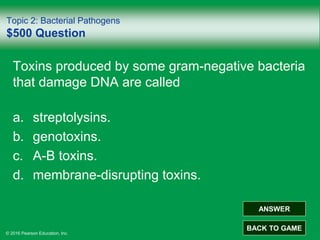
$500 Question
Toxins produced by some gram-negative bacteria
that damage DNA are called
a. streptolysins.
b. genotoxins.
c. A-B toxins.
d. membrane-disrupting toxins.
ANSWER
BACK TO GAME
© 2016 Pearson Education, Inc.
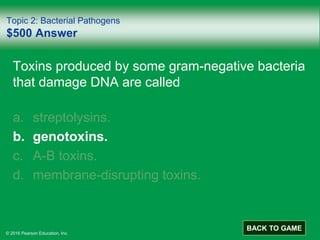
Topic 2: Bacterial Pathogens
$500 Answer
Toxins produced by some gram-negative bacteria
that damage DNA are called
a. streptolysins.
b. genotoxins.
c. A-B toxins.
d. membrane-disrupting toxins.
BACK TO GAME
© 2016 Pearson Education, Inc.
Topic 3: Viral Pathogens
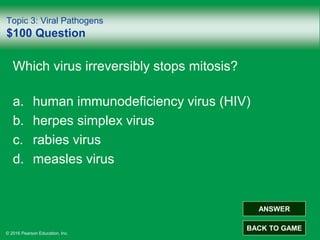
$100 Question
Which virus irreversibly stops mitosis?
a. human immunodeficiency virus (HIV)
b. herpes simplex virus
c. rabies virus
d. measles virus
ANSWER
BACK TO GAME
© 2016 Pearson Education, Inc.
Topic 3: Viral Pathogens
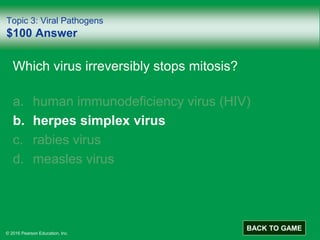
$100 Answer
Which virus irreversibly stops mitosis?
a. human immunodeficiency virus (HIV)
b. herpes simplex virus
c. rabies virus
d. measles virus
BACK TO GAME
© 2016 Pearson Education, Inc.
Topic 3: Viral Pathogens
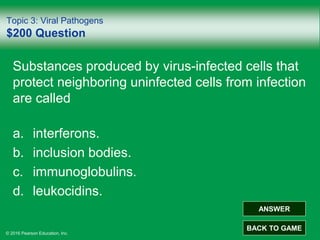
$200 Question
Substances produced by virus-infected cells that
protect neighboring uninfected cells from infection
are called
a. interferons.
b. inclusion bodies.
c. immunoglobulins.
d. leukocidins.
ANSWER
BACK TO GAME
© 2016 Pearson Education, Inc.
Topic 3: Viral Pathogens
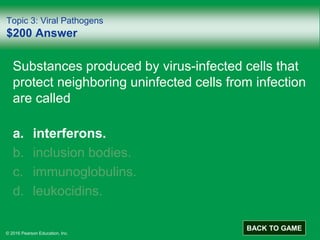
$200 Answer
Substances produced by virus-infected cells that
protect neighboring uninfected cells from infection
are called
a. interferons.
b. inclusion bodies.
c. immunoglobulins.
d. leukocidins.
BACK TO GAME
© 2016 Pearson Education, Inc.
Topic 3: Viral Pathogens
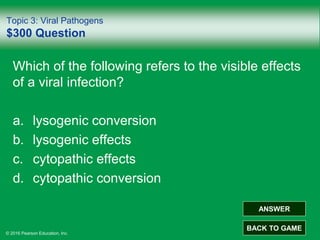
$300 Question
Which of the following refers to the visible effects
of a viral infection?
a. lysogenic conversion
b. lysogenic effects
c. cytopathic effects
d. cytopathic conversion
ANSWER
BACK TO GAME
© 2016 Pearson Education, Inc.
Topic 3: Viral Pathogens
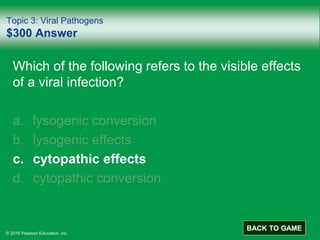
$300 Answer
Which of the following refers to the visible effects
of a viral infection?
a. lysogenic conversion
b. lysogenic effects
c. cytopathic effects
d. cytopathic conversion
BACK TO GAME
© 2016 Pearson Education, Inc.
Topic 3: Viral Pathogens
$400 Question
What are the granules found in the cytoplasm or
nucleus of some virus-infected cells?
a. syncytia
b. endotoxins
c. lysosomes
d. inclusion bodies
ANSWER
BACK TO GAME
© 2016 Pearson Education, Inc.
Topic 3: Viral Pathogens
$400 Answer
What are the granules found in the cytoplasm or
nucleus of some virus-infected cells?
a. syncytia
b. endotoxins
c. lysosomes
d. inclusion bodies
BACK TO GAME
© 2016 Pearson Education, Inc.
Topic 3: Viral Pathogens
$500 Question
Viruses that transform cells by causing loss of
contact inhibition result in
a. the formation of a syncytium.
b. chromosomal breakage.
c. unregulated cell growth.
d. antigenic changes on the host cell.
ANSWER
BACK TO GAME
© 2016 Pearson Education, Inc.
Topic 3: Viral Pathogens
$500 Answer
Viruses that transform cells by causing loss of
contact inhibition result in
a. the formation of a syncytium.
b. chromosomal breakage.
c. unregulated cell growth.
d. antigenic changes on the host cell.
BACK TO GAME
© 2016 Pearson Education, Inc.
Topic 4: Eukaryotic Pathogens
$100 Question
Which of the following is NOT a way fungi cause
disease?
a. by using antigenic variation
b. by producing toxins
c. by secreting protease
d. by provoking an allergic response
ANSWER
BACK TO GAME
© 2016 Pearson Education, Inc.
Topic 4: Eukaryotic Pathogens
$100 Answer
Which of the following is NOT a way fungi cause
disease?
a. by using antigenic variation
b. by producing toxins
c. by secreting protease
d. by provoking an allergic response
BACK TO GAME
© 2016 Pearson Education, Inc.
Topic 4: Eukaryotic Pathogens
$200 Question
What type of organism produces saxitoxin?
a. helminth
b. alga
c. fungus
d. plant
ANSWER
BACK TO GAME
© 2016 Pearson Education, Inc.
Topic 4: Eukaryotic Pathogens
$200 Answer
What type of organism produces saxitoxin?
a. helminth
b. alga
c. fungus
d. plant
BACK TO GAME
© 2016 Pearson Education, Inc.
Topic 4: Eukaryotic Pathogens
$300 Question
Which of the following toxins is an alkaloid that
can cause hallucinations resembling those
produced by LSD?
a. aflatoxin
b. ergot alkaloid
c. phalloidin
d. amanitin
ANSWER
BACK TO GAME
© 2016 Pearson Education, Inc.
Topic 4: Eukaryotic Pathogens
$300 Answer
Which of the following toxins is an alkaloid that
can cause hallucinations resembling those
produced by LSD?
a. aflatoxin
b. ergot alkaloid
c. phalloidin
d. amanitin
BACK TO GAME
© 2016 Pearson Education, Inc.
Topic 4: Eukaryotic Pathogens
$400 Question
Which of the following protozoa use antigenic
variation to stay one step ahead of the host's
immune system?
a. Toxoplasma
b. Cryptosporidium
c. Trypanosoma
d. Plasmodium
ANSWER
BACK TO GAME
© 2016 Pearson Education, Inc.
Topic 4: Eukaryotic Pathogens
$400 Answer
Which of the following protozoa use antigenic
variation to stay one step ahead of the host's
immune system?
a. Toxoplasma
b. Cryptosporidium
c. Trypanosoma
d. Plasmodium
BACK TO GAME
© 2016 Pearson Education, Inc.
Topic 4: Eukaryotic Pathogens
$500 Question
What is the causative agent of elephantiasis?
a. Entamoeba histolytica
b. Candida albicans
c. Cryptococcus neoformans
d. Wuchereria bancrofti
ANSWER
BACK TO GAME
© 2016 Pearson Education, Inc.
Topic 4: Eukaryotic Pathogens
$500 Answer
What is the causative agent of elephantiasis?
a. Entamoeba histolytica
b. Candida albicans
c. Cryptococcus neoformans
d. Wuchereria bancrofti
BACK TO GAME
© 2016 Pearson Education, Inc.
Topic 5: Portals of Exit
$100 Question
Arthropods provide a portal of exit for microbes
via the
a. skin.
b. blood.
c. respiratory tract.
d. genitourinary tract.
ANSWER
BACK TO GAME
© 2016 Pearson Education, Inc.
Topic 5: Portals of Exit
$100 Answer
Arthropods provide a portal of exit for microbes
via the
a. skin.
b. blood.
c. respiratory tract.
d. genitourinary tract.
BACK TO GAME
© 2016 Pearson Education, Inc.
Topic 5: Portals of Exit
$200 Question
Sneezing is a portal of exit for the
a. gastrointestinal tract.
b. respiratory tract.
c. blood.
d. genitourinary tract.
ANSWER
BACK TO GAME
© 2016 Pearson Education, Inc.
Topic 5: Portals of Exit
$200 Answer
Sneezing is a portal of exit for the
a. gastrointestinal tract.
b. respiratory tract.
c. blood.
d. genitourinary tract.
BACK TO GAME
© 2016 Pearson Education, Inc.
Topic 5: Portals of Exit
$300 Question
Pathogens that are discharged from the
respiratory tract can cause which of the following
diseases?
a. salmonella
b. whooping cough
c. poliomyelitis
d. tetanus
ANSWER
BACK TO GAME
© 2016 Pearson Education, Inc.
Topic 5: Portals of Exit
$300 Answer
Pathogens that are discharged from the
respiratory tract can cause which of the following
diseases?
a. salmonella
b. whooping cough
c. poliomyelitis
d. tetanus
BACK TO GAME
© 2016 Pearson Education, Inc.
Topic 5: Portals of Exit
$400 Question
Infections transmitted from the skin include
a. warts.
b. tularemia.
c. yellow fever.
d. plague.
ANSWER
BACK TO GAME
© 2016 Pearson Education, Inc.
Topic 5: Portals of Exit
$400 Answer
Infections transmitted from the skin include
a. warts.
b. tularemia.
c. yellow fever.
d. plague.
BACK TO GAME
© 2016 Pearson Education, Inc.
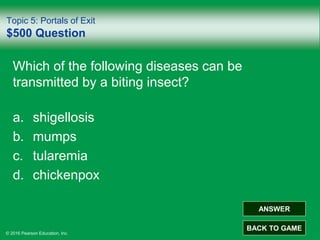
Topic 5: Portals of Exit
$500 Question
Which of the following diseases can be
transmitted by a biting insect?
a. shigellosis
b. mumps
c. tularemia
d. chickenpox
ANSWER
BACK TO GAME
© 2016 Pearson Education, Inc.
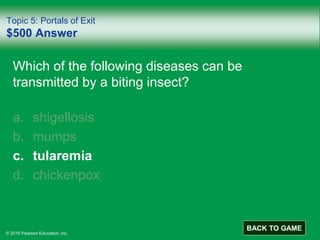
Topic 5: Portals of Exit
$500 Answer
Which of the following diseases can be
transmitted by a biting insect?
a. shigellosis
b. mumps
c. tularemia
d. chickenpox
BACK TO GAME
© 2016 Pearson Education, Inc.
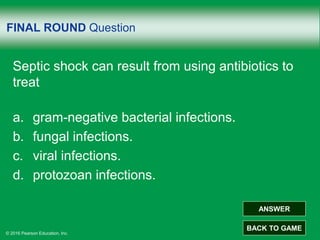
FINAL ROUND Question
Septic shock can result from using antibiotics to
treat
a. gram-negative bacterial infections.
b. fungal infections.
c. viral infections.
d. protozoan infections.
ANSWER
BACK TO GAME
© 2016 Pearson Education, Inc.
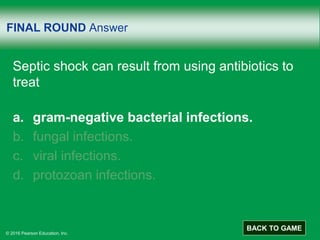
FINAL ROUND Answer
Septic shock can result from using antibiotics to
treat
a. gram-negative bacterial infections.
b. fungal infections.
c. viral infections.
d. protozoan infections.
BACK TO GAME

15 quiz show

  • 1.
    Bradley W. Christian,McLennan Community College © 2016 Pearson Education, Inc. $200 $100 $300 $400 $500 $100 $200 $300 $400 $500 $100 $200 $300 $400 $500 $100 $200 $300 $400 $500 $100 $200 $300 $400 $500 Chapter 15: Microbial Mechanisms of Pathogenicity Portals of Entry Bacterial Pathogens Viral Pathogens Portals of Exit Eukaryotic Pathogens FINAL ROUND
  • 2.
    © 2016 PearsonEducation, Inc. Topic 1: Portals of Entry $100 Question The easiest and MOST frequently traveled portal of entry for infectious microorganisms is the a. parenteral route. b. respiratory tract. c. gastrointestinal tract. d. skin. ANSWER BACK TO GAME
  • 3.
    © 2016 PearsonEducation, Inc. Topic 1: Portals of Entry $100 Answer The easiest and MOST frequently traveled portal of entry for infectious microorganisms is the a. parenteral route. b. respiratory tract. c. gastrointestinal tract. d. skin. BACK TO GAME
  • 4.
    © 2016 PearsonEducation, Inc. Topic 1: Portals of Entry $200 Question The degree of pathogenicity of an organism is known as the a. antigenicity. b. toxigenicity. c. virulence. d. cytopathic effect. ANSWER BACK TO GAME
  • 5.
    © 2016 PearsonEducation, Inc. Topic 1: Portals of Entry $200 Answer The degree of pathogenicity of an organism is known as the a. antigenicity. b. toxigenicity. c. virulence. d. cytopathic effect. BACK TO GAME
  • 6.
    © 2016 PearsonEducation, Inc. Topic 1: Portals of Entry $300 Question Which of the following is NOT an example of the parenteral route of entry? a. conjunctiva b. surgery c. injection d. bite ANSWER BACK TO GAME
  • 7.
    © 2016 PearsonEducation, Inc. Topic 1: Portals of Entry $300 Answer Which of the following is NOT an example of the parenteral route of entry? a. conjunctiva b. surgery c. injection d. bite BACK TO GAME
  • 8.
    © 2016 PearsonEducation, Inc. Topic 1: Portals of Entry $400 Question What is the preferred portal of entry for chlamydia? a. genitourinary tract b. gastrointestinal tract c. skin d. respiratory tract ANSWER BACK TO GAME
  • 9.
    © 2016 PearsonEducation, Inc. Topic 1: Portals of Entry $400 Answer What is the preferred portal of entry for chlamydia? a. genitourinary tract b. gastrointestinal tract c. skin d. respiratory tract BACK TO GAME
  • 10.
    © 2016 PearsonEducation, Inc. Topic 1: Portals of Entry $500 Question Communities of microbes that cling to surfaces and share available nutrients are called a. biofilms. b. fimbriae. c. ligands. d. superantigens. ANSWER BACK TO GAME
  • 11.
    © 2016 PearsonEducation, Inc. Topic 1: Portals of Entry $500 Answer Communities of microbes that cling to surfaces and share available nutrients are called a. biofilms. b. fimbriae. c. ligands. d. superantigens. BACK TO GAME
  • 12.
    © 2016 PearsonEducation, Inc. Topic 2: Bacterial Pathogens $100 Question The outer portion of gram-negative cell walls contain a. exotoxins. b. endotoxins. c. siderophores. d. exoenzymes. ANSWER BACK TO GAME
  • 13.
    © 2016 PearsonEducation, Inc. Topic 2: Bacterial Pathogens $100 Answer The outer portion of gram-negative cell walls contain a. exotoxins. b. endotoxins. c. siderophores. d. exoenzymes. BACK TO GAME
  • 14.
    © 2016 PearsonEducation, Inc. Topic 2: Bacterial Pathogens $200 Question What is the action of bacterial kinases? a. to coagulate fibrinogen b. to hydrolyze hyaluronic acid c. to break down fibrin d. to break down collagen ANSWER BACK TO GAME
  • 15.
    © 2016 PearsonEducation, Inc. Topic 2: Bacterial Pathogens $200 Answer What is the action of bacterial kinases? a. to coagulate fibrinogen b. to hydrolyze hyaluronic acid c. to break down fibrin d. to break down collagen BACK TO GAME
  • 16.
    © 2016 PearsonEducation, Inc. Topic 2: Bacterial Pathogens $300 Question Exotoxins that attack liver cells are known as a. leukotoxins. b. cytotoxins. c. hepatotoxins. d. enterotoxins. ANSWER BACK TO GAME
  • 17.
    © 2016 PearsonEducation, Inc. Topic 2: Bacterial Pathogens $300 Answer Exotoxins that attack liver cells are known as a. leukotoxins. b. cytotoxins. c. hepatotoxins. d. enterotoxins. BACK TO GAME
  • 18.
    © 2016 PearsonEducation, Inc. Topic 2: Bacterial Pathogens $400 Question Proteins secreted by pathogens that bind iron are known as a. superantigens. b. siderophores. c. leukocidins. d. hemolysins. ANSWER BACK TO GAME
  • 19.
    © 2016 PearsonEducation, Inc. Topic 2: Bacterial Pathogens $400 Answer Proteins secreted by pathogens that bind iron are known as a. superantigens. b. siderophores. c. leukocidins. d. hemolysins. BACK TO GAME
  • 20.
    © 2016 PearsonEducation, Inc. Topic 2: Bacterial Pathogens $500 Question Toxins produced by some gram-negative bacteria that damage DNA are called a. streptolysins. b. genotoxins. c. A-B toxins. d. membrane-disrupting toxins. ANSWER BACK TO GAME
  • 21.
    © 2016 PearsonEducation, Inc. Topic 2: Bacterial Pathogens $500 Answer Toxins produced by some gram-negative bacteria that damage DNA are called a. streptolysins. b. genotoxins. c. A-B toxins. d. membrane-disrupting toxins. BACK TO GAME
  • 22.
    © 2016 PearsonEducation, Inc. Topic 3: Viral Pathogens $100 Question Which virus irreversibly stops mitosis? a. human immunodeficiency virus (HIV) b. herpes simplex virus c. rabies virus d. measles virus ANSWER BACK TO GAME
  • 23.
    © 2016 PearsonEducation, Inc. Topic 3: Viral Pathogens $100 Answer Which virus irreversibly stops mitosis? a. human immunodeficiency virus (HIV) b. herpes simplex virus c. rabies virus d. measles virus BACK TO GAME
  • 24.
    © 2016 PearsonEducation, Inc. Topic 3: Viral Pathogens $200 Question Substances produced by virus-infected cells that protect neighboring uninfected cells from infection are called a. interferons. b. inclusion bodies. c. immunoglobulins. d. leukocidins. ANSWER BACK TO GAME
  • 25.
    © 2016 PearsonEducation, Inc. Topic 3: Viral Pathogens $200 Answer Substances produced by virus-infected cells that protect neighboring uninfected cells from infection are called a. interferons. b. inclusion bodies. c. immunoglobulins. d. leukocidins. BACK TO GAME
  • 26.
    © 2016 PearsonEducation, Inc. Topic 3: Viral Pathogens $300 Question Which of the following refers to the visible effects of a viral infection? a. lysogenic conversion b. lysogenic effects c. cytopathic effects d. cytopathic conversion ANSWER BACK TO GAME
  • 27.
    © 2016 PearsonEducation, Inc. Topic 3: Viral Pathogens $300 Answer Which of the following refers to the visible effects of a viral infection? a. lysogenic conversion b. lysogenic effects c. cytopathic effects d. cytopathic conversion BACK TO GAME
  • 28.
    © 2016 PearsonEducation, Inc. Topic 3: Viral Pathogens $400 Question What are the granules found in the cytoplasm or nucleus of some virus-infected cells? a. syncytia b. endotoxins c. lysosomes d. inclusion bodies ANSWER BACK TO GAME
  • 29.
    © 2016 PearsonEducation, Inc. Topic 3: Viral Pathogens $400 Answer What are the granules found in the cytoplasm or nucleus of some virus-infected cells? a. syncytia b. endotoxins c. lysosomes d. inclusion bodies BACK TO GAME
  • 30.
    © 2016 PearsonEducation, Inc. Topic 3: Viral Pathogens $500 Question Viruses that transform cells by causing loss of contact inhibition result in a. the formation of a syncytium. b. chromosomal breakage. c. unregulated cell growth. d. antigenic changes on the host cell. ANSWER BACK TO GAME
  • 31.
    © 2016 PearsonEducation, Inc. Topic 3: Viral Pathogens $500 Answer Viruses that transform cells by causing loss of contact inhibition result in a. the formation of a syncytium. b. chromosomal breakage. c. unregulated cell growth. d. antigenic changes on the host cell. BACK TO GAME
  • 32.
    © 2016 PearsonEducation, Inc. Topic 4: Eukaryotic Pathogens $100 Question Which of the following is NOT a way fungi cause disease? a. by using antigenic variation b. by producing toxins c. by secreting protease d. by provoking an allergic response ANSWER BACK TO GAME
  • 33.
    © 2016 PearsonEducation, Inc. Topic 4: Eukaryotic Pathogens $100 Answer Which of the following is NOT a way fungi cause disease? a. by using antigenic variation b. by producing toxins c. by secreting protease d. by provoking an allergic response BACK TO GAME
  • 34.
    © 2016 PearsonEducation, Inc. Topic 4: Eukaryotic Pathogens $200 Question What type of organism produces saxitoxin? a. helminth b. alga c. fungus d. plant ANSWER BACK TO GAME
  • 35.
    © 2016 PearsonEducation, Inc. Topic 4: Eukaryotic Pathogens $200 Answer What type of organism produces saxitoxin? a. helminth b. alga c. fungus d. plant BACK TO GAME
  • 36.
    © 2016 PearsonEducation, Inc. Topic 4: Eukaryotic Pathogens $300 Question Which of the following toxins is an alkaloid that can cause hallucinations resembling those produced by LSD? a. aflatoxin b. ergot alkaloid c. phalloidin d. amanitin ANSWER BACK TO GAME
  • 37.
    © 2016 PearsonEducation, Inc. Topic 4: Eukaryotic Pathogens $300 Answer Which of the following toxins is an alkaloid that can cause hallucinations resembling those produced by LSD? a. aflatoxin b. ergot alkaloid c. phalloidin d. amanitin BACK TO GAME
  • 38.
    © 2016 PearsonEducation, Inc. Topic 4: Eukaryotic Pathogens $400 Question Which of the following protozoa use antigenic variation to stay one step ahead of the host's immune system? a. Toxoplasma b. Cryptosporidium c. Trypanosoma d. Plasmodium ANSWER BACK TO GAME
  • 39.
    © 2016 PearsonEducation, Inc. Topic 4: Eukaryotic Pathogens $400 Answer Which of the following protozoa use antigenic variation to stay one step ahead of the host's immune system? a. Toxoplasma b. Cryptosporidium c. Trypanosoma d. Plasmodium BACK TO GAME
  • 40.
    © 2016 PearsonEducation, Inc. Topic 4: Eukaryotic Pathogens $500 Question What is the causative agent of elephantiasis? a. Entamoeba histolytica b. Candida albicans c. Cryptococcus neoformans d. Wuchereria bancrofti ANSWER BACK TO GAME
  • 41.
    © 2016 PearsonEducation, Inc. Topic 4: Eukaryotic Pathogens $500 Answer What is the causative agent of elephantiasis? a. Entamoeba histolytica b. Candida albicans c. Cryptococcus neoformans d. Wuchereria bancrofti BACK TO GAME
  • 42.
    © 2016 PearsonEducation, Inc. Topic 5: Portals of Exit $100 Question Arthropods provide a portal of exit for microbes via the a. skin. b. blood. c. respiratory tract. d. genitourinary tract. ANSWER BACK TO GAME
  • 43.
    © 2016 PearsonEducation, Inc. Topic 5: Portals of Exit $100 Answer Arthropods provide a portal of exit for microbes via the a. skin. b. blood. c. respiratory tract. d. genitourinary tract. BACK TO GAME
  • 44.
    © 2016 PearsonEducation, Inc. Topic 5: Portals of Exit $200 Question Sneezing is a portal of exit for the a. gastrointestinal tract. b. respiratory tract. c. blood. d. genitourinary tract. ANSWER BACK TO GAME
  • 45.
    © 2016 PearsonEducation, Inc. Topic 5: Portals of Exit $200 Answer Sneezing is a portal of exit for the a. gastrointestinal tract. b. respiratory tract. c. blood. d. genitourinary tract. BACK TO GAME
  • 46.
    © 2016 PearsonEducation, Inc. Topic 5: Portals of Exit $300 Question Pathogens that are discharged from the respiratory tract can cause which of the following diseases? a. salmonella b. whooping cough c. poliomyelitis d. tetanus ANSWER BACK TO GAME
  • 47.
    © 2016 PearsonEducation, Inc. Topic 5: Portals of Exit $300 Answer Pathogens that are discharged from the respiratory tract can cause which of the following diseases? a. salmonella b. whooping cough c. poliomyelitis d. tetanus BACK TO GAME
  • 48.
    © 2016 PearsonEducation, Inc. Topic 5: Portals of Exit $400 Question Infections transmitted from the skin include a. warts. b. tularemia. c. yellow fever. d. plague. ANSWER BACK TO GAME
  • 49.
    © 2016 PearsonEducation, Inc. Topic 5: Portals of Exit $400 Answer Infections transmitted from the skin include a. warts. b. tularemia. c. yellow fever. d. plague. BACK TO GAME
  • 50.
    © 2016 PearsonEducation, Inc. Topic 5: Portals of Exit $500 Question Which of the following diseases can be transmitted by a biting insect? a. shigellosis b. mumps c. tularemia d. chickenpox ANSWER BACK TO GAME
  • 51.
    © 2016 PearsonEducation, Inc. Topic 5: Portals of Exit $500 Answer Which of the following diseases can be transmitted by a biting insect? a. shigellosis b. mumps c. tularemia d. chickenpox BACK TO GAME
  • 52.
    © 2016 PearsonEducation, Inc. FINAL ROUND Question Septic shock can result from using antibiotics to treat a. gram-negative bacterial infections. b. fungal infections. c. viral infections. d. protozoan infections. ANSWER BACK TO GAME
  • 53.
    © 2016 PearsonEducation, Inc. FINAL ROUND Answer Septic shock can result from using antibiotics to treat a. gram-negative bacterial infections. b. fungal infections. c. viral infections. d. protozoan infections. BACK TO GAME