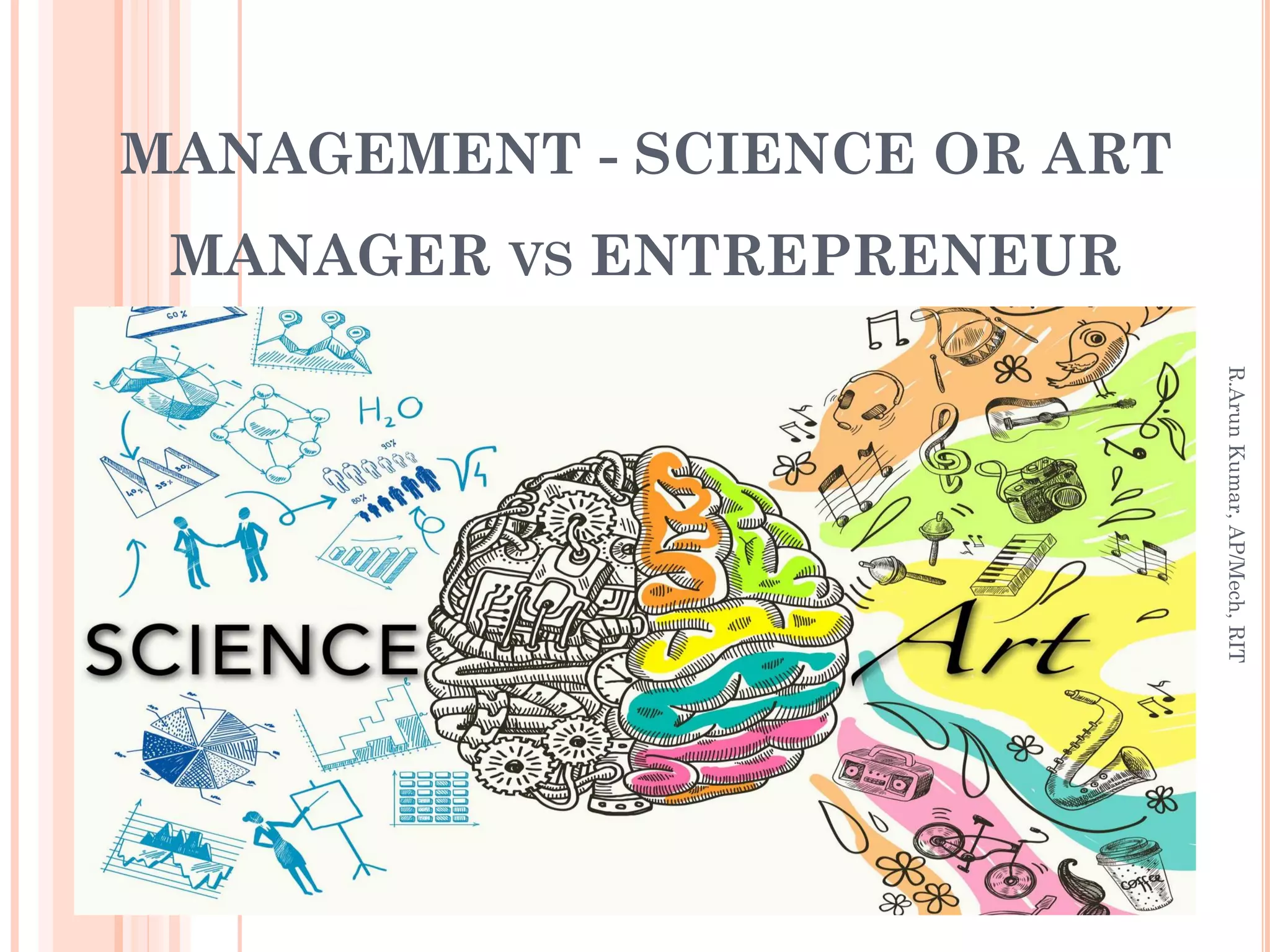
MANAGEMENT - SCIENCE OR ART
MANAGER VS ENTREPRENEUR
R.ArunKumar,AP/Mech,RIT
FUNCTIONS OF MANAGEMENT:
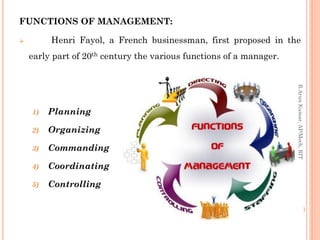
 Henri Fayol, a French businessman, first proposed in the
early part of 20th century the various functions of a manager.
1) Planning
2) Organizing
3) Commanding
4) Coordinating
5) Controlling
R.ArunKumar,AP/Mech,RIT
FUNCTIONS OF MANAGEMENT:
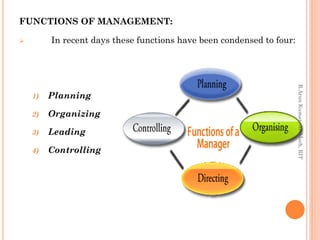
 In recent days these functions have been condensed to four:
1) Planning
2) Organizing
3) Leading
4) Controlling
R.ArunKumar,AP/Mech,RIT
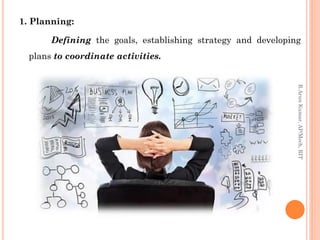
1. Planning:
Defining the goals, establishing strategy and developing
plans to coordinate activities.
R.ArunKumar,AP/Mech,RIT
2. Organizing:
Determining what needs to be done, how it will be done
and who is to do it.
R.ArunKumar,AP/Mech,RIT
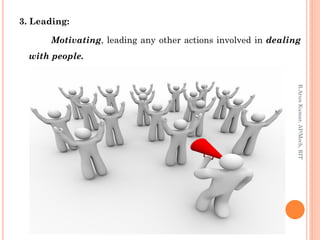
3. Leading:
Motivating, leading any other actions involved in dealing
with people.
R.ArunKumar,AP/Mech,RIT
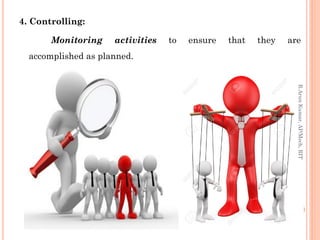
4. Controlling:
Monitoring activities to ensure that they are
accomplished as planned.
R.ArunKumar,AP/Mech,RIT
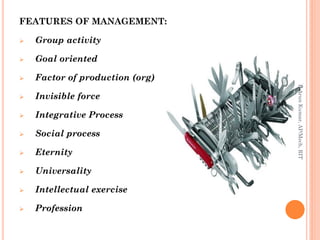
FEATURES OF MANAGEMENT:
 Group activity
 Goal oriented
 Factor of production (org)
 Invisible force
 Integrative Process
 Social process
 Eternity
 Universality
 Intellectual exercise
 Profession
R.ArunKumar,AP/Mech,RIT
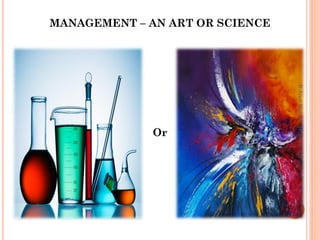
MANAGEMENT – AN ART OR SCIENCE
Or
R.ArunKumar,AP/Mech,RIT
MANAGEMENT – AS A SCIENCE
 Science is a systematic body of knowledge relating to a
specific field of study that contains general facts which
explains a phenomenon.
 It establishes cause and effect relationship between two or
more variables and underlines the principles governing their
relationship.
 These principles are developed through scientific method of
observation and verification through testing.
R.ArunKumar,AP/Mech,RIT
Universally accepted principles:
 Scientific principles represent basic truth about a particular
field of enquiry.
 These principles may be applied in all situations, at all time
& at all places.
R.ArunKumar,AP/Mech,RIT
Experimentation and observation:
 Scientific principles are derived through scientific investigation &
researching i.e. they are based on logic.
 Management principles are also based on scientific enquiry
and observation.
 They have been developed through experiments and practical
experiences of large number of managers.
Example:
 The principle that earth revolves the sun has been scientifically
proved.
 It is observed that fair remuneration to personal helps in
creating a satisfied work force.
R.ArunKumar,AP/Mech,RIT
Cause and effect relationship:
 When metals are heated, they are expanded. The cause is
heating & result is expansion.
 Similarly if workers are given bonuses, fair wages they will
work hard but when not treated in fair and just manner, reduces
productivity of organization.
R.ArunKumar,AP/Mech,RIT
Test of validity and predictability:
 Validity of scientific principles can be tested at any time or any
number of times i.e. they stand the time of test.
 Moreover future events can be predicted with reasonable
accuracy by using scientific principles.
Examples:
The chemical combination of Hydrogen and Oxygen will give
water.
Similarly, principle of unity of command can be tested by
comparing two persons – one having single boss and one having two
bosses, the performance of first person is better than second.
R.ArunKumar,AP/Mech,RIT
Conclusion:
 The reason for the inexactness of science of management is
that it deals with human beings and it is very difficult to predict
their behavior accurately.
 Since it is a social process, therefore it falls in the area of
social sciences.
 Ernest Dale has called it as a Soft Science.
R.ArunKumar,AP/Mech,RIT
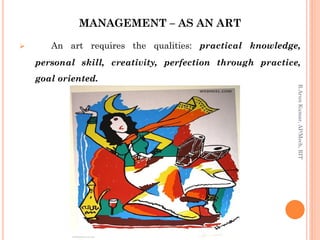
MANAGEMENT – AS AN ART
 An art requires the qualities: practical knowledge,
personal skill, creativity, perfection through practice,
goal oriented.
R.ArunKumar,AP/Mech,RIT
Practical Knowledge:
 Every art requires practical knowledge therefore learning of
theory is not sufficient.
 It is very important to know practical application of
theoretical principles.
Example:
 A manager can never be successful just by obtaining degree
in management; he must have also know how to apply various
principles in real situations by functioning in capacity of
manager.
R.ArunKumar,AP/Mech,RIT
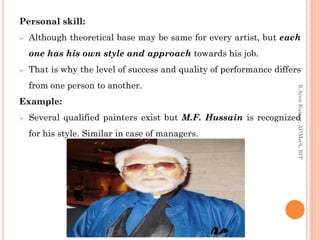
Personal skill:
 Although theoretical base may be same for every artist, but each
one has his own style and approach towards his job.
 That is why the level of success and quality of performance differs
from one person to another.
Example:
 Several qualified painters exist but M.F. Hussain is recognized
for his style. Similar in case of managers.
R.ArunKumar,AP/Mech,RIT
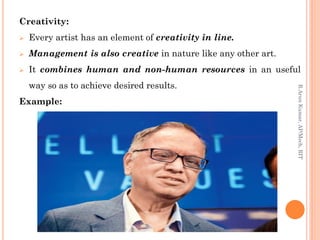
Creativity:
 Every artist has an element of creativity in line.
 Management is also creative in nature like any other art.
 It combines human and non-human resources in an useful
way so as to achieve desired results.
Example:
R.ArunKumar,AP/Mech,RIT
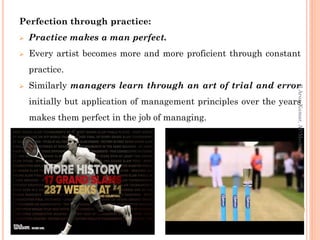
Perfection through practice:
 Practice makes a man perfect.
 Every artist becomes more and more proficient through constant
practice.
 Similarly managers learn through an art of trial and error
initially but application of management principles over the years
makes them perfect in the job of managing.
R.ArunKumar,AP/Mech,RIT
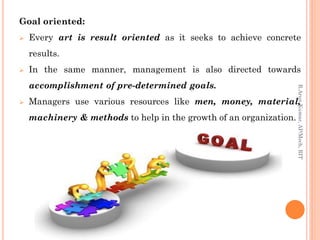
Goal oriented:
 Every art is result oriented as it seeks to achieve concrete
results.
 In the same manner, management is also directed towards
accomplishment of pre-determined goals.
 Managers use various resources like men, money, material,
machinery & methods to help in the growth of an organization.
R.ArunKumar,AP/Mech,RIT
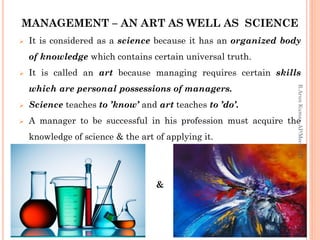
MANAGEMENT – AN ART AS WELL AS SCIENCE
 It is considered as a science because it has an organized body
of knowledge which contains certain universal truth.
 It is called an art because managing requires certain skills
which are personal possessions of managers.
 Science teaches to ’know’ and art teaches to ’do’.
 A manager to be successful in his profession must acquire the
knowledge of science & the art of applying it.
&
R.ArunKumar,AP/Mech,RIT
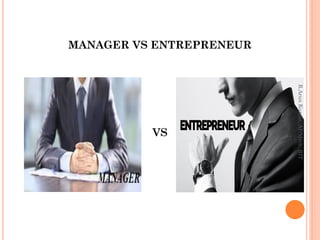
MANAGER VS ENTREPRENEUR
VS
R.ArunKumar,AP/Mech,RIT
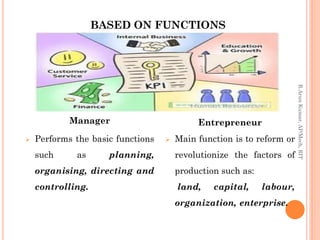
BASED ON FUNCTIONS
Manager
 Performs the basic functions
such as planning,
organising, directing and
controlling.
Entrepreneur
 Main function is to reform or
revolutionize the factors of
production such as:
land, capital, labour,
organization, enterprise.
R.ArunKumar,AP/Mech,RIT
BASED ON EDUCATION
Manager
 A person can become a
manager by the acquisition
of knowledge through
formal education in
business management
(MBA)
Entrepreneur
 They learn by trial and
error method.
 They learn from their own
mistakes and mistakes of
others.
 They are self made.
R.ArunKumar,AP/Mech,RIT
BASED ON JOINING THE ORGANIZATION
Manager
 They join the business only
after it is established
Entrepreneur
 They are founders of the
organization.
R.ArunKumar,AP/Mech,RIT
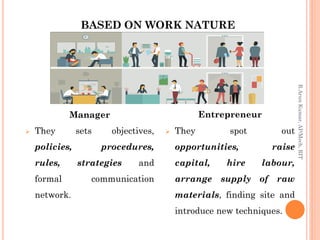
BASED ON WORK NATURE
Manager
 They sets objectives,
policies, procedures,
rules, strategies and
formal communication
network.
Entrepreneur
 They spot out
opportunities, raise
capital, hire labour,
arrange supply of raw
materials, finding site and
introduce new techniques.
R.ArunKumar,AP/Mech,RIT
BASED ON DESIRE
Manager
 They desire to produce best
results in the shortest time
and least cost and to
achieve profit and growth.
Entrepreneur
 They are the owners of the
business.
 They visualizes a business,
take bold decisions to
establish and undertaking
and bear the risk of
uncertainties.
R.ArunKumar,AP/Mech,RIT
BASED ON DIFFERENT NAMES
Manager
 Disturbance handler,
 Resource allocator,
 Negotiator,
 Spokesperson,
 Liaison officer and
 Disseminator
Entrepreneur
 Risk taker,
 Uncertainty bearer,
 Problem solver,
 Innovator and
 Idealist.
R.ArunKumar,AP/Mech,RIT
BASED ON FAILURE
Manager
 Failure of a manager results
in little loss to his career
and he can join another
company.
Entrepreneur
 Leads to great loss of
money and career.
R.ArunKumar,AP/Mech,RIT
BASED ON WORK LIMITS
Manager
 Manager has to work
within the framework of
policy guidelines laid down
by the entrepreneur.
Entrepreneur
 He/she has full freedom of
work.
 He has the chance of
working independently and
can show their talent.
R.ArunKumar,AP/Mech,RIT
BASED ON SALARY
Manager
 Managers are entitled to
receive salaries for their
job.
Entrepreneur
 Supplies all capital needed
to run the organization.
 He/she enjoys the profit of
the business
R.ArunKumar,AP/Mech,RIT
BASED ON EXPERTISE
Manager
 Managers are specialists.
 They are focused on
managing and growing a
business.
Entrepreneur
 They are generalists.
 They need to know about
everything.
R.ArunKumar,AP/Mech,RIT
BASED ON REWARDS
Manager
Rewards come in the form of
 Salaries,
 Promotions,
 Job title,
 Bonus and incentives.
Entrepreneur
 Capital gains,
 Asset acquisition and
 Cash flow
R.ArunKumar,AP/Mech,RIT
BASED ON DECISION MAKING
Manager
 Cannot make quick
decisions.
 Need some consultants.
Entrepreneur
 Can make quick decisions.
 They need not consult with
anyone while making
decisions.
R.ArunKumar,AP/Mech,RIT
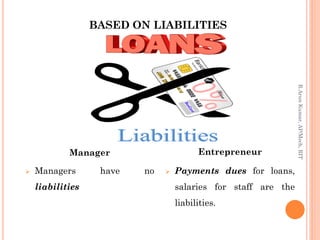
BASED ON LIABILITIES
Manager
 Managers have no
liabilities
Entrepreneur
 Payments dues for loans,
salaries for staff are the
liabilities.
R.ArunKumar,AP/Mech,RIT
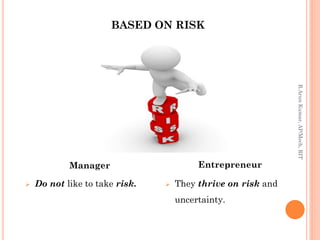
BASED ON RISK
Manager
 Do not like to take risk.
Entrepreneur
 They thrive on risk and
uncertainty.
R.ArunKumar,AP/Mech,RIT

Management science or art

  • 1.
    MANAGEMENT - SCIENCEOR ART MANAGER VS ENTREPRENEUR R.ArunKumar,AP/Mech,RIT
  • 2.
    FUNCTIONS OF MANAGEMENT: Henri Fayol, a French businessman, first proposed in the early part of 20th century the various functions of a manager. 1) Planning 2) Organizing 3) Commanding 4) Coordinating 5) Controlling R.ArunKumar,AP/Mech,RIT
  • 3.
    FUNCTIONS OF MANAGEMENT: In recent days these functions have been condensed to four: 1) Planning 2) Organizing 3) Leading 4) Controlling R.ArunKumar,AP/Mech,RIT
  • 4.
    1. Planning: Defining thegoals, establishing strategy and developing plans to coordinate activities. R.ArunKumar,AP/Mech,RIT
  • 5.
    2. Organizing: Determining whatneeds to be done, how it will be done and who is to do it. R.ArunKumar,AP/Mech,RIT
  • 6.
    3. Leading: Motivating, leadingany other actions involved in dealing with people. R.ArunKumar,AP/Mech,RIT
  • 7.
    4. Controlling: Monitoring activitiesto ensure that they are accomplished as planned. R.ArunKumar,AP/Mech,RIT
  • 8.
    FEATURES OF MANAGEMENT: Group activity  Goal oriented  Factor of production (org)  Invisible force  Integrative Process  Social process  Eternity  Universality  Intellectual exercise  Profession R.ArunKumar,AP/Mech,RIT
  • 9.
    MANAGEMENT – ANART OR SCIENCE Or R.ArunKumar,AP/Mech,RIT
  • 10.
    MANAGEMENT – ASA SCIENCE  Science is a systematic body of knowledge relating to a specific field of study that contains general facts which explains a phenomenon.  It establishes cause and effect relationship between two or more variables and underlines the principles governing their relationship.  These principles are developed through scientific method of observation and verification through testing. R.ArunKumar,AP/Mech,RIT
  • 11.
    Universally accepted principles: Scientific principles represent basic truth about a particular field of enquiry.  These principles may be applied in all situations, at all time & at all places. R.ArunKumar,AP/Mech,RIT
  • 12.
    Experimentation and observation: Scientific principles are derived through scientific investigation & researching i.e. they are based on logic.  Management principles are also based on scientific enquiry and observation.  They have been developed through experiments and practical experiences of large number of managers. Example:  The principle that earth revolves the sun has been scientifically proved.  It is observed that fair remuneration to personal helps in creating a satisfied work force. R.ArunKumar,AP/Mech,RIT
  • 13.
    Cause and effectrelationship:  When metals are heated, they are expanded. The cause is heating & result is expansion.  Similarly if workers are given bonuses, fair wages they will work hard but when not treated in fair and just manner, reduces productivity of organization. R.ArunKumar,AP/Mech,RIT
  • 14.
    Test of validityand predictability:  Validity of scientific principles can be tested at any time or any number of times i.e. they stand the time of test.  Moreover future events can be predicted with reasonable accuracy by using scientific principles. Examples: The chemical combination of Hydrogen and Oxygen will give water. Similarly, principle of unity of command can be tested by comparing two persons – one having single boss and one having two bosses, the performance of first person is better than second. R.ArunKumar,AP/Mech,RIT
  • 15.
    Conclusion:  The reasonfor the inexactness of science of management is that it deals with human beings and it is very difficult to predict their behavior accurately.  Since it is a social process, therefore it falls in the area of social sciences.  Ernest Dale has called it as a Soft Science. R.ArunKumar,AP/Mech,RIT
  • 16.
    MANAGEMENT – ASAN ART  An art requires the qualities: practical knowledge, personal skill, creativity, perfection through practice, goal oriented. R.ArunKumar,AP/Mech,RIT
  • 17.
    Practical Knowledge:  Everyart requires practical knowledge therefore learning of theory is not sufficient.  It is very important to know practical application of theoretical principles. Example:  A manager can never be successful just by obtaining degree in management; he must have also know how to apply various principles in real situations by functioning in capacity of manager. R.ArunKumar,AP/Mech,RIT
  • 18.
    Personal skill:  Althoughtheoretical base may be same for every artist, but each one has his own style and approach towards his job.  That is why the level of success and quality of performance differs from one person to another. Example:  Several qualified painters exist but M.F. Hussain is recognized for his style. Similar in case of managers. R.ArunKumar,AP/Mech,RIT
  • 19.
    Creativity:  Every artisthas an element of creativity in line.  Management is also creative in nature like any other art.  It combines human and non-human resources in an useful way so as to achieve desired results. Example: R.ArunKumar,AP/Mech,RIT
  • 20.
    Perfection through practice: Practice makes a man perfect.  Every artist becomes more and more proficient through constant practice.  Similarly managers learn through an art of trial and error initially but application of management principles over the years makes them perfect in the job of managing. R.ArunKumar,AP/Mech,RIT
  • 21.
    Goal oriented:  Everyart is result oriented as it seeks to achieve concrete results.  In the same manner, management is also directed towards accomplishment of pre-determined goals.  Managers use various resources like men, money, material, machinery & methods to help in the growth of an organization. R.ArunKumar,AP/Mech,RIT
  • 22.
    MANAGEMENT – ANART AS WELL AS SCIENCE  It is considered as a science because it has an organized body of knowledge which contains certain universal truth.  It is called an art because managing requires certain skills which are personal possessions of managers.  Science teaches to ’know’ and art teaches to ’do’.  A manager to be successful in his profession must acquire the knowledge of science & the art of applying it. & R.ArunKumar,AP/Mech,RIT
  • 23.
  • 24.
    BASED ON FUNCTIONS Manager Performs the basic functions such as planning, organising, directing and controlling. Entrepreneur  Main function is to reform or revolutionize the factors of production such as: land, capital, labour, organization, enterprise. R.ArunKumar,AP/Mech,RIT
  • 25.
    BASED ON EDUCATION Manager A person can become a manager by the acquisition of knowledge through formal education in business management (MBA) Entrepreneur  They learn by trial and error method.  They learn from their own mistakes and mistakes of others.  They are self made. R.ArunKumar,AP/Mech,RIT
  • 26.
    BASED ON JOININGTHE ORGANIZATION Manager  They join the business only after it is established Entrepreneur  They are founders of the organization. R.ArunKumar,AP/Mech,RIT
  • 27.
    BASED ON WORKNATURE Manager  They sets objectives, policies, procedures, rules, strategies and formal communication network. Entrepreneur  They spot out opportunities, raise capital, hire labour, arrange supply of raw materials, finding site and introduce new techniques. R.ArunKumar,AP/Mech,RIT
  • 28.
    BASED ON DESIRE Manager They desire to produce best results in the shortest time and least cost and to achieve profit and growth. Entrepreneur  They are the owners of the business.  They visualizes a business, take bold decisions to establish and undertaking and bear the risk of uncertainties. R.ArunKumar,AP/Mech,RIT
  • 29.
    BASED ON DIFFERENTNAMES Manager  Disturbance handler,  Resource allocator,  Negotiator,  Spokesperson,  Liaison officer and  Disseminator Entrepreneur  Risk taker,  Uncertainty bearer,  Problem solver,  Innovator and  Idealist. R.ArunKumar,AP/Mech,RIT
  • 30.
    BASED ON FAILURE Manager Failure of a manager results in little loss to his career and he can join another company. Entrepreneur  Leads to great loss of money and career. R.ArunKumar,AP/Mech,RIT
  • 31.
    BASED ON WORKLIMITS Manager  Manager has to work within the framework of policy guidelines laid down by the entrepreneur. Entrepreneur  He/she has full freedom of work.  He has the chance of working independently and can show their talent. R.ArunKumar,AP/Mech,RIT
  • 32.
    BASED ON SALARY Manager Managers are entitled to receive salaries for their job. Entrepreneur  Supplies all capital needed to run the organization.  He/she enjoys the profit of the business R.ArunKumar,AP/Mech,RIT
  • 33.
    BASED ON EXPERTISE Manager Managers are specialists.  They are focused on managing and growing a business. Entrepreneur  They are generalists.  They need to know about everything. R.ArunKumar,AP/Mech,RIT
  • 34.
    BASED ON REWARDS Manager Rewardscome in the form of  Salaries,  Promotions,  Job title,  Bonus and incentives. Entrepreneur  Capital gains,  Asset acquisition and  Cash flow R.ArunKumar,AP/Mech,RIT
  • 35.
    BASED ON DECISIONMAKING Manager  Cannot make quick decisions.  Need some consultants. Entrepreneur  Can make quick decisions.  They need not consult with anyone while making decisions. R.ArunKumar,AP/Mech,RIT
  • 36.
    BASED ON LIABILITIES Manager Managers have no liabilities Entrepreneur  Payments dues for loans, salaries for staff are the liabilities. R.ArunKumar,AP/Mech,RIT
  • 37.
    BASED ON RISK Manager Do not like to take risk. Entrepreneur  They thrive on risk and uncertainty. R.ArunKumar,AP/Mech,RIT