Presented by George D’lima.
                   Roll No: M1215.
Subject: Perspective Management.
Controlling and the other
            management functions
 Controlling referred to as the terminal management function.

 Controlling is a pervasive function- which means it is performed by
  managers at all levels and in all type of concerns.

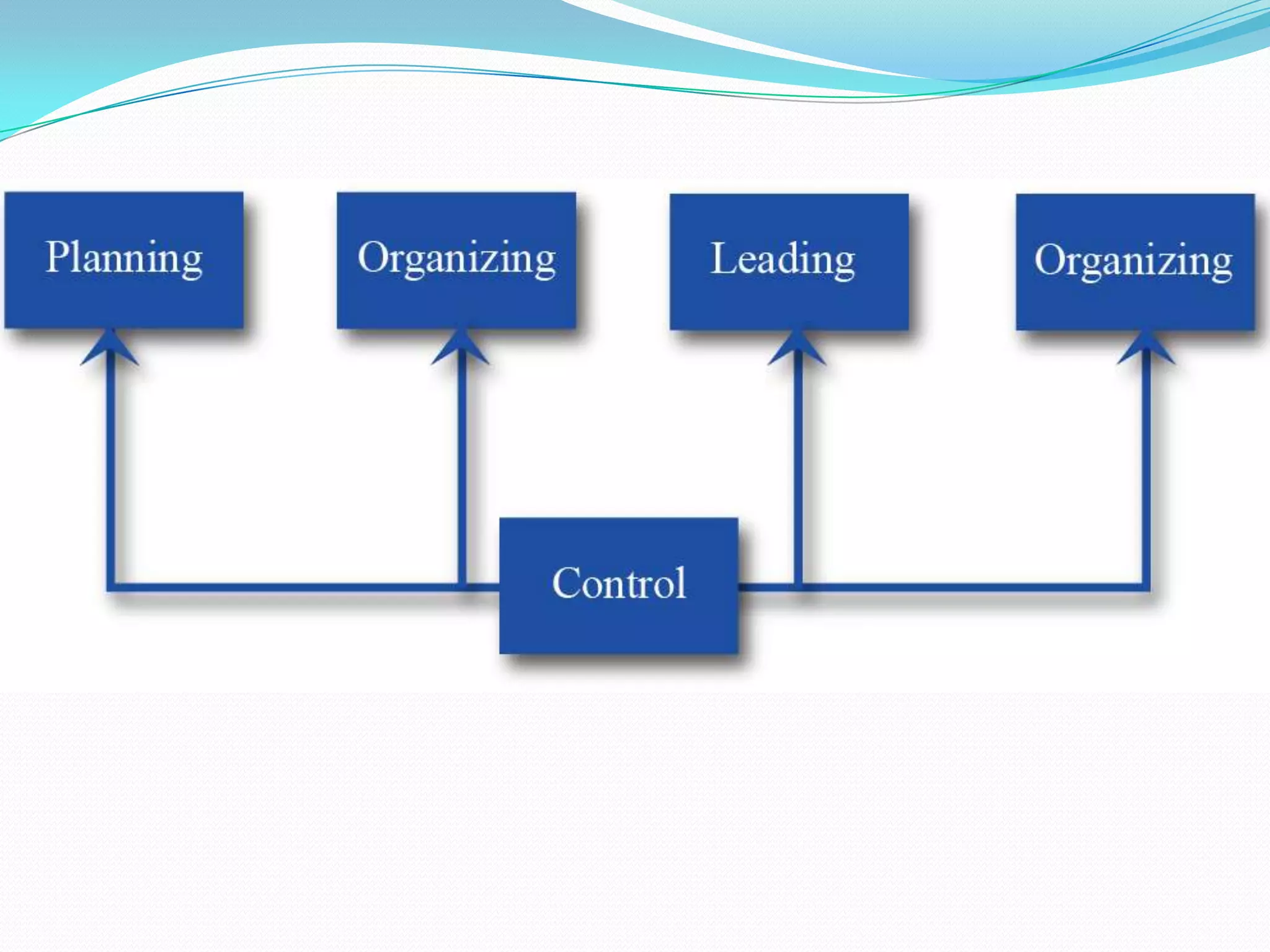
 Evaluating the other management functions.

 Controlling is a dynamic process- since controlling requires taking
  reviewal methods, changes have to be made wherever possible.

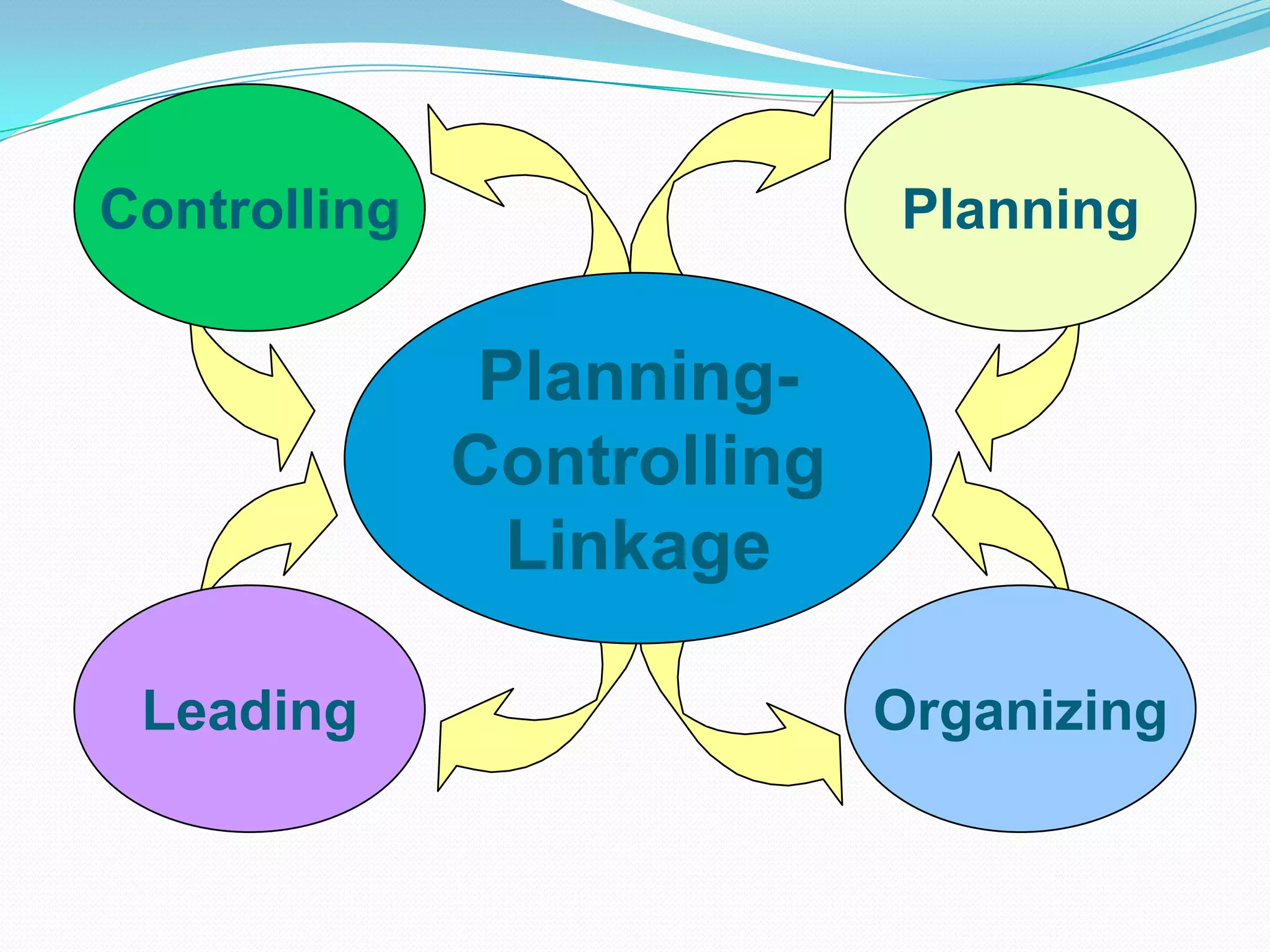
 Strongly associated with planning.

 Controlling is forward looking- Controlling analysis the past and
  help achieving future goals.
Controlling                 Planning


               Planning-
              Controlling
                Linkage

 Leading                    Organizing
Types and strategies of control
Controlling can be classified in
1.   According to time
a.   Before
b.   During
c.   After
2.   According to the source of control
a.   Internal
b.   External
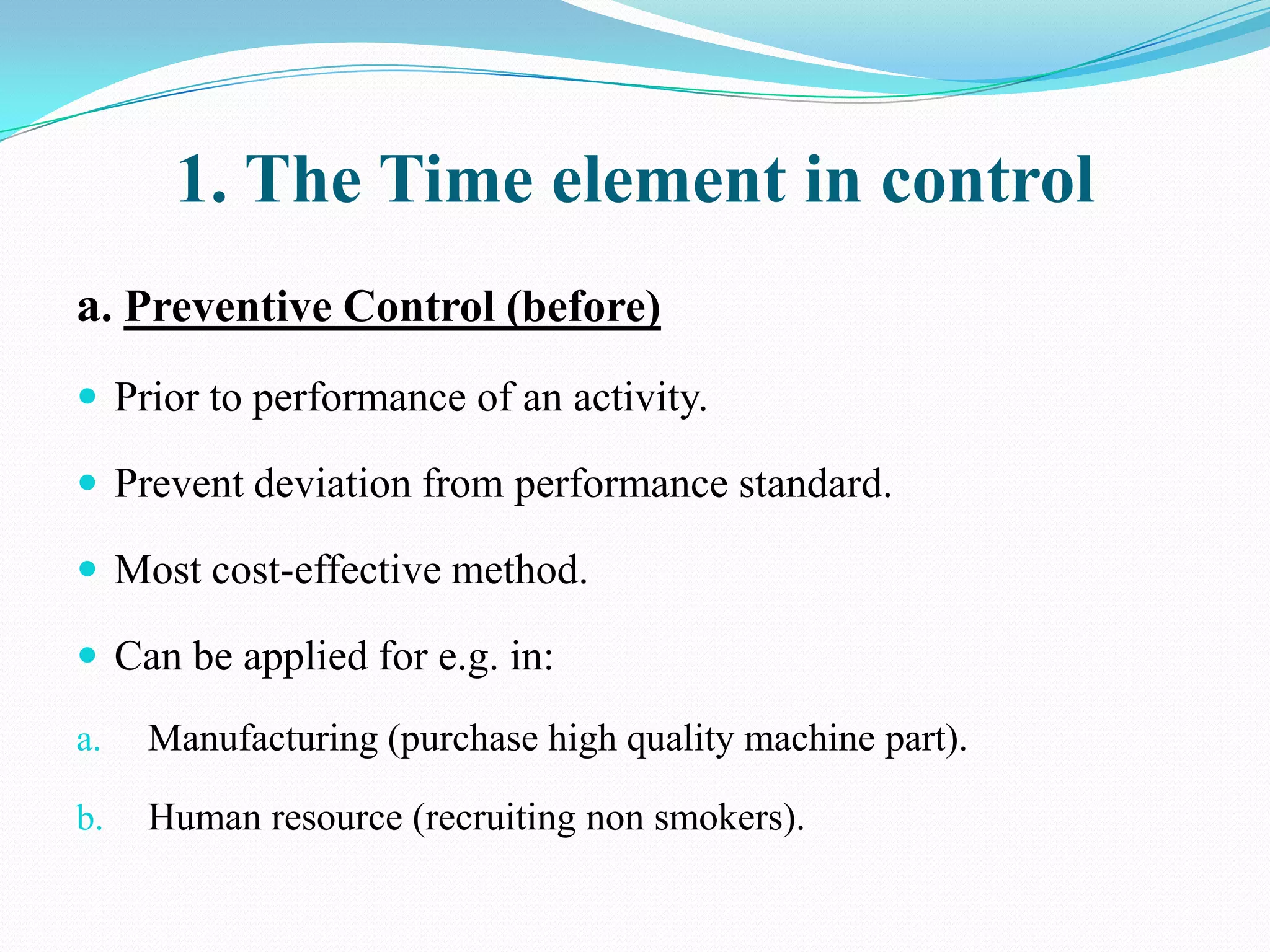
1. The Time element in control
a. Preventive Control (before)
 Prior to performance of an activity.

 Prevent deviation from performance standard.

 Most cost-effective method.

 Can be applied for e.g. in:

a.   Manufacturing (purchase high quality machine part).

b.   Human resource (recruiting non smokers).
Cont….
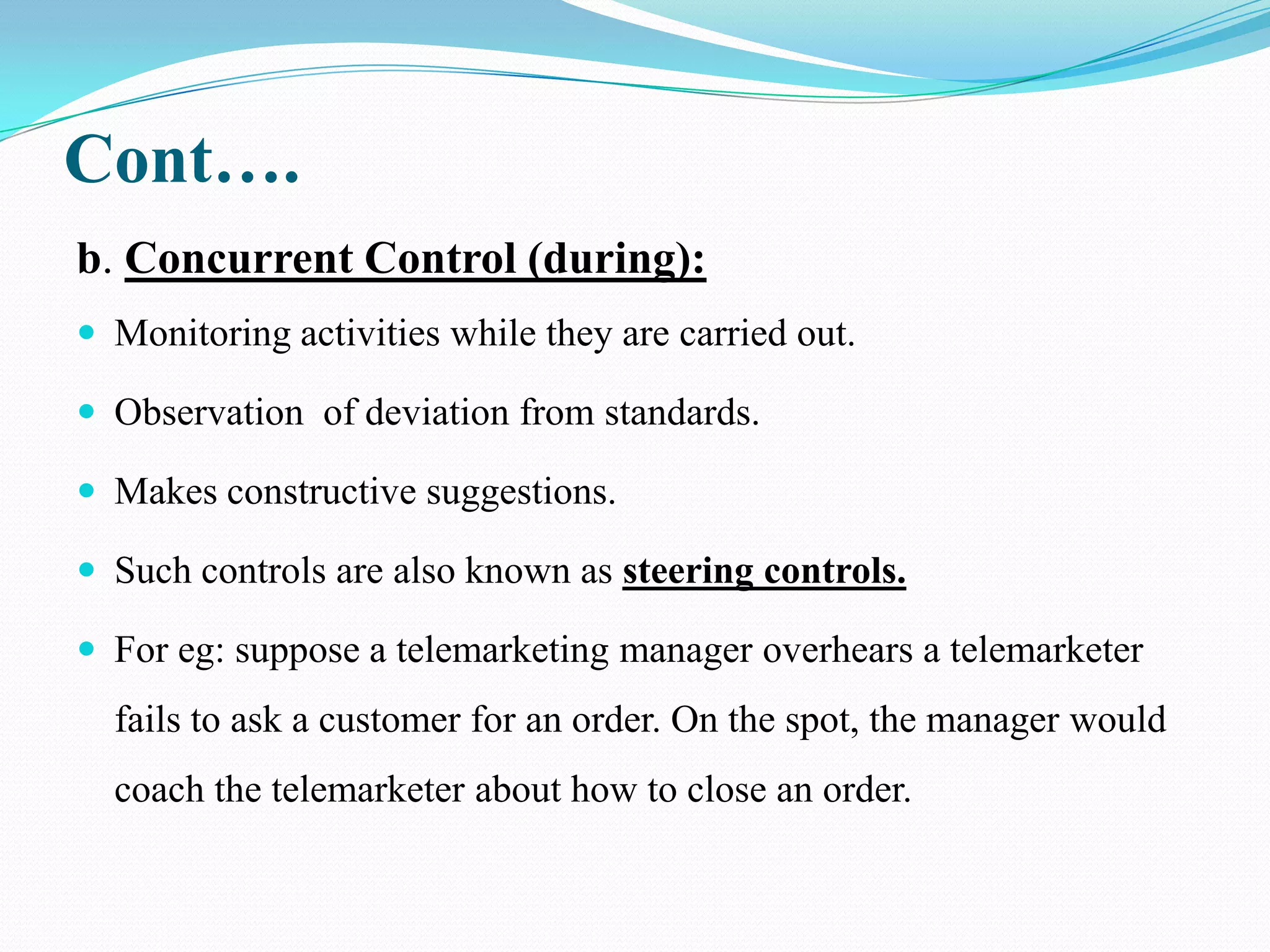
b. Concurrent Control (during):
 Monitoring activities while they are carried out.

 Observation of deviation from standards.

 Makes constructive suggestions.

 Such controls are also known as steering controls.

 For eg: suppose a telemarketing manager overhears a telemarketer
  fails to ask a customer for an order. On the spot, the manager would
  coach the telemarketer about how to close an order.
Cont….
c. Feedback Control or post controls (after):
 Evaluate an activity after it is performed.

 Pointing out what went wrong in the past.

 Financial statement analysis is a form of feedback control.
II. External and Internal Controls
External control strategy
 Based on the belief that employees are motivated primarily by
  external rewards and need to be controlled by their mangers.

 For eg: Relience

Internal control strategy
 Based on the belief that employees can be motivated by building
  their commitment to organisational goals.

 For eg: Toyota Corp.
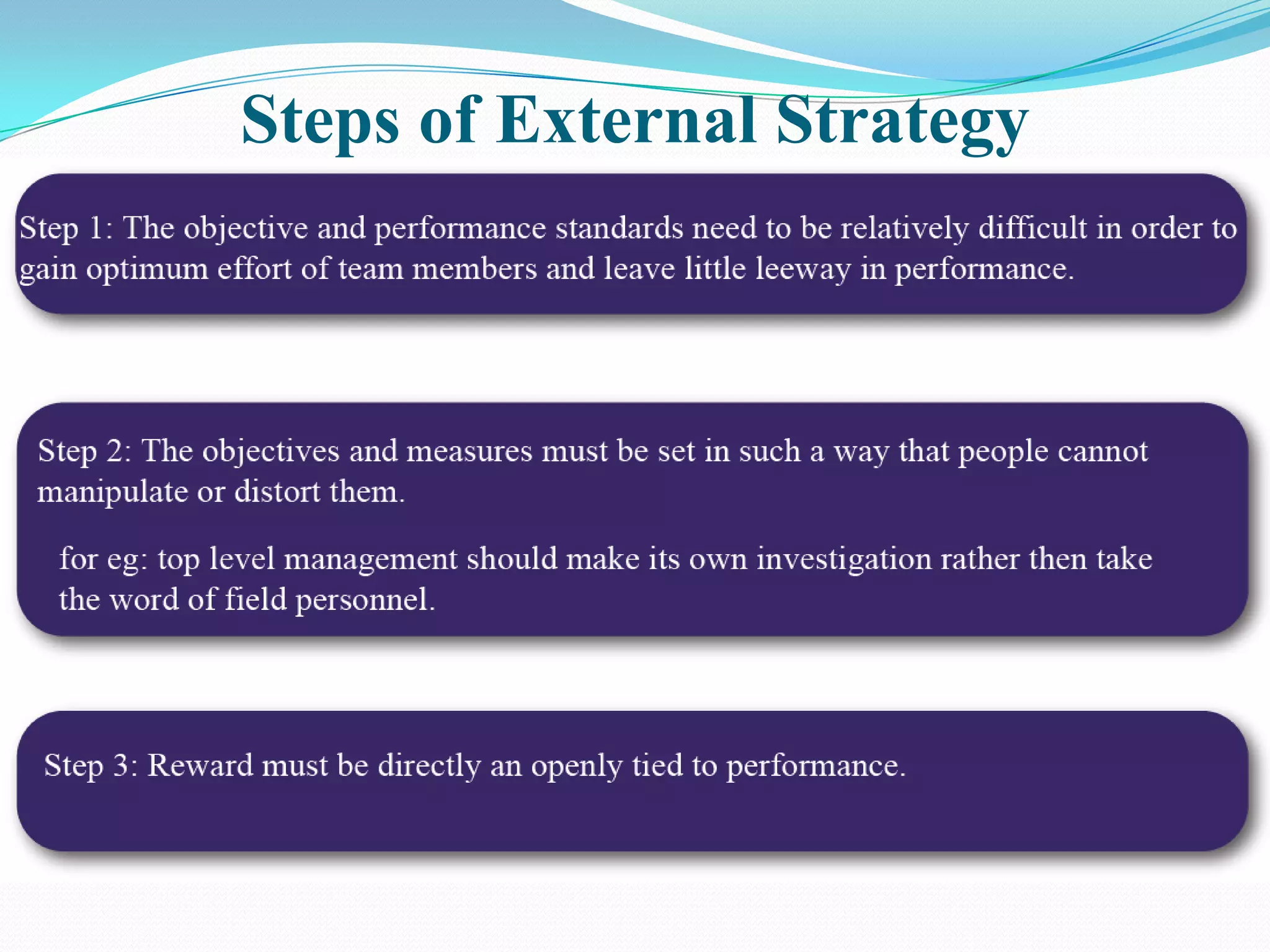
Steps of External Strategy
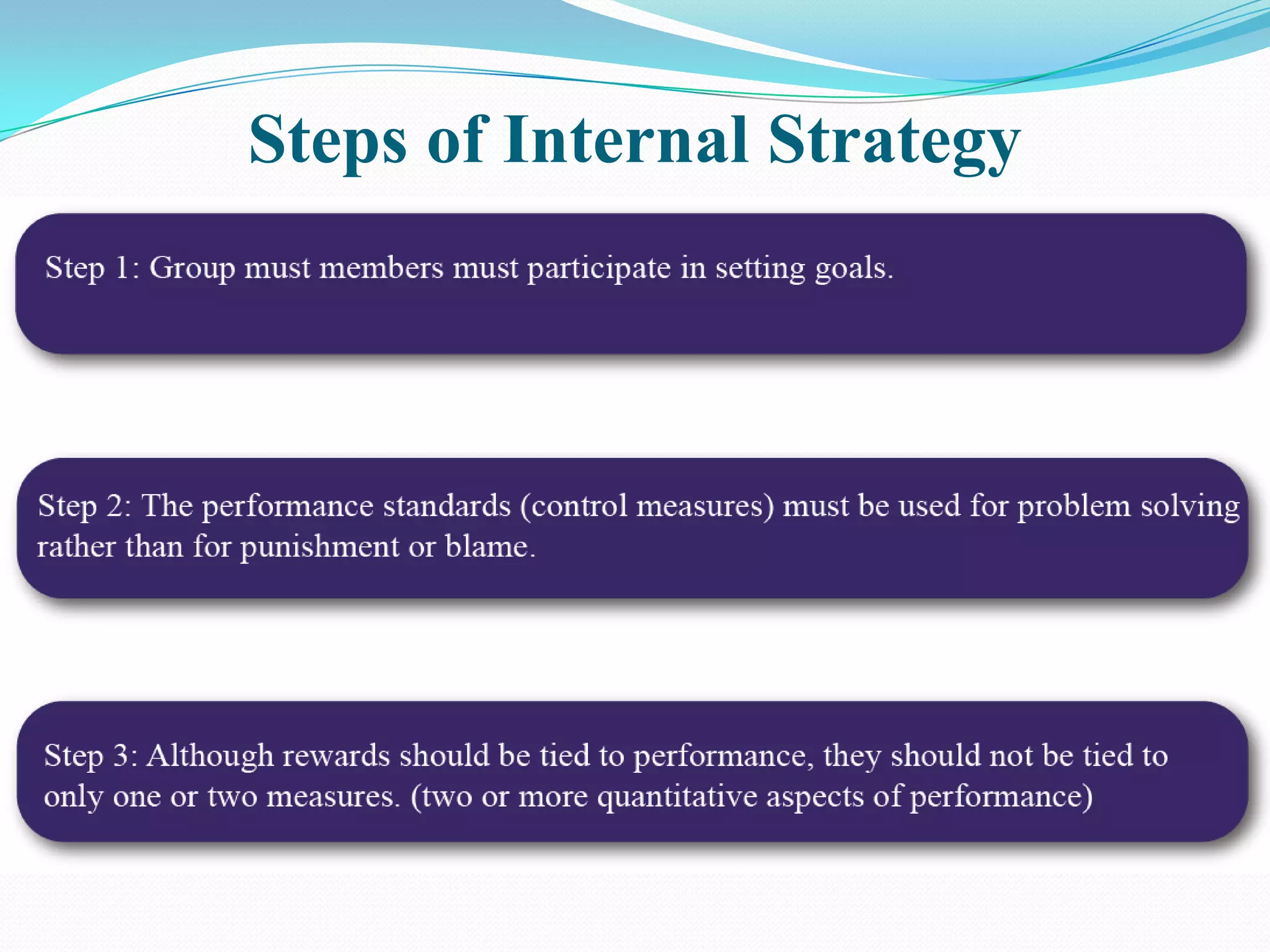
Steps of Internal Strategy
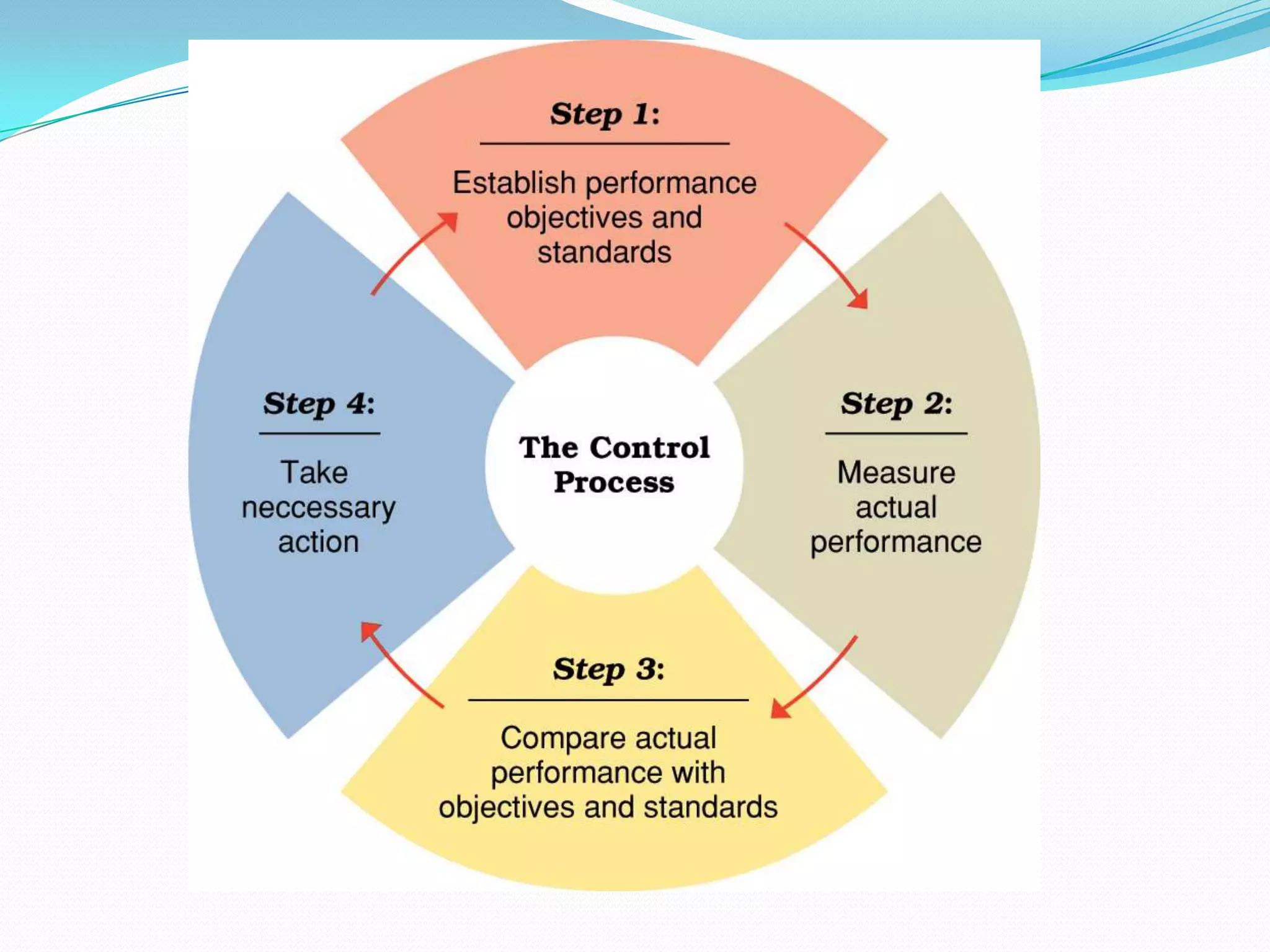
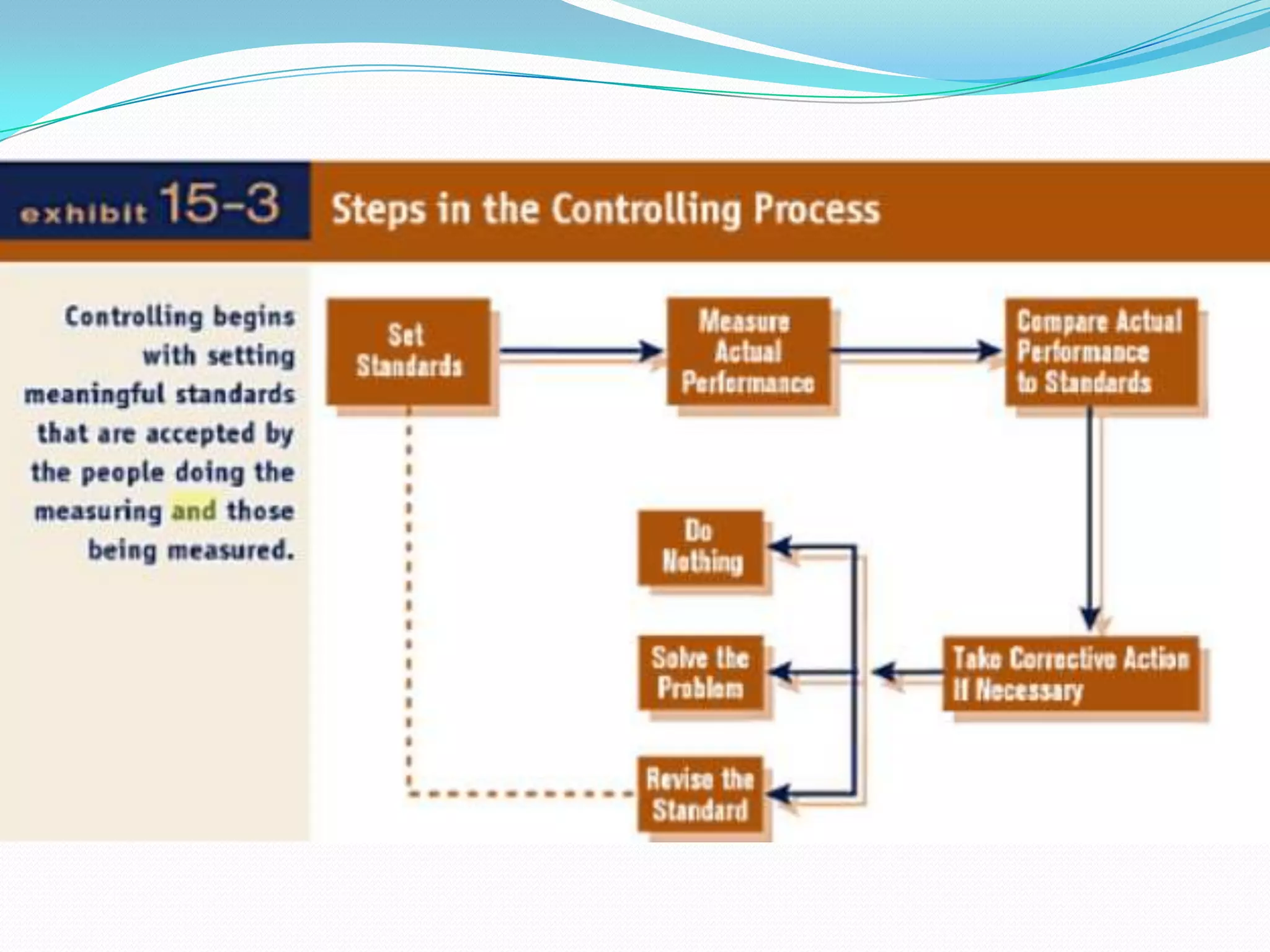
Steps in the control process
The steps in the control process follow the logic of planning:

1) Performance standard are set.

2) Performance is measured.

3) Performance is compared to standards.

4) Corrective action is taken if needed.
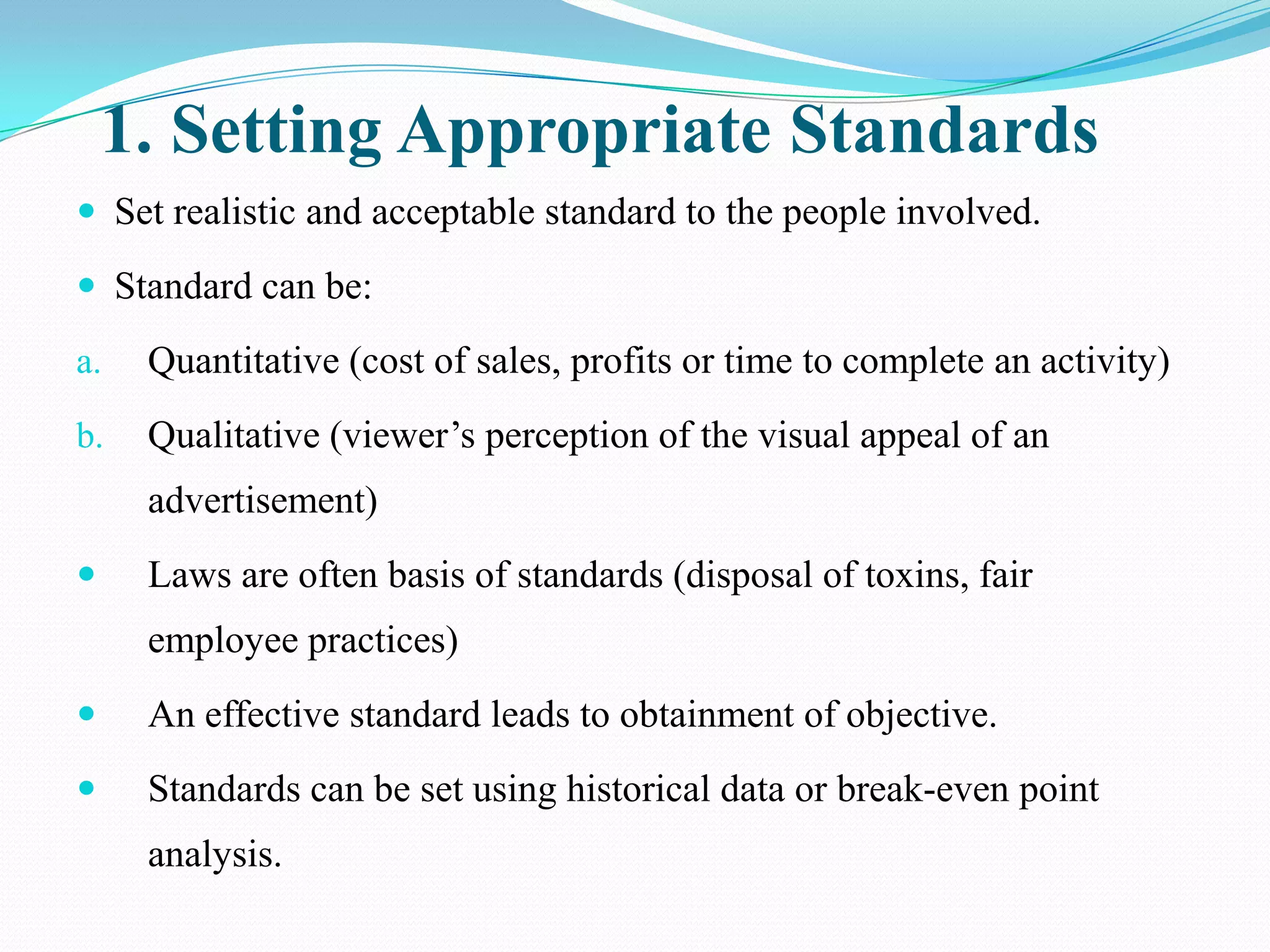
1. Setting Appropriate Standards
 Set realistic and acceptable standard to the people involved.

 Standard can be:

a.   Quantitative (cost of sales, profits or time to complete an activity)
b.   Qualitative (viewer’s perception of the visual appeal of an
     advertisement)
    Laws are often basis of standards (disposal of toxins, fair
     employee practices)
    An effective standard leads to obtainment of objective.
    Standards can be set using historical data or break-even point
     analysis.
2. Measuring Actual Performance
 Observation of the performance

     a simple example would be observing to make sure a sales associate
     always asks a customer “ Is there anything else I could show you
     now?”
 The three important conditions for effective performance
     measurement are:
a.    Agree on the specific aspects of performance to be measured.
b. Agree on the accuracy of measurement

       needed.
c. Agree on who will use the measurements.
3. Comparing Actual Performance To
            Standards
 Size of the discrepancy between performance standard and
  actual results.
 How much deviation from the standard is a basis for corrective
  action.(exception principle)
 The manager has to find out two things here- extent of
  deviation and cause of deviation.
 After finding out the deviation the information should be
  communicated.
4. Taking Corrective Action
 Once the causes and extent of deviations are known, the
  manager has to detect those errors and take remedial measures
  for it.

 There are three courses of action:

 Do nothing

 Solve the problem(taking corrective steps)

 Revise the standard(may occur in case of error in planning)
Non Budgetary Control Techniques
Non Budgetary control techniques can be classified into two types
 Qualitative Control Technique

  Qualitative control technique are methods based on human
  judgements about performance that result in a verbal rather than a
  numerical evaluation.
  For e.g. customer service might be rated as “outstanding”.
 Quantitative Control Technique

  Quantitative control technique are methods based on numerical
  measures of performance
  For e.g. such as lines of computer code produced per hour.
Qualitative Control Technique
The competence and ethics of people collecting information for qualitative
     controls influence the effectiveness of these controls.

Technique

1.     External Audit: Verification of financial records by external agency or
       individual. Conducted by an outside agency, such as a CPA (Certified
       Public Accounting Firm).

2.     Internal Audit: Verification of financial records by an internal group of
       personnel. Wide in scope, including evaluation of control system.
Cont….
3. Management Audit: Use of auditing techniques to evaluate the overall
     effectiveness of management. Examines wide range of management
     practices, policies and procedures.

4.   Personal Observation: Manager’s firsthand observations of how well
     plans are carried out. Natural part of manger’s job.

5.   Performance appraisal: formal method or system of measuring, evaluating
     and reviewing employee performance. Points out areas of deficiency and
     areas for corrective action; manger and group members jointly solve the
     problem.
Quantitative Control Techniques
 Gantt Chart: Chart depicting planned and actual progress of work on
  a project. Describes progress on a project.

 PERT: Method of scheduling activities and events using time
  estimates. Measuring how well the project is meeting the schedule.

 Break-even analysis: Ratio of fixed costs to price minus
  variable costs. Measuring organization's performance and gives
  basis for corrective action
Cont….
 Economic-Order Quantity: Inventory level that minimizes ordering
  and carrying costs. Avoids having too much or too little inventory.

 Variance Analysis: Major control device in manufacturing.
  Establishes standard costs for materials, labor and overhead and
  then measures deviations from these costs.
Budgetary and Financial Ratio as
       Control Devices
 The control process relies on the use of budget s and financial
  ratios.
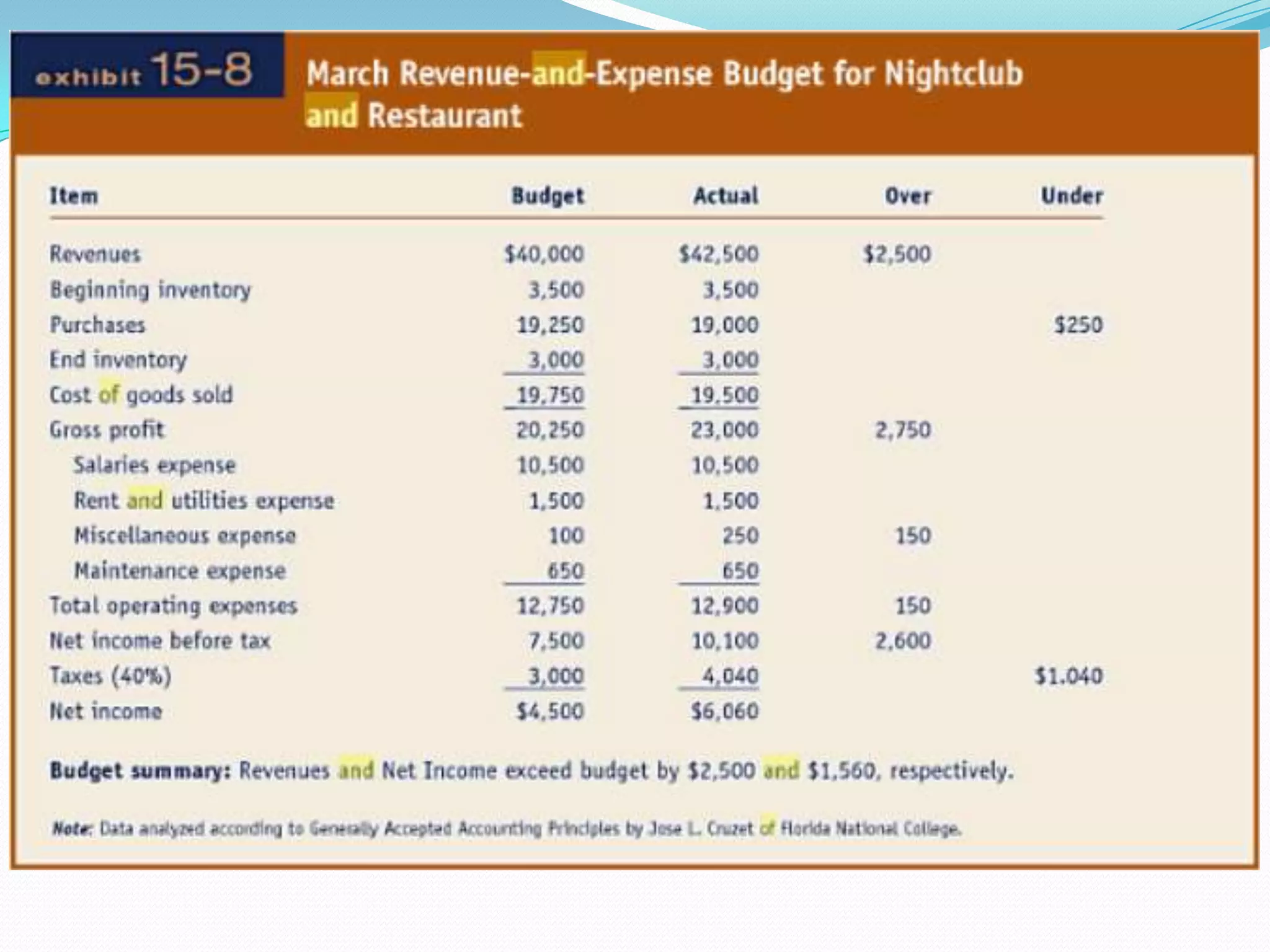
 In budgets planned expenditure and actual expenditures are
  compared.

 A more advanced method of using budgets for control is to use
  financial ratio guidelines for performance.
Cont….
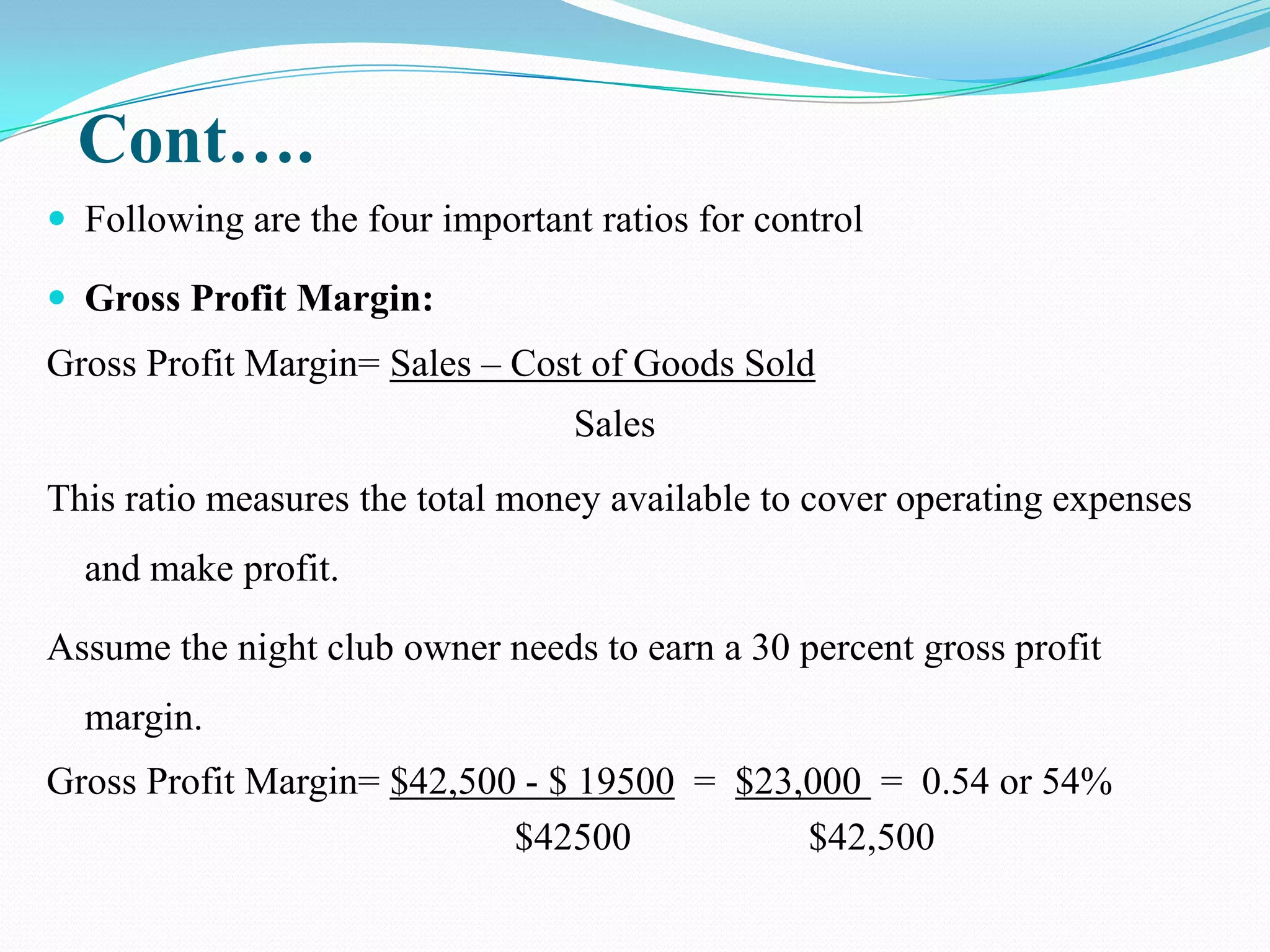
 Following are the four important ratios for control

 Gross Profit Margin:
Gross Profit Margin= Sales – Cost of Goods Sold
                                  Sales
This ratio measures the total money available to cover operating expenses
  and make profit.

Assume the night club owner needs to earn a 30 percent gross profit
  margin.
Gross Profit Margin= $42,500 - $ 19500 = $23,000 = 0.54 or 54%
                            $42500           $42,500
Cont….
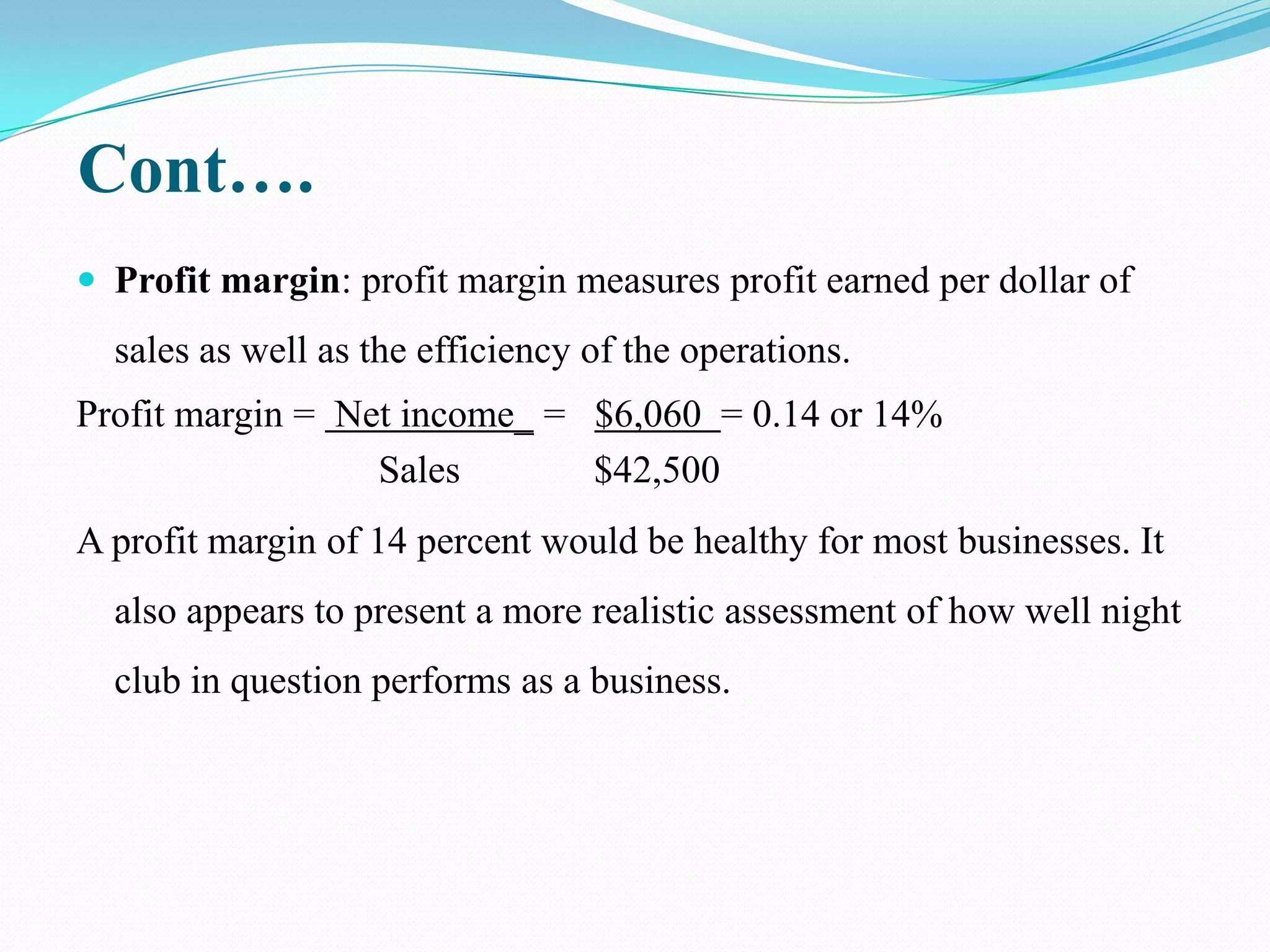
 Profit margin: profit margin measures profit earned per dollar of
  sales as well as the efficiency of the operations.
Profit margin = Net income_ = $6,060 = 0.14 or 14%
                  Sales       $42,500
A profit margin of 14 percent would be healthy for most businesses. It
  also appears to present a more realistic assessment of how well night
  club in question performs as a business.
Cont….
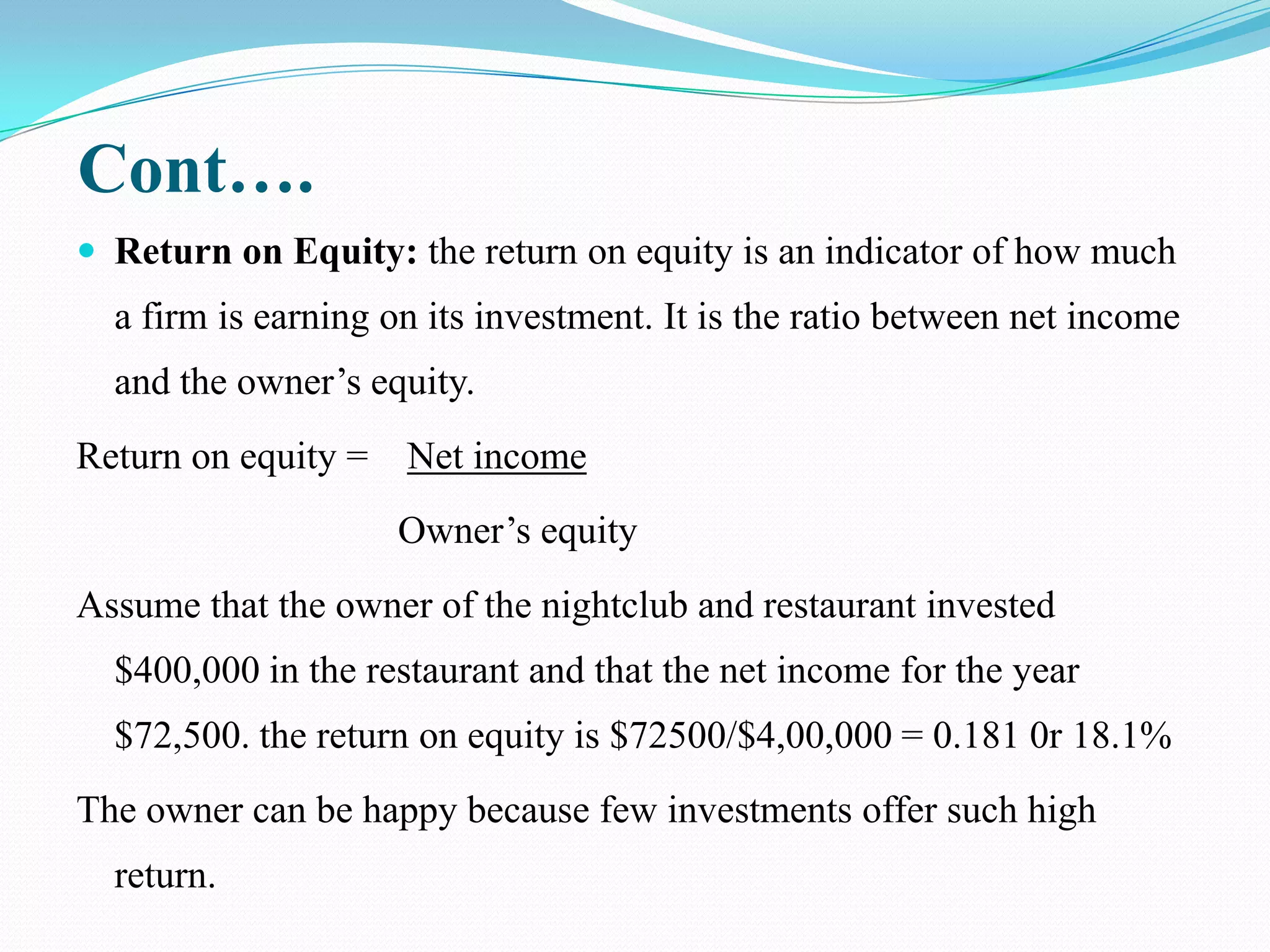
 Return on Equity: the return on equity is an indicator of how much
  a firm is earning on its investment. It is the ratio between net income
  and the owner’s equity.
Return on equity =   Net income
                     Owner’s equity
Assume that the owner of the nightclub and restaurant invested
  $400,000 in the restaurant and that the net income for the year
  $72,500. the return on equity is $72500/$4,00,000 = 0.181 0r 18.1%
The owner can be happy because few investments offer such high
  return.
Cont….
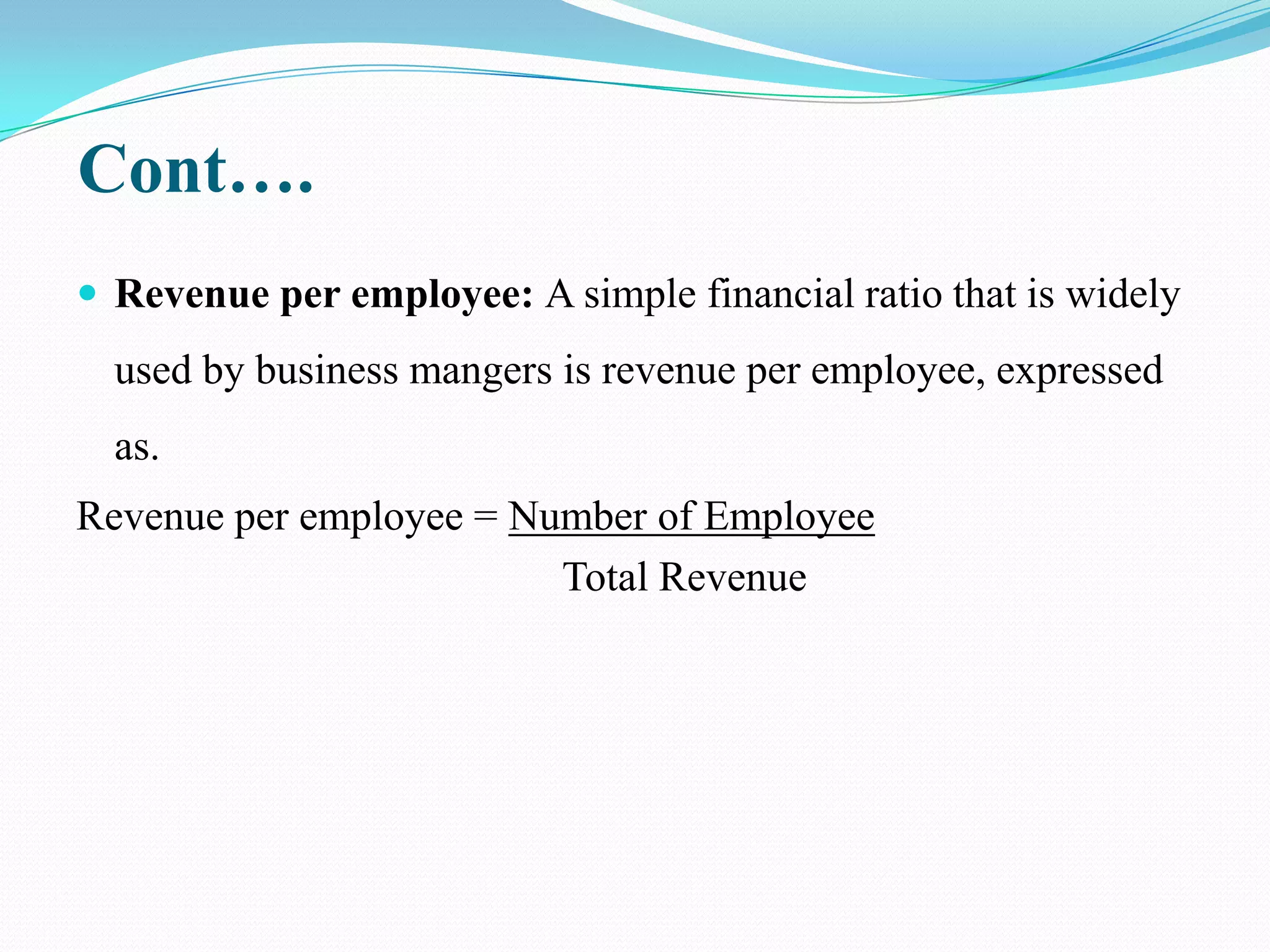
 Revenue per employee: A simple financial ratio that is widely
  used by business mangers is revenue per employee, expressed
  as.
Revenue per employee = Number of Employee
                         Total Revenue
Final essential of controlling

Final essential of controlling

  • 1.
    Presented by GeorgeD’lima. Roll No: M1215. Subject: Perspective Management.
  • 2.
    Controlling and theother management functions  Controlling referred to as the terminal management function.  Controlling is a pervasive function- which means it is performed by managers at all levels and in all type of concerns.  Evaluating the other management functions.  Controlling is a dynamic process- since controlling requires taking reviewal methods, changes have to be made wherever possible.  Strongly associated with planning.  Controlling is forward looking- Controlling analysis the past and help achieving future goals.
  • 4.
    Controlling Planning Planning- Controlling Linkage Leading Organizing
  • 5.
    Types and strategiesof control Controlling can be classified in 1. According to time a. Before b. During c. After 2. According to the source of control a. Internal b. External
  • 7.
    1. The Timeelement in control a. Preventive Control (before)  Prior to performance of an activity.  Prevent deviation from performance standard.  Most cost-effective method.  Can be applied for e.g. in: a. Manufacturing (purchase high quality machine part). b. Human resource (recruiting non smokers).
  • 8.
    Cont…. b. Concurrent Control(during):  Monitoring activities while they are carried out.  Observation of deviation from standards.  Makes constructive suggestions.  Such controls are also known as steering controls.  For eg: suppose a telemarketing manager overhears a telemarketer fails to ask a customer for an order. On the spot, the manager would coach the telemarketer about how to close an order.
  • 9.
    Cont…. c. Feedback Controlor post controls (after):  Evaluate an activity after it is performed.  Pointing out what went wrong in the past.  Financial statement analysis is a form of feedback control.
  • 10.
    II. External andInternal Controls External control strategy  Based on the belief that employees are motivated primarily by external rewards and need to be controlled by their mangers.  For eg: Relience Internal control strategy  Based on the belief that employees can be motivated by building their commitment to organisational goals.  For eg: Toyota Corp.
  • 11.
  • 12.
  • 13.
    Steps in thecontrol process The steps in the control process follow the logic of planning: 1) Performance standard are set. 2) Performance is measured. 3) Performance is compared to standards. 4) Corrective action is taken if needed.
  • 16.
    1. Setting AppropriateStandards  Set realistic and acceptable standard to the people involved.  Standard can be: a. Quantitative (cost of sales, profits or time to complete an activity) b. Qualitative (viewer’s perception of the visual appeal of an advertisement)  Laws are often basis of standards (disposal of toxins, fair employee practices)  An effective standard leads to obtainment of objective.  Standards can be set using historical data or break-even point analysis.
  • 17.
    2. Measuring ActualPerformance  Observation of the performance a simple example would be observing to make sure a sales associate always asks a customer “ Is there anything else I could show you now?”  The three important conditions for effective performance measurement are: a. Agree on the specific aspects of performance to be measured. b. Agree on the accuracy of measurement needed. c. Agree on who will use the measurements.
  • 18.
    3. Comparing ActualPerformance To Standards  Size of the discrepancy between performance standard and actual results.  How much deviation from the standard is a basis for corrective action.(exception principle)  The manager has to find out two things here- extent of deviation and cause of deviation.  After finding out the deviation the information should be communicated.
  • 19.
    4. Taking CorrectiveAction  Once the causes and extent of deviations are known, the manager has to detect those errors and take remedial measures for it.  There are three courses of action:  Do nothing  Solve the problem(taking corrective steps)  Revise the standard(may occur in case of error in planning)
  • 20.
    Non Budgetary ControlTechniques Non Budgetary control techniques can be classified into two types  Qualitative Control Technique Qualitative control technique are methods based on human judgements about performance that result in a verbal rather than a numerical evaluation. For e.g. customer service might be rated as “outstanding”.  Quantitative Control Technique Quantitative control technique are methods based on numerical measures of performance For e.g. such as lines of computer code produced per hour.
  • 21.
    Qualitative Control Technique Thecompetence and ethics of people collecting information for qualitative controls influence the effectiveness of these controls. Technique 1. External Audit: Verification of financial records by external agency or individual. Conducted by an outside agency, such as a CPA (Certified Public Accounting Firm). 2. Internal Audit: Verification of financial records by an internal group of personnel. Wide in scope, including evaluation of control system.
  • 22.
    Cont…. 3. Management Audit:Use of auditing techniques to evaluate the overall effectiveness of management. Examines wide range of management practices, policies and procedures. 4. Personal Observation: Manager’s firsthand observations of how well plans are carried out. Natural part of manger’s job. 5. Performance appraisal: formal method or system of measuring, evaluating and reviewing employee performance. Points out areas of deficiency and areas for corrective action; manger and group members jointly solve the problem.
  • 23.
    Quantitative Control Techniques Gantt Chart: Chart depicting planned and actual progress of work on a project. Describes progress on a project.  PERT: Method of scheduling activities and events using time estimates. Measuring how well the project is meeting the schedule.  Break-even analysis: Ratio of fixed costs to price minus variable costs. Measuring organization's performance and gives basis for corrective action
  • 24.
    Cont….  Economic-Order Quantity:Inventory level that minimizes ordering and carrying costs. Avoids having too much or too little inventory.  Variance Analysis: Major control device in manufacturing. Establishes standard costs for materials, labor and overhead and then measures deviations from these costs.
  • 25.
    Budgetary and FinancialRatio as Control Devices  The control process relies on the use of budget s and financial ratios.  In budgets planned expenditure and actual expenditures are compared.  A more advanced method of using budgets for control is to use financial ratio guidelines for performance.
  • 27.
    Cont….  Following arethe four important ratios for control  Gross Profit Margin: Gross Profit Margin= Sales – Cost of Goods Sold Sales This ratio measures the total money available to cover operating expenses and make profit. Assume the night club owner needs to earn a 30 percent gross profit margin. Gross Profit Margin= $42,500 - $ 19500 = $23,000 = 0.54 or 54% $42500 $42,500
  • 28.
    Cont….  Profit margin:profit margin measures profit earned per dollar of sales as well as the efficiency of the operations. Profit margin = Net income_ = $6,060 = 0.14 or 14% Sales $42,500 A profit margin of 14 percent would be healthy for most businesses. It also appears to present a more realistic assessment of how well night club in question performs as a business.
  • 29.
    Cont….  Return onEquity: the return on equity is an indicator of how much a firm is earning on its investment. It is the ratio between net income and the owner’s equity. Return on equity = Net income Owner’s equity Assume that the owner of the nightclub and restaurant invested $400,000 in the restaurant and that the net income for the year $72,500. the return on equity is $72500/$4,00,000 = 0.181 0r 18.1% The owner can be happy because few investments offer such high return.
  • 30.
    Cont….  Revenue peremployee: A simple financial ratio that is widely used by business mangers is revenue per employee, expressed as. Revenue per employee = Number of Employee Total Revenue