HUMAN RESOURCE MANAGEMENT
   IN PUBLICSECTOR
               GMGH 5214
College of Law, Government and international Studies


           SURVEILLANCE AND
           CONTROL AT WORK
         PRESENT BY : SHAHRIL BUDIMAN | 810089


                                                       LOGO
Contents


                 DEFINITION

           OPERATIONATIONALIZATION
                   CONCEPTS

               EXAMPLES / CASE


             BACKGROUND THEORY


             ANALYSIS OF THEORY


                  EXAMPLES


                                     shahril2204@gmail.com
Definition of control

  Controlling is the process of measuring
    performance and taking action to
           ensure desired results


Control consists of verifying whether everything occurs in
conformity with the plan adopted, the instructions issued, and
principles established. It„s object is to point out weaknesses and
errors in order to rectify them and prevent recurrence (Fayol :1949)


                                                    shahril2204@gmail.com
Definition of Surveillance


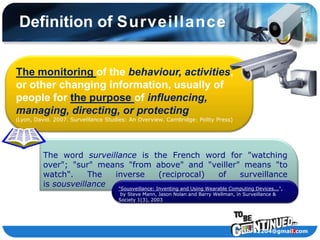
The monitoring of the behaviour, activities,
or other changing information, usually of
people for the purpose of influencing,
managing, directing, or protecting
(Lyon, David. 2007. Surveillance Studies: An Overview. Cambridge: Polity Press)


         The word surveillance is the French word for "watching
         over"; "sur" means "from above" and "veiller" means "to
         watch".     The  inverse           (reciprocal)           of      surveillance
         is sousveillance  "Sousveillance: Inventing and Using Wearable Computing Devices...",
                                     by Steve Mann, Jason Nolan and Barry Wellman, in Surveillance &
                                     Society 1(3), 2003


                                                                                    shahril2204@gmail.com
Control as part of Management


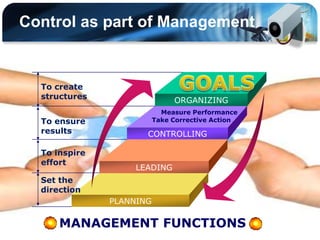
  To create
  structures                   ORGANIZING
                            Measure Performance
  To ensure               Take Corrective Action
  results             CONTROLLING

  To inspire
  effort
                    LEADING
  Set the
  direction
               PLANNING

      MANAGEMENT FUNCTIONS
                    shahril2204@gmail.com
OPERATIONALIZATION OF
CONCEPTS
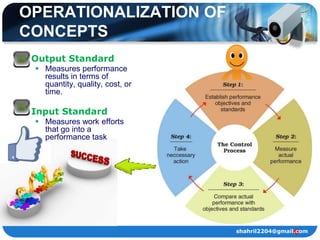
 Output Standard
   Measures performance
    results in terms of
    quantity, quality, cost, or
    time.

 Input Standard
   Measures work efforts
    that go into a
    performance task


                                  shahril2204@gmail.com
EXAMPLES


           shahril2204@gmail.com
BACKGROUND OF THEORY

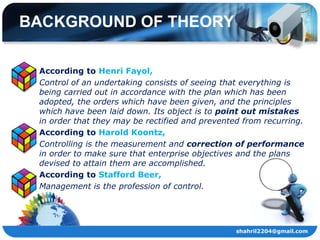
 According to Henri Fayol,
 Control of an undertaking consists of seeing that everything is
  being carried out in accordance with the plan which has been
  adopted, the orders which have been given, and the principles
  which have been laid down. Its object is to point out mistakes
  in order that they may be rectified and prevented from recurring.
 According to Harold Koontz,
 Controlling is the measurement and correction of performance
  in order to make sure that enterprise objectives and the plans
  devised to attain them are accomplished.
 According to Stafford Beer,
 Management is the profession of control.


                                                  shahril2204@gmail.com
BACKGROUND OF THEORY


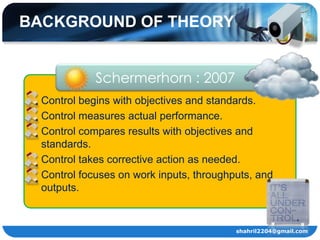
             Schermerhorn : 2007
 Control begins with objectives and standards.
 Control measures actual performance.
 Control compares results with objectives and
  standards.
 Control takes corrective action as needed.
 Control focuses on work inputs, throughputs, and
  outputs.


                                          shahril2204@gmail.com
BACKGROUND OF THEORY | CONTROL SYSTEMS

Types Of Control Systems
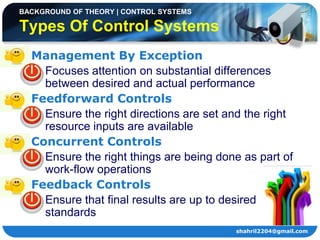
 Management By Exception
    Focuses attention on substantial differences
     between desired and actual performance
 Feedforward Controls
    Ensure the right directions are set and the right
     resource inputs are available
 Concurrent Controls
    Ensure the right things are being done as part of
     work-flow operations
 Feedback Controls
    Ensure that final results are up to desired
     standards
                                          shahril2204@gmail.com
BACKGROUND OF THEORY | CONTROL SYSTEMS

     Types Of Control Systems

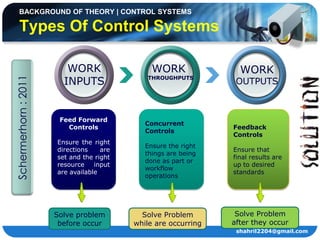
                         WORK                  WORK               WORK
                        INPUTS               THROUGHPUTS
Schermerhorn : 2011


                                                                 OUTPUTS


                       Feed Forward
                                             Concurrent
                         Controls                               Feedback
                                             Controls
                                                                Controls
                      Ensure the right
                                             Ensure the right
                      directions    are                         Ensure that
                                             things are being
                      set and the right                         final results are
                                             done as part or
                      resource    input                         up to desired
                                             workflow
                      are available                             standards
                                             operations


                      Solve problem         Solve Problem        Solve Problem
                       before occur       while are occurring   after they occur
                                                                 shahril2204@gmail.com
ANALYZE THE THEORY |
ORGANIZATIONAL CONTROL SYSTEMS AND TECHNIQUES

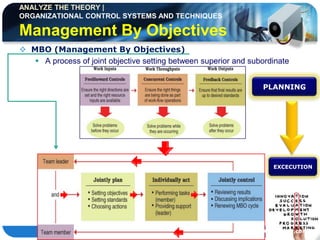
Management By Objectives
 MBO (Management By Objectives)
    A process of joint objective setting between superior and subordinate


                                                                  PLANNING


                                                                     EXCECUTION


                                                           shahril2204@gmail.com
ANALYZE THE THEORY | CONTROL AND CONTROL SYSTEMS
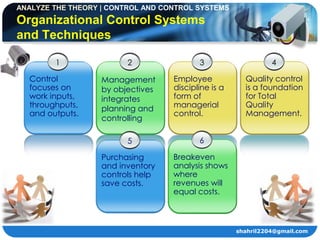
Organizational Control Systems
and Techniques

        1                2                3                    4

  Control          Management      Employee            Quality control
  focuses on       by objectives   discipline is a     is a foundation
  work inputs,     integrates      form of             for Total
  throughputs,     planning and    managerial          Quality
  and outputs.                     control.            Management.
                   controlling

                         5                6

                   Purchasing      Breakeven
                   and inventory   analysis shows
                   controls help   where
                   save costs.     revenues will
                                   equal costs.


                                                     shahril2204@gmail.com
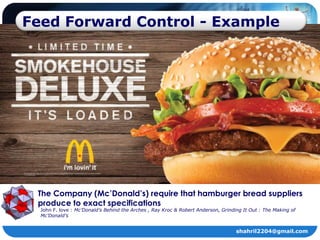
Feed Forward Control - Example


 The Company (Mc’Donald’s) require that hamburger bread suppliers
 produce to exact specifications
  John F. love : Mc’Donald’s Behind the Arches , Ray Kroc & Robert Anderson, Grinding It Out : The Making of
  Mc’Donald’s


                                                                                   shahril2204@gmail.com
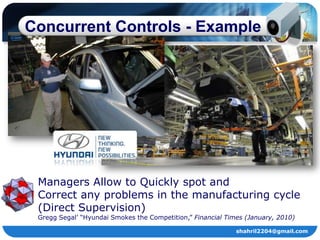
Concurrent Controls - Example


 Managers Allow to Quickly spot and
 Correct any problems in the manufacturing cycle
 (Direct Supervision)
 Gregg Segal‟ “Hyundai Smokes the Competition,” Financial Times (January, 2010)

                                                             shahril2204@gmail.com
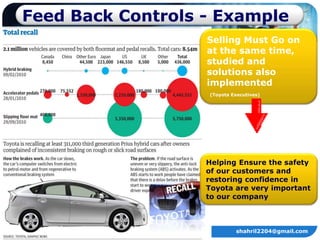
Feed Back Controls - Example
                   Selling Must Go on
                   at the same time,
                   studied and
                   solutions also
                   implemented
                   (Toyota Executives)


                   Helping Ensure the safety
                   of our customers and
                   restoring confidence in
                   Toyota are very important
                   to our company


                            shahril2204@gmail.com
References
Fayol, Henri. 1949. General and Industrial Management. New York:
    Pitman Publishing. pp. 107–109
Love, J. F. (1986). McDonald's: behind the arches. Toronto: Bantam
    Books.
Lyon, D. (2007). Surveillance studies: An overview. Cambridge, UK:
    Polity.
Kroc, R., Kroc, R., Anderson, R., & Anderson, R. (1977). Grinding it
    out: the making of McDonald's. Chicago: H. Regnery.
Robbins, S. P., & Cenzo, D. A. (2008).Fundamentals of
    Management (6. ed.). Boston, Mass.: Pearson.
Schermerhorn, J. R. (2011). Introduction to management (11th ed.).
    Hoboken, N.J.: Wiley.
Schermerhorn, J. R. (2007). Exploring management: In modules.
    Princeton, NJ: Recording for the Blind & Dyslexic.


                                                    shahril2204@gmail.com
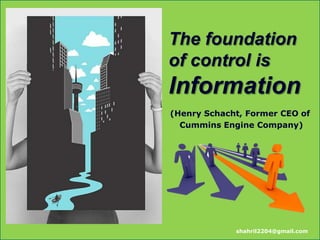
The foundation
of control is
Information
(Henry Schacht, Former CEO of
  Cummins Engine Company)


             shahril2204@gmail.com
Thank you for
your attention
  Prepared by : SHAHRIL BUDIMAN
   “Control and surveillance at work”
                        | 810089
              shahril2204@gmail.com


                                        shahril2204@gmail.com

Surveillance and control in organization

  • 1.
    HUMAN RESOURCE MANAGEMENT IN PUBLICSECTOR GMGH 5214 College of Law, Government and international Studies SURVEILLANCE AND CONTROL AT WORK PRESENT BY : SHAHRIL BUDIMAN | 810089 LOGO
  • 2.
    Contents DEFINITION OPERATIONATIONALIZATION CONCEPTS EXAMPLES / CASE BACKGROUND THEORY ANALYSIS OF THEORY EXAMPLES shahril2204@gmail.com
  • 3.
    Definition of control Controlling is the process of measuring performance and taking action to ensure desired results Control consists of verifying whether everything occurs in conformity with the plan adopted, the instructions issued, and principles established. It„s object is to point out weaknesses and errors in order to rectify them and prevent recurrence (Fayol :1949) shahril2204@gmail.com
  • 4.
    Definition of Surveillance Themonitoring of the behaviour, activities, or other changing information, usually of people for the purpose of influencing, managing, directing, or protecting (Lyon, David. 2007. Surveillance Studies: An Overview. Cambridge: Polity Press) The word surveillance is the French word for "watching over"; "sur" means "from above" and "veiller" means "to watch". The inverse (reciprocal) of surveillance is sousveillance "Sousveillance: Inventing and Using Wearable Computing Devices...", by Steve Mann, Jason Nolan and Barry Wellman, in Surveillance & Society 1(3), 2003 shahril2204@gmail.com
  • 5.
    Control as partof Management To create structures ORGANIZING Measure Performance To ensure Take Corrective Action results CONTROLLING To inspire effort LEADING Set the direction PLANNING MANAGEMENT FUNCTIONS shahril2204@gmail.com
  • 6.
    OPERATIONALIZATION OF CONCEPTS  OutputStandard  Measures performance results in terms of quantity, quality, cost, or time.  Input Standard  Measures work efforts that go into a performance task shahril2204@gmail.com
  • 7.
    EXAMPLES shahril2204@gmail.com
  • 8.
    BACKGROUND OF THEORY According to Henri Fayol,  Control of an undertaking consists of seeing that everything is being carried out in accordance with the plan which has been adopted, the orders which have been given, and the principles which have been laid down. Its object is to point out mistakes in order that they may be rectified and prevented from recurring.  According to Harold Koontz,  Controlling is the measurement and correction of performance in order to make sure that enterprise objectives and the plans devised to attain them are accomplished.  According to Stafford Beer,  Management is the profession of control. shahril2204@gmail.com
  • 9.
    BACKGROUND OF THEORY Schermerhorn : 2007  Control begins with objectives and standards.  Control measures actual performance.  Control compares results with objectives and standards.  Control takes corrective action as needed.  Control focuses on work inputs, throughputs, and outputs. shahril2204@gmail.com
  • 10.
    BACKGROUND OF THEORY| CONTROL SYSTEMS Types Of Control Systems  Management By Exception  Focuses attention on substantial differences between desired and actual performance  Feedforward Controls  Ensure the right directions are set and the right resource inputs are available  Concurrent Controls  Ensure the right things are being done as part of work-flow operations  Feedback Controls  Ensure that final results are up to desired standards shahril2204@gmail.com
  • 11.
    BACKGROUND OF THEORY| CONTROL SYSTEMS Types Of Control Systems WORK WORK WORK INPUTS THROUGHPUTS Schermerhorn : 2011 OUTPUTS Feed Forward Concurrent Controls Feedback Controls Controls Ensure the right Ensure the right directions are Ensure that things are being set and the right final results are done as part or resource input up to desired workflow are available standards operations Solve problem Solve Problem Solve Problem before occur while are occurring after they occur shahril2204@gmail.com
  • 12.
    ANALYZE THE THEORY| ORGANIZATIONAL CONTROL SYSTEMS AND TECHNIQUES Management By Objectives  MBO (Management By Objectives)  A process of joint objective setting between superior and subordinate PLANNING EXCECUTION shahril2204@gmail.com
  • 13.
    ANALYZE THE THEORY| CONTROL AND CONTROL SYSTEMS Organizational Control Systems and Techniques 1 2 3 4 Control Management Employee Quality control focuses on by objectives discipline is a is a foundation work inputs, integrates form of for Total throughputs, planning and managerial Quality and outputs. control. Management. controlling 5 6 Purchasing Breakeven and inventory analysis shows controls help where save costs. revenues will equal costs. shahril2204@gmail.com
  • 14.
    Feed Forward Control- Example The Company (Mc’Donald’s) require that hamburger bread suppliers produce to exact specifications John F. love : Mc’Donald’s Behind the Arches , Ray Kroc & Robert Anderson, Grinding It Out : The Making of Mc’Donald’s shahril2204@gmail.com
  • 15.
    Concurrent Controls -Example Managers Allow to Quickly spot and Correct any problems in the manufacturing cycle (Direct Supervision) Gregg Segal‟ “Hyundai Smokes the Competition,” Financial Times (January, 2010) shahril2204@gmail.com
  • 16.
    Feed Back Controls- Example Selling Must Go on at the same time, studied and solutions also implemented (Toyota Executives) Helping Ensure the safety of our customers and restoring confidence in Toyota are very important to our company shahril2204@gmail.com
  • 17.
    References Fayol, Henri. 1949.General and Industrial Management. New York: Pitman Publishing. pp. 107–109 Love, J. F. (1986). McDonald's: behind the arches. Toronto: Bantam Books. Lyon, D. (2007). Surveillance studies: An overview. Cambridge, UK: Polity. Kroc, R., Kroc, R., Anderson, R., & Anderson, R. (1977). Grinding it out: the making of McDonald's. Chicago: H. Regnery. Robbins, S. P., & Cenzo, D. A. (2008).Fundamentals of Management (6. ed.). Boston, Mass.: Pearson. Schermerhorn, J. R. (2011). Introduction to management (11th ed.). Hoboken, N.J.: Wiley. Schermerhorn, J. R. (2007). Exploring management: In modules. Princeton, NJ: Recording for the Blind & Dyslexic. shahril2204@gmail.com
  • 18.
    The foundation of controlis Information (Henry Schacht, Former CEO of Cummins Engine Company) shahril2204@gmail.com
  • 19.
    Thank you for yourattention Prepared by : SHAHRIL BUDIMAN “Control and surveillance at work” | 810089 shahril2204@gmail.com shahril2204@gmail.com

Editor's Notes

  • #4 Definition
  • #5 The monitoring of the behaviour, activities, or other changing information, usually of people for the purpose of influencing, managing, directing, or protecting(Lyon, David. 2007. Surveillance Studies: An Overview. Cambridge: Polity Press)
  • #6 Control is part of management functions