What is personality?
Specifically how people differ in behavior,
feelings, reactions to the environment and to
other people
Basic questions about personality
 How does one measure and describe
personality differences
 For example– what kind of person do you want to
date?
 Can personality be measured objectively?
Trait Perspective
 Take a piece of paper and write down a list of
adjectives that describes the personality of
someone you know well
Contemporary Research-- The
Trait Perspective
 Trait
 a characteristic pattern of behavior
 a disposition to feel and act, as assessed by self-
report inventories and peer reports
 Personality Inventory
 a questionnaire (often with true-false or agree-
disagree items) on which people respond to items
designed to gauge a wide range of feelings and
behaviors
 used to assess selected personality traits
The Trait Perspective
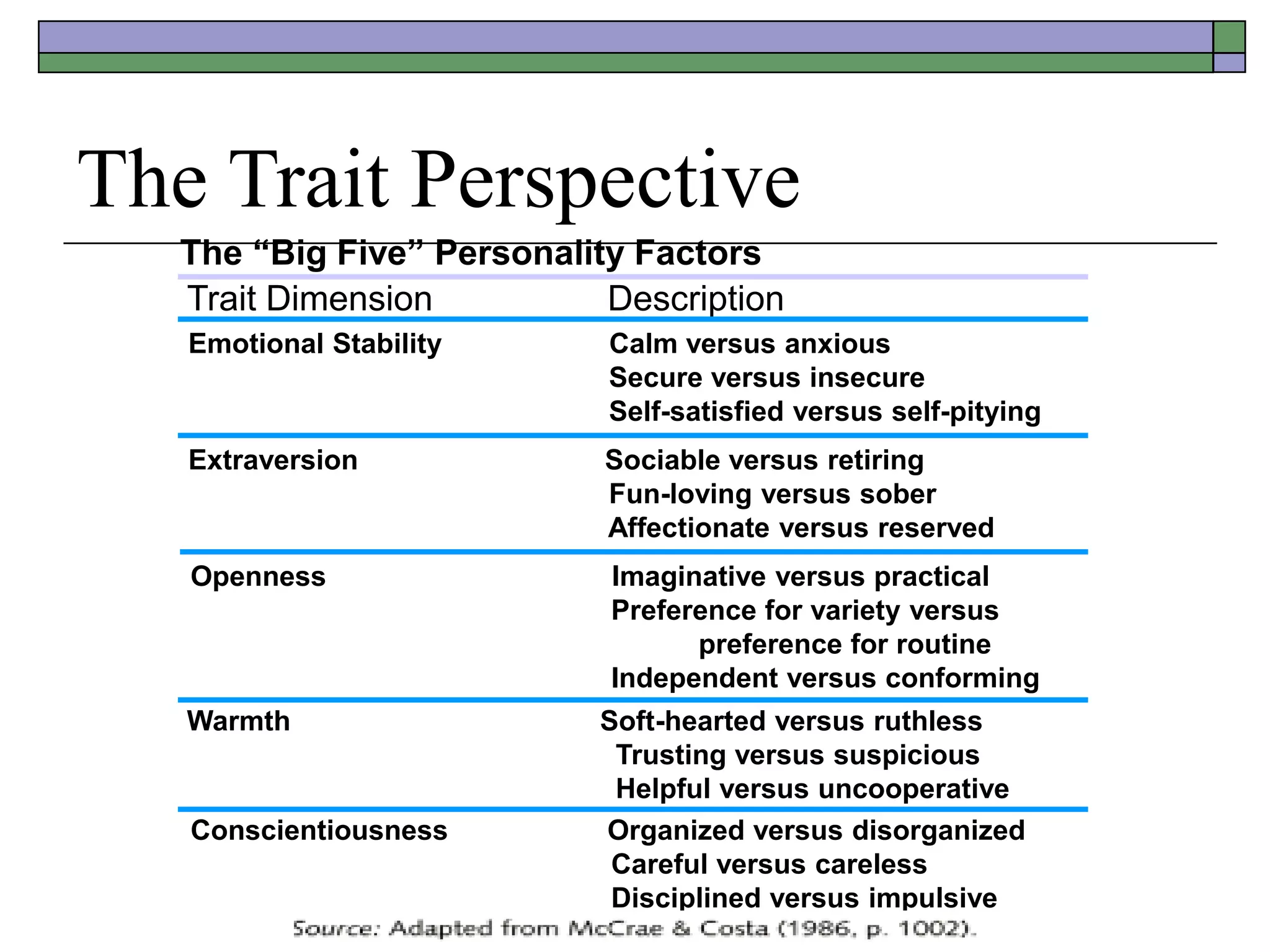
The “Big Five” Personality Factors
Trait Dimension Description
Emotional Stability Calm versus anxious
Secure versus insecure
Self-satisfied versus self-pitying
Extraversion Sociable versus retiring
Fun-loving versus sober
Affectionate versus reserved
Openness Imaginative versus practical
Preference for variety versus
preference for routine
Independent versus conforming
Warmth Soft-hearted versus ruthless
Trusting versus suspicious
Helpful versus uncooperative
Conscientiousness Organized versus disorganized
Careful versus careless
Disciplined versus impulsive
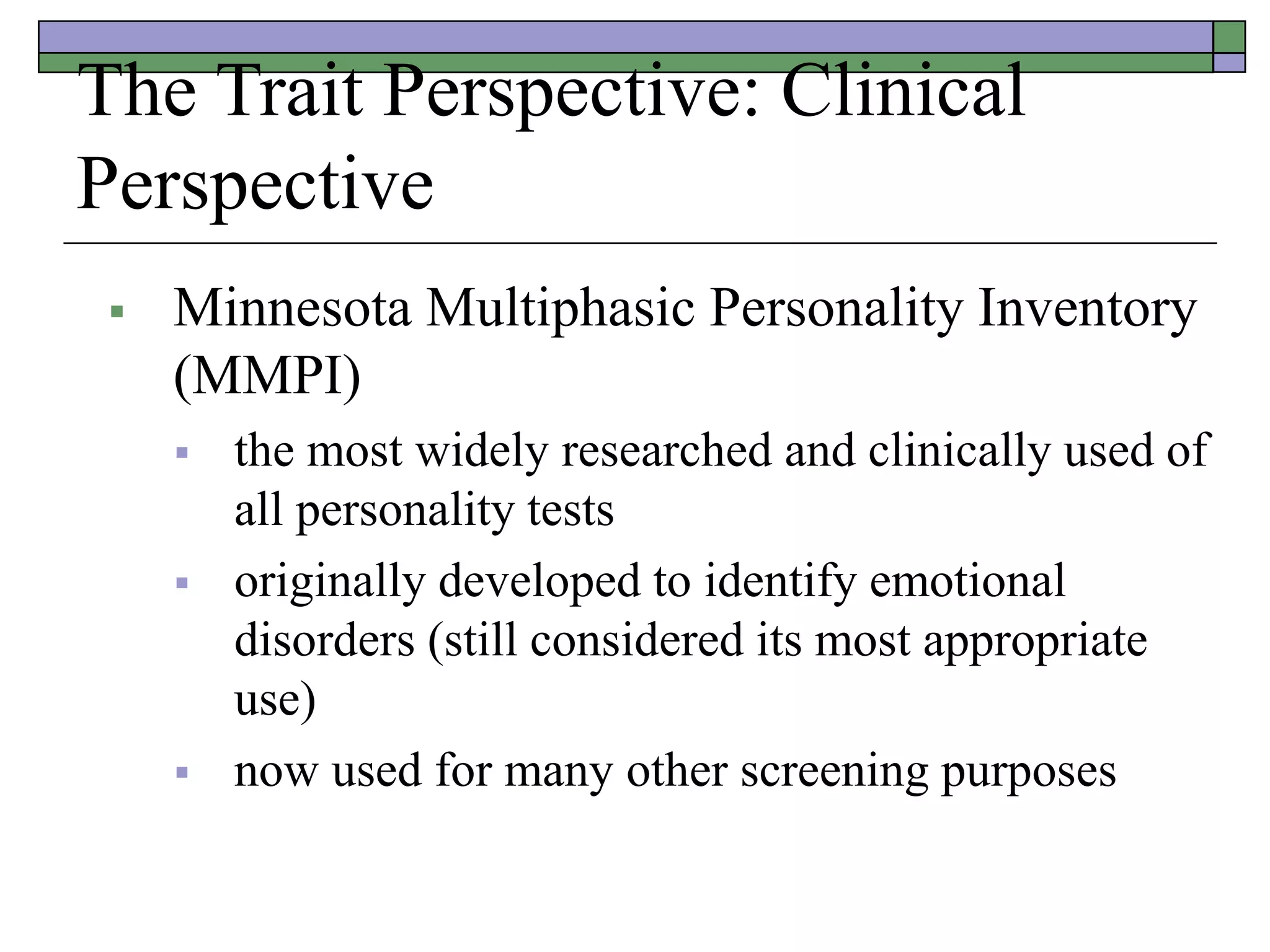
The Trait Perspective: Clinical
Perspective
 Minnesota Multiphasic Personality Inventory
(MMPI)
 the most widely researched and clinically used of
all personality tests
 originally developed to identify emotional
disorders (still considered its most appropriate
use)
 now used for many other screening purposes
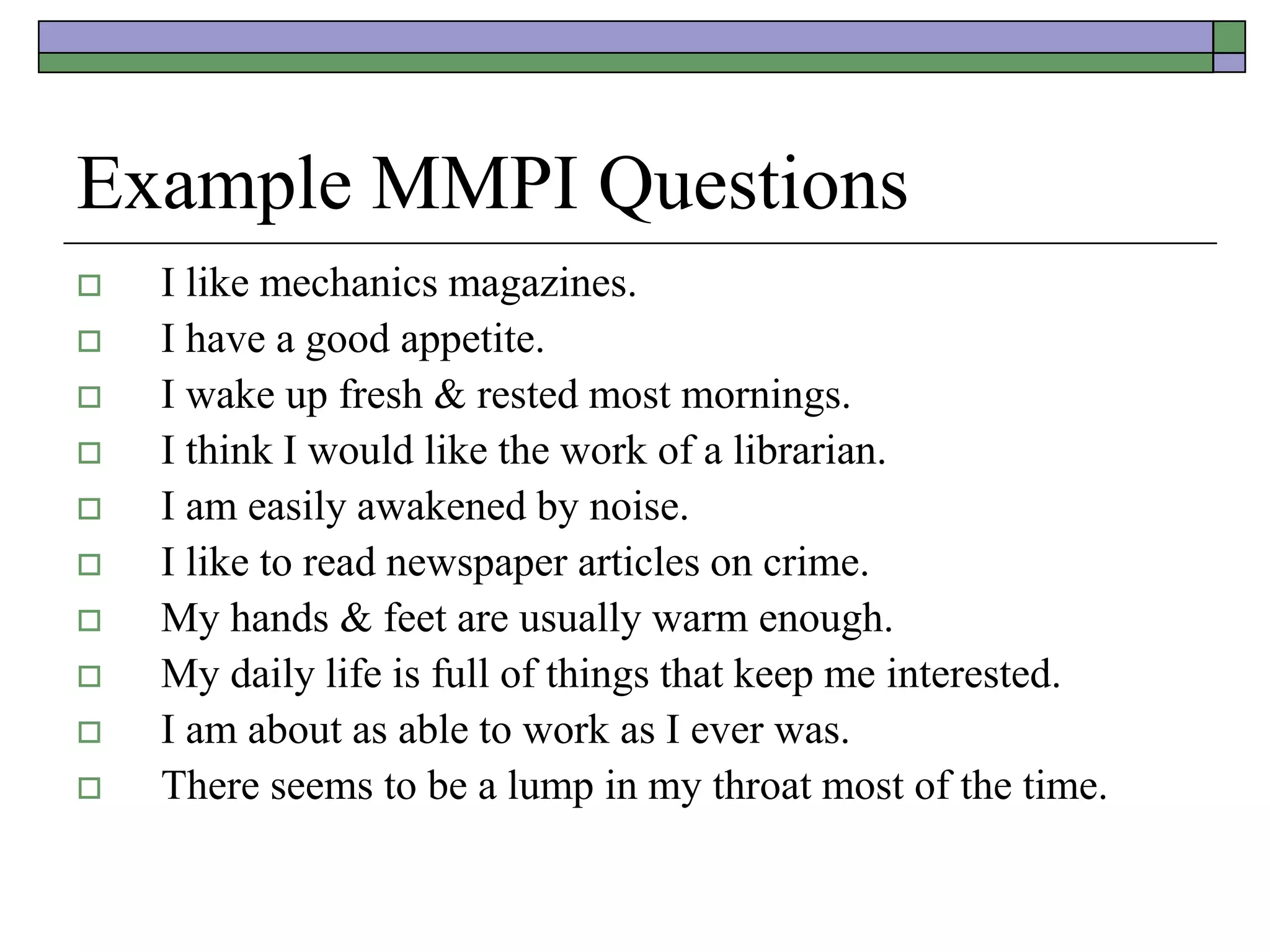
Example MMPI Questions
 I like mechanics magazines.
 I have a good appetite.
 I wake up fresh & rested most mornings.
 I think I would like the work of a librarian.
 I am easily awakened by noise.
 I like to read newspaper articles on crime.
 My hands & feet are usually warm enough.
 My daily life is full of things that keep me interested.
 I am about as able to work as I ever was.
 There seems to be a lump in my throat most of the time.
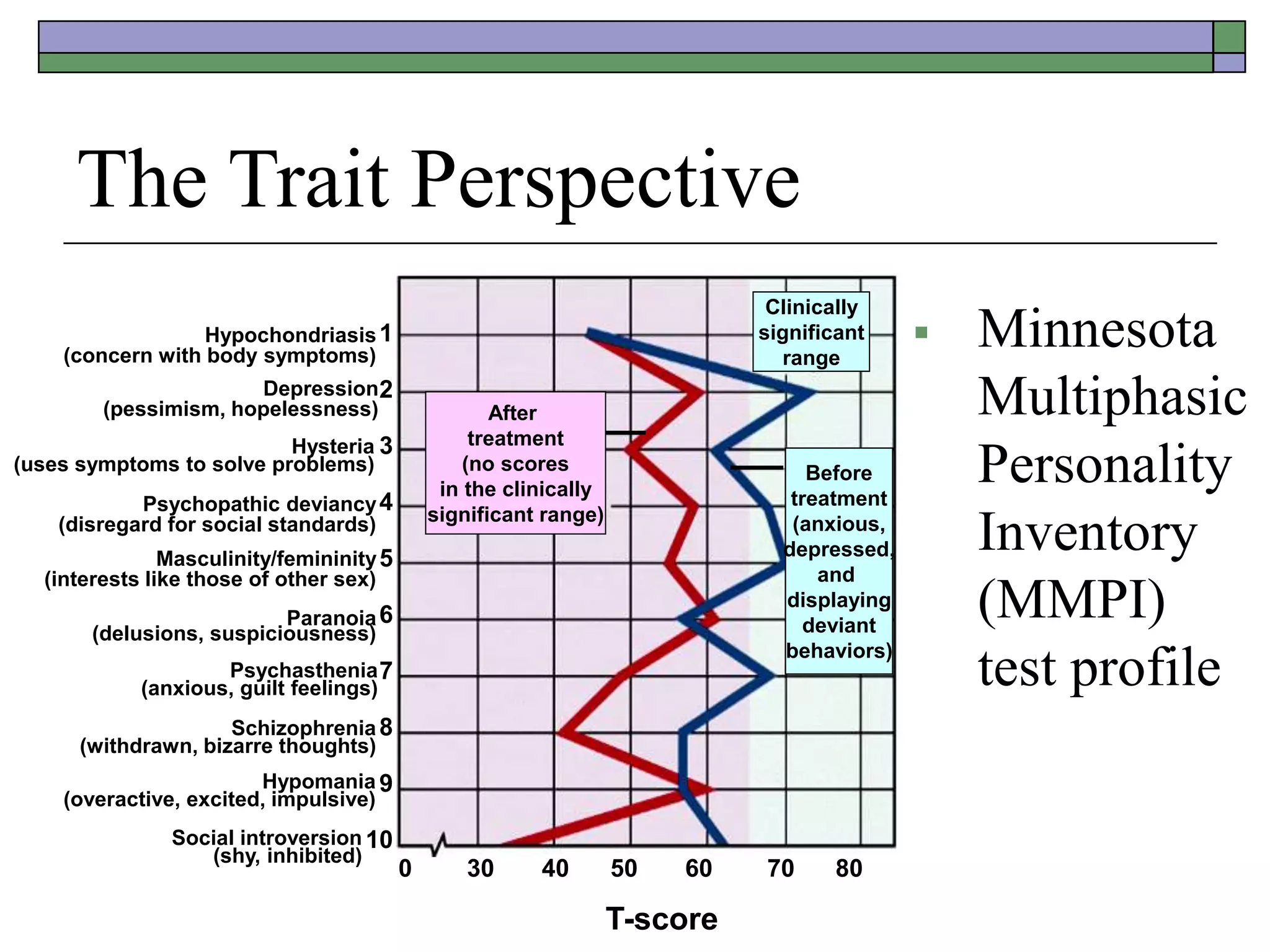
The Trait Perspective
 Minnesota
Multiphasic
Personality
Inventory
(MMPI)
test profile
Hysteria
(uses symptoms to solve problems)
Masculinity/femininity
(interests like those of other sex)
T-score
1
2
3
4
5
6
7
8
9
10
0 30 40 50 60 70 80
Hypochondriasis
(concern with body symptoms)
Depression
(pessimism, hopelessness)
Psychopathic deviancy
(disregard for social standards)
Paranoia
(delusions, suspiciousness)
Psychasthenia
(anxious, guilt feelings)
Schizophrenia
(withdrawn, bizarre thoughts)
Hypomania
(overactive, excited, impulsive)
Social introversion
(shy, inhibited)
Clinically
significant
range
After
treatment
(no scores
in the clinically
significant range)
Before
treatment
(anxious,
depressed,
and
displaying
deviant
behaviors)
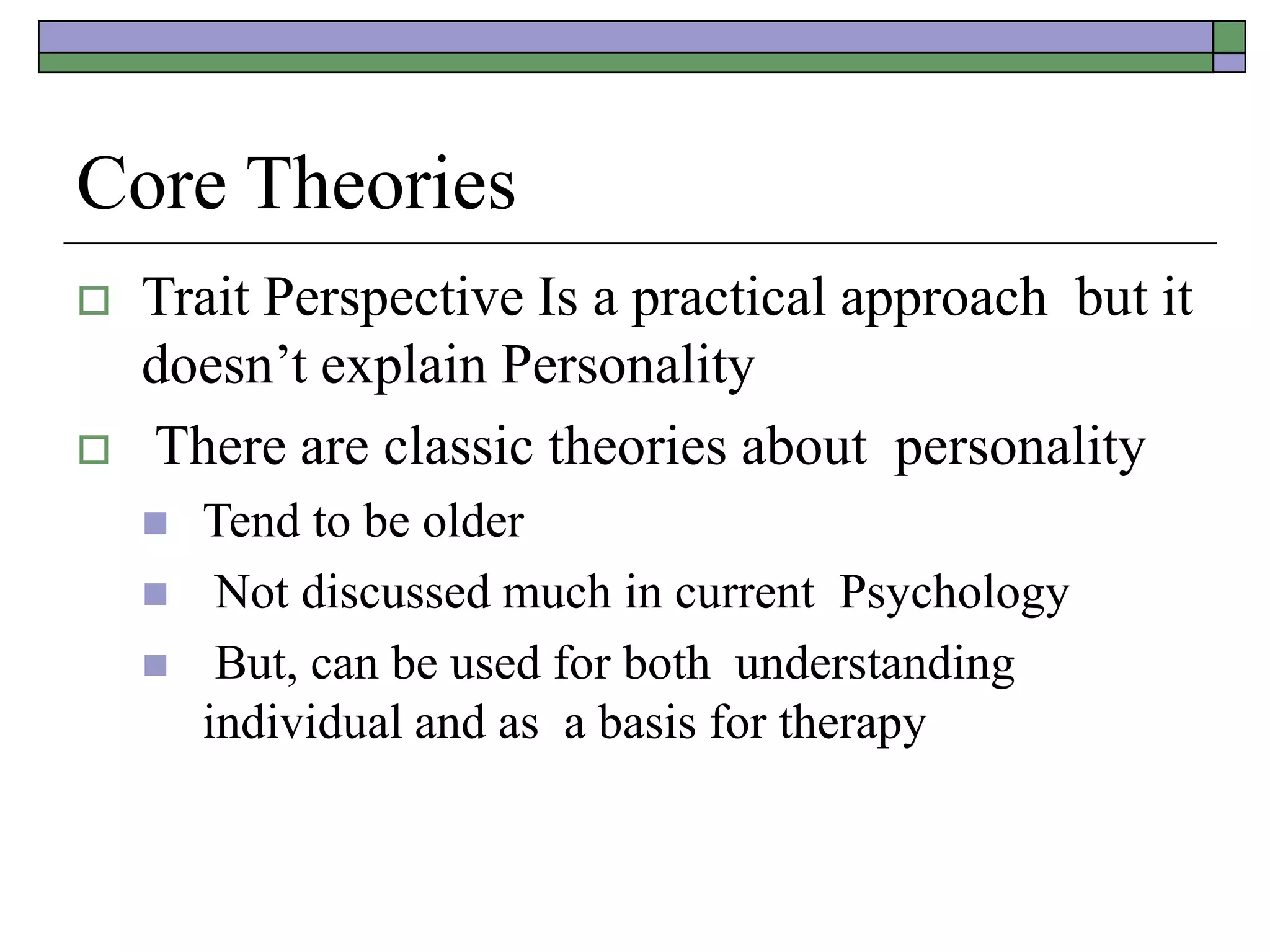
Core Theories
 Trait Perspective Is a practical approach but it
doesn’t explain Personality
 There are classic theories about personality
 Tend to be older
 Not discussed much in current Psychology
 But, can be used for both understanding
individual and as a basis for therapy
Your Theory of Personality
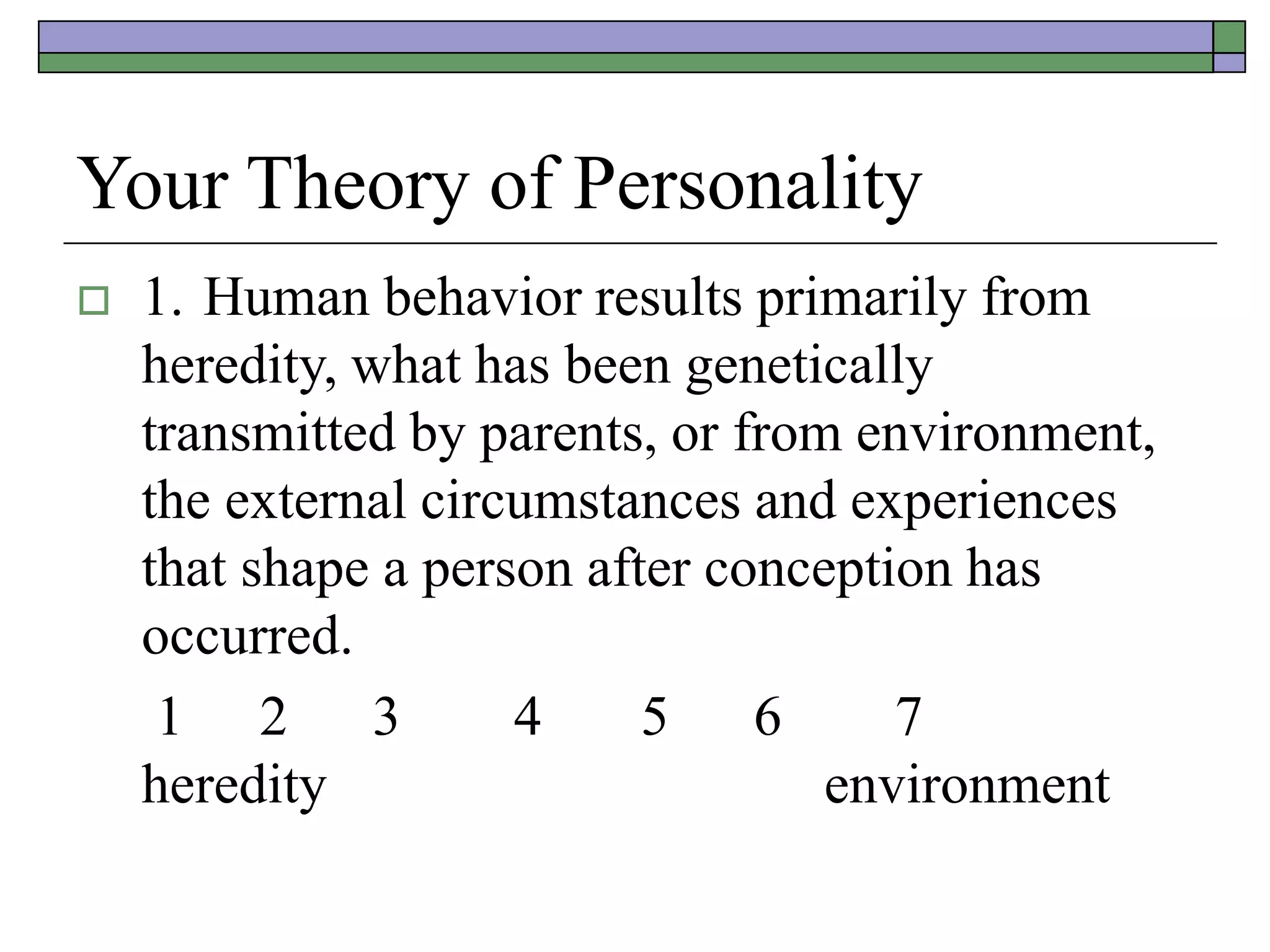
 1. Human behavior results primarily from
heredity, what has been genetically
transmitted by parents, or from environment,
the external circumstances and experiences
that shape a person after conception has
occurred.
1 2 3 4 5 6 7
heredity environment
Your Theory of Personality
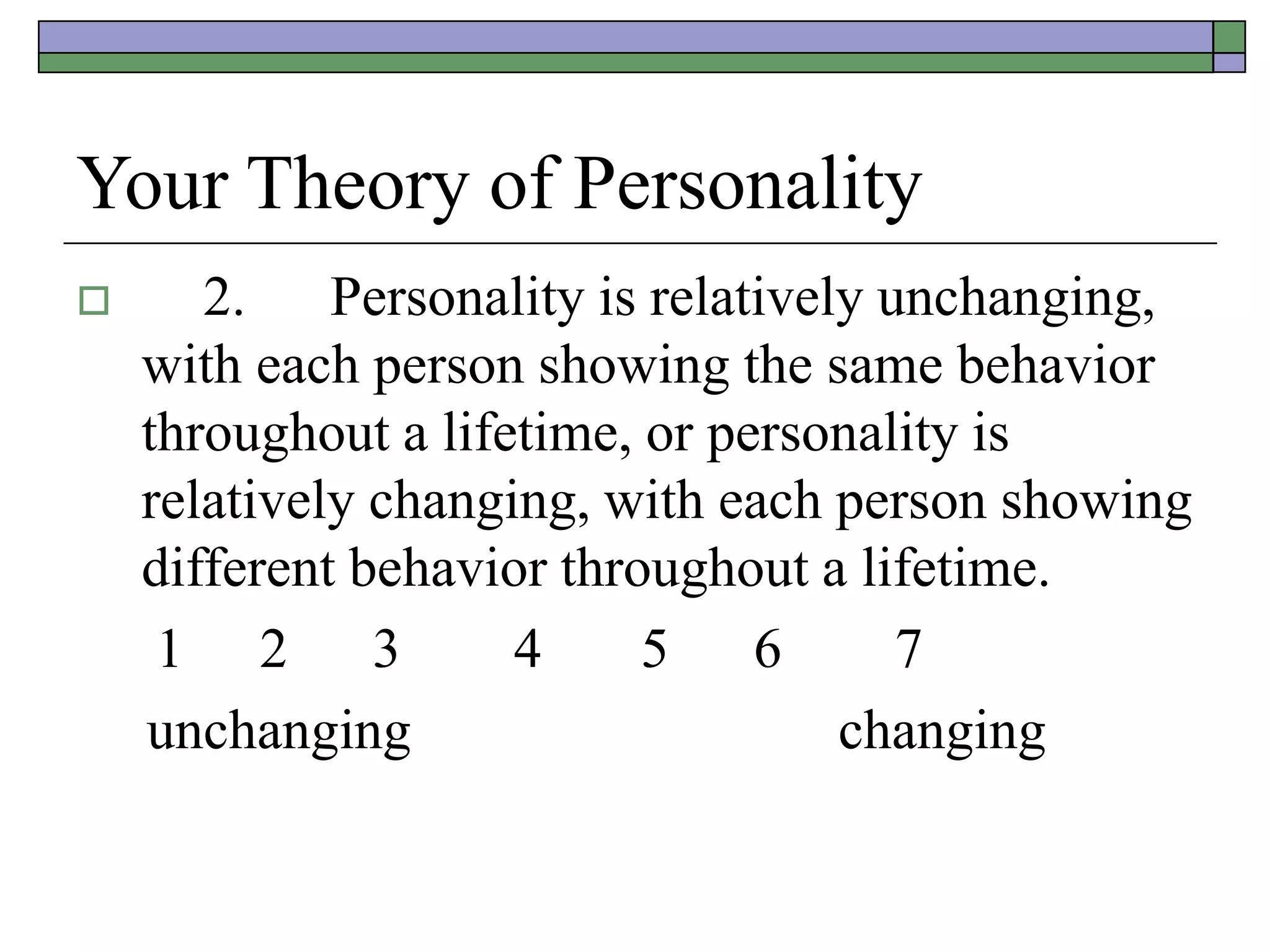
 2. Personality is relatively unchanging,
with each person showing the same behavior
throughout a lifetime, or personality is
relatively changing, with each person showing
different behavior throughout a lifetime.
1 2 3 4 5 6 7
unchanging changing
Your Theory of Personality
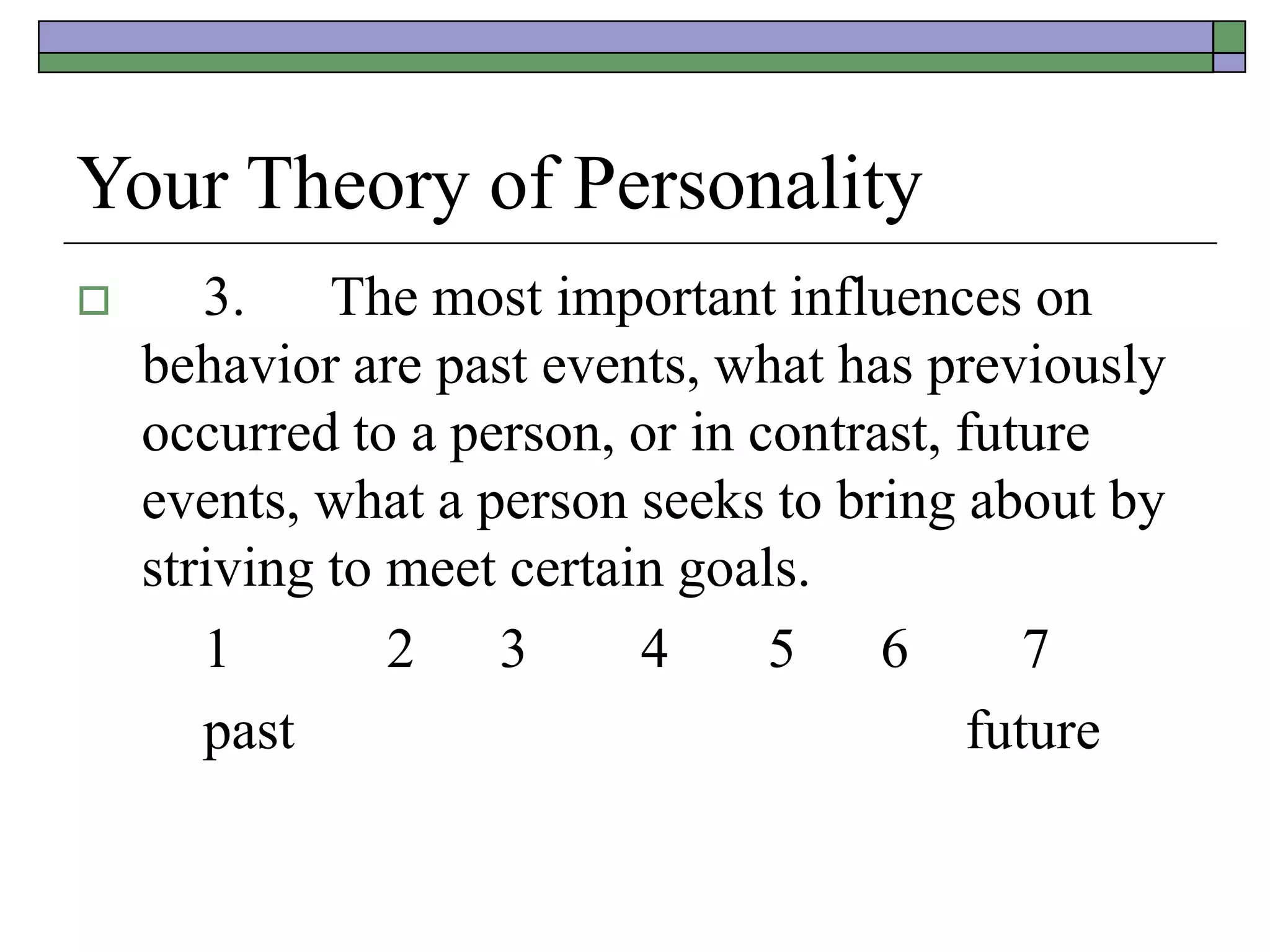
 3. The most important influences on
behavior are past events, what has previously
occurred to a person, or in contrast, future
events, what a person seeks to bring about by
striving to meet certain goals.
1 2 3 4 5 6 7
past future
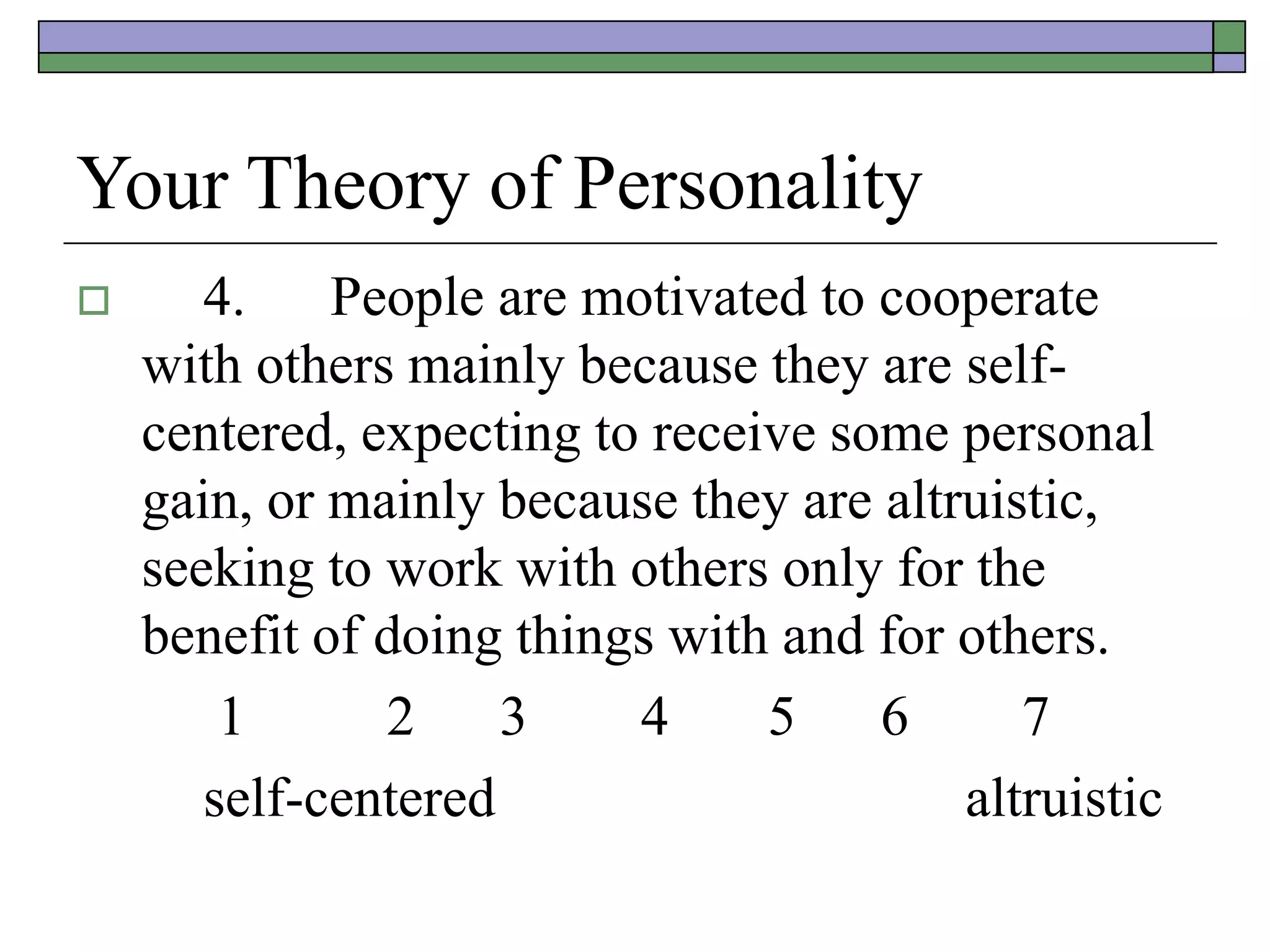
Your Theory of Personality
 4. People are motivated to cooperate
with others mainly because they are self-
centered, expecting to receive some personal
gain, or mainly because they are altruistic,
seeking to work with others only for the
benefit of doing things with and for others.
1 2 3 4 5 6 7
self-centered altruistic
What is Personality?
Basic perspectives
 Psychoanalytic—Sigmund Freud
 Humanistic– Carl Rogers
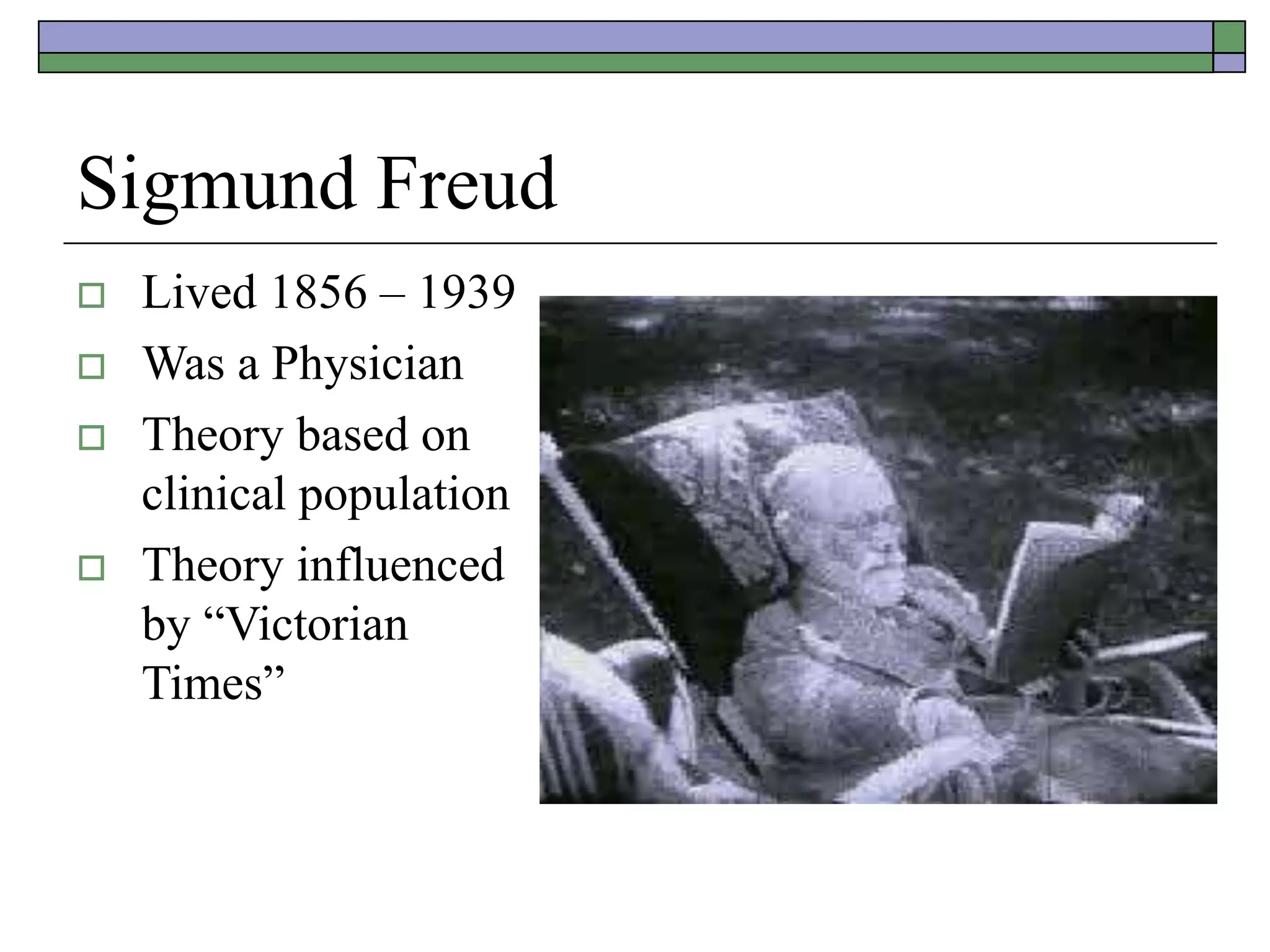
Sigmund Freud
 Lived 1856 – 1939
 Was a Physician
 Theory based on
clinical population
 Theory influenced
by “Victorian
Times”
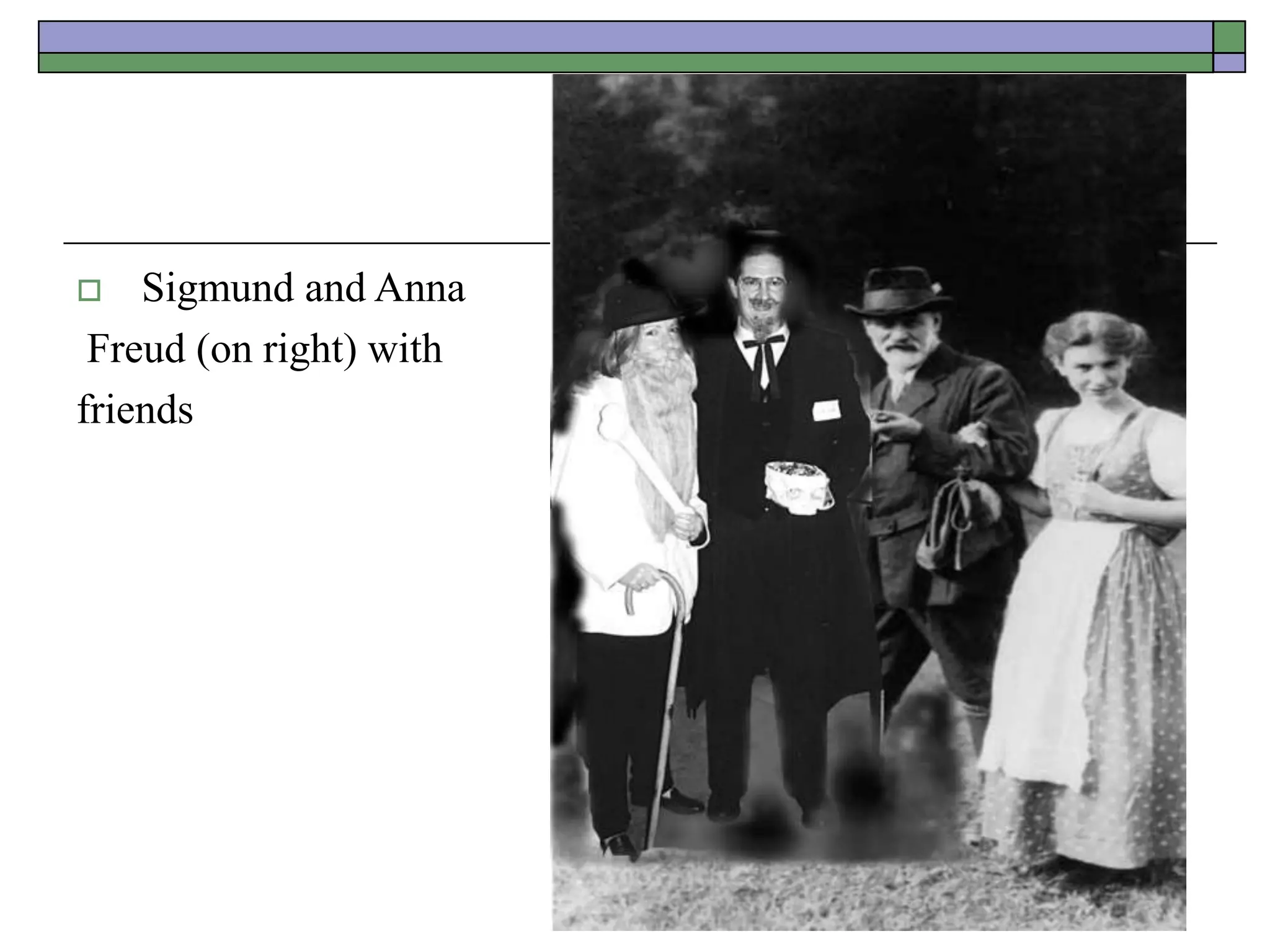
 Sigmund and Anna
Freud (on right) with
friends
The Psychoanalytic
Perspective
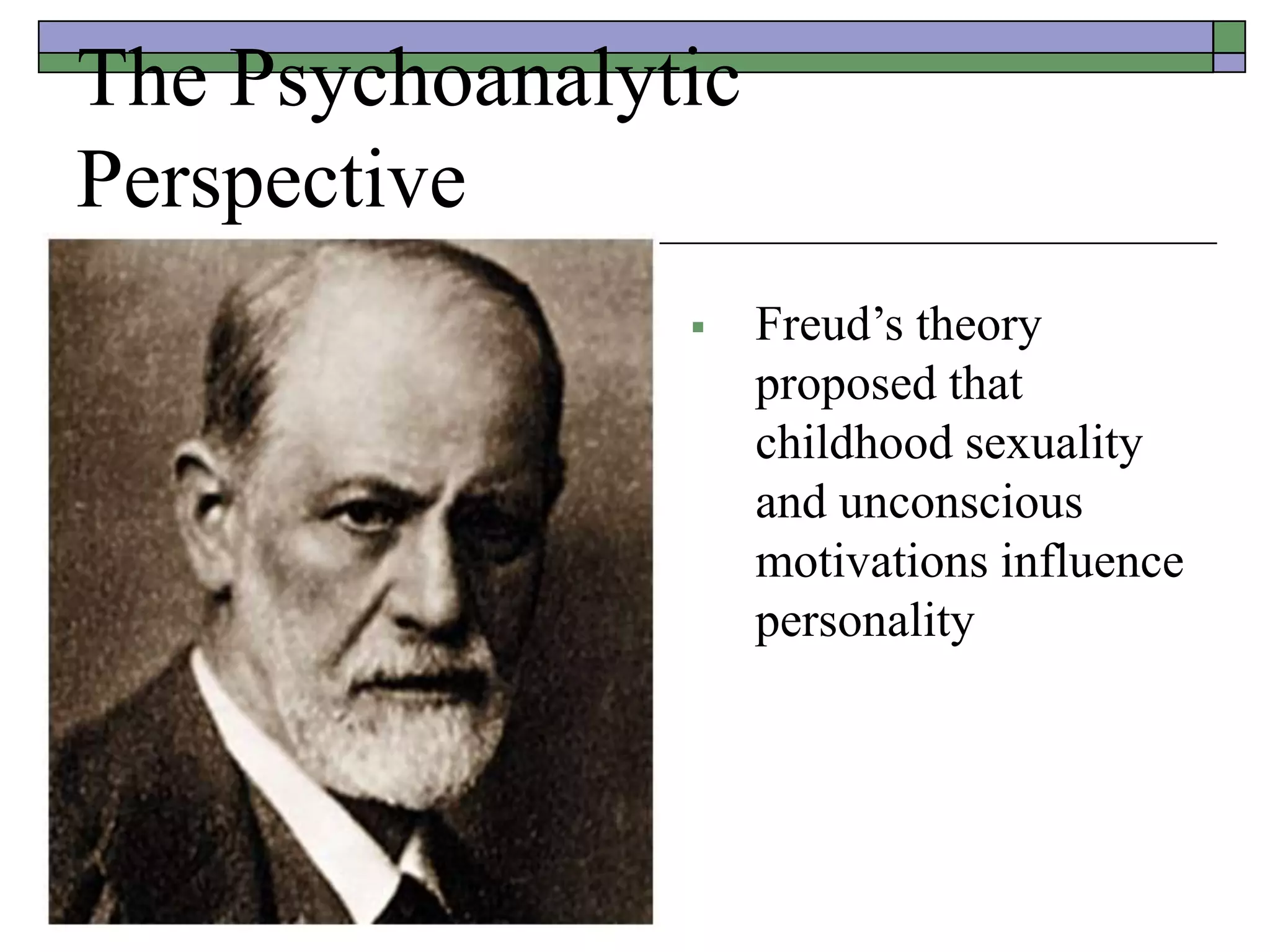
 Freud’s theory
proposed that
childhood sexuality
and unconscious
motivations influence
personality
The Psychoanalytic
Perspective
 Psychoanalysis
 Freud’s theory of personality that attributes
our thoughts and actions to unconscious
motives and conflicts
 techniques used in treating psychological
disorders by seeking to expose and
interpret unconscious tensions
The Psychoanalytic
Perspective
 First Came up use of hypnosis –
influenced by work of Dr. Mesmer
 Free Association
 in psychoanalysis, a method of
exploring the unconscious
 person relaxes and says whatever
comes to mind, no matter how trivial or
embarrassing
The Psychoanalytic
Perspective
 Unconscious
 according to Freud, a reservoir of mostly
unacceptable thoughts, wishes, feelings
and memories
 contemporary viewpoint- information
processing of which we are unaware
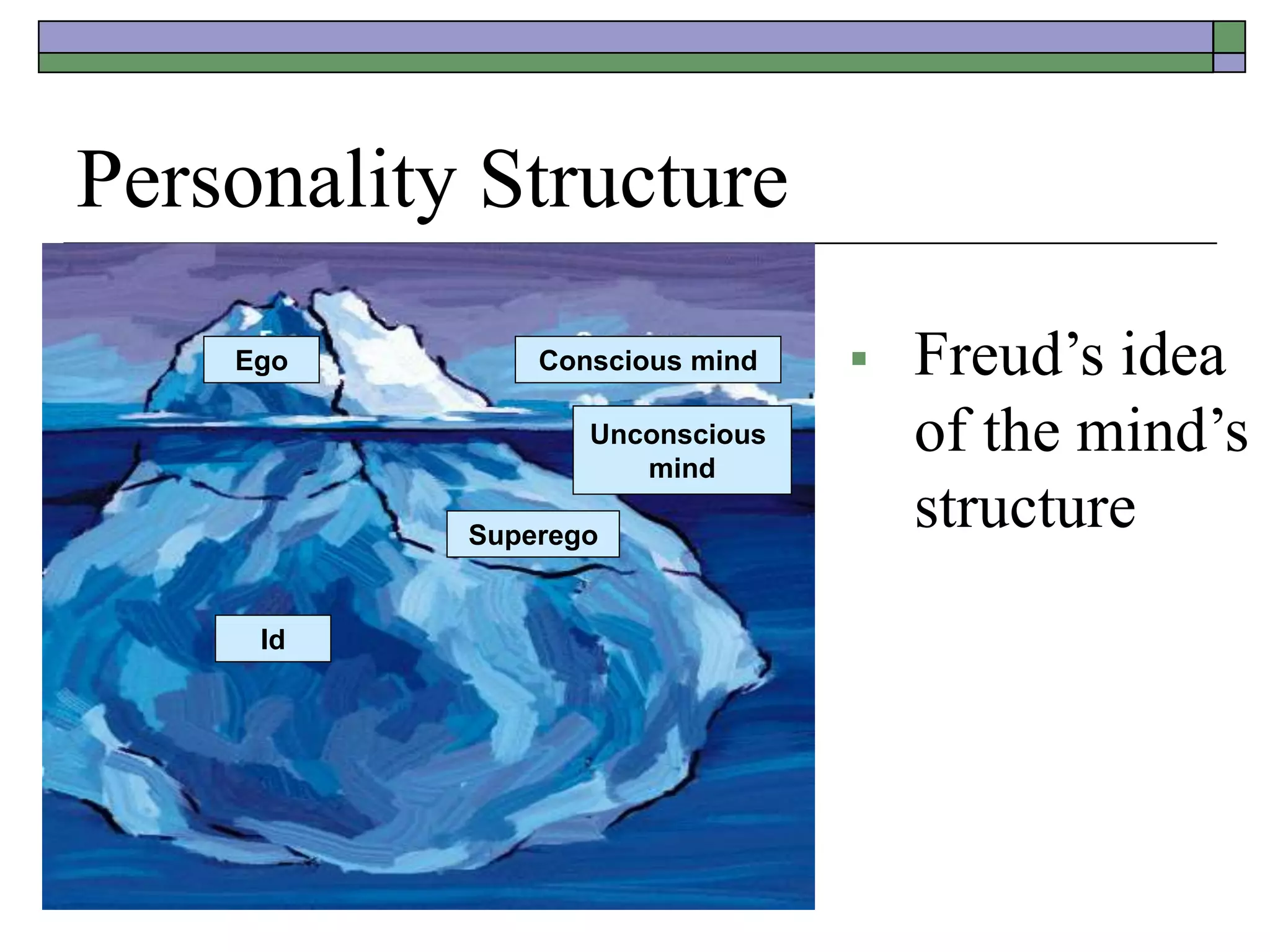
Personality Structure
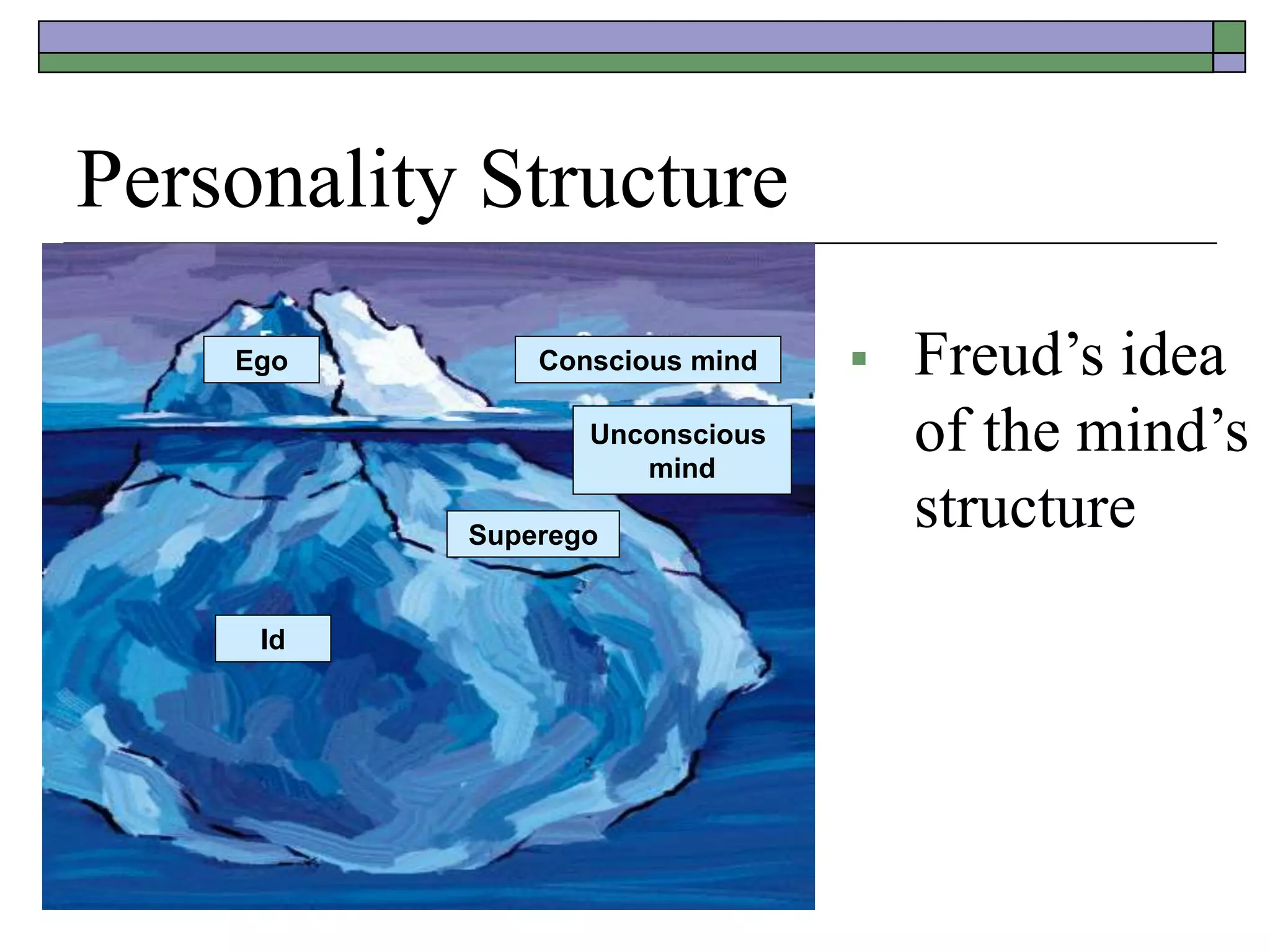
 Freud’s idea
of the mind’s
structure
Id
Superego
Ego Conscious mind
Unconscious
mind
Personality Structure
 Id
 contains a reservoir of unconscious psychic
energy
 strives to satisfy basic sexual and
aggressive drives
 operates on the pleasure principle,
demanding immediate gratification
Personality Structure
 Superego
 the part of personality that presents
internalized ideals
 Represents “rules” of society
 provides standards for judgment (the
conscience) and for future aspirations
Id and Superego
 Id and Superego are in constant conflict
 This cause guilt and anxiety
 People need to learn how to cope with this
conflict– some do it successfully and others
don’t
 Conflicts most be resolved by ego
Personality Structure
 Ego
 the largely conscious, “executive” part of
personality
 mediates among the demands of the id,
superego, and reality
 operates on the reality principle, satisfying
the id’s desires in ways that will
realistically bring pleasure rather than pain
Personality Structure
 Freud’s idea
of the mind’s
structure
Id
Superego
Ego Conscious mind
Unconscious
mind
Defense Mechanisms
 Defense Mechanisms
 the ego’s protective methods of reducing anxiety
by unconsciously distorting reality (can be a
normal process, but can also lead to disordered
behavior)
 Repression
 the basic defense mechanism that banishes
anxiety-arousing thoughts, feelings, and
memories from consciousness (e.g., memories of
childhood or past marriage)
Defense Mechanisms
 Regression
 defense mechanism in which an
individual faced with anxiety retreats
to a more infantile psychosexual
stage, where some psychic energy
remains fixated
 Example– party behavior?
Defense Mechanisms
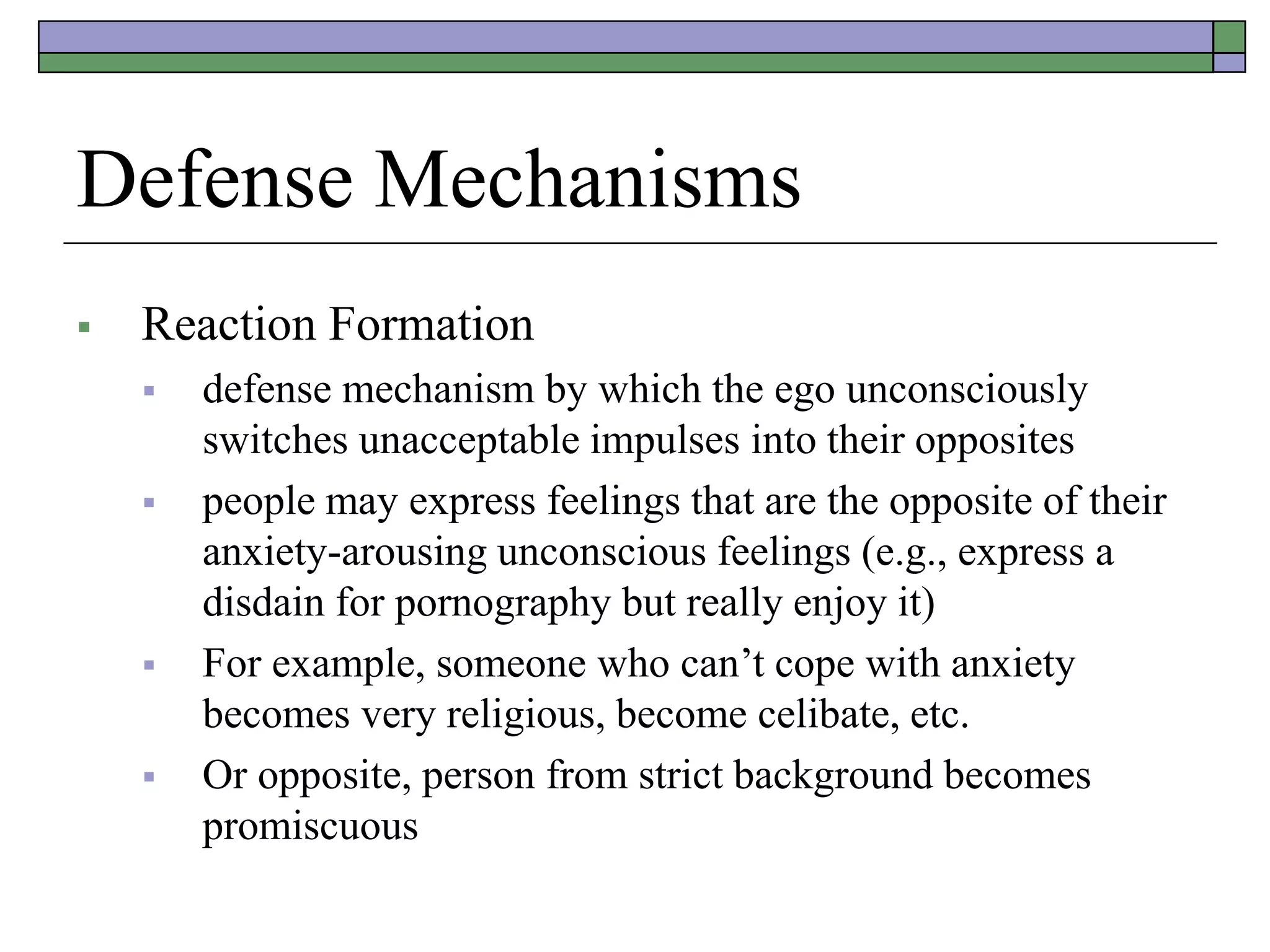
 Reaction Formation
 defense mechanism by which the ego unconsciously
switches unacceptable impulses into their opposites
 people may express feelings that are the opposite of their
anxiety-arousing unconscious feelings (e.g., express a
disdain for pornography but really enjoy it)
 For example, someone who can’t cope with anxiety
becomes very religious, become celibate, etc.
 Or opposite, person from strict background becomes
promiscuous
Defense Mechanisms
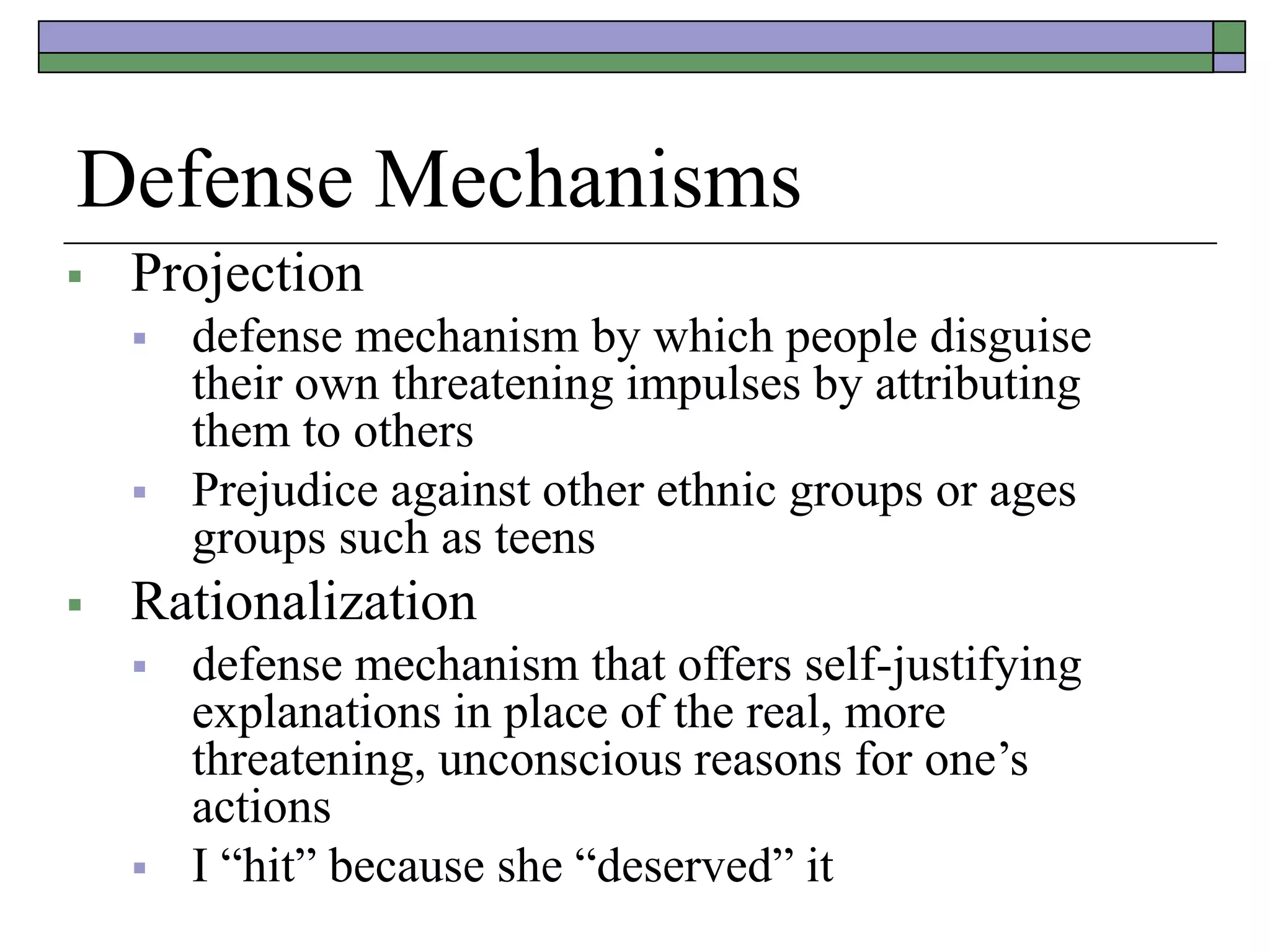
 Projection
 defense mechanism by which people disguise
their own threatening impulses by attributing
them to others
 Prejudice against other ethnic groups or ages
groups such as teens
 Rationalization
 defense mechanism that offers self-justifying
explanations in place of the real, more
threatening, unconscious reasons for one’s
actions
 I “hit” because she “deserved” it
Defense Mechanisms
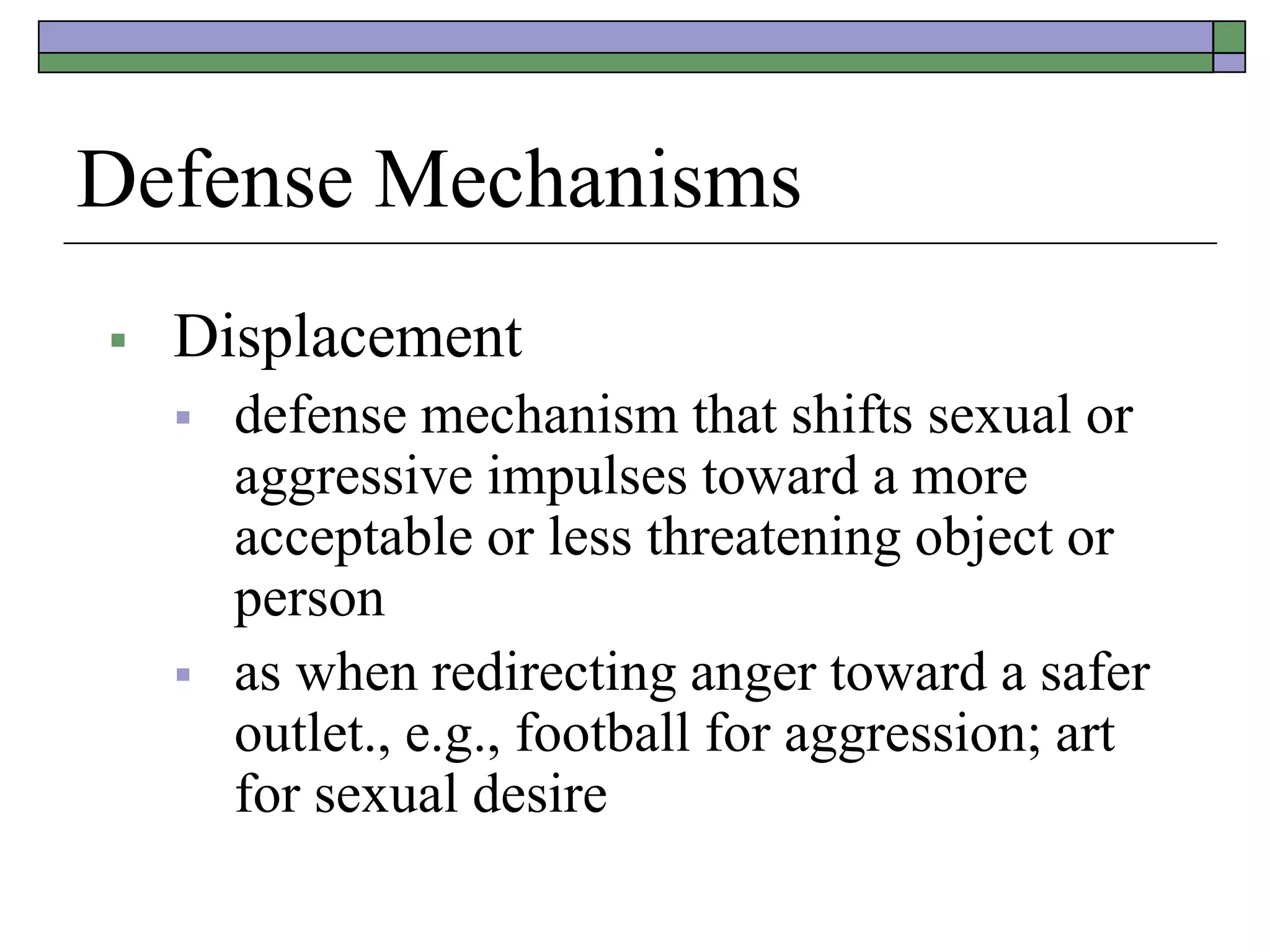
 Displacement
 defense mechanism that shifts sexual or
aggressive impulses toward a more
acceptable or less threatening object or
person
 as when redirecting anger toward a safer
outlet., e.g., football for aggression; art
for sexual desire
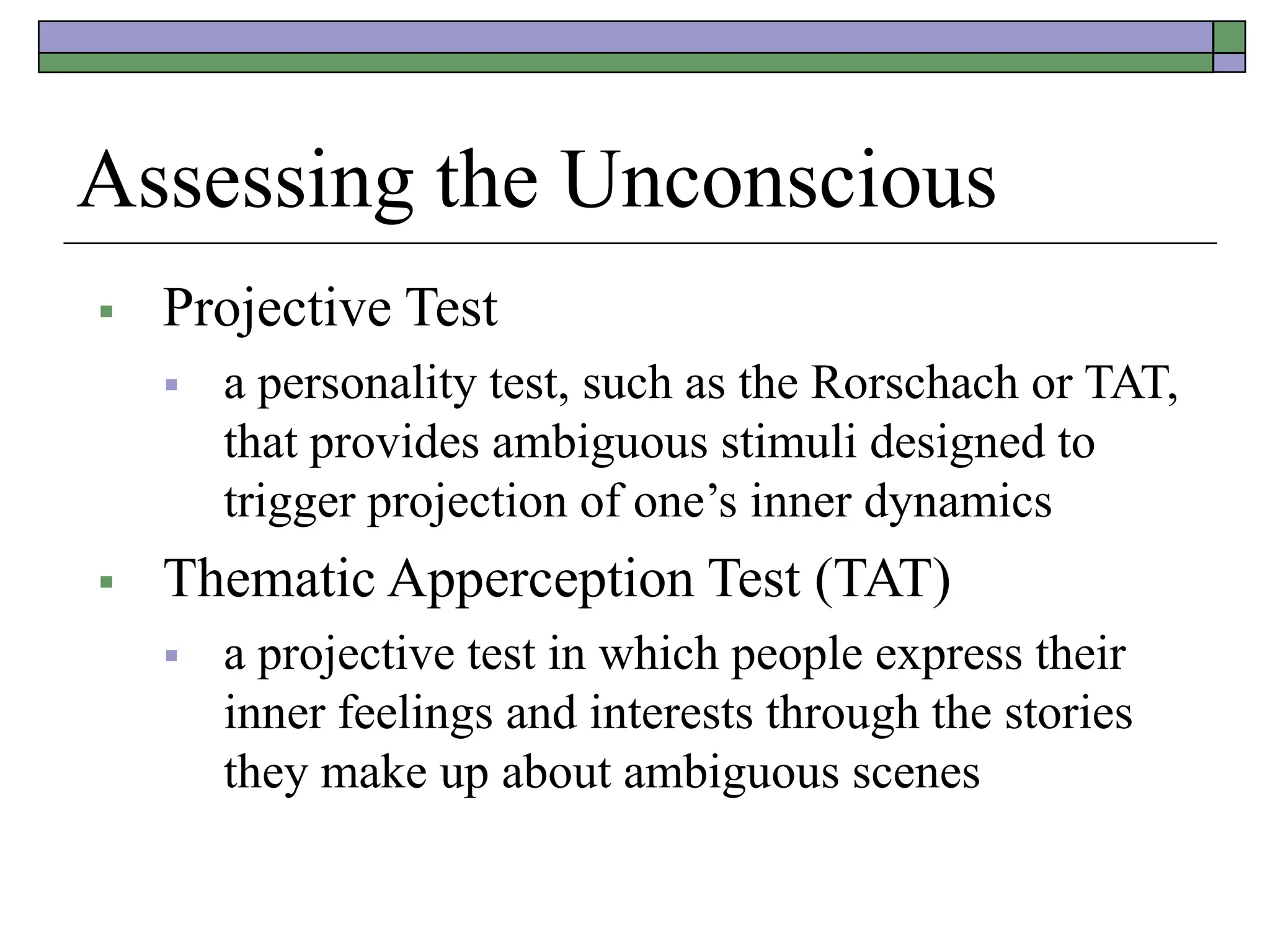
Assessing the Unconscious
 Projective Test
 a personality test, such as the Rorschach or TAT,
that provides ambiguous stimuli designed to
trigger projection of one’s inner dynamics
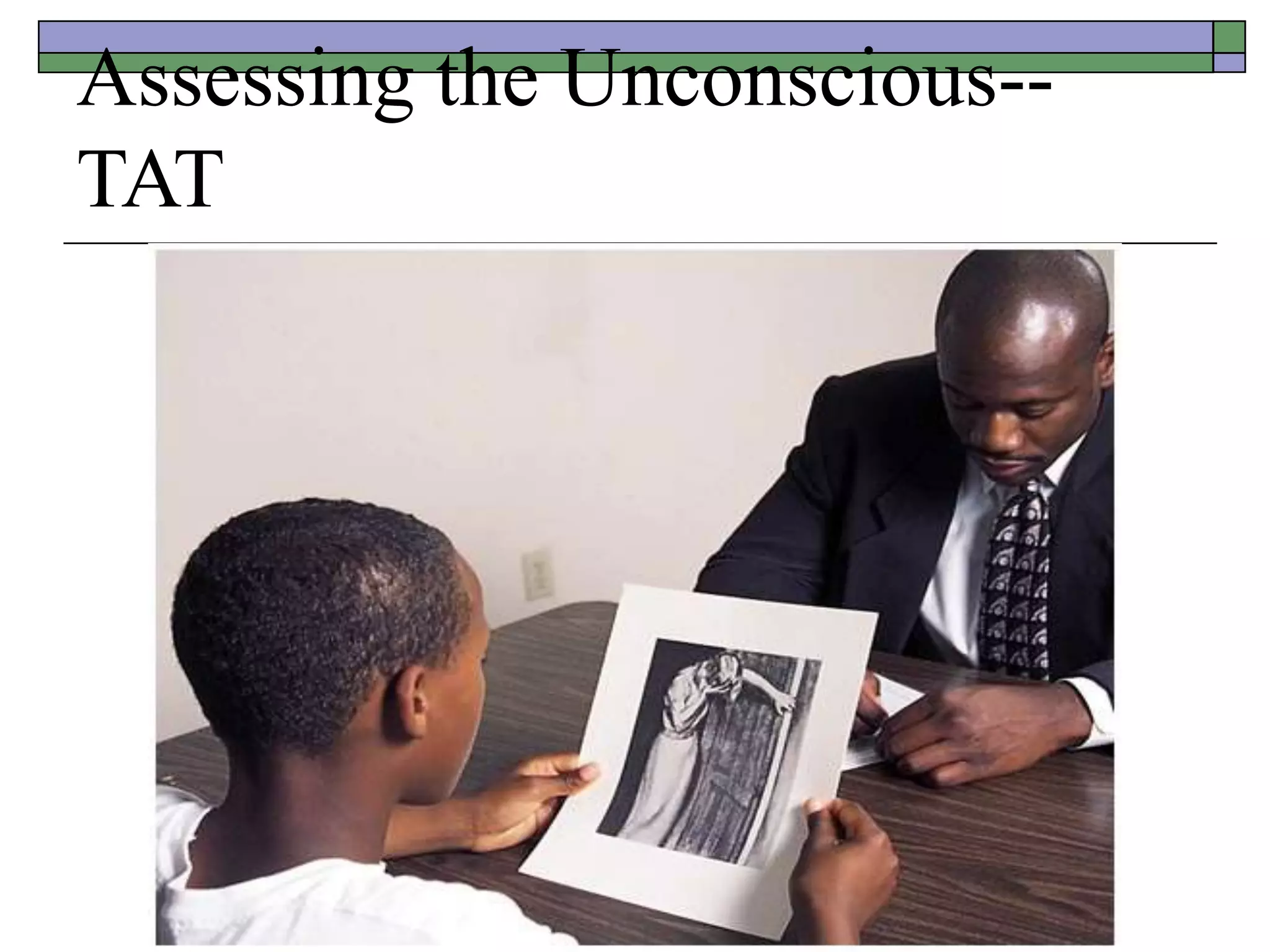
 Thematic Apperception Test (TAT)
 a projective test in which people express their
inner feelings and interests through the stories
they make up about ambiguous scenes
Assessing the Unconscious--
TAT
Assessing the Unconscious
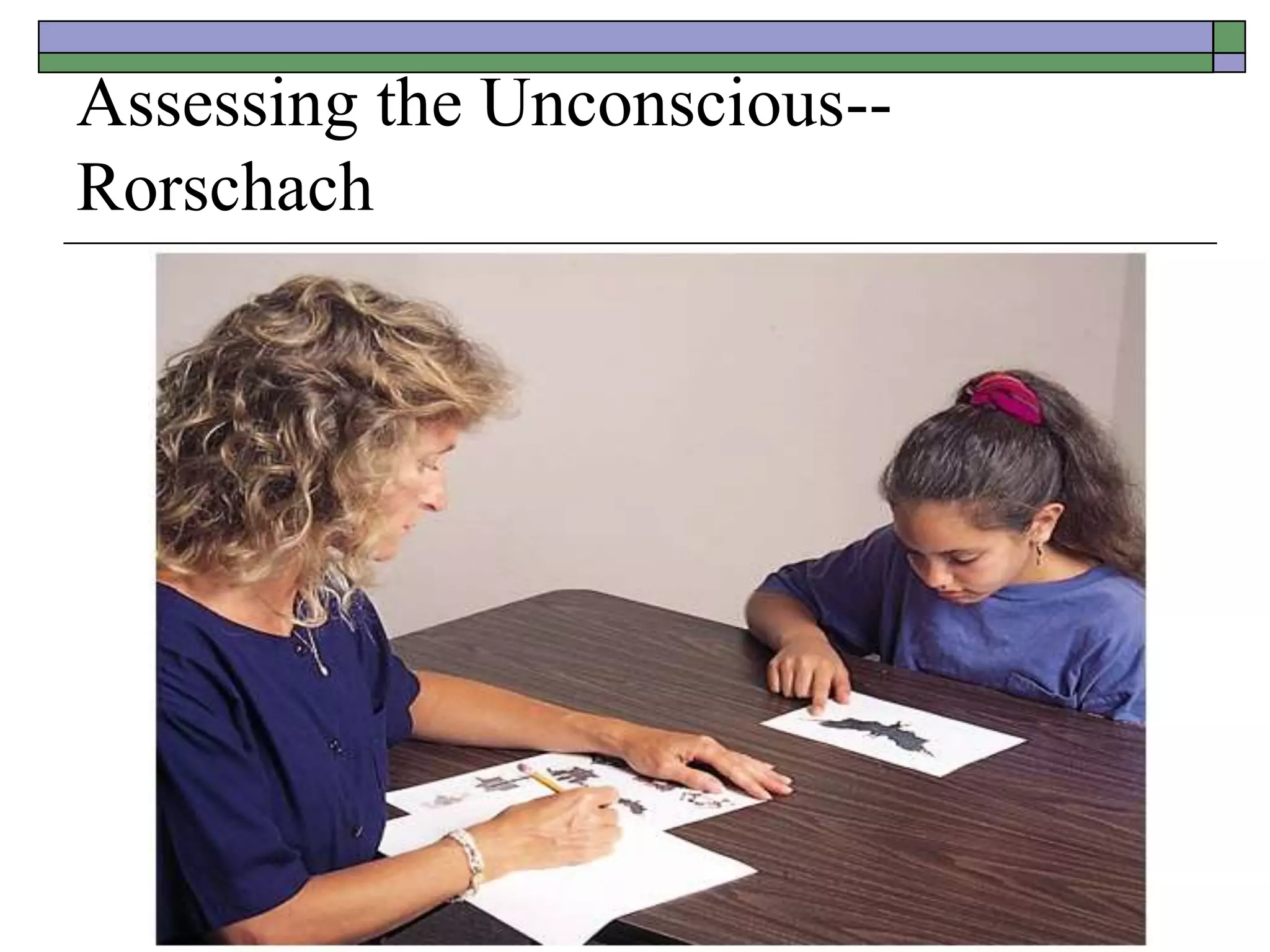
 Rorschach Inkblot Test
 the most widely used projective test
 a set of 10 inkblots designed by Hermann
Rorschach
 seeks to identify people’s inner feelings by
analyzing their interpretations of the blots
Assessing the Unconscious--
Rorschach
Personality Development
 Psychosexual Stages
 the childhood stages of development
during which the id’s pleasure-seeking
energies focus on distinct erogenous zones
Personality Development
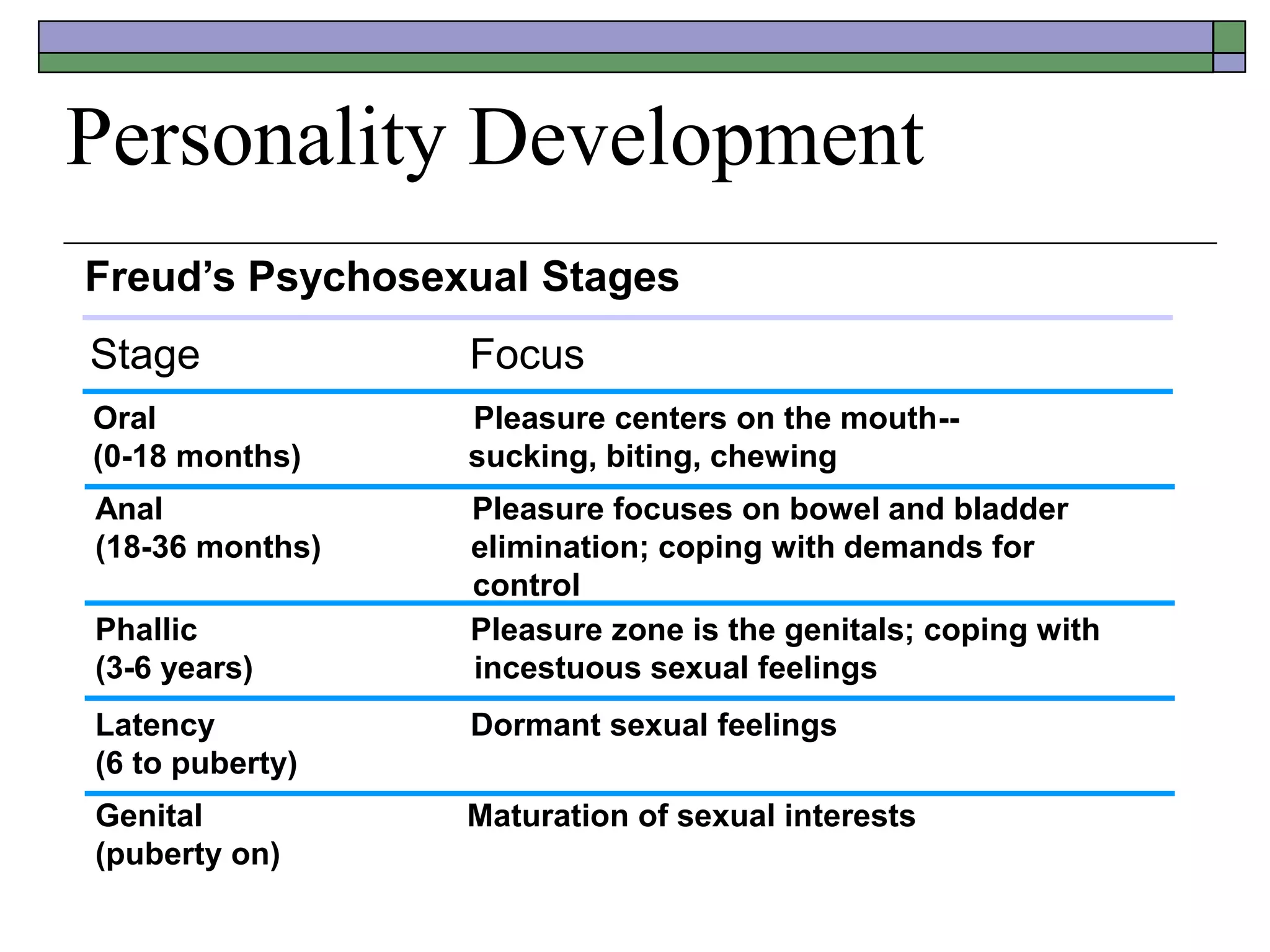
Freud’s Psychosexual Stages
Stage Focus
Oral Pleasure centers on the mouth--
(0-18 months) sucking, biting, chewing
Anal Pleasure focuses on bowel and bladder
(18-36 months) elimination; coping with demands for
control
Phallic Pleasure zone is the genitals; coping with
(3-6 years) incestuous sexual feelings
Latency Dormant sexual feelings
(6 to puberty)
Genital Maturation of sexual interests
(puberty on)
Personality Development
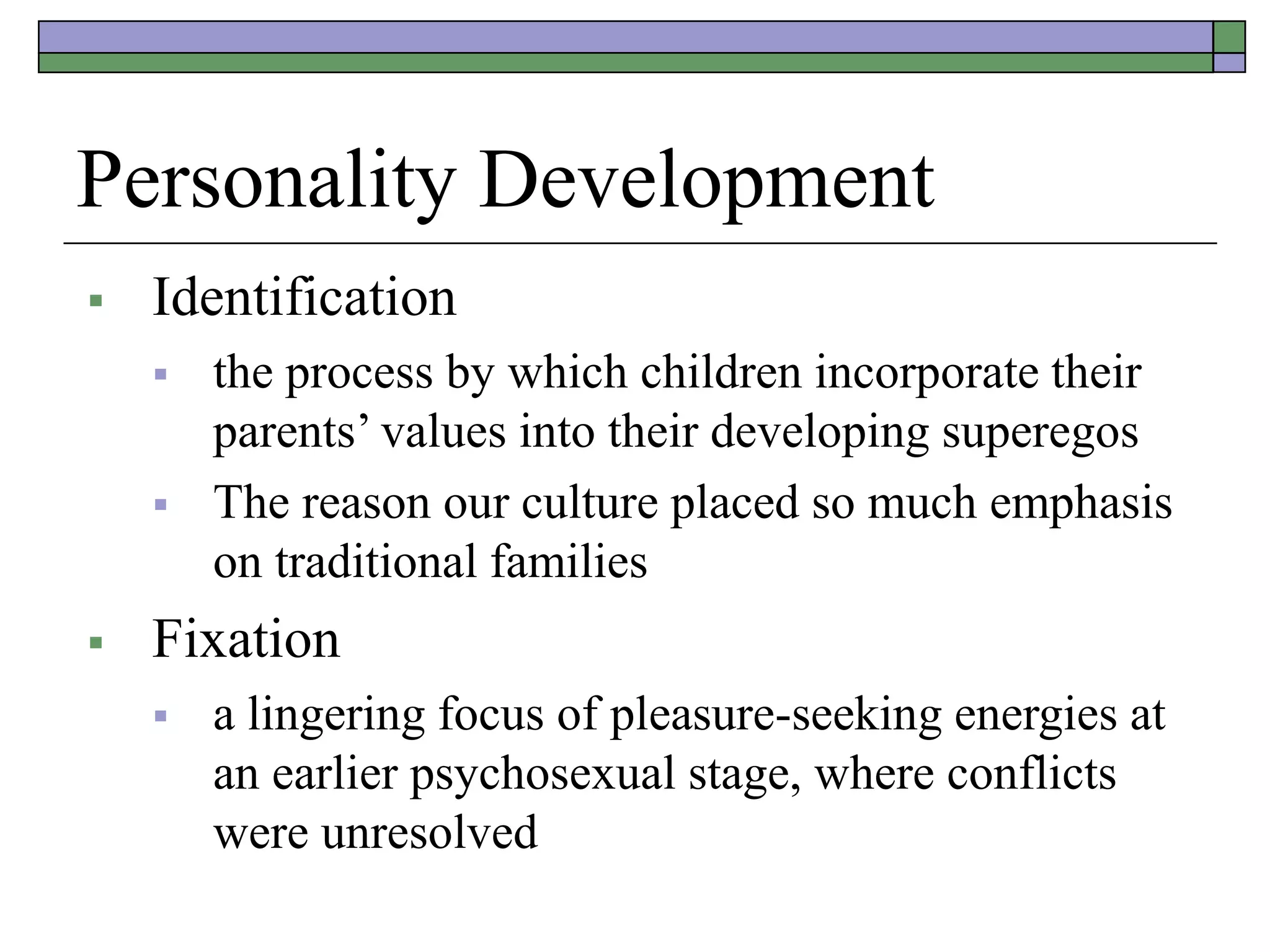
 Identification
 the process by which children incorporate their
parents’ values into their developing superegos
 The reason our culture placed so much emphasis
on traditional families
 Fixation
 a lingering focus of pleasure-seeking energies at
an earlier psychosexual stage, where conflicts
were unresolved
Humanistic Perspective
 Self-Actualization
 the ultimate psychological need that arises
after basic physical and psychological
needs are met and self-esteem is achieved
 the motivation to fulfill one’s potential
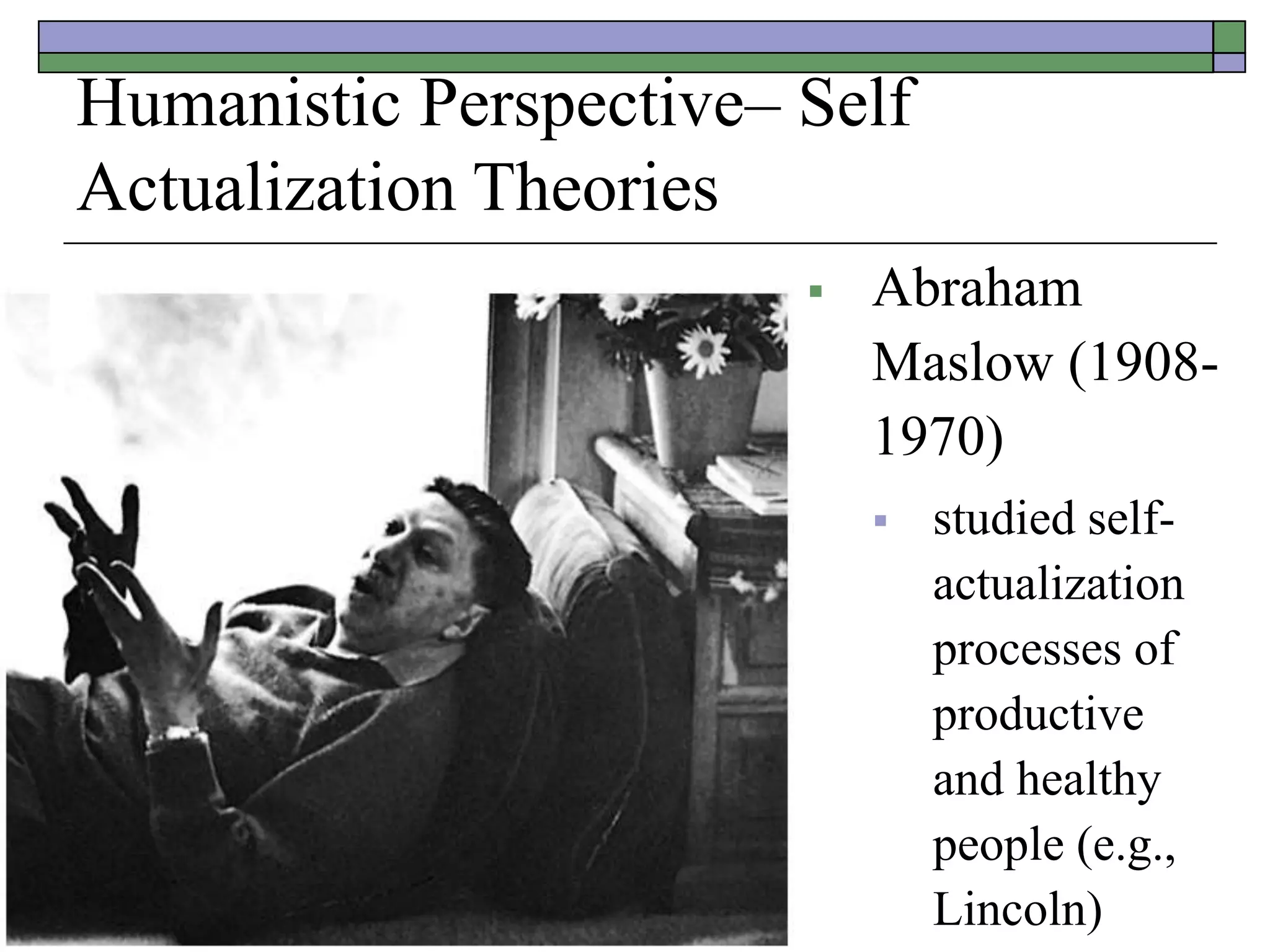
Humanistic Perspective– Self
Actualization Theories
 Abraham
Maslow (1908-
1970)
 studied self-
actualization
processes of
productive
and healthy
people (e.g.,
Lincoln)
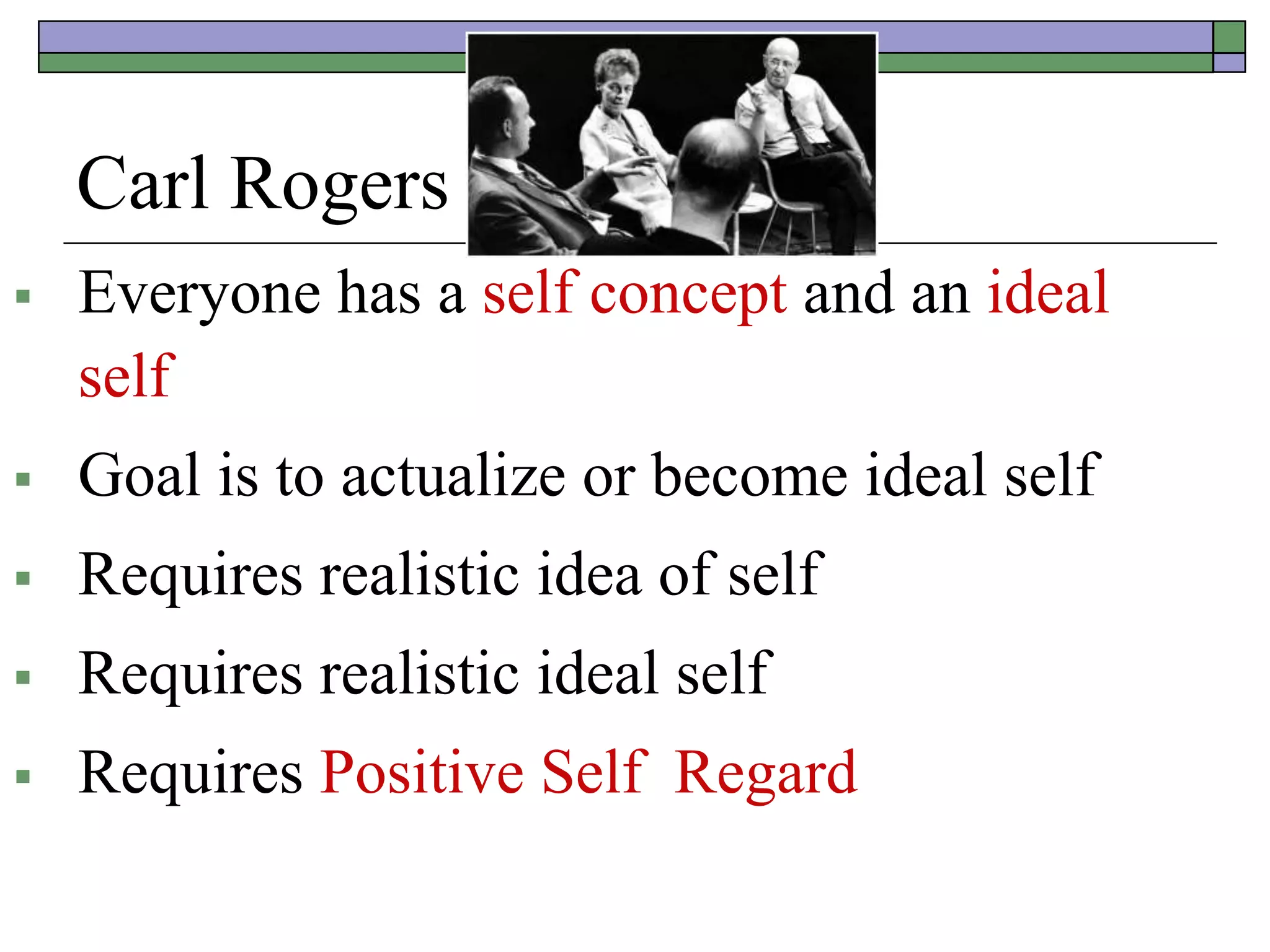
Carl Rogers
 Everyone has a self concept and an ideal
self
 Goal is to actualize or become ideal self
 Requires realistic idea of self
 Requires realistic ideal self
 Requires Positive Self Regard
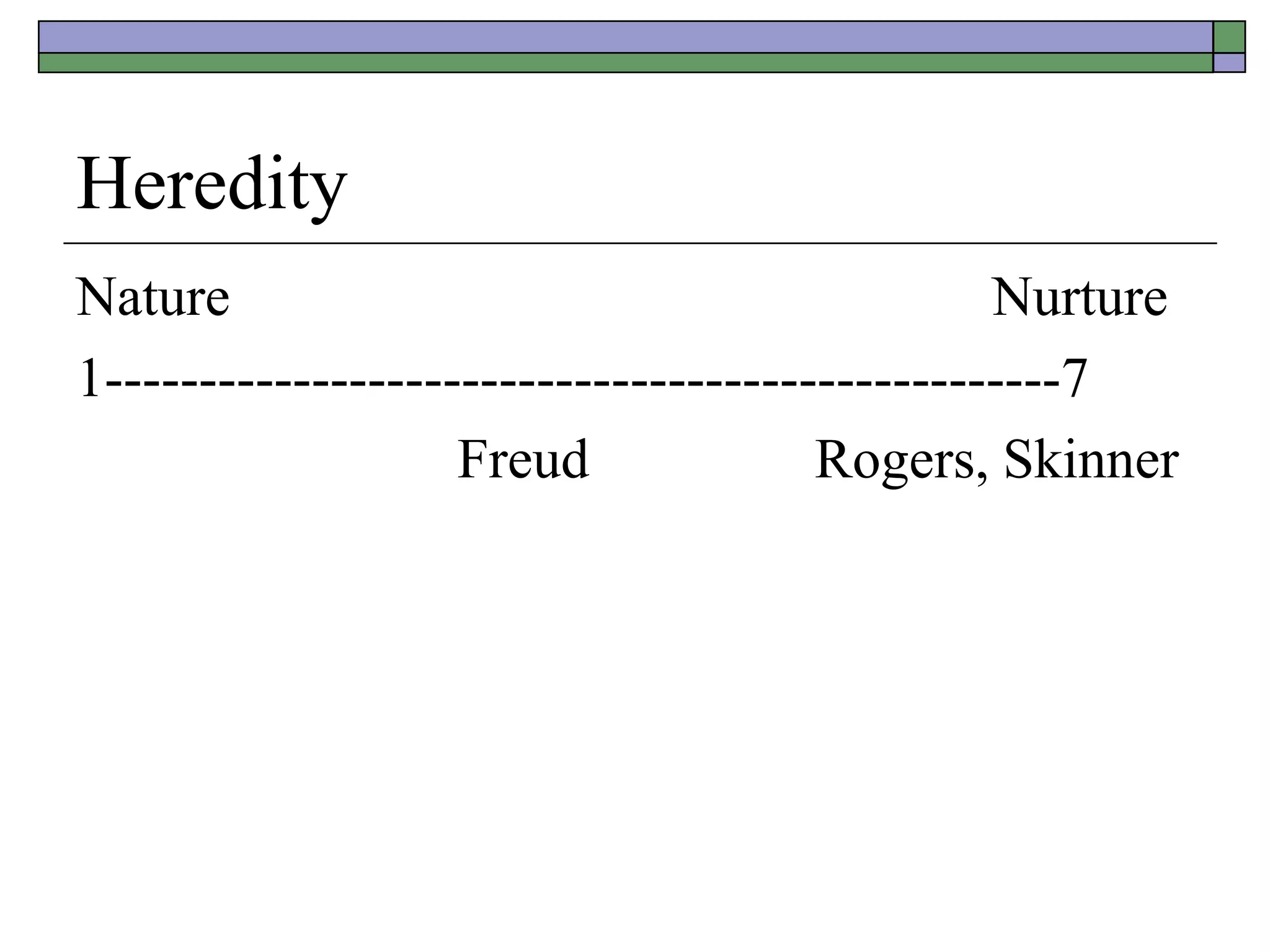
Heredity
Nature Nurture
1---------------------------------------------------7
Freud Rogers, Skinner
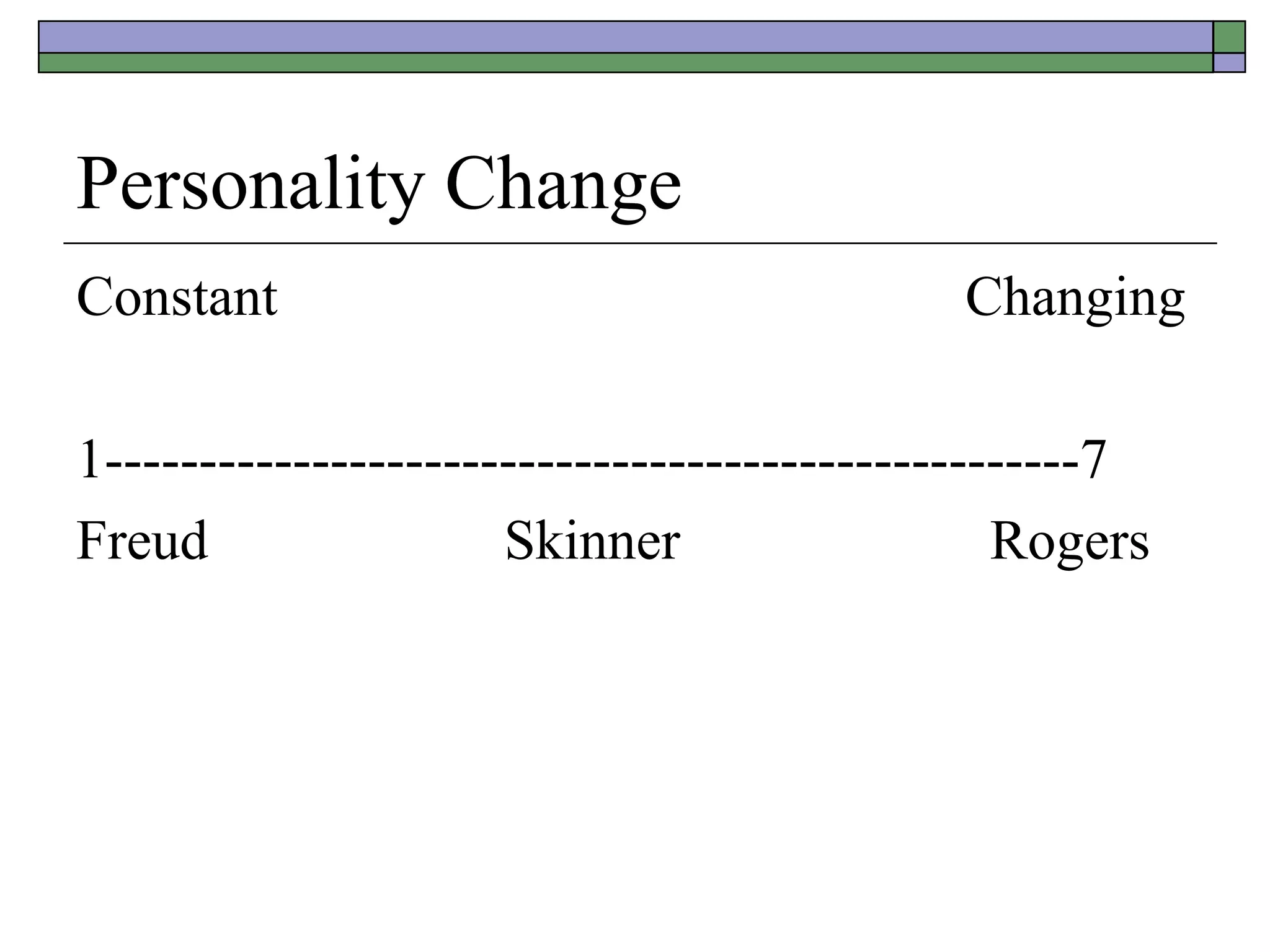
Personality Change
Constant Changing
1----------------------------------------------------7
Freud Skinner Rogers
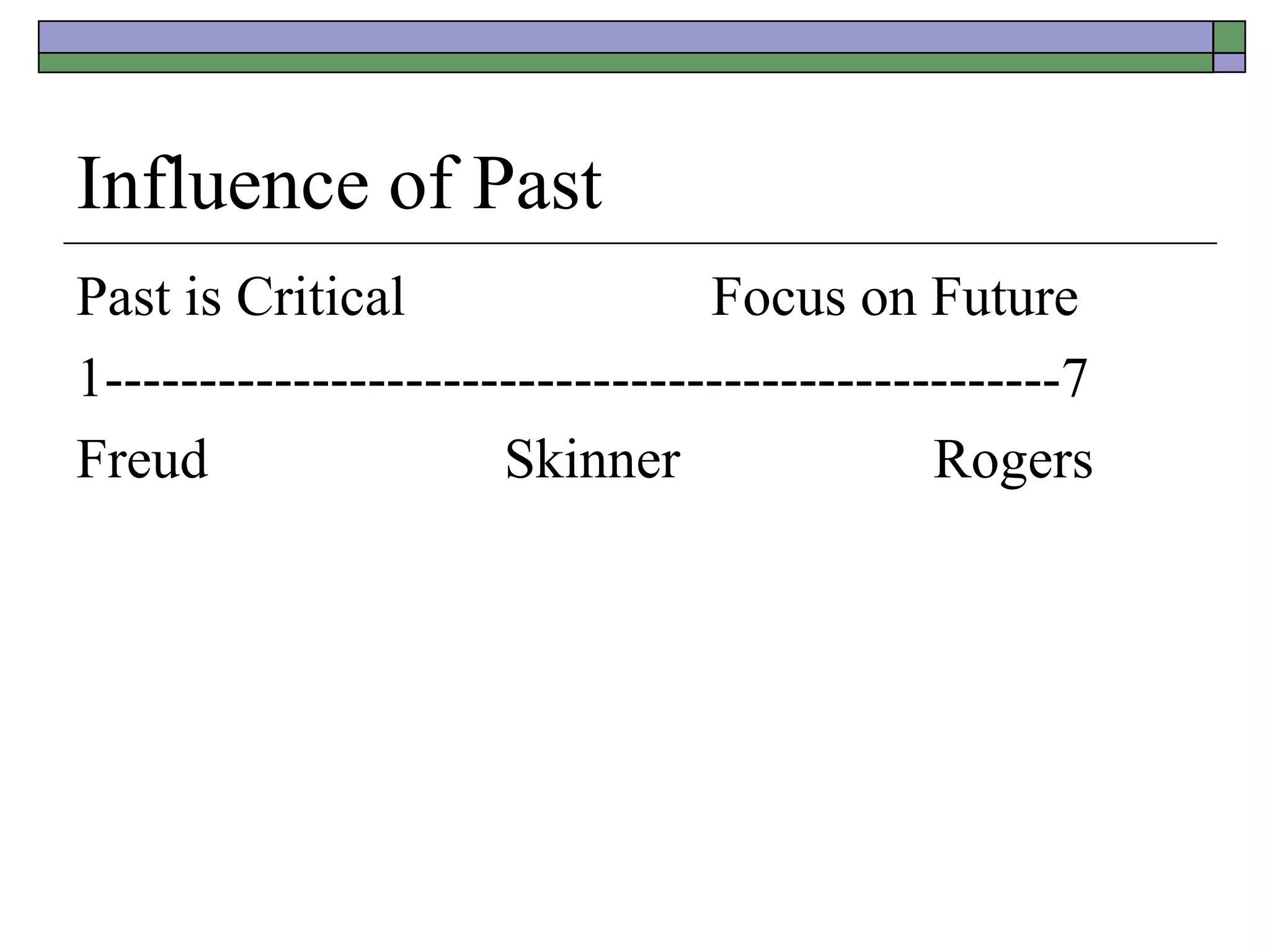
Influence of Past
Past is Critical Focus on Future
1---------------------------------------------------7
Freud Skinner Rogers
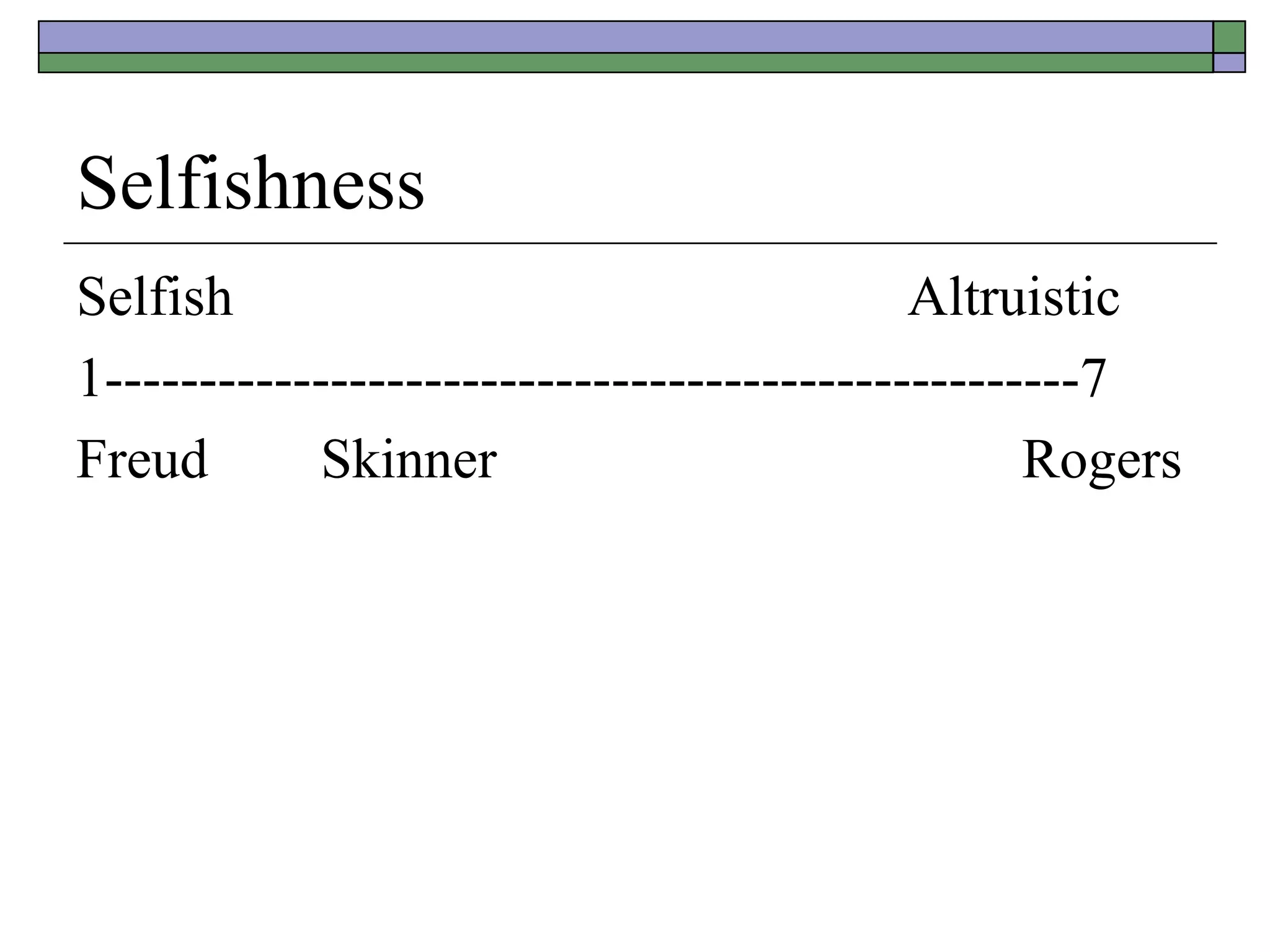
Selfishness
Selfish Altruistic
1----------------------------------------------------7
Freud Skinner Rogers

Introduction to personality.ppt

  • 1.
    What is personality? Specificallyhow people differ in behavior, feelings, reactions to the environment and to other people
  • 2.
    Basic questions aboutpersonality  How does one measure and describe personality differences  For example– what kind of person do you want to date?  Can personality be measured objectively?
  • 3.
    Trait Perspective  Takea piece of paper and write down a list of adjectives that describes the personality of someone you know well
  • 4.
    Contemporary Research-- The TraitPerspective  Trait  a characteristic pattern of behavior  a disposition to feel and act, as assessed by self- report inventories and peer reports  Personality Inventory  a questionnaire (often with true-false or agree- disagree items) on which people respond to items designed to gauge a wide range of feelings and behaviors  used to assess selected personality traits
  • 5.
    The Trait Perspective The“Big Five” Personality Factors Trait Dimension Description Emotional Stability Calm versus anxious Secure versus insecure Self-satisfied versus self-pitying Extraversion Sociable versus retiring Fun-loving versus sober Affectionate versus reserved Openness Imaginative versus practical Preference for variety versus preference for routine Independent versus conforming Warmth Soft-hearted versus ruthless Trusting versus suspicious Helpful versus uncooperative Conscientiousness Organized versus disorganized Careful versus careless Disciplined versus impulsive
  • 6.
    The Trait Perspective:Clinical Perspective  Minnesota Multiphasic Personality Inventory (MMPI)  the most widely researched and clinically used of all personality tests  originally developed to identify emotional disorders (still considered its most appropriate use)  now used for many other screening purposes
  • 7.
    Example MMPI Questions I like mechanics magazines.  I have a good appetite.  I wake up fresh & rested most mornings.  I think I would like the work of a librarian.  I am easily awakened by noise.  I like to read newspaper articles on crime.  My hands & feet are usually warm enough.  My daily life is full of things that keep me interested.  I am about as able to work as I ever was.  There seems to be a lump in my throat most of the time.
  • 8.
    The Trait Perspective Minnesota Multiphasic Personality Inventory (MMPI) test profile Hysteria (uses symptoms to solve problems) Masculinity/femininity (interests like those of other sex) T-score 1 2 3 4 5 6 7 8 9 10 0 30 40 50 60 70 80 Hypochondriasis (concern with body symptoms) Depression (pessimism, hopelessness) Psychopathic deviancy (disregard for social standards) Paranoia (delusions, suspiciousness) Psychasthenia (anxious, guilt feelings) Schizophrenia (withdrawn, bizarre thoughts) Hypomania (overactive, excited, impulsive) Social introversion (shy, inhibited) Clinically significant range After treatment (no scores in the clinically significant range) Before treatment (anxious, depressed, and displaying deviant behaviors)
  • 9.
    Core Theories  TraitPerspective Is a practical approach but it doesn’t explain Personality  There are classic theories about personality  Tend to be older  Not discussed much in current Psychology  But, can be used for both understanding individual and as a basis for therapy
  • 10.
    Your Theory ofPersonality  1. Human behavior results primarily from heredity, what has been genetically transmitted by parents, or from environment, the external circumstances and experiences that shape a person after conception has occurred. 1 2 3 4 5 6 7 heredity environment
  • 11.
    Your Theory ofPersonality  2. Personality is relatively unchanging, with each person showing the same behavior throughout a lifetime, or personality is relatively changing, with each person showing different behavior throughout a lifetime. 1 2 3 4 5 6 7 unchanging changing
  • 12.
    Your Theory ofPersonality  3. The most important influences on behavior are past events, what has previously occurred to a person, or in contrast, future events, what a person seeks to bring about by striving to meet certain goals. 1 2 3 4 5 6 7 past future
  • 13.
    Your Theory ofPersonality  4. People are motivated to cooperate with others mainly because they are self- centered, expecting to receive some personal gain, or mainly because they are altruistic, seeking to work with others only for the benefit of doing things with and for others. 1 2 3 4 5 6 7 self-centered altruistic
  • 14.
    What is Personality? Basicperspectives  Psychoanalytic—Sigmund Freud  Humanistic– Carl Rogers
  • 15.
    Sigmund Freud  Lived1856 – 1939  Was a Physician  Theory based on clinical population  Theory influenced by “Victorian Times”
  • 16.
     Sigmund andAnna Freud (on right) with friends
  • 17.
    The Psychoanalytic Perspective  Freud’stheory proposed that childhood sexuality and unconscious motivations influence personality
  • 18.
    The Psychoanalytic Perspective  Psychoanalysis Freud’s theory of personality that attributes our thoughts and actions to unconscious motives and conflicts  techniques used in treating psychological disorders by seeking to expose and interpret unconscious tensions
  • 19.
    The Psychoanalytic Perspective  FirstCame up use of hypnosis – influenced by work of Dr. Mesmer  Free Association  in psychoanalysis, a method of exploring the unconscious  person relaxes and says whatever comes to mind, no matter how trivial or embarrassing
  • 20.
    The Psychoanalytic Perspective  Unconscious according to Freud, a reservoir of mostly unacceptable thoughts, wishes, feelings and memories  contemporary viewpoint- information processing of which we are unaware
  • 21.
    Personality Structure  Freud’sidea of the mind’s structure Id Superego Ego Conscious mind Unconscious mind
  • 22.
    Personality Structure  Id contains a reservoir of unconscious psychic energy  strives to satisfy basic sexual and aggressive drives  operates on the pleasure principle, demanding immediate gratification
  • 23.
    Personality Structure  Superego the part of personality that presents internalized ideals  Represents “rules” of society  provides standards for judgment (the conscience) and for future aspirations
  • 24.
    Id and Superego Id and Superego are in constant conflict  This cause guilt and anxiety  People need to learn how to cope with this conflict– some do it successfully and others don’t  Conflicts most be resolved by ego
  • 25.
    Personality Structure  Ego the largely conscious, “executive” part of personality  mediates among the demands of the id, superego, and reality  operates on the reality principle, satisfying the id’s desires in ways that will realistically bring pleasure rather than pain
  • 26.
    Personality Structure  Freud’sidea of the mind’s structure Id Superego Ego Conscious mind Unconscious mind
  • 27.
    Defense Mechanisms  DefenseMechanisms  the ego’s protective methods of reducing anxiety by unconsciously distorting reality (can be a normal process, but can also lead to disordered behavior)  Repression  the basic defense mechanism that banishes anxiety-arousing thoughts, feelings, and memories from consciousness (e.g., memories of childhood or past marriage)
  • 28.
    Defense Mechanisms  Regression defense mechanism in which an individual faced with anxiety retreats to a more infantile psychosexual stage, where some psychic energy remains fixated  Example– party behavior?
  • 29.
    Defense Mechanisms  ReactionFormation  defense mechanism by which the ego unconsciously switches unacceptable impulses into their opposites  people may express feelings that are the opposite of their anxiety-arousing unconscious feelings (e.g., express a disdain for pornography but really enjoy it)  For example, someone who can’t cope with anxiety becomes very religious, become celibate, etc.  Or opposite, person from strict background becomes promiscuous
  • 30.
    Defense Mechanisms  Projection defense mechanism by which people disguise their own threatening impulses by attributing them to others  Prejudice against other ethnic groups or ages groups such as teens  Rationalization  defense mechanism that offers self-justifying explanations in place of the real, more threatening, unconscious reasons for one’s actions  I “hit” because she “deserved” it
  • 31.
    Defense Mechanisms  Displacement defense mechanism that shifts sexual or aggressive impulses toward a more acceptable or less threatening object or person  as when redirecting anger toward a safer outlet., e.g., football for aggression; art for sexual desire
  • 32.
    Assessing the Unconscious Projective Test  a personality test, such as the Rorschach or TAT, that provides ambiguous stimuli designed to trigger projection of one’s inner dynamics  Thematic Apperception Test (TAT)  a projective test in which people express their inner feelings and interests through the stories they make up about ambiguous scenes
  • 33.
  • 34.
    Assessing the Unconscious Rorschach Inkblot Test  the most widely used projective test  a set of 10 inkblots designed by Hermann Rorschach  seeks to identify people’s inner feelings by analyzing their interpretations of the blots
  • 35.
  • 36.
    Personality Development  PsychosexualStages  the childhood stages of development during which the id’s pleasure-seeking energies focus on distinct erogenous zones
  • 37.
    Personality Development Freud’s PsychosexualStages Stage Focus Oral Pleasure centers on the mouth-- (0-18 months) sucking, biting, chewing Anal Pleasure focuses on bowel and bladder (18-36 months) elimination; coping with demands for control Phallic Pleasure zone is the genitals; coping with (3-6 years) incestuous sexual feelings Latency Dormant sexual feelings (6 to puberty) Genital Maturation of sexual interests (puberty on)
  • 38.
    Personality Development  Identification the process by which children incorporate their parents’ values into their developing superegos  The reason our culture placed so much emphasis on traditional families  Fixation  a lingering focus of pleasure-seeking energies at an earlier psychosexual stage, where conflicts were unresolved
  • 39.
    Humanistic Perspective  Self-Actualization the ultimate psychological need that arises after basic physical and psychological needs are met and self-esteem is achieved  the motivation to fulfill one’s potential
  • 40.
    Humanistic Perspective– Self ActualizationTheories  Abraham Maslow (1908- 1970)  studied self- actualization processes of productive and healthy people (e.g., Lincoln)
  • 41.
    Carl Rogers  Everyonehas a self concept and an ideal self  Goal is to actualize or become ideal self  Requires realistic idea of self  Requires realistic ideal self  Requires Positive Self Regard
  • 42.
  • 43.
  • 44.
    Influence of Past Pastis Critical Focus on Future 1---------------------------------------------------7 Freud Skinner Rogers
  • 45.