Design for
Manufacturing
By: Nalin Fernando
BSC (Eng) Hons.,MBA (Colombo), MIE (Aust),
MSOE, MIPlantE, MSLID(SL), MIPM(SL)
Consulting Mechanical Engineer
Nontraditional Machining And
Thermal Cutting Processes
1. Mechanical Energy Processes
2. Electrochemical Machining
Processes
3. Thermal Energy Processes
4. Chemical Machining
5. Application Considerations
2
Nontraditional Processes
Defined
A group of processes that remove
excess material by techniques involving
mechanical, thermal, electrical, or
chemical energy (or a combinations of
these energies)
They do not use a sharp cutting tool in the
conventional sense
Developed since World War II in response to
new and unusual machining requirements
that could not be satisfied by conventional
machining methods
3
Importance of
Nontraditional Processes
Need to machine newly developed metals and
non metals with special properties that make
‑
them difficult or impossible to machine by
conventional methods
Need for unusual and/or complex part
geometries that cannot readily be accomplished
by conventional machining
Need to avoid surface damage that often
accompanies conventional machining
4
Classification of Nontraditional
Processes
Mechanical mechanical erosion of work
‑
material by a high velocity stream of abrasives or
fluid (or both)
Electrical electrochemical energy to remove
‑
material (reverse of electroplating)
Thermal – thermal energy applied to small
portion of work surface, causing that portion to
be fused and/or vaporized
Chemical – chemical etchants selectively
remove material from portions of work part, while
other portions are protected by a mask
5
Mechanical Energy
Processes
1. Ultrasonic machining
2. Water jet cutting
3. Abrasive water jet cutting
4. Abrasive jet machining
5. Abrasive flow machining
6
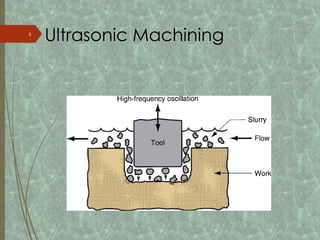
Ultrasonic Machining (USM)
Abrasives contained in a slurry are
driven at high velocity against work
by a tool vibrating at low amplitude
and high frequency
Tool oscillation is perpendicular to work
surface
Abrasives accomplish material removal
Tool is fed slowly into work
Shape of tool is formed into part
7
Ultrasonic Machining
8
USM Applications
Hard, brittle work materials such as ceramics,
glass, and carbides
Also successful on certain metals, such as stainless
steel and titanium
Shapes include non-round holes, holes along a
curved axis
“Coining operations” - pattern on tool is imparted
to a flat work surface
9
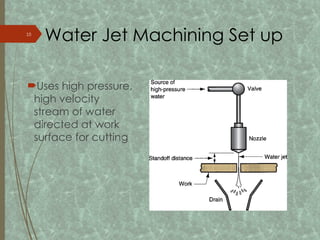
Uses high pressure,
high velocity
stream of water
directed at work
surface for cutting
Water Jet Machining Set up
10
WJC Applications
Usually automated by CNC or industrial robots
to manipulate nozzle along desired trajectory
Used to cut narrow slits in flat stock such as
plastic, textiles, composites, floor tile, carpet,
leather, and cardboard
Not suitable for brittle materials (e.g., glass)
11
WJC Advantages
No crushing or burning of work
surface
Minimum material loss
No environmental pollution
Ease of automation
12
Abrasive Water Jet Cutting
(AWJC)
When WJC is used on metals,
abrasive particles must be added to
jet stream usually
Additional process parameters:
abrasive type, grit size, and flow rate
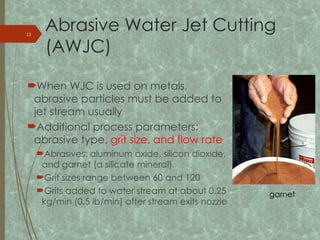
Abrasives: aluminum oxide, silicon dioxide,
and garnet (a silicate mineral)
Grit sizes range between 60 and 120
Grits added to water stream at about 0.25
kg/min (0.5 lb/min) after stream exits nozzle
garnet
13
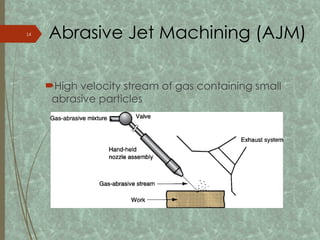
High velocity stream of gas containing small
abrasive particles
Abrasive Jet Machining (AJM)
14
AJM Application Notes
Usually performed manually by operator
who aims nozzle
Normally used as a finishing process
rather than cutting process
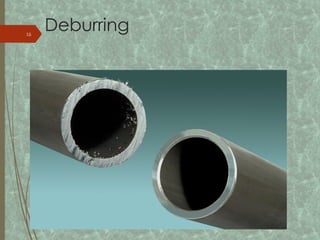
Applications: deburring, trimming and
deflashing, cleaning, and polishing
Work materials: thin flat stock of hard,
brittle materials (e.g., glass, silicon, mica,
ceramics)
15
Deburring
16
Electrochemical
Machining Processes
A group of processes in which electrical
energy is used in combination with
chemical reactions to remove material
Reverse of electroplating
Work material must be a conductor
Processes:
Electrochemical machining (ECM)
Electrochemical deburring (ECD)
Electrochemical grinding (ECG)
17
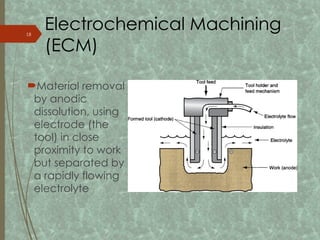
Material removal
by anodic
dissolution, using
electrode (the
tool) in close
proximity to work
but separated by
a rapidly flowing
electrolyte
Electrochemical Machining
(ECM)
18
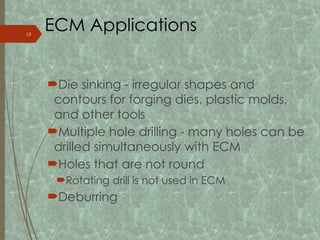
ECM Applications
Die sinking - irregular shapes and
contours for forging dies, plastic molds,
and other tools
Multiple hole drilling - many holes can be
drilled simultaneously with ECM
Holes that are not round
Rotating drill is not used in ECM
Deburring
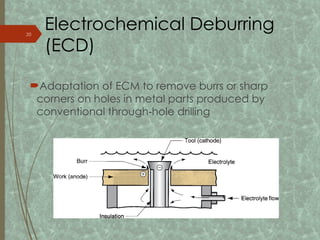
19
Adaptation of ECM to remove burrs or sharp
corners on holes in metal parts produced by
conventional through hole drilling
‑
Electrochemical Deburring
(ECD)
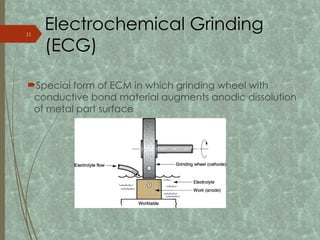
20
Special form of ECM in which grinding wheel with
conductive bond material augments anodic dissolution
of metal part surface
Electrochemical Grinding
(ECG)
21
Applications and
Advantages of ECG
Applications:
Sharpening of cemented carbide tools
Grinding of surgical needles and other thin-wall
tubes, and fragile parts
Advantages:
Deplating responsible for 95% of metal removal
Because machining is mostly by
electrochemical action, grinding wheel lasts
much longer
22
Thermal Energy Processes
- Summary
Very high local temperatures
Material is removed by fusion or vaporization
Physical and metallurgical damage to
the new work surface
In some cases, resulting finish is so poor
that subsequent processing is required
23
Thermal Energy Processes
1. Electric discharge machining
2. Electric discharge wire cutting
3. Electron beam machining
4. Laser beam machining
5. Plasma arc machining
6. Conventional thermal cutting
processes
24
Electric Discharge
Processes
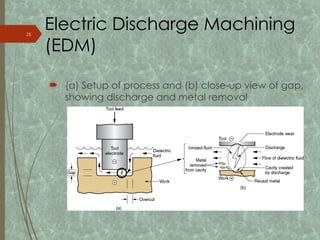
Metal removal by a series of discrete
electrical discharges (sparks) causing
localized temperatures high enough to
melt or vaporize the metal
 Can be used only on electrically conducting
work materials
 Two main processes:
 Electric discharge machining
 Wire electric discharge machining
25
 (a) Setup of process and (b) close up view of gap,
‑
showing discharge and metal removal
Electric Discharge Machining
(EDM)
26
Work Materials in EDM
Work materials must be electrically
conducting
Hardness and strength of work material are
not factors in EDM
Material removal rate depends on melting
point of work material
27
EDM Applications
Tooling for many mechanical processes: molds
for plastic injection molding, extrusion dies, wire
drawing dies, forging and heading dies, and
sheet metal stamping dies
Production parts: delicate parts not rigid
enough to withstand conventional cutting
forces, hole drilling where hole axis is at an acute
angle to surface, and machining of hard and
exotic metals
28
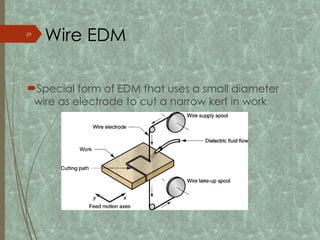
Special form of EDM that uses a small diameter
wire as electrode to cut a narrow kerf in work
Wire EDM
29
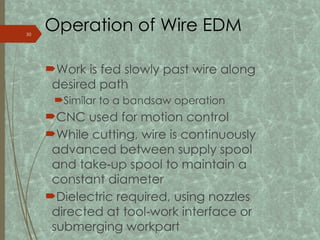
Operation of Wire EDM
Work is fed slowly past wire along
desired path
Similar to a bandsaw operation
CNC used for motion control
While cutting, wire is continuously
advanced between supply spool
and take up spool to maintain a
‑
constant diameter
Dielectric required, using nozzles
directed at tool work interface or
‑
submerging workpart
30
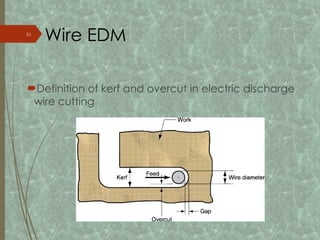
Definition of kerf and overcut in electric discharge
wire cutting
Wire EDM
31
Wire EDM Applications
Ideal for stamping die components
Since kerf is so narrow, it is often possible
to fabricate punch and die in a single
cut
Other tools and parts with intricate
outline shapes, such as lathe form
tools, extrusion dies, and flat
templates
32
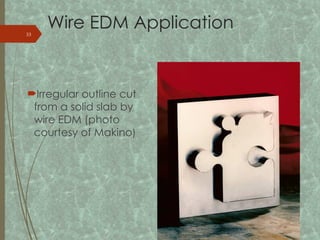
Wire EDM Application
Irregular outline cut
from a solid slab by
wire EDM (photo
courtesy of Makino)
33
34

DFM Lecture Non Traditional Machining.pptx

  • 1.
    Design for Manufacturing By: NalinFernando BSC (Eng) Hons.,MBA (Colombo), MIE (Aust), MSOE, MIPlantE, MSLID(SL), MIPM(SL) Consulting Mechanical Engineer
  • 2.
    Nontraditional Machining And ThermalCutting Processes 1. Mechanical Energy Processes 2. Electrochemical Machining Processes 3. Thermal Energy Processes 4. Chemical Machining 5. Application Considerations 2
  • 3.
    Nontraditional Processes Defined A groupof processes that remove excess material by techniques involving mechanical, thermal, electrical, or chemical energy (or a combinations of these energies) They do not use a sharp cutting tool in the conventional sense Developed since World War II in response to new and unusual machining requirements that could not be satisfied by conventional machining methods 3
  • 4.
    Importance of Nontraditional Processes Needto machine newly developed metals and non metals with special properties that make ‑ them difficult or impossible to machine by conventional methods Need for unusual and/or complex part geometries that cannot readily be accomplished by conventional machining Need to avoid surface damage that often accompanies conventional machining 4
  • 5.
    Classification of Nontraditional Processes Mechanicalmechanical erosion of work ‑ material by a high velocity stream of abrasives or fluid (or both) Electrical electrochemical energy to remove ‑ material (reverse of electroplating) Thermal – thermal energy applied to small portion of work surface, causing that portion to be fused and/or vaporized Chemical – chemical etchants selectively remove material from portions of work part, while other portions are protected by a mask 5
  • 6.
    Mechanical Energy Processes 1. Ultrasonicmachining 2. Water jet cutting 3. Abrasive water jet cutting 4. Abrasive jet machining 5. Abrasive flow machining 6
  • 7.
    Ultrasonic Machining (USM) Abrasivescontained in a slurry are driven at high velocity against work by a tool vibrating at low amplitude and high frequency Tool oscillation is perpendicular to work surface Abrasives accomplish material removal Tool is fed slowly into work Shape of tool is formed into part 7
  • 8.
  • 9.
    USM Applications Hard, brittlework materials such as ceramics, glass, and carbides Also successful on certain metals, such as stainless steel and titanium Shapes include non-round holes, holes along a curved axis “Coining operations” - pattern on tool is imparted to a flat work surface 9
  • 10.
    Uses high pressure, highvelocity stream of water directed at work surface for cutting Water Jet Machining Set up 10
  • 11.
    WJC Applications Usually automatedby CNC or industrial robots to manipulate nozzle along desired trajectory Used to cut narrow slits in flat stock such as plastic, textiles, composites, floor tile, carpet, leather, and cardboard Not suitable for brittle materials (e.g., glass) 11
  • 12.
    WJC Advantages No crushingor burning of work surface Minimum material loss No environmental pollution Ease of automation 12
  • 13.
    Abrasive Water JetCutting (AWJC) When WJC is used on metals, abrasive particles must be added to jet stream usually Additional process parameters: abrasive type, grit size, and flow rate Abrasives: aluminum oxide, silicon dioxide, and garnet (a silicate mineral) Grit sizes range between 60 and 120 Grits added to water stream at about 0.25 kg/min (0.5 lb/min) after stream exits nozzle garnet 13
  • 14.
    High velocity streamof gas containing small abrasive particles Abrasive Jet Machining (AJM) 14
  • 15.
    AJM Application Notes Usuallyperformed manually by operator who aims nozzle Normally used as a finishing process rather than cutting process Applications: deburring, trimming and deflashing, cleaning, and polishing Work materials: thin flat stock of hard, brittle materials (e.g., glass, silicon, mica, ceramics) 15
  • 16.
  • 17.
    Electrochemical Machining Processes A groupof processes in which electrical energy is used in combination with chemical reactions to remove material Reverse of electroplating Work material must be a conductor Processes: Electrochemical machining (ECM) Electrochemical deburring (ECD) Electrochemical grinding (ECG) 17
  • 18.
    Material removal by anodic dissolution,using electrode (the tool) in close proximity to work but separated by a rapidly flowing electrolyte Electrochemical Machining (ECM) 18
  • 19.
    ECM Applications Die sinking- irregular shapes and contours for forging dies, plastic molds, and other tools Multiple hole drilling - many holes can be drilled simultaneously with ECM Holes that are not round Rotating drill is not used in ECM Deburring 19
  • 20.
    Adaptation of ECMto remove burrs or sharp corners on holes in metal parts produced by conventional through hole drilling ‑ Electrochemical Deburring (ECD) 20
  • 21.
    Special form ofECM in which grinding wheel with conductive bond material augments anodic dissolution of metal part surface Electrochemical Grinding (ECG) 21
  • 22.
    Applications and Advantages ofECG Applications: Sharpening of cemented carbide tools Grinding of surgical needles and other thin-wall tubes, and fragile parts Advantages: Deplating responsible for 95% of metal removal Because machining is mostly by electrochemical action, grinding wheel lasts much longer 22
  • 23.
    Thermal Energy Processes -Summary Very high local temperatures Material is removed by fusion or vaporization Physical and metallurgical damage to the new work surface In some cases, resulting finish is so poor that subsequent processing is required 23
  • 24.
    Thermal Energy Processes 1.Electric discharge machining 2. Electric discharge wire cutting 3. Electron beam machining 4. Laser beam machining 5. Plasma arc machining 6. Conventional thermal cutting processes 24
  • 25.
    Electric Discharge Processes Metal removalby a series of discrete electrical discharges (sparks) causing localized temperatures high enough to melt or vaporize the metal  Can be used only on electrically conducting work materials  Two main processes:  Electric discharge machining  Wire electric discharge machining 25
  • 26.
     (a) Setupof process and (b) close up view of gap, ‑ showing discharge and metal removal Electric Discharge Machining (EDM) 26
  • 27.
    Work Materials inEDM Work materials must be electrically conducting Hardness and strength of work material are not factors in EDM Material removal rate depends on melting point of work material 27
  • 28.
    EDM Applications Tooling formany mechanical processes: molds for plastic injection molding, extrusion dies, wire drawing dies, forging and heading dies, and sheet metal stamping dies Production parts: delicate parts not rigid enough to withstand conventional cutting forces, hole drilling where hole axis is at an acute angle to surface, and machining of hard and exotic metals 28
  • 29.
    Special form ofEDM that uses a small diameter wire as electrode to cut a narrow kerf in work Wire EDM 29
  • 30.
    Operation of WireEDM Work is fed slowly past wire along desired path Similar to a bandsaw operation CNC used for motion control While cutting, wire is continuously advanced between supply spool and take up spool to maintain a ‑ constant diameter Dielectric required, using nozzles directed at tool work interface or ‑ submerging workpart 30
  • 31.
    Definition of kerfand overcut in electric discharge wire cutting Wire EDM 31
  • 32.
    Wire EDM Applications Idealfor stamping die components Since kerf is so narrow, it is often possible to fabricate punch and die in a single cut Other tools and parts with intricate outline shapes, such as lathe form tools, extrusion dies, and flat templates 32
  • 33.
    Wire EDM Application Irregularoutline cut from a solid slab by wire EDM (photo courtesy of Makino) 33
  • 34.