Downloaded 266 times

![IES 2007
What is the principle of resistance welding?
Indicate where the resistance is maximum in spot
welding operation.
[ 2 marks]](https://image.slidesharecdn.com/ch-20resistanceandspecialwelding-170423125833/85/Ch-20-resistance-and-special-welding-8-320.jpg)

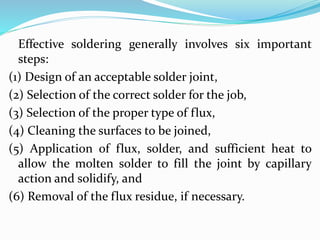
![IES 2007 Conventional
Two steel sheets of thickness one mm are welded
by resistance projection welding technique. A
current of 30,000 A for 0·005 second is made to
flow. The effective resistance of joint can be taken
as 100 micro ohms. The joint can be considered as
a cylinder of diameter 5 mm and height 1·5 mm.
The density of steel is 0·00786 gm/mm3. The heat
needed for welding steel is 10 J/mm3. Calculate the
efficiency of welding. [20]](https://image.slidesharecdn.com/ch-20resistanceandspecialwelding-170423125833/85/Ch-20-resistance-and-special-welding-29-320.jpg)

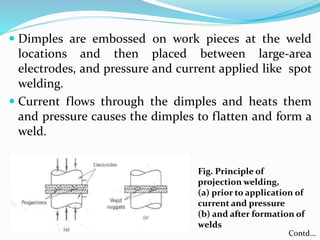


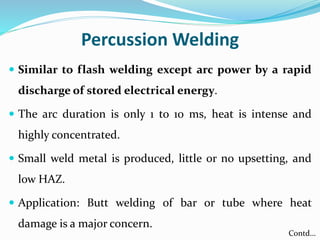
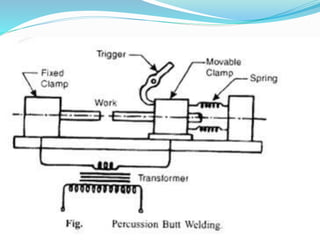
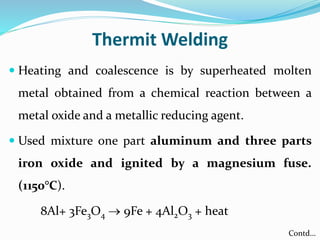





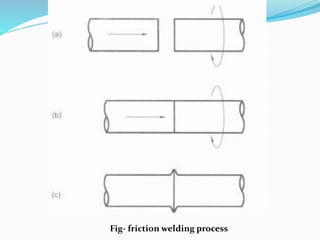

![IFS-2011
Discuss with figure the various steps required for
friction welding, mentioning at least two methods
of control.
[5-marks]](https://image.slidesharecdn.com/ch-20resistanceandspecialwelding-170423125833/85/Ch-20-resistance-and-special-welding-89-320.jpg)



![IFS - 2009
Two plates of aluminium and stainless steel are to
be welded back to back to create a single plate of
thickness equal to the sum of the thicknesses of
the two plates. Suggest the suitable process and
explain it in brief.
[ 10 – marks]](https://image.slidesharecdn.com/ch-20resistanceandspecialwelding-170423125833/85/Ch-20-resistance-and-special-welding-109-320.jpg)
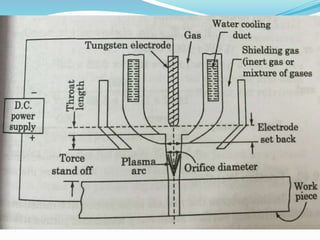
![IAS-2014, IES-2015 Conv.
Explain with neat sketches the Plasma Arc Welding
(PAW) process and discuss its applications and
limitations. [20 Marks]](https://image.slidesharecdn.com/ch-20resistanceandspecialwelding-170423125833/85/Ch-20-resistance-and-special-welding-117-320.jpg)

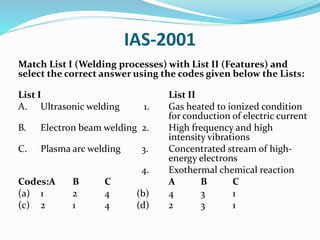
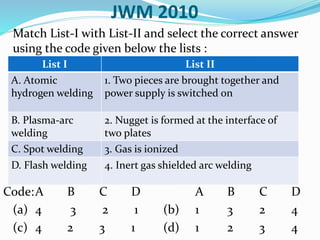
![IES 2011 Conventional
Discuss the process capabilities and applications of Gas
Metal Arc Welding, Gas tungsten Arc Welding, and
Diffusion Bonding processes.
[15 Marks]](https://image.slidesharecdn.com/ch-20resistanceandspecialwelding-170423125833/85/Ch-20-resistance-and-special-welding-123-320.jpg)


![IES 2011 Conventional
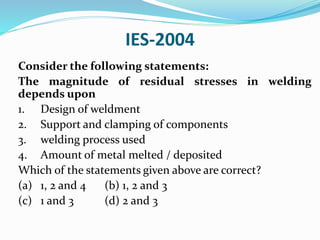
Enumerate four defects caused due to residual stresses in
welded joints.
[2 Marks]
Ans.
1. Distortion
2. Cracking in the base metal
3. Lamellar Tearing
4. Reduction of fatigue strength](https://image.slidesharecdn.com/ch-20resistanceandspecialwelding-170423125833/85/Ch-20-resistance-and-special-welding-166-320.jpg)
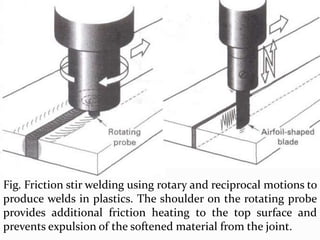
![IES-2015 Conventional
Differentiate between the working principles of
Friction Stir welding and Friction welding.
[ 10 Marks]](https://image.slidesharecdn.com/ch-20resistanceandspecialwelding-170423125833/85/Ch-20-resistance-and-special-welding-190-320.jpg)
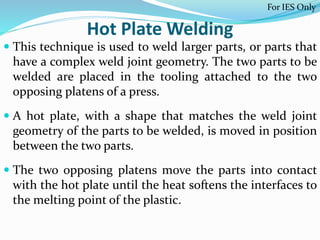
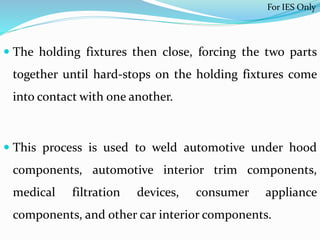
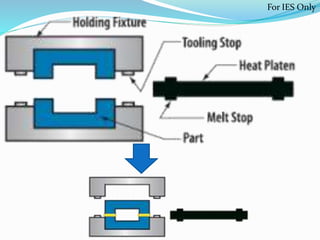



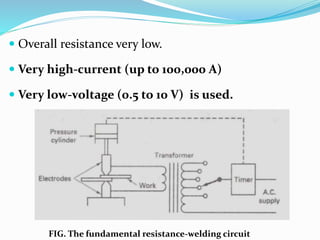
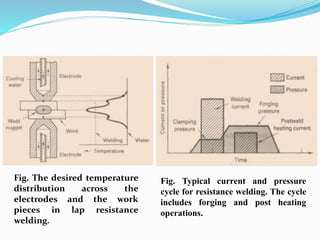
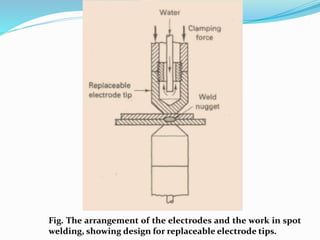
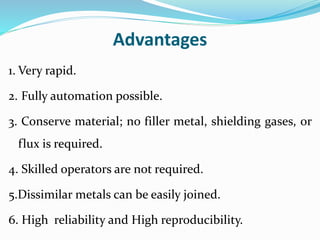
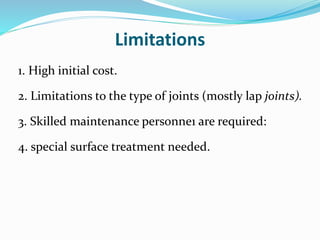
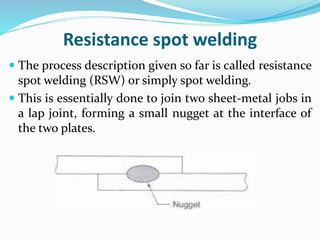
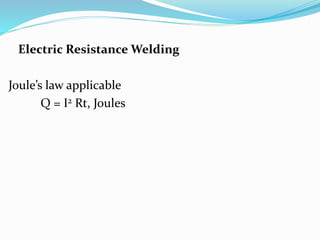
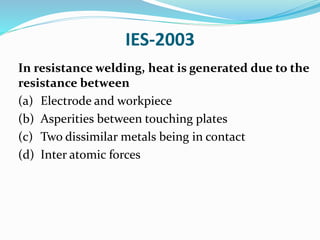
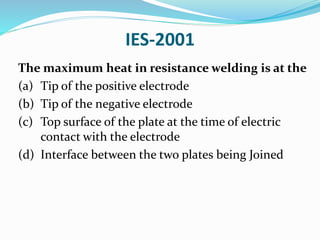
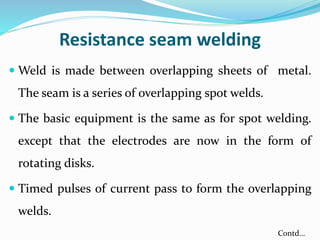
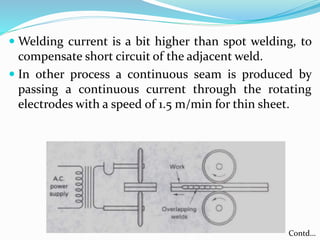
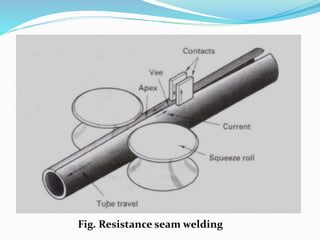
Resistance welding uses both heat and pressure to join metal workpieces. Heat is generated by the electrical resistance between the workpieces when a current is passed through them. Pressure holds the workpieces together during welding. Some key advantages of resistance welding are that it is very fast, can be fully automated, and does not require filler metal, shielding gases, or flux. Common types of resistance welding include resistance spot welding, seam welding, and projection welding.


