© The McGraw-Hill Companies, Inc.
Introductory Psychology Concepts
Chapter 12: Abnormal Psychology
© The McGraw-Hill Companies, Inc.
Introductory Psychology Concepts: Abnormal Psychology
Abnormal Psychology:
Defining the Study of Abnormal Behavior
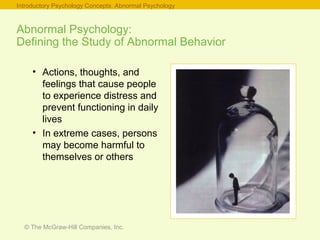
• Actions, thoughts, and
feelings that cause people
to experience distress and
prevent functioning in daily
lives
• In extreme cases, persons
may become harmful to
themselves or others
© The McGraw-Hill Companies, Inc.
Introductory Psychology Concepts: Abnormal Psychology
Abnormal Psychology:
What is “abnormal”?
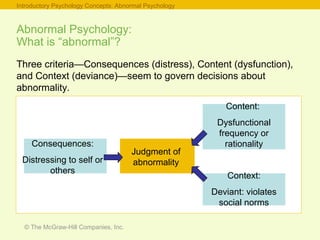
Three criteria—Consequences (distress), Content (dysfunction),
and Context (deviance)—seem to govern decisions about
abnormality.
Consequences:
Distressing to self or
others
Content:
Dysfunctional
frequency or
rationality
Context:
Deviant: violates
social norms
Judgment of
abnormality
© The McGraw-Hill Companies, Inc.
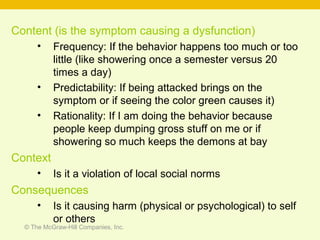
Content (is the symptom causing a dysfunction)
• Frequency: If the behavior happens too much or too
little (like showering once a semester versus 20
times a day)
• Predictability: If being attacked brings on the
symptom or if seeing the color green causes it)
• Rationality: If I am doing the behavior because
people keep dumping gross stuff on me or if
showering so much keeps the demons at bay
Context
• Is it a violation of local social norms
Consequences
• Is it causing harm (physical or psychological) to self
or others
© The McGraw-Hill Companies, Inc.
Psychological Perspective:
Understanding Abnormal Behavior in Terms of
Psychological Events
• Behavior is due to underlying issues.
• Stems from childhood conflicts over opposing wishes
regarding sex and aggression.
• If conflicts are not resolved they can be buried in the
unconscious, which can bring about abnormal
behavior in adulthood.
• This view was held most famously by Freud.
Introductory Psychology Concepts: Abnormal Psychology
© The McGraw-Hill Companies, Inc.
Behavioral Perspective:
Understanding Abnormal Behavior in Terms of the
Principles of Learning
• All behavior is merely a response to various stimuli,
and these responses have been learned through past
experience.
• Abnormal behavior occurs because a person has
learned abnormal behavior.
Introductory Psychology Concepts: Abnormal Psychology
© The McGraw-Hill Companies, Inc.
Neuroscience Perspective:
Understanding Abnormal Behavior in Terms of Biology
• Behavior is due to underlying issues.
• The root cause is found in a physical examination of
the individual, which is why we use terms like mental
“illness” and mental “hospitals”.
• Examination may reveal a hormonal imbalance, a
chemical deficiency, or a brain injury causing the
abnormal behavior.
Introductory Psychology Concepts: Abnormal Psychology
© The McGraw-Hill Companies, Inc.
Cognitive Perspective:
Understanding Abnormal Behavior in Terms of
Cognitive Events
• Behavior is a result of factors that are within an
individual’s control.
• People’s cognition, their thoughts and beliefs, are a
central component of abnormal behavior.
Introductory Psychology Concepts: Abnormal Psychology
© The McGraw-Hill Companies, Inc.
Group Perspective:
Understanding Abnormal Behavior in Terms of the
Effects of Groups on Abnormal Behavior.
• People’s behavior is shaped by the kind of family
group, society, and culture in which they live.
• One’s relationships with others can support or cause
abnormal behaviors.
• Daily interactions that cause stress and conflict can
also promote and maintain abnormal behaviors.
Introductory Psychology Concepts: Abnormal Psychology
© The McGraw-Hill Companies, Inc.
DSM V
•Diagnostic and Statistical Manual of Mental Disorders,
5th
edition
•Published by the APA
•Book used as reference book for diagnosing which
specific disorder the symptoms listed is called
© The McGraw-Hill Companies, Inc.
Introductory Psychology Concepts
Anxiety Disorders
© The McGraw-Hill Companies, Inc.
Anxiety Disorders: Excessive and Unrealistic Anxiety
• Anxiety is the state of tension and apprehension that
one naturally feels in threatening situations.
• An anxiety disorder is classified by excessive
responses that are out of proportion to the situation
that triggers them.
Introductory Psychology Concepts: Anxiety Disorders
© The McGraw-Hill Companies, Inc.
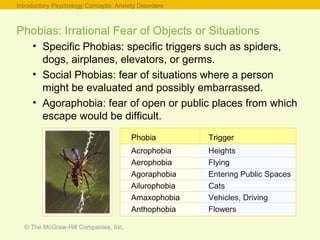
Phobias: Irrational Fear of Objects or Situations
• Specific Phobias: specific triggers such as spiders,
dogs, airplanes, elevators, or germs.
• Social Phobias: fear of situations where a person
might be evaluated and possibly embarrassed.
• Agoraphobia: fear of open or public places from which
escape would be difficult.
Introductory Psychology Concepts: Anxiety Disorders
Phobia Trigger
Acrophobia
Aerophobia
Agoraphobia
Ailurophobia
Amaxophobia
Anthophobia
Heights
Flying
Entering Public Spaces
Cats
Vehicles, Driving
Flowers
© The McGraw-Hill Companies, Inc.
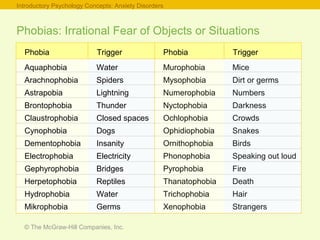
Phobias: Irrational Fear of Objects or Situations
Introductory Psychology Concepts: Anxiety Disorders
Phobia Trigger Phobia Trigger
Aquaphobia
Arachnophobia
Astrapobia
Brontophobia
Claustrophobia
Cynophobia
Dementophobia
Electrophobia
Gephyrophobia
Herpetophobia
Hydrophobia
Mikrophobia
Water
Spiders
Lightning
Thunder
Closed spaces
Dogs
Insanity
Electricity
Bridges
Reptiles
Water
Germs
Murophobia
Mysophobia
Numerophobia
Nyctophobia
Ochlophobia
Ophidiophobia
Ornithophobia
Phonophobia
Pyrophobia
Thanatophobia
Trichophobia
Xenophobia
Mice
Dirt or germs
Numbers
Darkness
Crowds
Snakes
Birds
Speaking out loud
Fire
Death
Hair
Strangers
© The McGraw-Hill Companies, Inc.
Obsessive-Compulsive Disorder:
Obsessive Thoughts and Compulsive Behaviors
• Obsessions are persistent and unwelcome thoughts
that keep recurring.
• Compulsions are irritable urges to repeatedly carry out
some act that is unreasonable.
Introductory Psychology Concepts: Anxiety Disorders
© The McGraw-Hill Companies, Inc.
Panic Disorder:
Intense Panic With Physical Symptoms
• Usually characterized by a panic attack, a sudden and
unpredictable surge of tension and anxiety that can last
from several seconds to several hours.
Introductory Psychology Concepts: Anxiety Disorders
© The McGraw-Hill Companies, Inc.
Generalized Anxiety Disorder:
Intense Anxiety for At Least Six Months
• Chronic, or ongoing, state of anxiety that is not
attached to any specific situation or object.
Introductory Psychology Concepts: Anxiety Disorders
© The McGraw-Hill Companies, Inc.
Posttraumatic Disorder:
Re-experiencing a Traumatic Event
• Posttraumatic Stress Disorder (PTSD) is a severe
anxiety disorder that occurs to people who have been
exposed to traumatic life events.
• PTSD primarily identified through the study of soldiers
returning from war, specifically their problems with
images and acts they witnessed.
Introductory Psychology Concepts: Anxiety Disorders
© The McGraw-Hill Companies, Inc.
Causes of Anxiety Disorders:
Psychoanalytic, Behavioral, Cognitive, and Biological
• Psychoanalytic:
Form of neuroses that occurs when unacceptable
impulses threaten to overwhelm the ego’s defenses
and explode into consciousness.
• Behavioral:
Created through learned classical conditioning,
observational learning, or operant conditioning.
• Cognitive:
Problem of maladaptive thought patterns and beliefs.
• Biological:
Created through genetics.
Introductory Psychology Concepts: Anxiety Disorders
© The McGraw-Hill Companies, Inc.
Components of Anxiety
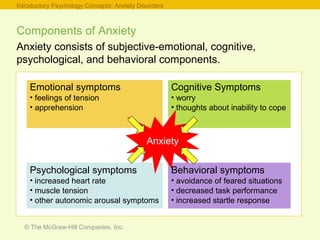
Anxiety consists of subjective-emotional, cognitive,
psychological, and behavioral components.
Introductory Psychology Concepts: Anxiety Disorders
Emotional symptoms
• feelings of tension
• apprehension
Anxiety
Psychological symptoms
• increased heart rate
• muscle tension
• other autonomic arousal symptoms
Behavioral symptoms
• avoidance of feared situations
• decreased task performance
• increased startle response
Cognitive Symptoms
• worry
• thoughts about inability to cope
© The McGraw-Hill Companies, Inc.
Introductory Psychology Concepts
Mood Disorders
© The McGraw-Hill Companies, Inc.
Mood Disorders: Severe Disturbances in Emotion
• Emotion-based disturbance strong enough to intrude
on everyday life.
Introductory Psychology Concepts: Mood Disorders
© The McGraw-Hill Companies, Inc.
Major Depression:
Extreme Sadness, Despair, With No Obvious Cause
• Characterized by:
• Episodes of deep unhappiness
• Loss of interest in life.
• Secondary symptoms include:
• Elevated or decreased changes in sleep and
appetite
• Loss of interest in sex
• Loss of overall energy
• Difficulties concentrating and making decisions.
Introductory Psychology Concepts: Mood Disorders
© The McGraw-Hill Companies, Inc.
Major Depression:
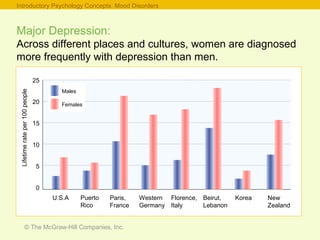
Across different places and cultures, women are diagnosed
more frequently with depression than men.
Introductory Psychology Concepts: Mood Disorders
25
20
15
10
5
0
U.S.A Puerto
Rico
Paris,
France
Lifetimerateper100people
Western
Germany
Florence,
Italy
Beirut,
Lebanon
Korea New
Zealand
Males
Females
© The McGraw-Hill Companies, Inc.
Bipolar Disorders:
•Bipolar I
• Characterized by periods of mania and normal
moods (MANIA ONLY)
•Bipolar II
• Characterized by:
• An internal struggle with depression (usually the dominant
state)
• Alternated with periods of mania, a state of highly excited
moods of euphoria and grandeur.
• ***Only need (1) Manic and (1) Depressed episode in 6
months!!
Introductory Psychology Concepts: Mood Disorders
© The McGraw-Hill Companies, Inc.
Causes of Mood Disorders
• Psychoanalytic:
Occurs when an early traumatic loss or rejection
creates vulnerability that is not properly resolved.
Introductory Psychology Concepts: Mood Disorders
© The McGraw-Hill Companies, Inc.
Causes of Mood Disorders
• Behavioral:
• Learned via reinforcement
• May be triggered by a loss or some other punishing
event
Introductory Psychology Concepts: Mood Disorders
© The McGraw-Hill Companies, Inc.
Causes of Mood Disorders
• Cognitive:
A person’s perceptions, thoughts, or self statements
cause feelings of worthlessness and inadequacy.
Introductory Psychology Concepts: Mood Disorders
© The McGraw-Hill Companies, Inc.
Causes of Mood Disorders
• Family Issues:
Caused from our surrounding culture, family, friends,
and the presence or absence of a strong social
support network when dealing with negative factors.
Introductory Psychology Concepts: Mood Disorders
© The McGraw-Hill Companies, Inc.
Causes of Mood Disorders
• Biological:
Created through genetics and neurochemical factors
Introductory Psychology Concepts: Mood Disorders
© The McGraw-Hill Companies, Inc.
Introductory Psychology Concepts
Schizophrenia
© The McGraw-Hill Companies, Inc.
Schizophrenia:
A Split Between Thoughts, Emotions, and Behavior
• Psychiatric mental illness characterized by
impairments in the perception or expression of reality,
which results in significant social or occupational
dysfunction.
Introductory Psychology Concepts: Schizophrenia
© The McGraw-Hill Companies, Inc.
Main Symptoms of Schizophrenia 3 categories
• Positive (addition of)
• Delusions (beliefs)
• Hallucinations (sensory experiences)
• Negative (loss of…)
• Affect (emotions)
• Alogia (words)
• Anhedonia (pleasure)
• Avolition (motivation)
• Disorganized
• Disorganized speech
• Disorganized behaviors
• Disorganized emotions
Introductory Psychology Concepts: Schizophrenia
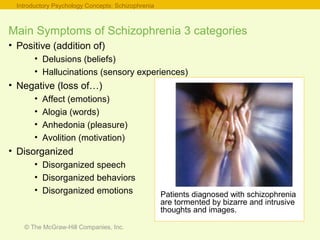
Patients diagnosed with schizophrenia
are tormented by bizarre and intrusive
thoughts and images.
© The McGraw-Hill Companies, Inc.
Possible Causes of Schizophrenia
Psychoanalytic:
Suggests that schizophrenia is a form of regression to earlier
experiences and stages of life.
• Freud: people with schizophrenia lack egos strong enough to
cope with unacceptable impulses.
Behavioral:
Suggests that the disorder is created through learned classical
conditioning, observational learning, or operant conditioning.
Cognitive:
Suggests that schizophrenia results from overattention to stimuli
in the environment.
• People with the disorder may be receptive to everything in their
environment, unable to screen out unimportant stimuli.
Introductory Psychology Concepts: Schizophrenia
© The McGraw-Hill Companies, Inc.
Possible Causes of Schizophrenia (continued)
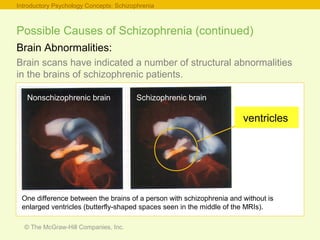
Brain Abnormalities:
Brain scans have indicated a number of structural abnormalities
in the brains of schizophrenic patients.
Introductory Psychology Concepts: Schizophrenia
One difference between the brains of a person with schizophrenia and without is
enlarged ventricles (butterfly-shaped spaces seen in the middle of the MRIs).
Schizophrenic brainNonschizophrenic brain
ventricles
© The McGraw-Hill Companies, Inc.
Possible Causes of Schizophrenia (continued)
Biological hypothesis:
The brains of people with schizophrenia may harbor either a
biochemical imbalance or a structural abnormality.
• The dopamine hypothesis suggests that schizophrenia occurs
when there is excess activity in the areas of the brain that use
dopamine as a neurotransmitter.
• Drugs that block dopamine action in brain pathways can be
highly effective in reducing the symptoms of schizophrenia.
Introductory Psychology Concepts: Schizophrenia
© The McGraw-Hill Companies, Inc.
Introductory Psychology Concepts: Schizophrenia
Possible Causes of Schizophrenia (continued)
Genetic:
Strong evidence exists for a genetic predisposition to
schizophrenia.
• Specific genes and their roles in creating the disposition are
unknown.
• Twin studies show that identical twins have higher concordance
rates than fraternal twins.
• Adoption studies show much higher concordance with biological
parents than with adoptive parents.
© The McGraw-Hill Companies, Inc.
Introductory Psychology Concepts: Schizophrenia
Genes and schizophrenia
The degree of risk for developing schizophrenia correlates highly with
the degree of genetic relationship with someone who has that disorder.
Data summarizes results of 40 concordance studies conducted in many countries.
SOURCE: Based on Gottesman, 1991
Relationship
Genetic
relatedness
Unrelated person in the
general population
Nephew/niece
Sibling
Offspring of 1 schizophrenic
patient
Fraternal twin
Offspring of 2 schizophrenic
patients
Identical twin
0%
25%
50%
50%
50%
50% with
each parent
100%
10 20 30 40 50 60
Lifetime risk
1%
3%
10%
13%
17%
46%
48%

ch 12

  • 1.
    © The McGraw-HillCompanies, Inc. Introductory Psychology Concepts Chapter 12: Abnormal Psychology
  • 2.
    © The McGraw-HillCompanies, Inc. Introductory Psychology Concepts: Abnormal Psychology Abnormal Psychology: Defining the Study of Abnormal Behavior • Actions, thoughts, and feelings that cause people to experience distress and prevent functioning in daily lives • In extreme cases, persons may become harmful to themselves or others
  • 3.
    © The McGraw-HillCompanies, Inc. Introductory Psychology Concepts: Abnormal Psychology Abnormal Psychology: What is “abnormal”? Three criteria—Consequences (distress), Content (dysfunction), and Context (deviance)—seem to govern decisions about abnormality. Consequences: Distressing to self or others Content: Dysfunctional frequency or rationality Context: Deviant: violates social norms Judgment of abnormality
  • 4.
    © The McGraw-HillCompanies, Inc. Content (is the symptom causing a dysfunction) • Frequency: If the behavior happens too much or too little (like showering once a semester versus 20 times a day) • Predictability: If being attacked brings on the symptom or if seeing the color green causes it) • Rationality: If I am doing the behavior because people keep dumping gross stuff on me or if showering so much keeps the demons at bay Context • Is it a violation of local social norms Consequences • Is it causing harm (physical or psychological) to self or others
  • 5.
    © The McGraw-HillCompanies, Inc. Psychological Perspective: Understanding Abnormal Behavior in Terms of Psychological Events • Behavior is due to underlying issues. • Stems from childhood conflicts over opposing wishes regarding sex and aggression. • If conflicts are not resolved they can be buried in the unconscious, which can bring about abnormal behavior in adulthood. • This view was held most famously by Freud. Introductory Psychology Concepts: Abnormal Psychology
  • 6.
    © The McGraw-HillCompanies, Inc. Behavioral Perspective: Understanding Abnormal Behavior in Terms of the Principles of Learning • All behavior is merely a response to various stimuli, and these responses have been learned through past experience. • Abnormal behavior occurs because a person has learned abnormal behavior. Introductory Psychology Concepts: Abnormal Psychology
  • 7.
    © The McGraw-HillCompanies, Inc. Neuroscience Perspective: Understanding Abnormal Behavior in Terms of Biology • Behavior is due to underlying issues. • The root cause is found in a physical examination of the individual, which is why we use terms like mental “illness” and mental “hospitals”. • Examination may reveal a hormonal imbalance, a chemical deficiency, or a brain injury causing the abnormal behavior. Introductory Psychology Concepts: Abnormal Psychology
  • 8.
    © The McGraw-HillCompanies, Inc. Cognitive Perspective: Understanding Abnormal Behavior in Terms of Cognitive Events • Behavior is a result of factors that are within an individual’s control. • People’s cognition, their thoughts and beliefs, are a central component of abnormal behavior. Introductory Psychology Concepts: Abnormal Psychology
  • 9.
    © The McGraw-HillCompanies, Inc. Group Perspective: Understanding Abnormal Behavior in Terms of the Effects of Groups on Abnormal Behavior. • People’s behavior is shaped by the kind of family group, society, and culture in which they live. • One’s relationships with others can support or cause abnormal behaviors. • Daily interactions that cause stress and conflict can also promote and maintain abnormal behaviors. Introductory Psychology Concepts: Abnormal Psychology
  • 10.
    © The McGraw-HillCompanies, Inc. DSM V •Diagnostic and Statistical Manual of Mental Disorders, 5th edition •Published by the APA •Book used as reference book for diagnosing which specific disorder the symptoms listed is called
  • 11.
    © The McGraw-HillCompanies, Inc. Introductory Psychology Concepts Anxiety Disorders
  • 12.
    © The McGraw-HillCompanies, Inc. Anxiety Disorders: Excessive and Unrealistic Anxiety • Anxiety is the state of tension and apprehension that one naturally feels in threatening situations. • An anxiety disorder is classified by excessive responses that are out of proportion to the situation that triggers them. Introductory Psychology Concepts: Anxiety Disorders
  • 13.
    © The McGraw-HillCompanies, Inc. Phobias: Irrational Fear of Objects or Situations • Specific Phobias: specific triggers such as spiders, dogs, airplanes, elevators, or germs. • Social Phobias: fear of situations where a person might be evaluated and possibly embarrassed. • Agoraphobia: fear of open or public places from which escape would be difficult. Introductory Psychology Concepts: Anxiety Disorders Phobia Trigger Acrophobia Aerophobia Agoraphobia Ailurophobia Amaxophobia Anthophobia Heights Flying Entering Public Spaces Cats Vehicles, Driving Flowers
  • 14.
    © The McGraw-HillCompanies, Inc. Phobias: Irrational Fear of Objects or Situations Introductory Psychology Concepts: Anxiety Disorders Phobia Trigger Phobia Trigger Aquaphobia Arachnophobia Astrapobia Brontophobia Claustrophobia Cynophobia Dementophobia Electrophobia Gephyrophobia Herpetophobia Hydrophobia Mikrophobia Water Spiders Lightning Thunder Closed spaces Dogs Insanity Electricity Bridges Reptiles Water Germs Murophobia Mysophobia Numerophobia Nyctophobia Ochlophobia Ophidiophobia Ornithophobia Phonophobia Pyrophobia Thanatophobia Trichophobia Xenophobia Mice Dirt or germs Numbers Darkness Crowds Snakes Birds Speaking out loud Fire Death Hair Strangers
  • 15.
    © The McGraw-HillCompanies, Inc. Obsessive-Compulsive Disorder: Obsessive Thoughts and Compulsive Behaviors • Obsessions are persistent and unwelcome thoughts that keep recurring. • Compulsions are irritable urges to repeatedly carry out some act that is unreasonable. Introductory Psychology Concepts: Anxiety Disorders
  • 16.
    © The McGraw-HillCompanies, Inc. Panic Disorder: Intense Panic With Physical Symptoms • Usually characterized by a panic attack, a sudden and unpredictable surge of tension and anxiety that can last from several seconds to several hours. Introductory Psychology Concepts: Anxiety Disorders
  • 17.
    © The McGraw-HillCompanies, Inc. Generalized Anxiety Disorder: Intense Anxiety for At Least Six Months • Chronic, or ongoing, state of anxiety that is not attached to any specific situation or object. Introductory Psychology Concepts: Anxiety Disorders
  • 18.
    © The McGraw-HillCompanies, Inc. Posttraumatic Disorder: Re-experiencing a Traumatic Event • Posttraumatic Stress Disorder (PTSD) is a severe anxiety disorder that occurs to people who have been exposed to traumatic life events. • PTSD primarily identified through the study of soldiers returning from war, specifically their problems with images and acts they witnessed. Introductory Psychology Concepts: Anxiety Disorders
  • 19.
    © The McGraw-HillCompanies, Inc. Causes of Anxiety Disorders: Psychoanalytic, Behavioral, Cognitive, and Biological • Psychoanalytic: Form of neuroses that occurs when unacceptable impulses threaten to overwhelm the ego’s defenses and explode into consciousness. • Behavioral: Created through learned classical conditioning, observational learning, or operant conditioning. • Cognitive: Problem of maladaptive thought patterns and beliefs. • Biological: Created through genetics. Introductory Psychology Concepts: Anxiety Disorders
  • 20.
    © The McGraw-HillCompanies, Inc. Components of Anxiety Anxiety consists of subjective-emotional, cognitive, psychological, and behavioral components. Introductory Psychology Concepts: Anxiety Disorders Emotional symptoms • feelings of tension • apprehension Anxiety Psychological symptoms • increased heart rate • muscle tension • other autonomic arousal symptoms Behavioral symptoms • avoidance of feared situations • decreased task performance • increased startle response Cognitive Symptoms • worry • thoughts about inability to cope
  • 21.
    © The McGraw-HillCompanies, Inc. Introductory Psychology Concepts Mood Disorders
  • 22.
    © The McGraw-HillCompanies, Inc. Mood Disorders: Severe Disturbances in Emotion • Emotion-based disturbance strong enough to intrude on everyday life. Introductory Psychology Concepts: Mood Disorders
  • 23.
    © The McGraw-HillCompanies, Inc. Major Depression: Extreme Sadness, Despair, With No Obvious Cause • Characterized by: • Episodes of deep unhappiness • Loss of interest in life. • Secondary symptoms include: • Elevated or decreased changes in sleep and appetite • Loss of interest in sex • Loss of overall energy • Difficulties concentrating and making decisions. Introductory Psychology Concepts: Mood Disorders
  • 24.
    © The McGraw-HillCompanies, Inc. Major Depression: Across different places and cultures, women are diagnosed more frequently with depression than men. Introductory Psychology Concepts: Mood Disorders 25 20 15 10 5 0 U.S.A Puerto Rico Paris, France Lifetimerateper100people Western Germany Florence, Italy Beirut, Lebanon Korea New Zealand Males Females
  • 25.
    © The McGraw-HillCompanies, Inc. Bipolar Disorders: •Bipolar I • Characterized by periods of mania and normal moods (MANIA ONLY) •Bipolar II • Characterized by: • An internal struggle with depression (usually the dominant state) • Alternated with periods of mania, a state of highly excited moods of euphoria and grandeur. • ***Only need (1) Manic and (1) Depressed episode in 6 months!! Introductory Psychology Concepts: Mood Disorders
  • 26.
    © The McGraw-HillCompanies, Inc. Causes of Mood Disorders • Psychoanalytic: Occurs when an early traumatic loss or rejection creates vulnerability that is not properly resolved. Introductory Psychology Concepts: Mood Disorders
  • 27.
    © The McGraw-HillCompanies, Inc. Causes of Mood Disorders • Behavioral: • Learned via reinforcement • May be triggered by a loss or some other punishing event Introductory Psychology Concepts: Mood Disorders
  • 28.
    © The McGraw-HillCompanies, Inc. Causes of Mood Disorders • Cognitive: A person’s perceptions, thoughts, or self statements cause feelings of worthlessness and inadequacy. Introductory Psychology Concepts: Mood Disorders
  • 29.
    © The McGraw-HillCompanies, Inc. Causes of Mood Disorders • Family Issues: Caused from our surrounding culture, family, friends, and the presence or absence of a strong social support network when dealing with negative factors. Introductory Psychology Concepts: Mood Disorders
  • 30.
    © The McGraw-HillCompanies, Inc. Causes of Mood Disorders • Biological: Created through genetics and neurochemical factors Introductory Psychology Concepts: Mood Disorders
  • 31.
    © The McGraw-HillCompanies, Inc. Introductory Psychology Concepts Schizophrenia
  • 32.
    © The McGraw-HillCompanies, Inc. Schizophrenia: A Split Between Thoughts, Emotions, and Behavior • Psychiatric mental illness characterized by impairments in the perception or expression of reality, which results in significant social or occupational dysfunction. Introductory Psychology Concepts: Schizophrenia
  • 33.
    © The McGraw-HillCompanies, Inc. Main Symptoms of Schizophrenia 3 categories • Positive (addition of) • Delusions (beliefs) • Hallucinations (sensory experiences) • Negative (loss of…) • Affect (emotions) • Alogia (words) • Anhedonia (pleasure) • Avolition (motivation) • Disorganized • Disorganized speech • Disorganized behaviors • Disorganized emotions Introductory Psychology Concepts: Schizophrenia Patients diagnosed with schizophrenia are tormented by bizarre and intrusive thoughts and images.
  • 34.
    © The McGraw-HillCompanies, Inc. Possible Causes of Schizophrenia Psychoanalytic: Suggests that schizophrenia is a form of regression to earlier experiences and stages of life. • Freud: people with schizophrenia lack egos strong enough to cope with unacceptable impulses. Behavioral: Suggests that the disorder is created through learned classical conditioning, observational learning, or operant conditioning. Cognitive: Suggests that schizophrenia results from overattention to stimuli in the environment. • People with the disorder may be receptive to everything in their environment, unable to screen out unimportant stimuli. Introductory Psychology Concepts: Schizophrenia
  • 35.
    © The McGraw-HillCompanies, Inc. Possible Causes of Schizophrenia (continued) Brain Abnormalities: Brain scans have indicated a number of structural abnormalities in the brains of schizophrenic patients. Introductory Psychology Concepts: Schizophrenia One difference between the brains of a person with schizophrenia and without is enlarged ventricles (butterfly-shaped spaces seen in the middle of the MRIs). Schizophrenic brainNonschizophrenic brain ventricles
  • 36.
    © The McGraw-HillCompanies, Inc. Possible Causes of Schizophrenia (continued) Biological hypothesis: The brains of people with schizophrenia may harbor either a biochemical imbalance or a structural abnormality. • The dopamine hypothesis suggests that schizophrenia occurs when there is excess activity in the areas of the brain that use dopamine as a neurotransmitter. • Drugs that block dopamine action in brain pathways can be highly effective in reducing the symptoms of schizophrenia. Introductory Psychology Concepts: Schizophrenia
  • 37.
    © The McGraw-HillCompanies, Inc. Introductory Psychology Concepts: Schizophrenia Possible Causes of Schizophrenia (continued) Genetic: Strong evidence exists for a genetic predisposition to schizophrenia. • Specific genes and their roles in creating the disposition are unknown. • Twin studies show that identical twins have higher concordance rates than fraternal twins. • Adoption studies show much higher concordance with biological parents than with adoptive parents.
  • 38.
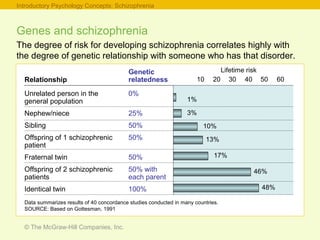
    © The McGraw-HillCompanies, Inc. Introductory Psychology Concepts: Schizophrenia Genes and schizophrenia The degree of risk for developing schizophrenia correlates highly with the degree of genetic relationship with someone who has that disorder. Data summarizes results of 40 concordance studies conducted in many countries. SOURCE: Based on Gottesman, 1991 Relationship Genetic relatedness Unrelated person in the general population Nephew/niece Sibling Offspring of 1 schizophrenic patient Fraternal twin Offspring of 2 schizophrenic patients Identical twin 0% 25% 50% 50% 50% 50% with each parent 100% 10 20 30 40 50 60 Lifetime risk 1% 3% 10% 13% 17% 46% 48%

Editor's Notes

  • #3 Photo: Smith pg528
  • #4 Photo: Smith pg528
  • #14 Passer & Smith, pg 536
  • #15 Passer & Smith, pg 536
  • #34 Passer pg555 fig14.27
  • #36 Passer, 557: Fig 14.30