What is a Mental Disorder?History of Abnormal PsychologyAbnormal Psychology and Life: Themes
History of Abnormal PsychologyAbnormal Psychology and Life: ThemesWhat is a Mental Disorder?
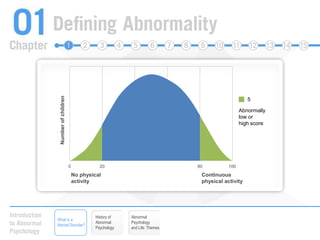
5Abnormally low or high scoreNumber of children20100080No physicalactivityContinuous physical activityHistory of Abnormal PsychologyAbnormal Psychology and Life: ThemesWhat is a Mental Disorder?
History of Abnormal PsychologyAbnormal Psychology and Life: ThemesWhat is a Mental Disorder?
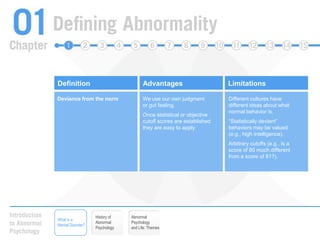
DefinitionAdvantagesLimitationsDeviance from the normDifferent cultures have different ideas about what normal behavior is.“Statistically deviant” behaviors may be valued (e.g., high intelligence).Arbitrary cutoffs (e.g., is a score of 80 much different from a score of 81?).We use our own judgment or gut feeling.Once statistical or objective cutoff scores are established they are easy to apply. History of Abnormal PsychologyAbnormal Psychology and Life: ThemesWhat is a Mental Disorder?
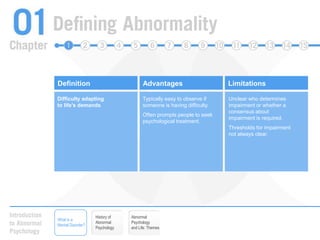
DefinitionAdvantagesLimitationsDeviance from the normDifferent cultures have different ideas about what normal behavior is.“Statistically deviant” behaviors may be valued (e.g., high intelligence).Arbitrary cutoffs (e.g., is a score of 80 much different from a score of 81?).We use our own judgment or gut feeling.Once statistical or objective cutoff scores are established they are easy to apply. Difficulty adapting to life’s demandsUnclear who determines impairment or whether a consensus about impairment is required.Thresholds for impairment not always clear.Typically easy to observe if someone is having difficulty.Often prompts people to seek psychological treatment. History of Abnormal PsychologyAbnormal Psychology and Life: ThemesWhat is a Mental Disorder?
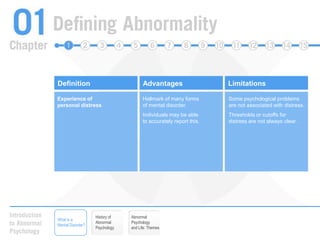
DefinitionAdvantagesLimitationsDeviance from the normDifferent cultures have different ideas about what normal behavior is.“Statistically deviant” behaviors may be valued (e.g., high intelligence).Arbitrary cutoffs (e.g., is a score of 80 much different from a score of 81?).We use our own judgment or gut feeling.Once statistical or objective cutoff scores are established they are easy to apply. Difficulty adapting to life’s demandsUnclear who determines impairment or whether a consensus about impairment is required.Thresholds for impairment not always clear.Typically easy to observe if someone is having difficulty.Often prompts people to seek psychological treatment. Experience of personal distressSome psychological problems are not associated with distress.Thresholds or cutoffs for distress are not always clear.Hallmark of many forms of mental disorder.Individuals may be able to accurately report this.History of Abnormal PsychologyAbnormal Psychology and Life: ThemesWhat is a Mental Disorder?
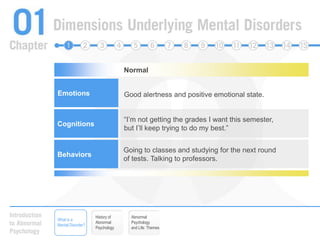
NormalMental Disorder – Less SevereGood alertness and positive emotional state.“I’m not getting the grades I want this semester, but I’ll keep trying to do my best.”Going to classes and studying for the next round of tests. Talking to professors. EmotionsCognitionsBehaviorsHistory of Abnormal PsychologyAbnormal Psychology and Life: ThemesWhat is a Mental Disorder?
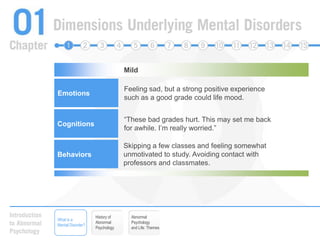
MildMental Disorder – Less SevereFeeling sad, but a strong positive experience such as a good grade could life mood.“These bad grades hurt. This may set me back for awhile. I’m really worried.”Skipping a few classes and feeling somewhat unmotivated to study. Avoiding contact with professors and classmates.EmotionsCognitionsBehaviorsHistory of Abnormal PsychologyAbnormal Psychology and Life: ThemesWhat is a Mental Disorder?
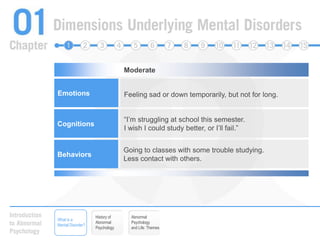
NormalMildModerateMental Disorder – Less SevereFeeling sad or down temporarily, but not for long.“I’m struggling at school this semester. I wish I could study better, or I’ll fail.”Going to classes with some trouble studying. Less contact with others. EmotionsCognitionsBehaviorsHistory of Abnormal PsychologyAbnormal Psychology and Life: ThemesWhat is a Mental Disorder?
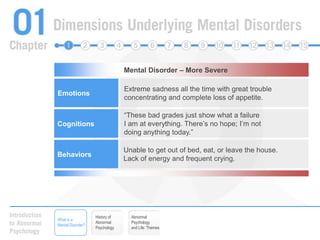
NormalMildModerateMental Disorder – Less SevereMental Disorder – More SevereExtreme sadness all the time with great trouble concentrating and complete loss of appetite.“These bad grades just show what a failure I am at everything. There’s no hope; I’m not doing anything today.”Unable to get out of bed, eat, or leave the house. Lack of energy and frequent crying.EmotionsCognitionsBehaviorsHistory of Abnormal PsychologyAbnormal Psychology and Life: ThemesWhat is a Mental Disorder?
History of Abnormal PsychologyAbnormal Psychology and Life: ThemesWhat is a Mental Disorder?
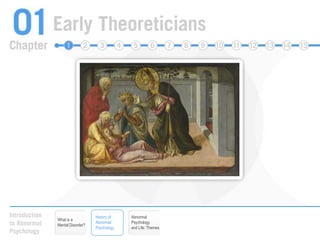
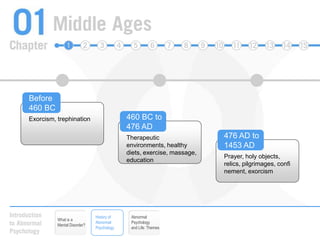
Before 460 BC460 BC to 476 ADExorcism, trephinationTherapeutic environments, healthy diets, exercise, massage, education476 AD to1453 ADPrayer, holy objects, relics, pilgrimages, confinement, exorcismHistory of Abnormal PsychologyAbnormal Psychology and Life: ThemesWhat is a Mental Disorder?
History of Abnormal PsychologyAbnormal Psychology and Life: ThemesWhat is a Mental Disorder?
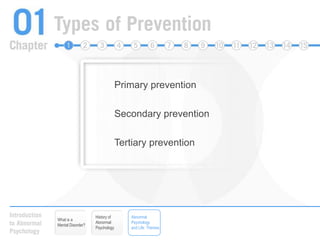
Primary preventionSecondary preventionTertiary preventionHistory of Abnormal PsychologyAbnormal Psychology and Life: ThemesWhat is a Mental Disorder?
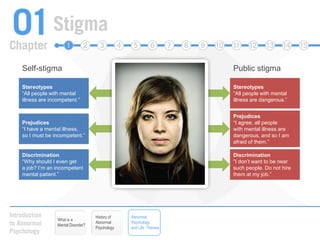
Self-stigmaPublic stigmaStereotypes“All people with mental illness are incompetent.”Stereotypes“All people with mental illness are dangerous.”Prejudices“I agree, all people with mental illness are dangerous, and so I am afraid of them.”Prejudices“I have a mental illness, so I must be incompetent.”Discrimination“Why should I even get a job? I’m an incompetent mental patient.”Discrimination“I don’t want to be near such people. Do not hire them at my job.”History of Abnormal PsychologyAbnormal Psychology and Life: ThemesWhat is a Mental Disorder?

Chapt1intro2fix

  • 1.
    What is aMental Disorder?History of Abnormal PsychologyAbnormal Psychology and Life: Themes
  • 2.
    History of AbnormalPsychologyAbnormal Psychology and Life: ThemesWhat is a Mental Disorder?
  • 3.
    5Abnormally low orhigh scoreNumber of children20100080No physicalactivityContinuous physical activityHistory of Abnormal PsychologyAbnormal Psychology and Life: ThemesWhat is a Mental Disorder?
  • 4.
    History of AbnormalPsychologyAbnormal Psychology and Life: ThemesWhat is a Mental Disorder?
  • 5.
    DefinitionAdvantagesLimitationsDeviance from thenormDifferent cultures have different ideas about what normal behavior is.“Statistically deviant” behaviors may be valued (e.g., high intelligence).Arbitrary cutoffs (e.g., is a score of 80 much different from a score of 81?).We use our own judgment or gut feeling.Once statistical or objective cutoff scores are established they are easy to apply. History of Abnormal PsychologyAbnormal Psychology and Life: ThemesWhat is a Mental Disorder?
  • 6.
    DefinitionAdvantagesLimitationsDeviance from thenormDifferent cultures have different ideas about what normal behavior is.“Statistically deviant” behaviors may be valued (e.g., high intelligence).Arbitrary cutoffs (e.g., is a score of 80 much different from a score of 81?).We use our own judgment or gut feeling.Once statistical or objective cutoff scores are established they are easy to apply. Difficulty adapting to life’s demandsUnclear who determines impairment or whether a consensus about impairment is required.Thresholds for impairment not always clear.Typically easy to observe if someone is having difficulty.Often prompts people to seek psychological treatment. History of Abnormal PsychologyAbnormal Psychology and Life: ThemesWhat is a Mental Disorder?
  • 7.
    DefinitionAdvantagesLimitationsDeviance from thenormDifferent cultures have different ideas about what normal behavior is.“Statistically deviant” behaviors may be valued (e.g., high intelligence).Arbitrary cutoffs (e.g., is a score of 80 much different from a score of 81?).We use our own judgment or gut feeling.Once statistical or objective cutoff scores are established they are easy to apply. Difficulty adapting to life’s demandsUnclear who determines impairment or whether a consensus about impairment is required.Thresholds for impairment not always clear.Typically easy to observe if someone is having difficulty.Often prompts people to seek psychological treatment. Experience of personal distressSome psychological problems are not associated with distress.Thresholds or cutoffs for distress are not always clear.Hallmark of many forms of mental disorder.Individuals may be able to accurately report this.History of Abnormal PsychologyAbnormal Psychology and Life: ThemesWhat is a Mental Disorder?
  • 8.
    NormalMental Disorder –Less SevereGood alertness and positive emotional state.“I’m not getting the grades I want this semester, but I’ll keep trying to do my best.”Going to classes and studying for the next round of tests. Talking to professors. EmotionsCognitionsBehaviorsHistory of Abnormal PsychologyAbnormal Psychology and Life: ThemesWhat is a Mental Disorder?
  • 9.
    MildMental Disorder –Less SevereFeeling sad, but a strong positive experience such as a good grade could life mood.“These bad grades hurt. This may set me back for awhile. I’m really worried.”Skipping a few classes and feeling somewhat unmotivated to study. Avoiding contact with professors and classmates.EmotionsCognitionsBehaviorsHistory of Abnormal PsychologyAbnormal Psychology and Life: ThemesWhat is a Mental Disorder?
  • 10.
    NormalMildModerateMental Disorder –Less SevereFeeling sad or down temporarily, but not for long.“I’m struggling at school this semester. I wish I could study better, or I’ll fail.”Going to classes with some trouble studying. Less contact with others. EmotionsCognitionsBehaviorsHistory of Abnormal PsychologyAbnormal Psychology and Life: ThemesWhat is a Mental Disorder?
  • 11.
    NormalMildModerateMental Disorder –Less SevereMental Disorder – More SevereExtreme sadness all the time with great trouble concentrating and complete loss of appetite.“These bad grades just show what a failure I am at everything. There’s no hope; I’m not doing anything today.”Unable to get out of bed, eat, or leave the house. Lack of energy and frequent crying.EmotionsCognitionsBehaviorsHistory of Abnormal PsychologyAbnormal Psychology and Life: ThemesWhat is a Mental Disorder?
  • 12.
    History of AbnormalPsychologyAbnormal Psychology and Life: ThemesWhat is a Mental Disorder?
  • 13.
    History of AbnormalPsychologyAbnormal Psychology and Life: ThemesWhat is a Mental Disorder?
  • 14.
    Before 460 BC460BC to 476 ADExorcism, trephinationTherapeutic environments, healthy diets, exercise, massage, education476 AD to1453 ADPrayer, holy objects, relics, pilgrimages, confinement, exorcismHistory of Abnormal PsychologyAbnormal Psychology and Life: ThemesWhat is a Mental Disorder?
  • 15.
    History of AbnormalPsychologyAbnormal Psychology and Life: ThemesWhat is a Mental Disorder?
  • 16.
    History of AbnormalPsychologyAbnormal Psychology and Life: ThemesWhat is a Mental Disorder?
  • 17.
    History of AbnormalPsychologyAbnormal Psychology and Life: ThemesWhat is a Mental Disorder?
  • 18.
    Primary preventionSecondary preventionTertiarypreventionHistory of Abnormal PsychologyAbnormal Psychology and Life: ThemesWhat is a Mental Disorder?
  • 19.
    Self-stigmaPublic stigmaStereotypes“All peoplewith mental illness are incompetent.”Stereotypes“All people with mental illness are dangerous.”Prejudices“I agree, all people with mental illness are dangerous, and so I am afraid of them.”Prejudices“I have a mental illness, so I must be incompetent.”Discrimination“Why should I even get a job? I’m an incompetent mental patient.”Discrimination“I don’t want to be near such people. Do not hire them at my job.”History of Abnormal PsychologyAbnormal Psychology and Life: ThemesWhat is a Mental Disorder?