Introduction to operations management
presented by; Iltaf khokhar
CONTENTS;
What is operations management
Operations management in business
Difference between manufacturers and service organizations
Operations management decisions
Strategic OM decisions
Supply chain management
Quality management
Historical development of operations management
Operations management in practice
Today’s OM Environment
Operations Management
Introduction to Operations Management
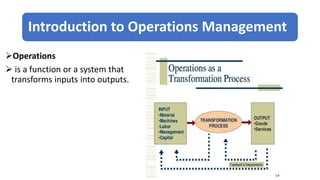
Operations
 is a function or a system that
transforms inputs into outputs.
Introductions to Operations Management
Management
 is the process which
combines and transforms
various resources used in the
operations subsystems of the
organization.
Operations Management (OM)
Def: Operations Management is the Business function, that plans,
organizes, coordinates and controls the resources needed to produce
company’s goods and services
Operations management is a management function
Operations management is the central core function of every
company, whether the company is large or small, provides goods or
services.
Three major functions of management
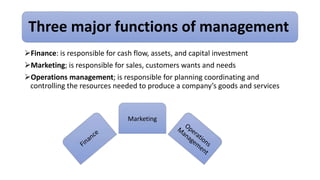
Finance: is responsible for cash flow, assets, and capital investment
Marketing; is responsible for sales, customers wants and needs
Operations management; is responsible for planning coordinating and
controlling the resources needed to produce a company’s goods and services
Marketing
The Role of major Functions
Every company has an operations management function, primarily all
the other organizational functions (Accounting, marketing, HRM, MIS,
and engineering) are there to support the operations function.
Operations management is responsible for orchestrating all the
resources needed to produce the final product this includes designing
the product deciding what resources are needed arranging schedules,
equipment and facilities, controlling the quality designing the
products.
Actually, OM covers all the aspects of the process of transforming
inputs into outputs customer feedback and performance.
Example;
A retailer shop which sells commodities, the marketing function
provides promotions for the merchandise, and finance function
provides the needed capital. It is OM that coordinates, design and
produce a product.
Without operations there would be no goods or services to sell to
customers.
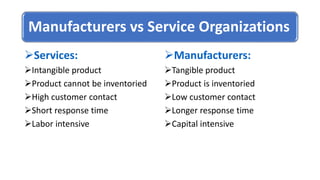
Manufacturers vs Service Organizations
Services:
Intangible product
Product cannot be inventoried
High customer contact
Short response time
Labor intensive
Manufacturers:
Tangible product
Product is inventoried
Low customer contact
Longer response time
Capital intensive
Similarities for Service/Manufacturers
Both use technology
Both have quality, productivity, & response issues
Both must forecast demand
Both can have capacity, layout, and location issues
Both have customers, suppliers, scheduling and staffing issues
Operation Management Decisions
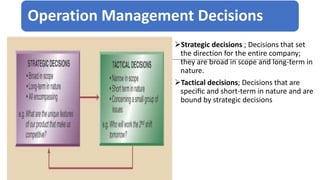
Strategic decisions ; Decisions that set
the direction for the entire company;
they are broad in scope and long-term in
nature.
Tactical decisions; Decisions that are
specific and short-term in nature and are
bound by strategic decisions
Strategic OM’s Decisions
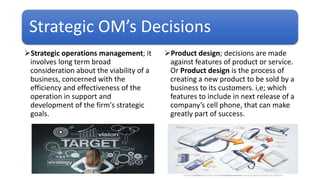
Strategic operations management; it
involves long term broad
consideration about the viability of a
business, concerned with the
efficiency and effectiveness of the
operation in support and
development of the firm's strategic
goals.
Product design; decisions are made
against features of product or service.
Or Product design is the process of
creating a new product to be sold by a
business to its customers. i,e; which
features to include in next release of a
company’s cell phone, that can make
greatly part of success.
Strategic OM’s Decisions ( cont.)
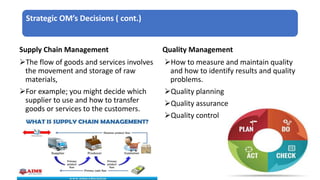
Supply Chain Management
The flow of goods and services involves
the movement and storage of raw
materials,
For example; you might decide which
supplier to use and how to transfer
goods or services to the customers.
Quality Management
How to measure and maintain quality
and how to identify results and quality
problems.
Quality planning
Quality assurance
Quality control
Historical Development Of Operations Management
Industrial revolution Late 1700s
Scientific management Early 1900s
Human relations movement 1930s-60s
Management science 1940s-60s
Computer age 1960s
Environmental Issues 1970s
Just in Time 1980s
Total Quality Management 1980s
Historical Development Of OM con’t
Reengineering 1990s
Global competition 1980s
Flexibility 1990s
Time-Based Competition 1990s
Supply chain Management 1990s
Electronic Commerce 2000s
For long-run success, companies must place much importance on their operations
Historical Development of OM con’t
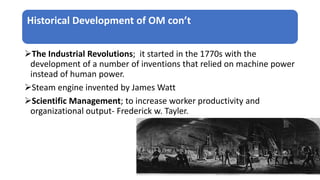
The Industrial Revolutions; it started in the 1770s with the
development of a number of inventions that relied on machine power
instead of human power.
Steam engine invented by James Watt
Scientific Management; to increase worker productivity and
organizational output- Frederick w. Tayler.
Historical Development Of OM con’t
The Computer age; The growth in computing capability continues to
impact operations management.
Just In Time; JIT achieved through coordination of the flow of
materials so that the right parts arrive at the right place in the right
quantity.
Historical Development Of OM con’t
Reengineering; Redesigning a company’s processes to make them
more efficient
Flexibility; An organizational strategy in which the company attempts
to offer a greater variety of product choices to its customers
Time-based competition; An organizational strategy focusing on
efforts to develop new products and deliver them to customers faster
than competitors.
Today’s OM Environment
Customers demand better quality, greater speed, and lower costs
Companies implementing lean system concepts – a total systems
approach to efficient operations
Recognized need to better manage information using Enterprise
resource planning (ERP) and Customer relationship management
(CRM) systems
Increased cross-functional decision making
OM in Practice
OM has the most diverse organizational function
Manages the transformation process
OM has many faces and names such as;
V. P. operations, Director of supply chains, Manufacturing manager
Plant manger, Quality specialists, etc.
All business functions need information from OM in order to perform
their tasks
OM Across the Organization
Many of the decisions made by operations managers are dependent
on information from the other functions.
At the same time, other functions can not be carried out properly
without information from the operations.
Information system (IS) bring the latest capabilities in information
technology to the organization to enhance the function
OM Across the Organization (con’t)
Marketing is not fully capable of meeting customer needs if marketing
managers do not understand what operations can produce, the marketing
department can develop an exciting marketing campaign, but if operations
can not produce desired product sales will not be made.
Finance cannot judge the need for capital investments if they do not
understand operations concepts and needs
Information systems enables the information flow throughout the
organization
Human resources must understand job requirements and worker skills
Accounting needs to consider inventory management, capacity
information, and labor standards
THANKS
The End
• Reference; Operations Management an Integrated Approach 4rth
edition. By R Dan Reid and Nada R. Sanders

Operations Management

  • 1.
    Introduction to operationsmanagement presented by; Iltaf khokhar
  • 2.
    CONTENTS; What is operationsmanagement Operations management in business Difference between manufacturers and service organizations Operations management decisions Strategic OM decisions Supply chain management Quality management Historical development of operations management Operations management in practice Today’s OM Environment
  • 3.
  • 4.
    Introduction to OperationsManagement Operations  is a function or a system that transforms inputs into outputs.
  • 5.
    Introductions to OperationsManagement Management  is the process which combines and transforms various resources used in the operations subsystems of the organization.
  • 6.
    Operations Management (OM) Def:Operations Management is the Business function, that plans, organizes, coordinates and controls the resources needed to produce company’s goods and services Operations management is a management function Operations management is the central core function of every company, whether the company is large or small, provides goods or services.
  • 7.
    Three major functionsof management Finance: is responsible for cash flow, assets, and capital investment Marketing; is responsible for sales, customers wants and needs Operations management; is responsible for planning coordinating and controlling the resources needed to produce a company’s goods and services Marketing
  • 8.
    The Role ofmajor Functions Every company has an operations management function, primarily all the other organizational functions (Accounting, marketing, HRM, MIS, and engineering) are there to support the operations function. Operations management is responsible for orchestrating all the resources needed to produce the final product this includes designing the product deciding what resources are needed arranging schedules, equipment and facilities, controlling the quality designing the products. Actually, OM covers all the aspects of the process of transforming inputs into outputs customer feedback and performance.
  • 9.
    Example; A retailer shopwhich sells commodities, the marketing function provides promotions for the merchandise, and finance function provides the needed capital. It is OM that coordinates, design and produce a product. Without operations there would be no goods or services to sell to customers.
  • 10.
    Manufacturers vs ServiceOrganizations Services: Intangible product Product cannot be inventoried High customer contact Short response time Labor intensive Manufacturers: Tangible product Product is inventoried Low customer contact Longer response time Capital intensive
  • 11.
    Similarities for Service/Manufacturers Bothuse technology Both have quality, productivity, & response issues Both must forecast demand Both can have capacity, layout, and location issues Both have customers, suppliers, scheduling and staffing issues
  • 12.
    Operation Management Decisions Strategicdecisions ; Decisions that set the direction for the entire company; they are broad in scope and long-term in nature. Tactical decisions; Decisions that are specific and short-term in nature and are bound by strategic decisions
  • 13.
    Strategic OM’s Decisions Strategicoperations management; it involves long term broad consideration about the viability of a business, concerned with the efficiency and effectiveness of the operation in support and development of the firm's strategic goals. Product design; decisions are made against features of product or service. Or Product design is the process of creating a new product to be sold by a business to its customers. i,e; which features to include in next release of a company’s cell phone, that can make greatly part of success.
  • 14.
    Strategic OM’s Decisions( cont.) Supply Chain Management The flow of goods and services involves the movement and storage of raw materials, For example; you might decide which supplier to use and how to transfer goods or services to the customers. Quality Management How to measure and maintain quality and how to identify results and quality problems. Quality planning Quality assurance Quality control
  • 15.
    Historical Development OfOperations Management Industrial revolution Late 1700s Scientific management Early 1900s Human relations movement 1930s-60s Management science 1940s-60s Computer age 1960s Environmental Issues 1970s Just in Time 1980s Total Quality Management 1980s
  • 16.
    Historical Development OfOM con’t Reengineering 1990s Global competition 1980s Flexibility 1990s Time-Based Competition 1990s Supply chain Management 1990s Electronic Commerce 2000s For long-run success, companies must place much importance on their operations
  • 17.
    Historical Development ofOM con’t The Industrial Revolutions; it started in the 1770s with the development of a number of inventions that relied on machine power instead of human power. Steam engine invented by James Watt Scientific Management; to increase worker productivity and organizational output- Frederick w. Tayler.
  • 18.
    Historical Development OfOM con’t The Computer age; The growth in computing capability continues to impact operations management. Just In Time; JIT achieved through coordination of the flow of materials so that the right parts arrive at the right place in the right quantity.
  • 19.
    Historical Development OfOM con’t Reengineering; Redesigning a company’s processes to make them more efficient Flexibility; An organizational strategy in which the company attempts to offer a greater variety of product choices to its customers Time-based competition; An organizational strategy focusing on efforts to develop new products and deliver them to customers faster than competitors.
  • 20.
    Today’s OM Environment Customersdemand better quality, greater speed, and lower costs Companies implementing lean system concepts – a total systems approach to efficient operations Recognized need to better manage information using Enterprise resource planning (ERP) and Customer relationship management (CRM) systems Increased cross-functional decision making
  • 21.
    OM in Practice OMhas the most diverse organizational function Manages the transformation process OM has many faces and names such as; V. P. operations, Director of supply chains, Manufacturing manager Plant manger, Quality specialists, etc. All business functions need information from OM in order to perform their tasks
  • 22.
    OM Across theOrganization Many of the decisions made by operations managers are dependent on information from the other functions. At the same time, other functions can not be carried out properly without information from the operations. Information system (IS) bring the latest capabilities in information technology to the organization to enhance the function
  • 23.
    OM Across theOrganization (con’t) Marketing is not fully capable of meeting customer needs if marketing managers do not understand what operations can produce, the marketing department can develop an exciting marketing campaign, but if operations can not produce desired product sales will not be made. Finance cannot judge the need for capital investments if they do not understand operations concepts and needs Information systems enables the information flow throughout the organization Human resources must understand job requirements and worker skills Accounting needs to consider inventory management, capacity information, and labor standards
  • 24.
  • 25.
    The End • Reference;Operations Management an Integrated Approach 4rth edition. By R Dan Reid and Nada R. Sanders