Introduction
to
Dr. T. FEBRY. C. ST., MT
Learning Objectives
• Define and explain OM
• Explain the role of OM in business
• Describe the decisions that operations managers make
• Describe the differences between service and manufacturing
operations
• Identify major historical developments in OM
• Identify current trends in OM
• Describe the flow of information between OM and other business
functions
Operations Management is:
The business function responsible for
planning, coordinating, and controlling
the resources needed to produce
products and services for a company
Operations Management is:
•A management function
•An organization’s core function
•In every organization whether Service or
Manufacturing, profit or Not for profit
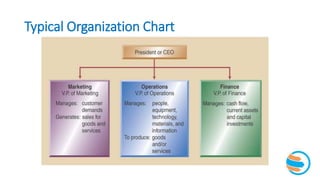
Typical Organization Chart
What is Role of OM?
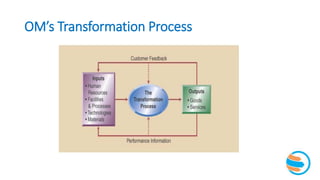
•OM Transforms inputs to outputs
• Inputs are resources such as
• People, Material, Energy, Information, and Money,
• Outputs are goods and services
OM’s Transformation Process
OM’s Transformation Role
• To add value
• Increase product value at each stage
• Value added is the net increase between output product value and input
material value
• Provide an efficient transformation
• Efficiency – means performing activities well for least possible cost
Manufacturers vs Service Organizations
• Services:
• Intangible product
• Product cannot be inventoried
• High customer contact
• Short response time
• Labor intensive
•Manufacturers:
• Tangible product
• Product is inventoried
• Low customer contact
• Longer response time
• Capital intensive
Similarities for Service/Manufacturers
• Both use technology
• Both have quality, productivity, & response issues
• Both must forecast demand
• Both can have capacity, layout, and location issues
• Both have customers, suppliers, scheduling and staffing
issues
Service vs Manufacturing
• Manufacturing often provides services
• Services often provides tangible goods
• Some organizations are a blend of
service/manufacturing/quasi-manufacturing Quasi-
Manufacturing (QM) organizations
• QM characteristics include
• Low customer contact & Capital Intensive
OM Decisions
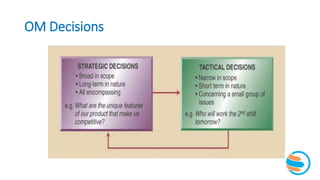
• All organizations make decisions and follow a similar
path
•First decisions very broad – Strategic decisions
• Strategic Decisions – set the direction for the entire company;
they are broad in scope and long-term in nature
OM Decisions
• Following decisions focus on specifics - Tactical decision
• Tactical decisions: focus on specific day-to-day issues like resource
needs, schedules, & quantities to produce
• are frequent
• Strategic decisions less frequent
• Tactical and Strategic decisions must align
OM Decisions
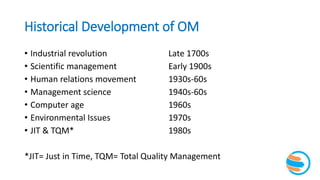
Historical Development of OM
• Industrial revolution Late 1700s
• Scientific management Early 1900s
• Human relations movement 1930s-60s
• Management science 1940s-60s
• Computer age 1960s
• Environmental Issues 1970s
• JIT & TQM* 1980s
*JIT= Just in Time, TQM= Total Quality Management
Historical Development con’t
• Reengineering 1990s
• Global competition 1980s
• Flexibility 1990s
• Time-Based Competition 1990s
• Supply chain Management 1990s
• Electronic Commerce 2000s
• Outsourcing & flattening of world 2000s
For long-run success, companies must place much importance on their operations
Today’s OM Environment
• Customers demand better quality, greater speed, and lower
costs
• Companies implementing lean system concepts – a total
systems approach to efficient operations
• Recognized need to better manage information using ERP
and CRM systems
• Increased cross-functional decision making
OM in Practice
• OM has the most diverse organizational function
• Manages the transformation process
• OM has many faces and names such as;
• V. P. operations, Director of supply chains, Manufacturing manager
• Plant manger, Quality specialists, etc.
• All business functions need information from OM in order to
perform their tasks
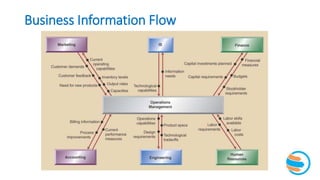
Business Information Flow
OM Across the Organization
•Most businesses are supported by the functions
of operations, marketing, and finance
•The major functional areas must interact to
achieve the organization goals
OM Across the
Organization – con’t
• Marketing is not fully able to meet customer needs if they do not
understand what operations can produce
• Finance cannot judge the need for capital investments if they do not
understand operations concepts and needs
• Information systems enables the information flow throughout the
organization
• Human resources must understand job requirements and worker
skills
• Accounting needs to consider inventory management, capacity
information, and labor standards
Resume
• OM is the business function that is responsible for managing and
coordinating the resources needed to produce a company’s products
and services.
• The role of OM is to transform organizational inputs into company’s
products or services outputs
• OM is responsible for a wide range of decisions, ranging from
strategic to tactical.
• Organizations can be divided into manufacturing and service
organizations, which differ in the tangibility of the product or service
Resume
• Many historical milestones have shaped OM. Some of these are the
Industrial Revolution, scientific management, the human relations
movement, management science, and the computer age
• OM is highly important function in today’s dynamic business
environment. Among the trends with significant impact are just-in-
time, TQM, reengineering, flexibility, time-based competition, SCM,
global marketplace, and environmental issues
• OM works closely with all other business functions
THANKS
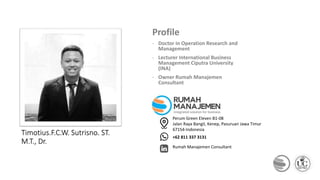
Timotius.F.C.W. Sutrisno. ST.
M.T., Dr.
Profile
- Doctor in Operation Research and
Management
- Lecturer International Business
Management Ciputra University
(INA)
- Owner Rumah Manajemen
Consultant
Perum Green Eleven B1-08
Jalan Raya Bangil, Kenep, Pasuruan Jawa Timur
67154-Indonesia
+62 811 337 3131
Rumah Manajemen Consultant

Introduction to operational management

  • 1.
  • 2.
    Learning Objectives • Defineand explain OM • Explain the role of OM in business • Describe the decisions that operations managers make • Describe the differences between service and manufacturing operations • Identify major historical developments in OM • Identify current trends in OM • Describe the flow of information between OM and other business functions
  • 3.
    Operations Management is: Thebusiness function responsible for planning, coordinating, and controlling the resources needed to produce products and services for a company
  • 4.
    Operations Management is: •Amanagement function •An organization’s core function •In every organization whether Service or Manufacturing, profit or Not for profit
  • 5.
  • 6.
    What is Roleof OM? •OM Transforms inputs to outputs • Inputs are resources such as • People, Material, Energy, Information, and Money, • Outputs are goods and services
  • 7.
  • 8.
    OM’s Transformation Role •To add value • Increase product value at each stage • Value added is the net increase between output product value and input material value • Provide an efficient transformation • Efficiency – means performing activities well for least possible cost
  • 9.
    Manufacturers vs ServiceOrganizations • Services: • Intangible product • Product cannot be inventoried • High customer contact • Short response time • Labor intensive •Manufacturers: • Tangible product • Product is inventoried • Low customer contact • Longer response time • Capital intensive
  • 10.
    Similarities for Service/Manufacturers •Both use technology • Both have quality, productivity, & response issues • Both must forecast demand • Both can have capacity, layout, and location issues • Both have customers, suppliers, scheduling and staffing issues
  • 11.
    Service vs Manufacturing •Manufacturing often provides services • Services often provides tangible goods • Some organizations are a blend of service/manufacturing/quasi-manufacturing Quasi- Manufacturing (QM) organizations • QM characteristics include • Low customer contact & Capital Intensive
  • 12.
    OM Decisions • Allorganizations make decisions and follow a similar path •First decisions very broad – Strategic decisions • Strategic Decisions – set the direction for the entire company; they are broad in scope and long-term in nature
  • 13.
    OM Decisions • Followingdecisions focus on specifics - Tactical decision • Tactical decisions: focus on specific day-to-day issues like resource needs, schedules, & quantities to produce • are frequent • Strategic decisions less frequent • Tactical and Strategic decisions must align
  • 14.
  • 15.
    Historical Development ofOM • Industrial revolution Late 1700s • Scientific management Early 1900s • Human relations movement 1930s-60s • Management science 1940s-60s • Computer age 1960s • Environmental Issues 1970s • JIT & TQM* 1980s *JIT= Just in Time, TQM= Total Quality Management
  • 16.
    Historical Development con’t •Reengineering 1990s • Global competition 1980s • Flexibility 1990s • Time-Based Competition 1990s • Supply chain Management 1990s • Electronic Commerce 2000s • Outsourcing & flattening of world 2000s For long-run success, companies must place much importance on their operations
  • 17.
    Today’s OM Environment •Customers demand better quality, greater speed, and lower costs • Companies implementing lean system concepts – a total systems approach to efficient operations • Recognized need to better manage information using ERP and CRM systems • Increased cross-functional decision making
  • 18.
    OM in Practice •OM has the most diverse organizational function • Manages the transformation process • OM has many faces and names such as; • V. P. operations, Director of supply chains, Manufacturing manager • Plant manger, Quality specialists, etc. • All business functions need information from OM in order to perform their tasks
  • 19.
  • 20.
    OM Across theOrganization •Most businesses are supported by the functions of operations, marketing, and finance •The major functional areas must interact to achieve the organization goals
  • 21.
    OM Across the Organization– con’t • Marketing is not fully able to meet customer needs if they do not understand what operations can produce • Finance cannot judge the need for capital investments if they do not understand operations concepts and needs • Information systems enables the information flow throughout the organization • Human resources must understand job requirements and worker skills • Accounting needs to consider inventory management, capacity information, and labor standards
  • 22.
    Resume • OM isthe business function that is responsible for managing and coordinating the resources needed to produce a company’s products and services. • The role of OM is to transform organizational inputs into company’s products or services outputs • OM is responsible for a wide range of decisions, ranging from strategic to tactical. • Organizations can be divided into manufacturing and service organizations, which differ in the tangibility of the product or service
  • 23.
    Resume • Many historicalmilestones have shaped OM. Some of these are the Industrial Revolution, scientific management, the human relations movement, management science, and the computer age • OM is highly important function in today’s dynamic business environment. Among the trends with significant impact are just-in- time, TQM, reengineering, flexibility, time-based competition, SCM, global marketplace, and environmental issues • OM works closely with all other business functions
  • 24.
    THANKS Timotius.F.C.W. Sutrisno. ST. M.T.,Dr. Profile - Doctor in Operation Research and Management - Lecturer International Business Management Ciputra University (INA) - Owner Rumah Manajemen Consultant Perum Green Eleven B1-08 Jalan Raya Bangil, Kenep, Pasuruan Jawa Timur 67154-Indonesia +62 811 337 3131 Rumah Manajemen Consultant