CADORNA CALAWOD BELA-ONG SAWIT
GLOBAL
SOURCING
the process of
identifying, developing,
and utilizing the best
source of supply for the
enterprise, regardless of
location
GLOBAL
SOURCING
Global sourcing
comprises both shared
services and outsourcing
solutions that can be
implemented
domestically and
offshore.
GLOBAL
SOURCING
Shared Services
concentration of an
organization’s resources;
performing similar activities,
normally distributed across
the organization, to service
multiple internal partners with
the common goal of
achieving customer
satisfaction
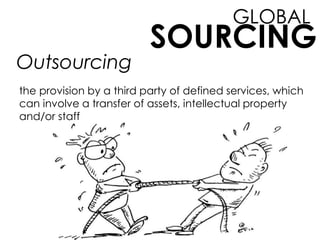
Outsourcing
GLOBAL
SOURCING
the provision by a third party of defined services, which
can involve a transfer of assets, intellectual property
and/or staff
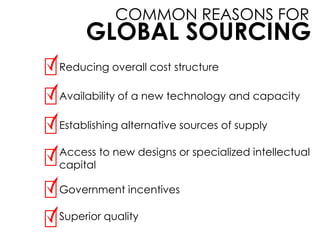
COMMON REASONS FOR
GLOBAL SOURCING
Reducing overall cost structure
Availability of a new technology and capacity
Establishing alternative sources of supply
Access to new designs or specialized intellectual
capital
Government incentives
Superior quality
GLOBAL SOURCING
FACTORSGlobal sourcing factors that must be understood and
balanced can be segmented into six categories:
1. Material Costs
GLOBAL SOURCING
FACTORSGlobal sourcing factors that must be understood and
balanced can be segmented into six categories:
2. Transportation Costs
GLOBAL SOURCING
FACTORSGlobal sourcing factors that must be understood and
balanced can be segmented into six categories:
3. Inventory carrying out
GLOBAL SOURCING
FACTORSGlobal sourcing factors that must be understood and
balanced can be segmented into six categories:
4. Cross-border taxes, tariffs, and duty costs
GLOBAL SOURCING
FACTORSGlobal sourcing factors that must be understood and
balanced can be segmented into six categories:
5. Supply and operational performance
GLOBAL SOURCING
FACTORSGlobal sourcing factors that must be understood and
balanced can be segmented into six categories:
6. Supply and operational risks
HIDDEN COSTS OF
GLOBAL SOURCING
1. Internal Expenses
2. Supplier Health
3. Post-contract lull
4. Duty and tariff changes
5. Contract non-compliance
6. True inventory costs
7. Logistics Volatility
8. Technology
9. Quality breakdown
QUANTITATIVE AND
QUALITATIVE
ASPECTS
QUANTITATIVE
ASPECTSthose that are easily measurable
Logistics
Economic
Quality
Information and Communication
QUALITATIVE
ASPECTSthose which are more difficult to quantify
Political
Legal
Cultural
Bureaucratic
Environmental
Ethical Nature
GLOBAL RISK
ISSUES
1. Distance
the distant between the
buyer and selling firm is
significant in terms of time
zones and physical
location.
2. Communication
GLOBAL RISK
ISSUES
can be described as the
glue that holds together a
sourcing relationship.
3. The value of money
GLOBAL RISK
ISSUES
Currency Exchange Rates.
Depending on the
performance and strength
of the dollar, goods can
cost American firms
different amounts from
what's expected.
4. Quality Issues
GLOBAL RISK
ISSUES
the buying firm must
spend the necessary time
to correctly specify and
articulate quality
expectations.
5. Pipeline inventory
GLOBAL RISK
ISSUES
pipeline inventory issues
will always occur when a
third party (the shipper) is
involved.
6. Staffing
GLOBAL RISK
ISSUES
if a buying firm is to be
effective with an offshore
sourcing strategy, it must
either hire experts or
develop specialists that
are assigned to offshore
suppliers.
NEGOTIATION
Negotiation is a process in
which explicit proposals are
put forward for discussion in
order to reach
agreement on an exchange
or on the realization of a
common interest where
conflicting interests are
present.
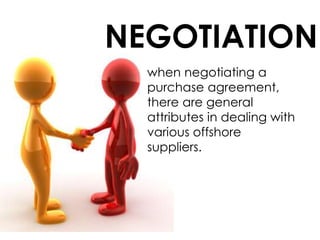
NEGOTIATION
when negotiating a
purchase agreement,
there are general
attributes in dealing with
various offshore
suppliers.
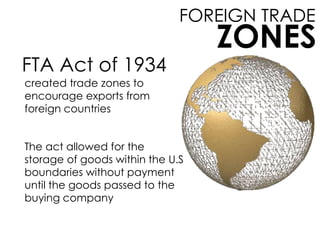
FOREIGN TRADE
ZONES
FTA Act of 1934
created trade zones to
encourage exports from
foreign countries
The act allowed for the
storage of goods within the U.S
boundaries without payment
until the goods passed to the
buying company
EU (European Union)
the formulation of this leads to
the elimination of customs
formalities between countries.
There also will be tariffs
reductions in 4000 categories
of manufacturing goods as
well as other schedules for
reducing trade barriers.
FOREIGN TRADE
ZONES
COUNTER TRADE
exchange of goods for goods in full or partial
payment of a sales transactions.
FORMS OF COUNTER TRADE
1. Offsets
are commercial practices
required as a condition of
purchase of goods and
services.
COUNTER TRADE
exchange of goods for goods in full or partial
payment of a sales transactions.
FORMS OF COUNTER TRADE
2. Indirect offsets
occur where products or
services transferred in an
offset arrangement are
unrelated to the specific
products referred to in the
export agreement
COUNTER TRADE
exchange of goods for goods in full or partial
payment of a sales transactions.
FORMS OF COUNTER TRADE
3. Coproduction
this form of agreement
involves that purchaser
being given a share in the
manufacture of a foreign
designed product.
COUNTER TRADE
exchange of goods for goods in full or partial
payment of a sales transactions.
FORMS OF COUNTER TRADE
4. Licensed production
is when the recipient
obtains a share of the
production work for its own
order.
COUNTER TRADE
exchange of goods for goods in full or partial
payment of a sales transactions.
FORMS OF COUNTER TRADE
5. Subcontractor production
in this case the prime
contractor substitutes an
existing supplier with one
located in the buying
country.
COUNTER TRADE
exchange of goods for goods in full or partial
payment of a sales transactions.
FORMS OF COUNTER TRADE
6. Barter
the non monetary
exchange of goods-for-
goods.
COUNTER TRADE
exchange of goods for goods in full or partial
payment of a sales transactions.
FORMS OF COUNTER TRADE
7. Counter purchase
the seller exchanges
products for
compensatory amounts of
commodities.
GLOBAL SOURCING

GLOBAL SOURCING

  • 1.
  • 2.
    GLOBAL SOURCING the process of identifying,developing, and utilizing the best source of supply for the enterprise, regardless of location
  • 3.
    GLOBAL SOURCING Global sourcing comprises bothshared services and outsourcing solutions that can be implemented domestically and offshore.
  • 4.
    GLOBAL SOURCING Shared Services concentration ofan organization’s resources; performing similar activities, normally distributed across the organization, to service multiple internal partners with the common goal of achieving customer satisfaction
  • 5.
    Outsourcing GLOBAL SOURCING the provision bya third party of defined services, which can involve a transfer of assets, intellectual property and/or staff
  • 6.
    COMMON REASONS FOR GLOBALSOURCING Reducing overall cost structure Availability of a new technology and capacity Establishing alternative sources of supply Access to new designs or specialized intellectual capital Government incentives Superior quality
  • 7.
    GLOBAL SOURCING FACTORSGlobal sourcingfactors that must be understood and balanced can be segmented into six categories: 1. Material Costs
  • 8.
    GLOBAL SOURCING FACTORSGlobal sourcingfactors that must be understood and balanced can be segmented into six categories: 2. Transportation Costs
  • 9.
    GLOBAL SOURCING FACTORSGlobal sourcingfactors that must be understood and balanced can be segmented into six categories: 3. Inventory carrying out
  • 10.
    GLOBAL SOURCING FACTORSGlobal sourcingfactors that must be understood and balanced can be segmented into six categories: 4. Cross-border taxes, tariffs, and duty costs
  • 11.
    GLOBAL SOURCING FACTORSGlobal sourcingfactors that must be understood and balanced can be segmented into six categories: 5. Supply and operational performance
  • 12.
    GLOBAL SOURCING FACTORSGlobal sourcingfactors that must be understood and balanced can be segmented into six categories: 6. Supply and operational risks
  • 13.
    HIDDEN COSTS OF GLOBALSOURCING 1. Internal Expenses 2. Supplier Health 3. Post-contract lull 4. Duty and tariff changes 5. Contract non-compliance 6. True inventory costs 7. Logistics Volatility 8. Technology 9. Quality breakdown
  • 14.
  • 15.
    QUANTITATIVE ASPECTSthose that areeasily measurable Logistics Economic Quality Information and Communication
  • 16.
    QUALITATIVE ASPECTSthose which aremore difficult to quantify Political Legal Cultural Bureaucratic Environmental Ethical Nature
  • 17.
    GLOBAL RISK ISSUES 1. Distance thedistant between the buyer and selling firm is significant in terms of time zones and physical location.
  • 18.
    2. Communication GLOBAL RISK ISSUES canbe described as the glue that holds together a sourcing relationship.
  • 19.
    3. The valueof money GLOBAL RISK ISSUES Currency Exchange Rates. Depending on the performance and strength of the dollar, goods can cost American firms different amounts from what's expected.
  • 20.
    4. Quality Issues GLOBALRISK ISSUES the buying firm must spend the necessary time to correctly specify and articulate quality expectations.
  • 21.
    5. Pipeline inventory GLOBALRISK ISSUES pipeline inventory issues will always occur when a third party (the shipper) is involved.
  • 22.
    6. Staffing GLOBAL RISK ISSUES ifa buying firm is to be effective with an offshore sourcing strategy, it must either hire experts or develop specialists that are assigned to offshore suppliers.
  • 23.
    NEGOTIATION Negotiation is aprocess in which explicit proposals are put forward for discussion in order to reach agreement on an exchange or on the realization of a common interest where conflicting interests are present.
  • 24.
    NEGOTIATION when negotiating a purchaseagreement, there are general attributes in dealing with various offshore suppliers.
  • 25.
    FOREIGN TRADE ZONES FTA Actof 1934 created trade zones to encourage exports from foreign countries The act allowed for the storage of goods within the U.S boundaries without payment until the goods passed to the buying company
  • 26.
    EU (European Union) theformulation of this leads to the elimination of customs formalities between countries. There also will be tariffs reductions in 4000 categories of manufacturing goods as well as other schedules for reducing trade barriers. FOREIGN TRADE ZONES
  • 27.
    COUNTER TRADE exchange ofgoods for goods in full or partial payment of a sales transactions. FORMS OF COUNTER TRADE 1. Offsets are commercial practices required as a condition of purchase of goods and services.
  • 28.
    COUNTER TRADE exchange ofgoods for goods in full or partial payment of a sales transactions. FORMS OF COUNTER TRADE 2. Indirect offsets occur where products or services transferred in an offset arrangement are unrelated to the specific products referred to in the export agreement
  • 29.
    COUNTER TRADE exchange ofgoods for goods in full or partial payment of a sales transactions. FORMS OF COUNTER TRADE 3. Coproduction this form of agreement involves that purchaser being given a share in the manufacture of a foreign designed product.
  • 30.
    COUNTER TRADE exchange ofgoods for goods in full or partial payment of a sales transactions. FORMS OF COUNTER TRADE 4. Licensed production is when the recipient obtains a share of the production work for its own order.
  • 31.
    COUNTER TRADE exchange ofgoods for goods in full or partial payment of a sales transactions. FORMS OF COUNTER TRADE 5. Subcontractor production in this case the prime contractor substitutes an existing supplier with one located in the buying country.
  • 32.
    COUNTER TRADE exchange ofgoods for goods in full or partial payment of a sales transactions. FORMS OF COUNTER TRADE 6. Barter the non monetary exchange of goods-for- goods.
  • 33.
    COUNTER TRADE exchange ofgoods for goods in full or partial payment of a sales transactions. FORMS OF COUNTER TRADE 7. Counter purchase the seller exchanges products for compensatory amounts of commodities.