Small Vessel Vasculitis
Dr. Julfikar Saif
Resident, Phase A
Department of oncology
Violet Unit, Internal Medicine
Definition
• Vasculitis is charecterised by inflammation
and necrosis of blood-vessel walls, with
associated damage to skin, kidney, lung, heart,
brain and GIT.
Why we need to learn vasculitis?
Lets see some common clinical
features
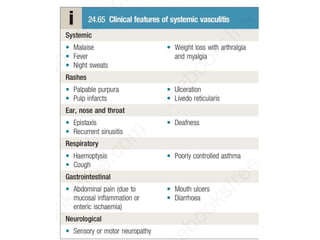
• fever
• weight loss
• Fatigue
• raised inflammatory marker
• evidence of multisystem involvement
classification of vasculitis
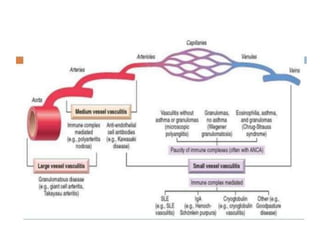
• According to the size of the vessel involved
1. Large vessel vascculitis
– Takayasu arteritis
– giant cell arteritis/temporal arteritis and
polymyelgia rheumatica
Cont…
• Medium vessel vasculitis
– Polyarteritis Nodosa
– Kawasaki disease
Cont…
• Small vessel Vasculitis
– ANCA associated vasculitis
– Immune complex mediated vasculitis
ANCA associated vasculitis
• Definition
– A life threatening disorder charecterised by
inflammatory infiltration of small blood vessels,
fibrinoid necrosis and the presence of circulating
antibodies to ANCA
– Combined incidence 10-15/1000000 (million)
ANCA
• ANCA stands for anti-nutrophil cytoplasmic
antibody
• Are a group of antibody directed against
cytoplasm of granulocyte and monocyte
• Detected by immunoflurocense
• 2 types according to the pattern of staining
Cont….
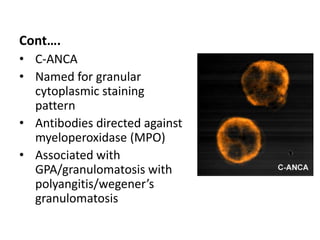
• C-ANCA
• Named for granular
cytoplasmic staining
pattern
• Antibodies directed against
myeloperoxidase (MPO)
• Associated with
GPA/granulomatosis with
polyangitis/wegener’s
granulomatosis
Cont…
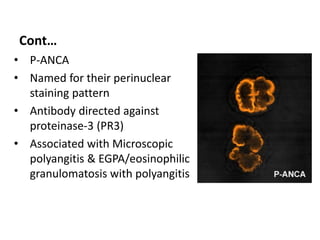
• P-ANCA
• Named for their perinuclear
staining pattern
• Antibody directed against
proteinase-3 (PR3)
• Associated with Microscopic
polyangitis & EGPA/eosinophilic
granulomatosis with polyangitis
Interesting fact…
• Skin lesion more common in small vessel and
medium vessel vasculitis
• Large vessel vasculitis associated with absence
of pulse, claudication, pain etc…
ANCA associated vasculitis…scenerio
• A patient presented with (Fever, Wt Loss, Fatigue), skin
lesion, (haemoptysis, hematuria), renal impairment
• A patient presents with (Fever, Wt Loss, Fatigue), skin
lesion, (haemoptysis, but no hematuria),
ENT+ophthalmological features (eye- proptosis,
ophthalmoplegia, diplopia, Ear- deafness,Nose- crusting,
bleeding, sinusitis, collapse of nose, oral ulcer, throat
nodule) less severe renal impairment
• A patient presents with (Fever, Wt Loss, Fatigue), skin
lesion, H/O allergic rhinitis, nasal polyp, asthma, cbc
reveals eosinophilia
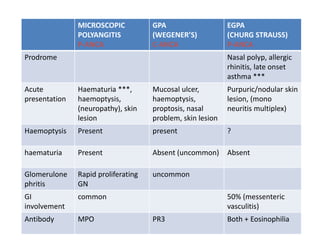
MICROSCOPIC
POLYANGITIS
P-ANCA
GPA
(WEGENER’S)
C-ANCA
EGPA
(CHURG STRAUSS)
P-ANCA
Prodrome Nasal polyp, allergic
rhinitis, late onset
asthma ***
Acute
presentation
Haematuria ***,
haemoptysis,
(neuropathy), skin
lesion
Mucosal ulcer,
haemoptysis,
proptosis, nasal
problem, skin lesion
Purpuric/nodular skin
lesion, (mono
neuritis multiplex)
Haemoptysis Present present ?
haematuria Present Absent (uncommon) Absent
Glomerulone
phritis
Rapid proliferating
GN
uncommon
GI
involvement
common 50% (messenteric
vasculitis)
Antibody MPO PR3 Both + Eosinophilia
Answers…
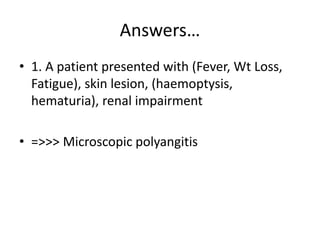
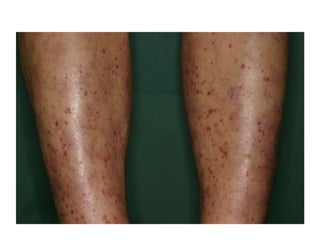
• 1. A patient presented with (Fever, Wt Loss,
Fatigue), skin lesion, (haemoptysis,
hematuria), renal impairment
• =>>> Microscopic polyangitis
Cont…
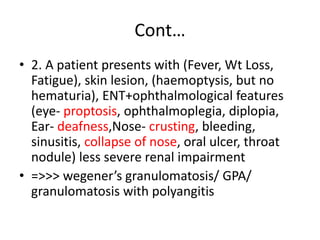
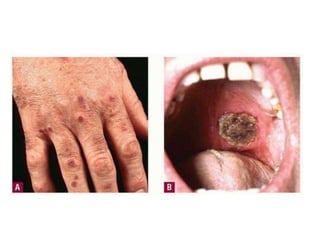
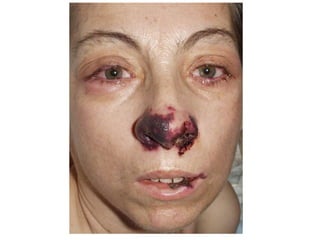
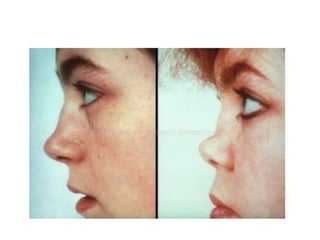
• 2. A patient presents with (Fever, Wt Loss,
Fatigue), skin lesion, (haemoptysis, but no
hematuria), ENT+ophthalmological features
(eye- proptosis, ophthalmoplegia, diplopia,
Ear- deafness,Nose- crusting, bleeding,
sinusitis, collapse of nose, oral ulcer, throat
nodule) less severe renal impairment
• =>>> wegener’s granulomatosis/ GPA/
granulomatosis with polyangitis
Cont…
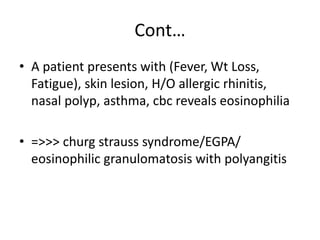
• A patient presents with (Fever, Wt Loss,
Fatigue), skin lesion, H/O allergic rhinitis,
nasal polyp, asthma, cbc reveals eosinophilia
• =>>> churg strauss syndrome/EGPA/
eosinophilic granulomatosis with polyangitis
Work up…investigations
• Routine
– CBC (anemia, eosinophilia- EGPA)
– ESR ↑
– CRP ↑
– Urine R/E (hematuria in Microscopic polyangitis)
– S. Creatinine (microscopic polyangitis, GPA)
– CXR (pulmonary infiltrate/alveolar hemorrhage, effusion)
Cont…
• MRI Chest
– Migratory infiltrate in case of GPA***, other
nodules in airway
• Serological
– MPO/P-ANCA↑ (M.P)
– PR3/C-ANCA ↑ (GPA)
– Both+eosinophilia (EGPA)
Biopsy…
• Specimen- skin with muscle
• Microscopic polyangitis=necrotising vasculitis,
nongranulomatous inflammation
• GPA= necrotising vasculitis, with
granulomatous inflammation
• EGPA=small vessel vasculitis with eosinophilic
infiltration
treatment
• Organ threatening/acute severe disease
– High dose steroid such as pulse I/V methy
prednisolone .5-1g for 3 day then oral .5mg/kg and IV
cyclophosphamide .5-1g 2wkly 3month
– Followed by maintenance with lower dose steroid
and azathiprine/MTX/MMF
– Plasmapheresis in case of fulminant lung involvement
– Oral Cyclophosphamide can be substituted by
Rituximab, equally effective
– Steroid+MTX effective in limited AAV (anca associated
vasculitis) such as indolent skin, lung, sinus disease
Follow up
• Chance of relapse
• So regular followup for long term
– CBC
– Urine R/E
– S. Creatinine
– ESR
– CRP
– Lung Function
– C-ANCA, P-ANCA
Immune complex mediated vasculitis…
• SLE
• Systemic Sclerosis
• Cryoglobulinemia (hepatitis c associated)
• They are also considered secondary vasculitis
SLE
• Incidence from 10% upto 40%
• Risk factor
– Young onset, long term disease, male
• Features
– Usully small, but may involve large & medium sized vessel
– Usually cutaneous (punctate lesion and palpable purpura)
– Mononeuritis multiplex
– Messenteric ischaemia
– Infarction
SLE
• Other features
– Raynaud’s phenomenon
– Neuropsychiatric
– Myocarditis
– Serositis
– Leukopenia
– Anti phospholipid syndrome
SLE
• Investigation
– Biopsy and/or arteriography
• Treatment
– High dose steroid
– Cyclophosphamide (Oral/pulse; pulse safer)
– MMF
– Rituximab
Systemic sclerosis
• Occlusive vasculopathy is common feature
• Vasculitis is less common
– Hard to confirm clinically
– Histopathology required
• Features
– Telangiectasias
– digital ulcers
– tissue ischemia
• Rx- immunosupressant
Cryoglobulinemia
• 3 types, but only type II and III associated with
vasculitis
• Immunoglobulin precipitate in cold
• Associated with hepatitis C virus
• Maybe associated with other autoimmune
disease
Cryoglobulinemia
• Features
– Rash
– Raynaud’s phenomenon
– Arthalgia
– Neuropathy
• Investigations
– Screening hepatitis B,C.
– Histopathology
Cont…
• Treatment
– No consensus
– Treatment of hepatitis c may produce good
outcome
– Use of immunosuppressents maybe associated
with poor outcome
Other, antibody associated vasculitis…
• Goodpasture syndrome
– Due to antibody(IgG type) directed against
glomerular basement membrane
• Risk factor
– Exclusively in smoker
Cont…
• Feature
– Renal
• Haematuria, glomerulonephritis, HTN
– Lung
• Haemoptysis, tachypnea, hypoxia
– Rash
• DD
– Microscopic polyangitis, GPA/wegener’s
– SLE
Cont…
• Investigation
– Biopsy
– Anti GBM antibody
– Maybe ANCA positive
• Treatment
– Plasmapheresis
– Steroid
– immunosupressent
Other Small vessel vasculitis
• Leukocytoclastic vasculitis
– Synonym=hypersensitivoty vasculitis
– Cause= idiopathic (50%), collagen disease, drug,
food, malignancy
• Feature
– Papable purpura, urticarial plaque, vesicle, bullae
– Rash are painful/burning
– arthalgia
Cont…LCV
• *****HSP/IgA vasculitis is a distinct entity of
LCV
• Investigation
– Biopsy with immune flurocense
– Leucocytoclasis (perivascular nuclear debris of
neutrophil)
– In case of HSP, IgA deposition , not in others
Cont…
• Treatment
– Remove inciting agent
– Pain management
– In severe case prednisolone 1mg/kg for 4wk
– 15mg/kg single pulse can be given
Other…..behcet’s disease…
• Epidemiology
– Common in silk route countries
– Male predominant
– HLA B51 associated
• Clinical feature
– Recurrent oral ulcer (atleast 3 times in 12 months)
• universal
• Multiple
• Deeper
• Lasts 10-30 days
Clinical features…..
• Plus any of the two
– Recurrent genital ulcer
– Eye lesion (uveitis, retinal vasculitis, cells in
vitreous etc)
– Skin lesion ( erythema nodosum,
oseudofolliculitis, acenform nodules etc)
– Positive pathergy test (pustule formation after
prick)
Cont…
• Treatment
– Steroid
– Colchicine in case of erythema nodosum
– Thalidomide in case of resistant oral-genital ulcer
Changes between 23rd and 22nd
davidson
• ANCA associated vasculitis were advised to be
managed like SLE, but in 23rd they have
specifically stated management
source
• Davidson 23rd
• NCBI
• internet
Small vessel vasculitis

Small vessel vasculitis

  • 1.
    Small Vessel Vasculitis Dr.Julfikar Saif Resident, Phase A Department of oncology Violet Unit, Internal Medicine
  • 2.
    Definition • Vasculitis ischarecterised by inflammation and necrosis of blood-vessel walls, with associated damage to skin, kidney, lung, heart, brain and GIT.
  • 3.
    Why we needto learn vasculitis?
  • 4.
    Lets see somecommon clinical features • fever • weight loss • Fatigue • raised inflammatory marker • evidence of multisystem involvement
  • 5.
    classification of vasculitis •According to the size of the vessel involved 1. Large vessel vascculitis – Takayasu arteritis – giant cell arteritis/temporal arteritis and polymyelgia rheumatica
  • 6.
    Cont… • Medium vesselvasculitis – Polyarteritis Nodosa – Kawasaki disease
  • 7.
    Cont… • Small vesselVasculitis – ANCA associated vasculitis – Immune complex mediated vasculitis
  • 9.
    ANCA associated vasculitis •Definition – A life threatening disorder charecterised by inflammatory infiltration of small blood vessels, fibrinoid necrosis and the presence of circulating antibodies to ANCA – Combined incidence 10-15/1000000 (million)
  • 10.
    ANCA • ANCA standsfor anti-nutrophil cytoplasmic antibody • Are a group of antibody directed against cytoplasm of granulocyte and monocyte • Detected by immunoflurocense • 2 types according to the pattern of staining
  • 11.
    Cont…. • C-ANCA • Namedfor granular cytoplasmic staining pattern • Antibodies directed against myeloperoxidase (MPO) • Associated with GPA/granulomatosis with polyangitis/wegener’s granulomatosis
  • 12.
    Cont… • P-ANCA • Namedfor their perinuclear staining pattern • Antibody directed against proteinase-3 (PR3) • Associated with Microscopic polyangitis & EGPA/eosinophilic granulomatosis with polyangitis
  • 14.
    Interesting fact… • Skinlesion more common in small vessel and medium vessel vasculitis • Large vessel vasculitis associated with absence of pulse, claudication, pain etc…
  • 15.
    ANCA associated vasculitis…scenerio •A patient presented with (Fever, Wt Loss, Fatigue), skin lesion, (haemoptysis, hematuria), renal impairment • A patient presents with (Fever, Wt Loss, Fatigue), skin lesion, (haemoptysis, but no hematuria), ENT+ophthalmological features (eye- proptosis, ophthalmoplegia, diplopia, Ear- deafness,Nose- crusting, bleeding, sinusitis, collapse of nose, oral ulcer, throat nodule) less severe renal impairment • A patient presents with (Fever, Wt Loss, Fatigue), skin lesion, H/O allergic rhinitis, nasal polyp, asthma, cbc reveals eosinophilia
  • 16.
    MICROSCOPIC POLYANGITIS P-ANCA GPA (WEGENER’S) C-ANCA EGPA (CHURG STRAUSS) P-ANCA Prodrome Nasalpolyp, allergic rhinitis, late onset asthma *** Acute presentation Haematuria ***, haemoptysis, (neuropathy), skin lesion Mucosal ulcer, haemoptysis, proptosis, nasal problem, skin lesion Purpuric/nodular skin lesion, (mono neuritis multiplex) Haemoptysis Present present ? haematuria Present Absent (uncommon) Absent Glomerulone phritis Rapid proliferating GN uncommon GI involvement common 50% (messenteric vasculitis) Antibody MPO PR3 Both + Eosinophilia
  • 17.
    Answers… • 1. Apatient presented with (Fever, Wt Loss, Fatigue), skin lesion, (haemoptysis, hematuria), renal impairment • =>>> Microscopic polyangitis
  • 19.
    Cont… • 2. Apatient presents with (Fever, Wt Loss, Fatigue), skin lesion, (haemoptysis, but no hematuria), ENT+ophthalmological features (eye- proptosis, ophthalmoplegia, diplopia, Ear- deafness,Nose- crusting, bleeding, sinusitis, collapse of nose, oral ulcer, throat nodule) less severe renal impairment • =>>> wegener’s granulomatosis/ GPA/ granulomatosis with polyangitis
  • 23.
    Cont… • A patientpresents with (Fever, Wt Loss, Fatigue), skin lesion, H/O allergic rhinitis, nasal polyp, asthma, cbc reveals eosinophilia • =>>> churg strauss syndrome/EGPA/ eosinophilic granulomatosis with polyangitis
  • 24.
    Work up…investigations • Routine –CBC (anemia, eosinophilia- EGPA) – ESR ↑ – CRP ↑ – Urine R/E (hematuria in Microscopic polyangitis) – S. Creatinine (microscopic polyangitis, GPA) – CXR (pulmonary infiltrate/alveolar hemorrhage, effusion)
  • 25.
    Cont… • MRI Chest –Migratory infiltrate in case of GPA***, other nodules in airway • Serological – MPO/P-ANCA↑ (M.P) – PR3/C-ANCA ↑ (GPA) – Both+eosinophilia (EGPA)
  • 26.
    Biopsy… • Specimen- skinwith muscle • Microscopic polyangitis=necrotising vasculitis, nongranulomatous inflammation • GPA= necrotising vasculitis, with granulomatous inflammation • EGPA=small vessel vasculitis with eosinophilic infiltration
  • 27.
    treatment • Organ threatening/acutesevere disease – High dose steroid such as pulse I/V methy prednisolone .5-1g for 3 day then oral .5mg/kg and IV cyclophosphamide .5-1g 2wkly 3month – Followed by maintenance with lower dose steroid and azathiprine/MTX/MMF – Plasmapheresis in case of fulminant lung involvement – Oral Cyclophosphamide can be substituted by Rituximab, equally effective – Steroid+MTX effective in limited AAV (anca associated vasculitis) such as indolent skin, lung, sinus disease
  • 28.
    Follow up • Chanceof relapse • So regular followup for long term – CBC – Urine R/E – S. Creatinine – ESR – CRP – Lung Function – C-ANCA, P-ANCA
  • 29.
    Immune complex mediatedvasculitis… • SLE • Systemic Sclerosis • Cryoglobulinemia (hepatitis c associated) • They are also considered secondary vasculitis
  • 30.
    SLE • Incidence from10% upto 40% • Risk factor – Young onset, long term disease, male • Features – Usully small, but may involve large & medium sized vessel – Usually cutaneous (punctate lesion and palpable purpura) – Mononeuritis multiplex – Messenteric ischaemia – Infarction
  • 31.
    SLE • Other features –Raynaud’s phenomenon – Neuropsychiatric – Myocarditis – Serositis – Leukopenia – Anti phospholipid syndrome
  • 32.
    SLE • Investigation – Biopsyand/or arteriography • Treatment – High dose steroid – Cyclophosphamide (Oral/pulse; pulse safer) – MMF – Rituximab
  • 33.
    Systemic sclerosis • Occlusivevasculopathy is common feature • Vasculitis is less common – Hard to confirm clinically – Histopathology required • Features – Telangiectasias – digital ulcers – tissue ischemia • Rx- immunosupressant
  • 34.
    Cryoglobulinemia • 3 types,but only type II and III associated with vasculitis • Immunoglobulin precipitate in cold • Associated with hepatitis C virus • Maybe associated with other autoimmune disease
  • 35.
    Cryoglobulinemia • Features – Rash –Raynaud’s phenomenon – Arthalgia – Neuropathy • Investigations – Screening hepatitis B,C. – Histopathology
  • 36.
    Cont… • Treatment – Noconsensus – Treatment of hepatitis c may produce good outcome – Use of immunosuppressents maybe associated with poor outcome
  • 37.
    Other, antibody associatedvasculitis… • Goodpasture syndrome – Due to antibody(IgG type) directed against glomerular basement membrane • Risk factor – Exclusively in smoker
  • 38.
    Cont… • Feature – Renal •Haematuria, glomerulonephritis, HTN – Lung • Haemoptysis, tachypnea, hypoxia – Rash • DD – Microscopic polyangitis, GPA/wegener’s – SLE
  • 39.
    Cont… • Investigation – Biopsy –Anti GBM antibody – Maybe ANCA positive • Treatment – Plasmapheresis – Steroid – immunosupressent
  • 40.
    Other Small vesselvasculitis • Leukocytoclastic vasculitis – Synonym=hypersensitivoty vasculitis – Cause= idiopathic (50%), collagen disease, drug, food, malignancy • Feature – Papable purpura, urticarial plaque, vesicle, bullae – Rash are painful/burning – arthalgia
  • 41.
    Cont…LCV • *****HSP/IgA vasculitisis a distinct entity of LCV • Investigation – Biopsy with immune flurocense – Leucocytoclasis (perivascular nuclear debris of neutrophil) – In case of HSP, IgA deposition , not in others
  • 42.
    Cont… • Treatment – Removeinciting agent – Pain management – In severe case prednisolone 1mg/kg for 4wk – 15mg/kg single pulse can be given
  • 43.
    Other…..behcet’s disease… • Epidemiology –Common in silk route countries – Male predominant – HLA B51 associated • Clinical feature – Recurrent oral ulcer (atleast 3 times in 12 months) • universal • Multiple • Deeper • Lasts 10-30 days
  • 44.
    Clinical features….. • Plusany of the two – Recurrent genital ulcer – Eye lesion (uveitis, retinal vasculitis, cells in vitreous etc) – Skin lesion ( erythema nodosum, oseudofolliculitis, acenform nodules etc) – Positive pathergy test (pustule formation after prick)
  • 45.
    Cont… • Treatment – Steroid –Colchicine in case of erythema nodosum – Thalidomide in case of resistant oral-genital ulcer
  • 46.
    Changes between 23rdand 22nd davidson • ANCA associated vasculitis were advised to be managed like SLE, but in 23rd they have specifically stated management
  • 47.