 VASCULITIS
 BY
 NEETU OJHA
 PHARM.D INTERN
VASCULITIS :
Vasculitis is a general term for a group of uncommon diseases that feature
inflammation of the blood vessels and generally damage to these blood
vessels occur. The blood vessels of the body are referred to as the
vascular system. The blood vessels are comprised of:
1. arteries- passes oxygen-rich blood to the tissues of the body
2. veins- return oxygen-depleted blood from the tissues to the lungs for
oxygen.
Vasculitis is defined by certain patterns of distribution of blood vessel , its
involvement, particular organ involvement, and laboratory test
abnormalities. As a group, these diseases are referred to as vasculitides.
The word vasculitis is derived from the Latin "vasculum", vessel + "- itis,"
inflammation.
When arteries are inflamed , the condition is also referred to as arteritis.
When the veins are inflamed, it is referred to as venulitis.
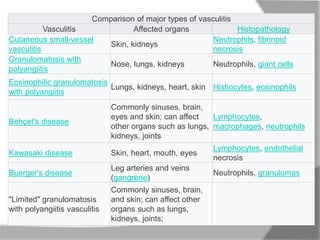
Comparison of major types of vasculitis
Vasculitis Affected organs Histopathology
Cutaneous small-vessel
vasculitis
Skin, kidneys
Neutrophils, fibrinoid
necrosis
Granulomatosis with
polyangiitis
Nose, lungs, kidneys Neutrophils, giant cells
Eosinophilic granulomatosis
with polyangiitis
Lungs, kidneys, heart, skin Histiocytes, eosinophils
Behçet's disease
Commonly sinuses, brain,
eyes and skin; can affect
other organs such as lungs,
kidneys, joints
Lymphocytes,
macrophages, neutrophils
Kawasaki disease Skin, heart, mouth, eyes
Lymphocytes, endothelial
necrosis
Buerger's disease
Leg arteries and veins
(gangrene)
Neutrophils, granulomas
"Limited" granulomatosis
with polyangiitis vasculitis
Commonly sinuses, brain,
and skin; can affect other
organs such as lungs,
kidneys, joints;
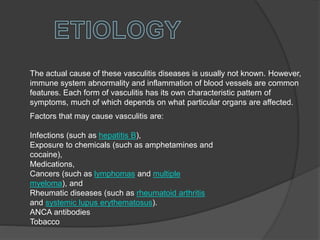
The actual cause of these vasculitis diseases is usually not known. However,
immune system abnormality and inflammation of blood vessels are common
features. Each form of vasculitis has its own characteristic pattern of
symptoms, much of which depends on what particular organs are affected.
Factors that may cause vasculitis are:
Infections (such as hepatitis B),
Exposure to chemicals (such as amphetamines and
cocaine),
Medications,
Cancers (such as lymphomas and multiple
myeloma), and
Rheumatic diseases (such as rheumatoid arthritis
and systemic lupus erythematosus).
ANCA antibodies
Tobacco
Buerger's disease
Thromboangiitis obliterans, also
known as Buerger, is a recurring
progressive inflammation and
thrombosis (clotting) of small and
medium arteries and veins of the hands
and feet. It is an autoimmune disease
triggered by various factors as
mentioned above among which tobacco
is the leading cause for this disease.
Signs and symptoms:
There is a recurrent acute and chronic inflammation and
thrombosis of arteries and veins of the hands and feet.
The main symptom is pain in the affected areas, at rest and
while walking (claudication).
The impaired circulation increases sensitivity to cold.
Peripheral pulses are diminished or absent.
There are color changes in the extremities (from cyanotic
blue to reddish blue)
Skin becomes thin and shiny. Hair growth is reduced.
Ulcerations and gangrene in the extremities are common
complications, often resulting in the need for amputation of
the involved extremity.
Pathophysiology:
There are characteristic pathologic findings of acute
inflammation and thrombosis (clotting) of arteries and
veins of the hands and feet (the lower limbs being more
common).
The mechanisms underlying Buerger's disease are still
largely unknown, but smoking and tobacco consumption
are major factors associated with it.
It has been suggested that the various immunological
antigen may trigger an immune response in susceptible
persons which could incite an inflammatory reaction of the
vessel wall.
This eventually leads to vasculitis and ischemic changes
in distal parts of limbs.
DIAGNOSIS
Clinical diagnostic criteria generally include the
following:
 (1) history of smoking or tobacco abuse;
 (2) age of onset less than 45 to 50 years;
 (3) intrapopliteal, segmental arterial occlusions with
sparing of the proximal vasculature;
 (4) frequent distal upper extremity arterial
involvement (Raynaud's syndrome or digital
ulceration);
 (5) superficial phlebitis; and
 (6) exclusion of arteriosclerosis, diabetes, true
arteritis, proximal embolic source, and
hypercoagulable states.
 Erythrocyte sedimentation rate (ESR)
 C–reactive protein (CRP)
 CT Scan/MRIs
 ANCA tests- specific to granulomatous
vasculitis
Treatment approach
 Medications to dilate blood vessels, improve blood flow or
dissolve blood clots, generally fibrinolytics and
anticoagulants(not well established) are preffered
 Intermittent compression of the arms and legs to increase
blood flow to your extremities
 Spinal cord stimulation
 Cortico-steriods are prescribed for reducing inflammatory
status.
 Surgery to cut the nerves to the affected area (surgical
sympathectomy) to control pain and increase blood flow,
although this procedure is controversial and long-term
results haven't been well-studied
 Amputation, if infection or gangrene occurs
In acute cases, anti-platelet therapy and
heparinization may be beneficial to
prevent progressive thrombosis.
Thrombolytic therapy has been reported
beneficial but yet its uncertain.
Anti-inflammatory are recommended
Infected lesions should be treated with
appropriate antibiotics to control infection.
For noninfected lesions, “benign neglect”
with pain control and local cleansing is
recommended
Sympathectomy, particularly lumbar, has
been used in patients with nonhealing
ischemic lesions, but the results are
unclear.
Under trials:
Three relatively new forms of therapy have
been attempted in patients with refractory
Buerger’s disease over the last decade:
(1) implantation of a spinal cord stimulator;
(2) administration of a prostacyclin
analogue with vasodilatory and platelet
inhibitory properties; and
(3) intramuscular gene transfer of vascular
endothelial growth factor (VEGF).
•Name: Mrs. X
•Age: 25 years
•I. P. No.: 21891823
•Department: surgery
•Date of admission: 21/7/2018
•Date of discharge: 24/7/2018
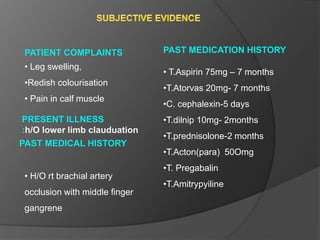
PATIENT COMPLAINTS
• Leg swelling,
•Redish colourisation
• Pain in calf muscle
PAST MEDICAL HISTORY
• H/O rt brachial artery
occlusion with middle finger
gangrene
• T.Aspirin 75mg – 7 months
•T.Atorvas 20mg- 7 months
•C. cephalexin-5 days
•T.dilnip 10mg- 2months
•T.prednisolone-2 months
•T.Acton(para) 50Omg
•T. Pregabalin
•T.Amitrypyiline
PRESENT ILLNESS
:h/O lower limb clauduation
PAST MEDICATION HISTORY
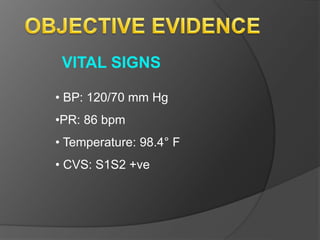
VITAL SIGNS
• BP: 120/70 mm Hg
•PR: 86 bpm
• Temperature: 98.4° F
• CVS: S1S2 +ve
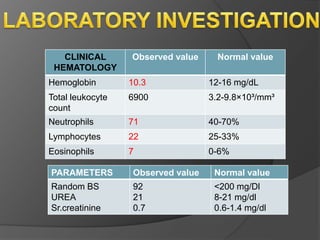
CLINICAL
HEMATOLOGY
Observed value Normal value
Hemoglobin 10.3 12-16 mg/dL
Total leukocyte
count
6900 3.2-9.8×10³/mm³
Neutrophils 71 40-70%
Lymphocytes 22 25-33%
Eosinophils 7 0-6%
PARAMETERS Observed value Normal value
Random BS
UREA
Sr.creatinine
92
21
0.7
<200 mg/Dl
8-21 mg/dl
0.6-1.4 mg/dl
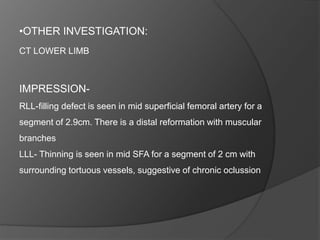
•OTHER INVESTIGATION:
CT LOWER LIMB
IMPRESSION-
RLL-filling defect is seen in mid superficial femoral artery for a
segment of 2.9cm. There is a distal reformation with muscular
branches
LLL- Thinning is seen in mid SFA for a segment of 2 cm with
surrounding tortuous vessels, suggestive of chronic oclussion
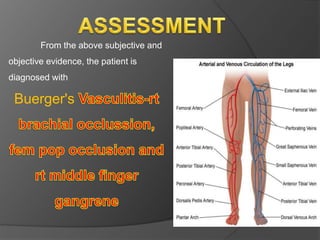
From the above subjective and
objective evidence, the patient is
diagnosed with
Buerger's
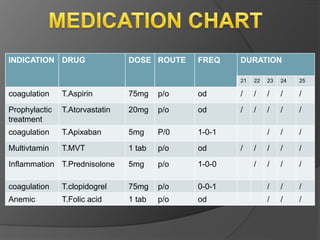
INDICATION DRUG DOSE ROUTE FREQ DURATION
21 22 23 24 25
coagulation T.Aspirin 75mg p/o od / / / / /
Prophylactic
treatment
T.Atorvastatin 20mg p/o od / / / / /
coagulation T.Apixaban 5mg P/0 1-0-1 / / /
Multivtamin T.MVT 1 tab p/o od / / / / /
Inflammation T.Prednisolone 5mg p/o 1-0-0 / / / /
coagulation T.clopidogrel 75mg p/o 0-0-1 / / /
Anemic T.Folic acid 1 tab p/o od / / /
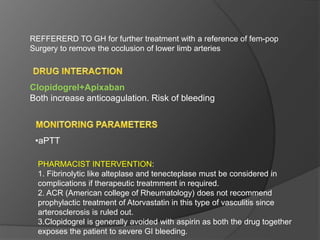
Clopidogrel+Apixaban
Both increase anticoagulation. Risk of bleeding
•aPTT
REFFERERD TO GH for further treatment with a reference of fem-pop
Surgery to remove the occlusion of lower limb arteries
PHARMACIST INTERVENTION:
1. Fibrinolytic like alteplase and tenecteplase must be considered in
complications if therapeutic treatmment in required.
2. ACR (American college of Rheumatology) does not recommend
prophylactic treatment of Atorvastatin in this type of vasculitis since
arterosclerosis is ruled out.
3.Clopidogrel is generally avoided with aspirin as both the drug together
exposes the patient to severe GI bleeding.
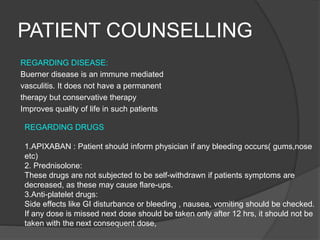
PATIENT COUNSELLING
REGARDING DISEASE:
Buerner disease is an immune mediated
vasculitis. It does not have a permanent
therapy but conservative therapy
Improves quality of life in such patients
REGARDING DRUGS
1.APIXABAN : Patient should inform physician if any bleeding occurs( gums,nose
etc)
2. Prednisolone:
These drugs are not subjected to be self-withdrawn if patients symptoms are
decreased, as these may cause flare-ups.
3.Anti-platelet drugs:
Side effects like GI disturbance or bleeding , nausea, vomiting should be checked.
If any dose is missed next dose should be taken only after 12 hrs, it should not be
taken with the next consequent dose,
REGARDING LIFESTYLE :
•Unrefined plant foods are preferred, rather than on
animal products or highly refined foods
•Foods higher in dietary fiber must be included.
•Drink plenty of water, prefer olive oil and garlic
•Move your feet and calf muscles as an exercise
and avoid heavy workout
•Use compression stockings
•Lift your foot off the floor and make circles in the air
with your toes
•Dressing of wounds properly.
•Not moving around barefoot.
VASCULITIS- CASE PRESENTATION

VASCULITIS- CASE PRESENTATION

  • 1.
     VASCULITIS  BY NEETU OJHA  PHARM.D INTERN
  • 2.
    VASCULITIS : Vasculitis isa general term for a group of uncommon diseases that feature inflammation of the blood vessels and generally damage to these blood vessels occur. The blood vessels of the body are referred to as the vascular system. The blood vessels are comprised of: 1. arteries- passes oxygen-rich blood to the tissues of the body 2. veins- return oxygen-depleted blood from the tissues to the lungs for oxygen. Vasculitis is defined by certain patterns of distribution of blood vessel , its involvement, particular organ involvement, and laboratory test abnormalities. As a group, these diseases are referred to as vasculitides. The word vasculitis is derived from the Latin "vasculum", vessel + "- itis," inflammation. When arteries are inflamed , the condition is also referred to as arteritis. When the veins are inflamed, it is referred to as venulitis.
  • 3.
    Comparison of majortypes of vasculitis Vasculitis Affected organs Histopathology Cutaneous small-vessel vasculitis Skin, kidneys Neutrophils, fibrinoid necrosis Granulomatosis with polyangiitis Nose, lungs, kidneys Neutrophils, giant cells Eosinophilic granulomatosis with polyangiitis Lungs, kidneys, heart, skin Histiocytes, eosinophils Behçet's disease Commonly sinuses, brain, eyes and skin; can affect other organs such as lungs, kidneys, joints Lymphocytes, macrophages, neutrophils Kawasaki disease Skin, heart, mouth, eyes Lymphocytes, endothelial necrosis Buerger's disease Leg arteries and veins (gangrene) Neutrophils, granulomas "Limited" granulomatosis with polyangiitis vasculitis Commonly sinuses, brain, and skin; can affect other organs such as lungs, kidneys, joints;
  • 4.
    The actual causeof these vasculitis diseases is usually not known. However, immune system abnormality and inflammation of blood vessels are common features. Each form of vasculitis has its own characteristic pattern of symptoms, much of which depends on what particular organs are affected. Factors that may cause vasculitis are: Infections (such as hepatitis B), Exposure to chemicals (such as amphetamines and cocaine), Medications, Cancers (such as lymphomas and multiple myeloma), and Rheumatic diseases (such as rheumatoid arthritis and systemic lupus erythematosus). ANCA antibodies Tobacco
  • 5.
    Buerger's disease Thromboangiitis obliterans,also known as Buerger, is a recurring progressive inflammation and thrombosis (clotting) of small and medium arteries and veins of the hands and feet. It is an autoimmune disease triggered by various factors as mentioned above among which tobacco is the leading cause for this disease.
  • 6.
    Signs and symptoms: Thereis a recurrent acute and chronic inflammation and thrombosis of arteries and veins of the hands and feet. The main symptom is pain in the affected areas, at rest and while walking (claudication). The impaired circulation increases sensitivity to cold. Peripheral pulses are diminished or absent. There are color changes in the extremities (from cyanotic blue to reddish blue) Skin becomes thin and shiny. Hair growth is reduced. Ulcerations and gangrene in the extremities are common complications, often resulting in the need for amputation of the involved extremity.
  • 7.
    Pathophysiology: There are characteristicpathologic findings of acute inflammation and thrombosis (clotting) of arteries and veins of the hands and feet (the lower limbs being more common). The mechanisms underlying Buerger's disease are still largely unknown, but smoking and tobacco consumption are major factors associated with it. It has been suggested that the various immunological antigen may trigger an immune response in susceptible persons which could incite an inflammatory reaction of the vessel wall. This eventually leads to vasculitis and ischemic changes in distal parts of limbs.
  • 8.
    DIAGNOSIS Clinical diagnostic criteriagenerally include the following:  (1) history of smoking or tobacco abuse;  (2) age of onset less than 45 to 50 years;  (3) intrapopliteal, segmental arterial occlusions with sparing of the proximal vasculature;  (4) frequent distal upper extremity arterial involvement (Raynaud's syndrome or digital ulceration);  (5) superficial phlebitis; and  (6) exclusion of arteriosclerosis, diabetes, true arteritis, proximal embolic source, and hypercoagulable states.
  • 9.
     Erythrocyte sedimentationrate (ESR)  C–reactive protein (CRP)  CT Scan/MRIs  ANCA tests- specific to granulomatous vasculitis
  • 10.
    Treatment approach  Medicationsto dilate blood vessels, improve blood flow or dissolve blood clots, generally fibrinolytics and anticoagulants(not well established) are preffered  Intermittent compression of the arms and legs to increase blood flow to your extremities  Spinal cord stimulation  Cortico-steriods are prescribed for reducing inflammatory status.  Surgery to cut the nerves to the affected area (surgical sympathectomy) to control pain and increase blood flow, although this procedure is controversial and long-term results haven't been well-studied  Amputation, if infection or gangrene occurs
  • 11.
    In acute cases,anti-platelet therapy and heparinization may be beneficial to prevent progressive thrombosis. Thrombolytic therapy has been reported beneficial but yet its uncertain. Anti-inflammatory are recommended Infected lesions should be treated with appropriate antibiotics to control infection. For noninfected lesions, “benign neglect” with pain control and local cleansing is recommended Sympathectomy, particularly lumbar, has been used in patients with nonhealing ischemic lesions, but the results are unclear. Under trials: Three relatively new forms of therapy have been attempted in patients with refractory Buerger’s disease over the last decade: (1) implantation of a spinal cord stimulator; (2) administration of a prostacyclin analogue with vasodilatory and platelet inhibitory properties; and (3) intramuscular gene transfer of vascular endothelial growth factor (VEGF).
  • 12.
    •Name: Mrs. X •Age:25 years •I. P. No.: 21891823 •Department: surgery •Date of admission: 21/7/2018 •Date of discharge: 24/7/2018
  • 13.
    PATIENT COMPLAINTS • Legswelling, •Redish colourisation • Pain in calf muscle PAST MEDICAL HISTORY • H/O rt brachial artery occlusion with middle finger gangrene • T.Aspirin 75mg – 7 months •T.Atorvas 20mg- 7 months •C. cephalexin-5 days •T.dilnip 10mg- 2months •T.prednisolone-2 months •T.Acton(para) 50Omg •T. Pregabalin •T.Amitrypyiline PRESENT ILLNESS :h/O lower limb clauduation PAST MEDICATION HISTORY
  • 14.
    VITAL SIGNS • BP:120/70 mm Hg •PR: 86 bpm • Temperature: 98.4° F • CVS: S1S2 +ve
  • 15.
    CLINICAL HEMATOLOGY Observed value Normalvalue Hemoglobin 10.3 12-16 mg/dL Total leukocyte count 6900 3.2-9.8×10³/mm³ Neutrophils 71 40-70% Lymphocytes 22 25-33% Eosinophils 7 0-6% PARAMETERS Observed value Normal value Random BS UREA Sr.creatinine 92 21 0.7 <200 mg/Dl 8-21 mg/dl 0.6-1.4 mg/dl
  • 16.
    •OTHER INVESTIGATION: CT LOWERLIMB IMPRESSION- RLL-filling defect is seen in mid superficial femoral artery for a segment of 2.9cm. There is a distal reformation with muscular branches LLL- Thinning is seen in mid SFA for a segment of 2 cm with surrounding tortuous vessels, suggestive of chronic oclussion
  • 17.
    From the abovesubjective and objective evidence, the patient is diagnosed with Buerger's
  • 18.
    INDICATION DRUG DOSEROUTE FREQ DURATION 21 22 23 24 25 coagulation T.Aspirin 75mg p/o od / / / / / Prophylactic treatment T.Atorvastatin 20mg p/o od / / / / / coagulation T.Apixaban 5mg P/0 1-0-1 / / / Multivtamin T.MVT 1 tab p/o od / / / / / Inflammation T.Prednisolone 5mg p/o 1-0-0 / / / / coagulation T.clopidogrel 75mg p/o 0-0-1 / / / Anemic T.Folic acid 1 tab p/o od / / /
  • 19.
    Clopidogrel+Apixaban Both increase anticoagulation.Risk of bleeding •aPTT REFFERERD TO GH for further treatment with a reference of fem-pop Surgery to remove the occlusion of lower limb arteries PHARMACIST INTERVENTION: 1. Fibrinolytic like alteplase and tenecteplase must be considered in complications if therapeutic treatmment in required. 2. ACR (American college of Rheumatology) does not recommend prophylactic treatment of Atorvastatin in this type of vasculitis since arterosclerosis is ruled out. 3.Clopidogrel is generally avoided with aspirin as both the drug together exposes the patient to severe GI bleeding.
  • 20.
    PATIENT COUNSELLING REGARDING DISEASE: Buernerdisease is an immune mediated vasculitis. It does not have a permanent therapy but conservative therapy Improves quality of life in such patients REGARDING DRUGS 1.APIXABAN : Patient should inform physician if any bleeding occurs( gums,nose etc) 2. Prednisolone: These drugs are not subjected to be self-withdrawn if patients symptoms are decreased, as these may cause flare-ups. 3.Anti-platelet drugs: Side effects like GI disturbance or bleeding , nausea, vomiting should be checked. If any dose is missed next dose should be taken only after 12 hrs, it should not be taken with the next consequent dose,
  • 21.
    REGARDING LIFESTYLE : •Unrefinedplant foods are preferred, rather than on animal products or highly refined foods •Foods higher in dietary fiber must be included. •Drink plenty of water, prefer olive oil and garlic
  • 22.
    •Move your feetand calf muscles as an exercise and avoid heavy workout •Use compression stockings •Lift your foot off the floor and make circles in the air with your toes •Dressing of wounds properly. •Not moving around barefoot.