Janet Gregory
Kenneth King
August 20, 2013
 Explains what has happened in the past
 Predicts what will happen in the future
 Implies ways to control or respond to what is happening
in the present
Theory Modelvs.
Descriptive Prescriptive
Things to attend to Framework of things to do
Mind Map Process Diagram
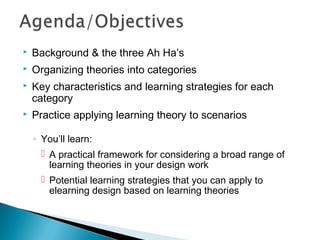
 Background & the three Ah Ha’s
 Organizing theories into categories
 Key characteristics and learning strategies for each
category
 Practice applying learning theory to scenarios
◦ You’ll learn:
 A practical framework for considering a broad range of
learning theories in your design work
 Potential learning strategies that you can apply to
elearning design based on learning theories
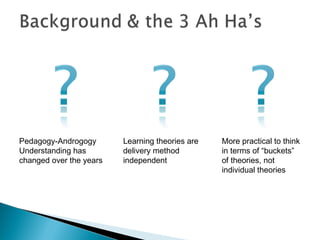
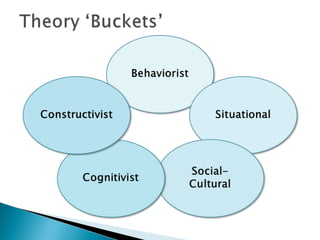
More practical to think
in terms of “buckets”
of theories, not
individual theories
Pedagogy-Androgogy
Understanding has
changed over the years
Learning theories are
delivery method
independent
 http://www.learning-theories.com
 http://www.instructionaldesign.org/theories/index.html
 http://en.wikipedia.org/wiki/Learning_theory_(education)
 http://infed.org/mobi
 http://www.funderstanding.com/learning/
 Others?
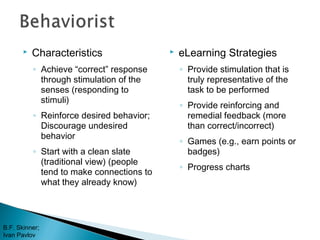
 Characteristics
◦ Achieve “correct” response
through stimulation of the
senses (responding to
stimuli)
◦ Reinforce desired behavior;
Discourage undesired
behavior
◦ Start with a clean slate
(traditional view) (people
tend to make connections to
what they already know)
 eLearning Strategies
◦ Provide stimulation that is
truly representative of the
task to be performed
◦ Provide reinforcing and
remedial feedback (more
than correct/incorrect)
◦ Games (e.g., earn points or
badges)
◦ Progress charts
B.F. Skinner;
Ivan Pavlov
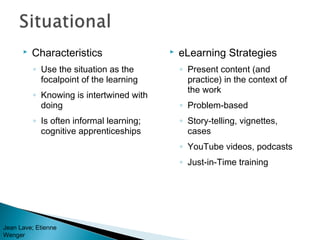
 Characteristics
◦ Use the situation as the
focalpoint of the learning
◦ Knowing is intertwined with
doing
◦ Is often informal learning;
cognitive apprenticeships
 eLearning Strategies
◦ Present content (and
practice) in the context of
the work
◦ Problem-based
◦ Story-telling, vignettes,
cases
◦ YouTube videos, podcasts
◦ Just-in-Time training
Jean Lave; Etienne
Wenger
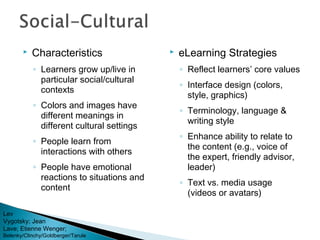
 Characteristics
◦ Learners grow up/live in
particular social/cultural
contexts
◦ Colors and images have
different meanings in
different cultural settings
◦ People learn from
interactions with others
◦ People have emotional
reactions to situations and
content
 eLearning Strategies
◦ Reflect learners’ core values
◦ Interface design (colors,
style, graphics)
◦ Terminology, language &
writing style
◦ Enhance ability to relate to
the content (e.g., voice of
the expert, friendly advisor,
leader)
◦ Text vs. media usage
(videos or avatars)
Lev
Vygotsky; Jean
Lave; Etienne Wenger;
Belenky/Clinchy/Goldberger/Tarule
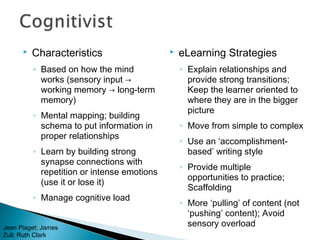
 Characteristics
◦ Based on how the mind
works (sensory input →
working memory → long-term
memory)
◦ Mental mapping; building
schema to put information in
proper relationships
◦ Learn by building strong
synapse connections with
repetition or intense emotions
(use it or lose it)
◦ Manage cognitive load
 eLearning Strategies
◦ Explain relationships and
provide strong transitions;
Keep the learner oriented to
where they are in the bigger
picture
◦ Move from simple to complex
◦ Use an ‘accomplishment-
based’ writing style
◦ Provide multiple
opportunities to practice;
Scaffolding
◦ More ‘pulling’ of content (not
‘pushing’ content); Avoid
sensory overloadJean Piaget; James
Zull; Ruth Clark
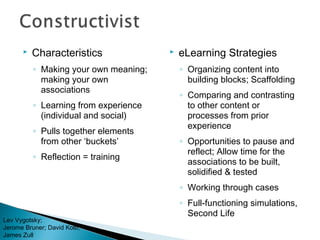
 Characteristics
◦ Making your own meaning;
making your own
associations
◦ Learning from experience
(individual and social)
◦ Pulls together elements
from other ‘buckets’
◦ Reflection = training
 eLearning Strategies
◦ Organizing content into
building blocks; Scaffolding
◦ Comparing and contrasting
to other content or
processes from prior
experience
◦ Opportunities to pause and
reflect; Allow time for the
associations to be built,
solidified & tested
◦ Working through cases
◦ Full-functioning simulations,
Second Life
Lev Vygotsky;
Jerome Bruner; David Kolb;
James Zull
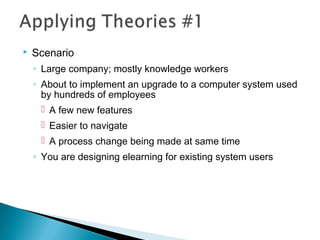
 Scenario
◦ Large company; mostly knowledge workers
◦ About to implement an upgrade to a computer system used
by hundreds of employees
 A few new features
 Easier to navigate
 A process change being made at same time
◦ You are designing elearning for existing system users
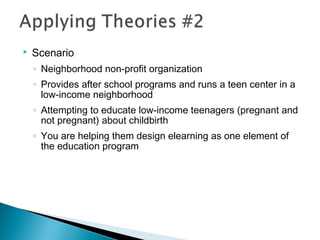
 Scenario
◦ Neighborhood non-profit organization
◦ Provides after school programs and runs a teen center in a
low-income neighborhood
◦ Attempting to educate low-income teenagers (pregnant and
not pregnant) about childbirth
◦ You are helping them design elearning as one element of
the education program
 Scenario
◦ A work process redesign is being implemented in a major
division of a large corporation
◦ The new process involves implementing new equipment
◦ A reorganization is taking place at the same time and many
employees will be performing different parts of the process
on the new equipment
◦ You are design an elearning overview to introduce division
personnel to the process, equipment and organization
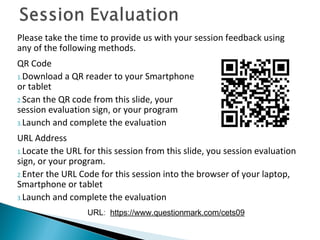
Please take the time to provide us with your session feedback using
any of the following methods.
QR Code
1.Download a QR reader to your Smartphone
or tablet
2.Scan the QR code from this slide, your
session evaluation sign, or your program
3.Launch and complete the evaluation
URL Address
1.Locate the URL for this session from this slide, you session evaluation
sign, or your program.
2.Enter the URL Code for this session into the browser of your laptop,
Smartphone or tablet
3.Launch and complete the evaluation
URL: https://www.questionmark.com/cets09

Cets 2013 gregory applying learning theories to e_learning design

  • 1.
  • 2.
     Explains whathas happened in the past  Predicts what will happen in the future  Implies ways to control or respond to what is happening in the present Theory Modelvs. Descriptive Prescriptive Things to attend to Framework of things to do Mind Map Process Diagram
  • 3.
     Background &the three Ah Ha’s  Organizing theories into categories  Key characteristics and learning strategies for each category  Practice applying learning theory to scenarios ◦ You’ll learn:  A practical framework for considering a broad range of learning theories in your design work  Potential learning strategies that you can apply to elearning design based on learning theories
  • 4.
    More practical tothink in terms of “buckets” of theories, not individual theories Pedagogy-Androgogy Understanding has changed over the years Learning theories are delivery method independent
  • 5.
     http://www.learning-theories.com  http://www.instructionaldesign.org/theories/index.html http://en.wikipedia.org/wiki/Learning_theory_(education)  http://infed.org/mobi  http://www.funderstanding.com/learning/  Others?
  • 7.
     Characteristics ◦ Achieve“correct” response through stimulation of the senses (responding to stimuli) ◦ Reinforce desired behavior; Discourage undesired behavior ◦ Start with a clean slate (traditional view) (people tend to make connections to what they already know)  eLearning Strategies ◦ Provide stimulation that is truly representative of the task to be performed ◦ Provide reinforcing and remedial feedback (more than correct/incorrect) ◦ Games (e.g., earn points or badges) ◦ Progress charts B.F. Skinner; Ivan Pavlov
  • 8.
     Characteristics ◦ Usethe situation as the focalpoint of the learning ◦ Knowing is intertwined with doing ◦ Is often informal learning; cognitive apprenticeships  eLearning Strategies ◦ Present content (and practice) in the context of the work ◦ Problem-based ◦ Story-telling, vignettes, cases ◦ YouTube videos, podcasts ◦ Just-in-Time training Jean Lave; Etienne Wenger
  • 9.
     Characteristics ◦ Learnersgrow up/live in particular social/cultural contexts ◦ Colors and images have different meanings in different cultural settings ◦ People learn from interactions with others ◦ People have emotional reactions to situations and content  eLearning Strategies ◦ Reflect learners’ core values ◦ Interface design (colors, style, graphics) ◦ Terminology, language & writing style ◦ Enhance ability to relate to the content (e.g., voice of the expert, friendly advisor, leader) ◦ Text vs. media usage (videos or avatars) Lev Vygotsky; Jean Lave; Etienne Wenger; Belenky/Clinchy/Goldberger/Tarule
  • 10.
     Characteristics ◦ Basedon how the mind works (sensory input → working memory → long-term memory) ◦ Mental mapping; building schema to put information in proper relationships ◦ Learn by building strong synapse connections with repetition or intense emotions (use it or lose it) ◦ Manage cognitive load  eLearning Strategies ◦ Explain relationships and provide strong transitions; Keep the learner oriented to where they are in the bigger picture ◦ Move from simple to complex ◦ Use an ‘accomplishment- based’ writing style ◦ Provide multiple opportunities to practice; Scaffolding ◦ More ‘pulling’ of content (not ‘pushing’ content); Avoid sensory overloadJean Piaget; James Zull; Ruth Clark
  • 11.
     Characteristics ◦ Makingyour own meaning; making your own associations ◦ Learning from experience (individual and social) ◦ Pulls together elements from other ‘buckets’ ◦ Reflection = training  eLearning Strategies ◦ Organizing content into building blocks; Scaffolding ◦ Comparing and contrasting to other content or processes from prior experience ◦ Opportunities to pause and reflect; Allow time for the associations to be built, solidified & tested ◦ Working through cases ◦ Full-functioning simulations, Second Life Lev Vygotsky; Jerome Bruner; David Kolb; James Zull
  • 12.
     Scenario ◦ Largecompany; mostly knowledge workers ◦ About to implement an upgrade to a computer system used by hundreds of employees  A few new features  Easier to navigate  A process change being made at same time ◦ You are designing elearning for existing system users
  • 13.
     Scenario ◦ Neighborhoodnon-profit organization ◦ Provides after school programs and runs a teen center in a low-income neighborhood ◦ Attempting to educate low-income teenagers (pregnant and not pregnant) about childbirth ◦ You are helping them design elearning as one element of the education program
  • 14.
     Scenario ◦ Awork process redesign is being implemented in a major division of a large corporation ◦ The new process involves implementing new equipment ◦ A reorganization is taking place at the same time and many employees will be performing different parts of the process on the new equipment ◦ You are design an elearning overview to introduce division personnel to the process, equipment and organization
  • 16.
    Please take thetime to provide us with your session feedback using any of the following methods. QR Code 1.Download a QR reader to your Smartphone or tablet 2.Scan the QR code from this slide, your session evaluation sign, or your program 3.Launch and complete the evaluation URL Address 1.Locate the URL for this session from this slide, you session evaluation sign, or your program. 2.Enter the URL Code for this session into the browser of your laptop, Smartphone or tablet 3.Launch and complete the evaluation URL: https://www.questionmark.com/cets09