MANIPULATIVES By: Deanna Riley and Coralisa Ford
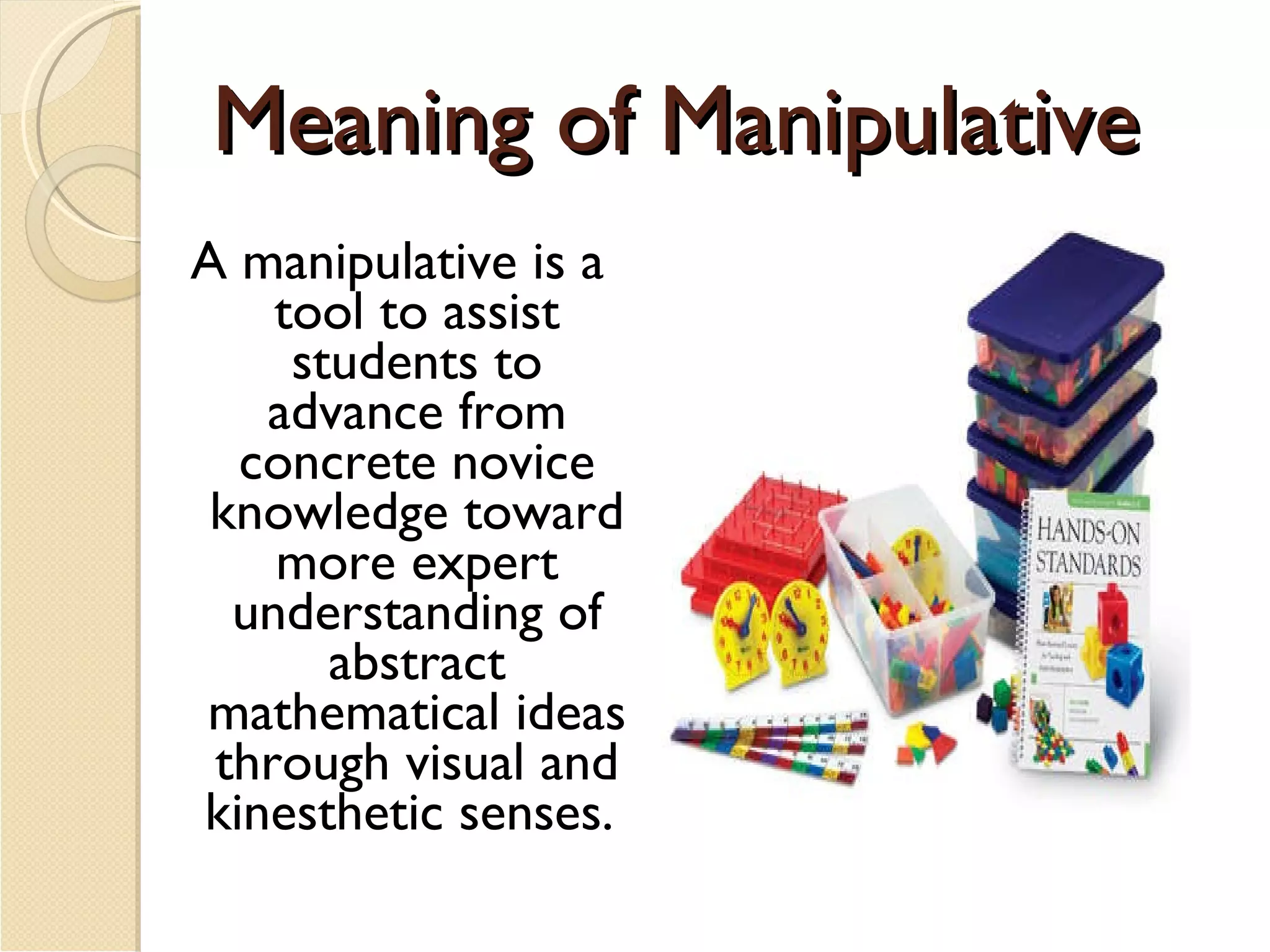
Meaning of Manipulative A manipulative is a tool to assist students to advance from concrete novice knowledge toward more expert understanding of abstract mathematical ideas through visual and kinesthetic senses.
The Passage from Concrete to Abstract Thinking “ There is no single route or rate to abstraction, but research has shown that manipulatives can be important to students taking this journey.” (Driscoll, 1981) It is known that the road to abstraction is not easy but manipulatives help to accelerate the student into thinking abstractly in mathematics.  Educational researchers like Piaget concluded that because students proceed through learning stages, that manipulatives are significant aids to learning in all four of Piaget’s stages.
Using Manipulatives The most important influence on the successful use of manipulatives is the quality of teacher-conducted instructions Lessons with manipulatives must be carefully designed to advance students’ thinking from “naïve” to “expert.” Avoid these assumptions: Do not assume that the images that you see when using manipulatives are identical to those seen by your students. Do not assume when students maneuver objects in specified ways that the expected mental associations automatically follow.  Realize that manipulatives can be used in a rote manner.
Using Manipulatives The effective use of manipulatives requires your thoughtful consideration to developing students’ thinking with your guidance.  Select manipulatives that the students all will use.  Select manipulatives that allow multiple applications.  Express the importance of proper treatment of classroom materials. Also give rules as to where they can be used and stored.  When introducing a topic, use one specific manipulative. Then after working and presenting that manipulative, you may allow the students to try other concrete representations. Its GOOD when they suggest them!
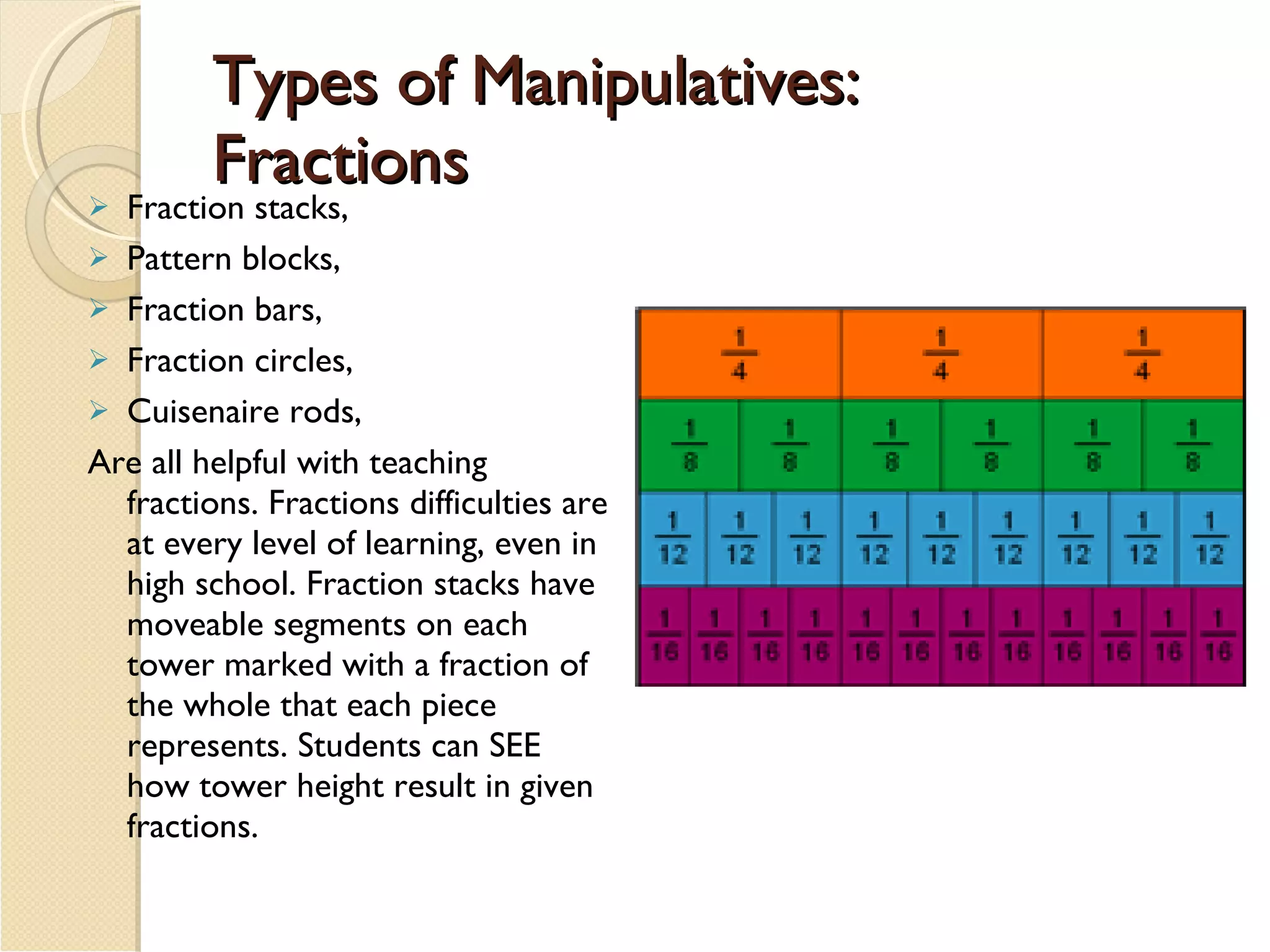
Types of Manipulatives: Fractions Fraction stacks, Pattern blocks, Fraction bars, Fraction circles, Cuisenaire rods, Are all helpful with teaching fractions. Fractions difficulties are at every level of learning, even in high school. Fraction stacks have moveable segments on each tower marked with a fraction of the whole that each piece represents. Students can SEE how tower height result in given fractions.
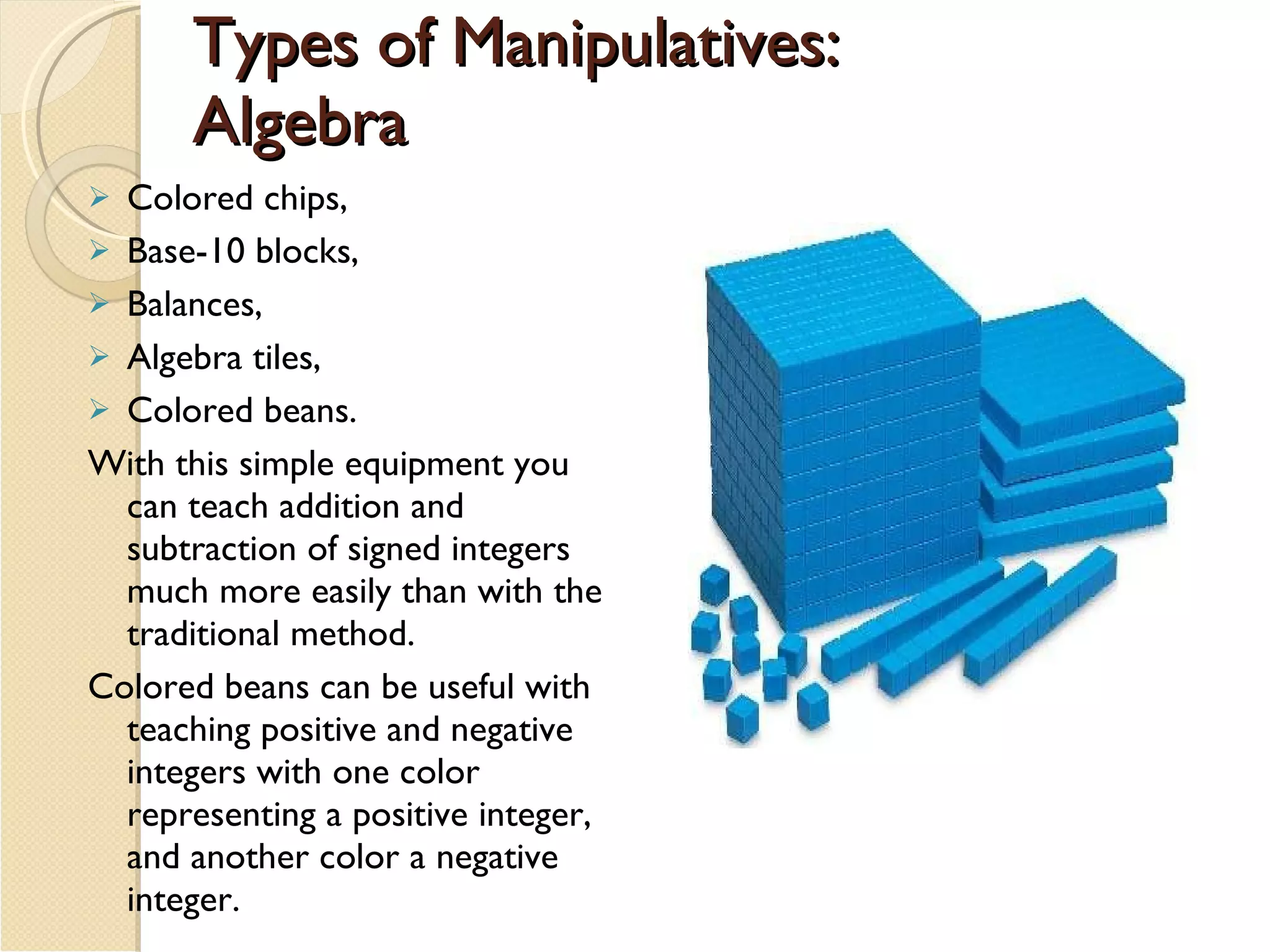
Types of Manipulatives: Algebra Colored chips, Base-10 blocks, Balances, Algebra tiles, Colored beans. With this simple equipment you can teach addition and subtraction of signed integers much more easily than with the traditional method. Colored beans can be useful with teaching positive and negative integers with one color representing a positive integer, and another color a negative integer.
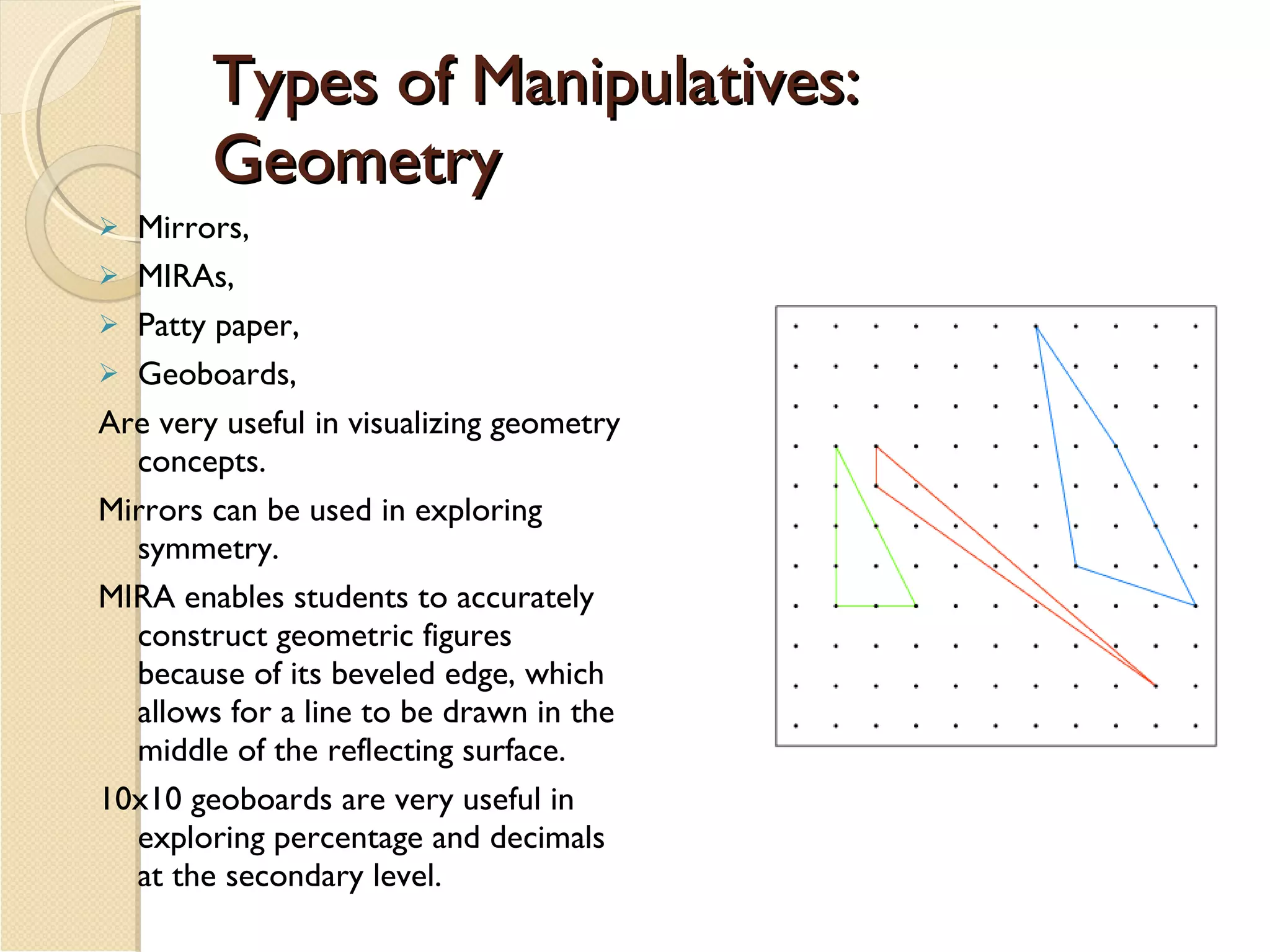
Types of Manipulatives: Geometry Mirrors, MIRAs, Patty paper, Geoboards, Are very useful in visualizing geometry concepts. Mirrors can be used in exploring symmetry. MIRA enables students to accurately construct geometric figures because of its beveled edge, which allows for a line to be drawn in the middle of the reflecting surface.  10x10 geoboards are very useful in exploring percentage and decimals at the secondary level.
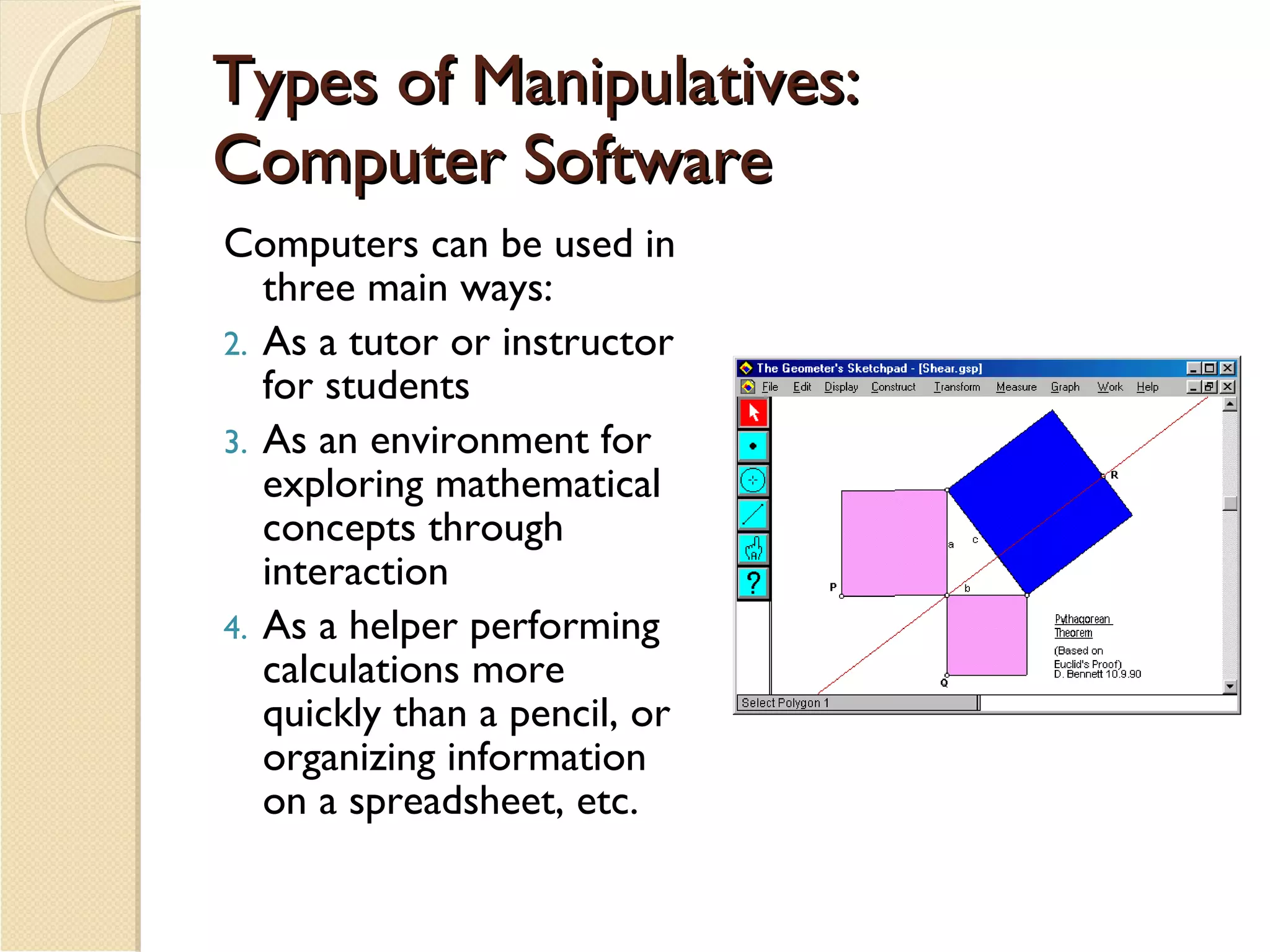
Types of Manipulatives: Computer Software Computers can be used in three main ways: As a tutor or instructor for students As an environment for exploring mathematical concepts through interaction As a helper performing calculations more quickly than a pencil, or organizing information on a spreadsheet, etc.
Let’s See How Manipulatives Work! http://www.youtube.com/watch?v=wVurSpBoD38

Manipulatives

  • 1.
    MANIPULATIVES By: DeannaRiley and Coralisa Ford
  • 2.
    Meaning of ManipulativeA manipulative is a tool to assist students to advance from concrete novice knowledge toward more expert understanding of abstract mathematical ideas through visual and kinesthetic senses.
  • 3.
    The Passage fromConcrete to Abstract Thinking “ There is no single route or rate to abstraction, but research has shown that manipulatives can be important to students taking this journey.” (Driscoll, 1981) It is known that the road to abstraction is not easy but manipulatives help to accelerate the student into thinking abstractly in mathematics. Educational researchers like Piaget concluded that because students proceed through learning stages, that manipulatives are significant aids to learning in all four of Piaget’s stages.
  • 4.
    Using Manipulatives Themost important influence on the successful use of manipulatives is the quality of teacher-conducted instructions Lessons with manipulatives must be carefully designed to advance students’ thinking from “naïve” to “expert.” Avoid these assumptions: Do not assume that the images that you see when using manipulatives are identical to those seen by your students. Do not assume when students maneuver objects in specified ways that the expected mental associations automatically follow. Realize that manipulatives can be used in a rote manner.
  • 5.
    Using Manipulatives Theeffective use of manipulatives requires your thoughtful consideration to developing students’ thinking with your guidance. Select manipulatives that the students all will use. Select manipulatives that allow multiple applications. Express the importance of proper treatment of classroom materials. Also give rules as to where they can be used and stored. When introducing a topic, use one specific manipulative. Then after working and presenting that manipulative, you may allow the students to try other concrete representations. Its GOOD when they suggest them!
  • 6.
    Types of Manipulatives:Fractions Fraction stacks, Pattern blocks, Fraction bars, Fraction circles, Cuisenaire rods, Are all helpful with teaching fractions. Fractions difficulties are at every level of learning, even in high school. Fraction stacks have moveable segments on each tower marked with a fraction of the whole that each piece represents. Students can SEE how tower height result in given fractions.
  • 7.
    Types of Manipulatives:Algebra Colored chips, Base-10 blocks, Balances, Algebra tiles, Colored beans. With this simple equipment you can teach addition and subtraction of signed integers much more easily than with the traditional method. Colored beans can be useful with teaching positive and negative integers with one color representing a positive integer, and another color a negative integer.
  • 8.
    Types of Manipulatives:Geometry Mirrors, MIRAs, Patty paper, Geoboards, Are very useful in visualizing geometry concepts. Mirrors can be used in exploring symmetry. MIRA enables students to accurately construct geometric figures because of its beveled edge, which allows for a line to be drawn in the middle of the reflecting surface. 10x10 geoboards are very useful in exploring percentage and decimals at the secondary level.
  • 9.
    Types of Manipulatives:Computer Software Computers can be used in three main ways: As a tutor or instructor for students As an environment for exploring mathematical concepts through interaction As a helper performing calculations more quickly than a pencil, or organizing information on a spreadsheet, etc.
  • 10.
    Let’s See HowManipulatives Work! http://www.youtube.com/watch?v=wVurSpBoD38

Editor's Notes

  • #4 The passage from Concrete is abstract thinking is the most important concept in teaching math. Without abstract thinking the student will not be able to grasp most mathematical ideas.
  • #5 The manipulatives cannot teach the students themselves. A good teacher helps to make abstraction happen. Assumptions by Clements and McMillen.
  • #7 quesinaire
  • #8 The following are manipulatives used to teach algebra
  • #10 We cannot forget about computer software
  • #11 this is a video of Two students playing a game with dice to practice two digit addition