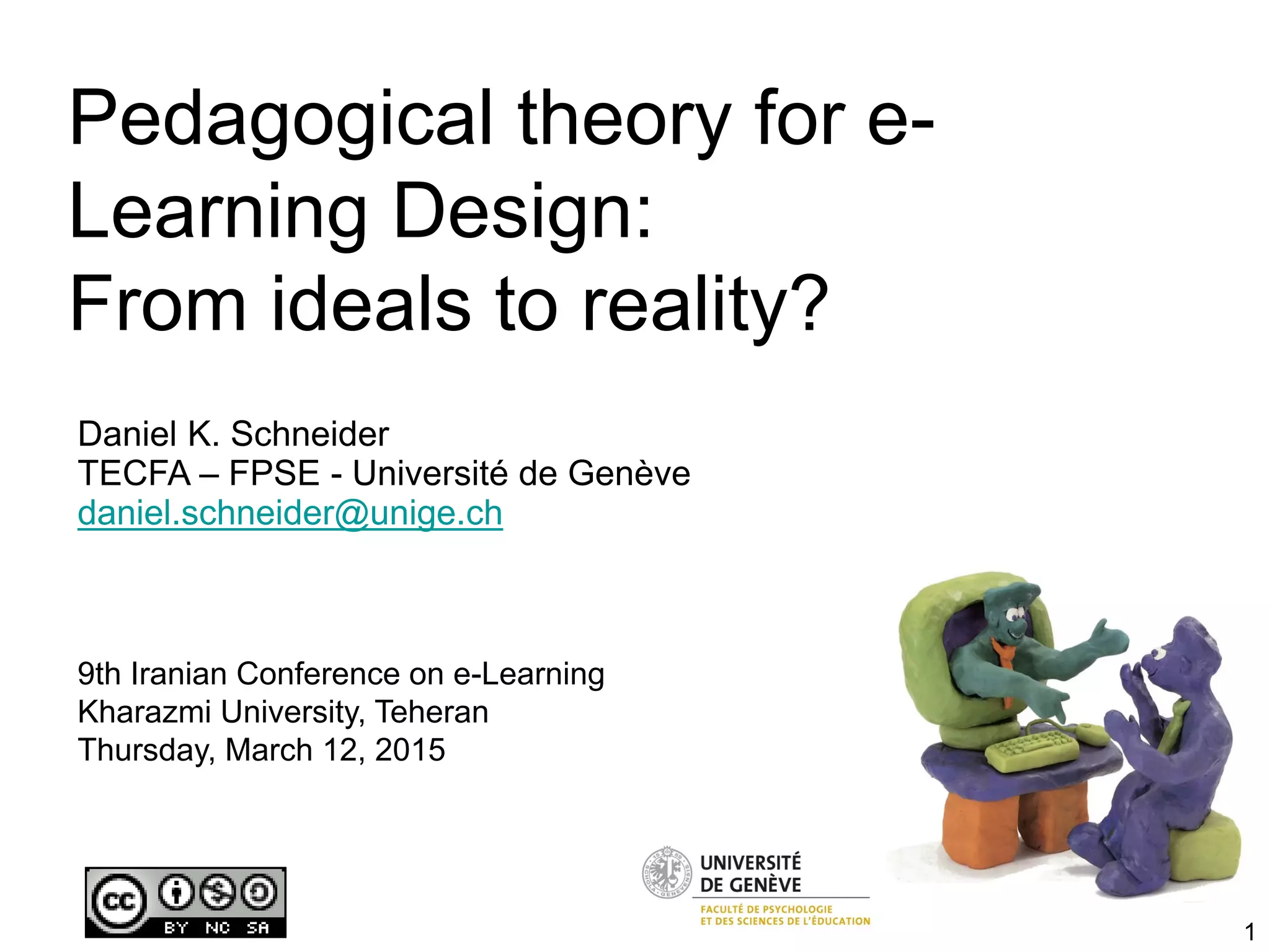
Pedagogical theory for e-
Learning Design:
From ideals to reality?
Daniel K. Schneider
TECFA – FPSE - Université de Genève
daniel.schneider@unige.ch
9th Iranian Conference on e-Learning
Kharazmi University, Teheran
Thursday, March 12, 2015
1
12.03.2015 2
1. What is e-learning ?
2. The role & evolution of technology
3. Educational principles – e-learning principles ?
4. People ?
5. E-learning and pedagogic change ?
Menu
What is
e-learning
?1.
3
12.03.2015 4
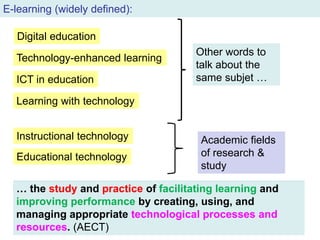
E-learning (widely defined):
Digital education
Technology-enhanced learning
ICT in education
Learning with technology
Instructional technology
Educational technology
Other words to
talk about the
same subjet …
Academic fields
of research &
study
… the study and practice of facilitating learning and
improving performance by creating, using, and
managing appropriate technological processes and
resources. (AECT)
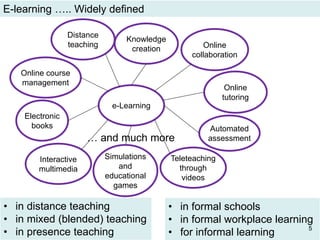
E-learning ….. Widely defined
e-Learning
Automated
assessment
Simulations
and
educational
games
Teleteaching
through
videos
Interactive
multimedia
Online course
management
Knowledge
creation Online
collaboration
Electronic
books
… and much more
• in formal schools
• in formal workplace learning
• for informal learning
• in distance teaching
• in mixed (blended) teaching
• in presence teaching
Online
tutoring
Distance
teaching
5
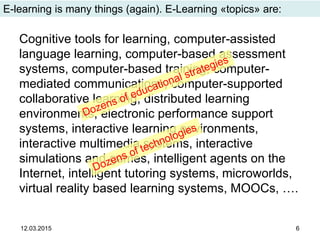
Cognitive tools for learning, computer-assisted
language learning, computer-based assessment
systems, computer-based training, computer-
mediated communications, computer-supported
collaborative learning, distributed learning
environments, electronic performance support
systems, interactive learning environments,
interactive multimedia systems, interactive
simulations and games, intelligent agents on the
Internet, intelligent tutoring systems, microworlds,
virtual reality based learning systems, MOOCs, ….
12.03.2015 6
E-learning is many things (again). E-Learning «topics» are:
3/12/2015 7
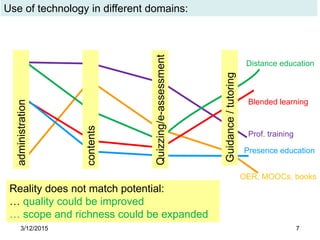
Use of technology in different domains:
Reality does not match potential:
… quality could be improved
… scope and richness could be expanded
administration
contents
Quizzing/e-assessment
Guidance/tutoring
Distance education
Presence education
Blended learning
Prof. training
OER, MOOCs, books
The role &
evolution of
technology2.
8
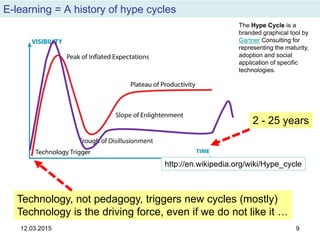
E-learning = A history of hype cycles
12.03.2015 9
http://en.wikipedia.org/wiki/Hype_cycle
Technology, not pedagogy, triggers new cycles (mostly)
Technology is the driving force, even if we do not like it …
The Hype Cycle is a
branded graphical tool by
Gartner Consulting for
representing the maturity,
adoption and social
application of specific
technologies.
2 - 25 years
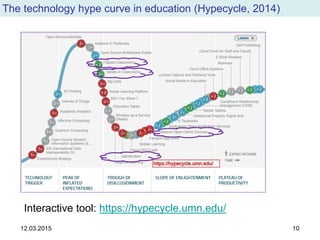
The technology hype curve in education (Hypecycle, 2014)
12.03.2015 10
Interactive tool: https://hypecycle.umn.edu/
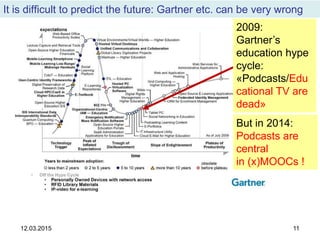
It is difficult to predict the future: Gartner etc. can be very wrong
12.03.2015 11
But in 2014:
Podcasts are
central
in (x)MOOCs !
2009:
Gartner’s
education hype
cycle:
«Podcasts/Edu
cational TV are
dead»
1960
E-learning
platforms
Computer-
based
training
1970 1980 1990 2000 2010
CBL,
micro-worlds
simulations
TV Intelligent
tutoring
Virtual
Env. I Virtual
Env. II
Analytics
MOOCs
OER
Edu
games
Non-edu
tools
CSCL
2015
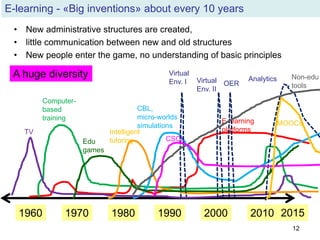
E-learning - «Big inventions» about every 10 years
• New administrative structures are created,
• little communication between new and old structures
• New people enter the game, no understanding of basic principles
A huge diversity
12
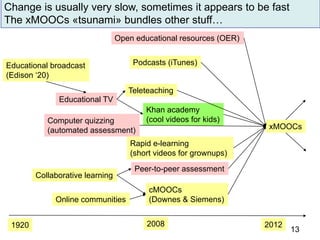
Change is usually very slow, sometimes it appears to be fast
The xMOOCs «tsunami» bundles other stuff…
cMOOCs
(Downes & Siemens)
xMOOCs
Podcasts (iTunes)
Khan academy
(cool videos for kids)
Rapid e-learning
(short videos for grownups)
Educational TV
Teleteaching
Computer quizzing
(automated assessment)
Peer-to-peer assessment
Online communities
Collaborative learning
2008
Educational broadcast
(Edison ‘20)
Open educational resources (OER)
1920 2012
13
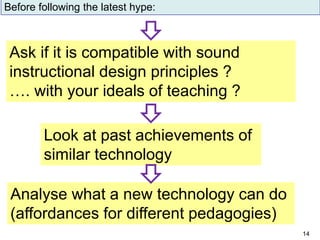
Before following the latest hype:
Ask if it is compatible with sound
instructional design principles ?
…. with your ideals of teaching ?
Look at past achievements of
similar technology
Analyse what a new technology can do
(affordances for different pedagogies)
14
Educational
principles –
e-learning
principles ?
3.
15
Are there first
principles of good e-
learning design ?
Is there an «e-
learning theory» ?
16
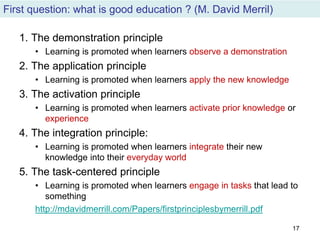
First question: what is good education ? (M. David Merril)
1. The demonstration principle
• Learning is promoted when learners observe a demonstration
2. The application principle
• Learning is promoted when learners apply the new knowledge
3. The activation principle
• Learning is promoted when learners activate prior knowledge or
experience
4. The integration principle:
• Learning is promoted when learners integrate their new
knowledge into their everyday world
5. The task-centered principle
• Learning is promoted when learners engage in tasks that lead to
something
http://mdavidmerrill.com/Papers/firstprinciplesbymerrill.pdf
17
12.03.2015 18
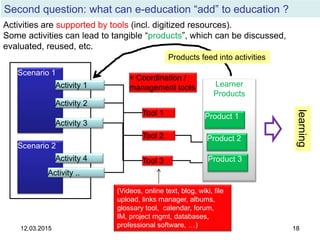
Second question: what can e-education “add” to education ?
12.03.2015 18
Scenario 1
Scenario 2
Activity ..
Activity 1
Activity 3
Activity 2
Activity 4
Tool 1
Tool 2
Tool 3
+ Coordination /
management tools Learner
Products
Product 1
Product 2
Product 3
(Videos, online text, blog, wiki, file
upload, links manager, albums,
glossary tool, calendar, forum,
IM, project mgmt, databases,
professional software, …)
Activities are supported by tools (incl. digitized resources).
Some activities can lead to tangible “products”, which can be discussed,
evaluated, reused, etc.
learning
Products feed into activities
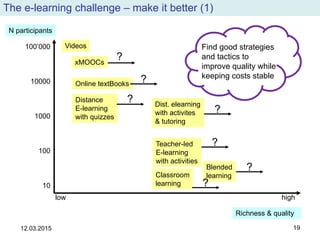
The e-learning challenge – make it better (1)
12.03.2015 19
low high
Richness & quality
N participants
xMOOCs
Online textBooks
Dist. elearning
with activites
& tutoring
Distance
E-learning
with quizzes
Teacher-led
E-learning
with activities
Blended
learning
10000
10
1000
100
100’000 Videos
?
?
?
?
?
Classroom
learning ?
Find good strategies
and tactics to
improve quality while
keeping costs stable
?
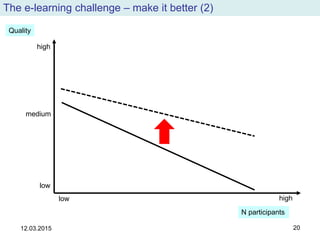
The e-learning challenge – make it better (2)
12.03.2015 20
low high
N participants
Quality
low
high
medium
12.03.2015 21
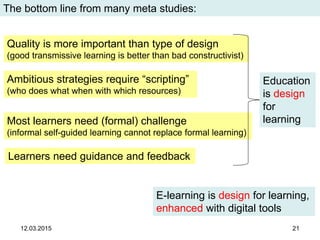
The bottom line from many meta studies:
Learners need guidance and feedback
Most learners need (formal) challenge
(informal self-guided learning cannot replace formal learning)
Quality is more important than type of design
(good transmissive learning is better than bad constructivist)
Education
is design
for
learning
Ambitious strategies require “scripting”
(who does what when with which resources)
E-learning is design for learning,
enhanced with digital tools
12.03.2015 22
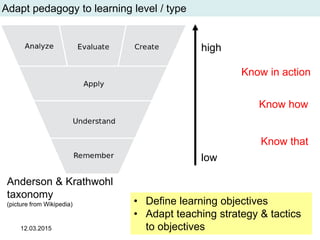
Adapt pedagogy to learning level / type
• Define learning objectives
• Adapt teaching strategy & tactics
to objectives
Anderson & Krathwohl
taxonomy
(picture from Wikipedia)
high
low
Know that
Know how
Know in action
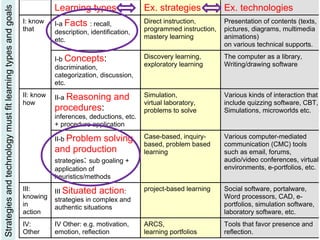
Learning types Ex. strategies Ex. technologies
I: know
that
I-a Facts : recall,
description, identification,
etc.
Direct instruction,
programmed instruction,
mastery learning
Presentation of contents (texts,
pictures, diagrams, multimedia
animations)
on various technical supports.
I-b Concepts:
discrimination,
categorization, discussion,
etc.
Discovery learning,
exploratory learning
The computer as a library,
Writing/drawing software
II: know
how
II-a Reasoning and
procedures:
inferences, deductions, etc.
+ procedure application
Simulation,
virtual laboratory,
problems to solve
Various kinds of interaction that
include quizzing software, CBT,
Simulations, microworlds etc.
II-b Problem solving
and production
strategies: sub goaling +
application of
heuristics/methods
Case-based, inquiry-
based, problem based
learning
Various computer-mediated
communication (CMC) tools
such as email, forums,
audio/video conferences, virtual
environments, e-portfolios, etc.
III:
knowing
in
action
III Situated action:
strategies in complex and
authentic situations
project-based learning Social software, portalware,
Word processors, CAD, e-
portfolios, simulation software,
laboratory software, etc.
IV:
Other
IV Other: e.g. motivation,
emotion, reflection
ARCS,
learning portfolios
Tools that favor presence and
reflection.
Strategiesandtechnologymustfitlearningtypesandgoals
12.03.2015
24
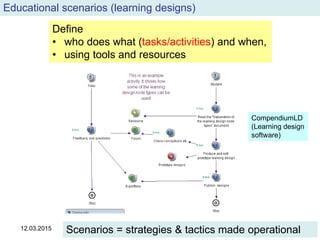
Educational scenarios (learning designs)
Define
• who does what (tasks/activities) and when,
• using tools and resources
Scenarios = strategies & tactics made operational
CompendiumLD
(Learning design
software)
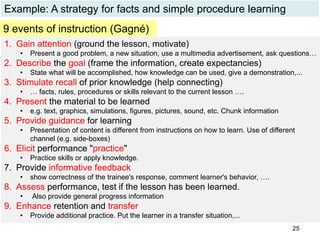
Example: A strategy for facts and simple procedure learning
1. Gain attention (ground the lesson, motivate)
• Present a good problem, a new situation, use a multimedia advertisement, ask questions…
2. Describe the goal (frame the information, create expectancies)
• State what will be accomplished, how knowledge can be used, give a demonstration,...
3. Stimulate recall of prior knowledge (help connecting)
• … facts, rules, procedures or skills relevant to the current lesson ….
4. Present the material to be learned
• e.g. text, graphics, simulations, figures, pictures, sound, etc. Chunk information
5. Provide guidance for learning
• Presentation of content is different from instructions on how to learn. Use of different
channel (e.g. side-boxes)
6. Elicit performance "practice"
• Practice skills or apply knowledge.
7. Provide informative feedback
• show correctness of the trainee's response, comment learner's behavior, ….
8. Assess performance, test if the lesson has been learned.
• Also provide general progress information
9. Enhance retention and transfer
• Provide additional practice. Put the learner in a transfer situation,...
9 events of instruction (Gagné)
25
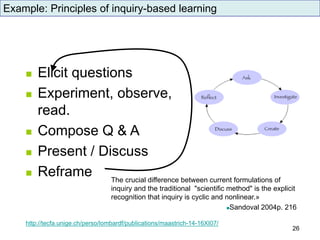
 Elicit questions
 Experiment, observe,
read.
 Compose Q & A
 Present / Discuss
 Reframe The crucial difference between current formulations of
inquiry and the traditional "scientific method" is the explicit
recognition that inquiry is cyclic and nonlinear.»
Sandoval 2004p. 216
http://tecfa.unige.ch/perso/lombardf/publications/maastrich-14-16XI07/
Example: Principles of inquiry-based learning
26
0 5 7
29
0
24 32
68
0
13
25
76
0
2
9
50
0
50
100
150
200
250
1 10 44 94
27, janvier 12h 27, janvier : 14h20 5,Février : 10h03 14, mars : 9h22
Nombred'items
Progression de l'investigation : numéro de version et date (2007)
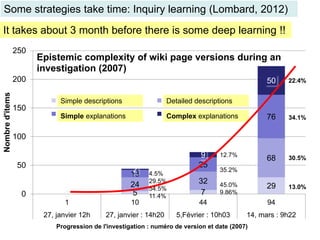
Epistemic complexity of wiki page versions during an
investigation (2007)
Descriptions-simples Descriptions étayées
Explications simples Explications étayées
4.5%
29.5%
54.5%
11.4%
12.7%
35.2%
45.0%
9.86%
Complex explanationsSimple explanations
Simple descriptions Detailed descriptions
22.4%
34.1%
30.5%
13.0%
Some strategies take time: Inquiry learning (Lombard, 2012)
It takes about 3 month before there is some deep learning !!
12.03.2015 28
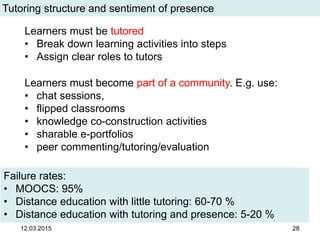
Tutoring structure and sentiment of presence
Failure rates:
• MOOCS: 95%
• Distance education with little tutoring: 60-70 %
• Distance education with tutoring and presence: 5-20 %
Learners must be tutored
• Break down learning activities into steps
• Assign clear roles to tutors
Learners must become part of a community. E.g. use:
• chat sessions,
• flipped classrooms
• knowledge co-construction activities
• sharable e-portfolios
• peer commenting/tutoring/evaluation
12.03.2015 29
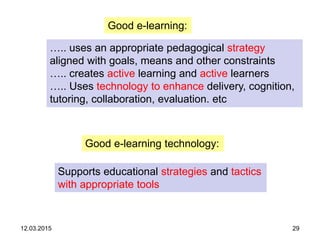
Good e-learning:
….. uses an appropriate pedagogical strategy
aligned with goals, means and other constraints
….. creates active learning and active learners
….. Uses technology to enhance delivery, cognition,
tutoring, collaboration, evaluation. etc
Good e-learning technology:
Supports educational strategies and tactics
with appropriate tools
People ?
4.
30
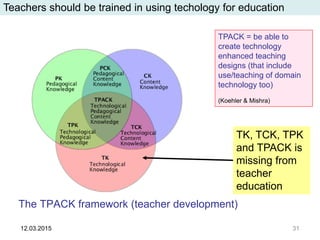
The TPACK framework (teacher development)
12.03.2015 31
TPACK = be able to
create technology
enhanced teaching
designs (that include
use/teaching of domain
technology too)
(Koehler & Mishra)
Teachers should be trained in using techology for education
TK, TCK, TPK
and TPACK is
missing from
teacher
education
12.03.2015 32
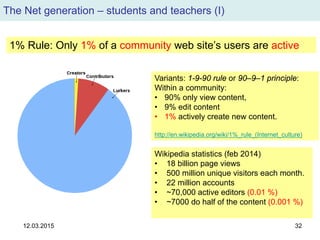
1% Rule: Only 1% of a community web site’s users are active
Wikipedia statistics (feb 2014)
• 18 billion page views
• 500 million unique visitors each month.
• 22 million accounts
• ~70,000 active editors (0.01 %)
• ~7000 do half of the content (0.001 %)
Variants: 1-9-90 rule or 90–9–1 principle:
Within a community:
• 90% only view content,
• 9% edit content
• 1% actively create new content.
http://en.wikipedia.org/wiki/1%_rule_(Internet_culture)
The Net generation – students and teachers (I)
12.03.2015 33
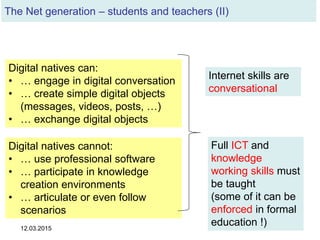
Digital natives can:
• … engage in digital conversation
• … create simple digital objects
(messages, videos, posts, …)
• … exchange digital objects
Digital natives cannot:
• … use professional software
• … participate in knowledge
creation environments
• … articulate or even follow
scenarios
Internet skills are
conversational
Full ICT and
knowledge
working skills must
be taught
(some of it can be
enforced in formal
education !)
The Net generation – students and teachers (II)
12.03.2015 34
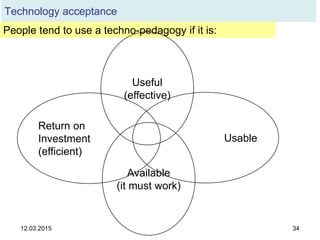
People tend to use a techno-pedagogy if it is:
Technology acceptance
Available
(it must work)
Useful
(effective)
Usable
Return on
Investment
(efficient)
E-learning
and
pedagogic
change ?
5.
35
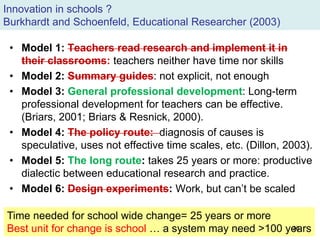
Innovation in schools ?
Burkhardt and Schoenfeld, Educational Researcher (2003)
• Model 1: Teachers read research and implement it in
their classrooms: teachers neither have time nor skills
• Model 2: Summary guides: not explicit, not enough
• Model 3: General professional development: Long-term
professional development for teachers can be effective.
(Briars, 2001; Briars & Resnick, 2000).
• Model 4: The policy route: diagnosis of causes is
speculative, uses not effective time scales, etc. (Dillon, 2003).
• Model 5: The long route: takes 25 years or more: productive
dialectic between educational research and practice.
• Model 6: Design experiments: Work, but can’t be scaled
Time needed for school wide change= 25 years or more
Best unit for change is school … a system may need >100 years36
3/12/2015 37
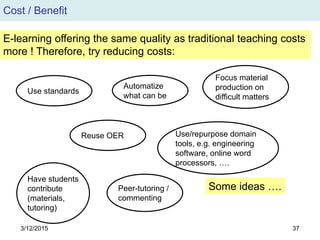
Cost / Benefit
E-learning offering the same quality as traditional teaching costs
more ! Therefore, try reducing costs:
Use standards
Automatize
what can be
Reuse OER
Peer-tutoring /
commenting
Focus material
production on
difficult matters
Use/repurpose domain
tools, e.g. engineering
software, online word
processors, ….
Have students
contribute
(materials,
tutoring)
Some ideas ….
12.03.2015 38
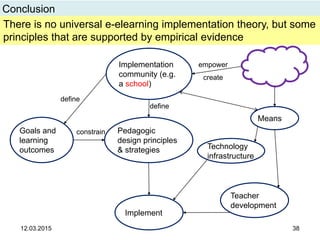
Conclusion
There is no universal e-elearning implementation theory, but some
principles that are supported by empirical evidence
Implementation
community (e.g.
a school)
create
Goals and
learning
outcomes
Teacher
development
Means
Pedagogic
design principles
& strategies
define
constrain
define
Implement
empower
Technology
infrastructure
39
Thank you
for listening
Questions ?
Comments ?

Pedagogical theory for e-Learning Design: From ideals to reality?

  • 1.
    Pedagogical theory fore- Learning Design: From ideals to reality? Daniel K. Schneider TECFA – FPSE - Université de Genève daniel.schneider@unige.ch 9th Iranian Conference on e-Learning Kharazmi University, Teheran Thursday, March 12, 2015 1
  • 2.
    12.03.2015 2 1. Whatis e-learning ? 2. The role & evolution of technology 3. Educational principles – e-learning principles ? 4. People ? 5. E-learning and pedagogic change ? Menu
  • 3.
  • 4.
    12.03.2015 4 E-learning (widelydefined): Digital education Technology-enhanced learning ICT in education Learning with technology Instructional technology Educational technology Other words to talk about the same subjet … Academic fields of research & study … the study and practice of facilitating learning and improving performance by creating, using, and managing appropriate technological processes and resources. (AECT)
  • 5.
    E-learning ….. Widelydefined e-Learning Automated assessment Simulations and educational games Teleteaching through videos Interactive multimedia Online course management Knowledge creation Online collaboration Electronic books … and much more • in formal schools • in formal workplace learning • for informal learning • in distance teaching • in mixed (blended) teaching • in presence teaching Online tutoring Distance teaching 5
  • 6.
    Cognitive tools forlearning, computer-assisted language learning, computer-based assessment systems, computer-based training, computer- mediated communications, computer-supported collaborative learning, distributed learning environments, electronic performance support systems, interactive learning environments, interactive multimedia systems, interactive simulations and games, intelligent agents on the Internet, intelligent tutoring systems, microworlds, virtual reality based learning systems, MOOCs, …. 12.03.2015 6 E-learning is many things (again). E-Learning «topics» are:
  • 7.
    3/12/2015 7 Use oftechnology in different domains: Reality does not match potential: … quality could be improved … scope and richness could be expanded administration contents Quizzing/e-assessment Guidance/tutoring Distance education Presence education Blended learning Prof. training OER, MOOCs, books
  • 8.
    The role & evolutionof technology2. 8
  • 9.
    E-learning = Ahistory of hype cycles 12.03.2015 9 http://en.wikipedia.org/wiki/Hype_cycle Technology, not pedagogy, triggers new cycles (mostly) Technology is the driving force, even if we do not like it … The Hype Cycle is a branded graphical tool by Gartner Consulting for representing the maturity, adoption and social application of specific technologies. 2 - 25 years
  • 10.
    The technology hypecurve in education (Hypecycle, 2014) 12.03.2015 10 Interactive tool: https://hypecycle.umn.edu/
  • 11.
    It is difficultto predict the future: Gartner etc. can be very wrong 12.03.2015 11 But in 2014: Podcasts are central in (x)MOOCs ! 2009: Gartner’s education hype cycle: «Podcasts/Edu cational TV are dead»
  • 12.
    1960 E-learning platforms Computer- based training 1970 1980 19902000 2010 CBL, micro-worlds simulations TV Intelligent tutoring Virtual Env. I Virtual Env. II Analytics MOOCs OER Edu games Non-edu tools CSCL 2015 E-learning - «Big inventions» about every 10 years • New administrative structures are created, • little communication between new and old structures • New people enter the game, no understanding of basic principles A huge diversity 12
  • 13.
    Change is usuallyvery slow, sometimes it appears to be fast The xMOOCs «tsunami» bundles other stuff… cMOOCs (Downes & Siemens) xMOOCs Podcasts (iTunes) Khan academy (cool videos for kids) Rapid e-learning (short videos for grownups) Educational TV Teleteaching Computer quizzing (automated assessment) Peer-to-peer assessment Online communities Collaborative learning 2008 Educational broadcast (Edison ‘20) Open educational resources (OER) 1920 2012 13
  • 14.
    Before following thelatest hype: Ask if it is compatible with sound instructional design principles ? …. with your ideals of teaching ? Look at past achievements of similar technology Analyse what a new technology can do (affordances for different pedagogies) 14
  • 15.
  • 16.
    Are there first principlesof good e- learning design ? Is there an «e- learning theory» ? 16
  • 17.
    First question: whatis good education ? (M. David Merril) 1. The demonstration principle • Learning is promoted when learners observe a demonstration 2. The application principle • Learning is promoted when learners apply the new knowledge 3. The activation principle • Learning is promoted when learners activate prior knowledge or experience 4. The integration principle: • Learning is promoted when learners integrate their new knowledge into their everyday world 5. The task-centered principle • Learning is promoted when learners engage in tasks that lead to something http://mdavidmerrill.com/Papers/firstprinciplesbymerrill.pdf 17
  • 18.
    12.03.2015 18 Second question:what can e-education “add” to education ? 12.03.2015 18 Scenario 1 Scenario 2 Activity .. Activity 1 Activity 3 Activity 2 Activity 4 Tool 1 Tool 2 Tool 3 + Coordination / management tools Learner Products Product 1 Product 2 Product 3 (Videos, online text, blog, wiki, file upload, links manager, albums, glossary tool, calendar, forum, IM, project mgmt, databases, professional software, …) Activities are supported by tools (incl. digitized resources). Some activities can lead to tangible “products”, which can be discussed, evaluated, reused, etc. learning Products feed into activities
  • 19.
    The e-learning challenge– make it better (1) 12.03.2015 19 low high Richness & quality N participants xMOOCs Online textBooks Dist. elearning with activites & tutoring Distance E-learning with quizzes Teacher-led E-learning with activities Blended learning 10000 10 1000 100 100’000 Videos ? ? ? ? ? Classroom learning ? Find good strategies and tactics to improve quality while keeping costs stable ?
  • 20.
    The e-learning challenge– make it better (2) 12.03.2015 20 low high N participants Quality low high medium
  • 21.
    12.03.2015 21 The bottomline from many meta studies: Learners need guidance and feedback Most learners need (formal) challenge (informal self-guided learning cannot replace formal learning) Quality is more important than type of design (good transmissive learning is better than bad constructivist) Education is design for learning Ambitious strategies require “scripting” (who does what when with which resources) E-learning is design for learning, enhanced with digital tools
  • 22.
    12.03.2015 22 Adapt pedagogyto learning level / type • Define learning objectives • Adapt teaching strategy & tactics to objectives Anderson & Krathwohl taxonomy (picture from Wikipedia) high low Know that Know how Know in action
  • 23.
    Learning types Ex.strategies Ex. technologies I: know that I-a Facts : recall, description, identification, etc. Direct instruction, programmed instruction, mastery learning Presentation of contents (texts, pictures, diagrams, multimedia animations) on various technical supports. I-b Concepts: discrimination, categorization, discussion, etc. Discovery learning, exploratory learning The computer as a library, Writing/drawing software II: know how II-a Reasoning and procedures: inferences, deductions, etc. + procedure application Simulation, virtual laboratory, problems to solve Various kinds of interaction that include quizzing software, CBT, Simulations, microworlds etc. II-b Problem solving and production strategies: sub goaling + application of heuristics/methods Case-based, inquiry- based, problem based learning Various computer-mediated communication (CMC) tools such as email, forums, audio/video conferences, virtual environments, e-portfolios, etc. III: knowing in action III Situated action: strategies in complex and authentic situations project-based learning Social software, portalware, Word processors, CAD, e- portfolios, simulation software, laboratory software, etc. IV: Other IV Other: e.g. motivation, emotion, reflection ARCS, learning portfolios Tools that favor presence and reflection. Strategiesandtechnologymustfitlearningtypesandgoals
  • 24.
    12.03.2015 24 Educational scenarios (learningdesigns) Define • who does what (tasks/activities) and when, • using tools and resources Scenarios = strategies & tactics made operational CompendiumLD (Learning design software)
  • 25.
    Example: A strategyfor facts and simple procedure learning 1. Gain attention (ground the lesson, motivate) • Present a good problem, a new situation, use a multimedia advertisement, ask questions… 2. Describe the goal (frame the information, create expectancies) • State what will be accomplished, how knowledge can be used, give a demonstration,... 3. Stimulate recall of prior knowledge (help connecting) • … facts, rules, procedures or skills relevant to the current lesson …. 4. Present the material to be learned • e.g. text, graphics, simulations, figures, pictures, sound, etc. Chunk information 5. Provide guidance for learning • Presentation of content is different from instructions on how to learn. Use of different channel (e.g. side-boxes) 6. Elicit performance "practice" • Practice skills or apply knowledge. 7. Provide informative feedback • show correctness of the trainee's response, comment learner's behavior, …. 8. Assess performance, test if the lesson has been learned. • Also provide general progress information 9. Enhance retention and transfer • Provide additional practice. Put the learner in a transfer situation,... 9 events of instruction (Gagné) 25
  • 26.
     Elicit questions Experiment, observe, read.  Compose Q & A  Present / Discuss  Reframe The crucial difference between current formulations of inquiry and the traditional "scientific method" is the explicit recognition that inquiry is cyclic and nonlinear.» Sandoval 2004p. 216 http://tecfa.unige.ch/perso/lombardf/publications/maastrich-14-16XI07/ Example: Principles of inquiry-based learning 26
  • 27.
    0 5 7 29 0 2432 68 0 13 25 76 0 2 9 50 0 50 100 150 200 250 1 10 44 94 27, janvier 12h 27, janvier : 14h20 5,Février : 10h03 14, mars : 9h22 Nombred'items Progression de l'investigation : numéro de version et date (2007) Epistemic complexity of wiki page versions during an investigation (2007) Descriptions-simples Descriptions étayées Explications simples Explications étayées 4.5% 29.5% 54.5% 11.4% 12.7% 35.2% 45.0% 9.86% Complex explanationsSimple explanations Simple descriptions Detailed descriptions 22.4% 34.1% 30.5% 13.0% Some strategies take time: Inquiry learning (Lombard, 2012) It takes about 3 month before there is some deep learning !!
  • 28.
    12.03.2015 28 Tutoring structureand sentiment of presence Failure rates: • MOOCS: 95% • Distance education with little tutoring: 60-70 % • Distance education with tutoring and presence: 5-20 % Learners must be tutored • Break down learning activities into steps • Assign clear roles to tutors Learners must become part of a community. E.g. use: • chat sessions, • flipped classrooms • knowledge co-construction activities • sharable e-portfolios • peer commenting/tutoring/evaluation
  • 29.
    12.03.2015 29 Good e-learning: …..uses an appropriate pedagogical strategy aligned with goals, means and other constraints ….. creates active learning and active learners ….. Uses technology to enhance delivery, cognition, tutoring, collaboration, evaluation. etc Good e-learning technology: Supports educational strategies and tactics with appropriate tools
  • 30.
  • 31.
    The TPACK framework(teacher development) 12.03.2015 31 TPACK = be able to create technology enhanced teaching designs (that include use/teaching of domain technology too) (Koehler & Mishra) Teachers should be trained in using techology for education TK, TCK, TPK and TPACK is missing from teacher education
  • 32.
    12.03.2015 32 1% Rule:Only 1% of a community web site’s users are active Wikipedia statistics (feb 2014) • 18 billion page views • 500 million unique visitors each month. • 22 million accounts • ~70,000 active editors (0.01 %) • ~7000 do half of the content (0.001 %) Variants: 1-9-90 rule or 90–9–1 principle: Within a community: • 90% only view content, • 9% edit content • 1% actively create new content. http://en.wikipedia.org/wiki/1%_rule_(Internet_culture) The Net generation – students and teachers (I)
  • 33.
    12.03.2015 33 Digital nativescan: • … engage in digital conversation • … create simple digital objects (messages, videos, posts, …) • … exchange digital objects Digital natives cannot: • … use professional software • … participate in knowledge creation environments • … articulate or even follow scenarios Internet skills are conversational Full ICT and knowledge working skills must be taught (some of it can be enforced in formal education !) The Net generation – students and teachers (II)
  • 34.
    12.03.2015 34 People tendto use a techno-pedagogy if it is: Technology acceptance Available (it must work) Useful (effective) Usable Return on Investment (efficient)
  • 35.
  • 36.
    Innovation in schools? Burkhardt and Schoenfeld, Educational Researcher (2003) • Model 1: Teachers read research and implement it in their classrooms: teachers neither have time nor skills • Model 2: Summary guides: not explicit, not enough • Model 3: General professional development: Long-term professional development for teachers can be effective. (Briars, 2001; Briars & Resnick, 2000). • Model 4: The policy route: diagnosis of causes is speculative, uses not effective time scales, etc. (Dillon, 2003). • Model 5: The long route: takes 25 years or more: productive dialectic between educational research and practice. • Model 6: Design experiments: Work, but can’t be scaled Time needed for school wide change= 25 years or more Best unit for change is school … a system may need >100 years36
  • 37.
    3/12/2015 37 Cost /Benefit E-learning offering the same quality as traditional teaching costs more ! Therefore, try reducing costs: Use standards Automatize what can be Reuse OER Peer-tutoring / commenting Focus material production on difficult matters Use/repurpose domain tools, e.g. engineering software, online word processors, …. Have students contribute (materials, tutoring) Some ideas ….
  • 38.
    12.03.2015 38 Conclusion There isno universal e-elearning implementation theory, but some principles that are supported by empirical evidence Implementation community (e.g. a school) create Goals and learning outcomes Teacher development Means Pedagogic design principles & strategies define constrain define Implement empower Technology infrastructure
  • 39.