From ADDIE to
   Improv

  Nancy Munro
        &
  Allison Black
Problem to Solve

   ROI Institute – CEO’s don’t see the connection to training

6% see connection of training to business
outcomes
94% want to see the connection but don’t feel they
are getting it.


“In the traditional ADDIE model dispprortionate amount of
time spent on Analysis vs. Evaluation”
Why?

•   Time
•   Money
•   Culture
•   Access to content
•   Attention Spans
•   Measurements
Improv +
• Correlation                   • Games/Methods
   – Acceleration of ideas to     –   Yes, and
     action                       –   Ad Game
   – Listening skills             –   One Word Sentence
   – Active vs. passive           –   Show and Tell
   – Collaboration
   – Working with unknowns
Begin w/ End
• Assess your current training projects to determine which
  ones you can re-design w/ new method
• Understand the underlying principals of how to facilitate
  training in a new way
• Decrease your production time
• Build methods to modify and update content rapidly
• Re-establish training effectiveness metrics
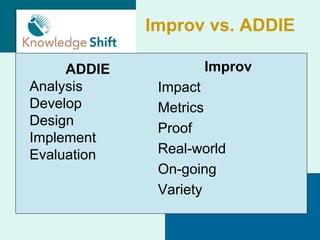
Improv vs. ADDIE

     ADDIE          Improv
Analysis      Impact
Develop       Metrics
Design
              Proof
Implement
Evaluation    Real-world
              On-going
              Variety
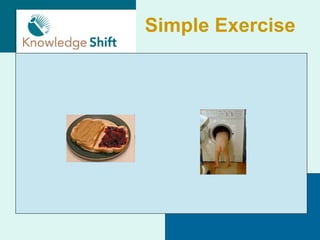
Simple Exercise
Making a
                                            Sandwich
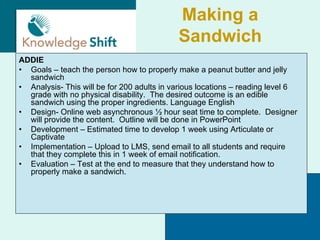
ADDIE
• Goals – teach the person how to properly make a peanut butter and jelly
  sandwich
• Analysis- This will be for 200 adults in various locations – reading level 6
  grade with no physical disability. The desired outcome is an edible
  sandwich using the proper ingredients. Language English
• Design- Online web asynchronous ½ hour seat time to complete. Designer
  will provide the content. Outline will be done in PowerPoint
• Development – Estimated time to develop 1 week using Articulate or
  Captivate
• Implementation – Upload to LMS, send email to all students and require
  that they complete this in 1 week of email notification.
• Evaluation – Test at the end to measure that they understand how to
  properly make a sandwich.
IMPROV
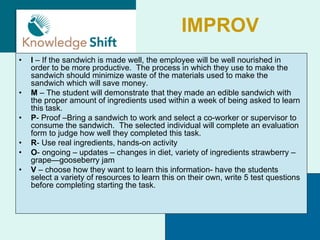
•   I – If the sandwich is made well, the employee will be well nourished in
    order to be more productive. The process in which they use to make the
    sandwich should minimize waste of the materials used to make the
    sandwich which will save money.
•   M – The student will demonstrate that they made an edible sandwich with
    the proper amount of ingredients used within a week of being asked to learn
    this task.
•   P- Proof –Bring a sandwich to work and select a co-worker or supervisor to
    consume the sandwich. The selected individual will complete an evaluation
    form to judge how well they completed this task.
•   R- Use real ingredients, hands-on activity
•   O- ongoing – updates – changes in diet, variety of ingredients strawberry –
    grape—gooseberry jam
•   V – choose how they want to learn this information- have the students
    select a variety of resources to learn this on their own, write 5 test questions
    before completing starting the task.
Doing Laundry
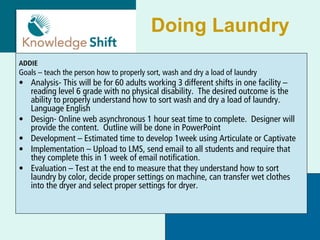
ADDIE
Goals – teach the person how to properly sort, wash and dry a load of laundry
• Analysis- This will be for 60 adults working 3 different shifts in one facility –
  reading level 6 grade with no physical disability. The desired outcome is the
  ability to properly understand how to sort wash and dry a load of laundry.
  Language English
• Design- Online web asynchronous 1 hour seat time to complete. Designer will
  provide the content. Outline will be done in PowerPoint
• Development – Estimated time to develop 1week using Articulate or Captivate
• Implementation – Upload to LMS, send email to all students and require that
  they complete this in 1 week of email notification.
• Evaluation – Test at the end to measure that they understand how to sort
  laundry by color, decide proper settings on machine, can transfer wet clothes
  into the dryer and select proper settings for dryer.
IMPROV

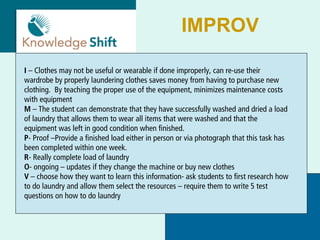
I – Clothes may not be useful or wearable if done improperly, can re-use their
wardrobe by properly laundering clothes saves money from having to purchase new
clothing. By teaching the proper use of the equipment, minimizes maintenance costs
with equipment
M – The student can demonstrate that they have successfully washed and dried a load
of laundry that allows them to wear all items that were washed and that the
equipment was left in good condition when finished.
P- Proof –Provide a finished load either in person or via photograph that this task has
been completed within one week.
R- Really complete load of laundry
O- ongoing – updates if they change the machine or buy new clothes
V – choose how they want to learn this information- ask students to first research how
to do laundry and allow them select the resources – require them to write 5 test
questions on how to do laundry
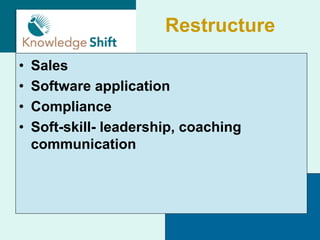
Restructure
•   Sales
•   Software application
•   Compliance
•   Soft-skill- leadership, coaching
    communication
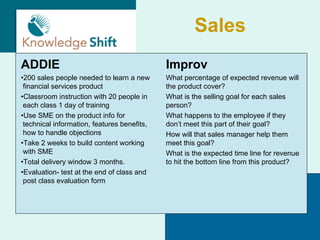
Sales
ADDIE                                        Improv
•200 sales people needed to learn a new      What percentage of expected revenue will
 financial services product                  the product cover?
•Classroom instruction with 20 people in     What is the selling goal for each sales
 each class 1 day of training                person?
•Use SME on the product info for             What happens to the employee if they
 technical information, features benefits,   don’t meet this part of their goal?
 how to handle objections                    How will that sales manager help them
•Take 2 weeks to build content working       meet this goal?
 with SME                                    What is the expected time line for revenue
•Total delivery window 3 months.             to hit the bottom line from this product?
•Evaluation- test at the end of class and
 post class evaluation form
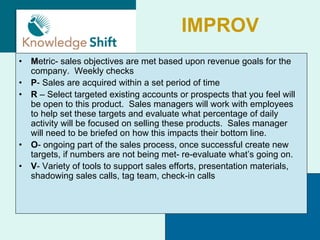
IMPROV
•   Metric- sales objectives are met based upon revenue goals for the
    company. Weekly checks
•   P- Sales are acquired within a set period of time
•   R – Select targeted existing accounts or prospects that you feel will
    be open to this product. Sales managers will work with employees
    to help set these targets and evaluate what percentage of daily
    activity will be focused on selling these products. Sales manager
    will need to be briefed on how this impacts their bottom line.
•   O- ongoing part of the sales process, once successful create new
    targets, if numbers are not being met- re-evaluate what’s going on.
•   V- Variety of tools to support sales efforts, presentation materials,
    shadowing sales calls, tag team, check-in calls
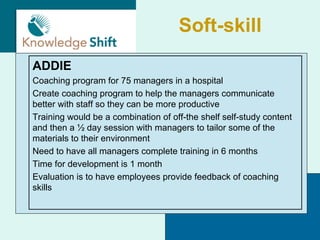
Soft-skill
ADDIE
Coaching program for 75 managers in a hospital
Create coaching program to help the managers communicate
better with staff so they can be more productive
Training would be a combination of off-the shelf self-study content
and then a ½ day session with managers to tailor some of the
materials to their environment
Need to have all managers complete training in 6 months
Time for development is 1 month
Evaluation is to have employees provide feedback of coaching
skills
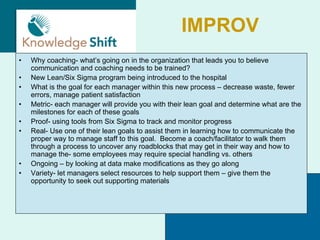
IMPROV
•   Why coaching- what’s going on in the organization that leads you to believe
    communication and coaching needs to be trained?
•   New Lean/Six Sigma program being introduced to the hospital
•   What is the goal for each manager within this new process – decrease waste, fewer
    errors, manage patient satisfaction
•   Metric- each manager will provide you with their lean goal and determine what are the
    milestones for each of these goals
•   Proof- using tools from Six Sigma to track and monitor progress
•   Real- Use one of their lean goals to assist them in learning how to communicate the
    proper way to manage staff to this goal. Become a coach/facilitator to walk them
    through a process to uncover any roadblocks that may get in their way and how to
    manage the- some employees may require special handling vs. others
•   Ongoing – by looking at data make modifications as they go along
•   Variety- let managers select resources to help support them – give them the
    opportunity to seek out supporting materials
Pro vs. Con
• Two team
  – One group for Improv
  – One group for ADDIE

• 5 Minutes – 5 reasons for your
  argument
How to Start
•   Pick one topic you are familiar with
•   What is your metric
•   What would a final test be– realistic
•   Where are the materials – SMEs, templates, videos,
    PowerPoint
•   Work with SME or other stake-holder for quick turn-
    around –be open to non-traditional approach
•   Make sure content aligns to metric
•   Deliver
•   Loop back- use feedback (audience or metrics) to
    continue to modify
Books

•“Group Genius” by Keith Sawyer
•“Truth in Comedy” by Kim Johnson, Del Close and Charna Halpern
•“58 ½ ways to Improvise in Training” Paul Z. Jackson
•“Impro: Improvisation and the Theatre” by Keith Johnstone
•“Free Play, Improvisation in Life and Art” by Stephen
Nachmoanovitch
•“Improvise: Scene from the Inside Out” by Mick Napier
•“Impro Learning: How to Make Training Creative, Flexible and
Spontaneous” by Paul Z. Jackson
•“Playfair: Everybody's Guide To Non-Competitive Play” Matt
Weinstein
Web sites
                            Websites
                  4-Door Learning @ Moodle
                http://4d-elearning.com/login/index.php

                        Thiagi’s Website
                        www.thiagi.com

                 AIN (Applied Improv Network)
                    http://appliedimprov.ning.com/

                     Paul Jackson Associates
                         http://www.impro.org.uk
                          Articulate Blog
http://www.articulate.com/rapid-elearning/is-google-making-our-e-
                         learning-stupid/
YouTube

Thiagi - UMBC Training Forum: Rapid Instructional Design with Thiagi
             http://www.youtube.com/watch?v=CYqm8ao1i2c


              Dr. David Merrill on Instructional Design

           http://www.youtube.com/watch?v=i_TKaO2-jXA
Contact Info


   Nancy Munro, CEO
nancy@knowledgeshift.net
     630-221-8759
 www.knowledgeshift.net

CETS2010, Nancy Munro & Allison Black, From Addie to Improv

  • 1.
    From ADDIE to Improv Nancy Munro & Allison Black
  • 2.
    Problem to Solve ROI Institute – CEO’s don’t see the connection to training 6% see connection of training to business outcomes 94% want to see the connection but don’t feel they are getting it. “In the traditional ADDIE model dispprortionate amount of time spent on Analysis vs. Evaluation”
  • 3.
    Why? • Time • Money • Culture • Access to content • Attention Spans • Measurements
  • 4.
    Improv + • Correlation • Games/Methods – Acceleration of ideas to – Yes, and action – Ad Game – Listening skills – One Word Sentence – Active vs. passive – Show and Tell – Collaboration – Working with unknowns
  • 5.
    Begin w/ End •Assess your current training projects to determine which ones you can re-design w/ new method • Understand the underlying principals of how to facilitate training in a new way • Decrease your production time • Build methods to modify and update content rapidly • Re-establish training effectiveness metrics
  • 6.
    Improv vs. ADDIE ADDIE Improv Analysis Impact Develop Metrics Design Proof Implement Evaluation Real-world On-going Variety
  • 8.
  • 9.
    Making a Sandwich ADDIE • Goals – teach the person how to properly make a peanut butter and jelly sandwich • Analysis- This will be for 200 adults in various locations – reading level 6 grade with no physical disability. The desired outcome is an edible sandwich using the proper ingredients. Language English • Design- Online web asynchronous ½ hour seat time to complete. Designer will provide the content. Outline will be done in PowerPoint • Development – Estimated time to develop 1 week using Articulate or Captivate • Implementation – Upload to LMS, send email to all students and require that they complete this in 1 week of email notification. • Evaluation – Test at the end to measure that they understand how to properly make a sandwich.
  • 10.
    IMPROV • I – If the sandwich is made well, the employee will be well nourished in order to be more productive. The process in which they use to make the sandwich should minimize waste of the materials used to make the sandwich which will save money. • M – The student will demonstrate that they made an edible sandwich with the proper amount of ingredients used within a week of being asked to learn this task. • P- Proof –Bring a sandwich to work and select a co-worker or supervisor to consume the sandwich. The selected individual will complete an evaluation form to judge how well they completed this task. • R- Use real ingredients, hands-on activity • O- ongoing – updates – changes in diet, variety of ingredients strawberry – grape—gooseberry jam • V – choose how they want to learn this information- have the students select a variety of resources to learn this on their own, write 5 test questions before completing starting the task.
  • 11.
    Doing Laundry ADDIE Goals –teach the person how to properly sort, wash and dry a load of laundry • Analysis- This will be for 60 adults working 3 different shifts in one facility – reading level 6 grade with no physical disability. The desired outcome is the ability to properly understand how to sort wash and dry a load of laundry. Language English • Design- Online web asynchronous 1 hour seat time to complete. Designer will provide the content. Outline will be done in PowerPoint • Development – Estimated time to develop 1week using Articulate or Captivate • Implementation – Upload to LMS, send email to all students and require that they complete this in 1 week of email notification. • Evaluation – Test at the end to measure that they understand how to sort laundry by color, decide proper settings on machine, can transfer wet clothes into the dryer and select proper settings for dryer.
  • 12.
    IMPROV I – Clothesmay not be useful or wearable if done improperly, can re-use their wardrobe by properly laundering clothes saves money from having to purchase new clothing. By teaching the proper use of the equipment, minimizes maintenance costs with equipment M – The student can demonstrate that they have successfully washed and dried a load of laundry that allows them to wear all items that were washed and that the equipment was left in good condition when finished. P- Proof –Provide a finished load either in person or via photograph that this task has been completed within one week. R- Really complete load of laundry O- ongoing – updates if they change the machine or buy new clothes V – choose how they want to learn this information- ask students to first research how to do laundry and allow them select the resources – require them to write 5 test questions on how to do laundry
  • 13.
    Restructure • Sales • Software application • Compliance • Soft-skill- leadership, coaching communication
  • 14.
    Sales ADDIE Improv •200 sales people needed to learn a new What percentage of expected revenue will financial services product the product cover? •Classroom instruction with 20 people in What is the selling goal for each sales each class 1 day of training person? •Use SME on the product info for What happens to the employee if they technical information, features benefits, don’t meet this part of their goal? how to handle objections How will that sales manager help them •Take 2 weeks to build content working meet this goal? with SME What is the expected time line for revenue •Total delivery window 3 months. to hit the bottom line from this product? •Evaluation- test at the end of class and post class evaluation form
  • 15.
    IMPROV • Metric- sales objectives are met based upon revenue goals for the company. Weekly checks • P- Sales are acquired within a set period of time • R – Select targeted existing accounts or prospects that you feel will be open to this product. Sales managers will work with employees to help set these targets and evaluate what percentage of daily activity will be focused on selling these products. Sales manager will need to be briefed on how this impacts their bottom line. • O- ongoing part of the sales process, once successful create new targets, if numbers are not being met- re-evaluate what’s going on. • V- Variety of tools to support sales efforts, presentation materials, shadowing sales calls, tag team, check-in calls
  • 16.
    Soft-skill ADDIE Coaching program for75 managers in a hospital Create coaching program to help the managers communicate better with staff so they can be more productive Training would be a combination of off-the shelf self-study content and then a ½ day session with managers to tailor some of the materials to their environment Need to have all managers complete training in 6 months Time for development is 1 month Evaluation is to have employees provide feedback of coaching skills
  • 17.
    IMPROV • Why coaching- what’s going on in the organization that leads you to believe communication and coaching needs to be trained? • New Lean/Six Sigma program being introduced to the hospital • What is the goal for each manager within this new process – decrease waste, fewer errors, manage patient satisfaction • Metric- each manager will provide you with their lean goal and determine what are the milestones for each of these goals • Proof- using tools from Six Sigma to track and monitor progress • Real- Use one of their lean goals to assist them in learning how to communicate the proper way to manage staff to this goal. Become a coach/facilitator to walk them through a process to uncover any roadblocks that may get in their way and how to manage the- some employees may require special handling vs. others • Ongoing – by looking at data make modifications as they go along • Variety- let managers select resources to help support them – give them the opportunity to seek out supporting materials
  • 18.
    Pro vs. Con •Two team – One group for Improv – One group for ADDIE • 5 Minutes – 5 reasons for your argument
  • 19.
    How to Start • Pick one topic you are familiar with • What is your metric • What would a final test be– realistic • Where are the materials – SMEs, templates, videos, PowerPoint • Work with SME or other stake-holder for quick turn- around –be open to non-traditional approach • Make sure content aligns to metric • Deliver • Loop back- use feedback (audience or metrics) to continue to modify
  • 20.
    Books •“Group Genius” byKeith Sawyer •“Truth in Comedy” by Kim Johnson, Del Close and Charna Halpern •“58 ½ ways to Improvise in Training” Paul Z. Jackson •“Impro: Improvisation and the Theatre” by Keith Johnstone •“Free Play, Improvisation in Life and Art” by Stephen Nachmoanovitch •“Improvise: Scene from the Inside Out” by Mick Napier •“Impro Learning: How to Make Training Creative, Flexible and Spontaneous” by Paul Z. Jackson •“Playfair: Everybody's Guide To Non-Competitive Play” Matt Weinstein
  • 21.
    Web sites Websites 4-Door Learning @ Moodle http://4d-elearning.com/login/index.php Thiagi’s Website www.thiagi.com AIN (Applied Improv Network) http://appliedimprov.ning.com/ Paul Jackson Associates http://www.impro.org.uk Articulate Blog http://www.articulate.com/rapid-elearning/is-google-making-our-e- learning-stupid/
  • 22.
    YouTube Thiagi - UMBCTraining Forum: Rapid Instructional Design with Thiagi http://www.youtube.com/watch?v=CYqm8ao1i2c Dr. David Merrill on Instructional Design http://www.youtube.com/watch?v=i_TKaO2-jXA
  • 23.
    Contact Info Nancy Munro, CEO nancy@knowledgeshift.net 630-221-8759 www.knowledgeshift.net