Cervical Cancer Screening
Module III
Techniques of Screening
Screening Guidelines
Special Screening Situations
Cervical Cancer Screening
Techniques of Screening
Physical Exam
Visual Inspection with Acetic Acid
Pap Smear
HPV Testing

Cervical Biopsies
Module III
Techniques of Screening
Physical Exam
1. Visually examine the vulva and perianal region

2. Insert the speculum into the vagina
3. Visually examine the cervix and the walls of the
vagina
4. Palpate the cervix and the walls of the vagina.
5. Palpate the parametria and uterosacral ligaments by
rectovaginal exam
Module III
Techniques of Screening
Visual Inspection with Acetic Acid
With the speculum in the vagina and the
cervix visualized, apply 3% acetic acid using
a sponge (ALERT: confirm that the acetic
acid has been diluted. 100% acetic acid
will cause third degree burns)
Wait 60 seconds and then visually examine .
Dysplastic lesions are nuclear dense. The
dehydration of the mucous membrane will
temporarily cause dysplastic lesions to look
white
Module III
Visual Inspection
Author, year of
publication, country of
study

No. of participants

Sensitivity, % (95%
CI)

Specificity, % (95%
CI)

University of
Zimbabwe/JHPIEGO [5],
1999, Zimbabwe

2148

77 (70–82)

64 (61–66)

Denny et al. 2000, South
Africa

2885

67 (56–77)

84 (82–85)

Belinson et al. [24],
2001, China

1997

71 (60–80)

74 (71–76)

Denny et al. [8], 2002,
a,c
South Africa

2754

70 (59–79)

79 (77–81)

Cronjé et al. [9], 2003,
South Africa

1093

79 (69–87)

49 (45–52)

54,981

79 (77–81)

86 (85–86)

Sankaranarayanan et al.
[25], 2004 India and
b,c
Africa

Sensitivity – 67-79% Specificity – 49-86%
Technique :Place Speculum
Apply 3-5% Acetic Acid
Wait at least 1 Minute; record Observations

Module III
Techniques of Screening
Pap Smear
With a spatula, rotate the spatula 360
degrees around the exocervix

With a cytobrush, place the brush within
the endocervix and rotate 360 degrees
Apply both the spatula and cytobrush to a
slide and then apply fixative
Or place spatula and cytobrush into liquid
based solution and break off the tips
Module III
SCREENING
 conventional cytologic sampling
 Thin layer (or liquid-based) cytology





ThinPrep (1996)
AutocytPrep (1999)
SurePath (2000)
MonoPrep (2006)

 liquid-based : other diagnostic assessments (only Thin

Prep is FDA approved )





testing for gonorrhea
chlamydia
HPV

Module III
Sources of potential error in the Pap smear
The clinician may not sample the area of cervical
abnormality.
The abnormal cells may not be plated on the slide or
transferred to the liquid medium.
The cells may not be adequately preserved with fixative.
The cytologist may inaccurately report the findings
The cytopathologist may not identify the abnormal cells.

Module III
Techniques of Screening
HPV Testing
HPV testing should be confined to testing
for high risk (oncogenic) subtypes
HPV testing for low risk (nonocogenic)
subtypes has NO role in the evaluation of
abnormal pap smears

Module III
HPV TESTING
p16 cytology
P16 cytology can be used as a triage test in HPV-positive
women.
P16 is a marker of HPV oncogene activity that is
independent of carcinogenic HPV tyoe
Carozzi . Lancet Oncol 2012
Of 1170 HPV positive women,493 (42%) overexpressed p16
at baseline
At baseline, 55 of these 493 women had CIN3 (9.7%)
Compared to p16 negative over expression, positive p16 had
a longitudinal sensitivity of 82.4%
Module III
Techniques of Screening
Colposcopy &Cervical Biopsies

Module III
Cervical Cancer Screening
Screening Guidelines
Screening Guidelines can be separated
into two sections
General guidelines for when to pap
smears and on whom
What follow up and intervention is
recommended based on pap sear results

Module III
Cervical Cancer Screening
Screening Guidelines
Guidelines are only for women at average risk for cervical cancer.
These guideline do not apply to women with:
history of cervical cancer
In Utero exposure to DES
who are immuno-compromised
organ transplantation,

chronic steroid use,
chemotherapy

HIV positive
Module III
Screening Guidelines
When to perform pap smear
Do not screen before age 21 years

Screening should start at age 21
Screening guidelines are age dependent

Annual pap smears in women without a history of
premalignant or malignant lower genital disease are no
longer recommended
Recommended Screening practices should not change
on the basis of HPV vaccination status
Module III
PREVALENCE OF CIN 3 OR GREATER BY AGE
MOORE 2008

CIN3 OR
GREATER

LESS THAN CIN 3

TOTAL

<50 YEARS

189 (71%)

77 (29%)

266

>50 YEARS

51 (59%)

35 (41%)

86

TOTAL

240

112

352

Patients older

than 50 had

Signif higher

Prevalence CIN3

Module III
Vaccination Against HPV
Recommend routine HPV vaccination for females aged
11 to 12 years
Recommend routine vaccination for females aged 13 to
18 years to “catch-up” those who missed earlier
screening
Insufficient data to recommend for or against universal
vaccination of females aged 19 to 26 years

Module III
Screening Guidelines
When to perform pap smear
Ages 21- 29 years: PAP SMEAR screening every three
years
No screening HPV testing
HPV testing only for evaluation of atypical squamous
cells of uncertain significance

Module III
Screening Guidelines
When to perform pap smear
Ages 30 – 65 years:
screening with both PAP SMEAR and HPV testing
every five years (preferred)
Or PAP SMEAR testing every three years (accepted)

Module III
Screening Guidelines
When to perform PAP SMEAR
Ages greater than 65: No Further Pap Smear Testing
who have had > 3 consecutive normal pap tests
or > 2 consecutive negative HPV tests and pap tests in
last 10 years with the most recent pap occurring within
the last 5 years
or women who have had hysterectomies for benign
disease

Module III
Cervical Cancer Screening
Screening Guidelines
In 2012 the American Society for
Colposcopy and Cervical Pathology
(ASCCP) published new guidelines for
management of pap smear results
Guidelines should never replace clinical
judgment
Module III
ASCCP Guidelines
Guidelines for management of abnormal pap smears
are different by the following age categories:
Ages 21- 24
Ages over 30

Guidelines for management of abnormal pap smears
are different for the pregnant woman (see screening:
special situations)

Module III
ASCCP Guidelines
Unsatisfactory Cytology
Repeat pap smear after 2 to 4 months

Refer to colposcopy for persistently unsatisfactory pap
smears
http://www.asccp.org/Portals/9/docs/Algorithms%207.30.1
3.pdf (Page 4)
ASCCP Guidelines
Absent Endocervical Cells
For ages 21-29: perform routine screening

For ages > 30 : HPV testing
http://www.asccp.org/Portals/9/docs/Algorithms%207.30
.13.pdf (Page 5)
ASCCP Guidelines
Age > 30: Cytology Negative & HPV positive
For HPV 16 and 18: colposcopy

Repeat co-testing in one year is acceptable
http://www.asccp.org/Portals/9/docs/Algorithms%207.30
.13.pdf (Page 6)
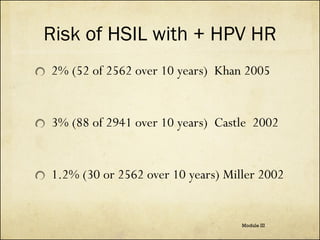
Risk of HSIL with + HPV HR
2% (52 of 2562 over 10 years) Khan 2005

3% (88 of 2941 over 10 years) Castle 2002

1.2% (30 or 2562 over 10 years) Miller 2002

Module III
ASCCP Guidelines
ASC - US
Repeat pap smear in one year, if ASC-US again: refer
to colposcopy
OR
Upfront HPV testing, if HPV positive: refer to
colposcopy
http://www.asccp.org/Portals/9/docs/Algorithms%207.30
.13.pdf (Page 7)
ASCCP Guidelines
Ages 21-24 – ASC-US or LSIL
HPV testing:
If HPV negative: return to routine testing
If HPV positive: repeat pap smear in one year
http://www.asccp.org/Portals/9/docs/Algorithms%207.30.
13.pdf (Page 8)
ASCCP Guidelines
ASC-US ages 21-24
Initial Management
Cytology alone in 12 months is preferred

Reflex HPV testing acceptable
If HPV positive, repeat cytology one year

If HPV negative, return to routine screening with
cytology alone in three years

Module III
ASCCP Guidelines
LSIL

If LSIl and HPV negative, repeat pap smear in one year

If LSIL and HPV positive: refer to colposcopy
http://www.asccp.org/Portals/9/docs/Algorithms%207.30.13.p
df (Page 9)
ASCCP Guidelines
ASC-H
Refer all ASC-H to colposcopy
http://www.asccp.org/Portals/9/docs/Algorithms%207.30.13.p
df (Page 11)
ASCCP Guidelines
Ages 21-24 -ASC-H
If colposcopy is negative, repeat pap smear and
colposcopy every six months for two years
If HSIL is found, acceptable to monitor for one year. If
lesion is persistent for one year, treat with excision
http://www.asccp.org/Portals/9/docs/Algorithms%207.30.13.p
df (Page 12)
ASCCP Guidelines
HSIL
Immediate LEEP or colposcopy
http://www.asccp.org/Portals/9/docs/Algorithms%207.30.13.p
df (Page 13)
ASCCP Guidelines
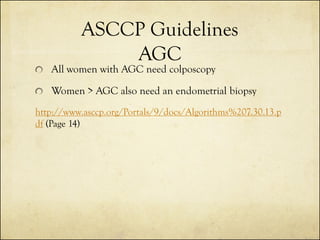
AGC

All women with AGC need colposcopy

Women > AGC also need an endometrial biopsy
http://www.asccp.org/Portals/9/docs/Algorithms%207.30.13.p
df (Page 14)
ASCCP
Subsequent management of AGC after
colposcopy
For CIN 2 but no glandular lesion, manage per
ASCCP guideline

For negative biopsies, repeat pap and HPV testing
yearly for two years
For preinvasive glandular lesion, treat by excisional
biopsy
http://www.asccp.org/Portals/9/docs/Algorithms%207.30.13.p
df (Page 15)
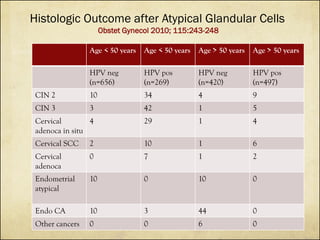
Histologic Outcome after Atypical Glandular Cells
Obstet Gynecol 2010; 115:243-248

Age < 50 years

Age < 50 years

Age > 50 years

Age > 50 years

HPV neg
(n=656)

HPV pos
(n=269)

HPV neg
(n=420)

HPV pos
(n=497)

CIN 2

10

34

4

9

CIN 3

3

42

1

5

Cervical
4
adenoca in situ

29

1

4

Cervical SCC

2

10

1

6

Cervical
adenoca

0

7

1

2

Endometrial
atypical

10

0

10

0

Endo CA

10

3

44

0

Other cancers

0

0

6

0
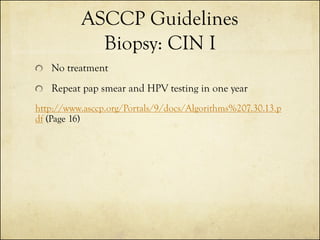
ASCCP Guidelines
Biopsy: CIN I
No treatment

Repeat pap smear and HPV testing in one year
http://www.asccp.org/Portals/9/docs/Algorithms%207.30.13.p
df (Page 16)
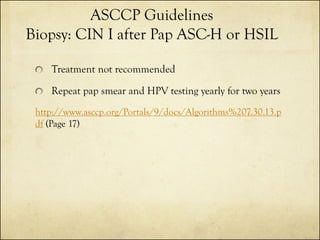
ASCCP Guidelines
Biopsy: CIN I after Pap ASC-H or HSIL
Treatment not recommended

Repeat pap smear and HPV testing yearly for two years
http://www.asccp.org/Portals/9/docs/Algorithms%207.30.13.p
df (Page 17)
ASCCP Guidelines
Ages 21-24 – Biopsy CIN I
Treatment not recommended

After ASC-US or LSIL pap: Repeat pap smear
After ASC-H or HSIL pap: repeat pap smear and
colposcopy every six months for one year
If colposcopy is inadequate: excisional procedure
http://www.asccp.org/Portals/9/docs/Algorithms%207.30.13.p
df (Page 18)
ASCCP Guidelines
Biopsy: CIN 2-3
Recommend excisional procedure
http://www.asccp.org/Portals/9/docs/Algorithms%207.30.13.p
df (Page 19)
ASCCP Guidelines
Young women, Biopsy: CIN 2-3
Excisional procedure
OR
Pap smear and colposcopy every six months for one
year
http://www.asccp.org/Portals/9/docs/Algorithms%207.30.13.p
df (Page 20)
ASCCP Guidelines
Biopsy: AIS
Excisional procedure
Hysterectomy is preferred treatment
http://www.asccp.org/Portals/9/docs/Algorithms%207.30.13.p
df (Page 21)
Cervical Cancer Screening
Special Screening Situations
Immunosuppression

Pregnancy
After Hysterectomy
After Treatment for Cervical Cancer
After Pelvic Radiation
Challenging Anatomy

History of Sexual Assault
In Utero DES (diethylstilbestrol) exposure
Module III
Special Screening Situations
Immunosuppression
Human Immunodeficiency Virus
Organ Transplant
Chronic Steroid Use

Module III
Immunosuppression
Human Immunodeficiency Virus
Women with HIV infection are at high risk
for preinvasive lower genital tract disease
and cervical cancer
They are high risk for persistent HPV
infections
They should be screened by PAP SMEAR
twice in the first year and then yearly
thereafter
Module III
Immunosuppression
Organ Transplant
Women who are on high dose
immunosuppressants are at high risk for
lower genital tract neoplasia

They should be screened by PAP SMEAR
twice in the first year and then yearly
thereafter
Module III
Immunosuppression
Chronic Steroid Use
Chronic steroid use can lead to a
reduction in the clearance of HPV
infection

They should be screened by PAP SMEAR
twice in the first year and then yearly
thereafter
Module III
Special Screening Situations
Pregnancy
Pap smear is performed at first prenatal
visit and at the six week post partum visit
Abnormal Pap smears are evaluated in a
similar manner to non-pregnant women

Module III
Special Screening Situations
Pregnancy: ASC-US pap
Identical to non-pregnant women

It is acceptable to defer colposcopy until 6
weeks postpartum
Endocervical curettage is unacceptable
For pregnant women with no cytologic,
colposcopic , or histologic findings of CIN,
postpartum follow-up is recommended
Module III
ASCCP Guidelines
Pregnant with LSIL
Colposcopy in pregnancy
Treatment of all preinvasive lesions delayed until after
delivery
http://www.asccp.org/Portals/9/docs/Algorithms%207.30.13.p
df (Page 10)
Special Screening Situations
After Hysterectomy
Cervical cancer screening is not indicated if
removal of cervix or entire uterus in women
with no history of cervical cancer or
preinvasive disease.

Women who have undergone a subtotal
hysterectomy with preservation of the cervix
should follow screening recommendations
of average risk women
Module III
Special Screening Situations
After Treatment for Cervical Cancer
No age cut off for stopping screening

Women should undergo pap smears every 3 to 4
months for the first two years after treatment for
cervical cancer.
Pap smear screening is performed every 6
months from years 2 to 5 after treatment
Annual pap smear screening five years after
treatment
Module III
Special Screening Situations
After Pelvic Radiation
There is a higher risk of radiation induced
malignancies after pelvic radiation.
Annual pap smear screening should be
performed in women who receive pelvic
radiation for all cancer types (lymphoma,
cervical cancer, endometrial cancer, rectal
and anal cancer)
Module III
Special Screening Situations
Challenging Anatomy
Vaginismus

Vaginal Atrophy
Pelvic Floor Prolapse

Vaginal Agglutination
Cervical Stenosis

Obesity
Module III
Challenging Anatomy
Vaginismus
Vaginismus is the painful and
involuntary contraction of vaginal
muscles
Causes: sexual assault, vulvar vestibulitis,
inflammatory conditions of the pelvic
floor such as diverticulitis

Adequate pelvic examination and pap
smear may require an examination under
anesthesia
Module III
Challenging Anatomy
Vaginal Atrophy
Consideration should be given to a short
course of estrogen vaginal cream prior to
performing a pap smear

Module III
Challenging Anatomy
Pelvic Floor Prolapse
Uterine prolapse can place the cervix at
the introitus leading to trauma and
cornification of the cervix

Module III
Challenging Anatomy
Vaginal Agglutination
Vaginal agglutination can occur after
radiation, trauma, surgery, and infection
Evaluation by examination under
anesthesia should be considered
Use of vaginal dilators and estrogen
vaginal cream should be considered
Module III
Challenging Anatomy
Cervical Stenosis
Cervical stenosis is defined as the inability
to place a cutip or cytobrush within the
endocervix
There is increased risk of a false negative
pap smear
Recommendation:
Dilation of cervix
In a postmenopausal woman, consideration
of a transvaginal ultrasound to evaluate the
endometrial cavity for fluid
Module III
Challenging Anatomy
Obesity
Obesity can in some women lead to
difficulty examining the cervix due to
discomfort, vaginal wall redundancy, or
increased vaginal length.

Sensitive use of larger speculums and
retraction of the labia by an assistant can be
helpful in optimally postioning the
speculum to visualize the cervix
Module III
Special Screening Situations
History of Sexual Assault
Women who have survived the trauma of sexual
assault should be screened for sexually
transmitted disease including HIV testing.
For women who are older than age 30, high risk
HPV testing should be offered.
Consideration should be given for a pap smear
regardless of the timing of their previous pap
smear test within six months of sexual assault for
women older than age 21 years.
Module III
Special Screening Situations
In Utero DES (diethylstilbestrol) exposure
The cohort of women exposed to
Utero DES were born before 1980.

In-

They have a twofold increased risk of
cervical dysplasia
Based on clinician judgment, they should be
screened at least every three years if they
have had three consecutive normal pap
smears
Module III
CERVICAL CANCER
SCREENING
MODULE III
CONCLUSIONS

-This module summarizes the screening recommendations
for the average risk patient.
-The full algorithms can be reviewed on the asccp website:
http://www.asccp.org/Guidelines
-Providers must be cognizant of special screening situations
and tailor evaluation to each patient, their particular
anatomy, and their particular risk factors.

Cervical cancer screening module 3

  • 1.
    Cervical Cancer Screening ModuleIII Techniques of Screening Screening Guidelines Special Screening Situations
  • 2.
    Cervical Cancer Screening Techniquesof Screening Physical Exam Visual Inspection with Acetic Acid Pap Smear HPV Testing Cervical Biopsies Module III
  • 3.
    Techniques of Screening PhysicalExam 1. Visually examine the vulva and perianal region 2. Insert the speculum into the vagina 3. Visually examine the cervix and the walls of the vagina 4. Palpate the cervix and the walls of the vagina. 5. Palpate the parametria and uterosacral ligaments by rectovaginal exam Module III
  • 4.
    Techniques of Screening VisualInspection with Acetic Acid With the speculum in the vagina and the cervix visualized, apply 3% acetic acid using a sponge (ALERT: confirm that the acetic acid has been diluted. 100% acetic acid will cause third degree burns) Wait 60 seconds and then visually examine . Dysplastic lesions are nuclear dense. The dehydration of the mucous membrane will temporarily cause dysplastic lesions to look white Module III
  • 5.
    Visual Inspection Author, yearof publication, country of study No. of participants Sensitivity, % (95% CI) Specificity, % (95% CI) University of Zimbabwe/JHPIEGO [5], 1999, Zimbabwe 2148 77 (70–82) 64 (61–66) Denny et al. 2000, South Africa 2885 67 (56–77) 84 (82–85) Belinson et al. [24], 2001, China 1997 71 (60–80) 74 (71–76) Denny et al. [8], 2002, a,c South Africa 2754 70 (59–79) 79 (77–81) Cronjé et al. [9], 2003, South Africa 1093 79 (69–87) 49 (45–52) 54,981 79 (77–81) 86 (85–86) Sankaranarayanan et al. [25], 2004 India and b,c Africa Sensitivity – 67-79% Specificity – 49-86% Technique :Place Speculum Apply 3-5% Acetic Acid Wait at least 1 Minute; record Observations Module III
  • 6.
    Techniques of Screening PapSmear With a spatula, rotate the spatula 360 degrees around the exocervix With a cytobrush, place the brush within the endocervix and rotate 360 degrees Apply both the spatula and cytobrush to a slide and then apply fixative Or place spatula and cytobrush into liquid based solution and break off the tips Module III
  • 7.
    SCREENING  conventional cytologicsampling  Thin layer (or liquid-based) cytology     ThinPrep (1996) AutocytPrep (1999) SurePath (2000) MonoPrep (2006)  liquid-based : other diagnostic assessments (only Thin Prep is FDA approved )    testing for gonorrhea chlamydia HPV Module III
  • 8.
    Sources of potentialerror in the Pap smear The clinician may not sample the area of cervical abnormality. The abnormal cells may not be plated on the slide or transferred to the liquid medium. The cells may not be adequately preserved with fixative. The cytologist may inaccurately report the findings The cytopathologist may not identify the abnormal cells. Module III
  • 9.
    Techniques of Screening HPVTesting HPV testing should be confined to testing for high risk (oncogenic) subtypes HPV testing for low risk (nonocogenic) subtypes has NO role in the evaluation of abnormal pap smears Module III
  • 10.
    HPV TESTING p16 cytology P16cytology can be used as a triage test in HPV-positive women. P16 is a marker of HPV oncogene activity that is independent of carcinogenic HPV tyoe Carozzi . Lancet Oncol 2012 Of 1170 HPV positive women,493 (42%) overexpressed p16 at baseline At baseline, 55 of these 493 women had CIN3 (9.7%) Compared to p16 negative over expression, positive p16 had a longitudinal sensitivity of 82.4% Module III
  • 11.
    Techniques of Screening Colposcopy&Cervical Biopsies Module III
  • 12.
    Cervical Cancer Screening ScreeningGuidelines Screening Guidelines can be separated into two sections General guidelines for when to pap smears and on whom What follow up and intervention is recommended based on pap sear results Module III
  • 13.
    Cervical Cancer Screening ScreeningGuidelines Guidelines are only for women at average risk for cervical cancer. These guideline do not apply to women with: history of cervical cancer In Utero exposure to DES who are immuno-compromised organ transplantation, chronic steroid use, chemotherapy HIV positive Module III
  • 14.
    Screening Guidelines When toperform pap smear Do not screen before age 21 years Screening should start at age 21 Screening guidelines are age dependent Annual pap smears in women without a history of premalignant or malignant lower genital disease are no longer recommended Recommended Screening practices should not change on the basis of HPV vaccination status Module III
  • 15.
    PREVALENCE OF CIN3 OR GREATER BY AGE MOORE 2008 CIN3 OR GREATER LESS THAN CIN 3 TOTAL <50 YEARS 189 (71%) 77 (29%) 266 >50 YEARS 51 (59%) 35 (41%) 86 TOTAL 240 112 352 Patients older than 50 had Signif higher Prevalence CIN3 Module III
  • 16.
    Vaccination Against HPV Recommendroutine HPV vaccination for females aged 11 to 12 years Recommend routine vaccination for females aged 13 to 18 years to “catch-up” those who missed earlier screening Insufficient data to recommend for or against universal vaccination of females aged 19 to 26 years Module III
  • 17.
    Screening Guidelines When toperform pap smear Ages 21- 29 years: PAP SMEAR screening every three years No screening HPV testing HPV testing only for evaluation of atypical squamous cells of uncertain significance Module III
  • 18.
    Screening Guidelines When toperform pap smear Ages 30 – 65 years: screening with both PAP SMEAR and HPV testing every five years (preferred) Or PAP SMEAR testing every three years (accepted) Module III
  • 19.
    Screening Guidelines When toperform PAP SMEAR Ages greater than 65: No Further Pap Smear Testing who have had > 3 consecutive normal pap tests or > 2 consecutive negative HPV tests and pap tests in last 10 years with the most recent pap occurring within the last 5 years or women who have had hysterectomies for benign disease Module III
  • 20.
    Cervical Cancer Screening ScreeningGuidelines In 2012 the American Society for Colposcopy and Cervical Pathology (ASCCP) published new guidelines for management of pap smear results Guidelines should never replace clinical judgment Module III
  • 21.
    ASCCP Guidelines Guidelines formanagement of abnormal pap smears are different by the following age categories: Ages 21- 24 Ages over 30 Guidelines for management of abnormal pap smears are different for the pregnant woman (see screening: special situations) Module III
  • 22.
    ASCCP Guidelines Unsatisfactory Cytology Repeatpap smear after 2 to 4 months Refer to colposcopy for persistently unsatisfactory pap smears http://www.asccp.org/Portals/9/docs/Algorithms%207.30.1 3.pdf (Page 4)
  • 23.
    ASCCP Guidelines Absent EndocervicalCells For ages 21-29: perform routine screening For ages > 30 : HPV testing http://www.asccp.org/Portals/9/docs/Algorithms%207.30 .13.pdf (Page 5)
  • 24.
    ASCCP Guidelines Age >30: Cytology Negative & HPV positive For HPV 16 and 18: colposcopy Repeat co-testing in one year is acceptable http://www.asccp.org/Portals/9/docs/Algorithms%207.30 .13.pdf (Page 6)
  • 25.
    Risk of HSILwith + HPV HR 2% (52 of 2562 over 10 years) Khan 2005 3% (88 of 2941 over 10 years) Castle 2002 1.2% (30 or 2562 over 10 years) Miller 2002 Module III
  • 26.
    ASCCP Guidelines ASC -US Repeat pap smear in one year, if ASC-US again: refer to colposcopy OR Upfront HPV testing, if HPV positive: refer to colposcopy http://www.asccp.org/Portals/9/docs/Algorithms%207.30 .13.pdf (Page 7)
  • 27.
    ASCCP Guidelines Ages 21-24– ASC-US or LSIL HPV testing: If HPV negative: return to routine testing If HPV positive: repeat pap smear in one year http://www.asccp.org/Portals/9/docs/Algorithms%207.30. 13.pdf (Page 8)
  • 28.
    ASCCP Guidelines ASC-US ages21-24 Initial Management Cytology alone in 12 months is preferred Reflex HPV testing acceptable If HPV positive, repeat cytology one year If HPV negative, return to routine screening with cytology alone in three years Module III
  • 29.
    ASCCP Guidelines LSIL If LSIland HPV negative, repeat pap smear in one year If LSIL and HPV positive: refer to colposcopy http://www.asccp.org/Portals/9/docs/Algorithms%207.30.13.p df (Page 9)
  • 30.
    ASCCP Guidelines ASC-H Refer allASC-H to colposcopy http://www.asccp.org/Portals/9/docs/Algorithms%207.30.13.p df (Page 11)
  • 31.
    ASCCP Guidelines Ages 21-24-ASC-H If colposcopy is negative, repeat pap smear and colposcopy every six months for two years If HSIL is found, acceptable to monitor for one year. If lesion is persistent for one year, treat with excision http://www.asccp.org/Portals/9/docs/Algorithms%207.30.13.p df (Page 12)
  • 32.
    ASCCP Guidelines HSIL Immediate LEEPor colposcopy http://www.asccp.org/Portals/9/docs/Algorithms%207.30.13.p df (Page 13)
  • 33.
    ASCCP Guidelines AGC All womenwith AGC need colposcopy Women > AGC also need an endometrial biopsy http://www.asccp.org/Portals/9/docs/Algorithms%207.30.13.p df (Page 14)
  • 34.
    ASCCP Subsequent management ofAGC after colposcopy For CIN 2 but no glandular lesion, manage per ASCCP guideline For negative biopsies, repeat pap and HPV testing yearly for two years For preinvasive glandular lesion, treat by excisional biopsy http://www.asccp.org/Portals/9/docs/Algorithms%207.30.13.p df (Page 15)
  • 35.
    Histologic Outcome afterAtypical Glandular Cells Obstet Gynecol 2010; 115:243-248 Age < 50 years Age < 50 years Age > 50 years Age > 50 years HPV neg (n=656) HPV pos (n=269) HPV neg (n=420) HPV pos (n=497) CIN 2 10 34 4 9 CIN 3 3 42 1 5 Cervical 4 adenoca in situ 29 1 4 Cervical SCC 2 10 1 6 Cervical adenoca 0 7 1 2 Endometrial atypical 10 0 10 0 Endo CA 10 3 44 0 Other cancers 0 0 6 0
  • 36.
    ASCCP Guidelines Biopsy: CINI No treatment Repeat pap smear and HPV testing in one year http://www.asccp.org/Portals/9/docs/Algorithms%207.30.13.p df (Page 16)
  • 37.
    ASCCP Guidelines Biopsy: CINI after Pap ASC-H or HSIL Treatment not recommended Repeat pap smear and HPV testing yearly for two years http://www.asccp.org/Portals/9/docs/Algorithms%207.30.13.p df (Page 17)
  • 38.
    ASCCP Guidelines Ages 21-24– Biopsy CIN I Treatment not recommended After ASC-US or LSIL pap: Repeat pap smear After ASC-H or HSIL pap: repeat pap smear and colposcopy every six months for one year If colposcopy is inadequate: excisional procedure http://www.asccp.org/Portals/9/docs/Algorithms%207.30.13.p df (Page 18)
  • 39.
    ASCCP Guidelines Biopsy: CIN2-3 Recommend excisional procedure http://www.asccp.org/Portals/9/docs/Algorithms%207.30.13.p df (Page 19)
  • 40.
    ASCCP Guidelines Young women,Biopsy: CIN 2-3 Excisional procedure OR Pap smear and colposcopy every six months for one year http://www.asccp.org/Portals/9/docs/Algorithms%207.30.13.p df (Page 20)
  • 41.
    ASCCP Guidelines Biopsy: AIS Excisionalprocedure Hysterectomy is preferred treatment http://www.asccp.org/Portals/9/docs/Algorithms%207.30.13.p df (Page 21)
  • 42.
    Cervical Cancer Screening SpecialScreening Situations Immunosuppression Pregnancy After Hysterectomy After Treatment for Cervical Cancer After Pelvic Radiation Challenging Anatomy History of Sexual Assault In Utero DES (diethylstilbestrol) exposure Module III
  • 43.
    Special Screening Situations Immunosuppression HumanImmunodeficiency Virus Organ Transplant Chronic Steroid Use Module III
  • 44.
    Immunosuppression Human Immunodeficiency Virus Womenwith HIV infection are at high risk for preinvasive lower genital tract disease and cervical cancer They are high risk for persistent HPV infections They should be screened by PAP SMEAR twice in the first year and then yearly thereafter Module III
  • 45.
    Immunosuppression Organ Transplant Women whoare on high dose immunosuppressants are at high risk for lower genital tract neoplasia They should be screened by PAP SMEAR twice in the first year and then yearly thereafter Module III
  • 46.
    Immunosuppression Chronic Steroid Use Chronicsteroid use can lead to a reduction in the clearance of HPV infection They should be screened by PAP SMEAR twice in the first year and then yearly thereafter Module III
  • 47.
    Special Screening Situations Pregnancy Papsmear is performed at first prenatal visit and at the six week post partum visit Abnormal Pap smears are evaluated in a similar manner to non-pregnant women Module III
  • 48.
    Special Screening Situations Pregnancy:ASC-US pap Identical to non-pregnant women It is acceptable to defer colposcopy until 6 weeks postpartum Endocervical curettage is unacceptable For pregnant women with no cytologic, colposcopic , or histologic findings of CIN, postpartum follow-up is recommended Module III
  • 49.
    ASCCP Guidelines Pregnant withLSIL Colposcopy in pregnancy Treatment of all preinvasive lesions delayed until after delivery http://www.asccp.org/Portals/9/docs/Algorithms%207.30.13.p df (Page 10)
  • 50.
    Special Screening Situations AfterHysterectomy Cervical cancer screening is not indicated if removal of cervix or entire uterus in women with no history of cervical cancer or preinvasive disease. Women who have undergone a subtotal hysterectomy with preservation of the cervix should follow screening recommendations of average risk women Module III
  • 51.
    Special Screening Situations AfterTreatment for Cervical Cancer No age cut off for stopping screening Women should undergo pap smears every 3 to 4 months for the first two years after treatment for cervical cancer. Pap smear screening is performed every 6 months from years 2 to 5 after treatment Annual pap smear screening five years after treatment Module III
  • 52.
    Special Screening Situations AfterPelvic Radiation There is a higher risk of radiation induced malignancies after pelvic radiation. Annual pap smear screening should be performed in women who receive pelvic radiation for all cancer types (lymphoma, cervical cancer, endometrial cancer, rectal and anal cancer) Module III
  • 53.
    Special Screening Situations ChallengingAnatomy Vaginismus Vaginal Atrophy Pelvic Floor Prolapse Vaginal Agglutination Cervical Stenosis Obesity Module III
  • 54.
    Challenging Anatomy Vaginismus Vaginismus isthe painful and involuntary contraction of vaginal muscles Causes: sexual assault, vulvar vestibulitis, inflammatory conditions of the pelvic floor such as diverticulitis Adequate pelvic examination and pap smear may require an examination under anesthesia Module III
  • 55.
    Challenging Anatomy Vaginal Atrophy Considerationshould be given to a short course of estrogen vaginal cream prior to performing a pap smear Module III
  • 56.
    Challenging Anatomy Pelvic FloorProlapse Uterine prolapse can place the cervix at the introitus leading to trauma and cornification of the cervix Module III
  • 57.
    Challenging Anatomy Vaginal Agglutination Vaginalagglutination can occur after radiation, trauma, surgery, and infection Evaluation by examination under anesthesia should be considered Use of vaginal dilators and estrogen vaginal cream should be considered Module III
  • 58.
    Challenging Anatomy Cervical Stenosis Cervicalstenosis is defined as the inability to place a cutip or cytobrush within the endocervix There is increased risk of a false negative pap smear Recommendation: Dilation of cervix In a postmenopausal woman, consideration of a transvaginal ultrasound to evaluate the endometrial cavity for fluid Module III
  • 59.
    Challenging Anatomy Obesity Obesity canin some women lead to difficulty examining the cervix due to discomfort, vaginal wall redundancy, or increased vaginal length. Sensitive use of larger speculums and retraction of the labia by an assistant can be helpful in optimally postioning the speculum to visualize the cervix Module III
  • 60.
    Special Screening Situations Historyof Sexual Assault Women who have survived the trauma of sexual assault should be screened for sexually transmitted disease including HIV testing. For women who are older than age 30, high risk HPV testing should be offered. Consideration should be given for a pap smear regardless of the timing of their previous pap smear test within six months of sexual assault for women older than age 21 years. Module III
  • 61.
    Special Screening Situations InUtero DES (diethylstilbestrol) exposure The cohort of women exposed to Utero DES were born before 1980. In- They have a twofold increased risk of cervical dysplasia Based on clinician judgment, they should be screened at least every three years if they have had three consecutive normal pap smears Module III
  • 62.
    CERVICAL CANCER SCREENING MODULE III CONCLUSIONS -Thismodule summarizes the screening recommendations for the average risk patient. -The full algorithms can be reviewed on the asccp website: http://www.asccp.org/Guidelines -Providers must be cognizant of special screening situations and tailor evaluation to each patient, their particular anatomy, and their particular risk factors.