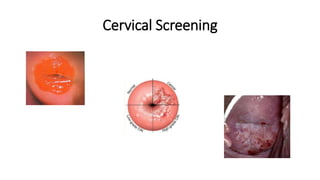

Cervical Screening
State of the Art 2016
Dr Dirk Grothuesmann
http://dg-maternalhealth.de/
Expected worldwide Cervical Cancer 2020
2002 2020 2020
(% Increase) (% Burden)
World 493.000* 702.500 100%
(+42%)
Less developed Areas 409.000 639.500 83%
(+56%)
More developed Areas 83.000 92.500 17%
(+11%)
Parkin and Bray, 2006
*530,000 cases in 2008; Arbyn M, et al
Cervical Screening
Champions of Prevention
Georgios Nikolaou
Papanikolaou *1883 –1962
Hans Hinselmann
*1884 - 1959
Harald zur Hausen
*1936 -
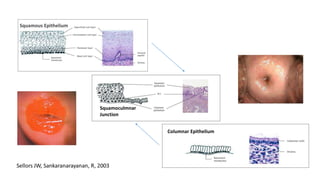
Squamoculmnar Junction
Squamoculmnar
Junction
Columnar Epithelium
Squamous Epithelium
Squamoculmnar Junction
Sellors and Sankaranarayanan, 2003
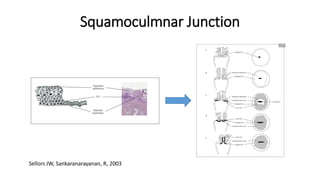
Squamoculmnar Junction
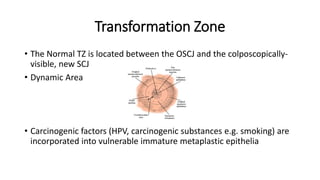
Transformation Zone
• The Normal TZ is located between the OSCJ and the colposcopically-
visible, new SCJ
• Dynamic Area
• Carcinogenic factors (HPV, carcinogenic substances e.g. smoking) are
incorporated into vulnerable immature metaplastic epithelia
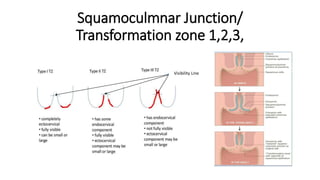
Squamoculmnar Junction/
Transformation zone 1,2,3,
Visibility Line
IFCPC, 2011
ASC-US Atypical squamous cells of
undetermined significance
ASC-H Atypical squamous cells –
cannot exclude HSIL
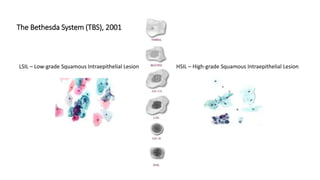
The Bethesda System (TBS), 2001
THE BETHESDA SYSTEM WEBSITE ATLAS, 2003
LSIL – Low-grade Squamous Intraepithelial Lesion HSIL – High-grade Squamous Intraepithelial Lesion
The Bethesda System (TBS), 2001
AGC-Atypical Glandular Cells
The Bethesda System (TBS), 2001
Terminology
Difference between the terms cervical intraepithelial lesion and squamous
intraepithelial lesion
• Squamous intraepithelial lesion (SIL) is used to describe Pap test result
• SIL is not a diagnosis of precancer or cancer
• A cervical biopsy is needed
• Cervical intraepithelial lesion (CIN) used to report cervical biopsy results
• CIN 1 is used for mild (low-grade) changes
• CIN 2 is used for moderate changes
• CIN 3 is used for more severe (high-grade) changes
Moderate and high-grade changes can progress to cancer
Different Types of abnormal Pap Test Results
• Atypical squamous cells of undetermined significance (ASC-US)— mostly a
sign of an HPV infection (most common abnormal test result)
• Low-grade squamous intraepithelial lesion (LSIL)—mildly
abnormal.Usually is caused by an HPV infection, goes away on its own.
• High-grade squamous intraepithelial lesion (HSIL)—more serious changes
in the cervix. More likely associated with precancer and cancer.
• Atypical squamous cells, cannot exclude HSIL (ASC-H)—changes that raise
concern for the presence of HSIL.
• Atypical glandular cells (AGC)—Glandular cells also are present inside the
uterus. Changes in glandular cells that raise concern for the presence of
precancer or cancer.
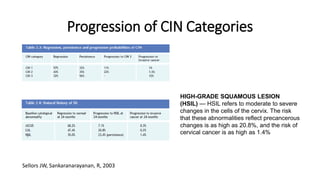
Progression of CIN Categories
HIGH-GRADE SQUAMOUS LESION
(HSIL) — HSIL refers to moderate to severe
changes in the cells of the cervix. The risk
that these abnormalities reflect precancerous
changes is as high as 20.8%, and the risk of
cervical cancer is as high as 1.4%
Sellors JW, Sankaranarayanan, R, 2003
What Testing is needed after an abnormal cervical
Cancer Screening Test
• Repeat Pap test or Co-Test (Pap test and a test for high-risk types of
HPV)—recommended as a follow-up to some abnormal test result
• HPV Test—presence of the HPV types linked to cervical cancer
• Colposcopy
• Biopsy
• Endocervical sampling
Adolescents Needs
• Care for contraception and STI screening/treatment
• NO Pap test
• No speculum examination for asymptomatic women
• STI Testing can be done using urine
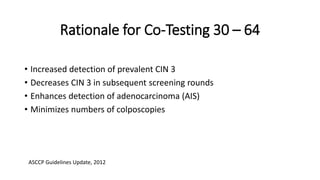
Rationale for Co-Testing 30 – 64
• Increased detection of prevalent CIN 3
• Decreases CIN 3 in subsequent screening rounds
• Enhances detection of adenocarcinoma (AIS)
• Minimizes numbers of colposcopies
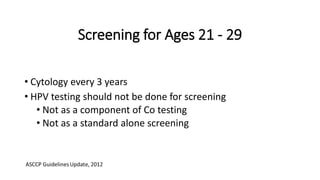
Screening for Ages 21 - 29
• Cytology every 3 years
• HPV testing should not be done for screening
• Not as a component of Co testing
• Not as a standard alone screening
Rational of avoiding HPV test among Women Ages
21 - 29
• Prevalence of carcinogenic HPV approaches 20% in teens and early
20s
• Most carcinogenic HPV resolve without intervention
• Identifying carcinogenic HPV that will resolve spontaneously will lead
to repeated call-back, anxiety and interventions without benefit
Screening for Women Ages 30 - 64
• Cytology plus HPV (Co-testing) every 5 years is
preferred
• Cytology every 3 years is acceptable
Rationale for Co-testing Ages 30 -64
• Increased detection of CIN 3
• Decreased CIN 3 in subsequent screening rounds
• Enhances detection of adenocarcinoma in situ (AIS)
• Minimizes the increased numbers of colposcopies
Why not Co-testing all Women Ages 30 – 64
Lack of access to co-testing
• Financial
• Logistical
Cytology remains effective but:
• Requires more frequent visits
• Requires more colposcopies for equivocal results
Managing ASC-US/HPV negative tests
“Women with ASC-US cytology and negative HPV test result
should continue screening with age-specific guidelines “
• CIN 3 od ASC-US/HPV neg < 2% is below threshold for colposcopy
Managing HPV+/Cytology- Cotests
Women contesting HPV+/Cytology- :
• Repeat Cotesting in 12 month
• Immediate HPV genotype specific testing for HPV 16/18
Direct referral to colposcopy not indicated
Repeat Cotest in 12 Month
• If either test is positive, refer to colposcopy
• If both tests are negative return to routine screening
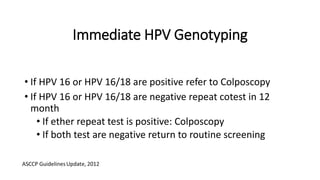
Immediate HPV Genotyping
• If HPV 16 or HPV 16/18 are positive refer to Colposcopy
• If HPV 16 or HPV 16/18 are negative repeat cotest in 12
month
• If ether repeat test is positive: Colposcopy
• If both test are negative return to routine screening
When to stop Screening
Stop screening at 65 with adequate negative
screening (no CIN in last 20 years)
This means:
• 3 consecutive Pap screenings
• 2 consecutive neg. HPV tests
Stop Screening at 65
Screening “should not resume even it woman
reports having a new sexual partner”
When not to stop:
• If history of CIN2, CIN3, AIS (in these cases at least 20 years screening)
ASCCP Guidelines, 2012
Cervical Cancer Screening and Follow Up
The American College of Obstetricians and Gynecologists, 2016
Cervical Cancer Screening and Follow Up
Literature
Arbine et al, 2011, Worldwide burden of cervical cancer in 2008. Ann Oncol, 22(12), 2675 - 86
ASCCP Guidelines, 2012, from http://www.asccp.org/guidelines
Sellors JW, Sankaranarayanan, R, 2003, Colposcopy and Treatment of Cervical Intraepithelial Neoplasia: A Beginners’ Manual, from
http://screening.iarc.fr/doc/Colposcopymanual.pdf
Parkin DM and Bray, 2006, Chapter 2: The burden of HPV-related cancers, Vaccine, 31;24 Suppl 3:S3/11-25
IFCPC, IFCPC Nomenclature 2011, from http://www.ifcpc.org/en/healthcare-professionals/resource-material/2011-ifcpc-nomenclature
THE 2001 BETHESDA SYSTEM, from http://nih.techriver.net/bethesdaTable.php
2011 Colposcopic Terminology of the International Federation for Cervical Pathology and Colposcopy, Bornstein, j et al., OBSTETRICS & GYNECOLOGY, 120, (1), 166- 172
from http://jgcs21.umin.jp/colposcopy_02.pdf
2012 Updated Consensus Guidelines for the Management of Abnormal Cervical Cancer Screening Tests and Cancer Precursors, Steward ML et al., 2013, Journal of
Lower Genital Tract Disease, Volume 17, Number 5, 2013, S1YS27
The American College of Obstetricians and Gynecologists, 2016, Abnormal Cervical Cancer Screening Test Results, FAQ187, from
http://www.acog.org/Patients/FAQs/Abnormal-Cervical-Cancer-Screening-Test-Results
THE BETHESDA SYSTEM WEBSITE ATLAS, 2003, from http://nih.techriver.net/
Aim of my Project
Dr. Dirk Grothuesmann Consultancy
Improving Maternal Health and Gynecology Services by Training Health Care
Providers: Relaying on standardized training modules I teach evidence-based
obstetrical procedures, gynecology surgery and related evaluation tools to local
personnel in developed and developing countries. Completing the programs
offered, skills gained enable to serve women in need in any requested setting.
http://dg-maternalhealth.de/index2.html
http://dg-maternalhealth.de/
Dr Dirk Grothuesmann
Consultancy

Cervical Screening State of the Art 2016

  • 1.
    Cervical Screening State ofthe Art 2016 Dr Dirk Grothuesmann http://dg-maternalhealth.de/
  • 2.
    Expected worldwide CervicalCancer 2020 2002 2020 2020 (% Increase) (% Burden) World 493.000* 702.500 100% (+42%) Less developed Areas 409.000 639.500 83% (+56%) More developed Areas 83.000 92.500 17% (+11%) Parkin and Bray, 2006 *530,000 cases in 2008; Arbyn M, et al
  • 3.
  • 4.
    Champions of Prevention GeorgiosNikolaou Papanikolaou *1883 –1962 Hans Hinselmann *1884 - 1959 Harald zur Hausen *1936 -
  • 5.
  • 6.
  • 7.
    Squamoculmnar Junction Sellors andSankaranarayanan, 2003
  • 8.
  • 9.
    Transformation Zone • TheNormal TZ is located between the OSCJ and the colposcopically- visible, new SCJ • Dynamic Area • Carcinogenic factors (HPV, carcinogenic substances e.g. smoking) are incorporated into vulnerable immature metaplastic epithelia
  • 10.
    Squamoculmnar Junction/ Transformation zone1,2,3, Visibility Line IFCPC, 2011
  • 11.
    ASC-US Atypical squamouscells of undetermined significance ASC-H Atypical squamous cells – cannot exclude HSIL The Bethesda System (TBS), 2001 THE BETHESDA SYSTEM WEBSITE ATLAS, 2003
  • 12.
    LSIL – Low-gradeSquamous Intraepithelial Lesion HSIL – High-grade Squamous Intraepithelial Lesion The Bethesda System (TBS), 2001
  • 13.
    AGC-Atypical Glandular Cells TheBethesda System (TBS), 2001
  • 14.
    Terminology Difference between theterms cervical intraepithelial lesion and squamous intraepithelial lesion • Squamous intraepithelial lesion (SIL) is used to describe Pap test result • SIL is not a diagnosis of precancer or cancer • A cervical biopsy is needed • Cervical intraepithelial lesion (CIN) used to report cervical biopsy results • CIN 1 is used for mild (low-grade) changes • CIN 2 is used for moderate changes • CIN 3 is used for more severe (high-grade) changes Moderate and high-grade changes can progress to cancer
  • 15.
    Different Types ofabnormal Pap Test Results • Atypical squamous cells of undetermined significance (ASC-US)— mostly a sign of an HPV infection (most common abnormal test result) • Low-grade squamous intraepithelial lesion (LSIL)—mildly abnormal.Usually is caused by an HPV infection, goes away on its own. • High-grade squamous intraepithelial lesion (HSIL)—more serious changes in the cervix. More likely associated with precancer and cancer. • Atypical squamous cells, cannot exclude HSIL (ASC-H)—changes that raise concern for the presence of HSIL. • Atypical glandular cells (AGC)—Glandular cells also are present inside the uterus. Changes in glandular cells that raise concern for the presence of precancer or cancer.
  • 16.
    Progression of CINCategories HIGH-GRADE SQUAMOUS LESION (HSIL) — HSIL refers to moderate to severe changes in the cells of the cervix. The risk that these abnormalities reflect precancerous changes is as high as 20.8%, and the risk of cervical cancer is as high as 1.4% Sellors JW, Sankaranarayanan, R, 2003
  • 17.
    What Testing isneeded after an abnormal cervical Cancer Screening Test • Repeat Pap test or Co-Test (Pap test and a test for high-risk types of HPV)—recommended as a follow-up to some abnormal test result • HPV Test—presence of the HPV types linked to cervical cancer • Colposcopy • Biopsy • Endocervical sampling
  • 18.
    Adolescents Needs • Carefor contraception and STI screening/treatment • NO Pap test • No speculum examination for asymptomatic women • STI Testing can be done using urine
  • 19.
    Rationale for Co-Testing30 – 64 • Increased detection of prevalent CIN 3 • Decreases CIN 3 in subsequent screening rounds • Enhances detection of adenocarcinoma (AIS) • Minimizes numbers of colposcopies
  • 20.
    Screening for Ages21 - 29 • Cytology every 3 years • HPV testing should not be done for screening • Not as a component of Co testing • Not as a standard alone screening
  • 21.
    Rational of avoidingHPV test among Women Ages 21 - 29 • Prevalence of carcinogenic HPV approaches 20% in teens and early 20s • Most carcinogenic HPV resolve without intervention • Identifying carcinogenic HPV that will resolve spontaneously will lead to repeated call-back, anxiety and interventions without benefit
  • 22.
    Screening for WomenAges 30 - 64 • Cytology plus HPV (Co-testing) every 5 years is preferred • Cytology every 3 years is acceptable
  • 23.
    Rationale for Co-testingAges 30 -64 • Increased detection of CIN 3 • Decreased CIN 3 in subsequent screening rounds • Enhances detection of adenocarcinoma in situ (AIS) • Minimizes the increased numbers of colposcopies
  • 24.
    Why not Co-testingall Women Ages 30 – 64 Lack of access to co-testing • Financial • Logistical Cytology remains effective but: • Requires more frequent visits • Requires more colposcopies for equivocal results
  • 25.
    Managing ASC-US/HPV negativetests “Women with ASC-US cytology and negative HPV test result should continue screening with age-specific guidelines “ • CIN 3 od ASC-US/HPV neg < 2% is below threshold for colposcopy
  • 26.
    Managing HPV+/Cytology- Cotests Womencontesting HPV+/Cytology- : • Repeat Cotesting in 12 month • Immediate HPV genotype specific testing for HPV 16/18 Direct referral to colposcopy not indicated
  • 27.
    Repeat Cotest in12 Month • If either test is positive, refer to colposcopy • If both tests are negative return to routine screening
  • 28.
    Immediate HPV Genotyping •If HPV 16 or HPV 16/18 are positive refer to Colposcopy • If HPV 16 or HPV 16/18 are negative repeat cotest in 12 month • If ether repeat test is positive: Colposcopy • If both test are negative return to routine screening
  • 29.
    When to stopScreening Stop screening at 65 with adequate negative screening (no CIN in last 20 years) This means: • 3 consecutive Pap screenings • 2 consecutive neg. HPV tests
  • 30.
    Stop Screening at65 Screening “should not resume even it woman reports having a new sexual partner” When not to stop: • If history of CIN2, CIN3, AIS (in these cases at least 20 years screening) ASCCP Guidelines, 2012
  • 31.
    Cervical Cancer Screeningand Follow Up The American College of Obstetricians and Gynecologists, 2016
  • 32.
  • 33.
  • 34.
    Literature Arbine et al,2011, Worldwide burden of cervical cancer in 2008. Ann Oncol, 22(12), 2675 - 86 ASCCP Guidelines, 2012, from http://www.asccp.org/guidelines Sellors JW, Sankaranarayanan, R, 2003, Colposcopy and Treatment of Cervical Intraepithelial Neoplasia: A Beginners’ Manual, from http://screening.iarc.fr/doc/Colposcopymanual.pdf Parkin DM and Bray, 2006, Chapter 2: The burden of HPV-related cancers, Vaccine, 31;24 Suppl 3:S3/11-25 IFCPC, IFCPC Nomenclature 2011, from http://www.ifcpc.org/en/healthcare-professionals/resource-material/2011-ifcpc-nomenclature THE 2001 BETHESDA SYSTEM, from http://nih.techriver.net/bethesdaTable.php 2011 Colposcopic Terminology of the International Federation for Cervical Pathology and Colposcopy, Bornstein, j et al., OBSTETRICS & GYNECOLOGY, 120, (1), 166- 172 from http://jgcs21.umin.jp/colposcopy_02.pdf 2012 Updated Consensus Guidelines for the Management of Abnormal Cervical Cancer Screening Tests and Cancer Precursors, Steward ML et al., 2013, Journal of Lower Genital Tract Disease, Volume 17, Number 5, 2013, S1YS27 The American College of Obstetricians and Gynecologists, 2016, Abnormal Cervical Cancer Screening Test Results, FAQ187, from http://www.acog.org/Patients/FAQs/Abnormal-Cervical-Cancer-Screening-Test-Results THE BETHESDA SYSTEM WEBSITE ATLAS, 2003, from http://nih.techriver.net/
  • 35.
    Aim of myProject Dr. Dirk Grothuesmann Consultancy Improving Maternal Health and Gynecology Services by Training Health Care Providers: Relaying on standardized training modules I teach evidence-based obstetrical procedures, gynecology surgery and related evaluation tools to local personnel in developed and developing countries. Completing the programs offered, skills gained enable to serve women in need in any requested setting. http://dg-maternalhealth.de/index2.html
  • 37.