Taking a PAP SMEAR
Cervical Cancer : Pap smear George N Papanicolaou introduced cervical cytology in clinical practice in 1940 In 1945, PAP smear was endorsed by American cancer society as an effective method for prevention of cervical cancer Many countries now have National cervical screening programs
Indian scenario Commonest cancer in women in India Major cause of deaths in women due to cancer Usually diagnosed at advanced stage No National program Uniformly low incidence of cervical screening  in India (6% in rich & 4% in poor)
Histological Types 30 Squamous Cell Carcinoma : 80-95% Adenocarcinoma : 5-20% Other : Clear cell, sarcomas
Transformation  zone Cervix develops from 2 embryonic sites * from Mullerian duct - lined by columnar epithelium * from urogenital plate - lined by stratified  squamous epithelium Point at which columnar and squamous epithelium meet is called as original squamo-columnar junction
Transformation  zone Under influence of estrogen, original SCJ moves onto the portio. Exposure of delicate columnar cells to vaginal environment leads to squamous metaplasia. Transformation zone - -  Area of squamous metaplasia  -  Area between original and new SCJ
Transformation  zone
Transformation Zone -TZ Exposure of TZ to carcinogens begins the process of intraepithelial neoplasia While exact role of carcinogens in this process remains poorly understood, it is clear that HPV and cigarette smoking can cause dysplasia at the TZ 95%  of  cervical cancers develop in TZ  Important to take sample from TZ
Transformation Zone Transformation zone may not be viewed during routine speculum examination
Why cervical screening is a feasible and useful strategy? Relative accessibility of cervix to take the smear Long natural history of cervical carcinogenesis Relative conservative treatment for premalignant lesions Cost effectiveness3
PAP  Smear PAP smear sampling of cervix involves scraping of cervical surface and a portion of non visualised cervical canal using various sampling devices
Significance of Pap smear Detect precancerous & invasive cancer cervix cases in early stages Positive screeners can be selected for selective tests and management  With treatment, progression of disease is halted. Thus morbidity associated with advanced cancer decreases Mortality reduces by 20-60 %. Helps us to study natural history of disease.
Cervical Cancer : Pap smear Early detection of pre-malignant  lesions by Pap smears prevent at least 70% of potential cervical cancers.
Of the 30% who actually develop cervical cancer: 8% elude cytological detection  - imperfections in cytological technology - biologic behavior of malignant lesions 22% represent women who develop cervical cancer because of failure to regularly seek Pap smears => women whose cancers could have been prevented with early detection and treatment.
How to take a Pap Smear ? Proper technique is very important More problems are due to improper sampling than screening Not to be collected during menses Avoid vaginal contraceptives, vaginal medications for at least 48 hrs before taking smear Abstinence  for 24 hrs Postpartum smear should be taken only after 6 - 8 weeks of delivery
Patient in dorsal position Good illumination is necessary Cusco’s speculum is inserted to visualise & fix the cervix Inspection of cervix done & findings are noted   Ayres spatula is inserted first. It is placed at cervical os so that longer end goes into cervical canal and smaller end rests on ectocervix  How to take a Pap Smear ?
How to take a Pap Smear ? Spatula is rotated through 360 degrees maintaining contact with ectocervix Do not use too much force [bleeding /pain] Do not use too less force [inadequate sample] Sample is smeared evenly on the slide and fixed immediately Both sides of spatula are to be smeared
How to take a Pap Smear ? Endocervical sample is collected using an endocervical brush Insert the cytobrush into canal, so that last bristles of brush are visible Rotate the brush through 180 degrees. [more rotations increase the chance of bleeding] Sample is rolled on the slide  and fixed.
Fixation of smear Fixation is done immediately with fixative like 95% alcohol or cytofix spray to avoid air drying Spray should be kept at 10 inches, to avoid destruction of cells by propellent in the spray Smear should monolayer for proper penetration of cell surface by fixative
How to take a Pap Smear ? Slide should be labeled properly  with patients name, identification no. and details Detailed history and clinical examination findings are to be mentioned  Patient  details and clinical findings are to be maintained in a register Advice is given regarding further follow up and treatment
Systems for cervical cytology reporting George N Papanicolaou (1954) 5 classifications based on certainty of finding malignant cells Descriptive system – WHO - (1968) based on morphologic criteria – included mild, moderate,   severe dysplasia and Ca In Situ Richart – CIN –based on histologic diagnosis
Systems for cervical cytology reporting  Bethesda system – TBS (1988) National cancer institute revised in 1991 and 2001 Adequacy of smear must be determined before reporting Smear is adequate when - Patient identification - adequate clinical history
Bethesda system Interpretable cellular cytology  not obscured by inflammation, debris,  blood, drying not scanty smear Adequate sampling from transformation zone  presence of at least 2 clusters of well preserved endocervical cells or metaplastic cells
Bethesda system Results : Within normal limits  ( WNL ) Benign cellular changes  - this term was removed and group was included in WNL in 2001 Reactive or Reparative changes – seen with atrophy, inflammation, surgery, radiation, IUCD, tampoons Infections – trichomoniasis, fungal, bacterial, HSV.
Bethesda system - results Epithelial cells abnormalities Squamous cells ASCUS ASCUS-H - suggestive of high grade lesion LSIL -  changes associated with HPV, atypical    changes, mild dysplasia/ CIN1 HSIL – moderate to severe dysplasia / CIN2, 3    and Ca In Situ HSIL – where invasion cannot be ruled out Squamous cell carcinoma
Bethesda system Results : Glandular cells – AGUS (Endocervical, endometrial) Adenocarcinoma (endocervical, endometrial, extrauterine) Other malignant neoplasms
Normal cervix-cytology Squamous cells  Exfoliated indivisual cells Navicular in shape with  abundant  cytoplasm  and small, dark, round /oval, pyknotic nuclei Glandular cells  Many times seen in clumps - linear or honeycombed pattern. Slightly larger and basal nuclei
Cervical cytology - Inflammation Interpretation difficult due to inflammatory  background  Lot of neutrophils and blood can obscure cellular details
Low grade lesions
High grade lesions High grade squamous  lesion High grade glandular  lesion
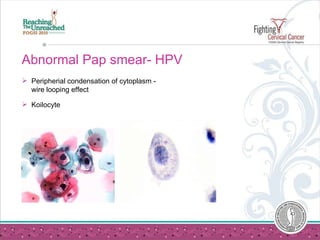
Abnormal Pap smear- HPV Peripherial condensation of cytoplasm -  wire looping effect Koilocyte
Invasive Invasive Invasive Class 5 HSIL CIN3 Ca In Situ Class 4 LSIL(HPV) HSIL HSIL CIN1 CIN2 CIN3 Mild dysplasia Moderate dysplasia Severe dysplasia Class 3 Reactive, reparatative changes, ASCUS, LSIL(HPV) Inflammatory, squamous, koilocytic atypia Class 2 WNL negative negative Class-1 Bethesda CIN Descriptive PAP
Single test will not detect cervical abnormality but  with 3 negative  tests there is less than 1% chance of cervical abnormality Conventional cytology has specificity of 98%  and sensitivity of 51%. PAP smear
PAP Smears - Limitations  Low sensitivity 51% False negative rates  are due to faulty sampling, improper fixation or interpretation problems Large group population & high risk group screening not possible  No consensus regarding testing
Pap smear as screening method  New guidelines  Target group -  All women aged 18-70 yrs  who have ever had sex Timing of Initial Screening - I nitial  screening   at age of  21 years or within 3 years of sexual activity  ACOG Guidelines-(Aug2003 ), American Cancer Society (Nov 2002) and U.S. Preventative Services Task  Force (Jan 2003)
Pap smear - guidelines Screening interval - yearly  till the age of 30  then 3 yearly When to End Screening - After 70 yrs  - Post Hysterectomy  - done for benign  lesions - previous 3 normal PAP  reports - confirmed complete removal of cervical epithelium
Pap smear - guidelines In high risk group after treatment  for CIN every 3 monthly for  2 years  every 6 monthly for 3yrs  Yearly thereafter Women who had hysterectomy for CIN, it is necessary to do vault smears  In women  who received vaccination against  HPV, it is  necessary to continue screening
Liquid Based Cytology To improve results of PAP newer techniques like liquid  based cytology are recommended   Cells are obtained with a broom, then the head is broken off in to a vial containing preservative fluid In the laboratory the sample is spun to remove obscuring material  It gives clearer image, no cell clumps It will assist in future automated reading
Several slides can be prepared from one smear Chlamydia, HPV testing can be done at later date Reduces the incidence of inadequate and repeat smears  Liquid Based Cytology
Cancer Cervix  IS PREVENTABLE , IF Detected EARLY!!!!!!!!! Thank You

Taking A Pap Smear

  • 1.
  • 2.
    Cervical Cancer :Pap smear George N Papanicolaou introduced cervical cytology in clinical practice in 1940 In 1945, PAP smear was endorsed by American cancer society as an effective method for prevention of cervical cancer Many countries now have National cervical screening programs
  • 3.
    Indian scenario Commonestcancer in women in India Major cause of deaths in women due to cancer Usually diagnosed at advanced stage No National program Uniformly low incidence of cervical screening in India (6% in rich & 4% in poor)
  • 4.
    Histological Types 30Squamous Cell Carcinoma : 80-95% Adenocarcinoma : 5-20% Other : Clear cell, sarcomas
  • 5.
    Transformation zoneCervix develops from 2 embryonic sites * from Mullerian duct - lined by columnar epithelium * from urogenital plate - lined by stratified squamous epithelium Point at which columnar and squamous epithelium meet is called as original squamo-columnar junction
  • 6.
    Transformation zoneUnder influence of estrogen, original SCJ moves onto the portio. Exposure of delicate columnar cells to vaginal environment leads to squamous metaplasia. Transformation zone - - Area of squamous metaplasia - Area between original and new SCJ
  • 7.
  • 8.
    Transformation Zone -TZExposure of TZ to carcinogens begins the process of intraepithelial neoplasia While exact role of carcinogens in this process remains poorly understood, it is clear that HPV and cigarette smoking can cause dysplasia at the TZ 95% of cervical cancers develop in TZ Important to take sample from TZ
  • 9.
    Transformation Zone Transformationzone may not be viewed during routine speculum examination
  • 10.
    Why cervical screeningis a feasible and useful strategy? Relative accessibility of cervix to take the smear Long natural history of cervical carcinogenesis Relative conservative treatment for premalignant lesions Cost effectiveness3
  • 11.
    PAP SmearPAP smear sampling of cervix involves scraping of cervical surface and a portion of non visualised cervical canal using various sampling devices
  • 12.
    Significance of Papsmear Detect precancerous & invasive cancer cervix cases in early stages Positive screeners can be selected for selective tests and management With treatment, progression of disease is halted. Thus morbidity associated with advanced cancer decreases Mortality reduces by 20-60 %. Helps us to study natural history of disease.
  • 13.
    Cervical Cancer :Pap smear Early detection of pre-malignant lesions by Pap smears prevent at least 70% of potential cervical cancers.
  • 14.
    Of the 30%who actually develop cervical cancer: 8% elude cytological detection - imperfections in cytological technology - biologic behavior of malignant lesions 22% represent women who develop cervical cancer because of failure to regularly seek Pap smears => women whose cancers could have been prevented with early detection and treatment.
  • 15.
    How to takea Pap Smear ? Proper technique is very important More problems are due to improper sampling than screening Not to be collected during menses Avoid vaginal contraceptives, vaginal medications for at least 48 hrs before taking smear Abstinence for 24 hrs Postpartum smear should be taken only after 6 - 8 weeks of delivery
  • 16.
    Patient in dorsalposition Good illumination is necessary Cusco’s speculum is inserted to visualise & fix the cervix Inspection of cervix done & findings are noted Ayres spatula is inserted first. It is placed at cervical os so that longer end goes into cervical canal and smaller end rests on ectocervix How to take a Pap Smear ?
  • 17.
    How to takea Pap Smear ? Spatula is rotated through 360 degrees maintaining contact with ectocervix Do not use too much force [bleeding /pain] Do not use too less force [inadequate sample] Sample is smeared evenly on the slide and fixed immediately Both sides of spatula are to be smeared
  • 18.
    How to takea Pap Smear ? Endocervical sample is collected using an endocervical brush Insert the cytobrush into canal, so that last bristles of brush are visible Rotate the brush through 180 degrees. [more rotations increase the chance of bleeding] Sample is rolled on the slide and fixed.
  • 19.
    Fixation of smearFixation is done immediately with fixative like 95% alcohol or cytofix spray to avoid air drying Spray should be kept at 10 inches, to avoid destruction of cells by propellent in the spray Smear should monolayer for proper penetration of cell surface by fixative
  • 20.
    How to takea Pap Smear ? Slide should be labeled properly with patients name, identification no. and details Detailed history and clinical examination findings are to be mentioned Patient details and clinical findings are to be maintained in a register Advice is given regarding further follow up and treatment
  • 21.
    Systems for cervicalcytology reporting George N Papanicolaou (1954) 5 classifications based on certainty of finding malignant cells Descriptive system – WHO - (1968) based on morphologic criteria – included mild, moderate, severe dysplasia and Ca In Situ Richart – CIN –based on histologic diagnosis
  • 22.
    Systems for cervicalcytology reporting Bethesda system – TBS (1988) National cancer institute revised in 1991 and 2001 Adequacy of smear must be determined before reporting Smear is adequate when - Patient identification - adequate clinical history
  • 23.
    Bethesda system Interpretablecellular cytology not obscured by inflammation, debris, blood, drying not scanty smear Adequate sampling from transformation zone presence of at least 2 clusters of well preserved endocervical cells or metaplastic cells
  • 24.
    Bethesda system Results: Within normal limits ( WNL ) Benign cellular changes - this term was removed and group was included in WNL in 2001 Reactive or Reparative changes – seen with atrophy, inflammation, surgery, radiation, IUCD, tampoons Infections – trichomoniasis, fungal, bacterial, HSV.
  • 25.
    Bethesda system -results Epithelial cells abnormalities Squamous cells ASCUS ASCUS-H - suggestive of high grade lesion LSIL - changes associated with HPV, atypical changes, mild dysplasia/ CIN1 HSIL – moderate to severe dysplasia / CIN2, 3 and Ca In Situ HSIL – where invasion cannot be ruled out Squamous cell carcinoma
  • 26.
    Bethesda system Results: Glandular cells – AGUS (Endocervical, endometrial) Adenocarcinoma (endocervical, endometrial, extrauterine) Other malignant neoplasms
  • 27.
    Normal cervix-cytology Squamouscells Exfoliated indivisual cells Navicular in shape with abundant cytoplasm and small, dark, round /oval, pyknotic nuclei Glandular cells Many times seen in clumps - linear or honeycombed pattern. Slightly larger and basal nuclei
  • 28.
    Cervical cytology -Inflammation Interpretation difficult due to inflammatory background Lot of neutrophils and blood can obscure cellular details
  • 29.
  • 30.
    High grade lesionsHigh grade squamous lesion High grade glandular lesion
  • 31.
    Abnormal Pap smear-HPV Peripherial condensation of cytoplasm - wire looping effect Koilocyte
  • 32.
    Invasive Invasive InvasiveClass 5 HSIL CIN3 Ca In Situ Class 4 LSIL(HPV) HSIL HSIL CIN1 CIN2 CIN3 Mild dysplasia Moderate dysplasia Severe dysplasia Class 3 Reactive, reparatative changes, ASCUS, LSIL(HPV) Inflammatory, squamous, koilocytic atypia Class 2 WNL negative negative Class-1 Bethesda CIN Descriptive PAP
  • 33.
    Single test willnot detect cervical abnormality but with 3 negative tests there is less than 1% chance of cervical abnormality Conventional cytology has specificity of 98% and sensitivity of 51%. PAP smear
  • 34.
    PAP Smears -Limitations Low sensitivity 51% False negative rates are due to faulty sampling, improper fixation or interpretation problems Large group population & high risk group screening not possible No consensus regarding testing
  • 35.
    Pap smear asscreening method New guidelines Target group - All women aged 18-70 yrs who have ever had sex Timing of Initial Screening - I nitial screening at age of 21 years or within 3 years of sexual activity ACOG Guidelines-(Aug2003 ), American Cancer Society (Nov 2002) and U.S. Preventative Services Task Force (Jan 2003)
  • 36.
    Pap smear -guidelines Screening interval - yearly till the age of 30 then 3 yearly When to End Screening - After 70 yrs - Post Hysterectomy - done for benign lesions - previous 3 normal PAP reports - confirmed complete removal of cervical epithelium
  • 37.
    Pap smear -guidelines In high risk group after treatment for CIN every 3 monthly for 2 years every 6 monthly for 3yrs Yearly thereafter Women who had hysterectomy for CIN, it is necessary to do vault smears In women who received vaccination against HPV, it is necessary to continue screening
  • 38.
    Liquid Based CytologyTo improve results of PAP newer techniques like liquid based cytology are recommended Cells are obtained with a broom, then the head is broken off in to a vial containing preservative fluid In the laboratory the sample is spun to remove obscuring material It gives clearer image, no cell clumps It will assist in future automated reading
  • 39.
    Several slides canbe prepared from one smear Chlamydia, HPV testing can be done at later date Reduces the incidence of inadequate and repeat smears Liquid Based Cytology
  • 40.
    Cancer Cervix IS PREVENTABLE , IF Detected EARLY!!!!!!!!! Thank You