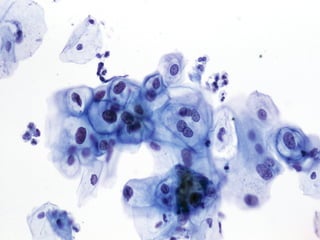
HPV DNA Testing
“Molecular Smear”
Abdulmohsen Alkushi, MD, Msc, FRCPC
Consultant Pathologist, National Guard Hospital, KAMC-Riyadh
The Role of Pathologists in 21st Century
HPV DNA Testing
n  Introduction
n  Techniques
n  Potential value
Cervical Cancer
n  Cervical cancer prevention programs have
relied on cytological testing using the
Papanicolaou (Pap) smear test.
Cervical Cancer
n  Research worldwide has clearly shown
that virtually all cervical cancer is
caused by human papillomavirus (HPV)
infection.
HPV & Cervical Cancer
n  The direct detection of HPV in cervical specimens
may offer an alternative or complement to
population-based cytological screening.
n  Recent studies have demonstrated that HPV test
results are more sensitive (although they are less
specific) than Pap smears in detecting high-grade
dysplasia in older women.
• Wright TC Jr, et al. Journal of the American Medical Association 283:81–86 (2000).
• Schiffman M, et al. Journal of the American Medical Association 283:87–93 (2000).
HPV Detection
n  HPV cannot be cultured reliably in a
laboratory setting.
n  Molecular techniques:
n  Non-amplification technologies
n  Amplification technologies
HPV DNA Detection
n  Amplification techniques can be further divided into
n  (1) target amplification
n  (2) signal amplification
n  (3) probe amplification (for example, ligase chain reaction).
n  To date, target and signal amplification techniques, in
addition to non-amplified techniques, have been
applied to the detection of HPV.
HPV DNA Testing
n  Because there are many HPV types with
differing oncogenic potential, diagnostic
tests must not only detect HPV DNA,
they also must determine the type(s)
present in each specimen.
Signal-amplified
techniques
n  Hybrid Capture Technology:
n  developed by the Digene Corporation, detects
nucleic acid targets directly, using signal
amplification
n  Digene has developed two products for the
detection of HPV: the first-generation Hybrid
Capture Tube (HCT) test and the more recent
Hybrid Capture II (hc2) assay
n  Both assays detect high-risk HPV types.
Hybrid Capture Technology
n  HCT test detects high-risk types (16, 18, 31,
33, 35, 45, 51, 52, and 56).
n  Four additional viral types were added to the
high-risk category in the hc2 test: 39, 58, 59,
and 68.
n  The level of detection of hc2 is rated at 5,000
viral copies per sample (one picogram of HPV
DNA per sample) in contrast to HCT, which
detects 10 picograms).
Hybrid Capture Technology
n  To perform the HC assay cervical or vaginal clinical
specimens collected through self-sampling or
obtained by a health care provider during a pelvic
examination are combined with an extraction buffer.
n  Once samples are taken, they can be stored at room
temperature for two weeks, at 4°C for one additional
week, and at -20°C for up to three months.
n  hc2 test involves a five-part process takes an
estimated 6 to 7 hours,
Hybrid Capture Technology
US FDA Approval
n  Hybrid Capture Tube (HCT) was granted US
FDA approval in May 1995.
n  In March 1999, the US FDA approved
Digene s second-generation HPV detection kit
(hc2).
n  In March 2003, the FDA approved hc2 test to
be used simultaneously with the Pap test to
screen for cervical cancer in women age 30
and older.
US FDA Approval
n  The Digene® HPV Test holds two US FDA approved
indications:
n  Primary adjunctive screening with a Pap test for
women age 30 and older to detect the presence or
absence of high–risk HPV for use as a guide for
patient management in cervical cancer screening
programs.
n  Reflex HPV testing: Triage for women with (ASC–US)
Pap results to determine appropriate follow–up.
HPV & Cervical Cancer
Based on a cohort analysis of 5,671 women age >30 years within a study that
included 7,932 women ages 15–76 (median age of 34).
Clavel C, Masure M, Bory J–P, et al. Brit J Cancer, 2001; 89 (12): 1616–1623.
Sensitivity of HPV + Pap test 98%
Sensitivity of HPV test 94%
Sensitivity of Pap test 75%
HPV & Cervical Cancer
n  The prevalence of HPV in women generally decreases over time, while the
incidence of cervical cancer increases.
n  The point at which HPV prevalence meets cervical cancer incidence is around the
age of 30
n  This supports the rationale for primary adjunctive screening (HPV + Pap) in
women 30 and older.
Target-amplified
techniques
n  DNA target amplification is a laboratory-based
procedure that duplicates DNA fragments
from a target sequence of a gene.
n  PCR is the most commonly used by this
method
n  GenoID® Reveal HPV® Real-Time HPV
Detection Kit
n  PapilloCheck® HPV-Screening
Non-amplified
techniques
n  Southern blot
n  Dot blot hybridizations
Non-amplified
techniques
n In situ hybridization
Non-amplified
techniques
n  Several factors limit the incorporation of
non-amplified techniques into large-
scale screening programs:
n  Relatively low sensitivity
n  Time-consuming
n  Require trained technicians
n  The demand for an array of laboratory
reagents and equipment required
DNA test may be more effective than Pap smear for detecting
cervical cancer, studies suggest.
The CBS Evening News (10/17, Couric) reported, "Doctors are telling
us tonight [that] a new test could replace the Pap smear for detecting
cervical cancer."
Potential for HPV DNA Testing
Potential Protocols for HPV
DNA Testing
n  As a means of triage for women whose
Pap test indicate ASC-US
n  As a means of surveillance of women
treated for HSIL or microinvasive
cancer.
n  As a primary screen for HSIL in older
women (women age 35 or older)
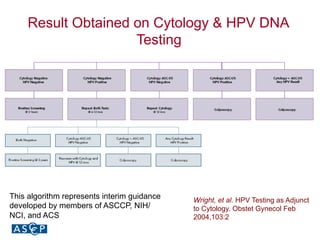
Result Obtained on Cytology & HPV DNA
Testing
Wright, et al. HPV Testing as Adjunct
to Cytology. Obstet Gynecol Feb
2004,103:2
This algorithm represents interim guidance
developed by members of ASCCP, NIH/
NCI, and ACS
Future of Gyne Cytology
Modern Uterine Cytopathology
Moving to Molecular Smear
Leading the News
Specific HPV test may prove useful in
countries with few resources, investigators
say.
Bloomberg News (4/2, Chase) reports that, "for
the first time," a test manufactured by Dutch
drugmaker Qiagen called careHPV may become
an essential and influential component of "a real
strategy for providing" human papilloma virus
(HPV) "screening to women globally."
Thank you for your attention!

Rev4.hpv dna testing for s2011

  • 1.
    HPV DNA Testing “MolecularSmear” Abdulmohsen Alkushi, MD, Msc, FRCPC Consultant Pathologist, National Guard Hospital, KAMC-Riyadh The Role of Pathologists in 21st Century
  • 2.
    HPV DNA Testing n Introduction n  Techniques n  Potential value
  • 3.
    Cervical Cancer n  Cervicalcancer prevention programs have relied on cytological testing using the Papanicolaou (Pap) smear test.
  • 9.
    Cervical Cancer n  Researchworldwide has clearly shown that virtually all cervical cancer is caused by human papillomavirus (HPV) infection.
  • 10.
    HPV & CervicalCancer n  The direct detection of HPV in cervical specimens may offer an alternative or complement to population-based cytological screening. n  Recent studies have demonstrated that HPV test results are more sensitive (although they are less specific) than Pap smears in detecting high-grade dysplasia in older women. • Wright TC Jr, et al. Journal of the American Medical Association 283:81–86 (2000). • Schiffman M, et al. Journal of the American Medical Association 283:87–93 (2000).
  • 11.
    HPV Detection n  HPVcannot be cultured reliably in a laboratory setting. n  Molecular techniques: n  Non-amplification technologies n  Amplification technologies
  • 12.
    HPV DNA Detection n Amplification techniques can be further divided into n  (1) target amplification n  (2) signal amplification n  (3) probe amplification (for example, ligase chain reaction). n  To date, target and signal amplification techniques, in addition to non-amplified techniques, have been applied to the detection of HPV.
  • 13.
    HPV DNA Testing n Because there are many HPV types with differing oncogenic potential, diagnostic tests must not only detect HPV DNA, they also must determine the type(s) present in each specimen.
  • 14.
    Signal-amplified techniques n  Hybrid CaptureTechnology: n  developed by the Digene Corporation, detects nucleic acid targets directly, using signal amplification n  Digene has developed two products for the detection of HPV: the first-generation Hybrid Capture Tube (HCT) test and the more recent Hybrid Capture II (hc2) assay n  Both assays detect high-risk HPV types.
  • 15.
    Hybrid Capture Technology n HCT test detects high-risk types (16, 18, 31, 33, 35, 45, 51, 52, and 56). n  Four additional viral types were added to the high-risk category in the hc2 test: 39, 58, 59, and 68. n  The level of detection of hc2 is rated at 5,000 viral copies per sample (one picogram of HPV DNA per sample) in contrast to HCT, which detects 10 picograms).
  • 16.
    Hybrid Capture Technology n To perform the HC assay cervical or vaginal clinical specimens collected through self-sampling or obtained by a health care provider during a pelvic examination are combined with an extraction buffer. n  Once samples are taken, they can be stored at room temperature for two weeks, at 4°C for one additional week, and at -20°C for up to three months. n  hc2 test involves a five-part process takes an estimated 6 to 7 hours,
  • 17.
  • 18.
  • 19.
    US FDA Approval n Hybrid Capture Tube (HCT) was granted US FDA approval in May 1995. n  In March 1999, the US FDA approved Digene s second-generation HPV detection kit (hc2). n  In March 2003, the FDA approved hc2 test to be used simultaneously with the Pap test to screen for cervical cancer in women age 30 and older.
  • 20.
    US FDA Approval n The Digene® HPV Test holds two US FDA approved indications: n  Primary adjunctive screening with a Pap test for women age 30 and older to detect the presence or absence of high–risk HPV for use as a guide for patient management in cervical cancer screening programs. n  Reflex HPV testing: Triage for women with (ASC–US) Pap results to determine appropriate follow–up.
  • 21.
    HPV & CervicalCancer Based on a cohort analysis of 5,671 women age >30 years within a study that included 7,932 women ages 15–76 (median age of 34). Clavel C, Masure M, Bory J–P, et al. Brit J Cancer, 2001; 89 (12): 1616–1623.
  • 22.
    Sensitivity of HPV+ Pap test 98% Sensitivity of HPV test 94% Sensitivity of Pap test 75%
  • 23.
    HPV & CervicalCancer n  The prevalence of HPV in women generally decreases over time, while the incidence of cervical cancer increases. n  The point at which HPV prevalence meets cervical cancer incidence is around the age of 30 n  This supports the rationale for primary adjunctive screening (HPV + Pap) in women 30 and older.
  • 24.
    Target-amplified techniques n  DNA targetamplification is a laboratory-based procedure that duplicates DNA fragments from a target sequence of a gene. n  PCR is the most commonly used by this method n  GenoID® Reveal HPV® Real-Time HPV Detection Kit n  PapilloCheck® HPV-Screening
  • 25.
  • 26.
  • 27.
    Non-amplified techniques n  Several factorslimit the incorporation of non-amplified techniques into large- scale screening programs: n  Relatively low sensitivity n  Time-consuming n  Require trained technicians n  The demand for an array of laboratory reagents and equipment required
  • 28.
    DNA test maybe more effective than Pap smear for detecting cervical cancer, studies suggest. The CBS Evening News (10/17, Couric) reported, "Doctors are telling us tonight [that] a new test could replace the Pap smear for detecting cervical cancer."
  • 29.
    Potential for HPVDNA Testing
  • 30.
    Potential Protocols forHPV DNA Testing n  As a means of triage for women whose Pap test indicate ASC-US n  As a means of surveillance of women treated for HSIL or microinvasive cancer. n  As a primary screen for HSIL in older women (women age 35 or older)
  • 35.
    Result Obtained onCytology & HPV DNA Testing Wright, et al. HPV Testing as Adjunct to Cytology. Obstet Gynecol Feb 2004,103:2 This algorithm represents interim guidance developed by members of ASCCP, NIH/ NCI, and ACS
  • 36.
    Future of GyneCytology Modern Uterine Cytopathology Moving to Molecular Smear
  • 37.
    Leading the News SpecificHPV test may prove useful in countries with few resources, investigators say. Bloomberg News (4/2, Chase) reports that, "for the first time," a test manufactured by Dutch drugmaker Qiagen called careHPV may become an essential and influential component of "a real strategy for providing" human papilloma virus (HPV) "screening to women globally."
  • 38.
    Thank you foryour attention!