Cervical Cancer Screening Cases by Clinton Pong Using the 2007-8 Guidelines, accessed 1/4/2009.
It’s ok to use notes and books I put this together because, as a male, I have no conception of these screens.  And its complicated! In my opinion, the most important thing is to remember where to look when you can’t remember what you need to do. Follow along with the references listed. Like USMLE World, read through the other answers for extra information.
References Algorithms for abnl cerv CA (ASCCP's October 2007)  Click here to download the PDF .  Algorithms for CIN (October 2007 ASCCP's Journal of Lower Genital Tract Disease.  Click here to download the PDF   USPSTF: Cervical Cancer (Pap Smear):  Screening  (2003)  Obstetrics, Gynecology and Infertility: (Red) Handbook for Clinicians 6 th  ed. (2007) p 375 BETHESDA SYSTEM WEBSITE ATLAS  http://nih.techriver.net/
Questions Sexually active woman, screen initiation Annual Pap    Q3  yr  screen D/c of screen 25 y/o ASCUS 18 y/o LSIL 30 y/o ASC-H, CIN I 30 y/o HSIL, CIN I unsatisfactory  colpo 33 y/o AGC 33 y/o AIS CIN II, III for adult CIN II for adolescent
Sexually active woman (1 st  sexual encounter @ 15 y/o) When should routine screening be initiated? 15 years old, then annually 18 years old, then annually 21 years old, then annually 30 years old, then annually
Sexually active woman (1 st  sexual encounter @ 15 y/o) B. 3 years after initiating sexual intercourse or age 21 (which ever comes first) 15 years old, then annually 18 years old, then annually (15+3 = 18) 21 years old, then annually (even in non-sexually active F, it is recommended by many organizations to test annually for 21+ d/t the high prevalence of sexually activity and concerns of inadequate sexual hx taking) ( ref ) 30 years old, then annually
Annual pap    Q3 year screen In which case would it be acceptable for annual Pap smear screens to transition to Q3 years, according to ACOG? 25 y/o nl until 19  ASCUS , but nl thereafter 30 y/o nl until  25 ASCUS , 25.5 nl, 26 nl, 27-29 nl 35 y/o CIN III @ age 25    LEEP, now found HIV+
Annual pap    Q3 year screen B. > 30 years old after 3 consecutive normal results (ACOG)    >age 30, after 3 (-) paps in a row   ok to  Δ  to Q3! USPSTF: no direct evidence that annual screening is better than Q3 years, but b/c high grade lesions may be missed (single Pap Sn 60-80%) ACS: wait until age 30 ACOG: at least 2 or 3 consecutive nl results before lengthening interval to Q3 years. ( ref ) 25 y/o (too young) 3 0+ y/o,  3 (-) paps    Δ  to Q 3 ! 35 y/o (ACOG recommends annual screening in presence of other risk factors like CIN, STDs, high-risk sexual behavior, in-utero DES exposure, HIV+, immunocompromised)
Discontinuation of  cervical cancer screening Which of the following situations still has an indication for cervical cancer screening? Transgender female to male with hormone therapy, status post total hysterectomy 70 year old immigrant with no history of screening in the past ten years 40 y/o w/ a total hysterectomy for benign disease
Discontinuation of  cervical cancer screening B. ACS recs: 70+ F w/ 3+ consecutive nl cervical cytology tests and with no abnl/(+) cytology w/in the last 10 years, can safely stop screening. Testosterone    atrophic changes that may mimic dysplasia, pathologist should be notified of pt status. Total hysterectomy indicates removal of cervix Optimal age to discontinue screening is not clear by evidence.  USPSTF recs: after age 65. ACS recs: at age 70.  Screening still recommended for older women who  have not been previously screened when information about previous screening is unavailable when screening is unlikely to have occurred in the past (e.g., among women from countries without screening programs) USPSTF recommends against routine Pap smear screening in women who have had a total hysterectomy for benign disease.
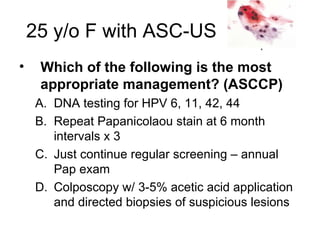
25 y/o F with ASC-US Which of the following is the most appropriate management? (ASCCP) DNA testing for HPV 6, 11, 42, 44 Repeat Papanicolaou stain at 6 month intervals x 3 Just continue regular screening – annual Pap exam Colposcopy w/ 3-5% acetic acid application and directed biopsies of suspicious lesions
25 y/o F with ASC-US D. Colposcopy. DNA testing for ( HPV 6, 11, 42, 44) is low risk.   Test for HIGH RISK forms of HPV 16, 18, 31, 33, 45 Pap at 6 month ( intervals x 3 is too long.)   Only need x 2 negative results (@ 6, 12 mo) Repeat pap stain at ( 12 month intervals)    6 month  x 2, then resume routine screening Definition of colposcopy: examination of the cervix,the vagina, and, in some instances the vulva with the colposcope after the application of a 3-5% acetic acid solution coupled with obtaining colposcopically directed biopsies of all lesions suspected of representing neoplasia.
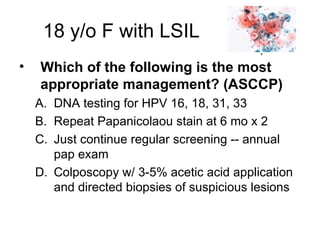
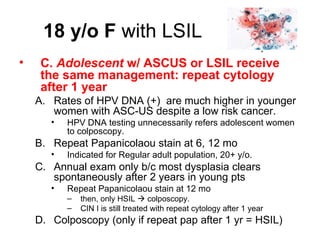
18 y/o F with LSIL Which of the following is the most appropriate management? (ASCCP) DNA testing for HPV 16, 18, 31, 33 Repeat Papanicolaou stain at 6 mo x 2 Just continue regular screening -- annual pap exam Colposcopy w/ 3-5% acetic acid application and directed biopsies of suspicious lesions
18 y/o F  with LSIL C.  Adolescent  w/ ASCUS or LSIL receive the same management: repeat cytology after 1 year Rates of HPV DNA (+)  are much higher in younger women with ASC-US despite a low risk cancer. HPV DNA testing unnecessarily refers adolescent women to colposcopy. Repeat Papanicolaou stain at 6, 12 mo Indicated for Regular adult population, 20+ y/o. Annual exam only b/c most dysplasia clears spontaneously after 2 years in young pts Repeat Papanicolaou stain at 12 mo then, only HSIL    colposcopy. CIN I is still treated with repeat cytology after 1 year Colposcopy (only if repeat pap after 1 yr = HSIL)
30 y/o F with ASC-H   (cannot exclude High-grade SIL): Colpo shows CIN I Which of the following is the most appropriate management? (ASCCP) DNA testing for HPV 16, 18, 31, 33 at current visit. Repeat Papanicolaou stain at 6 mo x 2 Repeat Papanicolaou stain at 12 mo (continue regular screening) Colposcopy w/ 3-5% acetic acid application and directed biopsies of suspicious lesions
B.  Either Cytology @6,12 mo OR HPV DNA testing @ 12 mo. DNA testing for HPV 16, 18, 31, 33 Wait 12 months and then perform HPV testing Repeat Papanicolaou stain at 6 mo x 2 Repeat Papanicolaou stain at 12 mo (continue regular screening) Colposcopy, ablative treatment if persistent > 2 yr 30 y/o F with ASC-H   (cannot exclude High-grade SIL): Colpo shows CIN I If the Cytology (-)@6,12 mo OR HPV (-) @ 12 mo, then  If the Cytology (+) @6,12 mo OR HPV (+) @ 12 mo, then
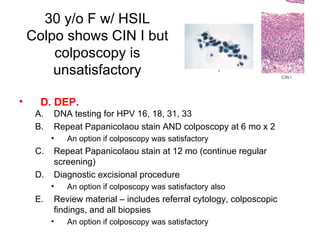
30 y/o F w/ HSIL Colpo shows CIN I but colposcopy is unsatisfactory Which of the following is the most appropriate management? (ASCCP)   DNA testing for HPV 16, 18, 31, 33 Repeat Papanicolaou stain AND colposcopy at 6 mo x 2 Repeat Papanicolaou stain at 12 mo (continue regular screening) Diagnostic excisional procedure Review of all findings
30 y/o F w/ HSIL Colpo shows CIN I but colposcopy is unsatisfactory D. DEP. DNA testing for HPV 16, 18, 31, 33 Repeat Papanicolaou stain AND colposcopy at 6 mo x 2 An option if colposcopy was satisfactory Repeat Papanicolaou stain at 12 mo (continue regular screening) Diagnostic excisional procedure An option if colposcopy was satisfactory also Review material – includes referral cytology, colposcopic findings, and all biopsies An option if colposcopy was satisfactory
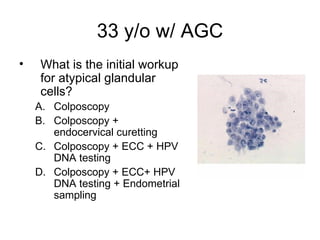
33 y/o w/ AGC What is the initial workup for atypical glandular cells? Colposcopy Colposcopy + endocervical curetting Colposcopy + ECC + HPV DNA testing Colposcopy + ECC+ HPV DNA testing + Endometrial sampling
33 y/o  w/ AGC C. include EMB only if  > 35 y/o, <35 y/o w/ AUB, obesity or oligomenorrhea Colposcopy Colposcopy w/ endocervical curetting  Colposcopy + ECC + HPV DNA testing Protocol for ALL women with AGC, unless they are  > 35 y/o or at risk for endometrial neoplasia Colposcopy + ECC + HPV DNA testing + Endometrial biopsies (EMB)
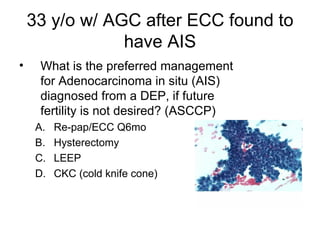
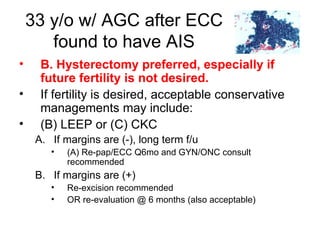
33 y/o w/ AGC after ECC found to have AIS What is the preferred management for Adenocarcinoma in situ (AIS) diagnosed from a DEP, if future fertility is not desired? (ASCCP) Re-pap/ECC Q6mo Hysterectomy LEEP CKC (cold knife cone)
33 y/o w/ AGC after ECC found to have AIS B. Hysterectomy preferred, especially if future fertility is not desired. If fertility is desired, acceptable conservative managements may include: (B) LEEP or (C) CKC If margins are (-), long term f/u (A) Re-pap/ECC Q6mo and GYN/ONC consult recommended If margins are (+) Re-excision recommended OR re-evaluation @ 6 months (also acceptable)
CIN II or III for adults What is the management for CIN II, III? (ASCCP) Re-pap OR Pap/HPV Q6mo until (-)x2 Immediate LEEP Colpo/Pap Q12 wk Hysterectomy
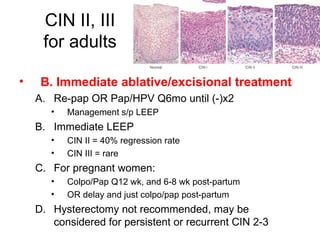
CIN II, III for adults B. Immediate ablative/excisional treatment Re-pap OR Pap/HPV Q6mo until (-)x2 Management s/p LEEP Immediate LEEP CIN II = 40% regression rate CIN III = rare For pregnant women: Colpo/Pap Q12 wk, and 6-8 wk post-partum OR delay and just colpo/pap post-partum Hysterectomy not recommended, may be considered for persistent or recurrent CIN 2-3
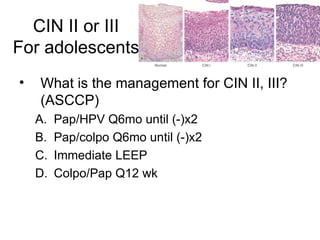
CIN II or III For adolescents What is the management for CIN II, III? (ASCCP) Pap/HPV Q6mo until (-)x2 Pap/colpo Q6mo until (-)x2 Immediate LEEP Colpo/Pap Q12 wk
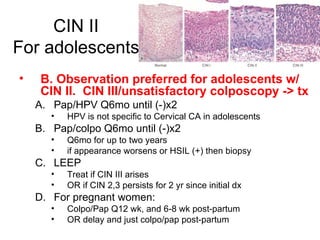
CIN II For adolescents B. Observation preferred for adolescents w/ CIN II.  CIN III/unsatisfactory colposcopy -> tx Pap/HPV Q6mo until (-)x2 HPV is not specific to Cervical CA in adolescents Pap/colpo Q6mo until (-)x2 Q6mo for up to two years if appearance worsens or HSIL (+) then biopsy LEEP Treat if CIN III arises  OR if CIN 2,3 persists for 2 yr since initial dx For pregnant women: Colpo/Pap Q12 wk, and 6-8 wk post-partum OR delay and just colpo/pap post-partum
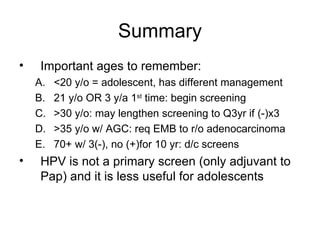
Summary Important ages to remember: <20 y/o = adolescent, has different management 21 y/o OR 3 y/a 1 st  time: begin screening >30 y/o: may lengthen screening to Q3yr if (-)x3 >35 y/o w/ AGC: req EMB to r/o adenocarcinoma 70+ w/ 3(-), no (+)for 10 yr: d/c screens HPV is not a primary screen (only adjuvant to Pap) and it is less useful for adolescents
Review of answers Sexually active woman, screen initiation 3yr p or 21 Annual Pap    Q3 yr screen @ 30 after 3(-)s. D/c screen @ 70 after 3(-)s, and no (+) for 10 yr 25 y/o ASCUS: colposcopy 18 y/o LSIL: resume normal screen (repeat pap @12) 30 y/o ASC-H, CIN I: repeat pap @ 6, 12 or HPV @12 30 y/o HSIL, CIN I unsatisfactory colpo: DEP 33 y/o AGC: colpo + ECC + HPV - EMB (+EMB  > 35) 33 y/o AIS: hysterectomy CIN II, III for adult: LEEP CIN II for adolescent: observation Pap/colpo Q6mo until (-)x2
References Algorithms for abnl cerv CA (ASCCP's October 2007)  Click here to download the PDF .  Algorithms for CIN (October 2007 ASCCP's Journal of Lower Genital Tract Disease.  Click here to download the PDF   USPSTF: Cervical Cancer (Pap Smear):  Screening  (2003)  Obstetrics, Gynecology and Infertility: (Red) Handbook for Clinicians 6 th  ed. (2007) p 375 BETHESDA SYSTEM WEBSITE ATLAS  http://nih.techriver.net/

Cervical Cancer Screening

  • 1.
    Cervical Cancer ScreeningCases by Clinton Pong Using the 2007-8 Guidelines, accessed 1/4/2009.
  • 2.
    It’s ok touse notes and books I put this together because, as a male, I have no conception of these screens. And its complicated! In my opinion, the most important thing is to remember where to look when you can’t remember what you need to do. Follow along with the references listed. Like USMLE World, read through the other answers for extra information.
  • 3.
    References Algorithms forabnl cerv CA (ASCCP's October 2007) Click here to download the PDF . Algorithms for CIN (October 2007 ASCCP's Journal of Lower Genital Tract Disease. Click here to download the PDF USPSTF: Cervical Cancer (Pap Smear): Screening (2003) Obstetrics, Gynecology and Infertility: (Red) Handbook for Clinicians 6 th ed. (2007) p 375 BETHESDA SYSTEM WEBSITE ATLAS http://nih.techriver.net/
  • 4.
    Questions Sexually activewoman, screen initiation Annual Pap  Q3 yr screen D/c of screen 25 y/o ASCUS 18 y/o LSIL 30 y/o ASC-H, CIN I 30 y/o HSIL, CIN I unsatisfactory colpo 33 y/o AGC 33 y/o AIS CIN II, III for adult CIN II for adolescent
  • 5.
    Sexually active woman(1 st sexual encounter @ 15 y/o) When should routine screening be initiated? 15 years old, then annually 18 years old, then annually 21 years old, then annually 30 years old, then annually
  • 6.
    Sexually active woman(1 st sexual encounter @ 15 y/o) B. 3 years after initiating sexual intercourse or age 21 (which ever comes first) 15 years old, then annually 18 years old, then annually (15+3 = 18) 21 years old, then annually (even in non-sexually active F, it is recommended by many organizations to test annually for 21+ d/t the high prevalence of sexually activity and concerns of inadequate sexual hx taking) ( ref ) 30 years old, then annually
  • 7.
    Annual pap  Q3 year screen In which case would it be acceptable for annual Pap smear screens to transition to Q3 years, according to ACOG? 25 y/o nl until 19 ASCUS , but nl thereafter 30 y/o nl until 25 ASCUS , 25.5 nl, 26 nl, 27-29 nl 35 y/o CIN III @ age 25  LEEP, now found HIV+
  • 8.
    Annual pap  Q3 year screen B. > 30 years old after 3 consecutive normal results (ACOG) >age 30, after 3 (-) paps in a row  ok to Δ to Q3! USPSTF: no direct evidence that annual screening is better than Q3 years, but b/c high grade lesions may be missed (single Pap Sn 60-80%) ACS: wait until age 30 ACOG: at least 2 or 3 consecutive nl results before lengthening interval to Q3 years. ( ref ) 25 y/o (too young) 3 0+ y/o, 3 (-) paps  Δ to Q 3 ! 35 y/o (ACOG recommends annual screening in presence of other risk factors like CIN, STDs, high-risk sexual behavior, in-utero DES exposure, HIV+, immunocompromised)
  • 9.
    Discontinuation of cervical cancer screening Which of the following situations still has an indication for cervical cancer screening? Transgender female to male with hormone therapy, status post total hysterectomy 70 year old immigrant with no history of screening in the past ten years 40 y/o w/ a total hysterectomy for benign disease
  • 10.
    Discontinuation of cervical cancer screening B. ACS recs: 70+ F w/ 3+ consecutive nl cervical cytology tests and with no abnl/(+) cytology w/in the last 10 years, can safely stop screening. Testosterone  atrophic changes that may mimic dysplasia, pathologist should be notified of pt status. Total hysterectomy indicates removal of cervix Optimal age to discontinue screening is not clear by evidence. USPSTF recs: after age 65. ACS recs: at age 70. Screening still recommended for older women who have not been previously screened when information about previous screening is unavailable when screening is unlikely to have occurred in the past (e.g., among women from countries without screening programs) USPSTF recommends against routine Pap smear screening in women who have had a total hysterectomy for benign disease.
  • 11.
    25 y/o Fwith ASC-US Which of the following is the most appropriate management? (ASCCP) DNA testing for HPV 6, 11, 42, 44 Repeat Papanicolaou stain at 6 month intervals x 3 Just continue regular screening – annual Pap exam Colposcopy w/ 3-5% acetic acid application and directed biopsies of suspicious lesions
  • 12.
    25 y/o Fwith ASC-US D. Colposcopy. DNA testing for ( HPV 6, 11, 42, 44) is low risk.  Test for HIGH RISK forms of HPV 16, 18, 31, 33, 45 Pap at 6 month ( intervals x 3 is too long.)  Only need x 2 negative results (@ 6, 12 mo) Repeat pap stain at ( 12 month intervals)  6 month x 2, then resume routine screening Definition of colposcopy: examination of the cervix,the vagina, and, in some instances the vulva with the colposcope after the application of a 3-5% acetic acid solution coupled with obtaining colposcopically directed biopsies of all lesions suspected of representing neoplasia.
  • 13.
    18 y/o Fwith LSIL Which of the following is the most appropriate management? (ASCCP) DNA testing for HPV 16, 18, 31, 33 Repeat Papanicolaou stain at 6 mo x 2 Just continue regular screening -- annual pap exam Colposcopy w/ 3-5% acetic acid application and directed biopsies of suspicious lesions
  • 14.
    18 y/o F with LSIL C. Adolescent w/ ASCUS or LSIL receive the same management: repeat cytology after 1 year Rates of HPV DNA (+) are much higher in younger women with ASC-US despite a low risk cancer. HPV DNA testing unnecessarily refers adolescent women to colposcopy. Repeat Papanicolaou stain at 6, 12 mo Indicated for Regular adult population, 20+ y/o. Annual exam only b/c most dysplasia clears spontaneously after 2 years in young pts Repeat Papanicolaou stain at 12 mo then, only HSIL  colposcopy. CIN I is still treated with repeat cytology after 1 year Colposcopy (only if repeat pap after 1 yr = HSIL)
  • 15.
    30 y/o Fwith ASC-H (cannot exclude High-grade SIL): Colpo shows CIN I Which of the following is the most appropriate management? (ASCCP) DNA testing for HPV 16, 18, 31, 33 at current visit. Repeat Papanicolaou stain at 6 mo x 2 Repeat Papanicolaou stain at 12 mo (continue regular screening) Colposcopy w/ 3-5% acetic acid application and directed biopsies of suspicious lesions
  • 16.
    B. EitherCytology @6,12 mo OR HPV DNA testing @ 12 mo. DNA testing for HPV 16, 18, 31, 33 Wait 12 months and then perform HPV testing Repeat Papanicolaou stain at 6 mo x 2 Repeat Papanicolaou stain at 12 mo (continue regular screening) Colposcopy, ablative treatment if persistent > 2 yr 30 y/o F with ASC-H (cannot exclude High-grade SIL): Colpo shows CIN I If the Cytology (-)@6,12 mo OR HPV (-) @ 12 mo, then If the Cytology (+) @6,12 mo OR HPV (+) @ 12 mo, then
  • 17.
    30 y/o Fw/ HSIL Colpo shows CIN I but colposcopy is unsatisfactory Which of the following is the most appropriate management? (ASCCP) DNA testing for HPV 16, 18, 31, 33 Repeat Papanicolaou stain AND colposcopy at 6 mo x 2 Repeat Papanicolaou stain at 12 mo (continue regular screening) Diagnostic excisional procedure Review of all findings
  • 18.
    30 y/o Fw/ HSIL Colpo shows CIN I but colposcopy is unsatisfactory D. DEP. DNA testing for HPV 16, 18, 31, 33 Repeat Papanicolaou stain AND colposcopy at 6 mo x 2 An option if colposcopy was satisfactory Repeat Papanicolaou stain at 12 mo (continue regular screening) Diagnostic excisional procedure An option if colposcopy was satisfactory also Review material – includes referral cytology, colposcopic findings, and all biopsies An option if colposcopy was satisfactory
  • 19.
    33 y/o w/AGC What is the initial workup for atypical glandular cells? Colposcopy Colposcopy + endocervical curetting Colposcopy + ECC + HPV DNA testing Colposcopy + ECC+ HPV DNA testing + Endometrial sampling
  • 20.
    33 y/o w/ AGC C. include EMB only if > 35 y/o, <35 y/o w/ AUB, obesity or oligomenorrhea Colposcopy Colposcopy w/ endocervical curetting Colposcopy + ECC + HPV DNA testing Protocol for ALL women with AGC, unless they are > 35 y/o or at risk for endometrial neoplasia Colposcopy + ECC + HPV DNA testing + Endometrial biopsies (EMB)
  • 21.
    33 y/o w/AGC after ECC found to have AIS What is the preferred management for Adenocarcinoma in situ (AIS) diagnosed from a DEP, if future fertility is not desired? (ASCCP) Re-pap/ECC Q6mo Hysterectomy LEEP CKC (cold knife cone)
  • 22.
    33 y/o w/AGC after ECC found to have AIS B. Hysterectomy preferred, especially if future fertility is not desired. If fertility is desired, acceptable conservative managements may include: (B) LEEP or (C) CKC If margins are (-), long term f/u (A) Re-pap/ECC Q6mo and GYN/ONC consult recommended If margins are (+) Re-excision recommended OR re-evaluation @ 6 months (also acceptable)
  • 23.
    CIN II orIII for adults What is the management for CIN II, III? (ASCCP) Re-pap OR Pap/HPV Q6mo until (-)x2 Immediate LEEP Colpo/Pap Q12 wk Hysterectomy
  • 24.
    CIN II, IIIfor adults B. Immediate ablative/excisional treatment Re-pap OR Pap/HPV Q6mo until (-)x2 Management s/p LEEP Immediate LEEP CIN II = 40% regression rate CIN III = rare For pregnant women: Colpo/Pap Q12 wk, and 6-8 wk post-partum OR delay and just colpo/pap post-partum Hysterectomy not recommended, may be considered for persistent or recurrent CIN 2-3
  • 25.
    CIN II orIII For adolescents What is the management for CIN II, III? (ASCCP) Pap/HPV Q6mo until (-)x2 Pap/colpo Q6mo until (-)x2 Immediate LEEP Colpo/Pap Q12 wk
  • 26.
    CIN II Foradolescents B. Observation preferred for adolescents w/ CIN II. CIN III/unsatisfactory colposcopy -> tx Pap/HPV Q6mo until (-)x2 HPV is not specific to Cervical CA in adolescents Pap/colpo Q6mo until (-)x2 Q6mo for up to two years if appearance worsens or HSIL (+) then biopsy LEEP Treat if CIN III arises OR if CIN 2,3 persists for 2 yr since initial dx For pregnant women: Colpo/Pap Q12 wk, and 6-8 wk post-partum OR delay and just colpo/pap post-partum
  • 27.
    Summary Important agesto remember: <20 y/o = adolescent, has different management 21 y/o OR 3 y/a 1 st time: begin screening >30 y/o: may lengthen screening to Q3yr if (-)x3 >35 y/o w/ AGC: req EMB to r/o adenocarcinoma 70+ w/ 3(-), no (+)for 10 yr: d/c screens HPV is not a primary screen (only adjuvant to Pap) and it is less useful for adolescents
  • 28.
    Review of answersSexually active woman, screen initiation 3yr p or 21 Annual Pap  Q3 yr screen @ 30 after 3(-)s. D/c screen @ 70 after 3(-)s, and no (+) for 10 yr 25 y/o ASCUS: colposcopy 18 y/o LSIL: resume normal screen (repeat pap @12) 30 y/o ASC-H, CIN I: repeat pap @ 6, 12 or HPV @12 30 y/o HSIL, CIN I unsatisfactory colpo: DEP 33 y/o AGC: colpo + ECC + HPV - EMB (+EMB > 35) 33 y/o AIS: hysterectomy CIN II, III for adult: LEEP CIN II for adolescent: observation Pap/colpo Q6mo until (-)x2
  • 29.
    References Algorithms forabnl cerv CA (ASCCP's October 2007) Click here to download the PDF . Algorithms for CIN (October 2007 ASCCP's Journal of Lower Genital Tract Disease. Click here to download the PDF USPSTF: Cervical Cancer (Pap Smear): Screening (2003) Obstetrics, Gynecology and Infertility: (Red) Handbook for Clinicians 6 th ed. (2007) p 375 BETHESDA SYSTEM WEBSITE ATLAS http://nih.techriver.net/